KINEMATIC FUNDAMENTAL
KINEMATICS & DYNAMICS OF
MACHINES (RME4C001)
BY
BIVASEET PRADHAN
-:INTRODUCTION:-
 Basic Kinematic concepts and definitions
 Elementary Mechanism : Link, joint, Kinematic Pair,
Classification of kinematic pairs, Kinematic chain and
mechanism
 Degrees of freedom
 Kutzbach criterion, Gruebler’s criterion
 Inversion of mechanism, Grashof criteria, Four bar linkage
and their inversions
 Single slider crank mechanism
 Double slider crank mechanism and their inversion
 Transmission angle and toggle position, Mechanical
advantage
THEORY OF MACHINES/KDM
• The subject Theory of Machines/KDM may be
defined as that branch of Engineering-science,
which deals with the study of relative motion
between the various parts of a machine, and
forces which act on them.
• The knowledge of this subject is very essential
for an engineer in designing the various parts
of a machine
THE MACHINE
• A machine is a combination of components which
can transmit power in a controlled manner and
which is capable of performing useful work. A
machine consists of a number of kinematically
related links.
• A machine is a combination of resistant bodies
(links or elements) with successfully constrained
relative motions, which is used for transmitting
other forms of energy into mechanical energy or
transmitting and modifying available energy to do
some particular kind of work.
• Every machine will be found to consist of a
system of parts (links or elements) connected
together in such a manner that, if one be made to
move, they all receive a motion, the relation of
which to that of the first depends upon the
nature of connections (i.e. joints).
• The links may be rigid, rigid-hydraulic, or rigid-
pneumatic. The power input may be mechanical,
electrical, hydraulic, chemical, or nuclear. The
power output may be mechanical, electrical
hydraulic or thermal.
Examples of machines:
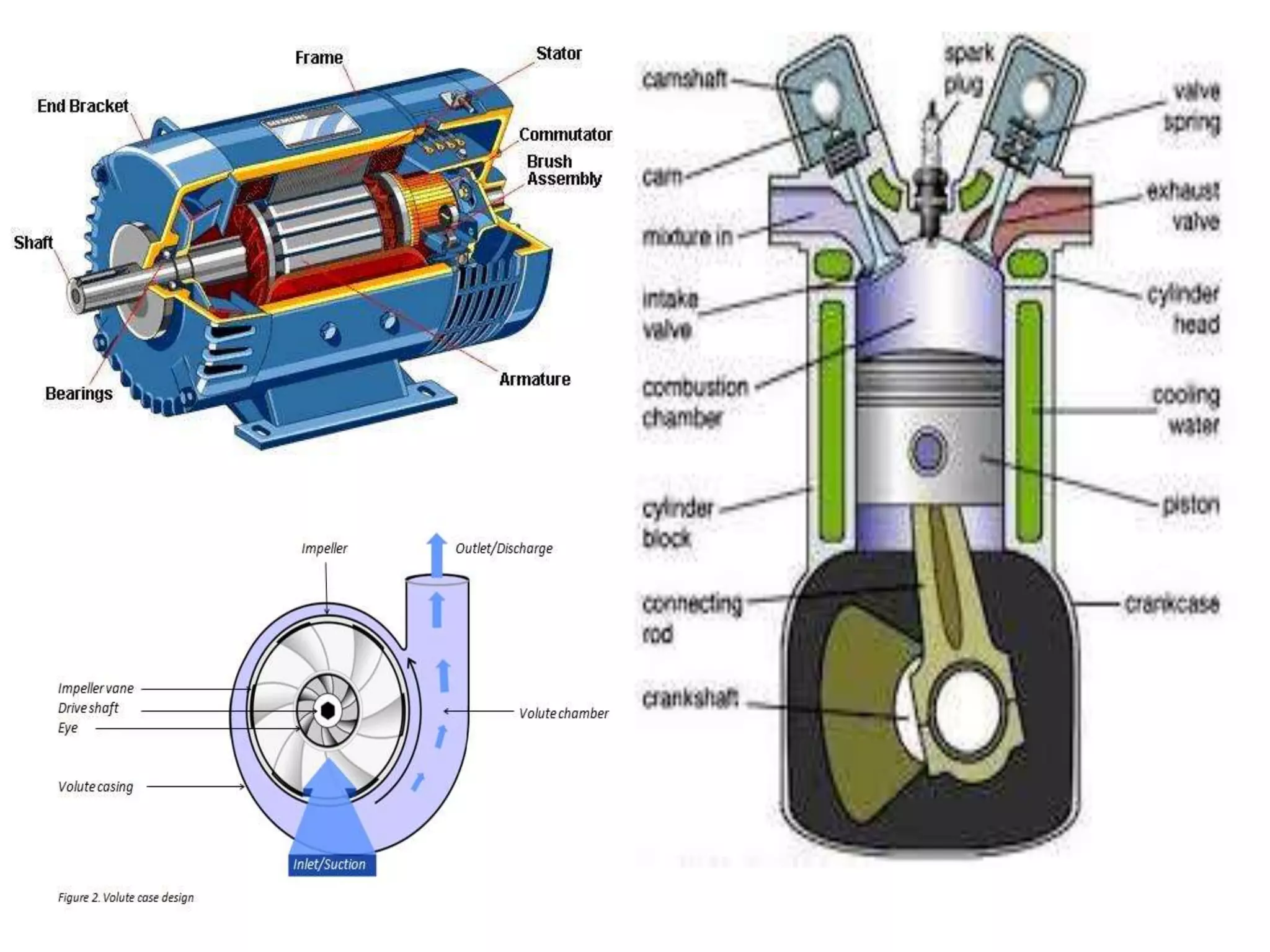
• Heat engine- Receives heat energy and transformers it into mechanical
energy.
• Electric motor- Changes electric energy into mechanical energy.
• A pump- Input electric power and output hydraulic power.
• The majority of machines receives mechanical energy, and
modify it so that the energy can be used for doing some
specific task, for which it is designed, common examples of
such machines being hoist, lathe, screw jack, etc.
• Note:-It should be noted that machine must be capable of
doing useful work. A series of kinematically related links put
into motion with no output link, and which simply converts
input energy to friction heat, is not a machine, unless the
original purpose was only to generate heat.
CLASSIFICATION OF MACHINES
1. Machines for generating mechanical energy
- Converts other forms of energy into mechanical work
Examples: Steam engines, Steam turbines, I. C. engines, gas
turbines, water turbines etc
2. Machines for transmitting mechanical energy into other form
of energy
- Known as converting machines
Examples: Electric generators, air or hydraulic pumps, etc.
3. Machines for utilizing mechanical energy in the performance
of useful work.
Examples: Lathe, and other machine tools, etc.
DIFFERENCE BETWEEN MACHINE AND MECHANISM
• In kinematics, a mechanism is a mean of transmitting,
controlling, or constraining relative movement. The central
theme for mechanisms is rigid bodies connected together by
joints. It can also be defined as a combination of resistant
bodies that are shaped and connected in such a way that they
move with definite relative motion with respect to each other.
• A machine is a combination of rigid or resistant bodies,
formed and connected in such a way that they move with
definite relative motions with each other and transmit force
also. A machine has two functions: transmitting definite
relative motion and transmitting force. The term mechanism
is applied to the combination of geometrical bodies which
constitute a machine or part of a machine.
DIFFERENCE BETWEEN MACHINE AND STRUCTURE
KINEMATIC ANALYSIS OF MECHANISM
• Various mechanisms have its own set of outputs when
they are put in motion. The analysis of the mechanism
is done by calculating the position, velocity and
acceleration at various points on the mechanisms. For
the analysis of velocity & acceleration at any point on
the mechanism we don’t need to calculate forces &
stresses acting in the parts of the mechanism. In other
means, in analysis of motion of a particular mechanism
we don’t need to consider the cross section area or
strength of the parts in that mechanism. Also, it does
not matter whether the parts are made of cast iron or
wood or anything else to study it motion analysis.
GRAPHICAL AND ANALYTICAL METHOD:
• Analysis of the Mechanism can be done by two types of
methods, generally known as graphical and analytical
methods. Each method has its own advantages and
disadvantages.
• The graphical method is easy to follow and gives the visual
image of the working of mechanism which can be applied
in some simple problems.
• But for more complex problems analytical methods are
more suitable. It is up to us by which method we want to
solve the problem in hand. With the advent of high speed
computing, analytical methods has very useful tool for
solving complex problems. In this course will concentrate
our study to graphical methods due its ease and simplicity.
SYNTHESIS OF DESIGN
• In the design of a mechanism, we will consider stress
analysis & others design parameters like bending,
fatigue etc. to find the dimensions of the parts. The
synthesis of a mechanism can be done by following
two approaches.
• In the first approach the dimensions of the parts in a
mechanism is found by considering load, stress &
bending etc. in the different parts of the mechanism.
• In the second approach, the dimensions of the parts
are assumed first and then the analysis is done to
check its strength. The second method of synthesis is
preferred by most of the engineers.

Kinematic Fundamental

  • 1.
    KINEMATIC FUNDAMENTAL KINEMATICS &DYNAMICS OF MACHINES (RME4C001) BY BIVASEET PRADHAN
  • 2.
    -:INTRODUCTION:-  Basic Kinematicconcepts and definitions  Elementary Mechanism : Link, joint, Kinematic Pair, Classification of kinematic pairs, Kinematic chain and mechanism  Degrees of freedom  Kutzbach criterion, Gruebler’s criterion  Inversion of mechanism, Grashof criteria, Four bar linkage and their inversions  Single slider crank mechanism  Double slider crank mechanism and their inversion  Transmission angle and toggle position, Mechanical advantage
  • 3.
    THEORY OF MACHINES/KDM •The subject Theory of Machines/KDM may be defined as that branch of Engineering-science, which deals with the study of relative motion between the various parts of a machine, and forces which act on them. • The knowledge of this subject is very essential for an engineer in designing the various parts of a machine
  • 5.
    THE MACHINE • Amachine is a combination of components which can transmit power in a controlled manner and which is capable of performing useful work. A machine consists of a number of kinematically related links. • A machine is a combination of resistant bodies (links or elements) with successfully constrained relative motions, which is used for transmitting other forms of energy into mechanical energy or transmitting and modifying available energy to do some particular kind of work.
  • 6.
    • Every machinewill be found to consist of a system of parts (links or elements) connected together in such a manner that, if one be made to move, they all receive a motion, the relation of which to that of the first depends upon the nature of connections (i.e. joints). • The links may be rigid, rigid-hydraulic, or rigid- pneumatic. The power input may be mechanical, electrical, hydraulic, chemical, or nuclear. The power output may be mechanical, electrical hydraulic or thermal.
  • 7.
    Examples of machines: •Heat engine- Receives heat energy and transformers it into mechanical energy. • Electric motor- Changes electric energy into mechanical energy. • A pump- Input electric power and output hydraulic power. • The majority of machines receives mechanical energy, and modify it so that the energy can be used for doing some specific task, for which it is designed, common examples of such machines being hoist, lathe, screw jack, etc. • Note:-It should be noted that machine must be capable of doing useful work. A series of kinematically related links put into motion with no output link, and which simply converts input energy to friction heat, is not a machine, unless the original purpose was only to generate heat.
  • 9.
    CLASSIFICATION OF MACHINES 1.Machines for generating mechanical energy - Converts other forms of energy into mechanical work Examples: Steam engines, Steam turbines, I. C. engines, gas turbines, water turbines etc 2. Machines for transmitting mechanical energy into other form of energy - Known as converting machines Examples: Electric generators, air or hydraulic pumps, etc. 3. Machines for utilizing mechanical energy in the performance of useful work. Examples: Lathe, and other machine tools, etc.
  • 10.
    DIFFERENCE BETWEEN MACHINEAND MECHANISM • In kinematics, a mechanism is a mean of transmitting, controlling, or constraining relative movement. The central theme for mechanisms is rigid bodies connected together by joints. It can also be defined as a combination of resistant bodies that are shaped and connected in such a way that they move with definite relative motion with respect to each other. • A machine is a combination of rigid or resistant bodies, formed and connected in such a way that they move with definite relative motions with each other and transmit force also. A machine has two functions: transmitting definite relative motion and transmitting force. The term mechanism is applied to the combination of geometrical bodies which constitute a machine or part of a machine.
  • 12.
  • 15.
    KINEMATIC ANALYSIS OFMECHANISM • Various mechanisms have its own set of outputs when they are put in motion. The analysis of the mechanism is done by calculating the position, velocity and acceleration at various points on the mechanisms. For the analysis of velocity & acceleration at any point on the mechanism we don’t need to calculate forces & stresses acting in the parts of the mechanism. In other means, in analysis of motion of a particular mechanism we don’t need to consider the cross section area or strength of the parts in that mechanism. Also, it does not matter whether the parts are made of cast iron or wood or anything else to study it motion analysis.
  • 16.
    GRAPHICAL AND ANALYTICALMETHOD: • Analysis of the Mechanism can be done by two types of methods, generally known as graphical and analytical methods. Each method has its own advantages and disadvantages. • The graphical method is easy to follow and gives the visual image of the working of mechanism which can be applied in some simple problems. • But for more complex problems analytical methods are more suitable. It is up to us by which method we want to solve the problem in hand. With the advent of high speed computing, analytical methods has very useful tool for solving complex problems. In this course will concentrate our study to graphical methods due its ease and simplicity.
  • 17.
    SYNTHESIS OF DESIGN •In the design of a mechanism, we will consider stress analysis & others design parameters like bending, fatigue etc. to find the dimensions of the parts. The synthesis of a mechanism can be done by following two approaches. • In the first approach the dimensions of the parts in a mechanism is found by considering load, stress & bending etc. in the different parts of the mechanism. • In the second approach, the dimensions of the parts are assumed first and then the analysis is done to check its strength. The second method of synthesis is preferred by most of the engineers.