Elena Mikhaylova
August, 2013
Current Success Rate on Kickstarter
is below 44%. For other platforms it is even lower.
One of the reasons for that is misunderstanding of
the platforms’ role in crowdfunding campaign.
Neither Kickstarter nor anybody else
WILL DO YOUR JOB!
In most cases the majority of backers
will come from your own network.

DOES IT MATTER
WHICH PLATFORM TO CHOOSE?
YES, It Does.
It depends on
Your project niche,
Your fundraising goal,
Your current level of community support ,
Your expertise in business development and
fundraising.
The first question you have to answer is:

Are you going to post your project on a
crowdfunding platform

or to raise money on your own?
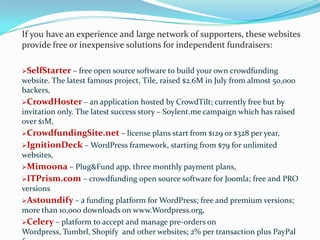
If you have an experience and large network of supporters, these websites
provide free or inexpensive solutions for independent fundraisers:
SelfStarter –

free open source software to build your own crowdfunding
website. The latest famous project, Tile, raised $2.6M in July from almost 50,000
backers,
CrowdHoster – an application hosted by CrowdTilt; currently free but by
invitation only. The latest success story – Soylent.me campaign which has raised
over $1M,
CrowdfundingSite.net – license plans start from $129 or $328 per year,
IgnitionDeck – WordPress framework, starting

from $79 for unlimited

websites,
Mimoona

– Plug&Fund app, three monthly payment plans,
ITPrism.com – crowdfunding open source software for Joomla; free and PRO
versions
Astoundify – a funding platform for WordPress; free and premium versions;
more than 10,000 downloads on www.Wordpress.org,
Celery – platform to accept and manage pre-orders on
Wordpress, Tumbrl, Shopify and other websites; 2% per transaction plus PayPal
If you want to use the resources
of a crowdfunding platform, you can choose
among more than 600 websites.
These directories would help you surf in the
crowdfunding ocean:

Crowdsourcing.org/directory/

CrowdsUnite.com
CrowdfundInsider.com/companies/
Crowdsurfer.co/
KickstarterCoaching.com/Top_Websites.html
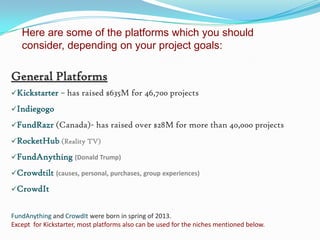
Here are some of the platforms which you should
consider, depending on your project goals:

General Platforms
Kickstarter

– has raised $635M for 46,700 projects

Indiegogo
FundRazr (Canada)-

has raised over $28M for more than 40,000 projects

RocketHub (Reality TV)
FundAnything (Donald Trump)
Crowdtilt (causes, personal, purchases, group experiences)
CrowdIt

FundAnything and CrowdIt were born in spring of 2013.
Except for Kickstarter, most platforms also can be used for the niches mentioned below.
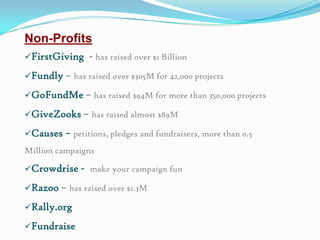
Non-Profits
FirstGiving

- has raised over $1 Billion

Fundly – has raised over $305M for 42,000 projects
GoFundMe – has raised $94M for more than 350,000 projects
GiveZooks – has raised almost $89M
Causes

– petitions, pledges and fundraisers, more than 0.5

Million campaigns
Crowdrise
Razoo

- make your campaign fun

– has raised over $1.3M

Rally.org
Fundraise
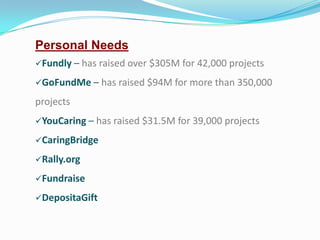
Personal Needs
Fundly – has raised over $305M for 42,000 projects
GoFundMe – has raised $94M for more than 350,000

projects
YouCaring – has raised $31.5M for 39,000 projects
CaringBridge
Rally.org
Fundraise
DepositaGift
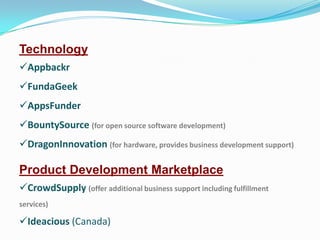
Technology
Appbackr

FundaGeek
AppsFunder
BountySource (for open source software development)
DragonInnovation (for hardware, provides business development support)

Product Development Marketplace
CrowdSupply (offer additional business support including fulfillment
services)

Ideacious (Canada)
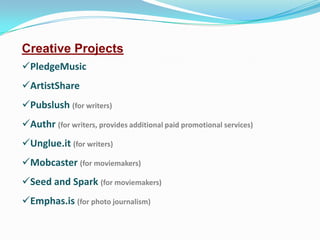
Creative Projects
PledgeMusic
ArtistShare

Pubslush (for writers)
Authr (for writers, provides additional paid promotional services)
Unglue.it (for writers)

Mobcaster (for moviemakers)
Seed and Spark (for moviemakers)
Emphas.is (for photo journalism)
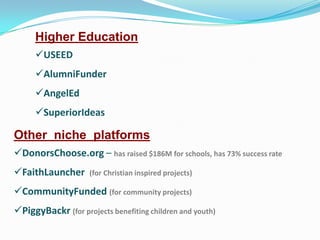
Higher Education
USEED
AlumniFunder
AngelEd

SuperiorIdeas

Other niche platforms
DonorsChoose.org – has raised $186M for schools, has 73% success rate

FaithLauncher

(for Christian inspired projects)

CommunityFunded (for community projects)
PiggyBackr (for projects benefiting children and youth)
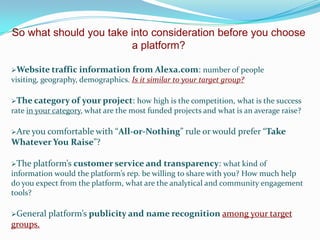
So what should you take into consideration before you choose
a platform?
Website traffic information from Alexa.com:

number of people
visiting, geography, demographics. Is it similar to your target group?
The category of

your project: how high is the competition, what is the success

rate in your category, what are the most funded projects and what is an average raise?
Are you comfortable with

“All-or-Nothing” rule or would prefer “Take

Whatever You Raise”?
The platform’s customer service and transparency:

what kind of
information would the platform’s rep. be willing to share with you? How much help
do you expect from the platform, what are the analytical and community engagement
tools?
General

groups.

platform’s publicity and name recognition among your target
Example: Comparison of Kickstarter and Indiegogo for a
photography project
Kickstarter Advantages
 The largest platform with the most
active backers
 The largest amounts of money have
risen for creative projects
 Transparency – publishes statistical
data on daily basis
 Creates the most buzz in media
 Approval process – adds credibility to a
project
 Photography category – 36.7% success
rate
 Photography category – has raised $8.5
mil. for 1,172 projects since 2009
 Photography category – 777 projects
raised between $1,000 and $10,000

Kickstarter Drawbacks
 Large competition – currently 114
photography projects live on the
website
 Backers more product and pre-sale
oriented
 Platform plus Amazon fees 9-10%
 Currently active in US, UK and
Canada, so it is more difficult for
people from other countries to
donate
 Very difficult to get featured
(promoted by the platform) or to get
help from their customer department
 “All-or-Nothing” fundraising
 Project must be approved by
Kickstarter
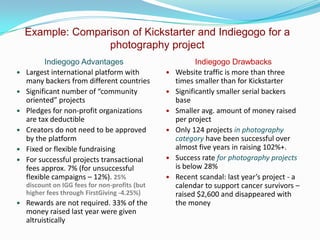
Example: Comparison of Kickstarter and Indiegogo for a
photography project







Indiegogo Advantages
Largest international platform with
many backers from different countries
Significant number of “community
oriented” projects
Pledges for non-profit organizations
are tax deductible
Creators do not need to be approved
by the platform
Fixed or flexible fundraising
For successful projects transactional
fees approx. 7% (for unsuccessful
flexible campaigns – 12%). 25%
discount on IGG fees for non-profits (but
higher fees through FirstGiving -4.25%)



Rewards are not required. 33% of the
money raised last year were given
altruistically









Indiegogo Drawbacks
Website traffic is more than three
times smaller than for Kickstarter
Significantly smaller serial backers
base
Smaller avg. amount of money raised
per project
Only 124 projects in photography
category have been successful over
almost five years in raising 102%+.
Success rate for photography projects
is below 28%
Recent scandal: last year’s project - a
calendar to support cancer survivors –
raised $2,600 and disappeared with
the money
When it makes sense to go with a smaller/niche
platform
There is a common misconception about the website traffic in regards

of general platforms like Kickstarter. Look for the target group for YOUR
project instead.
First timer – you can receive a
Funding goal

better customer support.

– if you are looking to raise smaller amount of money

Non product project
Less competition,

more chances to get featured and promoted by the

platform
For niche platforms –

highly targeted traffic, industry

expertise, additional services
Conclusion
Crowdfunding Platform will not do your job.
But by choosing a wrong platform you can make
your campaign more stressful and less efficient.
So do yourself a favor: do your homework, look
around, study similar projects, ask questions, talk
to the platform representatives and those who
posted their projects on this platform.
Take Your Time
to Make an Educated Decision
And Good Luck!

Kickstarter and its alternatives (other crowdfunding platforms and DIY crowd funding)

  • 1.
  • 2.
    Current Success Rateon Kickstarter is below 44%. For other platforms it is even lower. One of the reasons for that is misunderstanding of the platforms’ role in crowdfunding campaign. Neither Kickstarter nor anybody else WILL DO YOUR JOB!
  • 3.
    In most casesthe majority of backers will come from your own network. DOES IT MATTER WHICH PLATFORM TO CHOOSE?
  • 4.
    YES, It Does. Itdepends on Your project niche, Your fundraising goal, Your current level of community support , Your expertise in business development and fundraising.
  • 5.
    The first questionyou have to answer is: Are you going to post your project on a crowdfunding platform or to raise money on your own?
  • 6.
    If you havean experience and large network of supporters, these websites provide free or inexpensive solutions for independent fundraisers: SelfStarter – free open source software to build your own crowdfunding website. The latest famous project, Tile, raised $2.6M in July from almost 50,000 backers, CrowdHoster – an application hosted by CrowdTilt; currently free but by invitation only. The latest success story – Soylent.me campaign which has raised over $1M, CrowdfundingSite.net – license plans start from $129 or $328 per year, IgnitionDeck – WordPress framework, starting from $79 for unlimited websites, Mimoona – Plug&Fund app, three monthly payment plans, ITPrism.com – crowdfunding open source software for Joomla; free and PRO versions Astoundify – a funding platform for WordPress; free and premium versions; more than 10,000 downloads on www.Wordpress.org, Celery – platform to accept and manage pre-orders on Wordpress, Tumbrl, Shopify and other websites; 2% per transaction plus PayPal
  • 7.
    If you wantto use the resources of a crowdfunding platform, you can choose among more than 600 websites. These directories would help you surf in the crowdfunding ocean: Crowdsourcing.org/directory/ CrowdsUnite.com CrowdfundInsider.com/companies/ Crowdsurfer.co/ KickstarterCoaching.com/Top_Websites.html
  • 8.
    Here are someof the platforms which you should consider, depending on your project goals: General Platforms Kickstarter – has raised $635M for 46,700 projects Indiegogo FundRazr (Canada)- has raised over $28M for more than 40,000 projects RocketHub (Reality TV) FundAnything (Donald Trump) Crowdtilt (causes, personal, purchases, group experiences) CrowdIt FundAnything and CrowdIt were born in spring of 2013. Except for Kickstarter, most platforms also can be used for the niches mentioned below.
  • 9.
    Non-Profits FirstGiving - has raisedover $1 Billion Fundly – has raised over $305M for 42,000 projects GoFundMe – has raised $94M for more than 350,000 projects GiveZooks – has raised almost $89M Causes – petitions, pledges and fundraisers, more than 0.5 Million campaigns Crowdrise Razoo - make your campaign fun – has raised over $1.3M Rally.org Fundraise
  • 10.
    Personal Needs Fundly –has raised over $305M for 42,000 projects GoFundMe – has raised $94M for more than 350,000 projects YouCaring – has raised $31.5M for 39,000 projects CaringBridge Rally.org Fundraise DepositaGift
  • 11.
    Technology Appbackr FundaGeek AppsFunder BountySource (for opensource software development) DragonInnovation (for hardware, provides business development support) Product Development Marketplace CrowdSupply (offer additional business support including fulfillment services) Ideacious (Canada)
  • 12.
    Creative Projects PledgeMusic ArtistShare Pubslush (forwriters) Authr (for writers, provides additional paid promotional services) Unglue.it (for writers) Mobcaster (for moviemakers) Seed and Spark (for moviemakers) Emphas.is (for photo journalism)
  • 13.
    Higher Education USEED AlumniFunder AngelEd SuperiorIdeas Other nicheplatforms DonorsChoose.org – has raised $186M for schools, has 73% success rate FaithLauncher (for Christian inspired projects) CommunityFunded (for community projects) PiggyBackr (for projects benefiting children and youth)
  • 14.
    So what shouldyou take into consideration before you choose a platform? Website traffic information from Alexa.com: number of people visiting, geography, demographics. Is it similar to your target group? The category of your project: how high is the competition, what is the success rate in your category, what are the most funded projects and what is an average raise? Are you comfortable with “All-or-Nothing” rule or would prefer “Take Whatever You Raise”? The platform’s customer service and transparency: what kind of information would the platform’s rep. be willing to share with you? How much help do you expect from the platform, what are the analytical and community engagement tools? General groups. platform’s publicity and name recognition among your target
  • 15.
    Example: Comparison ofKickstarter and Indiegogo for a photography project Kickstarter Advantages  The largest platform with the most active backers  The largest amounts of money have risen for creative projects  Transparency – publishes statistical data on daily basis  Creates the most buzz in media  Approval process – adds credibility to a project  Photography category – 36.7% success rate  Photography category – has raised $8.5 mil. for 1,172 projects since 2009  Photography category – 777 projects raised between $1,000 and $10,000 Kickstarter Drawbacks  Large competition – currently 114 photography projects live on the website  Backers more product and pre-sale oriented  Platform plus Amazon fees 9-10%  Currently active in US, UK and Canada, so it is more difficult for people from other countries to donate  Very difficult to get featured (promoted by the platform) or to get help from their customer department  “All-or-Nothing” fundraising  Project must be approved by Kickstarter
  • 16.
    Example: Comparison ofKickstarter and Indiegogo for a photography project       Indiegogo Advantages Largest international platform with many backers from different countries Significant number of “community oriented” projects Pledges for non-profit organizations are tax deductible Creators do not need to be approved by the platform Fixed or flexible fundraising For successful projects transactional fees approx. 7% (for unsuccessful flexible campaigns – 12%). 25% discount on IGG fees for non-profits (but higher fees through FirstGiving -4.25%)  Rewards are not required. 33% of the money raised last year were given altruistically       Indiegogo Drawbacks Website traffic is more than three times smaller than for Kickstarter Significantly smaller serial backers base Smaller avg. amount of money raised per project Only 124 projects in photography category have been successful over almost five years in raising 102%+. Success rate for photography projects is below 28% Recent scandal: last year’s project - a calendar to support cancer survivors – raised $2,600 and disappeared with the money
  • 17.
    When it makessense to go with a smaller/niche platform There is a common misconception about the website traffic in regards of general platforms like Kickstarter. Look for the target group for YOUR project instead. First timer – you can receive a Funding goal better customer support. – if you are looking to raise smaller amount of money Non product project Less competition, more chances to get featured and promoted by the platform For niche platforms – highly targeted traffic, industry expertise, additional services
  • 18.
    Conclusion Crowdfunding Platform willnot do your job. But by choosing a wrong platform you can make your campaign more stressful and less efficient. So do yourself a favor: do your homework, look around, study similar projects, ask questions, talk to the platform representatives and those who posted their projects on this platform. Take Your Time to Make an Educated Decision And Good Luck!