December
2016
EdTech Proposal
Proposal Summary
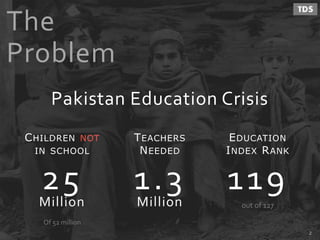
The
Problem
1.3
TEACHERS
NEEDED
119
out of 127
EDUCATION
INDEX RANK
25
Of 52 million
CHILDREN NOT
IN SCHOOL
Pakistan Education Crisis
MillionMillion
2
The
Solution
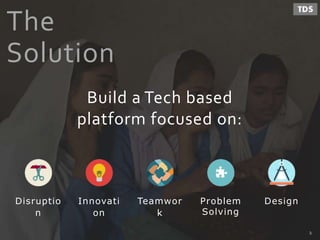
Build a Tech based
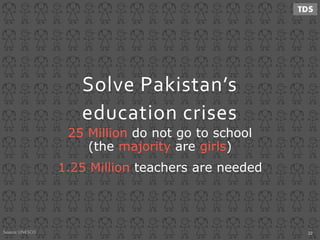
platform focused on:
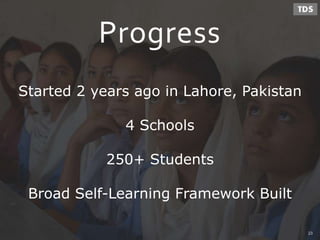
Innovati
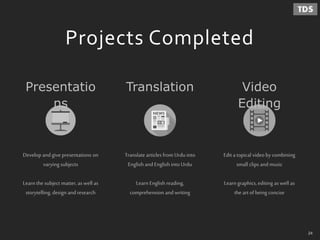
on
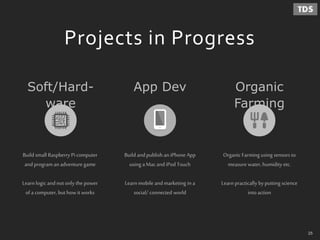
DesignTeamwor
k
Problem
Solving
Disruptio
n
3
The
Method
A 2 year Digital skills program
focused on adolescent girls
between the ages of 16-19
4
The
Method
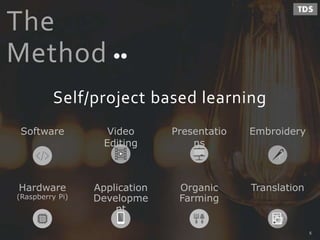
Self/project based learning
Hardware
(Raspberry Pi)
TranslationApplication
Developme
nt
Software EmbroideryVideo
Editing
Organic
Farming
5
Presentatio
ns
The
Method
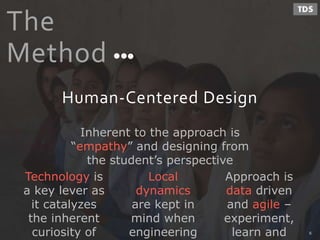
Human-Centered Design
Inherent to the approach is
“empathy” and designing from
the student’s perspective
Technology is
a key lever as
it catalyzes
the inherent
curiosity of
Approach is
data driven
and agile –
experiment,
learn and
Local
dynamics
are kept in
mind when
engineering
`
6
The
Method
Pedagogical Principles
Targeted Interventions
(Poverty, Early Marriage, etc.)
Evidence/Data Based Approach
(Experiment, Learn, Adjust)
Project Based Learning
`
7
`
The
Focus
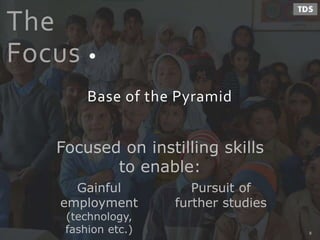
Base of the Pyramid
Gainful
employment
(technology,
fashion etc.)
Pursuit of
further studies
Focused on instilling skills
to enable:
8
The
Focus
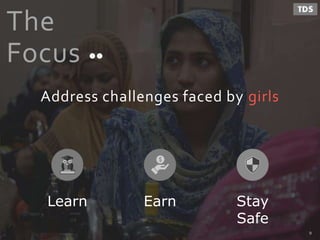
Address challenges faced by girls
Learn Earn Stay
Safe
9
The
Focus
Sustain/expand via a
for-profit model focused
on the middle class
10
The
Progress
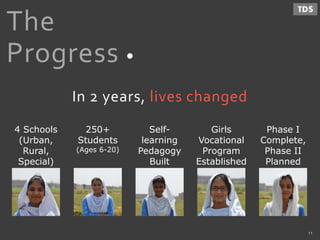
In 2 years, lives changed
4 Schools
(Urban,
Rural,
Special)
250+
Students
(Ages 6-20)
Phase I
Complete,
Phase II
Planned
Self-
learning
Pedagogy
Built
Girls
Vocational
Program
Established
11
In 2 years, lives changed
4 Schools
(Urban,
Rural,
Special)
250+
Students
(Ages 6-20)
Phase I
Complete,
Phase II
Planned
Self-
learning
Pedagogy
Built
The
Progress
Girls
Vocational
Program
Established
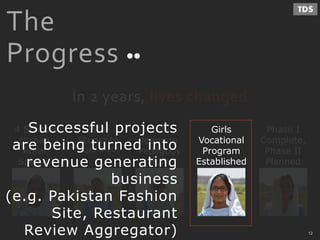
Successful projects
are being turned into
revenue generating
business
(e.g. Pakistan Fashion
Site, Restaurant
Review Aggregator) 12
The
Plan
What’s next?
Execute Scale Sustain
Accelerate
via 13
Focus on out of school girls
From marginalized communities
Covering various ethnicities and
minorities
Multi-dimensional approach to build a
sustainable model
14
The
Plan
Direct Impact – 900 Girls
Indirect Impact – 3,000+ Girls
(Partner with Government and NGO schools to
extend “open-source” self-learning, project based platform)
$120,000 over 5 years
15
The
Plan
Proposal
Details
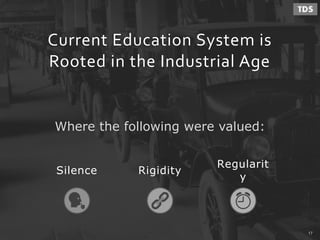
Current Education System is
Rooted in the Industrial Age
Where the following were valued:
RigiditySilence
Regularit
y
17
Time to explore alternatives
18
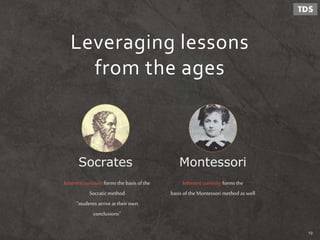
Leveraging lessons
from the ages
Inherent curiosity formsthe
basis ofthe Montessori method as well
Inherent curiosity formsthe basis of the
Socratic method
“students arriveat their own
conclusions”
MontessoriSocrates
19
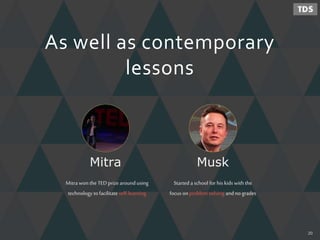
As well as contemporary
lessons
Starteda school forhis kids with the
focus on problem solving andno grades
Mitrawon the TEDprizearoundusing
technology tofacilitate self-learning
MuskMitra
20
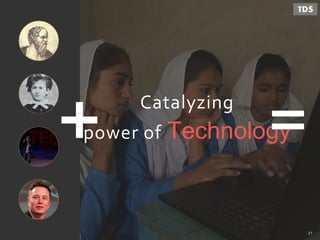
Catalyzing
power of Technology
21
Solve Pakistan’s
education crises
25 Million do not go to school
(the majority are girls)
1.25 Million teachers are needed
Source:UNESCO 22
Started 2 years ago in Lahore, Pakistan
4 Schools
250+ Students
Broad Self-Learning Framework Built
Progress
23
Edit a topical videoby combining
small clips andmusic
Learn graphics,editing as well as
the artofbeing concise
Presentatio
ns
Translation Video
Editing
Develop andgivepresentations on
varyingsubjects
Learn the subject matter, as well as
storytelling, design andresearch
Translate articles from Urduinto
English andEnglish into Urdu
Learn English reading,
comprehension and writing
Projects Completed
24
Projects in Progress
OrganicFarming using sensors to
measure water, humidity etc.
Learn practically byputting science
intoaction
Build andpublish an iPhone App
using aMacandiPod Touch
Learn mobile andmarketing in a
social/ connected world
Soft/Hard-
ware
Organic
Farming
App Dev
Build small Raspberry Pi computer
andprograman adventure game
Learn logic andnotonly the power
ofa computer, but how it works
25
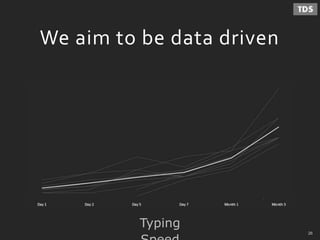
We aim to be data driven
Typing
26
- 27 -
Base of the Pyramid (BoP)
Our digital, self-learning pedagogy
is aimed squarely at educating
children from underprivileged
backgrounds.
Use technology to help educate
children given
a) teacher shortage (1.25 Million
teachers needed) 27
- 28 -
Base of the Pyramid (BoP)
We are focused on instilling skills
that will enable girl to either be
gainfully employed immediately
or pursue further studies
Lastly, as part of our vocational
schools we plan to place children
in jobs immediately
(e.g. embroidery work for high-
28
- 29 -
Girls
Establish vocational schools that will
address the challenges faced by girls
to learn, earn and stay safe
Skills in Focus:
App Development, Embroidery and
Tailoring
Partner with leading local technology
companies and fashion houses that 29
- 30 -
Girls
Develop creative ways to address
cultural obstacles faced by girls
For example, develop a “mother
hen” approach where girls can meet
at one of their houses under the
supervision of a mother to work
remotely on learning vocational
skills and eventually work remotely
30
- 31 -
Human-Centered Design
Inherent to our approach is
“empathy” and designing from the
customer perspective
Since, technology catalyzes the
inherent curiosity of children,
technology is a core part of our
solution
31
- 32 -
Human-Centered Design
Our project based learning is
designed with the students in
mind so as to enable them to
take advantage of employment
opportunities
Our approach is an agile one in
terms of what works and what
doesn’t – 32
- 33 -
Quotes from Children
I like self-learning … now we teach
other students … our lives are
changing – Ijaz M. (Grade 6)
“
“I am searching new things daily
and increasing my knowledge –
Amina R. (Grade 8)
I have improved my English by
using Google Translator – Rehan I.
(Grade 8)
“
Through the Khud lab I am linked
to the world by internet – Amina I.
(Grade 7)
“
33
The Financials
34
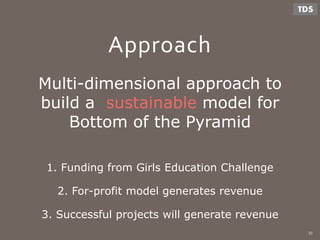
Multi-dimensional approach to
build a sustainable model for
Bottom of the Pyramid
1. Funding from Girls Education Challenge
2. For-profit model generates revenue
3. Successful projects will generate revenue
Approach
35
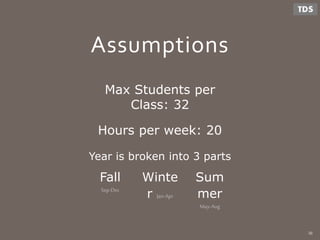
Assumptions
Max Students per
Class: 32
Hours per week: 20
Winte
r Jan-Apr
Sum
mer
May-Aug
Fall
Sep-Dec
Year is broken into 3 parts
36
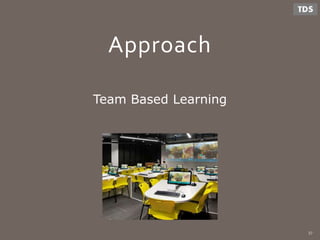
Approach
Team Based Learning
37
Growth
First cohort of 20
students
Grows by 2 each
semester
over 5 years
Leading to an ~900
students graduating from
the Digital School
Cost increases by 5% per 38
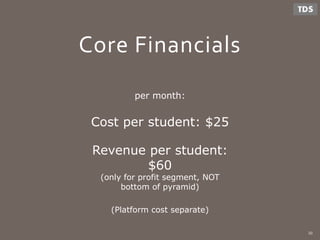
Core Financials
per month:
Cost per student: $25
Revenue per student:
$60
(only for profit segment, NOT
bottom of pyramid)
(Platform cost separate)
39
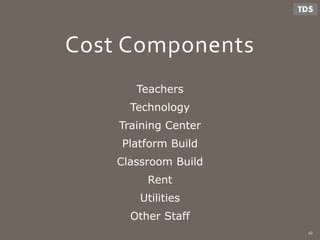
Cost Components
Teachers
Technology
Training Center
Platform Build
Classroom Build
Rent
Utilities
Other Staff
40
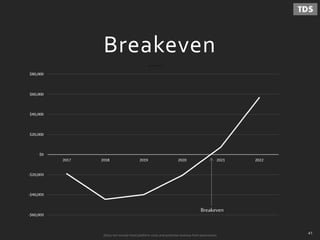
(Does not include fixed platform costs and potential revenue from businesses)
Breakeven
41
Breakeven
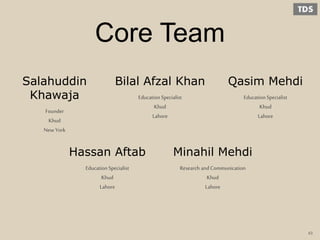
Team
Core Team
Hassan Aftab
Education Specialist
Khud
Lahore
Minahil Mehdi
Research andCommunication
Khud
Lahore
Salahuddin
Khawaja
Founder
Khud
New York
Bilal Afzal Khan
Education Specialist
Khud
Lahore
Qasim Mehdi
Education Specialist
Khud
Lahore
43
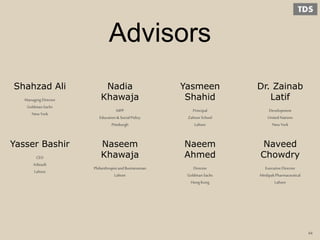
Advisors
Naveed
Chowdry
Executive Director
MedipakPharmaceutical
Lahore
Yasser Bashir
CEO
Arbisoft
Lahore
Naseem
Khawaja
PhilanthropistandBusinessman
Lahore
Naeem
Ahmed
Director
GoldmanSachs
HongKong
Shahzad Ali
ManagingDirector
GoldmanSachs
New York
Nadia
Khawaja
MPP
Education& SocialPolicy
Pittsburgh
Yasmeen
Shahid
Principal
ZahoorSchool
Lahore
Dr. Zainab
Latif
Development
UnitedNations
New York
44
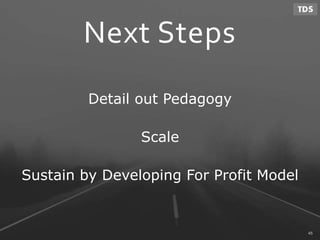
Detail out Pedagogy
Scale
Sustain by Developing For Profit Model
Next Steps
45
Thank you for viewing,
Salahuddin Khawaja
s@khud.org
About
Salahuddin
Salah has spent 15+ years in the financial sector in New York,
Hong Kong and Tokyo. Initially 11+ years as a management
consultant with Deloitte. He then moved to J. P. Morgan and Bank
of America where he worked in Investment Banking running large
scaleprograms.
He strongly believes in the transformational power of education
whichis whyhestartedThe KhudInitiative.

Khud + Acumen

  • 1.
  • 2.
  • 3.
    The Problem 1.3 TEACHERS NEEDED 119 out of 127 EDUCATION INDEXRANK 25 Of 52 million CHILDREN NOT IN SCHOOL Pakistan Education Crisis MillionMillion 2
  • 4.
    The Solution Build a Techbased platform focused on: Innovati on DesignTeamwor k Problem Solving Disruptio n 3
  • 5.
    The Method A 2 yearDigital skills program focused on adolescent girls between the ages of 16-19 4
  • 6.
    The Method Self/project based learning Hardware (RaspberryPi) TranslationApplication Developme nt Software EmbroideryVideo Editing Organic Farming 5 Presentatio ns
  • 7.
    The Method Human-Centered Design Inherent tothe approach is “empathy” and designing from the student’s perspective Technology is a key lever as it catalyzes the inherent curiosity of Approach is data driven and agile – experiment, learn and Local dynamics are kept in mind when engineering ` 6
  • 8.
    The Method Pedagogical Principles Targeted Interventions (Poverty,Early Marriage, etc.) Evidence/Data Based Approach (Experiment, Learn, Adjust) Project Based Learning ` 7 `
  • 9.
    The Focus Base of thePyramid Gainful employment (technology, fashion etc.) Pursuit of further studies Focused on instilling skills to enable: 8
  • 10.
    The Focus Address challenges facedby girls Learn Earn Stay Safe 9
  • 11.
    The Focus Sustain/expand via a for-profitmodel focused on the middle class 10
  • 12.
    The Progress In 2 years,lives changed 4 Schools (Urban, Rural, Special) 250+ Students (Ages 6-20) Phase I Complete, Phase II Planned Self- learning Pedagogy Built Girls Vocational Program Established 11
  • 13.
    In 2 years,lives changed 4 Schools (Urban, Rural, Special) 250+ Students (Ages 6-20) Phase I Complete, Phase II Planned Self- learning Pedagogy Built The Progress Girls Vocational Program Established Successful projects are being turned into revenue generating business (e.g. Pakistan Fashion Site, Restaurant Review Aggregator) 12
  • 14.
    The Plan What’s next? Execute ScaleSustain Accelerate via 13
  • 15.
    Focus on outof school girls From marginalized communities Covering various ethnicities and minorities Multi-dimensional approach to build a sustainable model 14 The Plan
  • 16.
    Direct Impact –900 Girls Indirect Impact – 3,000+ Girls (Partner with Government and NGO schools to extend “open-source” self-learning, project based platform) $120,000 over 5 years 15 The Plan
  • 17.
  • 18.
    Current Education Systemis Rooted in the Industrial Age Where the following were valued: RigiditySilence Regularit y 17
  • 19.
    Time to explorealternatives 18
  • 20.
    Leveraging lessons from theages Inherent curiosity formsthe basis ofthe Montessori method as well Inherent curiosity formsthe basis of the Socratic method “students arriveat their own conclusions” MontessoriSocrates 19
  • 21.
    As well ascontemporary lessons Starteda school forhis kids with the focus on problem solving andno grades Mitrawon the TEDprizearoundusing technology tofacilitate self-learning MuskMitra 20
  • 22.
  • 23.
    Solve Pakistan’s education crises 25Million do not go to school (the majority are girls) 1.25 Million teachers are needed Source:UNESCO 22
  • 24.
    Started 2 yearsago in Lahore, Pakistan 4 Schools 250+ Students Broad Self-Learning Framework Built Progress 23
  • 25.
    Edit a topicalvideoby combining small clips andmusic Learn graphics,editing as well as the artofbeing concise Presentatio ns Translation Video Editing Develop andgivepresentations on varyingsubjects Learn the subject matter, as well as storytelling, design andresearch Translate articles from Urduinto English andEnglish into Urdu Learn English reading, comprehension and writing Projects Completed 24
  • 26.
    Projects in Progress OrganicFarmingusing sensors to measure water, humidity etc. Learn practically byputting science intoaction Build andpublish an iPhone App using aMacandiPod Touch Learn mobile andmarketing in a social/ connected world Soft/Hard- ware Organic Farming App Dev Build small Raspberry Pi computer andprograman adventure game Learn logic andnotonly the power ofa computer, but how it works 25
  • 27.
    We aim tobe data driven Typing 26
  • 28.
    - 27 - Baseof the Pyramid (BoP) Our digital, self-learning pedagogy is aimed squarely at educating children from underprivileged backgrounds. Use technology to help educate children given a) teacher shortage (1.25 Million teachers needed) 27
  • 29.
    - 28 - Baseof the Pyramid (BoP) We are focused on instilling skills that will enable girl to either be gainfully employed immediately or pursue further studies Lastly, as part of our vocational schools we plan to place children in jobs immediately (e.g. embroidery work for high- 28
  • 30.
    - 29 - Girls Establishvocational schools that will address the challenges faced by girls to learn, earn and stay safe Skills in Focus: App Development, Embroidery and Tailoring Partner with leading local technology companies and fashion houses that 29
  • 31.
    - 30 - Girls Developcreative ways to address cultural obstacles faced by girls For example, develop a “mother hen” approach where girls can meet at one of their houses under the supervision of a mother to work remotely on learning vocational skills and eventually work remotely 30
  • 32.
    - 31 - Human-CenteredDesign Inherent to our approach is “empathy” and designing from the customer perspective Since, technology catalyzes the inherent curiosity of children, technology is a core part of our solution 31
  • 33.
    - 32 - Human-CenteredDesign Our project based learning is designed with the students in mind so as to enable them to take advantage of employment opportunities Our approach is an agile one in terms of what works and what doesn’t – 32
  • 34.
    - 33 - Quotesfrom Children I like self-learning … now we teach other students … our lives are changing – Ijaz M. (Grade 6) “ “I am searching new things daily and increasing my knowledge – Amina R. (Grade 8) I have improved my English by using Google Translator – Rehan I. (Grade 8) “ Through the Khud lab I am linked to the world by internet – Amina I. (Grade 7) “ 33
  • 35.
  • 36.
    Multi-dimensional approach to builda sustainable model for Bottom of the Pyramid 1. Funding from Girls Education Challenge 2. For-profit model generates revenue 3. Successful projects will generate revenue Approach 35
  • 37.
    Assumptions Max Students per Class:32 Hours per week: 20 Winte r Jan-Apr Sum mer May-Aug Fall Sep-Dec Year is broken into 3 parts 36
  • 38.
  • 39.
    Growth First cohort of20 students Grows by 2 each semester over 5 years Leading to an ~900 students graduating from the Digital School Cost increases by 5% per 38
  • 40.
    Core Financials per month: Costper student: $25 Revenue per student: $60 (only for profit segment, NOT bottom of pyramid) (Platform cost separate) 39
  • 41.
    Cost Components Teachers Technology Training Center PlatformBuild Classroom Build Rent Utilities Other Staff 40
  • 42.
    (Does not includefixed platform costs and potential revenue from businesses) Breakeven 41 Breakeven
  • 43.
  • 44.
    Core Team Hassan Aftab EducationSpecialist Khud Lahore Minahil Mehdi Research andCommunication Khud Lahore Salahuddin Khawaja Founder Khud New York Bilal Afzal Khan Education Specialist Khud Lahore Qasim Mehdi Education Specialist Khud Lahore 43
  • 45.
    Advisors Naveed Chowdry Executive Director MedipakPharmaceutical Lahore Yasser Bashir CEO Arbisoft Lahore Naseem Khawaja PhilanthropistandBusinessman Lahore Naeem Ahmed Director GoldmanSachs HongKong ShahzadAli ManagingDirector GoldmanSachs New York Nadia Khawaja MPP Education& SocialPolicy Pittsburgh Yasmeen Shahid Principal ZahoorSchool Lahore Dr. Zainab Latif Development UnitedNations New York 44
  • 46.
    Detail out Pedagogy Scale Sustainby Developing For Profit Model Next Steps 45
  • 47.
    Thank you forviewing, Salahuddin Khawaja s@khud.org About Salahuddin Salah has spent 15+ years in the financial sector in New York, Hong Kong and Tokyo. Initially 11+ years as a management consultant with Deloitte. He then moved to J. P. Morgan and Bank of America where he worked in Investment Banking running large scaleprograms. He strongly believes in the transformational power of education whichis whyhestartedThe KhudInitiative.