Technology Integration in Subject 
Areas 
New Tools 
New Opportunities
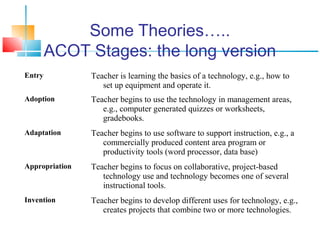
Some Theories….. 
ACOT Stages: the long version 
Entry Teacher is learning the basics of a technology, e.g., how to 
set up equipment and operate it. 
Adoption Teacher begins to use the technology in management areas, 
e.g., computer generated quizzes or worksheets, 
gradebooks. 
Adaptation Teacher begins to use software to support instruction, e.g., a 
commercially produced content area program or 
productivity tools (word processor, data base) 
Appropriation Teacher begins to focus on collaborative, project-based 
technology use and technology becomes one of several 
instructional tools. 
Invention Teacher begins to develop different uses for technology, e.g., 
creates projects that combine two or more technologies.
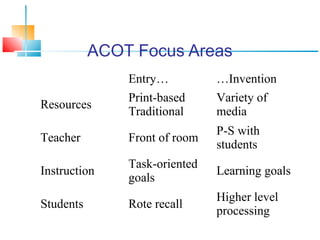
ACOT Focus Areas 
Entry… …Invention 
Resources Print-based 
Traditional 
Variety of 
media 
Teacher Front of room P-S with 
students 
Instruction Task-oriented 
goals Learning goals 
Students Rote recall Higher level 
processing
Pressing Need 
According to the latest TIMSS study, 
American 8th-grade students score lower 
than their counterparts in Japan, Canada, 
England, and the Russian federation. 
--Comparative Indicators of 
Education in the United States 
and Other G-8 Countries: 2002
Why Integrate 
Math and Technology? 
 Technology tools enhance math 
learning. 
 Math and technology integration address 
21st century skills. 
 Math and technology integration are 
powerful partners in meeting standards.
21st Century Skills 
“The definition of student achievement 
must be broadened to include the 21st 
century skills that will be required for 
students to thrive in the future.” 
--CEO Forum on Education 
and Technology (2001)
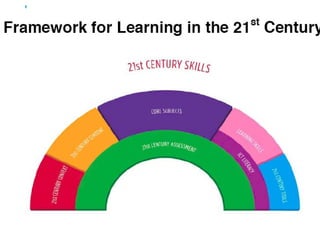
21st Century Skills 
 Personal and social responsibility 
 Planning, critical thinking, reasoning, and 
creativity 
 Strong communication skills 
 Cross-cultural understanding 
 Visualization and decision-making 
 Knowing how and when to use technology
NCTM 
“Mathematics learning is both 
about making sense of 
mathematical ideas and about 
acquiring skills and insights to 
solve problems.” 
--NCTM standards
What is Math and Technology 
Integration? 
 Day-to-day instruction 
 Student competitions 
 Online challenges and 
collaborations

Technology Integration K-12

  • 1.
    Technology Integration inSubject Areas New Tools New Opportunities
  • 2.
    Some Theories….. ACOTStages: the long version Entry Teacher is learning the basics of a technology, e.g., how to set up equipment and operate it. Adoption Teacher begins to use the technology in management areas, e.g., computer generated quizzes or worksheets, gradebooks. Adaptation Teacher begins to use software to support instruction, e.g., a commercially produced content area program or productivity tools (word processor, data base) Appropriation Teacher begins to focus on collaborative, project-based technology use and technology becomes one of several instructional tools. Invention Teacher begins to develop different uses for technology, e.g., creates projects that combine two or more technologies.
  • 3.
    ACOT Focus Areas Entry… …Invention Resources Print-based Traditional Variety of media Teacher Front of room P-S with students Instruction Task-oriented goals Learning goals Students Rote recall Higher level processing
  • 5.
    Pressing Need Accordingto the latest TIMSS study, American 8th-grade students score lower than their counterparts in Japan, Canada, England, and the Russian federation. --Comparative Indicators of Education in the United States and Other G-8 Countries: 2002
  • 6.
    Why Integrate Mathand Technology?  Technology tools enhance math learning.  Math and technology integration address 21st century skills.  Math and technology integration are powerful partners in meeting standards.
  • 7.
    21st Century Skills “The definition of student achievement must be broadened to include the 21st century skills that will be required for students to thrive in the future.” --CEO Forum on Education and Technology (2001)
  • 8.
    21st Century Skills  Personal and social responsibility  Planning, critical thinking, reasoning, and creativity  Strong communication skills  Cross-cultural understanding  Visualization and decision-making  Knowing how and when to use technology
  • 9.
    NCTM “Mathematics learningis both about making sense of mathematical ideas and about acquiring skills and insights to solve problems.” --NCTM standards
  • 10.
    What is Mathand Technology Integration?  Day-to-day instruction  Student competitions  Online challenges and collaborations

Editor's Notes

  • #2 Current technology tools allow students to experience learning in new and exciting ways, and prepare them to be competitive with other students globally.
  • #4 This slide details the 4 areas of classroom evaluation should be covered when considering whether or not technology is being used effectively for teaching and learning. Essentially trying to create a new teacher paradigm. Resources – Entry level is print-based and traditional (textbooks, pens, pencils, etc) Invention level is using a variety of media including the internet, digital equipment, graphing calculators, digital microscopes, smartboards, etc) Teacher – Entry level is the teacher in the front of the room lecturing to students that may appear completely disinterested or falling asleep. Invention is the teacher collaborating with the students to help them problem-solve and reach conclusion by cooperating with one another. This builds higher levels of learning and understanding of not only the material, but also improves societal skills for the students. Instruction – Entry level instruction is very task-oriented (and it has its place in instruction), but the ultimate goal is to achieve learning – not training, memorization or regurgitation. Students learn better by stimulating more than one sense. Teachers must learn to involve students in an active way to maximize student performance. The focus for teachers in the invention stage is more heavily on true alignment of learning goals to classroom activities and instruction. Students – The entry level of rote recall is paralleled with instruction. We must strive to achieve a higher level of learning in our students by actively stimulating the learning process.
  • #6 The Trends in International Mathematics and Science Study (TIMSS) looks at student achievement for primary and secondary students. The National Center for Education Statistics (NCES) compiles the findings and makes them available at http://nces.ed.gov/timss.
  • #7 Research shows that engaging students of all ages in interactive, hands-on work encourages understanding and deepens learning. Being able to use technology tools to problem-solve will continue to be required of knowledge workers in all fields, especially math and science. And more and more national, state, and regional curriculum standards are including mastery of technology tools as part of the charge to teachers and students.
  • #8 Other groups, such as the CEO Forum, NCREL (North Central Regional Educational Lab) and the Partnership for 21st Century Skills, have explored what students need to know and be able to do to succeed in school, work, and life. Along with content knowledge, students need an array of other skills, too.
  • #9 A variety of skills beyond the traditional “reading, ‘riting, and ‘rithmetic” are necessary for students to participate fully in the world of today, and the world of their future. These skills include: Personal and social responsibility Planning, critical thinking, reasoning, and creativity Strong communication skills Cross-cultural understanding Visualizaon and decision-making Knowing how and when to use technology
  • #10 The National Council of Teachers of Mathematics has developed comprehensive standards for preschool through 12th grade (http://standards.nctm.org) that broaden traditional mastery of skills as the sole requirement for mathematical competency.
  • #11 Math and technology can be integrated in a variety of ways. The most important factor is being convinced that technology can help the student or teacher do something that couldn’t be done better in other ways and with other tools. Examples abound. Have participants share how they integrate math and technology in day to day instruction (calculator use). National Math Trail (http://www.nationalmathtrail.org), encourage students to develop original math questions using local information.