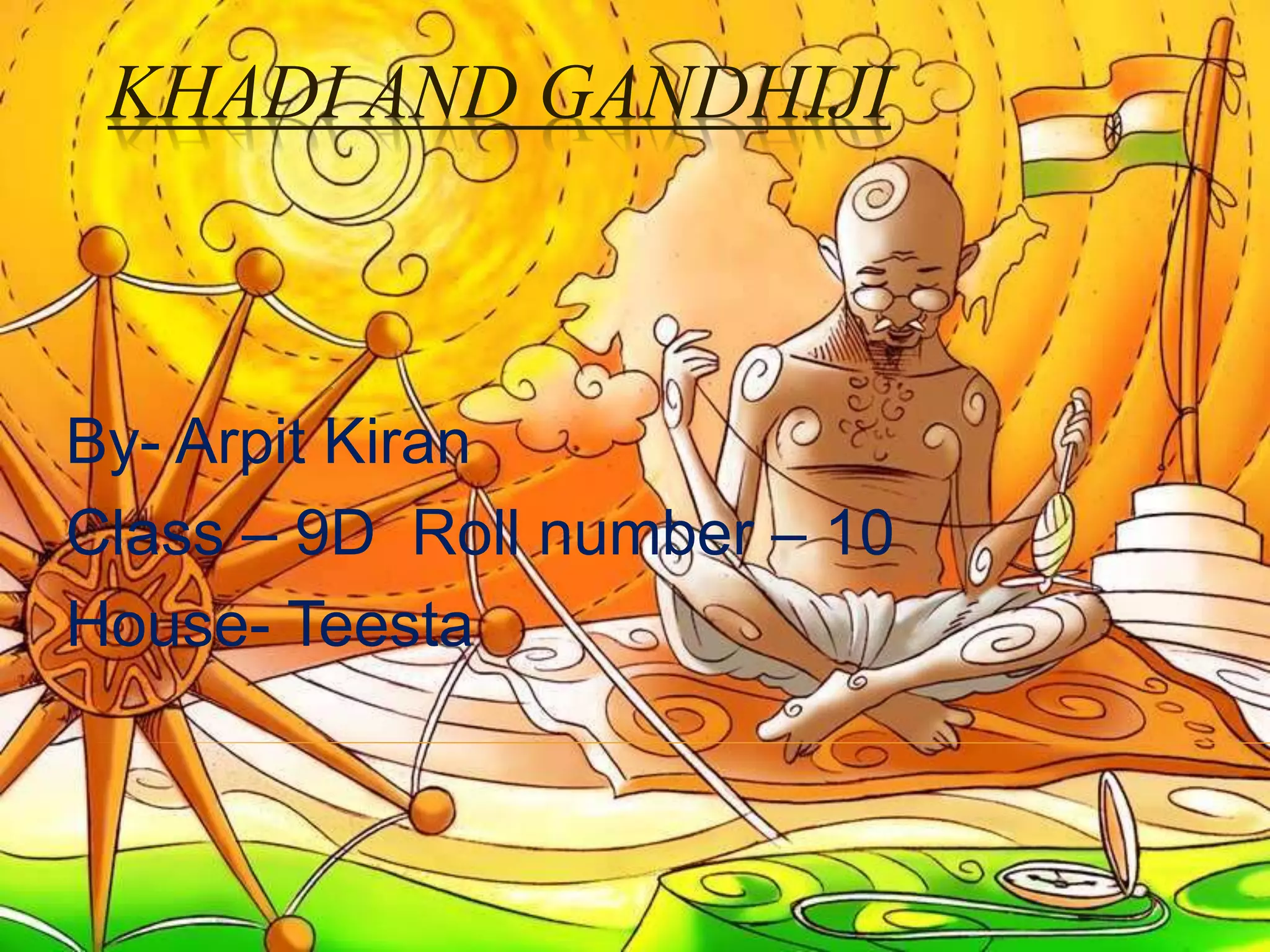
KHADI AND GANDHIJI
By- Arpit Kiran
Class – 9D Roll number – 10
House- Teesta
WHAT IS KHADI?
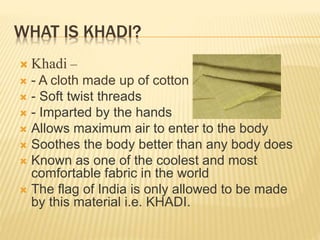
 Khadi –
 - A cloth made up of cotton fabric
 - Soft twist threads
 - Imparted by the hands
 Allows maximum air to enter to the body
 Soothes the body better than any body does
 Known as one of the coolest and most
comfortable fabric in the world
 The flag of India is only allowed to be made
by this material i.e. KHADI.
THE HISTORY OF KHADI
 Mahatma Gandhi is not only the father of our Nation
but also the father of Khadi.
 In 1908, he discovered Charkha (Spinning Wheel) in
London during discussion with fellow Indians.
 He had a clear vision of his programme of reviving
ancient industries for economic gains and achieve
freedom.
 He returned to India in 1915 during which swadeshi
and boycott movements of foreign goods (specially
cloths) were going on.
 In 1919, Gandhi launched the khadi programme in
the country.
THE HISTORY OF KHADI
 In 1920, Indian National Congress (INC)
started encouraging khadi producing
activities.
 In 1925, All India Spinners association or
charkha sangh was established.
 Gandhiji firmly believed that charkha was his
best gift to the nation contributing to its all
sided development economic, social, political
and moral.
SOME QUOTES BY GANDHIJI ON KHADI
 I believe that where there is pure and active
love for the poor there is God also. I see God in
every thread that I draw on the spinning wheel.
 The wearer of Khadi from a Swadeshi
standpoint is like a man making use of his
lungs.
 Khadi to me is the symbol of unity of Indian
humanity, of its economic freedom and equality
and therefore, in the poetic expression of
Jawaharlal Nehru," The Livery of India's
freedom. "
 Khadi is the sun of the village solar system.
IMPORTANCE OF KHADI IN INDIA'S
FREEDOM STRUGGLE
 Khadi is very important in Indian freedom struggle because of two main
events. One is Swadeshi movement. This started in 1905 because
British followed a policy of “drain of wealth” policy with regard to India.
They exported cotton from India to English cities like Manchester where
there were many cotton mills due to early industrial Revolution. They
made clothes with these cotton from India and sold it back to Indian.
Thus the wealth of India was drained to England. So Swadeshi
movement was launched to stop this drain of wealth. It was during this
time khadi came into prominence. After this when Mahatma Gandhi
came to forefront of the freedom. He faced a challenge that freedom
struggle was the struggle of the upper class and the poor and the
downtrodden was never a part of the freedom movements. For the
masses to participate in the freedom struggle khadi was used by Gandhi
as a symbol. Khadi was the dress of the common man and Gandhi
started wearing this and thus gave a feeling that freedom struggle is of
the masses and attracted all classes to be a part of freedom struggle.
KHADI’S ROLE AFTER INDEPENDENCE
 The role of khadi continued even after India
gained independence on 15th August, 1947.
 1948 Government policy on cottage and
village industries including Khadi.
 1953 All India Khadi and village industries
board.
 1957 Khadi and village industries commision
(KVIC).
THANK YOU

Khadi and gandhiji

  • 1.
    KHADI AND GANDHIJI By-Arpit Kiran Class – 9D Roll number – 10 House- Teesta
  • 2.
    WHAT IS KHADI? Khadi –  - A cloth made up of cotton fabric  - Soft twist threads  - Imparted by the hands  Allows maximum air to enter to the body  Soothes the body better than any body does  Known as one of the coolest and most comfortable fabric in the world  The flag of India is only allowed to be made by this material i.e. KHADI.
  • 3.
    THE HISTORY OFKHADI  Mahatma Gandhi is not only the father of our Nation but also the father of Khadi.  In 1908, he discovered Charkha (Spinning Wheel) in London during discussion with fellow Indians.  He had a clear vision of his programme of reviving ancient industries for economic gains and achieve freedom.  He returned to India in 1915 during which swadeshi and boycott movements of foreign goods (specially cloths) were going on.  In 1919, Gandhi launched the khadi programme in the country.
  • 4.
    THE HISTORY OFKHADI  In 1920, Indian National Congress (INC) started encouraging khadi producing activities.  In 1925, All India Spinners association or charkha sangh was established.  Gandhiji firmly believed that charkha was his best gift to the nation contributing to its all sided development economic, social, political and moral.
  • 5.
    SOME QUOTES BYGANDHIJI ON KHADI  I believe that where there is pure and active love for the poor there is God also. I see God in every thread that I draw on the spinning wheel.  The wearer of Khadi from a Swadeshi standpoint is like a man making use of his lungs.  Khadi to me is the symbol of unity of Indian humanity, of its economic freedom and equality and therefore, in the poetic expression of Jawaharlal Nehru," The Livery of India's freedom. "  Khadi is the sun of the village solar system.
  • 6.
    IMPORTANCE OF KHADIIN INDIA'S FREEDOM STRUGGLE  Khadi is very important in Indian freedom struggle because of two main events. One is Swadeshi movement. This started in 1905 because British followed a policy of “drain of wealth” policy with regard to India. They exported cotton from India to English cities like Manchester where there were many cotton mills due to early industrial Revolution. They made clothes with these cotton from India and sold it back to Indian. Thus the wealth of India was drained to England. So Swadeshi movement was launched to stop this drain of wealth. It was during this time khadi came into prominence. After this when Mahatma Gandhi came to forefront of the freedom. He faced a challenge that freedom struggle was the struggle of the upper class and the poor and the downtrodden was never a part of the freedom movements. For the masses to participate in the freedom struggle khadi was used by Gandhi as a symbol. Khadi was the dress of the common man and Gandhi started wearing this and thus gave a feeling that freedom struggle is of the masses and attracted all classes to be a part of freedom struggle.
  • 7.
    KHADI’S ROLE AFTERINDEPENDENCE  The role of khadi continued even after India gained independence on 15th August, 1947.  1948 Government policy on cottage and village industries including Khadi.  1953 All India Khadi and village industries board.  1957 Khadi and village industries commision (KVIC).
  • 8.