Bringing Collaborative Learning beyond Classroom: Case Studies
    KFIT International School Project
                  (KISP)
       Gyeong Mi Heo & Alain Breuleux (McGill University, Canada)
           Rhea Febro & Amelia Buan (MSU-IIT, Philippines)
KFIT International School Project
                                   The KISP was initiated
                                   (a) to provide teachers and
                                      students an opportunity
                                      to collaborate with other
                                      groups from different
                                      countries, and
                                   (b) to build an online
                                      learning community for
                                      teachers and students to
                                      promote PBL-
                                      Telecollaboration.


            Innovative Practices in Teaching and Learning: A Regional   2
            Seminar
Implementation of the KISP
• Participants from Canada, China, Republic of Korea,
  the Philippines, Malaysia, and Bangladesh.
• March 5 – July 25, 2012 (Culminating activity -
  Presentation of final collaborative outputs)
• Education Community portal and Voice/Video
  conferencing system (e.g., Skype and Adobe
  Connect)
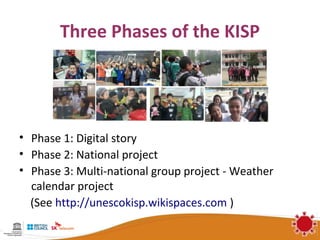
Three Phases of the KISP


• Phase 1: Digital story
• Phase 2: National project
• Phase 3: Multi-national group project - Weather
  calendar project
  (See http://unescokisp.wikispaces.com )
Impact of the KISP
•    Impact on Student Learning
    a) 21st Century Skills: Digital Literacy
    b) Intercultural Understanding

•    Impact on Teacher Competence
    a) Technological, Pedagogical, and Content
       Knowledge (TPACK)
    b) Professional Learning Communities


                      Innovative Practices in Teaching and Learning: A Regional   5
                      Seminar
Benefits of the KISP
The KISP provided the teachers and students a
   meaningful opportunity to
a) communicate and collaborate with others from
   different countries at different levels
b) learn from others with different background,
   knowledge, and skills
c) use various ICT tools for communication and
   collaboration as well as presentation and media
   production
d) increase awareness and appreciation of different
   countries and cultures.

                   Innovative Practices in Teaching and Learning: A Regional   6
                   Seminar
Challenges of the KISP
a) Organizational and cultural barriers: Differences
   of school calendars, available time, ICT facilities,
   and teaching and learning approaches to
   curriculum
b) Language barriers: Lack of English proficiency
c) Technical barriers: IT infrastructure for Internet
   connectivity
d) Collaboration barriers: Challenges of getting to
   know each other, and understanding better
   others' contexts, cultures, and perspectives


                    Innovative Practices in Teaching and Learning: A Regional   7
                    Seminar
Recommendations
a) Building an online learning community


b) Design of international PBL-Telecollaboration
   project


c) Teacher professional development


                   Innovative Practices in Teaching and Learning: A Regional   8
                   Seminar
THANK YOU!
Dr. Gyeong Mi Heo, Education Consultant, CEFRIO, Canada (
      gyeongmi.heo@gmail.com)
Ms. Rhea Febro, Asst. Professor, MSU-IIT, Philippines (
     rhea.febro@g.msuiit.edu.ph)

KFIT International School Project (KISP)

  • 1.
    Bringing Collaborative Learningbeyond Classroom: Case Studies KFIT International School Project (KISP) Gyeong Mi Heo & Alain Breuleux (McGill University, Canada) Rhea Febro & Amelia Buan (MSU-IIT, Philippines)
  • 2.
    KFIT International SchoolProject The KISP was initiated (a) to provide teachers and students an opportunity to collaborate with other groups from different countries, and (b) to build an online learning community for teachers and students to promote PBL- Telecollaboration. Innovative Practices in Teaching and Learning: A Regional 2 Seminar
  • 3.
    Implementation of theKISP • Participants from Canada, China, Republic of Korea, the Philippines, Malaysia, and Bangladesh. • March 5 – July 25, 2012 (Culminating activity - Presentation of final collaborative outputs) • Education Community portal and Voice/Video conferencing system (e.g., Skype and Adobe Connect)
  • 4.
    Three Phases ofthe KISP • Phase 1: Digital story • Phase 2: National project • Phase 3: Multi-national group project - Weather calendar project (See http://unescokisp.wikispaces.com )
  • 5.
    Impact of theKISP • Impact on Student Learning a) 21st Century Skills: Digital Literacy b) Intercultural Understanding • Impact on Teacher Competence a) Technological, Pedagogical, and Content Knowledge (TPACK) b) Professional Learning Communities Innovative Practices in Teaching and Learning: A Regional 5 Seminar
  • 6.
    Benefits of theKISP The KISP provided the teachers and students a meaningful opportunity to a) communicate and collaborate with others from different countries at different levels b) learn from others with different background, knowledge, and skills c) use various ICT tools for communication and collaboration as well as presentation and media production d) increase awareness and appreciation of different countries and cultures. Innovative Practices in Teaching and Learning: A Regional 6 Seminar
  • 7.
    Challenges of theKISP a) Organizational and cultural barriers: Differences of school calendars, available time, ICT facilities, and teaching and learning approaches to curriculum b) Language barriers: Lack of English proficiency c) Technical barriers: IT infrastructure for Internet connectivity d) Collaboration barriers: Challenges of getting to know each other, and understanding better others' contexts, cultures, and perspectives Innovative Practices in Teaching and Learning: A Regional 7 Seminar
  • 8.
    Recommendations a) Building anonline learning community b) Design of international PBL-Telecollaboration project c) Teacher professional development Innovative Practices in Teaching and Learning: A Regional 8 Seminar
  • 9.
    THANK YOU! Dr. GyeongMi Heo, Education Consultant, CEFRIO, Canada ( gyeongmi.heo@gmail.com) Ms. Rhea Febro, Asst. Professor, MSU-IIT, Philippines ( rhea.febro@g.msuiit.edu.ph)