Issue 1005
The Cabinet Secretary for National Treasury in his Budget speech announced
enactment of the long awaited VAT Regulations 2017. This, after the first
drafts were published in 2014.
Belowisasummaryofthesubsidiarylegislationsintroducedinthenewregulationsinordertoprovide
clarity as you seek to comply with the VAT laws.
VAT Regulations 2017
The subsidiary legislation seeks to streamline the VAT Act with the Tax Procedures Act 2015 and
will assist in interpretation and implementation of the VAT Act 2013. These regulations took
effect from 4 April 2017
VAT Regulations 2017
Continued...
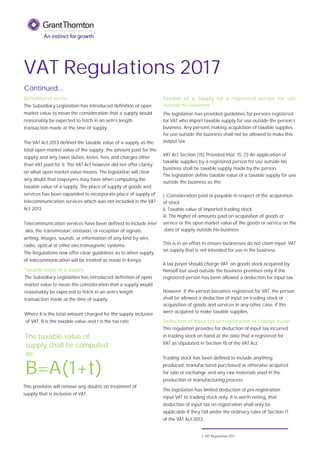
B=A(1+t)
The taxable value of
supply shall be computed
as;
The VAT Act 2013 defined the taxable value of a supply as the
total open market value of the supply, the amount paid for the
supply and any taxes duties, levies, fees and charges other
than VAT paid for it. The VAT Act however did not offer clarity
on what open market value means. The legislation will clear
any doubt that taxpayers may have when computing the
taxable value of a supply. The place of supply of goods and
services has been expanded to incorporate place of supply of
telecommunication services which was not included in the VAT
Act 2013.
Telecommunication services have been defined to include inter
alia, the transmission, emission, or reception of signals,
writing, images, sounds, or information of any kind by wire,
radio, optical or other electromagnetic systems.
The Regulations now offer clear guidelines as to when supply
of telecommunication will be treated as made in Kenya.
Taxable value of a supply
The Subsidiary Legislation has introduced definition of open
market value to mean the consideration that a supply would
reasonably be expected to fetch in an arm’s length
transaction made at the time of supply.
Where A is the total amount charged for the supply inclusive
of VAT, B is the taxable value and t is the tax rate
Definition of terms
The Subsidiary Legislation has introduced definition of open
market value to mean the consideration that a supply would
reasonably be expected to fetch in an arm’s length
transaction made at the time of supply.
Taxable of a Supply by a registered person for use
outside his business
The legislation has provided guidelines for persons registered
for VAT who import taxable supply for use outside the person’s
business. Any persons making acquisition of taxable supplies
for use outside the business shall not be allowed to make this
output tax.
VAT Act Section (15) Provided that; 15. (1) An application of
taxable supplies by a registered person for use outside his
business shall be taxable supply made by the person.
The legislation define taxable value of a taxable supply for use
outside the business as the;
i. Consideration paid or payable in respect of the acquisition
of stock
ii. Taxable value of imported trading stock
iii. The higher of amounts paid on acquisition of goods or
service or the open market value of the goods or service on the
date of supply outside his business
This is in an effort to ensure businesses do not claim input VAT
on supply that is not intended for use in the business.
A tax payer should charge VAT on goods stock acquired by
himself but used outside the business premises only if the
registered person has been allowed a deduction for input tax.
However, if the person becomes registered for VAT, the person
shall be allowed a deduction of input on trading stock or
acquisition of goods and services in any other case, if this
were acquired to make taxable supplies.
Trading stock has been defined to include anything
produced, manufactured purchased or otherwise acquired
for sale or exchange and any raw materials used in the
production or manufacturing process.
The legislation has limited deduction of pre-registration
input VAT to trading stock only. It is worth noting, that
deduction of input tax on registration shall only be
applicable if they fall under the ordinary rules of Section 17
of the VAT Act 2013.
Deduction of Input tax on registration or change in use
This regulation provides for deduction of input tax incurred
in trading stock on hand at the date that a registered for
VAT as stipulated in Section 18 of the VAT Act.
This provision will remove any doubts on treatment of
supply that is inclusive of VAT.
2 VAT Regulations 2017
VAT Regulations 2017
Continued...
Refund of Taxes
The legislation has given more emphasis on refund of VAT.
A registered person will only be entitled to a refund arising
from zero rated supplies for persons making both taxable at
the general rate and zero rate.
Refund of taxes paid erroneously to the KRA will be applied
in accordance with the Tax Procedures Act where, the
commissioner shall apply the overpayment in payment of
any other taxes under the tax law, in payment of a tax owing
to any other tax law. Any remainder shall then be refunded
to the tax payer.
The legislation also provides that, any persons who had
been refunded output tax paid on bad debts and recovers
the amounts hall issue a debit note to the recipient of the
taxable supply with a debit note specifying the amount of
tax refunded to the Commissioner.
Tax invoice
Currently the VAT Act dictates that for purposes deduction
of input tax, a supplier must maintain a tax invoice among
other requirements that supports the deduction claim. The
subsidiary legislation has now shed more light on what the
tax invoice should contain.
We list below the what the tax invoice furnished by the
supplier to a purchaser must contain;
We list below what the tax invoice furnished by the
supplier to a purchaser must contain;
i. the words “TAX INVOICE” in a prominent place;
ii. the name, address, and PIN of the supplier;
iii. the name, address, and PIN, if any, of the recipient;
iv. the individualized serial number of the tax invoice;
v. the date on which the tax invoice is issued and the
date on which the supply was made, if different from the
date of issue of the tax invoice;
vi. the description of the goods supplied including
quantity or volume or services provided;
We list below what the tax invoice furnished by the
supplier to a purchaser must contain; (cont..)
vi. the description of the goods supplied including
quantity or volume or services provided;
vii. the details of any discount allowed at the time of
supply; and
viii. the consideration for the supply and the amount of
tax charged.
For the suppliers who provide electronically
generated receipts, this must contain;
i. the name, address, and PIN of the supplier;
ii. the serial number of the receipt;
iii. the date and time of issue of the receipt;
iv. a brief description of the goods supplied (including
quantity or volume);
v. the tax payable; and
vi. the total amount payable for the supply inclusive of
tax.
We list below what a tax invoice for supplies of
imported services must contain;
i. the name, address, and PIN of the recipient;
ii. the name and address of the supplier;
iii. the individualised serial number of the tax invoice and
the date on which the tax invoice is prepared;
iv. a description of the services supplied and the date of
the supply;
v. the extent to which the supply has been applied other
than to make taxable supplies;
vi. the consideration for the supply and the amount of tax
charged.
The VAT Act provides for issuance of credit notes and debit
notes to reduce value of credit notes and increase value of
supply. We discuss below details that should be contained
in a credit note raised to a purchaser;
A credit note shall contain;
i. the words “CREDIT NOTE” in a prominent place;
ii. the name, address, and PIN of the supplier;
iii. the name, address, and PIN of the recipient;
iv. the individualised serial number of the credit note and
the date on which the credit note is issued;
of tax that relates to the difference.
On the matter of refund of output tax paid on bad debts, the
legislation has given emphasis that, such refunds shall be
allowed, however if the the supplier had issued a credit note
to the recipient of the supply, such refunds shall not be
allowed.
3 VAT Regulations 2017
VAT Regulations 2017
Continued...
A credit note shall contain; (cont)
v. a brief description of the circumstances giving rise to the
issuing of the credit note, including the invoice details to
which the credit note relates; vi. the consideration shown on
the tax invoice for the supply,vii. the correct amount of the
consideration, the difference between those two amounts,
and the amount
A debit note shall contain;
i. the words “DEBIT NOTE” in a prominent place;
ii. the name, address, and PIN of the supplier;
iii. the name, address, and PIN of the recipient;
iv. the individualised serial number of the debit note and
the date on which the debit note is issued;
v. a brief description of the circumstances giving rise to
the issuing of the debit note, including the invoice details
to which the debit note relates;
vi. the consideration shown on the tax invoice for the
supply;
vii. the correct amount of the consideration, the
difference between those two amounts, and the amount
of tax that relates to the difference.
Exportation of goods or services
The KRA has in the past raised assessments on taxpayers
for failure of charging VAT for services taxpayers feel were
exports however, this services according to the KRA were
consumed in Kenya and therefore subject to VAT.
The VAT Act 2013 defines export of services to mean
services provided for use or consumption outside Kenya.
The Act however does not go further to define the phrase
“use” and “consumption”. The place of supply also did not
offer proper guidance to taxpayers.
The regulations have been put in place to remove any
doubts as to the definition of exportation of goods or
services.
According the VAT Regulation 2017 the exportation of
goods or services has been defined to mean;
i. in the case of goods, when the taxable supply
involves the goods being entered for export under the
East African Community Customs Management Act
and delivered to a recipient outside Kenya at an
address outside Kenya; or
ii. in the case of services, when the taxable supply
involves the services being provided to a recipient
outside Kenya for use consumption, or enjoyment
outside Kenya.
Export of services shall not include;
i. taxable services consumed on exportation of goods
unless the services are in relation to transportation
of goods which terminates outside Kenya;
ii. taxable services provided in Kenya but paid for by
a person who is not a resident in Kenya.
A supplier must provide the following documents as
proof of exportation of goods or service;
i. a copy of the invoice showing the recipient of the
supply to be a person outside Kenya
ii. proof of payment for the supply of services
iii. for goods, a copy of:
(a) the bill of lading, road manifest, or airway bill, as
the case may be;
(b) the export or transfer entry certified by a proper
officer of Customs at the port of exit;
(c) for excisable goods, the documents shall be in
accordance with the provisions of the Excise Duty Act
2015;
(d) for services, such other documents as the
Commissioner may require as proof that the services
had been used or consumed outside Kenya.
If, however, the commissioner is not satisfied that a
service was not consumed outside Kenya. The
Commissioner may by notice in writing require the
registered person to produce, a certificate signed
and stamped by a competent authority outside
Kenya stating that the goods were duly landed and
entered for home consumption at a place outside
Kenya.
Documents to be maintained for supply of
goods to the Special Economics Zone and or
Export Processing Zone;
i. a copy of the recipient’s export processing zone
licence; or Special Economic Zone licence;
4 VAT Regulations 2017
Contacts
‘Grant Thornton’ refers to the brand under which the Grant Thornton member firms provide assurance, tax and
advisory services to their clients and/or refers to one or more member firms, as the context requires. Grant Thornton
International Ltd (GTIL) and the member firms are not a worldwide partnership. GTIL and each member firm is a
separate legal entity. Services are delivered by the member firms. GTIL does not provide services to clients. GTIL
and its member firms are not agents of, and do not obligate, one another and are not liable for one another’s acts
or omissions.
grantthornton.co.ke
©2017GrantThornton Kenya.Allrightsreserved.
Parag Shah
Partner
Grant Thornton
Kenya
T +254 (0) 20 375 2830
E parag.shah@ke.gt.com
Samuel Mwaura
Director
Grant Thornton
Kenya
T +254 (0) 20 375 2830
E samuel.mwaura@ke.gt.com
Mbiki Kamanjiri
Manager
Grant Thornton
Kenya
T +254 (0) 20 375 2830
E mbiki.kamanjiri@ke.gt.com
Continued...
Tax payers dealing with successive supplies will be
required to determine the tax payable for the
supply as per the guidelines outlined in the
regulations in the event there is increment,
reduction, withdrawal or imposition of new tax laws.
VAT Regulations 2017
i. Prominently state on its invoice that taxable supplies are
made inclusive of VAT and the supply is a taxable or exempt
supply and if taxable, the rate of tax charged.
Documents to be maintained for supply of
goods to the Special Economics Zone and or
Export Processing Zone; (cont)
ii. a certificate signed by the recipient of the supply
stating that the goods have been received and are
for use in the approved operations of an export
processing zone enterprise; and for goods, the
export entry duly certified by the proper officer of
customs.
Exportation of goods or services
Taxable supplies to unregistered persons
A registered person who is a retailer or who otherwise
makes taxable supplies to persons who are not registered
for VAT will be required to;
Application of increased or reduced tax rate to
successive supplies
The tax rates applicable shall be;
i. The tax rates applicable to a successive supply
on the change date shall be the tax rate
immediately before the change
ii In the case of imposition of a tax on the change
date, the supply shall be treated as not being
subject to tax;
The VAT Act 2013 defines successive supplies as
goods are supplied under a rental agreement;
or goods or services are made by metered
supplies, or under an agreement or law that
provides for periodic payments.
The regulation have been expanded to
accommodate taxes applicable in the case of
change in the rate of tax.
iii. In the case of withdrawal of the tax on the
change date, the supply shall be treated as
being subject to tax as if the tax had not been
withdrawn

Kenya: VAT Regulations 2017

  • 1.
    Issue 1005 The CabinetSecretary for National Treasury in his Budget speech announced enactment of the long awaited VAT Regulations 2017. This, after the first drafts were published in 2014. Belowisasummaryofthesubsidiarylegislationsintroducedinthenewregulationsinordertoprovide clarity as you seek to comply with the VAT laws. VAT Regulations 2017 The subsidiary legislation seeks to streamline the VAT Act with the Tax Procedures Act 2015 and will assist in interpretation and implementation of the VAT Act 2013. These regulations took effect from 4 April 2017
  • 2.
    VAT Regulations 2017 Continued... B=A(1+t) Thetaxable value of supply shall be computed as; The VAT Act 2013 defined the taxable value of a supply as the total open market value of the supply, the amount paid for the supply and any taxes duties, levies, fees and charges other than VAT paid for it. The VAT Act however did not offer clarity on what open market value means. The legislation will clear any doubt that taxpayers may have when computing the taxable value of a supply. The place of supply of goods and services has been expanded to incorporate place of supply of telecommunication services which was not included in the VAT Act 2013. Telecommunication services have been defined to include inter alia, the transmission, emission, or reception of signals, writing, images, sounds, or information of any kind by wire, radio, optical or other electromagnetic systems. The Regulations now offer clear guidelines as to when supply of telecommunication will be treated as made in Kenya. Taxable value of a supply The Subsidiary Legislation has introduced definition of open market value to mean the consideration that a supply would reasonably be expected to fetch in an arm’s length transaction made at the time of supply. Where A is the total amount charged for the supply inclusive of VAT, B is the taxable value and t is the tax rate Definition of terms The Subsidiary Legislation has introduced definition of open market value to mean the consideration that a supply would reasonably be expected to fetch in an arm’s length transaction made at the time of supply. Taxable of a Supply by a registered person for use outside his business The legislation has provided guidelines for persons registered for VAT who import taxable supply for use outside the person’s business. Any persons making acquisition of taxable supplies for use outside the business shall not be allowed to make this output tax. VAT Act Section (15) Provided that; 15. (1) An application of taxable supplies by a registered person for use outside his business shall be taxable supply made by the person. The legislation define taxable value of a taxable supply for use outside the business as the; i. Consideration paid or payable in respect of the acquisition of stock ii. Taxable value of imported trading stock iii. The higher of amounts paid on acquisition of goods or service or the open market value of the goods or service on the date of supply outside his business This is in an effort to ensure businesses do not claim input VAT on supply that is not intended for use in the business. A tax payer should charge VAT on goods stock acquired by himself but used outside the business premises only if the registered person has been allowed a deduction for input tax. However, if the person becomes registered for VAT, the person shall be allowed a deduction of input on trading stock or acquisition of goods and services in any other case, if this were acquired to make taxable supplies. Trading stock has been defined to include anything produced, manufactured purchased or otherwise acquired for sale or exchange and any raw materials used in the production or manufacturing process. The legislation has limited deduction of pre-registration input VAT to trading stock only. It is worth noting, that deduction of input tax on registration shall only be applicable if they fall under the ordinary rules of Section 17 of the VAT Act 2013. Deduction of Input tax on registration or change in use This regulation provides for deduction of input tax incurred in trading stock on hand at the date that a registered for VAT as stipulated in Section 18 of the VAT Act. This provision will remove any doubts on treatment of supply that is inclusive of VAT. 2 VAT Regulations 2017
  • 3.
    VAT Regulations 2017 Continued... Refundof Taxes The legislation has given more emphasis on refund of VAT. A registered person will only be entitled to a refund arising from zero rated supplies for persons making both taxable at the general rate and zero rate. Refund of taxes paid erroneously to the KRA will be applied in accordance with the Tax Procedures Act where, the commissioner shall apply the overpayment in payment of any other taxes under the tax law, in payment of a tax owing to any other tax law. Any remainder shall then be refunded to the tax payer. The legislation also provides that, any persons who had been refunded output tax paid on bad debts and recovers the amounts hall issue a debit note to the recipient of the taxable supply with a debit note specifying the amount of tax refunded to the Commissioner. Tax invoice Currently the VAT Act dictates that for purposes deduction of input tax, a supplier must maintain a tax invoice among other requirements that supports the deduction claim. The subsidiary legislation has now shed more light on what the tax invoice should contain. We list below the what the tax invoice furnished by the supplier to a purchaser must contain; We list below what the tax invoice furnished by the supplier to a purchaser must contain; i. the words “TAX INVOICE” in a prominent place; ii. the name, address, and PIN of the supplier; iii. the name, address, and PIN, if any, of the recipient; iv. the individualized serial number of the tax invoice; v. the date on which the tax invoice is issued and the date on which the supply was made, if different from the date of issue of the tax invoice; vi. the description of the goods supplied including quantity or volume or services provided; We list below what the tax invoice furnished by the supplier to a purchaser must contain; (cont..) vi. the description of the goods supplied including quantity or volume or services provided; vii. the details of any discount allowed at the time of supply; and viii. the consideration for the supply and the amount of tax charged. For the suppliers who provide electronically generated receipts, this must contain; i. the name, address, and PIN of the supplier; ii. the serial number of the receipt; iii. the date and time of issue of the receipt; iv. a brief description of the goods supplied (including quantity or volume); v. the tax payable; and vi. the total amount payable for the supply inclusive of tax. We list below what a tax invoice for supplies of imported services must contain; i. the name, address, and PIN of the recipient; ii. the name and address of the supplier; iii. the individualised serial number of the tax invoice and the date on which the tax invoice is prepared; iv. a description of the services supplied and the date of the supply; v. the extent to which the supply has been applied other than to make taxable supplies; vi. the consideration for the supply and the amount of tax charged. The VAT Act provides for issuance of credit notes and debit notes to reduce value of credit notes and increase value of supply. We discuss below details that should be contained in a credit note raised to a purchaser; A credit note shall contain; i. the words “CREDIT NOTE” in a prominent place; ii. the name, address, and PIN of the supplier; iii. the name, address, and PIN of the recipient; iv. the individualised serial number of the credit note and the date on which the credit note is issued; of tax that relates to the difference. On the matter of refund of output tax paid on bad debts, the legislation has given emphasis that, such refunds shall be allowed, however if the the supplier had issued a credit note to the recipient of the supply, such refunds shall not be allowed. 3 VAT Regulations 2017
  • 4.
    VAT Regulations 2017 Continued... Acredit note shall contain; (cont) v. a brief description of the circumstances giving rise to the issuing of the credit note, including the invoice details to which the credit note relates; vi. the consideration shown on the tax invoice for the supply,vii. the correct amount of the consideration, the difference between those two amounts, and the amount A debit note shall contain; i. the words “DEBIT NOTE” in a prominent place; ii. the name, address, and PIN of the supplier; iii. the name, address, and PIN of the recipient; iv. the individualised serial number of the debit note and the date on which the debit note is issued; v. a brief description of the circumstances giving rise to the issuing of the debit note, including the invoice details to which the debit note relates; vi. the consideration shown on the tax invoice for the supply; vii. the correct amount of the consideration, the difference between those two amounts, and the amount of tax that relates to the difference. Exportation of goods or services The KRA has in the past raised assessments on taxpayers for failure of charging VAT for services taxpayers feel were exports however, this services according to the KRA were consumed in Kenya and therefore subject to VAT. The VAT Act 2013 defines export of services to mean services provided for use or consumption outside Kenya. The Act however does not go further to define the phrase “use” and “consumption”. The place of supply also did not offer proper guidance to taxpayers. The regulations have been put in place to remove any doubts as to the definition of exportation of goods or services. According the VAT Regulation 2017 the exportation of goods or services has been defined to mean; i. in the case of goods, when the taxable supply involves the goods being entered for export under the East African Community Customs Management Act and delivered to a recipient outside Kenya at an address outside Kenya; or ii. in the case of services, when the taxable supply involves the services being provided to a recipient outside Kenya for use consumption, or enjoyment outside Kenya. Export of services shall not include; i. taxable services consumed on exportation of goods unless the services are in relation to transportation of goods which terminates outside Kenya; ii. taxable services provided in Kenya but paid for by a person who is not a resident in Kenya. A supplier must provide the following documents as proof of exportation of goods or service; i. a copy of the invoice showing the recipient of the supply to be a person outside Kenya ii. proof of payment for the supply of services iii. for goods, a copy of: (a) the bill of lading, road manifest, or airway bill, as the case may be; (b) the export or transfer entry certified by a proper officer of Customs at the port of exit; (c) for excisable goods, the documents shall be in accordance with the provisions of the Excise Duty Act 2015; (d) for services, such other documents as the Commissioner may require as proof that the services had been used or consumed outside Kenya. If, however, the commissioner is not satisfied that a service was not consumed outside Kenya. The Commissioner may by notice in writing require the registered person to produce, a certificate signed and stamped by a competent authority outside Kenya stating that the goods were duly landed and entered for home consumption at a place outside Kenya. Documents to be maintained for supply of goods to the Special Economics Zone and or Export Processing Zone; i. a copy of the recipient’s export processing zone licence; or Special Economic Zone licence; 4 VAT Regulations 2017
  • 5.
    Contacts ‘Grant Thornton’ refersto the brand under which the Grant Thornton member firms provide assurance, tax and advisory services to their clients and/or refers to one or more member firms, as the context requires. Grant Thornton International Ltd (GTIL) and the member firms are not a worldwide partnership. GTIL and each member firm is a separate legal entity. Services are delivered by the member firms. GTIL does not provide services to clients. GTIL and its member firms are not agents of, and do not obligate, one another and are not liable for one another’s acts or omissions. grantthornton.co.ke ©2017GrantThornton Kenya.Allrightsreserved. Parag Shah Partner Grant Thornton Kenya T +254 (0) 20 375 2830 E parag.shah@ke.gt.com Samuel Mwaura Director Grant Thornton Kenya T +254 (0) 20 375 2830 E samuel.mwaura@ke.gt.com Mbiki Kamanjiri Manager Grant Thornton Kenya T +254 (0) 20 375 2830 E mbiki.kamanjiri@ke.gt.com Continued... Tax payers dealing with successive supplies will be required to determine the tax payable for the supply as per the guidelines outlined in the regulations in the event there is increment, reduction, withdrawal or imposition of new tax laws. VAT Regulations 2017 i. Prominently state on its invoice that taxable supplies are made inclusive of VAT and the supply is a taxable or exempt supply and if taxable, the rate of tax charged. Documents to be maintained for supply of goods to the Special Economics Zone and or Export Processing Zone; (cont) ii. a certificate signed by the recipient of the supply stating that the goods have been received and are for use in the approved operations of an export processing zone enterprise; and for goods, the export entry duly certified by the proper officer of customs. Exportation of goods or services Taxable supplies to unregistered persons A registered person who is a retailer or who otherwise makes taxable supplies to persons who are not registered for VAT will be required to; Application of increased or reduced tax rate to successive supplies The tax rates applicable shall be; i. The tax rates applicable to a successive supply on the change date shall be the tax rate immediately before the change ii In the case of imposition of a tax on the change date, the supply shall be treated as not being subject to tax; The VAT Act 2013 defines successive supplies as goods are supplied under a rental agreement; or goods or services are made by metered supplies, or under an agreement or law that provides for periodic payments. The regulation have been expanded to accommodate taxes applicable in the case of change in the rate of tax. iii. In the case of withdrawal of the tax on the change date, the supply shall be treated as being subject to tax as if the tax had not been withdrawn