KEEP THE DONORS YOU WORK SO
HARD TO GET:
Proven Tips & Tricks
for Improving Donor Retention
with Alyssa Boger
INTERACT WITH US TODAY!
@pursuant
#pursuantwebinar
GoToMeeting® Chat
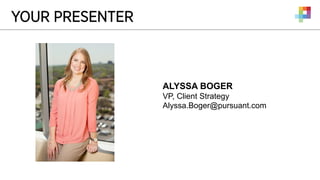
YOUR PRESENTER
ALYSSA BOGER
VP, Client Strategy
Alyssa.Boger@pursuant.com
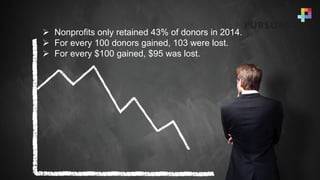
Ø  Nonprofits only retained 43% of donors in 2014.
Ø  For every 100 donors gained, 103 were lost.
Ø  For every $100 gained, $95 was lost.
The Key to Improving Donor Retention
Put Yourself in Your Donor’s Shoes
Questions to ask:
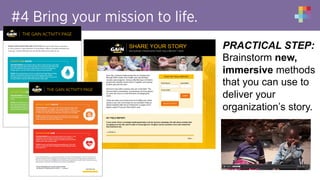
•  What brought them to your organization in the first place?
•  What are their desires and expectations?
•  What inspires them and moves them to action?
•  What do they need to become one of your most loyal
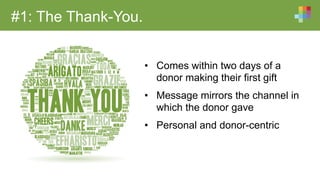
supporters?
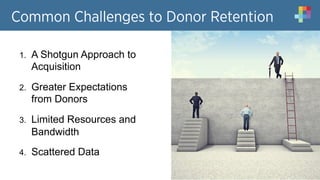
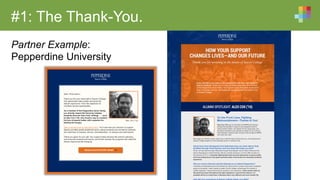
Common Challenges to Donor Retention
1.  A Shotgun Approach to
Acquisition
2.  Greater Expectations
from Donors
3.  Limited Resources and
Bandwidth
4.  Scattered Data
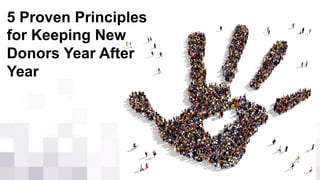
5 Proven Principles
for Keeping New
Donors Year After
Year
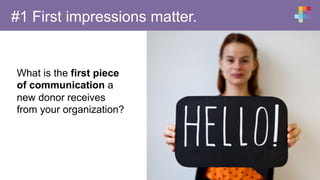
#1 First impressions matter.
What is the first piece
of communication a
new donor receives
from your organization?
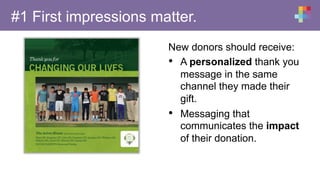
#1 First impressions matter.
New donors should receive:
•  A personalized thank you
message in the same
channel they made their
gift.
•  Messaging that
communicates the impact
of their donation.
#1 First impressions matter.
PRACTICAL STEP: Make small donations
to peer organizations to see what type of
new donor engagement process you
experience.
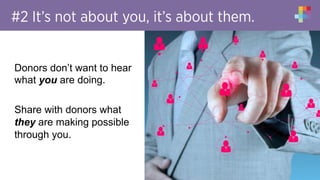
#2 It’s not about you, it’s about them.
Donors don’t want to hear
what you are doing.
Share with donors what
they are making possible
through you.
#2 It’s not about you, it’s about them.
7
Proven Principles for
New Donor Retention
What are their desires and expectations? What inspires them and moves them to action? What
every now and again?
1. First impressions matter.
ideally in the channel they made their gift, with messaging that communicates the impact of
Z Put it into practice:
2. It’s not about you, it’s about them.
Z Put it into practice:
7
Proven Principles for
New Donor Retention
What are their desires and expectations? What inspires them and moves them to action? What
every now and again?
1. First impressions matter.
ideally in the channel they made their gift, with messaging that communicates the impact of
Z Put it into practice:
2. It’s not about you, it’s about them.
Z Put it into practice:
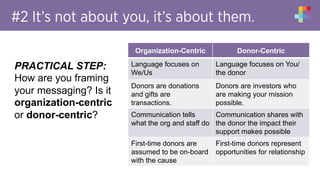
#2 It’s not about you, it’s about them.
PRACTICAL STEP:
How are you framing
your messaging? Is it
organization-centric
or donor-centric?
Organization-Centric Donor-Centric
Language focuses on
We/Us
Language focuses on You/
the donor
Donors are donations
and gifts are
transactions.
Donors are investors who
are making your mission
possible.
Communication tells
what the org and staff do
Communication shares with
the donor the impact their
support makes possible
First-time donors are
assumed to be on-board
with the cause
First-time donors represent
opportunities for relationship
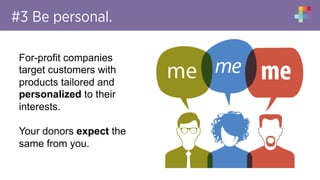
#3 Be personal.
For-profit companies
target customers with
products tailored and
personalized to their
interests.
Your donors expect the
same from you.
#3 Be personal.
PRACTICAL STEP:
List the different ways your
organization acquires new
donors and all of the areas
to which new donors can
give.
How can you communicate
to these various audiences
in a personal way?
#4 Bring your mission to life.
Donors want
information that will
inspire them,
encourage them, help
them, and engage
them . . . and they
don’t always want to
receive it through a
direct mail letter.
#4 Bring your mission to life.
PRACTICAL STEP:
Brainstorm new,
immersive methods
that you can use to
deliver your
organization’s story.
#5 Don’t be shy. Ask for that second gift!
Everything you do in the first
30 days following a new
donor’s gift should lead to a
second ask.
#5 Don’t be shy. Ask for that second gift!
PRACTICAL STEP: Use a
calendar to plot out the days
between a new donor’s
first gift and when they
receive a second ask from
your organization.
If it’s more than 30 days,
think about ways to shorten
the gap.
4 Elements of a
New Donor Engagement Series
#1: The Thank-You.
•  Comes within two days of a
donor making their first gift
•  Message mirrors the channel in
which the donor gave
•  Personal and donor-centric
#1: The Thank-You.
Partner Example:
Pepperdine University
#2: Communicate the Gift’s Impact.
•  Explain your case for support
•  Send the week following a donor’s first gift
•  Use video when possible
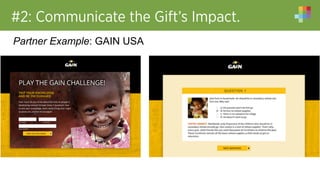
#2: Communicate the Gift’s Impact.
Partner Example: GAIN USA
#3: Help the Donor Get Involved.
•  Ask donors for feedback in a
short online survey
•  Invite them to become social
ambassadors
•  Share upcoming events and
volunteer opportunities
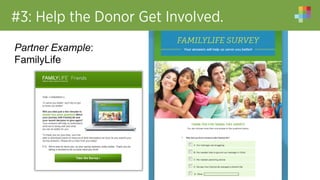
#3: Help the Donor Get Involved.
Partner Example:
FamilyLife
#4: Invite donors to continue their impact.
•  Make second ask within 21-30
days of your new donor’s first
gift
•  Share tangible outcomes of the
donor’s first gift
#4: Invite donors to continue their impact.
Partner Example:
Community Health Network Foundation
I’m writing to express my deepest gratitude. Because you were there…standing
with Community Health Network Foundation…a woman fighting cancer has
hope… an injured child received the exceptional care he needed to recover…and a
family is able to celebrate another birthday with their loved one.
Yet, every day more people turn to Community for the best possible patient care.
They need you to be there for them, too.
That’s why I’m asking you to become a monthly donor to Community Health
Network Foundation. Your steadfast, ongoing support will ensure that Community
can provide patients exceptional care and support for as long as they need it.
Please use the enclosed response form to indicate the amount you would like to
give monthly as a Community Partner member.Thank you for caring about your
neighbors and your Community.
Sincerely,
Joyce Irwin
President and CEO, Community Health Network Foundation
Joyce Irwin
Dear Mr. and Mrs. Koepfer,
Your first monthly gift of
$15 would make such a
difference.
How to Build Your
Own New Donor
Engagement Series
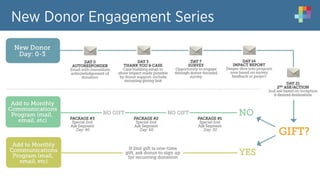
New Donor Engagement Series
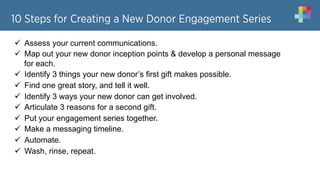
10 Steps for Creating a New Donor Engagement Series
ü  Assess your current communications.
ü  Map out your new donor inception points & develop a personal message
for each.
ü  Identify 3 things your new donor’s first gift makes possible.
ü  Find one great story, and tell it well.
ü  Identify 3 ways your new donor can get involved.
ü  Articulate 3 reasons for a second gift.
ü  Put your engagement series together.
ü  Make a messaging timeline.
ü  Automate.
ü  Wash, rinse, repeat.
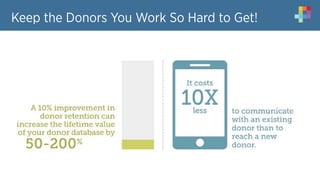
Keep the Donors You Work So Hard to Get!
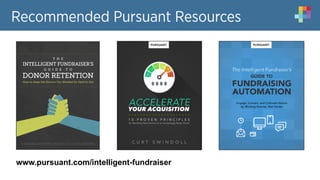
Recommended Pursuant Resources
www.pursuant.com/intelligent-fundraiser
How We Can Help
•  Strategic planning
•  Goal setting
•  Building consensus
•  Case and story development
•  Online / offline communications
•  Social media strategy and execution
•  Landing pages
•  Technology infrastructure
•  Video production
•  Follow up stewardship communications
•  And much more
QUESTIONS?
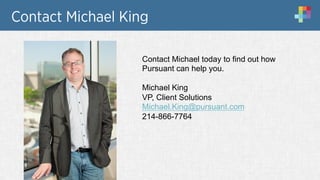
Contact Michael King
Contact Michael today to find out how
Pursuant can help you.
Michael King
VP, Client Solutions
Michael.King@pursuant.com
214-866-7764
Intelligent fundraising.

Keep the Donors Your Work So Hard to Get

  • 1.
    KEEP THE DONORSYOU WORK SO HARD TO GET: Proven Tips & Tricks for Improving Donor Retention with Alyssa Boger
  • 2.
    INTERACT WITH USTODAY! @pursuant #pursuantwebinar GoToMeeting® Chat
  • 3.
    YOUR PRESENTER ALYSSA BOGER VP,Client Strategy Alyssa.Boger@pursuant.com
  • 5.
    Ø  Nonprofits onlyretained 43% of donors in 2014. Ø  For every 100 donors gained, 103 were lost. Ø  For every $100 gained, $95 was lost.
  • 6.
    The Key toImproving Donor Retention
  • 7.
    Put Yourself inYour Donor’s Shoes Questions to ask: •  What brought them to your organization in the first place? •  What are their desires and expectations? •  What inspires them and moves them to action? •  What do they need to become one of your most loyal supporters?
  • 8.
    Common Challenges toDonor Retention 1.  A Shotgun Approach to Acquisition 2.  Greater Expectations from Donors 3.  Limited Resources and Bandwidth 4.  Scattered Data
  • 9.
    5 Proven Principles forKeeping New Donors Year After Year
  • 10.
    #1 First impressionsmatter. What is the first piece of communication a new donor receives from your organization?
  • 11.
    #1 First impressionsmatter. New donors should receive: •  A personalized thank you message in the same channel they made their gift. •  Messaging that communicates the impact of their donation.
  • 12.
    #1 First impressionsmatter. PRACTICAL STEP: Make small donations to peer organizations to see what type of new donor engagement process you experience.
  • 13.
    #2 It’s notabout you, it’s about them. Donors don’t want to hear what you are doing. Share with donors what they are making possible through you.
  • 14.
    #2 It’s notabout you, it’s about them. 7 Proven Principles for New Donor Retention What are their desires and expectations? What inspires them and moves them to action? What every now and again? 1. First impressions matter. ideally in the channel they made their gift, with messaging that communicates the impact of Z Put it into practice: 2. It’s not about you, it’s about them. Z Put it into practice: 7 Proven Principles for New Donor Retention What are their desires and expectations? What inspires them and moves them to action? What every now and again? 1. First impressions matter. ideally in the channel they made their gift, with messaging that communicates the impact of Z Put it into practice: 2. It’s not about you, it’s about them. Z Put it into practice:
  • 15.
    #2 It’s notabout you, it’s about them. PRACTICAL STEP: How are you framing your messaging? Is it organization-centric or donor-centric? Organization-Centric Donor-Centric Language focuses on We/Us Language focuses on You/ the donor Donors are donations and gifts are transactions. Donors are investors who are making your mission possible. Communication tells what the org and staff do Communication shares with the donor the impact their support makes possible First-time donors are assumed to be on-board with the cause First-time donors represent opportunities for relationship
  • 16.
    #3 Be personal. For-profitcompanies target customers with products tailored and personalized to their interests. Your donors expect the same from you.
  • 17.
    #3 Be personal. PRACTICALSTEP: List the different ways your organization acquires new donors and all of the areas to which new donors can give. How can you communicate to these various audiences in a personal way?
  • 18.
    #4 Bring yourmission to life. Donors want information that will inspire them, encourage them, help them, and engage them . . . and they don’t always want to receive it through a direct mail letter.
  • 19.
    #4 Bring yourmission to life. PRACTICAL STEP: Brainstorm new, immersive methods that you can use to deliver your organization’s story.
  • 20.
    #5 Don’t beshy. Ask for that second gift! Everything you do in the first 30 days following a new donor’s gift should lead to a second ask.
  • 21.
    #5 Don’t beshy. Ask for that second gift! PRACTICAL STEP: Use a calendar to plot out the days between a new donor’s first gift and when they receive a second ask from your organization. If it’s more than 30 days, think about ways to shorten the gap.
  • 22.
    4 Elements ofa New Donor Engagement Series
  • 23.
    #1: The Thank-You. • Comes within two days of a donor making their first gift •  Message mirrors the channel in which the donor gave •  Personal and donor-centric
  • 24.
    #1: The Thank-You. PartnerExample: Pepperdine University
  • 25.
    #2: Communicate theGift’s Impact. •  Explain your case for support •  Send the week following a donor’s first gift •  Use video when possible
  • 26.
    #2: Communicate theGift’s Impact. Partner Example: GAIN USA
  • 27.
    #3: Help theDonor Get Involved. •  Ask donors for feedback in a short online survey •  Invite them to become social ambassadors •  Share upcoming events and volunteer opportunities
  • 28.
    #3: Help theDonor Get Involved. Partner Example: FamilyLife
  • 29.
    #4: Invite donorsto continue their impact. •  Make second ask within 21-30 days of your new donor’s first gift •  Share tangible outcomes of the donor’s first gift
  • 30.
    #4: Invite donorsto continue their impact. Partner Example: Community Health Network Foundation I’m writing to express my deepest gratitude. Because you were there…standing with Community Health Network Foundation…a woman fighting cancer has hope… an injured child received the exceptional care he needed to recover…and a family is able to celebrate another birthday with their loved one. Yet, every day more people turn to Community for the best possible patient care. They need you to be there for them, too. That’s why I’m asking you to become a monthly donor to Community Health Network Foundation. Your steadfast, ongoing support will ensure that Community can provide patients exceptional care and support for as long as they need it. Please use the enclosed response form to indicate the amount you would like to give monthly as a Community Partner member.Thank you for caring about your neighbors and your Community. Sincerely, Joyce Irwin President and CEO, Community Health Network Foundation Joyce Irwin Dear Mr. and Mrs. Koepfer, Your first monthly gift of $15 would make such a difference.
  • 31.
    How to BuildYour Own New Donor Engagement Series
  • 32.
  • 33.
    10 Steps forCreating a New Donor Engagement Series ü  Assess your current communications. ü  Map out your new donor inception points & develop a personal message for each. ü  Identify 3 things your new donor’s first gift makes possible. ü  Find one great story, and tell it well. ü  Identify 3 ways your new donor can get involved. ü  Articulate 3 reasons for a second gift. ü  Put your engagement series together. ü  Make a messaging timeline. ü  Automate. ü  Wash, rinse, repeat.
  • 34.
    Keep the DonorsYou Work So Hard to Get!
  • 35.
  • 36.
    How We CanHelp •  Strategic planning •  Goal setting •  Building consensus •  Case and story development •  Online / offline communications •  Social media strategy and execution •  Landing pages •  Technology infrastructure •  Video production •  Follow up stewardship communications •  And much more
  • 37.
  • 38.
    Contact Michael King ContactMichael today to find out how Pursuant can help you. Michael King VP, Client Solutions Michael.King@pursuant.com 214-866-7764
  • 39.