Knowledge Centric Systems Engineering 
Dr. Juan Llorens 
Technical Director - Asociación Española de Ingeniería de Sistemas (AEIS) – INCOSE 
Professor at Informatics Department - Universidad Carlos III de Madrid – Spain 
CTO – The Reuse Company (TRC) 
Juan.Llorens@uc3m.es 
http://www.linkedin.com/pub/juan-llorens/b/857/632 
https://www.researchgate.net/profile/Juan_Llorens/ 
South European Systems Engineering Tour (SESE 2014) 
Zurich 1st September - Paris 23rd September - Madrid 24th September 2014
Knowledge Centric System Engineering 
Systems Engineering in a Nutshell 
2 © AEIS INCOSE – http://sese.aeis-incose.org/ September 24, 2014
Knowledge Centric System Engineering 
What is Systems Engineering 
Systems engineering is an interdisciplinary approach and means to enable the 
realization of successful systems. 
It focuses on defining customer needs and required functionality early in 
the development cycle, documenting requirements, and then proceeding 
with design synthesis and system validation while considering the 
complete problem: operations, cost and schedule, performance, training 
and support, test,manufacturing, and disposal. 
SE considers both the business and the technical needs of all customers 
with the goal of providing a quality product that meets the user needs. 
Source INCOSE 
Applied to: 
- Complex Systems 
- Systems developed by collaboration of multiple engineering disciplines 
3 © AEIS INCOSE – http://sese.aeis-incose.org/ September 24, 2014
Knowledge Centric System Engineering 
Why Systems Engineering 
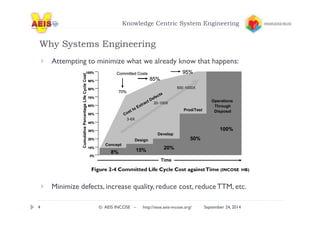
Attempting to minimize what we already know that happens: 
100% 
90% 
80% 
70% 
60% 
50% 
40% 
30% 
20% 
10% 
0% 
Committed Costs 
70% 
Concept 
Cost to Extract Defects 
3-6X 
Design 
85% 
20-100X 
Develop 
95% 
500-1000X 
Prod/Test 
Operations 
Through 
Disposal 
8% 15% 20% 
100% 
Time 
50% 
Cumulative Percentage Life Cycle Cost 
Figure 2-4 Committed Life Cycle Cost against Time (INCOSE HB) 
Minimize defects, increase quality, reduce cost, reduce TTM, etc. 
4 © AEIS INCOSE – http://sese.aeis-incose.org/ September 24, 2014
Knowledge Centric System Engineering 
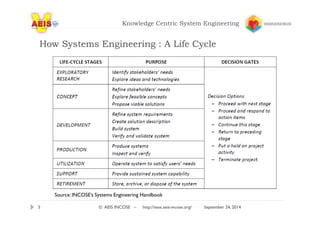
How Systems Engineering : A Life Cycle 
Source: INCOSE’s Systems Engineering Handbook 
5 © AEIS INCOSE – http://sese.aeis-incose.org/ September 24, 2014
Knowledge Centric System Engineering 
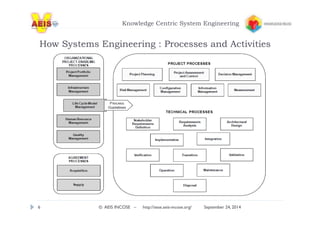
How Systems Engineering : Processes and Activities 
6 © AEIS INCOSE – http://sese.aeis-incose.org/ September 24, 2014
Knowledge Centric System Engineering 
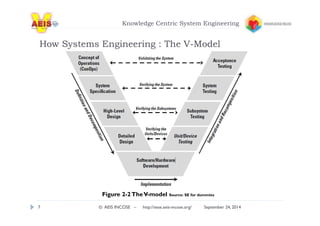
How Systems Engineering : The V-Model 
Figure 2-2 The V-model Source: SE for dummies 
7 © AEIS INCOSE – http://sese.aeis-incose.org/ September 24, 2014
Knowledge Centric System Engineering 
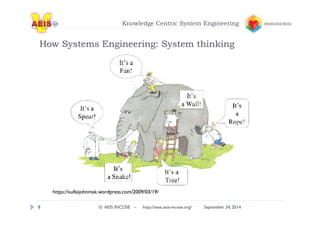
How Systems Engineering: System thinking 
https://suifaijohnmak.wordpress.com/2009/03/19/ 
8 © AEIS INCOSE – http://sese.aeis-incose.org/ September 24, 2014
Knowledge Centric System Engineering 
How Systems Engineering: STANDARDS 
ISO- IEC 15288 
9 © AEIS INCOSE – http://sese.aeis-incose.org/ September 24, 2014
Knowledge Centric System Engineering 
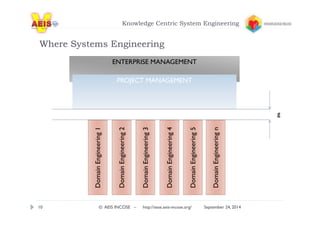
Where Systems Engineering 
EENNTTEERRPPRRIISSEE MMAANNAAGEEMMEENNTT 
PROJECT MANAGEMENT 
Domain Engineering 1 
Domain Engineering 2 
Domain Engineering 3 
Domain Engineering 4 
Domain Engineering 5 
Domain Engineering n 
10 © AEIS INCOSE – http://sese.aeis-incose.org/ September 24, 2014 
g
Knowledge Centric System Engineering 
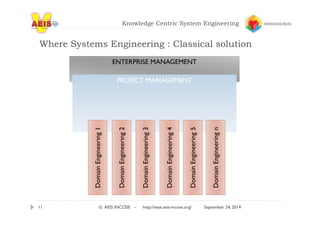
Where Systems Engineering : Classical solution 
EENNTTEERRPPRRIISSEE MMAANNAAGEEMMEENNTT 
PROJECT MANAGEMENT 
Domain Engineering 1 
Domain Engineering 2 
Domain Engineering 3 
Domain Engineering 4 
Domain Engineering 5 
Domain Engineering n 
11 © AEIS INCOSE – http://sese.aeis-incose.org/ September 24, 2014
Knowledge Centric System Engineering 
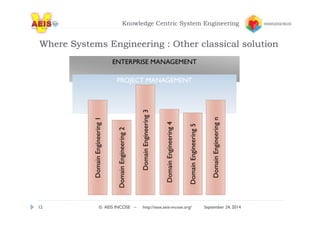
Where Systems Engineering : Other classical solution 
EENNTTEERRPPRRIISSEE MMAANNAAGEEMMEENNTT 
PROJECT MANAGEMENT 
Domain Engineering 1 
Domain Engineering 2 
Domain Engineering 3 
Domain Engineering 4 
Domain Engineering 5 
Domain Engineering n 
12 © AEIS INCOSE – http://sese.aeis-incose.org/ September 24, 2014
Knowledge Centric System Engineering 
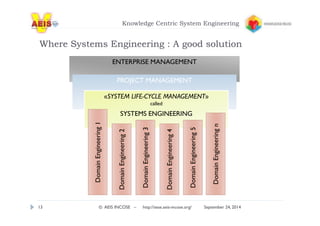
Where Systems Engineering : A good solution 
EENNTTEERRPPRRIISSEE MMAANNAAGEEMMEENNTT 
PROJECT MANAGEMENT 
«SYSTEM LIFE-CYCLE MANAGEMENT» 
called 
SYSTEMS ENGINEERING 
Domain Engineering 1 
Domain Engineering 2 
Domain Engineering 3 
Domain Engineering 4 
Domain Engineering 5 
Domain Engineering n 
13 © AEIS INCOSE – http://sese.aeis-incose.org/ September 24, 2014
Knowledge Centric System Engineering 
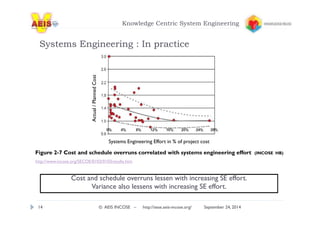
Systems Engineering : In practice 
Actual / Planned Cost 
Systems Engineering Effort in % of project cost 
Figure 2-7 Cost and schedule overruns correlated with systems engineering effort (INCOSE HB) 
http://www.incose.org/SECOE/0103/0103results.htm 
Cost and schedule overruns lessen with increasing SE effort. 
Variance also lessens with increasing SE effort. 
14 © AEIS INCOSE – http://sese.aeis-incose.org/ September 24, 2014
Knowledge Centric System Engineering 
Fundamentals of 
Knowledge Centric Systems Engineering (KCSE) 
15 © AEIS INCOSE – http://sese.aeis-incose.org/ September 24, 2014
Knowledge Centric System Engineering 
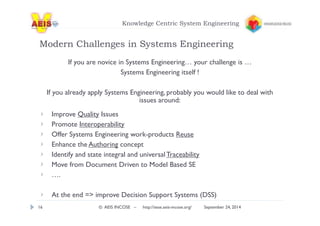
Modern Challenges in Systems Engineering 
If you are novice in Systems Engineering… your challenge is … 
Systems Engineering itself ! 
If you already apply Systems Engineering, probably you would like to deal with 
issues around: 
Improve Quality Issues 
Promote Interoperability 
Offer Systems Engineering work-products Reuse 
Enhance the Authoring concept 
Identify and state integral and universal Traceability 
Move from Document Driven to Model Based SE 
…. 
At the end => improve Decision Support Systems (DSS) 
16 © AEIS INCOSE – http://sese.aeis-incose.org/ September 24, 2014
Knowledge Centric System Engineering 
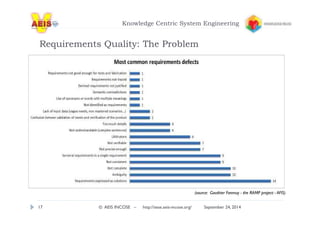
Requirements Quality: The Problem 
(source: Gauthier Fanmuy - the RAMP project: - AFIS) 
17 © AEIS INCOSE – http://sese.aeis-incose.org/ September 24, 2014
Knowledge Centric System Engineering 
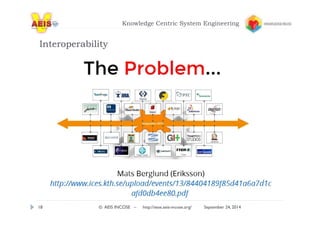
Interoperability 
18 © AEIS INCOSE – http://sese.aeis-incose.org/ September 24, 2014
Knowledge Centric System Engineering 
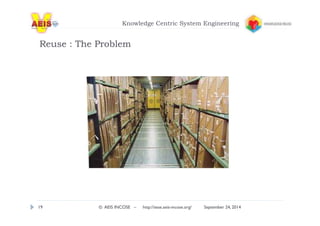
Reuse : The Problem 
19 © AEIS INCOSE – http://sese.aeis-incose.org/ September 24, 2014
Knowledge Centric System Engineering 
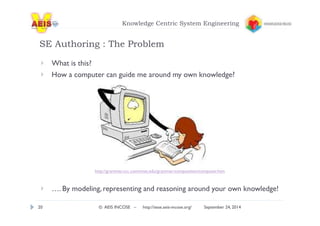
SE Authoring : The Problem 
What is this? 
How a computer can guide me around my own knowledge? 
http://grammar.ccc.commnet.edu/grammar/composition/computer.htm 
…. By modeling, representing and reasoning around your own knowledge! 
20 © AEIS INCOSE – http://sese.aeis-incose.org/ September 24, 2014
Knowledge Centric System Engineering 
Knowledge Needs : Practical examples 
How should I write proper performance requirements? 
It could be possible if .... My organization stores specific requirements patterns 
How can my models be aware of the existing requirements? 
It could be possible if .... System architects can get access to requirements 
terminology when they are modeling 
Can an authoring technology advice of inconsistency problems in my 
model? 
It could be possible if .... The complete requirements specification is formalized 
inside a repository 
Can I look for similar physical models when defining a simulation case? 
It could be possible if .... All the physical models are stored inside a repository 
21 © AEIS INCOSE – http://sese.aeis-incose.org/ September 24, 2014
Knowledge Centric System Engineering 
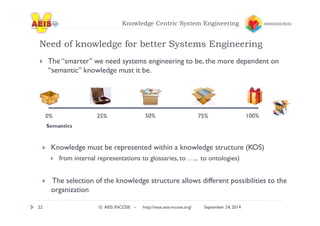
Need of knowledge for better Systems Engineering 
 The “smarter” we need systems engineering to be, the more dependent on 
“semantic” knowledge must it be. 
0% 25% 50% 75% 100% 
Semantics 
 Knowledge must be represented within a knowledge structure (KOS) 
 from internal representations to glossaries, to …., to ontologies) 
 The selection of the knowledge structure allows different possibilities to the 
organization 
22 © AEIS INCOSE – http://sese.aeis-incose.org/ September 24, 2014
Knowledge Centric System Engineering 
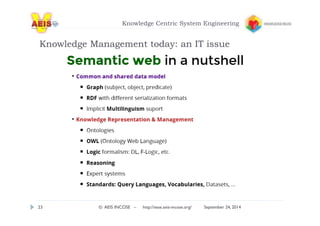
Knowledge Management today: an IT issue 
23 © AEIS INCOSE – http://sese.aeis-incose.org/ September 24, 2014
Knowledge Centric System Engineering 
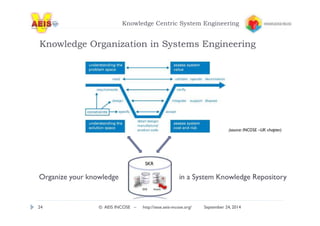
Knowledge Organization in Systems Engineering 
(source: INCOSE –UK chapter) 
Organize your knowledge in a System Knowledge Repository 
24 © AEIS INCOSE – http://sese.aeis-incose.org/ September 24, 2014
Knowledge Centric System Engineering 
Knowledge Organization in Systems Engineering 
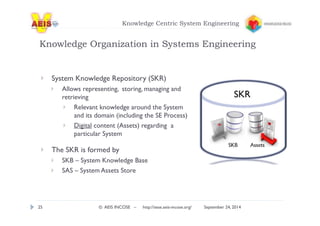
System Knowledge Repository (SKR) 
Allows representing, storing, managing and 
retrieving 
Relevant knowledge around the System 
and its domain (including the SE Process) 
Digital content (Assets) regarding a 
particular System 
The SKR is formed by 
SKB – System Knowledge Base 
SAS – System Assets Store 
25 © AEIS INCOSE – http://sese.aeis-incose.org/ September 24, 2014
Knowledge Centric System Engineering 
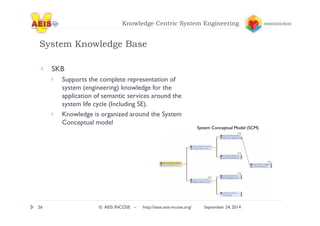
System Knowledge Base 
SKB 
Supports the complete representation of 
system (engineering) knowledge for the 
application of semantic services around the 
system life cycle (Including SE). 
Knowledge is organized around the System 
Conceptual model 
System Conceptual Model (SCM) 
26 © AEIS INCOSE – http://sese.aeis-incose.org/ September 24, 2014
Knowledge Centric System Engineering 
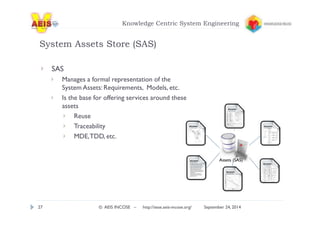
System Assets Store (SAS) 
SAS 
Manages a formal representation of the 
System Assets: Requirements, Models, etc. 
Is the base for offering services around these 
assets 
Reuse 
Traceability 
MDE, TDD, etc. 
Assets (SAS) 
27 © AEIS INCOSE – http://sese.aeis-incose.org/ September 24, 2014
Knowledge Centric System Engineering 
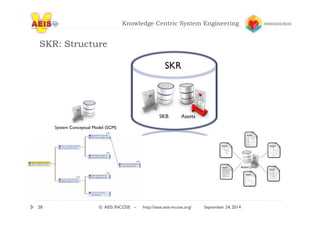
SKR: Structure 
System Conceptual Model (SCM) 
28 © AEIS INCOSE – http://sese.aeis-incose.org/ September 24, 2014
Knowledge Centric System Engineering 
System Knowledge Base: 
What is a system 
Interacting objects organized to achieve one or more stated 
purposes [INCOSE  ISO 15288] 
A System is never alone. It is affected by its surroundings, and interacts with them 
through an interface (boundary). 
System universe 
this “ecosystem” can be called System universe 
29 © AEIS INCOSE – http://sese.aeis-incose.org/ September 24, 2014
Knowledge Centric System Engineering 
System Knowledge Base: 
What is a System knowledge Base 
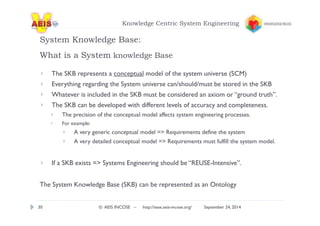
The SKB represents a conceptual model of the system universe (SCM) 
Everything regarding the System universe can/should/must be stored in the SKB 
Whatever is included in the SKB must be considered an axiom or “ground truth”. 
The SKB can be developed with different levels of accuracy and completeness. 
The precision of the conceptual model affects system engineering processes. 
For example: 
A very generic conceptual model = Requirements define the system 
A very detailed conceptual model = Requirements must fulfill the system model. 
If a SKB exists = Systems Engineering should be “REUSE-Intensive”. 
The System Knowledge Base (SKB) can be represented as an Ontology 
30 © AEIS INCOSE – http://sese.aeis-incose.org/ September 24, 2014
Knowledge Centric System Engineering 
System Knowledge Base: 
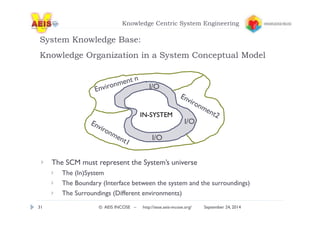
Knowledge Organization in a System Conceptual Model 
I/O 
IN-SYSTEM 
I/O 
I/O 
The SCM must represent the System’s universe 
The (In)System 
The Boundary (Interface between the system and the surroundings) 
The Surroundings (Different environments) 
31 © AEIS INCOSE – http://sese.aeis-incose.org/ September 24, 2014
Knowledge Centric System Engineering 
System Knowledge Base: 
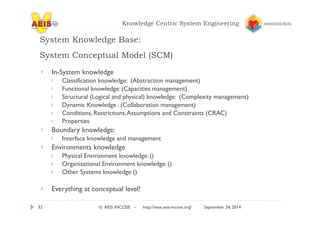
System Conceptual Model (SCM) 
In-System knowledge 
Classification knowledge: (Abstraction management) 
Functional knowledge: (Capacities management) 
Structural (Logical and physical) knowledge: (Complexity management) 
Dynamic Knowledge : (Collaboration management) 
Conditions, Restrictions, Assumptions and Constraints (CRAC) 
Properties 
Boundary knowledge: 
Interface knowledge and management 
Environments knowledge 
Physical Environment knowledge: () 
Organizational Environment knowledge: () 
Other Systems knowledge () 
Everything at conceptual level! 
32 © AEIS INCOSE – http://sese.aeis-incose.org/ September 24, 2014
Knowledge Centric System Engineering 
System Knowledge Base (SKB) 
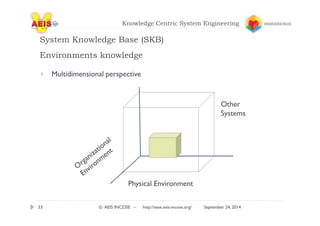
Environments knowledge 
Multidimensional perspective 
Physical Environment 
Other 
Systems 
33 © AEIS INCOSE – http://sese.aeis-incose.org/ September 24, 2014
Knowledge Centric System Engineering 
System Knowledge Base: Ontology 
What is an ontology 
An ontology is a “specification of a conceptualization” [Gruber 1995]. 
Specification: formal and declarative representation 
Conceptualization: abstract, simplified view of the world 
An ontology contains facts of the domain: 
Concept: represents an entity in the domain with name and textual definition 
Relation: labeled directed connection between concepts 
Axiom: formal relationship between two concepts, e.g. subclass or equivalence 
relation 
B A 
subclass-of subclass-of equivalence 
B1 B2 AA 
34 © AEIS INCOSE – http://sese.aeis-incose.org/ September 24, 2014
Knowledge Centric System Engineering 
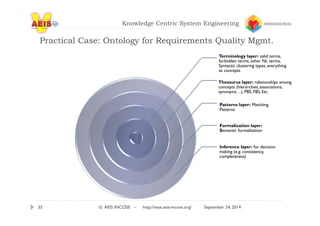
Practical Case: Ontology for Requirements Quality Mgmt. 
Terminology layer: valid terms, 
forbidden terms, other NL terms, 
Syntactic clustering types, everything 
as concepts 
Thesaurus layer: relationships among 
concepts (hierarchies, associations, 
synonyms…), PBS, FBS, Etc. 
Patterns layer: Matching 
Patterns 
Formalization layer: 
Semantic formalization 
Inference layer: for decision 
making (e.g. consistency, 
completeness) 
35 © AEIS INCOSE – http://sese.aeis-incose.org/ September 24, 2014
Knowledge Centric System Engineering 
Ontology : Example 
A380 A350 System Operate Temperature Environment Pressure Controlled 
Vocabulary 
Aircraft 
A380 A350 
Environment 
“ Greater than () “ 
“ Operation Range “ 
Operation 
Operate Work 
Aircraft Shall Operation At Minimum Environment Of 
36 © AEIS INCOSE – http://sese.aeis-incose.org/ September 24, 2014 
[MEASUREMENT 
UNIT] 
NUMBER 
temperature 
“ Greater than () “ 
-70 ºC 
Patterns 
Temperature Pressure 
Temperature [-60ºC , +60ºC] 
Inference 
Rules 
NUMBER “ Lower than () “ -70º  NUMBER “ Greater than () “ +65º 
Thesaurus 
Formalizations The aircraft shall be able to operate at a 
minimum temperature of -70º C 
If ºC ºC
Knowledge Centric System Engineering 
Conclusions 
Knowledge is necessary when trying to solve complex problems in SE 
This knowledge can/must be stored and represented inside an ontology 
and used for improving Systems Engineering practices 
If knowledge is good enough = it should be reusable 
37 © AEIS INCOSE – http://sese.aeis-incose.org/ September 24, 2014
Knowledge Centric Systems Engineering 
Dr. Juan Llorens 
Technical Director - Asociación Española de Ingeniería de Sistemas (AEIS) – INCOSE 
Professor at Informatics Department - Universidad Carlos III de Madrid – Spain 
CTO – The Reuse Company (TRC) 
Juan.Llorens@uc3m.es 
http://www.linkedin.com/pub/juan-llorens/b/857/632 
https://www.researchgate.net/profile/Juan_Llorens/ 
South European Systems Engineering Tour (SESE 2014) 
Zurich 1st September - Paris 23rd September - Madrid 24th September 2014

Knowledge Centric Systems Engineering

  • 1.
    Knowledge Centric SystemsEngineering Dr. Juan Llorens Technical Director - Asociación Española de Ingeniería de Sistemas (AEIS) – INCOSE Professor at Informatics Department - Universidad Carlos III de Madrid – Spain CTO – The Reuse Company (TRC) Juan.Llorens@uc3m.es http://www.linkedin.com/pub/juan-llorens/b/857/632 https://www.researchgate.net/profile/Juan_Llorens/ South European Systems Engineering Tour (SESE 2014) Zurich 1st September - Paris 23rd September - Madrid 24th September 2014
  • 2.
    Knowledge Centric SystemEngineering Systems Engineering in a Nutshell 2 © AEIS INCOSE – http://sese.aeis-incose.org/ September 24, 2014
  • 3.
    Knowledge Centric SystemEngineering What is Systems Engineering Systems engineering is an interdisciplinary approach and means to enable the realization of successful systems. It focuses on defining customer needs and required functionality early in the development cycle, documenting requirements, and then proceeding with design synthesis and system validation while considering the complete problem: operations, cost and schedule, performance, training and support, test,manufacturing, and disposal. SE considers both the business and the technical needs of all customers with the goal of providing a quality product that meets the user needs. Source INCOSE Applied to: - Complex Systems - Systems developed by collaboration of multiple engineering disciplines 3 © AEIS INCOSE – http://sese.aeis-incose.org/ September 24, 2014
  • 4.
    Knowledge Centric SystemEngineering Why Systems Engineering Attempting to minimize what we already know that happens: 100% 90% 80% 70% 60% 50% 40% 30% 20% 10% 0% Committed Costs 70% Concept Cost to Extract Defects 3-6X Design 85% 20-100X Develop 95% 500-1000X Prod/Test Operations Through Disposal 8% 15% 20% 100% Time 50% Cumulative Percentage Life Cycle Cost Figure 2-4 Committed Life Cycle Cost against Time (INCOSE HB) Minimize defects, increase quality, reduce cost, reduce TTM, etc. 4 © AEIS INCOSE – http://sese.aeis-incose.org/ September 24, 2014
  • 5.
    Knowledge Centric SystemEngineering How Systems Engineering : A Life Cycle Source: INCOSE’s Systems Engineering Handbook 5 © AEIS INCOSE – http://sese.aeis-incose.org/ September 24, 2014
  • 6.
    Knowledge Centric SystemEngineering How Systems Engineering : Processes and Activities 6 © AEIS INCOSE – http://sese.aeis-incose.org/ September 24, 2014
  • 7.
    Knowledge Centric SystemEngineering How Systems Engineering : The V-Model Figure 2-2 The V-model Source: SE for dummies 7 © AEIS INCOSE – http://sese.aeis-incose.org/ September 24, 2014
  • 8.
    Knowledge Centric SystemEngineering How Systems Engineering: System thinking https://suifaijohnmak.wordpress.com/2009/03/19/ 8 © AEIS INCOSE – http://sese.aeis-incose.org/ September 24, 2014
  • 9.
    Knowledge Centric SystemEngineering How Systems Engineering: STANDARDS ISO- IEC 15288 9 © AEIS INCOSE – http://sese.aeis-incose.org/ September 24, 2014
  • 10.
    Knowledge Centric SystemEngineering Where Systems Engineering EENNTTEERRPPRRIISSEE MMAANNAAGEEMMEENNTT PROJECT MANAGEMENT Domain Engineering 1 Domain Engineering 2 Domain Engineering 3 Domain Engineering 4 Domain Engineering 5 Domain Engineering n 10 © AEIS INCOSE – http://sese.aeis-incose.org/ September 24, 2014 g
  • 11.
    Knowledge Centric SystemEngineering Where Systems Engineering : Classical solution EENNTTEERRPPRRIISSEE MMAANNAAGEEMMEENNTT PROJECT MANAGEMENT Domain Engineering 1 Domain Engineering 2 Domain Engineering 3 Domain Engineering 4 Domain Engineering 5 Domain Engineering n 11 © AEIS INCOSE – http://sese.aeis-incose.org/ September 24, 2014
  • 12.
    Knowledge Centric SystemEngineering Where Systems Engineering : Other classical solution EENNTTEERRPPRRIISSEE MMAANNAAGEEMMEENNTT PROJECT MANAGEMENT Domain Engineering 1 Domain Engineering 2 Domain Engineering 3 Domain Engineering 4 Domain Engineering 5 Domain Engineering n 12 © AEIS INCOSE – http://sese.aeis-incose.org/ September 24, 2014
  • 13.
    Knowledge Centric SystemEngineering Where Systems Engineering : A good solution EENNTTEERRPPRRIISSEE MMAANNAAGEEMMEENNTT PROJECT MANAGEMENT «SYSTEM LIFE-CYCLE MANAGEMENT» called SYSTEMS ENGINEERING Domain Engineering 1 Domain Engineering 2 Domain Engineering 3 Domain Engineering 4 Domain Engineering 5 Domain Engineering n 13 © AEIS INCOSE – http://sese.aeis-incose.org/ September 24, 2014
  • 14.
    Knowledge Centric SystemEngineering Systems Engineering : In practice Actual / Planned Cost Systems Engineering Effort in % of project cost Figure 2-7 Cost and schedule overruns correlated with systems engineering effort (INCOSE HB) http://www.incose.org/SECOE/0103/0103results.htm Cost and schedule overruns lessen with increasing SE effort. Variance also lessens with increasing SE effort. 14 © AEIS INCOSE – http://sese.aeis-incose.org/ September 24, 2014
  • 15.
    Knowledge Centric SystemEngineering Fundamentals of Knowledge Centric Systems Engineering (KCSE) 15 © AEIS INCOSE – http://sese.aeis-incose.org/ September 24, 2014
  • 16.
    Knowledge Centric SystemEngineering Modern Challenges in Systems Engineering If you are novice in Systems Engineering… your challenge is … Systems Engineering itself ! If you already apply Systems Engineering, probably you would like to deal with issues around: Improve Quality Issues Promote Interoperability Offer Systems Engineering work-products Reuse Enhance the Authoring concept Identify and state integral and universal Traceability Move from Document Driven to Model Based SE …. At the end => improve Decision Support Systems (DSS) 16 © AEIS INCOSE – http://sese.aeis-incose.org/ September 24, 2014
  • 17.
    Knowledge Centric SystemEngineering Requirements Quality: The Problem (source: Gauthier Fanmuy - the RAMP project: - AFIS) 17 © AEIS INCOSE – http://sese.aeis-incose.org/ September 24, 2014
  • 18.
    Knowledge Centric SystemEngineering Interoperability 18 © AEIS INCOSE – http://sese.aeis-incose.org/ September 24, 2014
  • 19.
    Knowledge Centric SystemEngineering Reuse : The Problem 19 © AEIS INCOSE – http://sese.aeis-incose.org/ September 24, 2014
  • 20.
    Knowledge Centric SystemEngineering SE Authoring : The Problem What is this? How a computer can guide me around my own knowledge? http://grammar.ccc.commnet.edu/grammar/composition/computer.htm …. By modeling, representing and reasoning around your own knowledge! 20 © AEIS INCOSE – http://sese.aeis-incose.org/ September 24, 2014
  • 21.
    Knowledge Centric SystemEngineering Knowledge Needs : Practical examples How should I write proper performance requirements? It could be possible if .... My organization stores specific requirements patterns How can my models be aware of the existing requirements? It could be possible if .... System architects can get access to requirements terminology when they are modeling Can an authoring technology advice of inconsistency problems in my model? It could be possible if .... The complete requirements specification is formalized inside a repository Can I look for similar physical models when defining a simulation case? It could be possible if .... All the physical models are stored inside a repository 21 © AEIS INCOSE – http://sese.aeis-incose.org/ September 24, 2014
  • 22.
    Knowledge Centric SystemEngineering Need of knowledge for better Systems Engineering The “smarter” we need systems engineering to be, the more dependent on “semantic” knowledge must it be. 0% 25% 50% 75% 100% Semantics Knowledge must be represented within a knowledge structure (KOS) from internal representations to glossaries, to …., to ontologies) The selection of the knowledge structure allows different possibilities to the organization 22 © AEIS INCOSE – http://sese.aeis-incose.org/ September 24, 2014
  • 23.
    Knowledge Centric SystemEngineering Knowledge Management today: an IT issue 23 © AEIS INCOSE – http://sese.aeis-incose.org/ September 24, 2014
  • 24.
    Knowledge Centric SystemEngineering Knowledge Organization in Systems Engineering (source: INCOSE –UK chapter) Organize your knowledge in a System Knowledge Repository 24 © AEIS INCOSE – http://sese.aeis-incose.org/ September 24, 2014
  • 25.
    Knowledge Centric SystemEngineering Knowledge Organization in Systems Engineering System Knowledge Repository (SKR) Allows representing, storing, managing and retrieving Relevant knowledge around the System and its domain (including the SE Process) Digital content (Assets) regarding a particular System The SKR is formed by SKB – System Knowledge Base SAS – System Assets Store 25 © AEIS INCOSE – http://sese.aeis-incose.org/ September 24, 2014
  • 26.
    Knowledge Centric SystemEngineering System Knowledge Base SKB Supports the complete representation of system (engineering) knowledge for the application of semantic services around the system life cycle (Including SE). Knowledge is organized around the System Conceptual model System Conceptual Model (SCM) 26 © AEIS INCOSE – http://sese.aeis-incose.org/ September 24, 2014
  • 27.
    Knowledge Centric SystemEngineering System Assets Store (SAS) SAS Manages a formal representation of the System Assets: Requirements, Models, etc. Is the base for offering services around these assets Reuse Traceability MDE, TDD, etc. Assets (SAS) 27 © AEIS INCOSE – http://sese.aeis-incose.org/ September 24, 2014
  • 28.
    Knowledge Centric SystemEngineering SKR: Structure System Conceptual Model (SCM) 28 © AEIS INCOSE – http://sese.aeis-incose.org/ September 24, 2014
  • 29.
    Knowledge Centric SystemEngineering System Knowledge Base: What is a system Interacting objects organized to achieve one or more stated purposes [INCOSE ISO 15288] A System is never alone. It is affected by its surroundings, and interacts with them through an interface (boundary). System universe this “ecosystem” can be called System universe 29 © AEIS INCOSE – http://sese.aeis-incose.org/ September 24, 2014
  • 30.
    Knowledge Centric SystemEngineering System Knowledge Base: What is a System knowledge Base The SKB represents a conceptual model of the system universe (SCM) Everything regarding the System universe can/should/must be stored in the SKB Whatever is included in the SKB must be considered an axiom or “ground truth”. The SKB can be developed with different levels of accuracy and completeness. The precision of the conceptual model affects system engineering processes. For example: A very generic conceptual model = Requirements define the system A very detailed conceptual model = Requirements must fulfill the system model. If a SKB exists = Systems Engineering should be “REUSE-Intensive”. The System Knowledge Base (SKB) can be represented as an Ontology 30 © AEIS INCOSE – http://sese.aeis-incose.org/ September 24, 2014
  • 31.
    Knowledge Centric SystemEngineering System Knowledge Base: Knowledge Organization in a System Conceptual Model I/O IN-SYSTEM I/O I/O The SCM must represent the System’s universe The (In)System The Boundary (Interface between the system and the surroundings) The Surroundings (Different environments) 31 © AEIS INCOSE – http://sese.aeis-incose.org/ September 24, 2014
  • 32.
    Knowledge Centric SystemEngineering System Knowledge Base: System Conceptual Model (SCM) In-System knowledge Classification knowledge: (Abstraction management) Functional knowledge: (Capacities management) Structural (Logical and physical) knowledge: (Complexity management) Dynamic Knowledge : (Collaboration management) Conditions, Restrictions, Assumptions and Constraints (CRAC) Properties Boundary knowledge: Interface knowledge and management Environments knowledge Physical Environment knowledge: () Organizational Environment knowledge: () Other Systems knowledge () Everything at conceptual level! 32 © AEIS INCOSE – http://sese.aeis-incose.org/ September 24, 2014
  • 33.
    Knowledge Centric SystemEngineering System Knowledge Base (SKB) Environments knowledge Multidimensional perspective Physical Environment Other Systems 33 © AEIS INCOSE – http://sese.aeis-incose.org/ September 24, 2014
  • 34.
    Knowledge Centric SystemEngineering System Knowledge Base: Ontology What is an ontology An ontology is a “specification of a conceptualization” [Gruber 1995]. Specification: formal and declarative representation Conceptualization: abstract, simplified view of the world An ontology contains facts of the domain: Concept: represents an entity in the domain with name and textual definition Relation: labeled directed connection between concepts Axiom: formal relationship between two concepts, e.g. subclass or equivalence relation B A subclass-of subclass-of equivalence B1 B2 AA 34 © AEIS INCOSE – http://sese.aeis-incose.org/ September 24, 2014
  • 35.
    Knowledge Centric SystemEngineering Practical Case: Ontology for Requirements Quality Mgmt. Terminology layer: valid terms, forbidden terms, other NL terms, Syntactic clustering types, everything as concepts Thesaurus layer: relationships among concepts (hierarchies, associations, synonyms…), PBS, FBS, Etc. Patterns layer: Matching Patterns Formalization layer: Semantic formalization Inference layer: for decision making (e.g. consistency, completeness) 35 © AEIS INCOSE – http://sese.aeis-incose.org/ September 24, 2014
  • 36.
    Knowledge Centric SystemEngineering Ontology : Example A380 A350 System Operate Temperature Environment Pressure Controlled Vocabulary Aircraft A380 A350 Environment “ Greater than () “ “ Operation Range “ Operation Operate Work Aircraft Shall Operation At Minimum Environment Of 36 © AEIS INCOSE – http://sese.aeis-incose.org/ September 24, 2014 [MEASUREMENT UNIT] NUMBER temperature “ Greater than () “ -70 ºC Patterns Temperature Pressure Temperature [-60ºC , +60ºC] Inference Rules NUMBER “ Lower than () “ -70º NUMBER “ Greater than () “ +65º Thesaurus Formalizations The aircraft shall be able to operate at a minimum temperature of -70º C If ºC ºC
  • 37.
    Knowledge Centric SystemEngineering Conclusions Knowledge is necessary when trying to solve complex problems in SE This knowledge can/must be stored and represented inside an ontology and used for improving Systems Engineering practices If knowledge is good enough = it should be reusable 37 © AEIS INCOSE – http://sese.aeis-incose.org/ September 24, 2014
  • 38.
    Knowledge Centric SystemsEngineering Dr. Juan Llorens Technical Director - Asociación Española de Ingeniería de Sistemas (AEIS) – INCOSE Professor at Informatics Department - Universidad Carlos III de Madrid – Spain CTO – The Reuse Company (TRC) Juan.Llorens@uc3m.es http://www.linkedin.com/pub/juan-llorens/b/857/632 https://www.researchgate.net/profile/Juan_Llorens/ South European Systems Engineering Tour (SESE 2014) Zurich 1st September - Paris 23rd September - Madrid 24th September 2014