By:-
Pratiksha
Aniket
Monalika
Gaurav
Abhishek
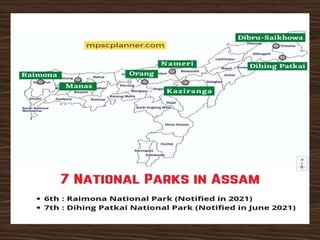
 Kaziranga National Park is a national park in
the Golaghat and Nagaon districts of the state of Assam,
India.
 A World Heritage Site, the park hosts two-thirds of the
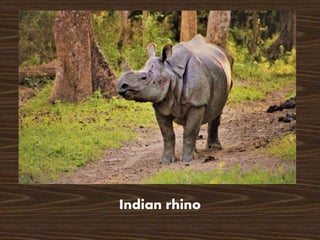
world's Great One-horned Rhinoceroses.
 Kaziranga boasts the highest density of
tigers among protected areas in the world and was declared
a Tiger Reserve in 2006.
 The park is home to large breeding populations of
elephants, wild water buffalo, and swamp deer.
 Kaziranga is recognized as an Important Bird
Area by Birdlife International for conservation of
avifaunal species.
 Compared to other protected areas in India, Kaziranga has
achieved notable success in wildlife conservation.
 Located on the edge of the Eastern Himalaya biodiversity
hotspot, the park combines high species diversity and
visibility.
 Kaziranga is a vast expanse of tall elephant
grass, marshland, and dense tropical moist broadleaf
forests, crisscrossed by four major rivers, including
the Brahmaputra, and the park includes numerous small
bodies of water.
 Kaziranga has been the theme of several books, songs, and
documentaries.
 The park celebrated its centennial in 2005 after its
establishment in 1905 as a reserve forest.
Contents
History
Etymology
Geography
Fauna
Flora
Transport
Current Data
Picture Gallery
Conclusion
References
 The history of Kaziranga as a protected area can be traced
back to 1904, when Mary Curzon, Baroness Curzon of
Kedleston, the wife of the Viceroy of India, Lord Curzon of
Kedleston, visited the area.
 After failing to see a single rhinoceros, for which the area
was renowned, she persuaded her husband to take urgent
measures to protect the dwindling species which he did by
initiating planning for their protection.
 On 1 June 1905, the Kaziranga Proposed Reserve Forest
was created with an area of 232 km2(90 sq mi). Over the
next three years, the park area was extended by
152 km2 (59 sq mi), to the banks of the Brahmaputra River.
 In 1908, Kaziranga was designated a Reserve Forest.
 It was named as Kaziranga game sanctuary. This was
because all used to play sports like golf here.
 The Kaziranga Game Sanctuary was renamed the
Kaziranga Wildlife Sanctuary in 1950 by P. D. Stracey, the
forest conservationist, in order to rid the name of hunting
connotations.
 In 1954, the government of Assam passed the Assam
(Rhinoceros) Bill, which imposed heavy penalties for
rhinoceros poaching.
 Fourteen years later, in 1968, the state government passed
the Assam National Park Act of 1968, declaring Kaziranga
a designated national park.
 The 430 km2 (166 sq mi) park was given official status by
the central government on 11 February 1974. In 1985,
Kaziranga was declared a World Heritage
Site by UNESCO for its unique natural environment.
Mary Curzon Baroness Curzon of
Kedleston
[The Viceroy of India]
 Although the etymology of the name Kaziranga is not
certain, there exist a number of possible explanations
derived from local legends and records.
 According to another legend, Srimanta Sankardeva, the
sixteenth century Vaisnava saint-scholar, once blessed a
childless couple, Kazi and Rangai, and asked them to
dig a big pond in the region so that their name would
live on.
 Kaziranga is located between latitudes 26°30' N and
26°45' N, and longitudes 93°08' E to 93°36' E within two
districts in the Indian state of Assam—the Nagaon
district and the Golaghat district.
 The park is approximately 40 km (25 mi) in length from
east to west, and 13 km (8 mi) in breadth from north to
south.
 It covers an area of 378 km2 with approximately 51.14 km2
lost to erosion in recent years.
 A total addition of 429 km2 along the present boundary of
the park has been made and designated with separate
national park status to provide extended habitat for
increasing the population of wildlife or, as a corridor for
safe movement of animals to Karbi Anglong Hills.
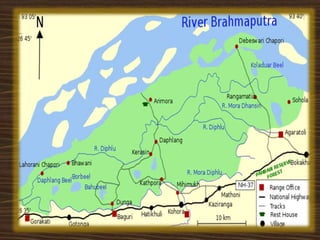
 Elevation ranges from 40 m to 80 m. The park area
is circumscribed by the Brahmaputra River, which
forms the northern and eastern boundaries, and
the Mora Diphlu, which forms the southern
boundary.
 Other notable rivers within the park is Dhansiri.
 Kaziranga has flat expanses of fertile, alluvial soil,
formed by erosion and silt deposition by the River
Brahmaputra.
 Kaziranga contains significant breeding populations of 35
mammalian species, of which 15 are threatened as per
the IUCN Red List.
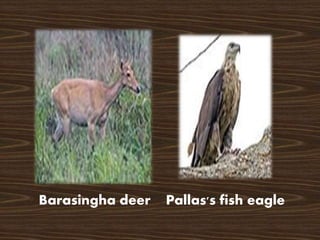
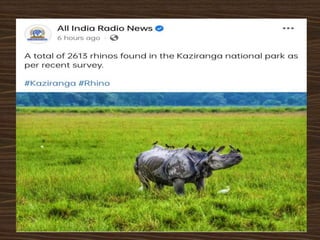
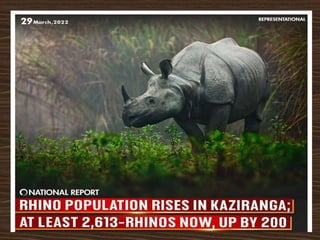
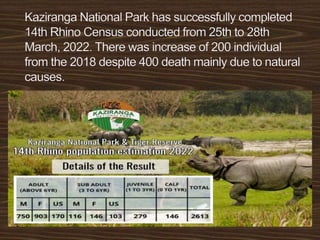
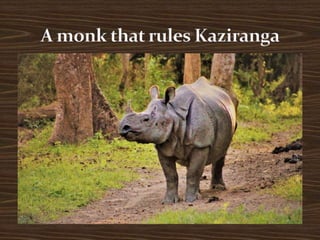
 The park has the distinction of being home to the world's
largest population of the Great Indian One-Horned
Rhinoceros (1,855), Wild Asiatic Water Buffalo (1,666) and
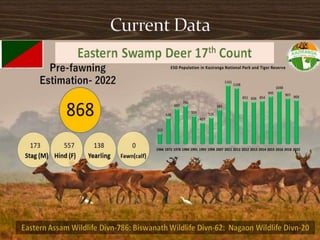
Eastern Swamp Deer (468).
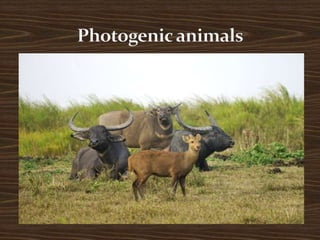
 Significant populations of large herbivores include
elephants (1,940), gaur (30) and sambar (58).
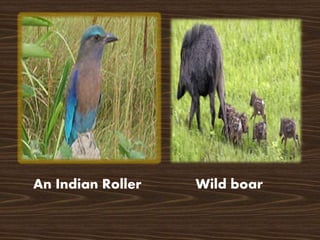
 Small herbivores include the Indian Muntjac, wild boar,
and hog deer.
 Kaziranga has the largest population of the Wild water buffalo
anywhere accounting for about 57% of the world population.
 Kaziranga is one of the few wild breeding areas
outside Africa for multiple species of large cats, such as Indian
Tigers and Leopards.
 Kaziranga is one of the few wild breeding areas
outside Africa for multiple species of large cats, such as Indian
Tigers and Leopards.
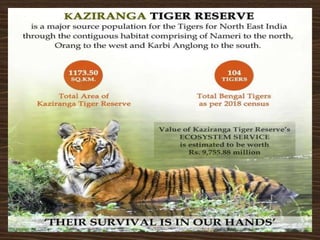
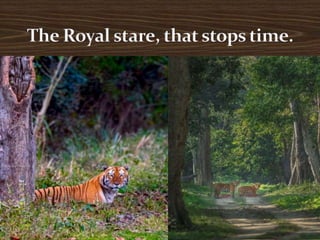
 Kaziranga was declared a Tiger Reserve in 2006 and has the
highest density of tigers in the world (one per five km²), with a
population of 86, as per the 2000 census.Other felids include
theJungle Cat, Fishing Cat, and Leopard Cats.
 Small mammals include the rare Hispid Hare, Indian Gray
Mongoose, Small Indian Mongooses, Large Indian Civet ,
Small Indian Civets, Bengal Fox, Golden Jackal, Sloth
Bear, Chinese Pangolin,Indian Pangolins, Hog
Badger, Chinese Ferret Badgers, and Particolored flying
squirrels.Nine of the 14 primate species found in India occur
in the park.
 Prominent among them are the Assamese
Macaque, Capped, Golden Langur, as well as the
only ape found in India, the Hoolock Gibbon. Kaziranga's
rivers are also home to the endangered Ganges Dolphin.
 Kaziranga has been identified by Birdlife International as
an Important Bird Area.It is home to a variety of migratory
birds, water birds, predators, scavengers, and game birds.
 Birds such as the Lesser White-fronted Goose, Ferruginous
Duck,Baer's Pochard duck and Lesser Adjutant, Greater
Adjutant, Black-necked Stork, and Asian
Openbill stork migrate from Central Asia to the park
during winter.Riverine birds include the Blyth's
Kingfisher, White-bellied Heron, Dalmatian Pelican,Spot-
billed Pelican, Nordmann's Greenshank, and Black-bellied
Tern.
 Birds of prey include the rare Eastern Imperial, Greater
Spotted, White-tailed, Pallas's Fish Eagle, Grey-headed
Fish Eagle, and the Lesser Kestrel.
 Monitor lizard species found in the park include the Bengal
monitor and the Water Monitor. Other reptiles include
fifteen species of turtle, such as the endemic Assam Roofed
Turtle and one species of tortoise, the Brown Tortoise. 42
species of fish are found in the area, including
the Tetraodon.
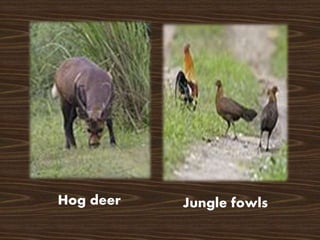
Hog deer Jungle fowls
Pallas's fish eagle
Barasingha deer
Wild boar
An Indian Roller
Indian rhino
 Four main types of vegetation exist in this park. These are alluvial
inundated grasslands, alluvial savanna woodlands, tropical moist
mixed deciduous forests, andtropical semi-evergreen forests.
 Based on Landsat data for 1986, percent coverage by vegetation
is: tall grasses 41%, short grasses 11%, open jungle 29%, swamps
4%, rivers and water bodies 8%, and sand 6%.
 There is a difference in altitude between the eastern and western
areas of the park, with the western side being at a lower altitude.
The western reaches of the park are dominated by grasslands.
 Tall elephant grass is found on higher ground, while short grasses
cover the lower grounds surrounding the beels or flood-created
ponds.
 Annual flooding, grazing by herbivores, and controlled burning
maintain and fertilize the grasslands and reeds. Common tall
grasses are sugarcanes, spear grass, elephant grass, and
the common reed
 Numerous forbs are present along with the grasses. Amidst
the grasses, providing cover and shade are scattered trees—
dominant species including kumbhi, Indian gooseberry, the
cotton tree (in savanna woodlands), and elephant apple (in
inundated grasslands).
 There are many different aquatic floras in the lakes and
ponds, and along the river shores. The invasive water
hyacinth is very common, often choking the water bodies, but
it is cleared during destructive floods. Another invasive
species, Mimosa invisa, which is toxic to herbivores, was
cleared by Kaziranga staff with help from the Wildlife Trust
of India in 2005.
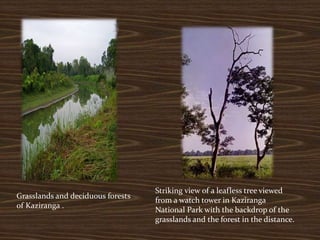
Grasslands and deciduous forests
of Kaziranga .
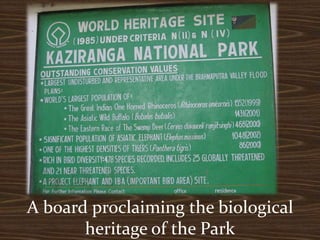
Striking view of a leafless tree viewed
from a watch tower in Kaziranga
National Park with the backdrop of the
grasslands and the forest in the distance.
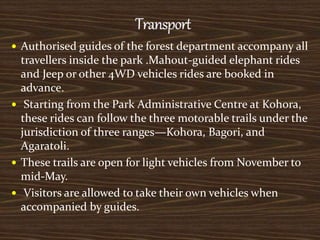
A board proclaiming the biological
heritage of the Park
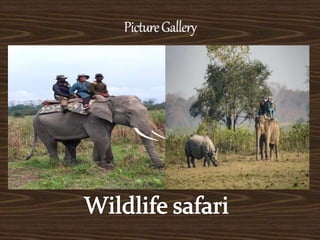
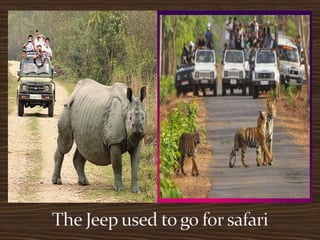
 Authorised guides of the forest department accompany all
travellers inside the park .Mahout-guided elephant rides
and Jeep or other 4WD vehicles rides are booked in
advance.
 Starting from the Park Administrative Centre at Kohora,
these rides can follow the three motorable trails under the
jurisdiction of three ranges—Kohora, Bagori, and
Agaratoli.
 These trails are open for light vehicles from November to
mid-May.
 Visitors are allowed to take their own vehicles when
accompanied by guides.
How to reach
 Air: Nearest airport is Salonibari Airport (TEZ), Tezpur located at a
distance of 80 km. Lokapriya Gopinath International (GAU) in
Guwahati airport is located at a distance of 130 km from Nagoan. The
other airport is positioned at Jorhat, 97-km as of Kaziranga.
Rail: There are several trains plying between Guwahati and Nagaon. It
takes around 2 to 3 hours to reach Nagaon from Guwahati.
Road: Nagaon is well connected by road from Guwahati. A good
many numbers of buses ply between the two places. The gateway for
Kaziranga Wildlife Sanctuary, at Kohora region on the NH-37, links
with a handful of cafes and a little regional bazaar. ASTC and private
buses end here, the root is from Guwahati, Tezpur and Upper Assam.
 Best Time to trip in Kaziranga For visiting in
Kaziranga, you can choose the time to 15th
November to early on April months which is
the best time for visiting you.
 Permits The management of Kaziranga
national park has set it mandatory for total
guests to get concurrence from administration
officers with the intension of tripping in the
park. In case you want to a daylight journey,
authorizes can be plainly attained from the
personal doorways.
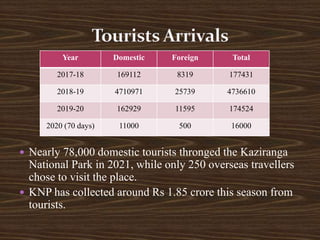
 Nearly 78,000 domestic tourists thronged the Kaziranga
National Park in 2021, while only 250 overseas travellers
chose to visit the place.
 KNP has collected around Rs 1.85 crore this season from
tourists.
Year Domestic Foreign Total
2017-18 169112 8319 177431
2018-19 4710971 25739 4736610
2019-20 162929 11595 174524
2020 (70 days) 11000 500 16000
Therefore, we conclude this presentation by saying that
‘One touch of nature makes the whole world kin.’
So we as a college going students can take more
efforts like creating awareness, and as many say
that computer is just a mere waste of time. We can
prove that wrong by even creating awareness
online and on many other websites and as a
human being we have to put our hands together
and strive hard to have a better future for our
world.
 https://en.wikipedia.org/wiki/Tourism_in_Kaziranga_Nati
onal_Park
 https://www.kaziranganationalparkonline.in/
 https://nagaon.gov.in/frontimpotentdata/kaziranga-
national-park
 https://timesofindia.indiatimes.com/city/guwahati/over-
64000-tourists-have-visited-knp-since-october-
21/articleshow/80068660.cms
 https://timesofindia.indiatimes.com/city/guwahati/assam-
kaziranga-coffers-overflow-with-record-visitors-in-three-
months/articleshow/88197729.cms
 https://nenow.in/north-east-news/assam/kaziranga-
records-marginal-increase-tourist-flow-2017-18.html
Thank You

kaziranga-national-park.pptx

  • 1.
  • 4.
     Kaziranga NationalPark is a national park in the Golaghat and Nagaon districts of the state of Assam, India.  A World Heritage Site, the park hosts two-thirds of the world's Great One-horned Rhinoceroses.  Kaziranga boasts the highest density of tigers among protected areas in the world and was declared a Tiger Reserve in 2006.
  • 5.
     The parkis home to large breeding populations of elephants, wild water buffalo, and swamp deer.  Kaziranga is recognized as an Important Bird Area by Birdlife International for conservation of avifaunal species.  Compared to other protected areas in India, Kaziranga has achieved notable success in wildlife conservation.  Located on the edge of the Eastern Himalaya biodiversity hotspot, the park combines high species diversity and visibility.
  • 6.
     Kaziranga isa vast expanse of tall elephant grass, marshland, and dense tropical moist broadleaf forests, crisscrossed by four major rivers, including the Brahmaputra, and the park includes numerous small bodies of water.  Kaziranga has been the theme of several books, songs, and documentaries.  The park celebrated its centennial in 2005 after its establishment in 1905 as a reserve forest.
  • 7.
  • 8.
     The historyof Kaziranga as a protected area can be traced back to 1904, when Mary Curzon, Baroness Curzon of Kedleston, the wife of the Viceroy of India, Lord Curzon of Kedleston, visited the area.  After failing to see a single rhinoceros, for which the area was renowned, she persuaded her husband to take urgent measures to protect the dwindling species which he did by initiating planning for their protection.
  • 9.
     On 1June 1905, the Kaziranga Proposed Reserve Forest was created with an area of 232 km2(90 sq mi). Over the next three years, the park area was extended by 152 km2 (59 sq mi), to the banks of the Brahmaputra River.  In 1908, Kaziranga was designated a Reserve Forest.  It was named as Kaziranga game sanctuary. This was because all used to play sports like golf here.  The Kaziranga Game Sanctuary was renamed the Kaziranga Wildlife Sanctuary in 1950 by P. D. Stracey, the forest conservationist, in order to rid the name of hunting connotations.
  • 10.
     In 1954,the government of Assam passed the Assam (Rhinoceros) Bill, which imposed heavy penalties for rhinoceros poaching.  Fourteen years later, in 1968, the state government passed the Assam National Park Act of 1968, declaring Kaziranga a designated national park.  The 430 km2 (166 sq mi) park was given official status by the central government on 11 February 1974. In 1985, Kaziranga was declared a World Heritage Site by UNESCO for its unique natural environment.
  • 11.
    Mary Curzon BaronessCurzon of Kedleston [The Viceroy of India]
  • 12.
     Although theetymology of the name Kaziranga is not certain, there exist a number of possible explanations derived from local legends and records.  According to another legend, Srimanta Sankardeva, the sixteenth century Vaisnava saint-scholar, once blessed a childless couple, Kazi and Rangai, and asked them to dig a big pond in the region so that their name would live on.
  • 13.
     Kaziranga islocated between latitudes 26°30' N and 26°45' N, and longitudes 93°08' E to 93°36' E within two districts in the Indian state of Assam—the Nagaon district and the Golaghat district.  The park is approximately 40 km (25 mi) in length from east to west, and 13 km (8 mi) in breadth from north to south.  It covers an area of 378 km2 with approximately 51.14 km2 lost to erosion in recent years.  A total addition of 429 km2 along the present boundary of the park has been made and designated with separate national park status to provide extended habitat for increasing the population of wildlife or, as a corridor for safe movement of animals to Karbi Anglong Hills.
  • 14.
     Elevation rangesfrom 40 m to 80 m. The park area is circumscribed by the Brahmaputra River, which forms the northern and eastern boundaries, and the Mora Diphlu, which forms the southern boundary.  Other notable rivers within the park is Dhansiri.  Kaziranga has flat expanses of fertile, alluvial soil, formed by erosion and silt deposition by the River Brahmaputra.
  • 15.
     Kaziranga containssignificant breeding populations of 35 mammalian species, of which 15 are threatened as per the IUCN Red List.  The park has the distinction of being home to the world's largest population of the Great Indian One-Horned Rhinoceros (1,855), Wild Asiatic Water Buffalo (1,666) and Eastern Swamp Deer (468).  Significant populations of large herbivores include elephants (1,940), gaur (30) and sambar (58).  Small herbivores include the Indian Muntjac, wild boar, and hog deer.
  • 16.
     Kaziranga hasthe largest population of the Wild water buffalo anywhere accounting for about 57% of the world population.  Kaziranga is one of the few wild breeding areas outside Africa for multiple species of large cats, such as Indian Tigers and Leopards.  Kaziranga is one of the few wild breeding areas outside Africa for multiple species of large cats, such as Indian Tigers and Leopards.  Kaziranga was declared a Tiger Reserve in 2006 and has the highest density of tigers in the world (one per five km²), with a population of 86, as per the 2000 census.Other felids include theJungle Cat, Fishing Cat, and Leopard Cats.
  • 17.
     Small mammalsinclude the rare Hispid Hare, Indian Gray Mongoose, Small Indian Mongooses, Large Indian Civet , Small Indian Civets, Bengal Fox, Golden Jackal, Sloth Bear, Chinese Pangolin,Indian Pangolins, Hog Badger, Chinese Ferret Badgers, and Particolored flying squirrels.Nine of the 14 primate species found in India occur in the park.  Prominent among them are the Assamese Macaque, Capped, Golden Langur, as well as the only ape found in India, the Hoolock Gibbon. Kaziranga's rivers are also home to the endangered Ganges Dolphin.  Kaziranga has been identified by Birdlife International as an Important Bird Area.It is home to a variety of migratory birds, water birds, predators, scavengers, and game birds.
  • 18.
     Birds suchas the Lesser White-fronted Goose, Ferruginous Duck,Baer's Pochard duck and Lesser Adjutant, Greater Adjutant, Black-necked Stork, and Asian Openbill stork migrate from Central Asia to the park during winter.Riverine birds include the Blyth's Kingfisher, White-bellied Heron, Dalmatian Pelican,Spot- billed Pelican, Nordmann's Greenshank, and Black-bellied Tern.  Birds of prey include the rare Eastern Imperial, Greater Spotted, White-tailed, Pallas's Fish Eagle, Grey-headed Fish Eagle, and the Lesser Kestrel.  Monitor lizard species found in the park include the Bengal monitor and the Water Monitor. Other reptiles include fifteen species of turtle, such as the endemic Assam Roofed Turtle and one species of tortoise, the Brown Tortoise. 42 species of fish are found in the area, including the Tetraodon.
  • 19.
  • 20.
  • 21.
  • 22.
  • 23.
     Four maintypes of vegetation exist in this park. These are alluvial inundated grasslands, alluvial savanna woodlands, tropical moist mixed deciduous forests, andtropical semi-evergreen forests.  Based on Landsat data for 1986, percent coverage by vegetation is: tall grasses 41%, short grasses 11%, open jungle 29%, swamps 4%, rivers and water bodies 8%, and sand 6%.  There is a difference in altitude between the eastern and western areas of the park, with the western side being at a lower altitude. The western reaches of the park are dominated by grasslands.  Tall elephant grass is found on higher ground, while short grasses cover the lower grounds surrounding the beels or flood-created ponds.  Annual flooding, grazing by herbivores, and controlled burning maintain and fertilize the grasslands and reeds. Common tall grasses are sugarcanes, spear grass, elephant grass, and the common reed
  • 24.
     Numerous forbsare present along with the grasses. Amidst the grasses, providing cover and shade are scattered trees— dominant species including kumbhi, Indian gooseberry, the cotton tree (in savanna woodlands), and elephant apple (in inundated grasslands).  There are many different aquatic floras in the lakes and ponds, and along the river shores. The invasive water hyacinth is very common, often choking the water bodies, but it is cleared during destructive floods. Another invasive species, Mimosa invisa, which is toxic to herbivores, was cleared by Kaziranga staff with help from the Wildlife Trust of India in 2005.
  • 25.
    Grasslands and deciduousforests of Kaziranga . Striking view of a leafless tree viewed from a watch tower in Kaziranga National Park with the backdrop of the grasslands and the forest in the distance.
  • 26.
    A board proclaimingthe biological heritage of the Park
  • 27.
     Authorised guidesof the forest department accompany all travellers inside the park .Mahout-guided elephant rides and Jeep or other 4WD vehicles rides are booked in advance.  Starting from the Park Administrative Centre at Kohora, these rides can follow the three motorable trails under the jurisdiction of three ranges—Kohora, Bagori, and Agaratoli.  These trails are open for light vehicles from November to mid-May.  Visitors are allowed to take their own vehicles when accompanied by guides.
  • 28.
    How to reach Air: Nearest airport is Salonibari Airport (TEZ), Tezpur located at a distance of 80 km. Lokapriya Gopinath International (GAU) in Guwahati airport is located at a distance of 130 km from Nagoan. The other airport is positioned at Jorhat, 97-km as of Kaziranga. Rail: There are several trains plying between Guwahati and Nagaon. It takes around 2 to 3 hours to reach Nagaon from Guwahati. Road: Nagaon is well connected by road from Guwahati. A good many numbers of buses ply between the two places. The gateway for Kaziranga Wildlife Sanctuary, at Kohora region on the NH-37, links with a handful of cafes and a little regional bazaar. ASTC and private buses end here, the root is from Guwahati, Tezpur and Upper Assam.
  • 30.
     Best Timeto trip in Kaziranga For visiting in Kaziranga, you can choose the time to 15th November to early on April months which is the best time for visiting you.  Permits The management of Kaziranga national park has set it mandatory for total guests to get concurrence from administration officers with the intension of tripping in the park. In case you want to a daylight journey, authorizes can be plainly attained from the personal doorways.
  • 36.
     Nearly 78,000domestic tourists thronged the Kaziranga National Park in 2021, while only 250 overseas travellers chose to visit the place.  KNP has collected around Rs 1.85 crore this season from tourists. Year Domestic Foreign Total 2017-18 169112 8319 177431 2018-19 4710971 25739 4736610 2019-20 162929 11595 174524 2020 (70 days) 11000 500 16000
  • 44.
    Therefore, we concludethis presentation by saying that ‘One touch of nature makes the whole world kin.’ So we as a college going students can take more efforts like creating awareness, and as many say that computer is just a mere waste of time. We can prove that wrong by even creating awareness online and on many other websites and as a human being we have to put our hands together and strive hard to have a better future for our world.
  • 46.
     https://en.wikipedia.org/wiki/Tourism_in_Kaziranga_Nati onal_Park  https://www.kaziranganationalparkonline.in/ https://nagaon.gov.in/frontimpotentdata/kaziranga- national-park  https://timesofindia.indiatimes.com/city/guwahati/over- 64000-tourists-have-visited-knp-since-october- 21/articleshow/80068660.cms  https://timesofindia.indiatimes.com/city/guwahati/assam- kaziranga-coffers-overflow-with-record-visitors-in-three- months/articleshow/88197729.cms  https://nenow.in/north-east-news/assam/kaziranga- records-marginal-increase-tourist-flow-2017-18.html
  • 47.