History
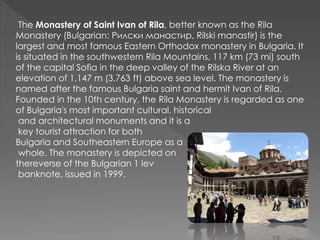
The Monastery of Saint Ivan of Rila, better known as the Rila
Monastery (Bulgarian: Рилски манастир, Rilski manastir) is the
largest and most famous Eastern Orthodox monastery in Bulgaria. It
is situated in the southwestern Rila Mountains, 117 km (73 mi) south
of the capital Sofia in the deep valley of the Rilska River at an
elevation of 1,147 m (3,763 ft) above sea level. The monastery is
named after the famous Bulgaria saint and hermit Ivan of Rila.
Founded in the 10th century, the Rila Monastery is regarded as one
of Bulgaria's most important cultural, historical
and architectural monuments and it is a
key tourist attraction for both
Bulgaria and Southeastern Europe as a
whole. The monastery is depicted on
thereverse of the Bulgarian 1 lev
banknote, issued in 1999.
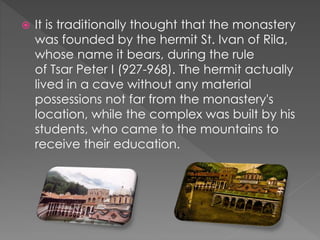
 It is traditionally thought that the monastery
was founded by the hermit St. Ivan of Rila,
whose name it bears, during the rule
of Tsar Peter I (927-968). The hermit actually
lived in a cave without any material
possessions not far from the monastery's
location, while the complex was built by his
students, who came to the mountains to
receive their education.
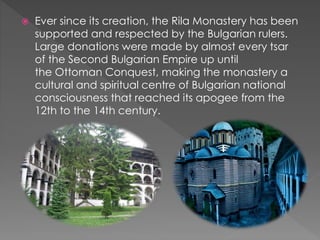
 Ever since its creation, the Rila Monastery has been
supported and respected by the Bulgarian rulers.
Large donations were made by almost every tsar
of the Second Bulgarian Empire up until
the Ottoman Conquest, making the monastery a
cultural and spiritual centre of Bulgarian national
consciousness that reached its apogee from the
12th to the 14th century.
Architecture
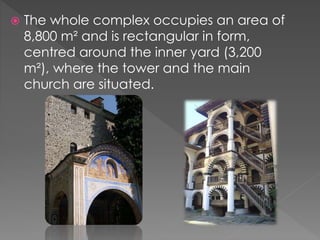
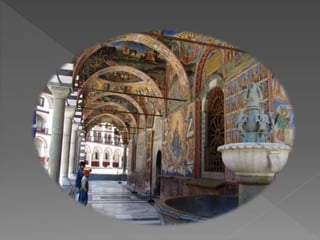
 The whole complex occupies an area of
8,800 m² and is rectangular in form,
centred around the inner yard (3,200
m²), where the tower and the main
church are situated.
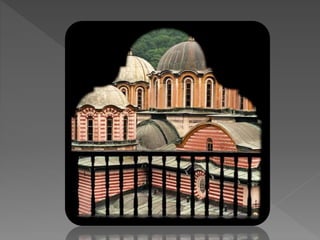
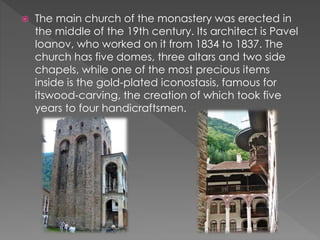
 The main church of the monastery was erected in
the middle of the 19th century. Its architect is Pavel
Ioanov, who worked on it from 1834 to 1837. The
church has five domes, three altars and two side
chapels, while one of the most precious items
inside is the gold-plated iconostasis, famous for
itswood-carving, the creation of which took five
years to four handicraftsmen.
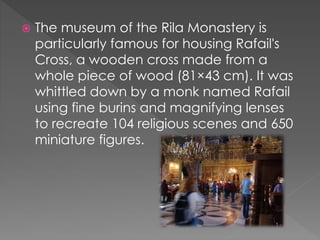
 The museum of the Rila Monastery is
particularly famous for housing Rafail's
Cross, a wooden cross made from a
whole piece of wood (81×43 cm). It was
whittled down by a monk named Rafail
using fine burins and magnifying lenses
to recreate 104 religious scenes and 650
miniature figures.
 Aleksandra Łabędzka
 Marta Gbur
 Kl.1F

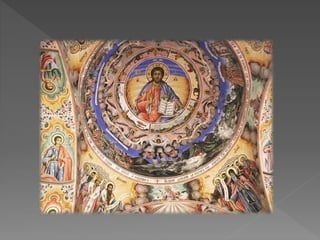
Bulgarian frescos

  • 2.
  • 3.
    The Monastery ofSaint Ivan of Rila, better known as the Rila Monastery (Bulgarian: Рилски манастир, Rilski manastir) is the largest and most famous Eastern Orthodox monastery in Bulgaria. It is situated in the southwestern Rila Mountains, 117 km (73 mi) south of the capital Sofia in the deep valley of the Rilska River at an elevation of 1,147 m (3,763 ft) above sea level. The monastery is named after the famous Bulgaria saint and hermit Ivan of Rila. Founded in the 10th century, the Rila Monastery is regarded as one of Bulgaria's most important cultural, historical and architectural monuments and it is a key tourist attraction for both Bulgaria and Southeastern Europe as a whole. The monastery is depicted on thereverse of the Bulgarian 1 lev banknote, issued in 1999.
  • 5.
     It istraditionally thought that the monastery was founded by the hermit St. Ivan of Rila, whose name it bears, during the rule of Tsar Peter I (927-968). The hermit actually lived in a cave without any material possessions not far from the monastery's location, while the complex was built by his students, who came to the mountains to receive their education.
  • 6.
     Ever sinceits creation, the Rila Monastery has been supported and respected by the Bulgarian rulers. Large donations were made by almost every tsar of the Second Bulgarian Empire up until the Ottoman Conquest, making the monastery a cultural and spiritual centre of Bulgarian national consciousness that reached its apogee from the 12th to the 14th century.
  • 7.
  • 8.
     The wholecomplex occupies an area of 8,800 m² and is rectangular in form, centred around the inner yard (3,200 m²), where the tower and the main church are situated.
  • 10.
     The mainchurch of the monastery was erected in the middle of the 19th century. Its architect is Pavel Ioanov, who worked on it from 1834 to 1837. The church has five domes, three altars and two side chapels, while one of the most precious items inside is the gold-plated iconostasis, famous for itswood-carving, the creation of which took five years to four handicraftsmen.
  • 12.
     The museumof the Rila Monastery is particularly famous for housing Rafail's Cross, a wooden cross made from a whole piece of wood (81×43 cm). It was whittled down by a monk named Rafail using fine burins and magnifying lenses to recreate 104 religious scenes and 650 miniature figures.
  • 14.
     Aleksandra Łabędzka Marta Gbur  Kl.1F