Inclusive Development through Converged Public Services
                     …Learnings from India


Vikas Kanungo,
Chairman – The Society for Promotion of e-Governance, India
vikaskanungo@egovindia.org                                    UNDP India, April 25,2011
Getting the basics right…

           Democracy – Government under people, not over them


           Mission of e-Government projects – empowering the citizens , not
            controlling them


           Use of Information technologies and new media - to enable participation
            in policy making (e-participation), not for converting monolithic
            government services to electronic format ( From big state to enabling
            state)


           Partnership Models – MSP not PPP


© Vikas Kanungo, 2011, All Rights Reserved                               UNDP India, April 25,2011
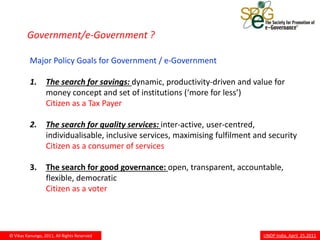
Government/e-Government ?

          Major Policy Goals for Government / e-Government

          1.      The search for savings: dynamic, productivity-driven and value for
                  money concept and set of institutions (‘more for less’)
                  Citizen as a Tax Payer

          2.      The search for quality services: inter-active, user-centred,
                  individualisable, inclusive services, maximising fulfilment and security
                  Citizen as a consumer of services

          3.      The search for good governance: open, transparent, accountable,
                  flexible, democratic
                  Citizen as a voter


© Vikas Kanungo, 2011, All Rights Reserved                                      UNDP India, April 25,2011
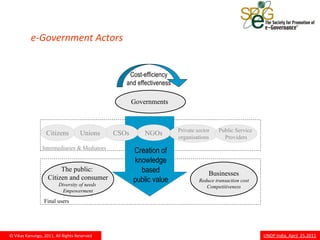
e-Government Actors


                                                  Cost-efficiency
                                                 and effectiveness

                                                     Governments


                                                                     Private sector    Public Service
                  Citizens         Unions     CSOs       NGOs
                                                                     organisations       Providers
                Intermediaries & Mediators
                                                     Creation of
                                                     knowledge
                        The public:                    based                      Businesses
                   Citizen and consumer              public value             Reduce transaction cost
                         Diversity of needs                                      Competitiveness
                          Empowerment

                 Final users


© Vikas Kanungo, 2011, All Rights Reserved                                                              UNDP India, April 25,2011
Major Strategic Areas in e-Government

           Government process re-engineering
           Meeting user needs and expectations
           Managing change and human resources
           Technology Deployment
           Socio-economic drivers of change
           Service delivery
           Access for all
           Institutional and legal structures
           e-Governance and e-Democracy


© Vikas Kanungo, 2011, All Rights Reserved         UNDP India, April 25,2011
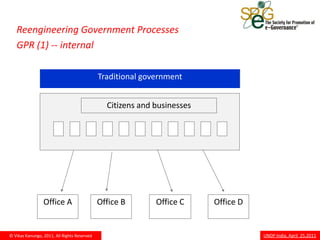
Reengineering Government Processes
   GPR (1) -- internal

                                             Traditional government


                                               Citizens and businesses


                 Office A                    Office B       Office C     Office D


© Vikas Kanungo, 2011, All Rights Reserved                                          UNDP India, April 25,2011
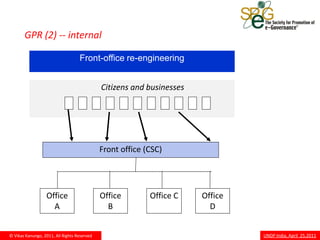
GPR (2) -- internal

                                   Front-office re-engineering


                                             Citizens and businesses


                                             Front office (CSC)


                  Office                     Office        Office C    Office
                    A                          B                         D


© Vikas Kanungo, 2011, All Rights Reserved                                      UNDP India, April 25,2011
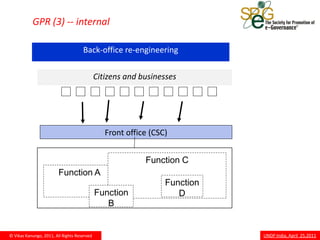
GPR (3) -- internal

                                     Back-office re-engineering

                                             Citizens and businesses


                                                Front office (CSC)


                                                           Function C
                         Function A
                                                                 Function
                                             Function               D
                                                B


© Vikas Kanungo, 2011, All Rights Reserved                                  UNDP India, April 25,2011
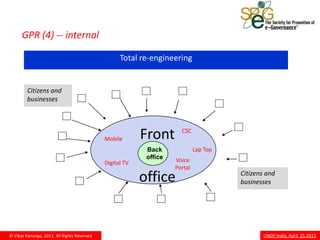
GPR (4) -- internal

                                                   Total re-engineering


         Citizens and
         businesses


                                             Mobile       Front       CSC


                                                           Back              Lap Top
                                                           office   Voice
                                             Digital TV
                                                                    Portal
                                                          office                       Citizens and
                                                                                       businesses


© Vikas Kanungo, 2011, All Rights Reserved                                                     UNDP India, April 25,2011
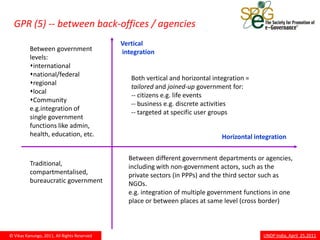
GPR (5) -- between back-offices / agencies
                                             Vertical
          Between government                 integration
          levels:
          international
          national/federal
                                                Both vertical and horizontal integration =
          regional
                                                tailored and joined-up government for:
          local
                                                -- citizens e.g. life events
          Community
                                                -- business e.g. discrete activities
          e.g.integration of
                                                -- targeted at specific user groups
          single government
          functions like admin,
          health, education, etc.                                               Horizontal integration


                                               Between different government departments or agencies,
          Traditional,                         including with non-government actors, such as the
          compartmentalised,                   private sectors (in PPPs) and the third sector such as
          bureaucratic government              NGOs.
                                               e.g. integration of multiple government functions in one
                                               place or between places at same level (cross border)


© Vikas Kanungo, 2011, All Rights Reserved                                                    UNDP India, April 25,2011
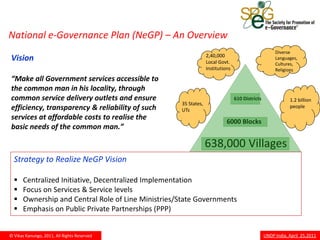
National e-Governance Plan (NeGP) – An Overview
                                                                                                     Diverse
                                                                 2,40,000
Vision                                                           Local Govt.
                                                                                                     Languages,
                                                                                                     Cultures,
                                                                 Institutions                        Religions
“Make all Government services accessible to
the common man in his locality, through
common service delivery outlets and ensure                                      610 Districts               1.2 billion
                                                    35 States,
efficiency, transparency & reliability of such      UTs
                                                                                                            people

services at affordable costs to realise the
                                                                           6000 Blocks
basic needs of the common man.”

                                                                 638,000 Villages
  Strategy to Realize NeGP Vision

     Centralized Initiative, Decentralized Implementation
     Focus on Services & Service levels
     Ownership and Central Role of Line Ministries/State Governments
     Emphasis on Public Private Partnerships (PPP)


© Vikas Kanungo, 2011, All Rights Reserved                                                      UNDP India, April 25,2011
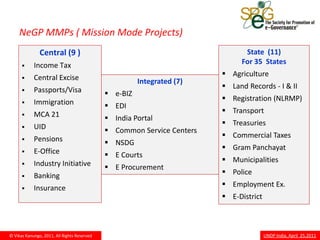
NeGP MMPs ( Mission Mode Projects)
               Central (9 )                                                    State (11)
           Income Tax                                                        For 35 States

           Central Excise                                               Agriculture
                                                       Integrated (7)
           Passports/Visa                                               Land Records - I & II
                                              e-BIZ
           Immigration                                                  Registration (NLRMP)
                                              EDI
           MCA 21                                                       Transport
                                              India Portal
           UID                                                          Treasuries
                                              Common Service Centers
           Pensions                                                     Commercial Taxes
                                              NSDG
           E-Office                                                     Gram Panchayat
                                              E Courts
           Industry Initiative                                          Municipalities
                                              E Procurement
           Banking                                                      Police
           Insurance                                                    Employment Ex.
                                                                         E-District


© Vikas Kanungo, 2011, All Rights Reserved                                             UNDP India, April 25,2011
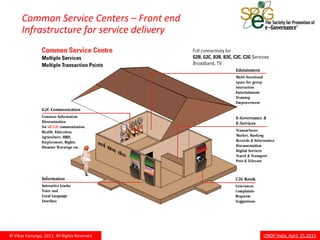
Common Service Centers – Front end
      Infrastructure for service delivery


© Vikas Kanungo, 2011, All Rights Reserved   UNDP India, April 25,2011
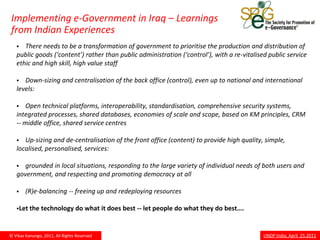
Implementing e-Government in Iraq – Learnings
from Indian Experiences
     There needs to be a transformation of government to prioritise the production and distribution of
   public goods (‘content’) rather than public administration (‘control’), with a re-vitalised public service
   ethic and high skill, high value staff

     Down-sizing and centralisation of the back office (control), even up to national and international
   levels:

      Open technical platforms, interoperability, standardisation, comprehensive security systems,
   integrated processes, shared databases, economies of scale and scope, based on KM principles, CRM
   -- middle office, shared service centres

     Up-sizing and de-centralisation of the front office (content) to provide high quality, simple,
   localised, personalised, services:

     grounded in local situations, responding to the large variety of individual needs of both users and
   government, and respecting and promoting democracy at all

       (R)e-balancing -- freeing up and redeploying resources

   Let the     technology do what it does best -- let people do what they do best….


© Vikas Kanungo, 2011, All Rights Reserved                                                   UNDP India, April 25,2011
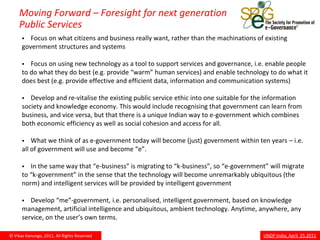
Moving Forward – Foresight for next generation
     Public Services
        Focus on what citizens and business really want, rather than the machinations of existing
      government structures and systems

        Focus on using new technology as a tool to support services and governance, i.e. enable people
      to do what they do best (e.g. provide “warm” human services) and enable technology to do what it
      does best (e.g. provide effective and efficient data, information and communication systems)

        Develop and re-vitalise the existing public service ethic into one suitable for the information
      society and knowledge economy. This would include recognising that government can learn from
      business, and vice versa, but that there is a unique Indian way to e-government which combines
      both economic efficiency as well as social cohesion and access for all.

         What we think of as e-government today will become (just) government within ten years – i.e.
      all of government will use and become “e”.

        In the same way that “e-business” is migrating to “k-business”, so “e-government” will migrate
      to “k-government” in the sense that the technology will become unremarkably ubiquitous (the
      norm) and intelligent services will be provided by intelligent government

        Develop “me”-government, i.e. personalised, intelligent government, based on knowledge
      management, artificial intelligence and ubiquitous, ambient technology. Anytime, anywhere, any
      service, on the user’s own terms.

© Vikas Kanungo, 2011, All Rights Reserved                                                UNDP India, April 25,2011
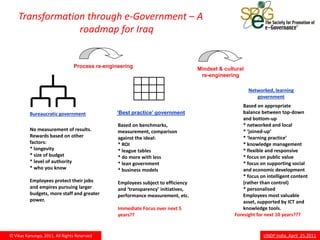
Transformation through e-Government – A
                 roadmap for Iraq


                                Process re-engineering                            Mindset & cultural
                                                                                   re-engineering

                                                                                                       Networked, learning
                                                                                                          government
                                                                                                    Based on appropriate
          Bureaucratic government               ‘Best practice’ government                          balance between top-down
                                                                                                    and bottom-up
                                                Based on benchmarks,                                * networked and local
          No measurement of results.            measurement, comparison                             * ‘joined-up’
          Rewards based on other                against the ideal:                                  * ‘learning practice’
          factors:                              * ROI                                               * knowledge management
          * longevity                           * league tables                                     * flexible and responsive
          * size of budget                      * do more with less                                 * focus on public value
          * level of authority                  * lean government                                   * focus on supporting social
          * who you know                        * business models                                   and economic development
                                                                                                    * focus on intelligent content
          Employees protect their jobs          Employees subject to efficiency                     (rather than control)
          and empires pursuing larger           and ‘transparency’ initiatives,                     * personalised
          budgets, more staff and greater       performance measurement, etc.                       Employees most valuable
          power.                                                                                    asset, supported by ICT and
                                                Immediate Focus over next 5                         knowledge tools.
                                                years??                                         Foresight for next 10 years???


© Vikas Kanungo, 2011, All Rights Reserved                                                                   UNDP India, April 25,2011
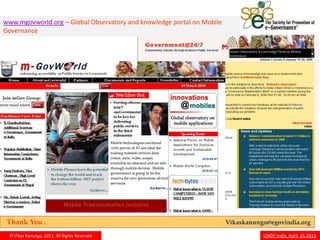
www.mgovworld.org – Global Observatory and knowledge portal on Mobile
Governance


 Thank You .                                                            Vikaskanungo@egovindia.org

 © Vikas Kanungo, 2011, All Rights Reserved                                        UNDP India, April 25,2011

Inclusive Developmnet through Converged Public Services - Learnings from India

  • 1.
    Inclusive Development throughConverged Public Services …Learnings from India Vikas Kanungo, Chairman – The Society for Promotion of e-Governance, India vikaskanungo@egovindia.org UNDP India, April 25,2011
  • 2.
    Getting the basicsright…  Democracy – Government under people, not over them  Mission of e-Government projects – empowering the citizens , not controlling them  Use of Information technologies and new media - to enable participation in policy making (e-participation), not for converting monolithic government services to electronic format ( From big state to enabling state)  Partnership Models – MSP not PPP © Vikas Kanungo, 2011, All Rights Reserved UNDP India, April 25,2011
  • 3.
    Government/e-Government ? Major Policy Goals for Government / e-Government 1. The search for savings: dynamic, productivity-driven and value for money concept and set of institutions (‘more for less’) Citizen as a Tax Payer 2. The search for quality services: inter-active, user-centred, individualisable, inclusive services, maximising fulfilment and security Citizen as a consumer of services 3. The search for good governance: open, transparent, accountable, flexible, democratic Citizen as a voter © Vikas Kanungo, 2011, All Rights Reserved UNDP India, April 25,2011
  • 4.
    e-Government Actors Cost-efficiency and effectiveness Governments Private sector Public Service Citizens Unions CSOs NGOs organisations Providers Intermediaries & Mediators Creation of knowledge The public: based Businesses Citizen and consumer public value Reduce transaction cost Diversity of needs Competitiveness Empowerment Final users © Vikas Kanungo, 2011, All Rights Reserved UNDP India, April 25,2011
  • 5.
    Major Strategic Areasin e-Government  Government process re-engineering  Meeting user needs and expectations  Managing change and human resources  Technology Deployment  Socio-economic drivers of change  Service delivery  Access for all  Institutional and legal structures  e-Governance and e-Democracy © Vikas Kanungo, 2011, All Rights Reserved UNDP India, April 25,2011
  • 6.
    Reengineering Government Processes GPR (1) -- internal Traditional government Citizens and businesses Office A Office B Office C Office D © Vikas Kanungo, 2011, All Rights Reserved UNDP India, April 25,2011
  • 7.
    GPR (2) --internal Front-office re-engineering Citizens and businesses Front office (CSC) Office Office Office C Office A B D © Vikas Kanungo, 2011, All Rights Reserved UNDP India, April 25,2011
  • 8.
    GPR (3) --internal Back-office re-engineering Citizens and businesses Front office (CSC) Function C Function A Function Function D B © Vikas Kanungo, 2011, All Rights Reserved UNDP India, April 25,2011
  • 9.
    GPR (4) --internal Total re-engineering Citizens and businesses Mobile Front CSC Back Lap Top office Voice Digital TV Portal office Citizens and businesses © Vikas Kanungo, 2011, All Rights Reserved UNDP India, April 25,2011
  • 10.
    GPR (5) --between back-offices / agencies Vertical Between government integration levels: international national/federal Both vertical and horizontal integration = regional tailored and joined-up government for: local -- citizens e.g. life events Community -- business e.g. discrete activities e.g.integration of -- targeted at specific user groups single government functions like admin, health, education, etc. Horizontal integration Between different government departments or agencies, Traditional, including with non-government actors, such as the compartmentalised, private sectors (in PPPs) and the third sector such as bureaucratic government NGOs. e.g. integration of multiple government functions in one place or between places at same level (cross border) © Vikas Kanungo, 2011, All Rights Reserved UNDP India, April 25,2011
  • 11.
    National e-Governance Plan(NeGP) – An Overview Diverse 2,40,000 Vision Local Govt. Languages, Cultures, Institutions Religions “Make all Government services accessible to the common man in his locality, through common service delivery outlets and ensure 610 Districts 1.2 billion 35 States, efficiency, transparency & reliability of such UTs people services at affordable costs to realise the 6000 Blocks basic needs of the common man.” 638,000 Villages Strategy to Realize NeGP Vision  Centralized Initiative, Decentralized Implementation  Focus on Services & Service levels  Ownership and Central Role of Line Ministries/State Governments  Emphasis on Public Private Partnerships (PPP) © Vikas Kanungo, 2011, All Rights Reserved UNDP India, April 25,2011
  • 12.
    NeGP MMPs (Mission Mode Projects) Central (9 ) State (11)  Income Tax For 35 States  Central Excise  Agriculture Integrated (7)  Passports/Visa  Land Records - I & II  e-BIZ  Immigration  Registration (NLRMP)  EDI  MCA 21  Transport  India Portal  UID  Treasuries  Common Service Centers  Pensions  Commercial Taxes  NSDG  E-Office  Gram Panchayat  E Courts  Industry Initiative  Municipalities  E Procurement  Banking  Police  Insurance  Employment Ex.  E-District © Vikas Kanungo, 2011, All Rights Reserved UNDP India, April 25,2011
  • 13.
    Common Service Centers– Front end Infrastructure for service delivery © Vikas Kanungo, 2011, All Rights Reserved UNDP India, April 25,2011
  • 14.
    Implementing e-Government inIraq – Learnings from Indian Experiences  There needs to be a transformation of government to prioritise the production and distribution of public goods (‘content’) rather than public administration (‘control’), with a re-vitalised public service ethic and high skill, high value staff  Down-sizing and centralisation of the back office (control), even up to national and international levels:  Open technical platforms, interoperability, standardisation, comprehensive security systems, integrated processes, shared databases, economies of scale and scope, based on KM principles, CRM -- middle office, shared service centres  Up-sizing and de-centralisation of the front office (content) to provide high quality, simple, localised, personalised, services:  grounded in local situations, responding to the large variety of individual needs of both users and government, and respecting and promoting democracy at all  (R)e-balancing -- freeing up and redeploying resources Let the technology do what it does best -- let people do what they do best…. © Vikas Kanungo, 2011, All Rights Reserved UNDP India, April 25,2011
  • 15.
    Moving Forward –Foresight for next generation Public Services  Focus on what citizens and business really want, rather than the machinations of existing government structures and systems  Focus on using new technology as a tool to support services and governance, i.e. enable people to do what they do best (e.g. provide “warm” human services) and enable technology to do what it does best (e.g. provide effective and efficient data, information and communication systems)  Develop and re-vitalise the existing public service ethic into one suitable for the information society and knowledge economy. This would include recognising that government can learn from business, and vice versa, but that there is a unique Indian way to e-government which combines both economic efficiency as well as social cohesion and access for all.  What we think of as e-government today will become (just) government within ten years – i.e. all of government will use and become “e”.  In the same way that “e-business” is migrating to “k-business”, so “e-government” will migrate to “k-government” in the sense that the technology will become unremarkably ubiquitous (the norm) and intelligent services will be provided by intelligent government  Develop “me”-government, i.e. personalised, intelligent government, based on knowledge management, artificial intelligence and ubiquitous, ambient technology. Anytime, anywhere, any service, on the user’s own terms. © Vikas Kanungo, 2011, All Rights Reserved UNDP India, April 25,2011
  • 16.
    Transformation through e-Government– A roadmap for Iraq Process re-engineering Mindset & cultural re-engineering Networked, learning government Based on appropriate Bureaucratic government ‘Best practice’ government balance between top-down and bottom-up Based on benchmarks, * networked and local No measurement of results. measurement, comparison * ‘joined-up’ Rewards based on other against the ideal: * ‘learning practice’ factors: * ROI * knowledge management * longevity * league tables * flexible and responsive * size of budget * do more with less * focus on public value * level of authority * lean government * focus on supporting social * who you know * business models and economic development * focus on intelligent content Employees protect their jobs Employees subject to efficiency (rather than control) and empires pursuing larger and ‘transparency’ initiatives, * personalised budgets, more staff and greater performance measurement, etc. Employees most valuable power. asset, supported by ICT and Immediate Focus over next 5 knowledge tools. years?? Foresight for next 10 years??? © Vikas Kanungo, 2011, All Rights Reserved UNDP India, April 25,2011
  • 17.
    www.mgovworld.org – GlobalObservatory and knowledge portal on Mobile Governance Thank You . Vikaskanungo@egovindia.org © Vikas Kanungo, 2011, All Rights Reserved UNDP India, April 25,2011