Ka Hikitia
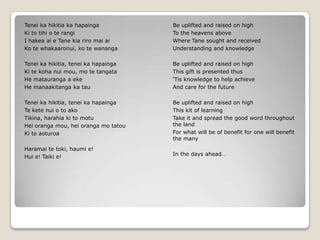
Tenei ka hikitia ka hapainga
Ki to tihi o te rangi
I hakea ai e Tane kia riro mai ai
Ko te whakaaronui, ko te wananga
Tenei ka hikitia, tenei ka hapainga
Ki te koha nui mou, mo te tangata
He matauranga a eke
He manaakitanga ka tau
Tenei ka hikitia, tenei ka hapainga
Te kete nui o to ako
Tikina, harahia ki to motu
Hei oranga mou, hei oranga mo tatou
Ki to aoturoa
Haramai te toki, haumi e!
Hui e! Taiki e!
Be uplifted and raised on high
To the heavens above
Where Tane sought and received
Understanding and knowledge
Be uplifted and raised on high
This gift is presented thus
„Tis knowledge to help achieve
And care for the future
Be uplifted and raised on high
This kit of learning
Take it and spread the good word throughout
the land
For what will be of benefit for one will benefit
the many
In the days ahead…
Ka Hikitia
Step Up
Be uplifted
Housing, employment,
health, families ,
education
 “ The classroom is a
fishbowl. You can at
least influence the quality
of the water.”
Research Poor pronunciation
 Deficit thinking
 A busy timetable
 Inadvertant Teacher racism
 Low T-expectation
 Low whanau involvement
Tikanga
Rules, expectations
Tikanga
• Shared kai provided after a meeting
• Round table introduction
• Mentoring programmes
• Blessing of a new house
• Opening address at the beginning of a
seminar or convention
• Shared kai provided
after a meeting
• Round table
introduction
• Mentoring
programmes
• Blessing of a new
house
• Opening address at
the beginning of a
seminar or convention
 Manaakitanga
 Whakawhanaungatanga
 Ako
 Karakia
 pohiri
Foundation Years
Participating in quality early childhood
education
Moving successfully into school
Building strong literacy foundations in the first
years.
Strengthen the participation of whanau in their
children‟s learning in the early years of school.
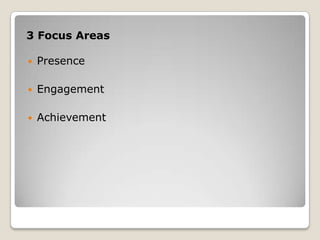
3 Focus Areas
 Presence
 Engagement
 Achievement
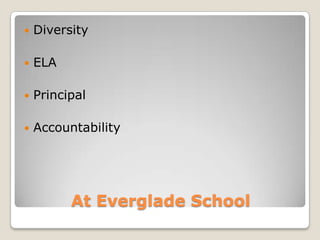
At Everglade School
 Diversity
 ELA
 Principal
 Accountability
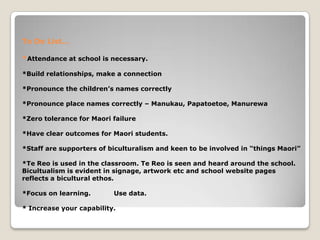
To Do List…
*Attendance at school is necessary.
*Build relationships, make a connection
*Pronounce the children’s names correctly
*Pronounce place names correctly – Manukau, Papatoetoe, Manurewa
*Zero tolerance for Maori failure
*Have clear outcomes for Maori students.
*Staff are supporters of biculturalism and keen to be involved in “things Maori”
*Te Reo is used in the classroom. Te Reo is seen and heard around the school.
Bicultualism is evident in signage, artwork etc and school website pages
reflects a bicultural ethos.
*Focus on learning. Use data.
* Increase your capability.
Te Wananga o Aotearoa has a free
course called “Mauri ora”
Google: Maori Language Commission
(words & phrases)
www.tki.org.nz Te Mangoroa –
stories, reports, statistics from a
wide range of schools.

Ka hikitia

  • 1.
  • 2.
    Tenei ka hikitiaka hapainga Ki to tihi o te rangi I hakea ai e Tane kia riro mai ai Ko te whakaaronui, ko te wananga Tenei ka hikitia, tenei ka hapainga Ki te koha nui mou, mo te tangata He matauranga a eke He manaakitanga ka tau Tenei ka hikitia, tenei ka hapainga Te kete nui o to ako Tikina, harahia ki to motu Hei oranga mou, hei oranga mo tatou Ki to aoturoa Haramai te toki, haumi e! Hui e! Taiki e! Be uplifted and raised on high To the heavens above Where Tane sought and received Understanding and knowledge Be uplifted and raised on high This gift is presented thus „Tis knowledge to help achieve And care for the future Be uplifted and raised on high This kit of learning Take it and spread the good word throughout the land For what will be of benefit for one will benefit the many In the days ahead…
  • 3.
  • 4.
  • 5.
     “ Theclassroom is a fishbowl. You can at least influence the quality of the water.”
  • 6.
    Research Poor pronunciation Deficit thinking  A busy timetable  Inadvertant Teacher racism  Low T-expectation  Low whanau involvement
  • 7.
  • 8.
  • 9.
    Tikanga • Shared kaiprovided after a meeting • Round table introduction • Mentoring programmes • Blessing of a new house • Opening address at the beginning of a seminar or convention
  • 10.
    • Shared kaiprovided after a meeting • Round table introduction • Mentoring programmes • Blessing of a new house • Opening address at the beginning of a seminar or convention  Manaakitanga  Whakawhanaungatanga  Ako  Karakia  pohiri
  • 11.
    Foundation Years Participating inquality early childhood education Moving successfully into school Building strong literacy foundations in the first years. Strengthen the participation of whanau in their children‟s learning in the early years of school.
  • 12.
    3 Focus Areas Presence  Engagement  Achievement
  • 13.
    At Everglade School Diversity  ELA  Principal  Accountability
  • 14.
    To Do List… *Attendanceat school is necessary. *Build relationships, make a connection *Pronounce the children’s names correctly *Pronounce place names correctly – Manukau, Papatoetoe, Manurewa *Zero tolerance for Maori failure *Have clear outcomes for Maori students. *Staff are supporters of biculturalism and keen to be involved in “things Maori” *Te Reo is used in the classroom. Te Reo is seen and heard around the school. Bicultualism is evident in signage, artwork etc and school website pages reflects a bicultural ethos. *Focus on learning. Use data. * Increase your capability.
  • 15.
    Te Wananga oAotearoa has a free course called “Mauri ora” Google: Maori Language Commission (words & phrases) www.tki.org.nz Te Mangoroa – stories, reports, statistics from a wide range of schools.