LD0025-04GB Date: 18-11-04
AC Servo Motor Controllers
AMC20, AMC21
and AMC22
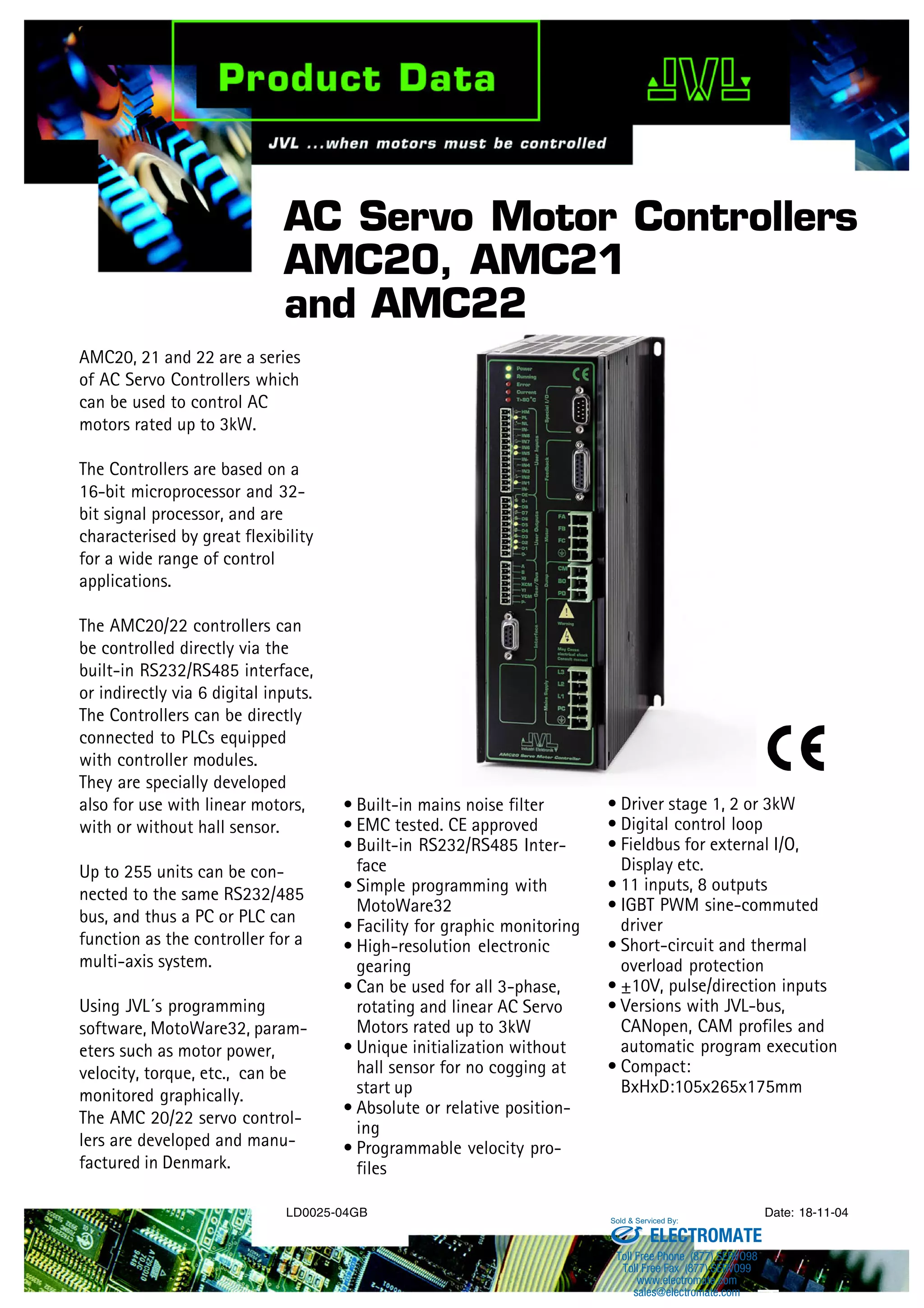
AMC20, 21 and 22 are a series
of AC Servo Controllers which
can be used to control AC
motors rated up to 3kW.
The Controllers are based on a
16-bit microprocessor and 32-
bit signal processor, and are
characterised by great flexibility
for a wide range of control
applications.
The AMC20/22 controllers can
be controlled directly via the
built-in RS232/RS485 interface,
or indirectly via 6 digital inputs.
The Controllers can be directly
connected to PLCs equipped
with controller modules.
They are specially developed
also for use with linear motors,
with or without hall sensor.
Up to 255 units can be con-
nected to the same RS232/485
bus, and thus a PC or PLC can
function as the controller for a
multi-axis system.
Using JVL´s programming
software, MotoWare32, param-
eters such as motor power,
velocity, torque, etc., can be
monitored graphically.
The AMC 20/22 servo control-
lers are developed and manu-
factured in Denmark.
• Built-in mains noise filter
• EMC tested. CE approved
• Built-in RS232/RS485 Inter-
face
• Simple programming with
MotoWare32
• Facility for graphic monitoring
• High-resolution electronic
gearing
• Can be used for all 3-phase,
rotating and linear AC Servo
Motors rated up to 3kW
• Unique initialization without
hall sensor for no cogging at
start up
• Absolute or relative position-
ing
• Programmable velocity pro-
files
• Driver stage 1, 2 or 3kW
• Digital control loop
• Fieldbus for external I/O,
Display etc.
• 11 inputs, 8 outputs
• IGBT PWM sine-commuted
driver
• Short-circuit and thermal
overload protection
• ±10V, pulse/direction inputs
• Versions with JVL-bus,
CANopen, CAM profiles and
automatic program execution
• Compact:
BxHxD:105x265x175mm
ELECTROMATE
Toll Free Phone (877) SERVO98
Toll Free Fax (877) SERV099
www.electromate.com
sales@electromate.com
Sold & Serviced By:
Description (continued)
Servo Controllers AMC20, 21 and 22
are equipped with 11 digital inputs. 6 of
these refer to 64 user-defined position
and velocity references which are read
into registers via the built-in RS232/
485 interface. The AMC Controllers can
also be velocity-controlled via an
analogue input of +/- 10V. In addition,
the Controllers can be controlled as a
step motor system using step-pulse and
direction signals.
A special mode of operation enables
electronic gearing at a selectable,
keyed-in ratio (from 0.001 to
9999.999) with a resolution of 1 to
1000.
In the standard model, preset values are
executed in response to external
signals, while in an extended model the
Controller itself can perform sequential
program execution.
8 general-purpose outputs can be
configured, e.g. to provide a signal
when the motor has reached a required
position, or to give an error signal if
some condition occurs that prevents
motor operation.
The Servo Controllers are very easy to
program. For example, different velocity
profiles can be set by defining accelera-
tion, deceleration (linear or s-curve)
and velocity. The Controllers also
include built-in programmable end-of-
travel limits and a zero-point seek
function.
As a signal from a feedback sensor to
the digital control loop, the Controllers
accept either a balanced or unbalanced
signal, for example from a standard 2-
channel incremental encoder.
A new feature of these Controllers is
the use of FLASH PROM, which enables
their basic firmware program to be
upgraded at a later date if required.
All inputs and outputs are galvanically
isolated and are voltage-overload
protected to give high immunity to
spurious noise signals. Similarly the
Controllers are also protected against
thermal overload and short-circuits. The
Controllers are designed and con-
structed to fulfil EMC requirements and
are CE-marked. The cabinet is equipped
with flanges for easy mounting in a
control rack.
The P-version further includes the
possibility for automatic sequential
program execution and inteface for
JVL-bus and CANopen bus.
The P-version also includes CAM
profiles where in- and output of the
CAM can be combined between time,
position, velocity, torque, acceleration
or register.
Programming and use with MotoWare
Programming of the AC Servo Control-
lers is easily accomplished using JVL's
windows-based programming software,
MotoWare. Controller programs are
written in a very simple, BASIC-like
language and several Controller
programs can be opened and edited at
the same time. Each Controller program
is saved in a separate disk file. Windows
show a complete overview of the
various parameters. Multiple parameter
sets can be saved under their own
unique name and these can be
retrieved, edited and sent to the
Controller. The current set-up of a
specific Controller can also be retrieved
from the unit and displayed on the
screen or saved on the PC. During motor
operation, the current values of motor
power, velocity, torque and deviation in
position are displayed graphically and
can be printed out. This feature can be
used for comparison with previously
recorded curves and is
extremely useful for
troubleshooting and
checking that the system is
operating optimally.
MotoWare is supplied on a
3½" diskette, and is easily
installed on a PC with
Windows 3.1 or higher.
Only ½ - 1 MByte of
available disk space is
required for installation — in
addition to an available
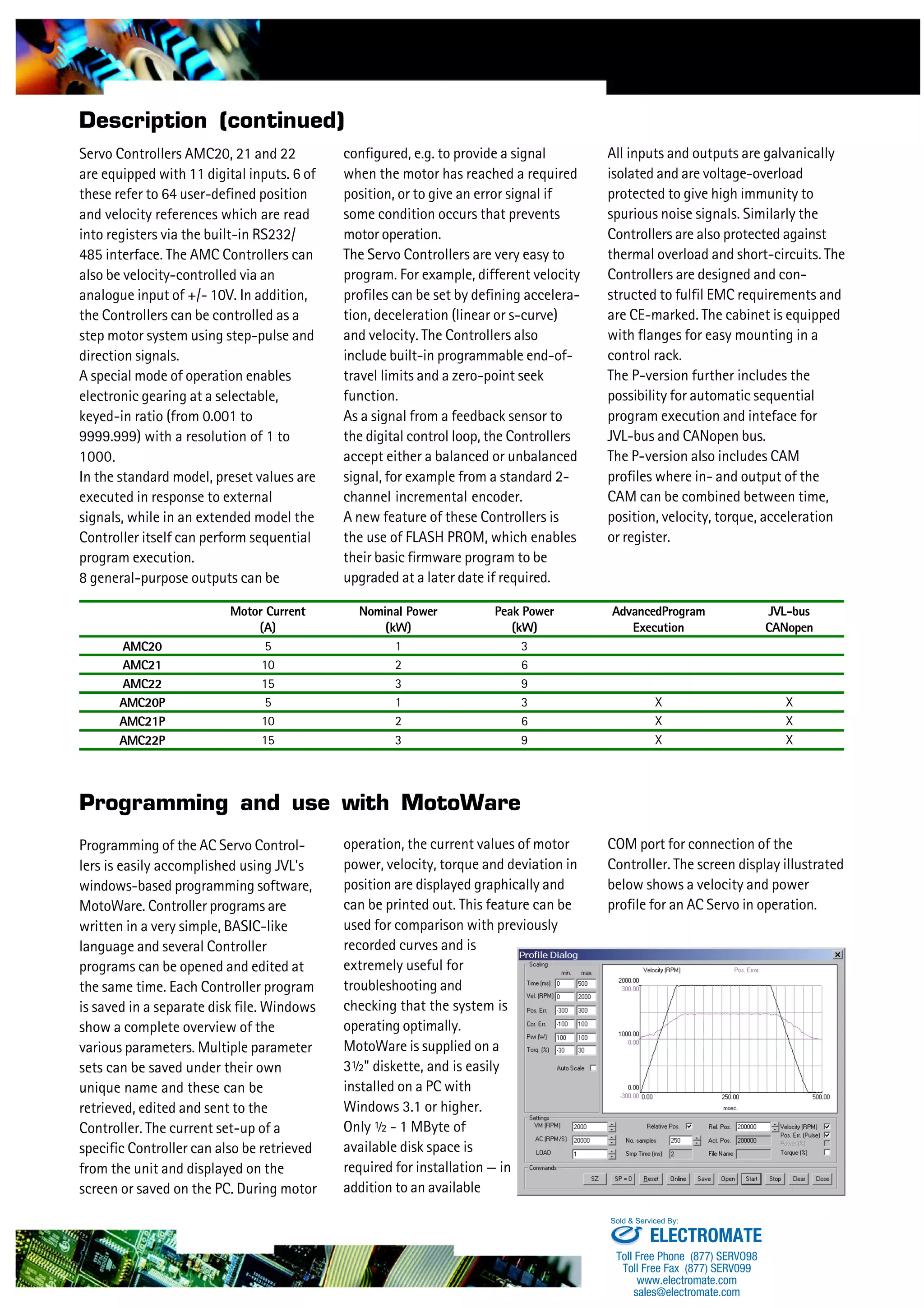
COM port for connection of the
Controller. The screen display illustrated
below shows a velocity and power
profile for an AC Servo in operation.
Motor Current
(A)
Nominal Power
(kW)
Peak Power
(kW)
AdvancedProgram
Execution
JVL-bus
CANopen
AMC20 5 1 3
AMC21 10 2 6
AMC22 15 3 9
AMC20P 5 1 3 X X
AMC21P 10 2 6 X X
AMC22P 15 3 9 X X
ELECTROMATE
Toll Free Phone (877) SERVO98
Toll Free Fax (877) SERV099
www.electromate.com
sales@electromate.com
Sold & Serviced By:
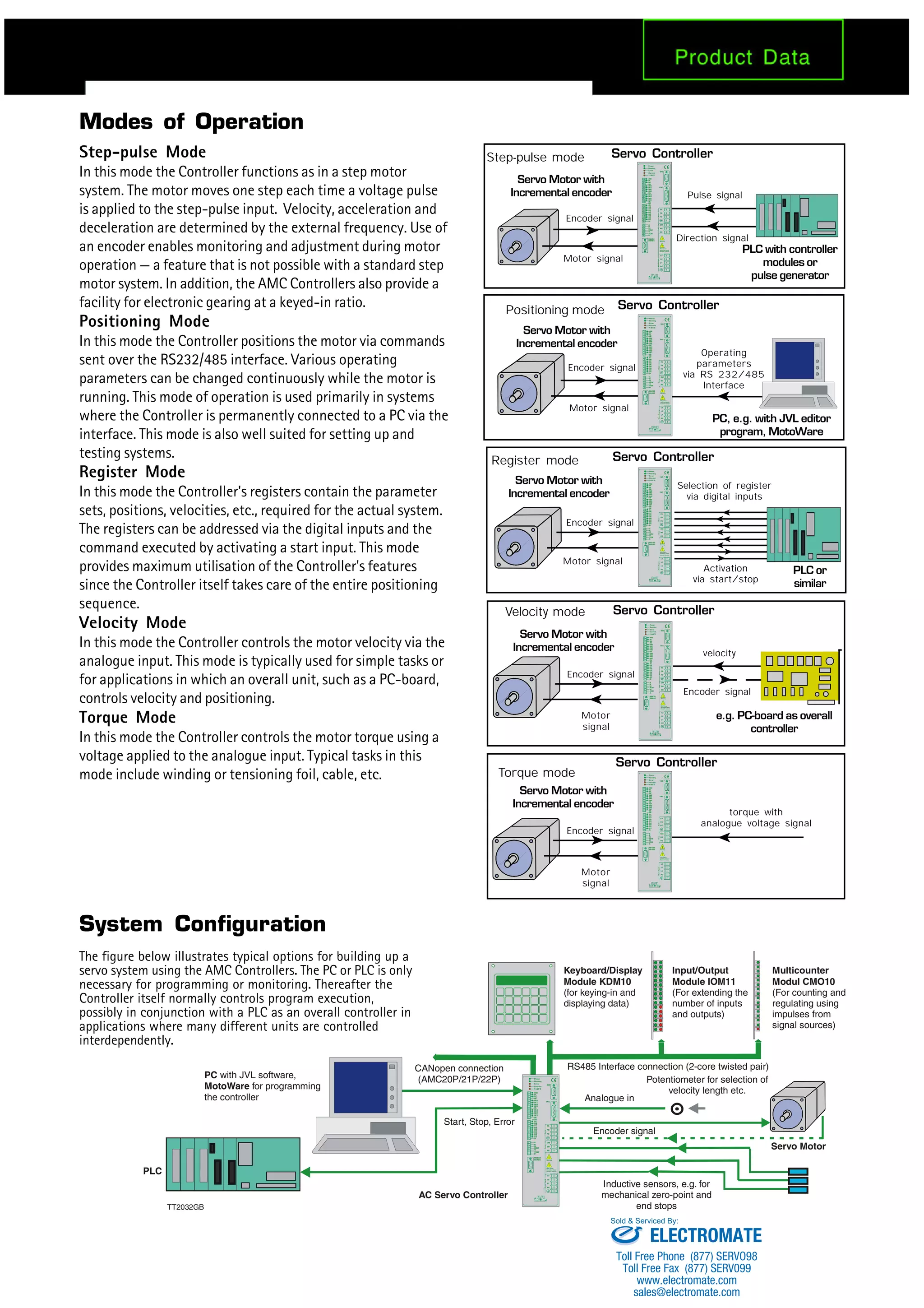
Modes of Operation
Step-pulse Mode
In this mode the Controller functions as in a step motor
system. The motor moves one step each time a voltage pulse
is applied to the step-pulse input. Velocity, acceleration and
deceleration are determined by the external frequency. Use of
an encoder enables monitoring and adjustment during motor
operation — a feature that is not possible with a standard step
motor system. In addition, the AMC Controllers also provide a
facility for electronic gearing at a keyed-in ratio.
Positioning Mode
In this mode the Controller positions the motor via commands
sent over the RS232/485 interface. Various operating
parameters can be changed continuously while the motor is
running. This mode of operation is used primarily in systems
where the Controller is permanently connected to a PC via the
interface. This mode is also well suited for setting up and
testing systems.
Register Mode
In this mode the Controller's registers contain the parameter
sets, positions, velocities, etc., required for the actual system.
The registers can be addressed via the digital inputs and the
command executed by activating a start input. This mode
provides maximum utilisation of the Controller's features
since the Controller itself takes care of the entire positioning
sequence.
Velocity Mode
In this mode the Controller controls the motor velocity via the
analogue input. This mode is typically used for simple tasks or
for applications in which an overall unit, such as a PC-board,
controls velocity and positioning.
Torque Mode
In this mode the Controller controls the motor torque using a
voltage applied to the analogue input. Typical tasks in this
mode include winding or tensioning foil, cable, etc.
Pulse signal
Motor signal
Servo Motor with
Incremental encoder
PLC with controller
modules or
pulse generator
Motor signal
Operating
parameters
via RS 232/485
Interface
Selection of register
via digital inputs
Activation
via start/stop
Servo Motor with
Incremental encoder
Motor
signal
velocity
Servo Motor with
Incremental encoder
torque with
analogue voltage signal
e.g. PC-board as overall
controller
Encoder signal
Direction signal
PC, e.g. with JVL editor
program, MotoWare
Encoder signal
Servo Motor with
Incremental encoder
Encoder signal
Motor signal
PLC or
similar
Encoder signal
Servo Controller
Servo Controller
Servo Controller
Servo Controller
Servo Controller
Step-pulse mode
Positioning mode
Register mode
Velocity mode
Torque mode
Encoder signal
Motor
signal
Servo Motor with
Incremental encoder
Encoder signal
Running
Error
Current
RS232
RS485
ENC
HM
PL
NL
IN-
IN8
IN7
IN6
IN5
IN-
IN4
IN3
FA
FB
FC
IN2
IN1
IN-
O+
OE
O8
O7
O6
O5
O4
O3
CM
BO
PD
SIO
O2
O1
O-
A
XI
YCM
YI
P-
B
XCM
Power
CT>80
L3
L2
L1
PC
Industri Elektronik
Warning
May Cause
electrical shock
Consult manual
MainsSupplyDumpMotor
Running
Error
Current
RS232
RS485
ENC
HM
PL
NL
IN-
IN8
IN7
IN6
IN5
IN-
IN4
IN3
FA
FB
FC
IN2
IN1
IN-
O+
OE
O8
O7
O6
O5
O4
O3
CM
BO
PD
SIO
O2
O1
O-
A
XI
YCM
YI
P-
B
XCM
Power
CT>80
L3
L2
L1
PC
Industri Elektronik
War ning
May Cause
electrical shock
Consult manual
MainsSupplyDumpMotor
Running
Error
Current
RS232
RS485
ENC
HM
PL
NL
IN-
IN8
IN7
IN6
IN5
IN-
IN4
IN3
FA
FB
FC
IN2
IN1
IN-
O+
OE
O8
O7
O6
O5
O4
O3
CM
BO
PD
SIO
O2
O1
O-
A
XI
YCM
YI
P-
B
XCM
Power
CT>80
L3
L2
L1
PC
Industri Elektronik
Warning
May Cause
electrical shock
Consult manual
MainsSupplyDumpMotor
Running
Error
Current
RS232
RS485
ENC
HM
PL
NL
IN-
IN8
IN7
IN6
IN5
IN-
IN4
IN3
FA
FB
FC
IN2
IN1
IN-
O+
OE
O8
O7
O6
O5
O4
O3
CM
BO
PD
SIO
O2
O1
O-
A
XI
YCM
YI
P-
B
XCM
Power
CT>80
L3
L2
L1
PC
Industri Elektronik
Warning
May Cause
electrical shock
Consult manual
MainsSupplyDumpMotor
Running
Error
Current
RS232
RS485
ENC
HM
PL
NL
IN-
IN8
IN7
IN6
IN5
IN-
IN4
IN3
FA
FB
FC
IN2
IN1
IN-
O+
OE
O8
O7
O6
O5
O4
O3
CM
BO
PD
SIO
O2
O1
O-
A
XI
YCM
YI
P-
B
XCM
Power
CT>80
L3
L2
L1
PC
Industri Elektronik
Warning
May Cause
electrical shock
Consult manual
MainsSupplyDumpMotor
System Configuration
CANopen connection
(AMC20P/21P/22P)
Start, Stop, Error
TT2032GB
PC
MotoWare
with JVL software,
for programming
the controller
PLC
Keyboard/Display
Module KDM10
(for keying-in and
displaying data)
Input/Output
Module IOM11
(For extending the
number of inputs
and outputs)
Multicounter
Modul CMO10
(For counting and
regulating using
impulses from
signal sources)
RS485 Interface connection (2-core twisted pair)
Analogue in
Encoder signal
Potentiometer for selection of
velocity length etc.
AC Servo Controller
Servo Motor
Inductive sensors, e.g. for
mechanical zero-point and
end stops
Running
Error
Current
RS232
RS485
ENC
HM
PL
NL
IN-
IN8
IN7
IN6
IN5
IN-
IN4
IN3
FA
FB
FC
IN2
IN1
IN-
O+
OE
O8
O7
O6
O5
O4
O3
CM
BO
PD
SIO
O2
O1
O-
A
XI
YCM
YI
P-
B
XCM
Power
CT>80
L3
L2
L1
PC
Industri Elektronik
Warning
May Cause
electrical shock
Consul t manu al
MainsSupplyDumpMotor
The figure below illustrates typical options for building up a
servo system using the AMC Controllers. The PC or PLC is only
necessary for programming or monitoring. Thereafter the
Controller itself normally controls program execution,
possibly in conjunction with a PLC as an overall controller in
applications where many different units are controlled
interdependently.
ELECTROMATE
Toll Free Phone (877) SERVO98
Toll Free Fax (877) SERV099
www.electromate.com
sales@electromate.com
Sold & Serviced By:
JVL Industri Elektronik A/S
Blokken 42
DK-3460 Birkerød, Denmark
Tel: +45 4582 4440
Fax: +45 4582 5550
E-mail: jvl@jvl.dk www.jvl.dk
AMC20, AMC21 and AMC22 AC Servo Controllers
Block diagram - functional description
Signal processor
3(2)-phase
IBGT
Driver
Brushless
Servo
Pulse output
Analogue output
Motor torque
Secondary
Encoder input
(electronic gear)
RS485
Encoder input
Hall input
Digital current
regulation
Short-circuit
protection
8
3
Current
100-850VDC
A/D converter
for digital
current loop
Flash PROM
Balanced
input
with code
protection
Power supply
Filter and
fuse
Power Dump
Transceiver
Opto-coupler
Opto-coupler
Opto-coupler
Daisy-Chain
Processor
Opto-coupler
Interface logic
Program Processor
Internal
power
supply
Reset and
temperature
monitoring
115VAC
230VAC
3x200VAC
3x400VAC
External
Ballast
Resistor
RS232/485
Programming
Interface
8 Basic inputs
2 End-of-travel limit inputs
1 Zero-point seek input
+/- 10V In
Velocity
Torque
8 Basic outputs
Voltage
monitoring
U=Min.
U=Max.
U=Dump
Opto-coupler
Opto-coupler
Opto-coupler
CANopen
JVL-bus
A/D Converter
10-bit + Sign
Digital Filter
TT2033GB
3
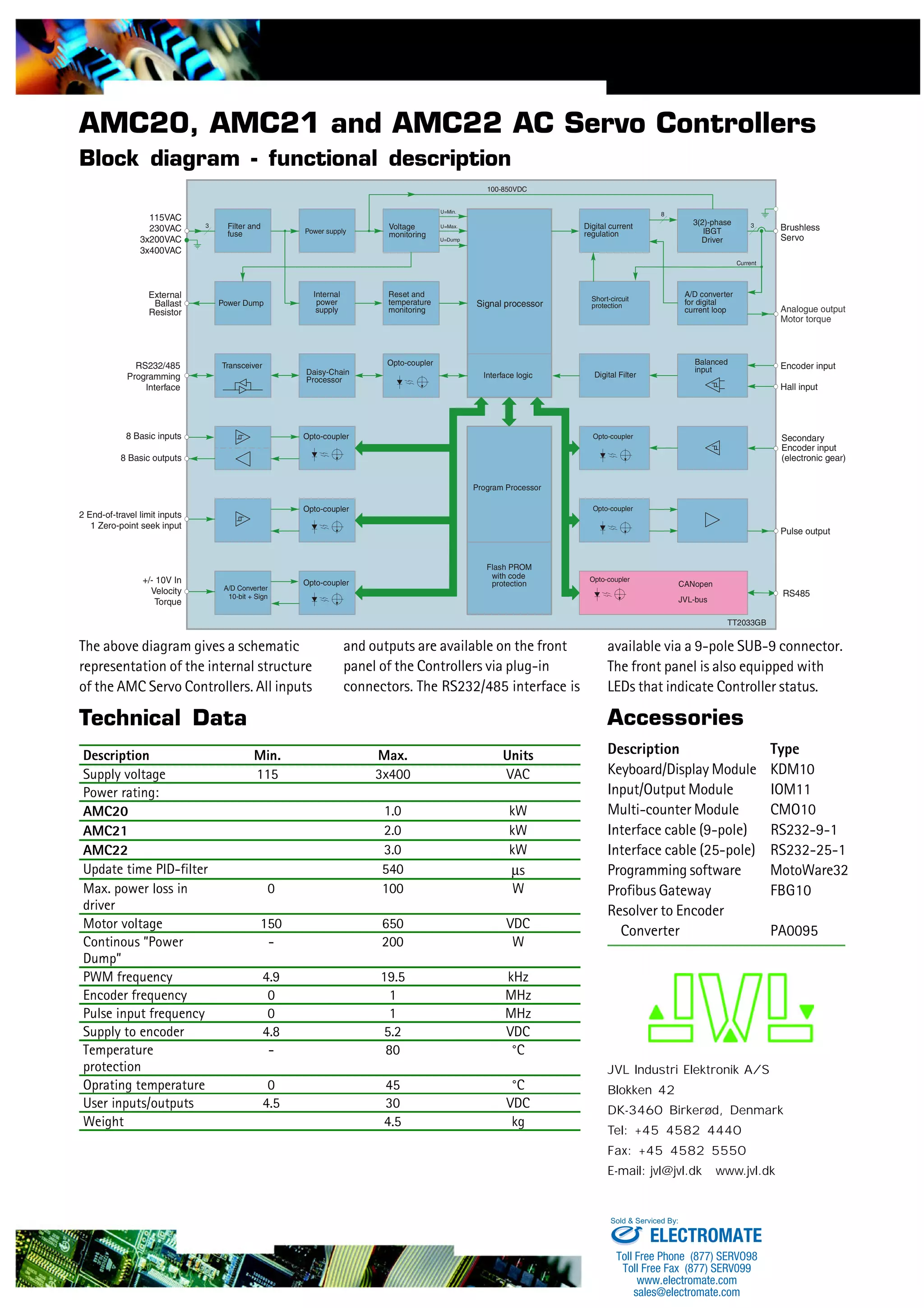
The above diagram gives a schematic
representation of the internal structure
of the AMC Servo Controllers. All inputs
and outputs are available on the front
panel of the Controllers via plug-in
connectors. The RS232/485 interface is
available via a 9-pole SUB-9 connector.
The front panel is also equipped with
LEDs that indicate Controller status.
Accessories
Description Type
Keyboard/Display Module KDM10
Input/Output Module IOM11
Multi-counter Module CMO10
Interface cable (9-pole) RS232-9-1
Interface cable (25-pole) RS232-25-1
Programming software MotoWare32
Profibus Gateway FBG10
Resolver to Encoder
Converter PA0095
Technical Data
Description Min. Max. Units
Supply voltage 115 3x400 VAC
Power rating:
AMC20 1.0 kW
AMC21 2.0 kW
AMC22 3.0 kW
Update time PID-filter 540 µs
Max. power loss in
driver
0 100 W
Motor voltage 150 650 VDC
Continous ”Power
Dump”
- 200 W
PWM frequency 4.9 19.5 kHz
Encoder frequency 0 1 MHz
Pulse input frequency 0 1 MHz
Supply to encoder 4.8 5.2 VDC
Temperature
protection
- 80 °C
Oprating temperature 0 45 °C
User inputs/outputs 4.5 30 VDC
Weight 4.5 kg
ELECTROMATE
Toll Free Phone (877) SERVO98
Toll Free Fax (877) SERV099
www.electromate.com
sales@electromate.com
Sold & Serviced By:

JVL AC Servo Motor Controllers AMC20, AMC21 and AMC22

  • 1.
    LD0025-04GB Date: 18-11-04 ACServo Motor Controllers AMC20, AMC21 and AMC22 AMC20, 21 and 22 are a series of AC Servo Controllers which can be used to control AC motors rated up to 3kW. The Controllers are based on a 16-bit microprocessor and 32- bit signal processor, and are characterised by great flexibility for a wide range of control applications. The AMC20/22 controllers can be controlled directly via the built-in RS232/RS485 interface, or indirectly via 6 digital inputs. The Controllers can be directly connected to PLCs equipped with controller modules. They are specially developed also for use with linear motors, with or without hall sensor. Up to 255 units can be con- nected to the same RS232/485 bus, and thus a PC or PLC can function as the controller for a multi-axis system. Using JVL´s programming software, MotoWare32, param- eters such as motor power, velocity, torque, etc., can be monitored graphically. The AMC 20/22 servo control- lers are developed and manu- factured in Denmark. • Built-in mains noise filter • EMC tested. CE approved • Built-in RS232/RS485 Inter- face • Simple programming with MotoWare32 • Facility for graphic monitoring • High-resolution electronic gearing • Can be used for all 3-phase, rotating and linear AC Servo Motors rated up to 3kW • Unique initialization without hall sensor for no cogging at start up • Absolute or relative position- ing • Programmable velocity pro- files • Driver stage 1, 2 or 3kW • Digital control loop • Fieldbus for external I/O, Display etc. • 11 inputs, 8 outputs • IGBT PWM sine-commuted driver • Short-circuit and thermal overload protection • ±10V, pulse/direction inputs • Versions with JVL-bus, CANopen, CAM profiles and automatic program execution • Compact: BxHxD:105x265x175mm ELECTROMATE Toll Free Phone (877) SERVO98 Toll Free Fax (877) SERV099 www.electromate.com sales@electromate.com Sold & Serviced By:
  • 2.
    Description (continued) Servo ControllersAMC20, 21 and 22 are equipped with 11 digital inputs. 6 of these refer to 64 user-defined position and velocity references which are read into registers via the built-in RS232/ 485 interface. The AMC Controllers can also be velocity-controlled via an analogue input of +/- 10V. In addition, the Controllers can be controlled as a step motor system using step-pulse and direction signals. A special mode of operation enables electronic gearing at a selectable, keyed-in ratio (from 0.001 to 9999.999) with a resolution of 1 to 1000. In the standard model, preset values are executed in response to external signals, while in an extended model the Controller itself can perform sequential program execution. 8 general-purpose outputs can be configured, e.g. to provide a signal when the motor has reached a required position, or to give an error signal if some condition occurs that prevents motor operation. The Servo Controllers are very easy to program. For example, different velocity profiles can be set by defining accelera- tion, deceleration (linear or s-curve) and velocity. The Controllers also include built-in programmable end-of- travel limits and a zero-point seek function. As a signal from a feedback sensor to the digital control loop, the Controllers accept either a balanced or unbalanced signal, for example from a standard 2- channel incremental encoder. A new feature of these Controllers is the use of FLASH PROM, which enables their basic firmware program to be upgraded at a later date if required. All inputs and outputs are galvanically isolated and are voltage-overload protected to give high immunity to spurious noise signals. Similarly the Controllers are also protected against thermal overload and short-circuits. The Controllers are designed and con- structed to fulfil EMC requirements and are CE-marked. The cabinet is equipped with flanges for easy mounting in a control rack. The P-version further includes the possibility for automatic sequential program execution and inteface for JVL-bus and CANopen bus. The P-version also includes CAM profiles where in- and output of the CAM can be combined between time, position, velocity, torque, acceleration or register. Programming and use with MotoWare Programming of the AC Servo Control- lers is easily accomplished using JVL's windows-based programming software, MotoWare. Controller programs are written in a very simple, BASIC-like language and several Controller programs can be opened and edited at the same time. Each Controller program is saved in a separate disk file. Windows show a complete overview of the various parameters. Multiple parameter sets can be saved under their own unique name and these can be retrieved, edited and sent to the Controller. The current set-up of a specific Controller can also be retrieved from the unit and displayed on the screen or saved on the PC. During motor operation, the current values of motor power, velocity, torque and deviation in position are displayed graphically and can be printed out. This feature can be used for comparison with previously recorded curves and is extremely useful for troubleshooting and checking that the system is operating optimally. MotoWare is supplied on a 3½" diskette, and is easily installed on a PC with Windows 3.1 or higher. Only ½ - 1 MByte of available disk space is required for installation — in addition to an available COM port for connection of the Controller. The screen display illustrated below shows a velocity and power profile for an AC Servo in operation. Motor Current (A) Nominal Power (kW) Peak Power (kW) AdvancedProgram Execution JVL-bus CANopen AMC20 5 1 3 AMC21 10 2 6 AMC22 15 3 9 AMC20P 5 1 3 X X AMC21P 10 2 6 X X AMC22P 15 3 9 X X ELECTROMATE Toll Free Phone (877) SERVO98 Toll Free Fax (877) SERV099 www.electromate.com sales@electromate.com Sold & Serviced By:
  • 3.
    Modes of Operation Step-pulseMode In this mode the Controller functions as in a step motor system. The motor moves one step each time a voltage pulse is applied to the step-pulse input. Velocity, acceleration and deceleration are determined by the external frequency. Use of an encoder enables monitoring and adjustment during motor operation — a feature that is not possible with a standard step motor system. In addition, the AMC Controllers also provide a facility for electronic gearing at a keyed-in ratio. Positioning Mode In this mode the Controller positions the motor via commands sent over the RS232/485 interface. Various operating parameters can be changed continuously while the motor is running. This mode of operation is used primarily in systems where the Controller is permanently connected to a PC via the interface. This mode is also well suited for setting up and testing systems. Register Mode In this mode the Controller's registers contain the parameter sets, positions, velocities, etc., required for the actual system. The registers can be addressed via the digital inputs and the command executed by activating a start input. This mode provides maximum utilisation of the Controller's features since the Controller itself takes care of the entire positioning sequence. Velocity Mode In this mode the Controller controls the motor velocity via the analogue input. This mode is typically used for simple tasks or for applications in which an overall unit, such as a PC-board, controls velocity and positioning. Torque Mode In this mode the Controller controls the motor torque using a voltage applied to the analogue input. Typical tasks in this mode include winding or tensioning foil, cable, etc. Pulse signal Motor signal Servo Motor with Incremental encoder PLC with controller modules or pulse generator Motor signal Operating parameters via RS 232/485 Interface Selection of register via digital inputs Activation via start/stop Servo Motor with Incremental encoder Motor signal velocity Servo Motor with Incremental encoder torque with analogue voltage signal e.g. PC-board as overall controller Encoder signal Direction signal PC, e.g. with JVL editor program, MotoWare Encoder signal Servo Motor with Incremental encoder Encoder signal Motor signal PLC or similar Encoder signal Servo Controller Servo Controller Servo Controller Servo Controller Servo Controller Step-pulse mode Positioning mode Register mode Velocity mode Torque mode Encoder signal Motor signal Servo Motor with Incremental encoder Encoder signal Running Error Current RS232 RS485 ENC HM PL NL IN- IN8 IN7 IN6 IN5 IN- IN4 IN3 FA FB FC IN2 IN1 IN- O+ OE O8 O7 O6 O5 O4 O3 CM BO PD SIO O2 O1 O- A XI YCM YI P- B XCM Power CT>80 L3 L2 L1 PC Industri Elektronik Warning May Cause electrical shock Consult manual MainsSupplyDumpMotor Running Error Current RS232 RS485 ENC HM PL NL IN- IN8 IN7 IN6 IN5 IN- IN4 IN3 FA FB FC IN2 IN1 IN- O+ OE O8 O7 O6 O5 O4 O3 CM BO PD SIO O2 O1 O- A XI YCM YI P- B XCM Power CT>80 L3 L2 L1 PC Industri Elektronik War ning May Cause electrical shock Consult manual MainsSupplyDumpMotor Running Error Current RS232 RS485 ENC HM PL NL IN- IN8 IN7 IN6 IN5 IN- IN4 IN3 FA FB FC IN2 IN1 IN- O+ OE O8 O7 O6 O5 O4 O3 CM BO PD SIO O2 O1 O- A XI YCM YI P- B XCM Power CT>80 L3 L2 L1 PC Industri Elektronik Warning May Cause electrical shock Consult manual MainsSupplyDumpMotor Running Error Current RS232 RS485 ENC HM PL NL IN- IN8 IN7 IN6 IN5 IN- IN4 IN3 FA FB FC IN2 IN1 IN- O+ OE O8 O7 O6 O5 O4 O3 CM BO PD SIO O2 O1 O- A XI YCM YI P- B XCM Power CT>80 L3 L2 L1 PC Industri Elektronik Warning May Cause electrical shock Consult manual MainsSupplyDumpMotor Running Error Current RS232 RS485 ENC HM PL NL IN- IN8 IN7 IN6 IN5 IN- IN4 IN3 FA FB FC IN2 IN1 IN- O+ OE O8 O7 O6 O5 O4 O3 CM BO PD SIO O2 O1 O- A XI YCM YI P- B XCM Power CT>80 L3 L2 L1 PC Industri Elektronik Warning May Cause electrical shock Consult manual MainsSupplyDumpMotor System Configuration CANopen connection (AMC20P/21P/22P) Start, Stop, Error TT2032GB PC MotoWare with JVL software, for programming the controller PLC Keyboard/Display Module KDM10 (for keying-in and displaying data) Input/Output Module IOM11 (For extending the number of inputs and outputs) Multicounter Modul CMO10 (For counting and regulating using impulses from signal sources) RS485 Interface connection (2-core twisted pair) Analogue in Encoder signal Potentiometer for selection of velocity length etc. AC Servo Controller Servo Motor Inductive sensors, e.g. for mechanical zero-point and end stops Running Error Current RS232 RS485 ENC HM PL NL IN- IN8 IN7 IN6 IN5 IN- IN4 IN3 FA FB FC IN2 IN1 IN- O+ OE O8 O7 O6 O5 O4 O3 CM BO PD SIO O2 O1 O- A XI YCM YI P- B XCM Power CT>80 L3 L2 L1 PC Industri Elektronik Warning May Cause electrical shock Consul t manu al MainsSupplyDumpMotor The figure below illustrates typical options for building up a servo system using the AMC Controllers. The PC or PLC is only necessary for programming or monitoring. Thereafter the Controller itself normally controls program execution, possibly in conjunction with a PLC as an overall controller in applications where many different units are controlled interdependently. ELECTROMATE Toll Free Phone (877) SERVO98 Toll Free Fax (877) SERV099 www.electromate.com sales@electromate.com Sold & Serviced By:
  • 4.
    JVL Industri ElektronikA/S Blokken 42 DK-3460 Birkerød, Denmark Tel: +45 4582 4440 Fax: +45 4582 5550 E-mail: jvl@jvl.dk www.jvl.dk AMC20, AMC21 and AMC22 AC Servo Controllers Block diagram - functional description Signal processor 3(2)-phase IBGT Driver Brushless Servo Pulse output Analogue output Motor torque Secondary Encoder input (electronic gear) RS485 Encoder input Hall input Digital current regulation Short-circuit protection 8 3 Current 100-850VDC A/D converter for digital current loop Flash PROM Balanced input with code protection Power supply Filter and fuse Power Dump Transceiver Opto-coupler Opto-coupler Opto-coupler Daisy-Chain Processor Opto-coupler Interface logic Program Processor Internal power supply Reset and temperature monitoring 115VAC 230VAC 3x200VAC 3x400VAC External Ballast Resistor RS232/485 Programming Interface 8 Basic inputs 2 End-of-travel limit inputs 1 Zero-point seek input +/- 10V In Velocity Torque 8 Basic outputs Voltage monitoring U=Min. U=Max. U=Dump Opto-coupler Opto-coupler Opto-coupler CANopen JVL-bus A/D Converter 10-bit + Sign Digital Filter TT2033GB 3 The above diagram gives a schematic representation of the internal structure of the AMC Servo Controllers. All inputs and outputs are available on the front panel of the Controllers via plug-in connectors. The RS232/485 interface is available via a 9-pole SUB-9 connector. The front panel is also equipped with LEDs that indicate Controller status. Accessories Description Type Keyboard/Display Module KDM10 Input/Output Module IOM11 Multi-counter Module CMO10 Interface cable (9-pole) RS232-9-1 Interface cable (25-pole) RS232-25-1 Programming software MotoWare32 Profibus Gateway FBG10 Resolver to Encoder Converter PA0095 Technical Data Description Min. Max. Units Supply voltage 115 3x400 VAC Power rating: AMC20 1.0 kW AMC21 2.0 kW AMC22 3.0 kW Update time PID-filter 540 µs Max. power loss in driver 0 100 W Motor voltage 150 650 VDC Continous ”Power Dump” - 200 W PWM frequency 4.9 19.5 kHz Encoder frequency 0 1 MHz Pulse input frequency 0 1 MHz Supply to encoder 4.8 5.2 VDC Temperature protection - 80 °C Oprating temperature 0 45 °C User inputs/outputs 4.5 30 VDC Weight 4.5 kg ELECTROMATE Toll Free Phone (877) SERVO98 Toll Free Fax (877) SERV099 www.electromate.com sales@electromate.com Sold & Serviced By: