COURSE UNIT 4:5 DISCIPLINARY PROCEDURES
CarolineKalagala Kanyago
SchoolofLaw,Uganda Christian University
Course Outline
Aims and objectives of “Discipline”
Discipline under the Employment Act, 2006
What amount to misconduct and gross misconduct
Definition of dismissal
Law regulating disciplinary procedures
Aims and objectives of “Discipline”
Discipline is the penalty imposed by an employer because of neglect, failure or
alleged failure on the part of an employee to carry out his or her duties under
his or her contract of service.
 See: Section 62 of the Employment Act, 2006 & the First Schedule to the Act:
Disciplinary Code.
The Employment Act, 2006 is available at:
https://old.ulii.org/ug/legislation/act/2015/2006-3
Discipline is a punishment that is intended to correct or instruct, especially a
sanction imposed after a finding of misconduct or poor performance.
Employee misconduct
A failure of the employee to fulfil his or her duties under the contract of employment; unlawful or improper
behaviour (See: Blacks Law Dictionary).
Misconduct includes but is not limited to:
a) abuse of office,
b) negligence,
c) insubordination, and
d) All those circumstances that impute fault on the part of the employee which include incompetence.
The above list was provided by the Industrial Court in the case of Benon H. Kanyangoga & Ors v Bank of Uganda,
Labour Dispute Claim No.080 of 2014. This case is available at: https://ulii.org/ug/judgment/industrial-court-
uganda/2016/22
Regulation 3 (5) of Schedule I of the Employment Act, 2006, Disciplinary Code, provides examples of misconduct.
The Employment Act, 2006 is available at: https://old.ulii.org/ug/legislation/act/2015/2006-3
What amounts to gross misconduct?
Behaviour that repudiates or flouts an essential condition of a
contract of employment, for example, wilful disobedience of any
lawful and reasonable orders of the employer
For an act to amount to gross misconduct, the misconduct must be
so grave that the there is a complete breakdown in the employer-
employee relationship.
It has to be a fundamental breach of the terms and conditions of the
contract of employment.
Misconduct outside working hours
The general rule is that an employer has no jurisdiction or competency to discipline an employee
for conduct that is not work related which occurs after working hours and away from the
workplace.
However, the employer can disciple the employee provided the employer establishes the
necessary connection between the misconduct, if any, and its business.
Regulation 3(9) of the Disciplinary Code, Schedule I of the Employment Act states:
The fact that an employee is charged with, or remanded in custody or is convicted of a criminal
offence for an act committed outside working hours shall not automatically give rise to a
dismissal or other disciplinary action and consideration in such cases shall always be given to
the extent to which such a conviction shall make the employee unsuitable for his or her work.
Case on misconduct outside working hours: Edcon Ltd v Ms.
Teresa Cantamessa & Ors, Case No. JR 30/17, Labour Court of
South Africa
In this case, the employee, Ms. Teresa Cantamessa, while on leave, using a personal laptop and data,
posted a racist comment on her personal Facebook page. However, her profile information indicated
that she worked with Edcon Ltd. The post followed the South African President Zuma’s reshuffles.
Some South Africans were unhappy and this saw several demonstrations. The post read: "Watching
Carte Blanch and listening to these fucking stupid monkeys running our country and how everyone
makes excuses for that stupid man we have to call a president... President my fucking ass!!
#zumamustfall This makes me crazy ass mad." (sic). One of the clients (potential) wrote to the
company complaining about the “racist” comments made by their employee when she referred to
the black leaders as “monkeys”. The employer conducted a disciplinary inquiry and decided to
summarily dismiss the employee. The employee brought a claim for unfair dismissal.
The Labour Court observed that the fact that the profile indicated that Ms. Teresa was working with
Edcon Ltd exposed the employer to reputational risk. The comment was a highly offensive remark in
respect of which Edcon was entitled to take disciplinary measures, lest its name be put into disrepute
for tolerating racism. Therefore , the dismissal was fair since the comment could be linked to the
employer’s business because the employer had black customers.
This case is available at: https://www.saflii.org/za/cases/ZALCJHB/2019/273.html
Progressive discipline under the
Employment Act, 2006
If the employee is found guilty of misconduct, the employer can dismiss the employee or impose any lesser punishment which
the employer will deem fit and just.
The First Schedule of the Employment Act provides for progressive discipline.
Regulation 3 (2) of Schedule I to the Employment Act states:
An employee is not liable to have his or her employment terminated on the commission of a first disciplinary infringement,
except in exceptional circumstances, and dismissal for misconduct shall be reserved for cases of serious or repeated
infringement of disciplinary rules
A verbal warning, written warning and then a final warning are the usual steps.
Regulation 3(7) states:
Under normal circumstances, a dismissal shall not be imposed as a penalty without the employee having received a final
written warning that he or she was in danger of losing his or her job because of his or her conduct and before deciding on
dismissal as the appropriate penalty, an employer shall first consider alternative penalties including loss of privileges, job
transfer, or suspension.
However, there are instances where the employer must skip the progressive disciplinary approach, and dismiss the employee, for
example, in cases of gross misconduct.
Disciplinary penalties
Disciplinary penalties include:
a) Written warning
b) Reprimand
c) Suspension from work
d) Dismissal
Refer to Sections 62& 63 of the Employment Act and the Code of Discipline Set out in Schedule I
of the Employment Act.
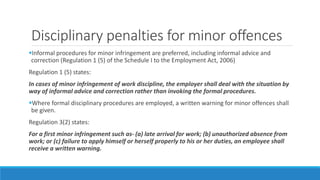
Disciplinary penalties for minor offences
Informal procedures for minor infringement are preferred, including informal advice and
correction (Regulation 1 (5) of the Schedule I to the Employment Act, 2006)
Regulation 1 (5) states:
In cases of minor infringement of work discipline, the employer shall deal with the situation by
way of informal advice and correction rather than invoking the formal procedures.
Where formal disciplinary procedures are employed, a written warning for minor offences shall
be given.
Regulation 3(2) states:
For a first minor infringement such as- (a) late arrival for work; (b) unauthorized absence from
work; or (c) failure to apply himself or herself properly to his or her duties, an employee shall
receive a written warning.
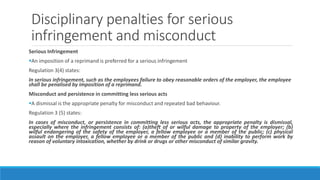
Disciplinary penalties for serious
infringement and misconduct
Serious Infringement
An imposition of a reprimand is preferred for a serious infringement
Regulation 3(4) states:
In serious infringement, such as the employees failure to obey reasonable orders of the employer, the employee
shall be penalised by imposition of a reprimand.
Misconduct and persistence in committing less serious acts
A dismissal is the appropriate penalty for misconduct and repeated bad behaviour.
Regulation 3 (5) states:
In cases of misconduct, or persistence in committing less serious acts, the appropriate penalty is dismissal,
especially where the infringement consists of: (a)theft of or wilful damage to property of the employer; (b)
wilful endangering of the safety of the employer, a fellow employee or a member of the public; (c) physical
assault on the employer, a fellow employee or a member of the public and (d) inability to perform work by
reason of voluntary intoxication, whether by drink or drugs or other misconduct of similar gravity.
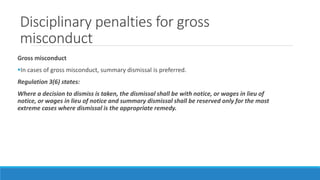
Disciplinary penalties for gross
misconduct
Gross misconduct
In cases of gross misconduct, summary dismissal is preferred.
Regulation 3(6) states:
Where a decision to dismiss is taken, the dismissal shall be with notice, or wages in lieu of
notice, or wages in lieu of notice and summary dismissal shall be reserved only for the most
extreme cases where dismissal is the appropriate remedy.
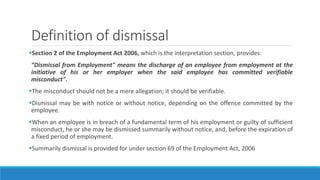
Definition of dismissal
Section 2 of the Employment Act 2006, which is the interpretation section, provides:
“Dismissal from Employment" means the discharge of an employee from employment at the
initiative of his or her employer when the said employee has committed verifiable
misconduct".
The misconduct should not be a mere allegation; it should be verifiable.
Dismissal may be with notice or without notice, depending on the offence committed by the
employee.
When an employee is in breach of a fundamental term of his employment or guilty of sufficient
misconduct, he or she may be dismissed summarily without notice, and, before the expiration of
a fixed period of employment.
Summarily dismissal is provided for under section 69 of the Employment Act, 2006
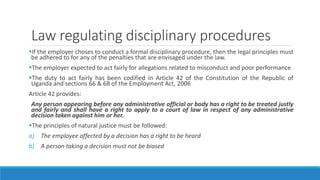
Law regulating disciplinary procedures
If the employer choses to conduct a formal disciplinary procedure, then the legal principles must
be adhered to for any of the penalties that are envisaged under the law.
The employer expected to act fairly for allegations related to misconduct and poor performance
The duty to act fairly has been codified in Article 42 of the Constitution of the Republic of
Uganda and sections 66 & 68 of the Employment Act, 2006
Article 42 provides:
Any person appearing before any administrative official or body has a right to be treated justly
and fairly and shall have a right to apply to a court of law in respect of any administrative
decision taken against him or her.
The principles of natural justice must be followed:
a) The employee affected by a decision has a right to be heard
b) A person taking a decision must not be biased
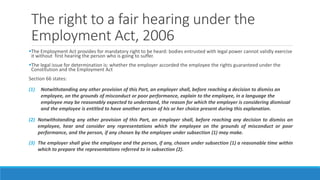
The right to a fair hearing under the
Employment Act, 2006
The Employment Act provides for mandatory right to be heard: bodies entrusted with legal power cannot validly exercise
it without first hearing the person who is going to suffer.
The legal issue for determination is: whether the employer accorded the employee the rights guaranteed under the
Constitution and the Employment Act
Section 66 states:
(1) Notwithstanding any other provision of this Part, an employer shall, before reaching a decision to dismiss an
employee, on the grounds of misconduct or poor performance, explain to the employee, in a language the
employee may be reasonably expected to understand, the reason for which the employer is considering dismissal
and the employee is entitled to have another person of his or her choice present during this explanation.
(2) Notwithstanding any other provision of this Part, an employer shall, before reaching any decision to dismiss an
employee, hear and consider any representations which the employee on the grounds of misconduct or poor
performance, and the person, if any chosen by the employee under subsection (1) may make.
(3) The employer shall give the employee and the person, if any, chosen under subsection (1) a reasonable time within
which to prepare the representations referred to in subsection (2).
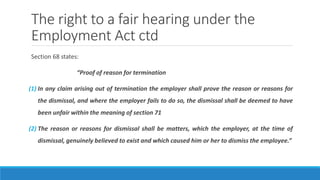
The right to a fair hearing under the
Employment Act ctd
Section 68 states:
“Proof of reason for termination
(1) In any claim arising out of termination the employer shall prove the reason or reasons for
the dismissal, and where the employer fails to do so, the dismissal shall be deemed to have
been unfair within the meaning of section 71
(2) The reason or reasons for dismissal shall be matters, which the employer, at the time of
dismissal, genuinely believed to exist and which caused him or her to dismiss the employee.”
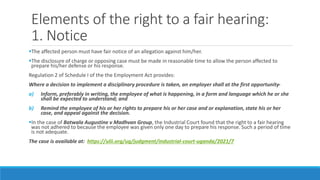
Elements of the right to a fair hearing:
1. Notice
The affected person must have fair notice of an allegation against him/her.
The disclosure of charge or opposing case must be made in reasonable time to allow the person affected to
prepare his/her defense or his response.
Regulation 2 of Schedule I of the the Employment Act provides:
Where a decision to implement a disciplinary procedure is taken, an employer shall at the first opportunity-
a) Inform, preferably in writing, the employee of what is happening, in a form and language which he or she
shall be expected to understand; and
b) Remind the employee of his or her rights to prepare his or her case and or explanation, state his or her
case, and appeal against the decision.
In the case of Batwala Augustine v Madhvan Group, the Industrial Court found that the right to a fair hearing
was not adhered to because the employee was given only one day to prepare his response. Such a period of time
is not adequate.
The case is available at: https://ulii.org/ug/judgment/industrial-court-uganda/2021/7
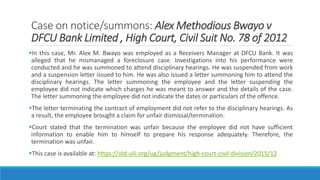
Case on notice/summons: Alex Methodious Bwayo v
DFCU Bank Limited , High Court, Civil Suit No. 78 of 2012
In this case, Mr. Alex M. Bwayo was employed as a Receivers Manager at DFCU Bank. It was
alleged that he mismanaged a foreclosure case. Investigations into his performance were
conducted and he was summoned to attend disciplinary hearings. He was suspended from work
and a suspension letter issued to him. He was also issued a letter summoning him to attend the
disciplinary hearings. The letter summoning the employee and the letter suspending the
employee did not indicate which charges he was meant to answer and the details of the case.
The letter summoning the employee did not indicate the dates or particulars of the offence.
The letter terminating the contract of employment did not refer to the disciplinary hearings. As
a result, the employee brought a claim for unfair dismissal/termination.
Court stated that the termination was unfair because the employee did not have sufficient
information to enable him to himself to prepare his response adequately. Therefore, the
termination was unfair.
This case is available at: https://old.ulii.org/ug/judgment/high-court-civil-division/2015/12
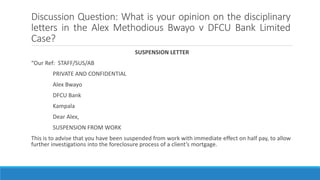
Discussion Question: What is your opinion on the disciplinary
letters in the Alex Methodious Bwayo v DFCU Bank Limited
Case?
SUSPENSION LETTER
“Our Ref: STAFF/SUS/AB
PRIVATE AND CONFIDENTIAL
Alex Bwayo
DFCU Bank
Kampala
Dear Alex,
SUSPENSION FROM WORK
This is to advise that you have been suspended from work with immediate effect on half pay, to allow
further investigations into the foreclosure process of a client’s mortgage.
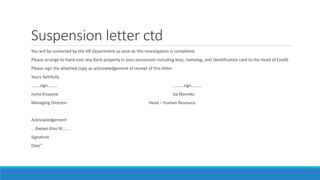
Suspension letter ctd
You will be contacted by the HR Department as soon as this investigation is completed.
Please arrange to hand over any Bank property in your possession including keys, nametag, and identification card to the Head of Credit.
Please sign the attached copy as acknowledgement of receipt of this letter.
Yours faithfully
……..sign……… ……….sign……….
Juma Kisaame Isa Nsereko
Managing Director Head – Human Resource
Acknowledgement
….Bwayo Alex M……..
Signature
Date”
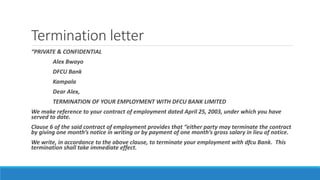
Termination letter
“PRIVATE & CONFIDENTIAL
Alex Bwayo
DFCU Bank
Kampala
Dear Alex,
TERMINATION OF YOUR EMPLOYMENT WITH DFCU BANK LIMITED
We make reference to your contract of employment dated April 25, 2003, under which you have
served to date.
Clause 6 of the said contract of employment provides that “either party may terminate the contract
by giving one month’s notice in writing or by payment of one month’s gross salary in lieu of notice.
We write, in accordance to the above clause, to terminate your employment with dfcu Bank. This
termination shall take immediate effect.
Termination letter
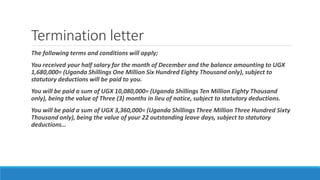
The following terms and conditions will apply;
You received your half salary for the month of December and the balance amounting to UGX
1,680,000= (Uganda Shillings One Million Six Hundred Eighty Thousand only), subject to
statutory deductions will be paid to you.
You will be paid a sum of UGX 10,080,000= (Uganda Shillings Ten Million Eighty Thousand
only), being the value of Three (3) months in lieu of notice, subject to statutory deductions.
You will be paid a sum of UGX 3,360,000= (Uganda Shillings Three Million Three Hundred Sixty
Thousand only), being the value of your 22 outstanding leave days, subject to statutory
deductions…
Termination letter
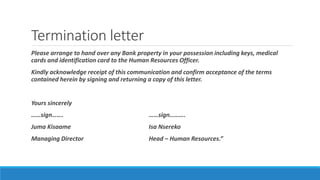
Please arrange to hand over any Bank property in your possession including keys, medical
cards and identification card to the Human Resources Officer.
Kindly acknowledge receipt of this communication and confirm acceptance of the terms
contained herein by signing and returning a copy of this letter.
Yours sincerely
……sign……. ……sign……….
Juma Kisaame Isa Nsereko
Managing Director Head – Human Resources.”
Summon to appear for a disciplinary
hearing
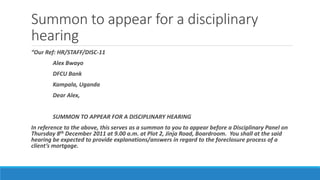
“Our Ref: HR/STAFF/DISC-11
Alex Bwayo
DFCU Bank
Kampala, Uganda
Dear Alex,
SUMMON TO APPEAR FOR A DISCIPLINARY HEARING
In reference to the above, this serves as a summon to you to appear before a Disciplinary Panel on
Thursday 8th December 2011 at 9.00 a.m. at Plot 2, Jinja Road, Boardroom. You shall at the said
hearing be expected to provide explanations/answers in regard to the foreclosure process of a
client’s mortgage.
Summon to appear for a disciplinary
hearing ctd
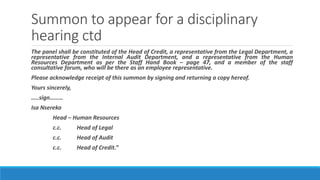
The panel shall be constituted of the Head of Credit, a representative from the Legal Department, a
representative from the Internal Audit Department, and a representative from the Human
Resources Department as per the Staff Hand Book – page 47, and a member of the staff
consultative forum, who will be there as an employee representative.
Please acknowledge receipt of this summon by signing and returning a copy hereof.
Yours sincerely,
…..sign………
Isa Nsereko
Head – Human Resources
c.c. Head of Legal
c.c. Head of Audit
c.c. Head of Credit.”
Court observations on the three letters
A perusal of the above two letters reveals that the suspension letter did not mention which
client’s foreclosure process the plaintiff was being suspended for.
Suspension, and indeed termination of employment, is a very serious matter which an employer
should take seriously and be very sensitive about, as it renders an employee jobless with
reduced, or no income at all. A lot more people are affected especially the employees
immediate defendants, and they end up suffering greatly when termination is effected, rightly or
wrongly. The employer ought, therefore, to put on a human face while dealing with such
matters that have an adverse effect on an individual.
Surely a whole Managing Director and Head, Human Resource of a Bank could do better than
sign a letter which does not portray the seriousness of what it is supposed to communicate.
Again, like the suspension letter, this letter [summons] also refers to a client’s mortgage. No
client’s name is given; neither are the particulars of the offence; or the dates when the alleged
offences were committed.
Court observations
The basics of a right to be heard must of necessity include:
a) Notice of allegations against the employee to be served on him within reasonable time to
allow him prepare his defence.
b) The notice has to set out clearly what allegations against the plaintiff are and what his rights
are at the oral hearing. Such rights would include the right to respond to the allegations against
him orally or in writing; the right to be accompanied at the hearing and the right to cross-
examine the defendant’s witnesses or call witnesses of his own.
In this case, there was no detailed account or any account of the allegations against the plaintiff
provided by the defendant in the letter inviting him for the disciplinary hearing.
Court observations on what amounts to a fair hearing citing
the case of Uganda Breweries Ltd v Robert Kigula, Court of
Appeal, Civil Appeal No.0183/2016
“……. It is an elementary principle in our system of the administration of justice
that a fair hearing, within a reasonable time, is ordinarily a judicial investigation
and listening to evidence and arguments, conducted impartially in accordance
with the fundamental principles of justice and due process of law of which a
party has had reasonable motion as to the time, place, and issues or charges, for
which he has had a reasonable opportunity to prepare, at which he is permitted
to have the assistance of a Lawyer of his choice as he may afford and during
which he has a right to present his witnesses and evidence in his favour, a right
to cross-examine his adversary’s witnesses, a right to be appraised of the
evidence against him in the matter, so that he will be fully aware of the basis of
the adverse view of him for the judgment, a right to argue that a decision be
made in accordance with the law and evidence.”
2. The right to know the opposing case
The right to be heard must carry with it a right of the accused person to know
the case which is brought against him/her.
He/she must know what evidence has been given, what statements have been
made affecting him/her
He/she must be given a fair opportunity to correct or contradict them.
Therefore, any evidence and witness against the person must be known to
him/her
3. Adjournment
The affected person should be allowed an adjournment
when requested for.
Failure to allow an adjournment may amount to failure to
give a hearing and thus a failure of natural justice.
4. Disciplinary hearing: An oral hearing/face to
face hearing/online hearing
The right to a fair hearing might require the decision maker to offer an oral hearing, depending
on the circumstances.
Sometimes written arguments or submissions may do.
According to DFCU Bank Ltd v Donna Kamuli, Court of Appeal, Civil Appeal No. 121 of 2016, the
hearing can be conducted either through correspondences or through face to face hearing. The
court relied on the case of Isaiah Gikumu v Manengai Oil Refineries Ltd Cause No. 296 of 2014
(Kenya High Court) where it was held that the hearing contemplated by Section 41 of the
Employment Act, 2007 (which is identical to our Section 66 of the Employment Act. 2006
(Uganda law)) did not require an employer to hold a mini court. The hearing can be conducted
either through correspondences or through face to face hearing.
Copy of the Kenya Employment Act is available:
http://kenyalaw.org/kl/fileadmin/pdfdownloads/Acts/EmploymentAct_Cap226-
No11of2007_01.pdf
Case on disciplinary hearings that result into a summary
dismissal: Uganda Breweries Ltd v Robert Kigula, Court of
Appeal, Civil Appeal No.0183/2016
In this case, Mr. Robert Kigula, the employee was employed as a regional
market manager at Uganda Nile Breweries Ltd. Customers alleged that the
employee was involved in fraudulent activities.
During the disciplinary hearings, the employee was not allowed to view the
written evidence against him and his request to have the customers who alleged
that he had received bribes to appear and testify at the disciplinary hearing was
denied. He brought a claim for unfair summary dismissal.
Court stated that there was no material evidence before the disciplinary
committee on which it would base itself to find the employee guilty of of
conduct which warranted summary dismissal. Therefore, the dismissal was
unfair because the employee was not given an opportunity to cross-examine the
witnesses.
Further court observations in Uganda Breweries Ltd v Robert
Kigula, Court of Appeal, Civil Appeal No.0183/2016
Procedure fairness is provided for in section 66 of the Employment Act, 2006.
The said provision lays down the minimum procedural fairness requirements which must be accorded
to an employee on grounds on grounds of misconduct is reached.
There is an additional requirement under the Employment Act, 2006 that the gross misconduct of the
employee for which summary dismissal is being considered by the employer is verifiable.
In other words, the allegations must be proved to a reasonable standard.
This is akin to the judicial process where liability would have to be established against the employee by
taking evidence against him or her,
In the this case, the employee ought to have called exporters from whom the employer had allegedly
received bribed, have them give evidence against the employee; and also give the employee an
opportunity to put questions to them. Thereafter, a decision would then be made on the strength of
the evidence of the exporters. However, none of the said exporters were presented at the disciplinary
hearing.
5. Witnesses
Natural justice may be infringed where a person is not
allowed to call witnesses in support of his case.
This may entail having a right to cross examine and know
the complainant, especially in cases of gross misconduct.
6. Legal Representation
The right to a fair hearing may entail the right to legal representation though it
may not be necessary in certain cases.
However, the right to legal representation should be allowed where the case
concerns a person’s reputation and livelihood.
7. The duty to give reasons
It is generally accepted that fairness in administration
includes the duty to give reasons for decisions.
Giving reasons is one of the fundamentals of good
administration.
Fair play requires that the parties concerned should know
why the particular decision was taken.
8. Rule against bias
There are two major aspects of this rule:
1. The adjudicator, who is usually the decision maker or disciplinary body members, must not
have any financial or proprietary interest in the outcome of the proceedings. No matter how
small the adjudicator’s financial interest maybe, or no matter how unlikely if it is to affect his
judgment, he/she is disqualified from taking part in the hearing and any decisions which he/she
makes will be set aside. A person with financial interests is conclusively presumed to be biased.
2. The adjudicator must not be reasonably suspected of or show a real likelihood of bias. For
example, where there is a relationship between the adjudicator and one of the parties which
might lead to a biased decision.
Case on the rule against bias: Action Aid Uganda v David
Mbarekye Tibekinga, Labour Dispute Appeal No.028/2016
In this case, the employee refused to attend the disciplinary proceedings. He was of the view that the
disciplinary committee appointed by the employer was biased. Court stated that the committee was
right to proceed in the employee’s absence. The employee should have shared his side of the
allegations before the committee after his misgivings being put on the record. Instead, he requested
the employer to appoint another committee, which court did not find necessary.
Court observed:
“It is not acceptable, in our considered view, that a person appearing before such a tribunal after
raising his/her concerns about the impartiality of the tribunal, that he/she marches in protest out
of the proceedings because he/she believes the outcome will be biased. The proper course of
action to take is for the party alleging bias to proceed after being overruled, and provide a defense
to the allegation for the “biased” committee to consider and thereafter use the appeal process to
overturn the decision of the tribunal on grounds that it was biased.”
This case is available at: https://ulii.org/ug/judgment/industrial-court-uganda/2019/12
Informal conversations between the employee and the supervisor do not amount to
a disciplinary hearing: Grace Tibihikirra Makoko v Standard Chartered Bank(U) Ltd ,
Labour Dispute Reference No. 315 Of 2015 (Uganda Industrial Court)
In this case, the employee, Grace Tibihikira Makoko, was employed as Regional Head of Financial
Markets and wholesale Banking for East Africa by Standard Chartered Bank. In 2014, she was
given a good performance rating. However, the following year, her contract was terminated
without a disciplinary hearing and before her formal assessment and implementation of a
performance improvement plan, she had been forced to undertake. The employer alleged that
there were discussions about her performance with her supervisor, which, in the employer’s
opinion amounted to a disciplinary hearing.
Court stated that informal conversations with the supervisor did not amount to a disciplinary
hearing. It stated that the informal conversations should have escalated into formal disciplinary
procedures, but there was no evidence of any disciplinary process on the record.
Therefore, the termination of the contract of employment was unfair.
This case is available at: https://ulii.org/ug/judgment/industrial-court-uganda/2020/37
Contents of disciplinary letters
1. Letter must contain enough information to enable the employee to
respond fully, for example, indicate which charges the employee is/was
meant to answer and the details of the case, relevant dates and
particulars of the offence
2. Be very specific with your allegations. Do not make vague references to
a breach of policy or a claim. Keep allegations short and clear. Use clear
language.
3. Provide copies of any written evidence to the employee, for example,
minutes of relevant meetings.
4. Give a time and venue for meeting and remind the employee of his or
her rights under the law.
Tips on conducting disciplinary meetings
Allow employee reasonable time to prepare his or her case. What amounts to reasonable time
depends on the gravity of the allegation.
Remind the employee of his or her rights to prepare his or her case and or explanation, state his or
her case, and appeal against the decision.
Employees should be encouraged to attend the meetings.
Deal with adjournments without delay. If the the employee asks for adjournment, grant it once or
twice for a couple of days, unless the reason is unreasonable.
Prepare for the meetings. Have everything you intend to rely on in advance. Know what you are going
to be putting to the employee.
Have a note-taker present to keep accurate and complete notes or record the meeting.
At the meeting, explain the disciplinary allegations to the employee and go through the evidence.
Allow the employee to go through all the evidence and invite the employee to respond to each
allegation and point that is being made.
Tips on conducting disciplinary meetings
Take careful notes of the employees responses and ask follow-up questions, if necessary. (conduct a mini-cross-
examination, if necessary).
Do not argue with the employee.
10. Do not give a decision immediately after or during the meeting. Let the employee know that the decision shall
be made and communicated to him or her later.
Give the employee a reasonable opportunity to respond to the employer’s case, ask questions and present his or
her evidence.
In cases that will result into summary dismissal, the employees have a right to cross-examine witnesses.
If employees fail to attend, adjourn a few times and then consider alternative methods of holding a meeting, for
example, through email correspondences, especially if they totally refuse to attend the meeting. It is better than
not holding a hearing at all
Read the case of Action Aid Uganda v David Mbarekye Tibekinga, Labour Dispute Appeal No.028/2016:
https://ulii.org/ug/judgment/industrial-court-uganda/2019/12 on actions to take when the employee refuses to
attend the meetings due to bias.
Tips on handling disciplinary cases
1. Always keep accurate written records of all important meetings and conversations, just in
case employees are secretly recording any meetings and conversations, to avoid
contradictions between the records of the disciplinary proceedings and the recordings of the
employee.
2. Raise and deal with issues promptly. Keep the times between meetings reasonably short.
3. If you are a line manager and you need more details on the case or proceedings, ask HR for
help
4. There has to be a fair reason for dismissal
5. Follow the proper procedure
6. The sanction imposed must be reasonable and proportionate to the allegation or offence.
When to skip disciplinary hearings for
misconduct or poor performance
1. Where the dismissal brings to an end a probationary contract.
Section 67 (1) of the Employment Act provides:
Section 66 [provides for a mandatory right to be heard ] does not apply where a dismissal
brings to an end a probationary contract
2. Where the employee being dismissed has not been continuously employed for at least thirteen
weeks immediately before the dismissal or termination of a contract of employment.
Section 71 (1) of the Employment Act provides:
An employee who has been continuously employed by his or her employer for at least thirteen
weeks immediately before the date of termination, shall have the right to complain that he or
she has been unfairly terminated.
Disciplinary Procedures. In employmentpptx

Disciplinary Procedures. In employmentpptx

  • 1.
    COURSE UNIT 4:5DISCIPLINARY PROCEDURES CarolineKalagala Kanyago SchoolofLaw,Uganda Christian University
  • 2.
    Course Outline Aims andobjectives of “Discipline” Discipline under the Employment Act, 2006 What amount to misconduct and gross misconduct Definition of dismissal Law regulating disciplinary procedures
  • 3.
    Aims and objectivesof “Discipline” Discipline is the penalty imposed by an employer because of neglect, failure or alleged failure on the part of an employee to carry out his or her duties under his or her contract of service.  See: Section 62 of the Employment Act, 2006 & the First Schedule to the Act: Disciplinary Code. The Employment Act, 2006 is available at: https://old.ulii.org/ug/legislation/act/2015/2006-3 Discipline is a punishment that is intended to correct or instruct, especially a sanction imposed after a finding of misconduct or poor performance.
  • 4.
    Employee misconduct A failureof the employee to fulfil his or her duties under the contract of employment; unlawful or improper behaviour (See: Blacks Law Dictionary). Misconduct includes but is not limited to: a) abuse of office, b) negligence, c) insubordination, and d) All those circumstances that impute fault on the part of the employee which include incompetence. The above list was provided by the Industrial Court in the case of Benon H. Kanyangoga & Ors v Bank of Uganda, Labour Dispute Claim No.080 of 2014. This case is available at: https://ulii.org/ug/judgment/industrial-court- uganda/2016/22 Regulation 3 (5) of Schedule I of the Employment Act, 2006, Disciplinary Code, provides examples of misconduct. The Employment Act, 2006 is available at: https://old.ulii.org/ug/legislation/act/2015/2006-3
  • 5.
    What amounts togross misconduct? Behaviour that repudiates or flouts an essential condition of a contract of employment, for example, wilful disobedience of any lawful and reasonable orders of the employer For an act to amount to gross misconduct, the misconduct must be so grave that the there is a complete breakdown in the employer- employee relationship. It has to be a fundamental breach of the terms and conditions of the contract of employment.
  • 6.
    Misconduct outside workinghours The general rule is that an employer has no jurisdiction or competency to discipline an employee for conduct that is not work related which occurs after working hours and away from the workplace. However, the employer can disciple the employee provided the employer establishes the necessary connection between the misconduct, if any, and its business. Regulation 3(9) of the Disciplinary Code, Schedule I of the Employment Act states: The fact that an employee is charged with, or remanded in custody or is convicted of a criminal offence for an act committed outside working hours shall not automatically give rise to a dismissal or other disciplinary action and consideration in such cases shall always be given to the extent to which such a conviction shall make the employee unsuitable for his or her work.
  • 7.
    Case on misconductoutside working hours: Edcon Ltd v Ms. Teresa Cantamessa & Ors, Case No. JR 30/17, Labour Court of South Africa In this case, the employee, Ms. Teresa Cantamessa, while on leave, using a personal laptop and data, posted a racist comment on her personal Facebook page. However, her profile information indicated that she worked with Edcon Ltd. The post followed the South African President Zuma’s reshuffles. Some South Africans were unhappy and this saw several demonstrations. The post read: "Watching Carte Blanch and listening to these fucking stupid monkeys running our country and how everyone makes excuses for that stupid man we have to call a president... President my fucking ass!! #zumamustfall This makes me crazy ass mad." (sic). One of the clients (potential) wrote to the company complaining about the “racist” comments made by their employee when she referred to the black leaders as “monkeys”. The employer conducted a disciplinary inquiry and decided to summarily dismiss the employee. The employee brought a claim for unfair dismissal. The Labour Court observed that the fact that the profile indicated that Ms. Teresa was working with Edcon Ltd exposed the employer to reputational risk. The comment was a highly offensive remark in respect of which Edcon was entitled to take disciplinary measures, lest its name be put into disrepute for tolerating racism. Therefore , the dismissal was fair since the comment could be linked to the employer’s business because the employer had black customers. This case is available at: https://www.saflii.org/za/cases/ZALCJHB/2019/273.html
  • 8.
    Progressive discipline underthe Employment Act, 2006 If the employee is found guilty of misconduct, the employer can dismiss the employee or impose any lesser punishment which the employer will deem fit and just. The First Schedule of the Employment Act provides for progressive discipline. Regulation 3 (2) of Schedule I to the Employment Act states: An employee is not liable to have his or her employment terminated on the commission of a first disciplinary infringement, except in exceptional circumstances, and dismissal for misconduct shall be reserved for cases of serious or repeated infringement of disciplinary rules A verbal warning, written warning and then a final warning are the usual steps. Regulation 3(7) states: Under normal circumstances, a dismissal shall not be imposed as a penalty without the employee having received a final written warning that he or she was in danger of losing his or her job because of his or her conduct and before deciding on dismissal as the appropriate penalty, an employer shall first consider alternative penalties including loss of privileges, job transfer, or suspension. However, there are instances where the employer must skip the progressive disciplinary approach, and dismiss the employee, for example, in cases of gross misconduct.
  • 9.
    Disciplinary penalties Disciplinary penaltiesinclude: a) Written warning b) Reprimand c) Suspension from work d) Dismissal Refer to Sections 62& 63 of the Employment Act and the Code of Discipline Set out in Schedule I of the Employment Act.
  • 10.
    Disciplinary penalties forminor offences Informal procedures for minor infringement are preferred, including informal advice and correction (Regulation 1 (5) of the Schedule I to the Employment Act, 2006) Regulation 1 (5) states: In cases of minor infringement of work discipline, the employer shall deal with the situation by way of informal advice and correction rather than invoking the formal procedures. Where formal disciplinary procedures are employed, a written warning for minor offences shall be given. Regulation 3(2) states: For a first minor infringement such as- (a) late arrival for work; (b) unauthorized absence from work; or (c) failure to apply himself or herself properly to his or her duties, an employee shall receive a written warning.
  • 11.
    Disciplinary penalties forserious infringement and misconduct Serious Infringement An imposition of a reprimand is preferred for a serious infringement Regulation 3(4) states: In serious infringement, such as the employees failure to obey reasonable orders of the employer, the employee shall be penalised by imposition of a reprimand. Misconduct and persistence in committing less serious acts A dismissal is the appropriate penalty for misconduct and repeated bad behaviour. Regulation 3 (5) states: In cases of misconduct, or persistence in committing less serious acts, the appropriate penalty is dismissal, especially where the infringement consists of: (a)theft of or wilful damage to property of the employer; (b) wilful endangering of the safety of the employer, a fellow employee or a member of the public; (c) physical assault on the employer, a fellow employee or a member of the public and (d) inability to perform work by reason of voluntary intoxication, whether by drink or drugs or other misconduct of similar gravity.
  • 12.
    Disciplinary penalties forgross misconduct Gross misconduct In cases of gross misconduct, summary dismissal is preferred. Regulation 3(6) states: Where a decision to dismiss is taken, the dismissal shall be with notice, or wages in lieu of notice, or wages in lieu of notice and summary dismissal shall be reserved only for the most extreme cases where dismissal is the appropriate remedy.
  • 13.
    Definition of dismissal Section2 of the Employment Act 2006, which is the interpretation section, provides: “Dismissal from Employment" means the discharge of an employee from employment at the initiative of his or her employer when the said employee has committed verifiable misconduct". The misconduct should not be a mere allegation; it should be verifiable. Dismissal may be with notice or without notice, depending on the offence committed by the employee. When an employee is in breach of a fundamental term of his employment or guilty of sufficient misconduct, he or she may be dismissed summarily without notice, and, before the expiration of a fixed period of employment. Summarily dismissal is provided for under section 69 of the Employment Act, 2006
  • 14.
    Law regulating disciplinaryprocedures If the employer choses to conduct a formal disciplinary procedure, then the legal principles must be adhered to for any of the penalties that are envisaged under the law. The employer expected to act fairly for allegations related to misconduct and poor performance The duty to act fairly has been codified in Article 42 of the Constitution of the Republic of Uganda and sections 66 & 68 of the Employment Act, 2006 Article 42 provides: Any person appearing before any administrative official or body has a right to be treated justly and fairly and shall have a right to apply to a court of law in respect of any administrative decision taken against him or her. The principles of natural justice must be followed: a) The employee affected by a decision has a right to be heard b) A person taking a decision must not be biased
  • 15.
    The right toa fair hearing under the Employment Act, 2006 The Employment Act provides for mandatory right to be heard: bodies entrusted with legal power cannot validly exercise it without first hearing the person who is going to suffer. The legal issue for determination is: whether the employer accorded the employee the rights guaranteed under the Constitution and the Employment Act Section 66 states: (1) Notwithstanding any other provision of this Part, an employer shall, before reaching a decision to dismiss an employee, on the grounds of misconduct or poor performance, explain to the employee, in a language the employee may be reasonably expected to understand, the reason for which the employer is considering dismissal and the employee is entitled to have another person of his or her choice present during this explanation. (2) Notwithstanding any other provision of this Part, an employer shall, before reaching any decision to dismiss an employee, hear and consider any representations which the employee on the grounds of misconduct or poor performance, and the person, if any chosen by the employee under subsection (1) may make. (3) The employer shall give the employee and the person, if any, chosen under subsection (1) a reasonable time within which to prepare the representations referred to in subsection (2).
  • 16.
    The right toa fair hearing under the Employment Act ctd Section 68 states: “Proof of reason for termination (1) In any claim arising out of termination the employer shall prove the reason or reasons for the dismissal, and where the employer fails to do so, the dismissal shall be deemed to have been unfair within the meaning of section 71 (2) The reason or reasons for dismissal shall be matters, which the employer, at the time of dismissal, genuinely believed to exist and which caused him or her to dismiss the employee.”
  • 17.
    Elements of theright to a fair hearing: 1. Notice The affected person must have fair notice of an allegation against him/her. The disclosure of charge or opposing case must be made in reasonable time to allow the person affected to prepare his/her defense or his response. Regulation 2 of Schedule I of the the Employment Act provides: Where a decision to implement a disciplinary procedure is taken, an employer shall at the first opportunity- a) Inform, preferably in writing, the employee of what is happening, in a form and language which he or she shall be expected to understand; and b) Remind the employee of his or her rights to prepare his or her case and or explanation, state his or her case, and appeal against the decision. In the case of Batwala Augustine v Madhvan Group, the Industrial Court found that the right to a fair hearing was not adhered to because the employee was given only one day to prepare his response. Such a period of time is not adequate. The case is available at: https://ulii.org/ug/judgment/industrial-court-uganda/2021/7
  • 18.
    Case on notice/summons:Alex Methodious Bwayo v DFCU Bank Limited , High Court, Civil Suit No. 78 of 2012 In this case, Mr. Alex M. Bwayo was employed as a Receivers Manager at DFCU Bank. It was alleged that he mismanaged a foreclosure case. Investigations into his performance were conducted and he was summoned to attend disciplinary hearings. He was suspended from work and a suspension letter issued to him. He was also issued a letter summoning him to attend the disciplinary hearings. The letter summoning the employee and the letter suspending the employee did not indicate which charges he was meant to answer and the details of the case. The letter summoning the employee did not indicate the dates or particulars of the offence. The letter terminating the contract of employment did not refer to the disciplinary hearings. As a result, the employee brought a claim for unfair dismissal/termination. Court stated that the termination was unfair because the employee did not have sufficient information to enable him to himself to prepare his response adequately. Therefore, the termination was unfair. This case is available at: https://old.ulii.org/ug/judgment/high-court-civil-division/2015/12
  • 19.
    Discussion Question: Whatis your opinion on the disciplinary letters in the Alex Methodious Bwayo v DFCU Bank Limited Case? SUSPENSION LETTER “Our Ref: STAFF/SUS/AB PRIVATE AND CONFIDENTIAL Alex Bwayo DFCU Bank Kampala Dear Alex, SUSPENSION FROM WORK This is to advise that you have been suspended from work with immediate effect on half pay, to allow further investigations into the foreclosure process of a client’s mortgage.
  • 20.
    Suspension letter ctd Youwill be contacted by the HR Department as soon as this investigation is completed. Please arrange to hand over any Bank property in your possession including keys, nametag, and identification card to the Head of Credit. Please sign the attached copy as acknowledgement of receipt of this letter. Yours faithfully ……..sign……… ……….sign………. Juma Kisaame Isa Nsereko Managing Director Head – Human Resource Acknowledgement ….Bwayo Alex M…….. Signature Date”
  • 21.
    Termination letter “PRIVATE &CONFIDENTIAL Alex Bwayo DFCU Bank Kampala Dear Alex, TERMINATION OF YOUR EMPLOYMENT WITH DFCU BANK LIMITED We make reference to your contract of employment dated April 25, 2003, under which you have served to date. Clause 6 of the said contract of employment provides that “either party may terminate the contract by giving one month’s notice in writing or by payment of one month’s gross salary in lieu of notice. We write, in accordance to the above clause, to terminate your employment with dfcu Bank. This termination shall take immediate effect.
  • 22.
    Termination letter The followingterms and conditions will apply; You received your half salary for the month of December and the balance amounting to UGX 1,680,000= (Uganda Shillings One Million Six Hundred Eighty Thousand only), subject to statutory deductions will be paid to you. You will be paid a sum of UGX 10,080,000= (Uganda Shillings Ten Million Eighty Thousand only), being the value of Three (3) months in lieu of notice, subject to statutory deductions. You will be paid a sum of UGX 3,360,000= (Uganda Shillings Three Million Three Hundred Sixty Thousand only), being the value of your 22 outstanding leave days, subject to statutory deductions…
  • 23.
    Termination letter Please arrangeto hand over any Bank property in your possession including keys, medical cards and identification card to the Human Resources Officer. Kindly acknowledge receipt of this communication and confirm acceptance of the terms contained herein by signing and returning a copy of this letter. Yours sincerely ……sign……. ……sign………. Juma Kisaame Isa Nsereko Managing Director Head – Human Resources.”
  • 24.
    Summon to appearfor a disciplinary hearing “Our Ref: HR/STAFF/DISC-11 Alex Bwayo DFCU Bank Kampala, Uganda Dear Alex, SUMMON TO APPEAR FOR A DISCIPLINARY HEARING In reference to the above, this serves as a summon to you to appear before a Disciplinary Panel on Thursday 8th December 2011 at 9.00 a.m. at Plot 2, Jinja Road, Boardroom. You shall at the said hearing be expected to provide explanations/answers in regard to the foreclosure process of a client’s mortgage.
  • 25.
    Summon to appearfor a disciplinary hearing ctd The panel shall be constituted of the Head of Credit, a representative from the Legal Department, a representative from the Internal Audit Department, and a representative from the Human Resources Department as per the Staff Hand Book – page 47, and a member of the staff consultative forum, who will be there as an employee representative. Please acknowledge receipt of this summon by signing and returning a copy hereof. Yours sincerely, …..sign……… Isa Nsereko Head – Human Resources c.c. Head of Legal c.c. Head of Audit c.c. Head of Credit.”
  • 26.
    Court observations onthe three letters A perusal of the above two letters reveals that the suspension letter did not mention which client’s foreclosure process the plaintiff was being suspended for. Suspension, and indeed termination of employment, is a very serious matter which an employer should take seriously and be very sensitive about, as it renders an employee jobless with reduced, or no income at all. A lot more people are affected especially the employees immediate defendants, and they end up suffering greatly when termination is effected, rightly or wrongly. The employer ought, therefore, to put on a human face while dealing with such matters that have an adverse effect on an individual. Surely a whole Managing Director and Head, Human Resource of a Bank could do better than sign a letter which does not portray the seriousness of what it is supposed to communicate. Again, like the suspension letter, this letter [summons] also refers to a client’s mortgage. No client’s name is given; neither are the particulars of the offence; or the dates when the alleged offences were committed.
  • 27.
    Court observations The basicsof a right to be heard must of necessity include: a) Notice of allegations against the employee to be served on him within reasonable time to allow him prepare his defence. b) The notice has to set out clearly what allegations against the plaintiff are and what his rights are at the oral hearing. Such rights would include the right to respond to the allegations against him orally or in writing; the right to be accompanied at the hearing and the right to cross- examine the defendant’s witnesses or call witnesses of his own. In this case, there was no detailed account or any account of the allegations against the plaintiff provided by the defendant in the letter inviting him for the disciplinary hearing.
  • 28.
    Court observations onwhat amounts to a fair hearing citing the case of Uganda Breweries Ltd v Robert Kigula, Court of Appeal, Civil Appeal No.0183/2016 “……. It is an elementary principle in our system of the administration of justice that a fair hearing, within a reasonable time, is ordinarily a judicial investigation and listening to evidence and arguments, conducted impartially in accordance with the fundamental principles of justice and due process of law of which a party has had reasonable motion as to the time, place, and issues or charges, for which he has had a reasonable opportunity to prepare, at which he is permitted to have the assistance of a Lawyer of his choice as he may afford and during which he has a right to present his witnesses and evidence in his favour, a right to cross-examine his adversary’s witnesses, a right to be appraised of the evidence against him in the matter, so that he will be fully aware of the basis of the adverse view of him for the judgment, a right to argue that a decision be made in accordance with the law and evidence.”
  • 29.
    2. The rightto know the opposing case The right to be heard must carry with it a right of the accused person to know the case which is brought against him/her. He/she must know what evidence has been given, what statements have been made affecting him/her He/she must be given a fair opportunity to correct or contradict them. Therefore, any evidence and witness against the person must be known to him/her
  • 30.
    3. Adjournment The affectedperson should be allowed an adjournment when requested for. Failure to allow an adjournment may amount to failure to give a hearing and thus a failure of natural justice.
  • 31.
    4. Disciplinary hearing:An oral hearing/face to face hearing/online hearing The right to a fair hearing might require the decision maker to offer an oral hearing, depending on the circumstances. Sometimes written arguments or submissions may do. According to DFCU Bank Ltd v Donna Kamuli, Court of Appeal, Civil Appeal No. 121 of 2016, the hearing can be conducted either through correspondences or through face to face hearing. The court relied on the case of Isaiah Gikumu v Manengai Oil Refineries Ltd Cause No. 296 of 2014 (Kenya High Court) where it was held that the hearing contemplated by Section 41 of the Employment Act, 2007 (which is identical to our Section 66 of the Employment Act. 2006 (Uganda law)) did not require an employer to hold a mini court. The hearing can be conducted either through correspondences or through face to face hearing. Copy of the Kenya Employment Act is available: http://kenyalaw.org/kl/fileadmin/pdfdownloads/Acts/EmploymentAct_Cap226- No11of2007_01.pdf
  • 32.
    Case on disciplinaryhearings that result into a summary dismissal: Uganda Breweries Ltd v Robert Kigula, Court of Appeal, Civil Appeal No.0183/2016 In this case, Mr. Robert Kigula, the employee was employed as a regional market manager at Uganda Nile Breweries Ltd. Customers alleged that the employee was involved in fraudulent activities. During the disciplinary hearings, the employee was not allowed to view the written evidence against him and his request to have the customers who alleged that he had received bribes to appear and testify at the disciplinary hearing was denied. He brought a claim for unfair summary dismissal. Court stated that there was no material evidence before the disciplinary committee on which it would base itself to find the employee guilty of of conduct which warranted summary dismissal. Therefore, the dismissal was unfair because the employee was not given an opportunity to cross-examine the witnesses.
  • 33.
    Further court observationsin Uganda Breweries Ltd v Robert Kigula, Court of Appeal, Civil Appeal No.0183/2016 Procedure fairness is provided for in section 66 of the Employment Act, 2006. The said provision lays down the minimum procedural fairness requirements which must be accorded to an employee on grounds on grounds of misconduct is reached. There is an additional requirement under the Employment Act, 2006 that the gross misconduct of the employee for which summary dismissal is being considered by the employer is verifiable. In other words, the allegations must be proved to a reasonable standard. This is akin to the judicial process where liability would have to be established against the employee by taking evidence against him or her, In the this case, the employee ought to have called exporters from whom the employer had allegedly received bribed, have them give evidence against the employee; and also give the employee an opportunity to put questions to them. Thereafter, a decision would then be made on the strength of the evidence of the exporters. However, none of the said exporters were presented at the disciplinary hearing.
  • 34.
    5. Witnesses Natural justicemay be infringed where a person is not allowed to call witnesses in support of his case. This may entail having a right to cross examine and know the complainant, especially in cases of gross misconduct.
  • 35.
    6. Legal Representation Theright to a fair hearing may entail the right to legal representation though it may not be necessary in certain cases. However, the right to legal representation should be allowed where the case concerns a person’s reputation and livelihood.
  • 36.
    7. The dutyto give reasons It is generally accepted that fairness in administration includes the duty to give reasons for decisions. Giving reasons is one of the fundamentals of good administration. Fair play requires that the parties concerned should know why the particular decision was taken.
  • 37.
    8. Rule againstbias There are two major aspects of this rule: 1. The adjudicator, who is usually the decision maker or disciplinary body members, must not have any financial or proprietary interest in the outcome of the proceedings. No matter how small the adjudicator’s financial interest maybe, or no matter how unlikely if it is to affect his judgment, he/she is disqualified from taking part in the hearing and any decisions which he/she makes will be set aside. A person with financial interests is conclusively presumed to be biased. 2. The adjudicator must not be reasonably suspected of or show a real likelihood of bias. For example, where there is a relationship between the adjudicator and one of the parties which might lead to a biased decision.
  • 38.
    Case on therule against bias: Action Aid Uganda v David Mbarekye Tibekinga, Labour Dispute Appeal No.028/2016 In this case, the employee refused to attend the disciplinary proceedings. He was of the view that the disciplinary committee appointed by the employer was biased. Court stated that the committee was right to proceed in the employee’s absence. The employee should have shared his side of the allegations before the committee after his misgivings being put on the record. Instead, he requested the employer to appoint another committee, which court did not find necessary. Court observed: “It is not acceptable, in our considered view, that a person appearing before such a tribunal after raising his/her concerns about the impartiality of the tribunal, that he/she marches in protest out of the proceedings because he/she believes the outcome will be biased. The proper course of action to take is for the party alleging bias to proceed after being overruled, and provide a defense to the allegation for the “biased” committee to consider and thereafter use the appeal process to overturn the decision of the tribunal on grounds that it was biased.” This case is available at: https://ulii.org/ug/judgment/industrial-court-uganda/2019/12
  • 39.
    Informal conversations betweenthe employee and the supervisor do not amount to a disciplinary hearing: Grace Tibihikirra Makoko v Standard Chartered Bank(U) Ltd , Labour Dispute Reference No. 315 Of 2015 (Uganda Industrial Court) In this case, the employee, Grace Tibihikira Makoko, was employed as Regional Head of Financial Markets and wholesale Banking for East Africa by Standard Chartered Bank. In 2014, she was given a good performance rating. However, the following year, her contract was terminated without a disciplinary hearing and before her formal assessment and implementation of a performance improvement plan, she had been forced to undertake. The employer alleged that there were discussions about her performance with her supervisor, which, in the employer’s opinion amounted to a disciplinary hearing. Court stated that informal conversations with the supervisor did not amount to a disciplinary hearing. It stated that the informal conversations should have escalated into formal disciplinary procedures, but there was no evidence of any disciplinary process on the record. Therefore, the termination of the contract of employment was unfair. This case is available at: https://ulii.org/ug/judgment/industrial-court-uganda/2020/37
  • 40.
    Contents of disciplinaryletters 1. Letter must contain enough information to enable the employee to respond fully, for example, indicate which charges the employee is/was meant to answer and the details of the case, relevant dates and particulars of the offence 2. Be very specific with your allegations. Do not make vague references to a breach of policy or a claim. Keep allegations short and clear. Use clear language. 3. Provide copies of any written evidence to the employee, for example, minutes of relevant meetings. 4. Give a time and venue for meeting and remind the employee of his or her rights under the law.
  • 41.
    Tips on conductingdisciplinary meetings Allow employee reasonable time to prepare his or her case. What amounts to reasonable time depends on the gravity of the allegation. Remind the employee of his or her rights to prepare his or her case and or explanation, state his or her case, and appeal against the decision. Employees should be encouraged to attend the meetings. Deal with adjournments without delay. If the the employee asks for adjournment, grant it once or twice for a couple of days, unless the reason is unreasonable. Prepare for the meetings. Have everything you intend to rely on in advance. Know what you are going to be putting to the employee. Have a note-taker present to keep accurate and complete notes or record the meeting. At the meeting, explain the disciplinary allegations to the employee and go through the evidence. Allow the employee to go through all the evidence and invite the employee to respond to each allegation and point that is being made.
  • 42.
    Tips on conductingdisciplinary meetings Take careful notes of the employees responses and ask follow-up questions, if necessary. (conduct a mini-cross- examination, if necessary). Do not argue with the employee. 10. Do not give a decision immediately after or during the meeting. Let the employee know that the decision shall be made and communicated to him or her later. Give the employee a reasonable opportunity to respond to the employer’s case, ask questions and present his or her evidence. In cases that will result into summary dismissal, the employees have a right to cross-examine witnesses. If employees fail to attend, adjourn a few times and then consider alternative methods of holding a meeting, for example, through email correspondences, especially if they totally refuse to attend the meeting. It is better than not holding a hearing at all Read the case of Action Aid Uganda v David Mbarekye Tibekinga, Labour Dispute Appeal No.028/2016: https://ulii.org/ug/judgment/industrial-court-uganda/2019/12 on actions to take when the employee refuses to attend the meetings due to bias.
  • 43.
    Tips on handlingdisciplinary cases 1. Always keep accurate written records of all important meetings and conversations, just in case employees are secretly recording any meetings and conversations, to avoid contradictions between the records of the disciplinary proceedings and the recordings of the employee. 2. Raise and deal with issues promptly. Keep the times between meetings reasonably short. 3. If you are a line manager and you need more details on the case or proceedings, ask HR for help 4. There has to be a fair reason for dismissal 5. Follow the proper procedure 6. The sanction imposed must be reasonable and proportionate to the allegation or offence.
  • 44.
    When to skipdisciplinary hearings for misconduct or poor performance 1. Where the dismissal brings to an end a probationary contract. Section 67 (1) of the Employment Act provides: Section 66 [provides for a mandatory right to be heard ] does not apply where a dismissal brings to an end a probationary contract 2. Where the employee being dismissed has not been continuously employed for at least thirteen weeks immediately before the dismissal or termination of a contract of employment. Section 71 (1) of the Employment Act provides: An employee who has been continuously employed by his or her employer for at least thirteen weeks immediately before the date of termination, shall have the right to complain that he or she has been unfairly terminated.

Editor's Notes

  • #32 Copy of the Kenya Employment Act is available