Michele Mostarda <me@michelemostarda.it>, Twitter: @micmos v1.3
JSONpedia
Facilitating consumption of
MediaWiki content
‣ What is JSONpedia
‣ Use cases
‣ Main features
‣ Online demo
‣ Web UI
‣ REST API
‣ jQuery plugin
‣ Programmatic Usage
‣ Internals
‣ GSoC 2014
‣ History & previous work
‣ Forthcoming features
‣ Next release
‣ Online resources
‣ Support up
‣ Acknowledgements
Outline
What is JSONpedia
JSONpedia is a Java library and a
REST service meant to read
MediaWiki pages as JSON.
JSONpedia is also able to enrich
the retrieved content with other
datasources like DBpedia.
Use Cases
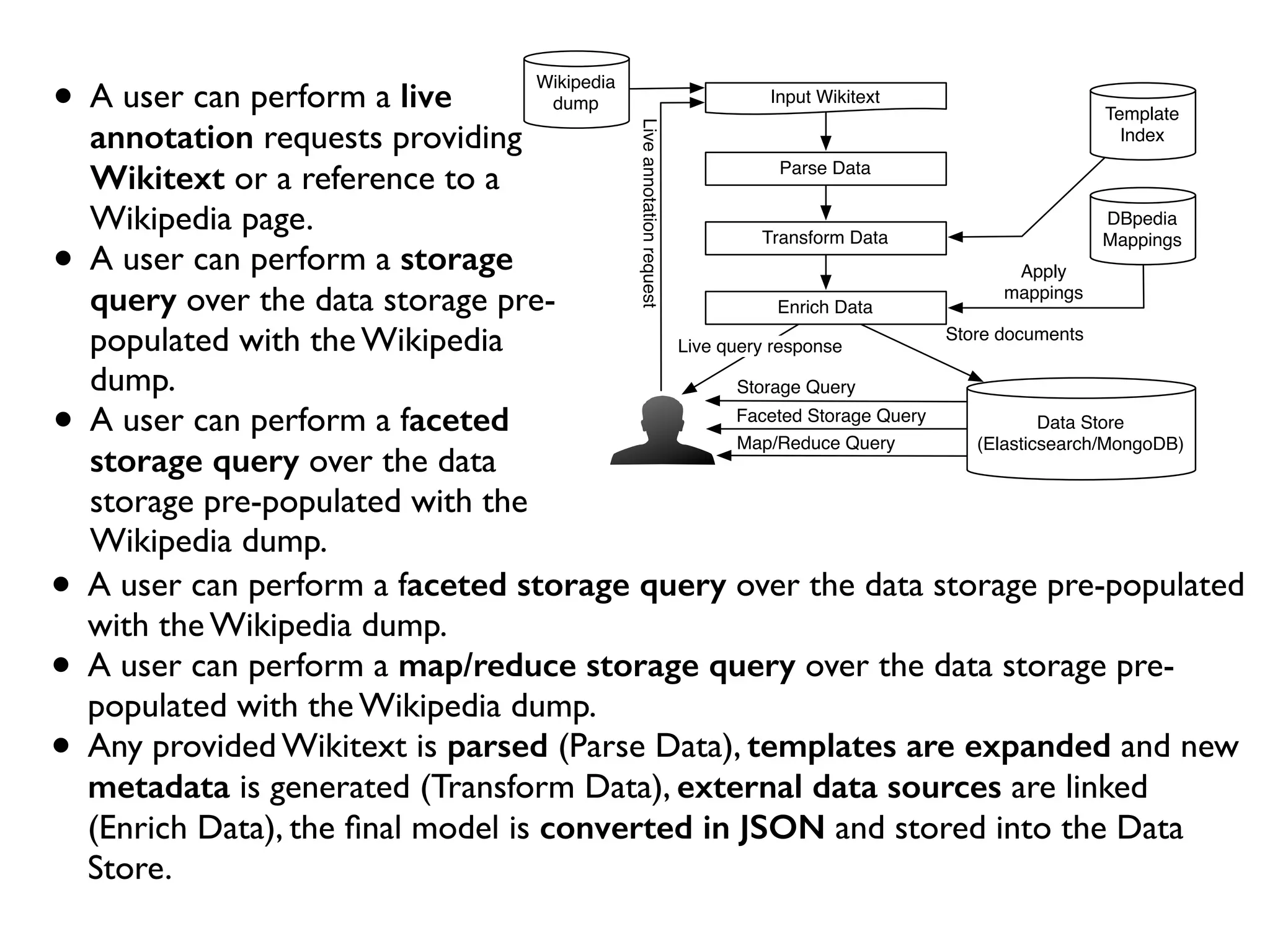
• A user can perform a Live
Query Request providing
plain WikiText or a reference
to a Wikipedia page.
• A user can perform a Storage
Query over the Data Store
that has been pre-populated
with a Wikipedia dump.
• A user can perform a Faceted
Storage Query over the
Data Store pre-populated
with a Wikipedia dump.
• A user can perform a Faceted Storage Query over the data storage pre-
populated with a Wikipedia dump.
• A user can perform a Map/Reduce Storage Query over the data storage pre-
populated with the Wikipedia dump.
• Any provided WikiText is parsed (Parse Data),Wiki Templates are expanded and
new Metadata is generated (Transform Data), external data sources are linked
(Enrich Data), the final model is serialized in JSON and stored into the Data
Store.
Input Wikitext
Parse Data
Transform Data
Enrich Data
Data Store
(Elasticsearch +
MongoDB)
Wikipedia
dump
LiveQueryRequest
DBpedia
Mappings
Apply
mappings
Store documentsQuery Response
Storage Query
Faceted Storage Query
Map/Reduce Query
Template
Index
Wikipedia
API
example:
en:London
Main Features
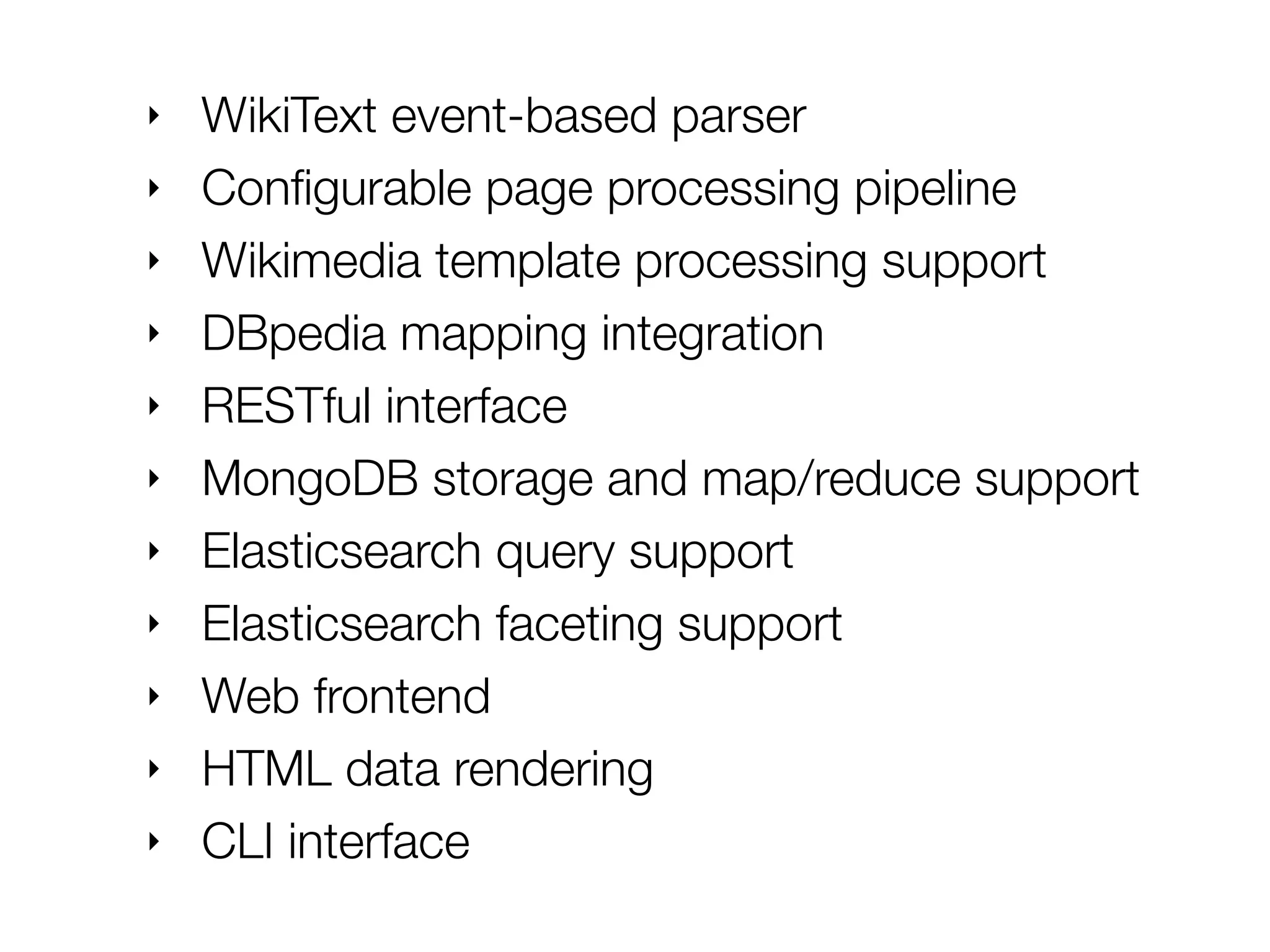
‣ WikiText event-based parser
‣ Configurable page processing pipeline
‣ MediaWiki template processing support
‣ DBpedia mapping integration
‣ RESTful interface
‣ MongoDB storage and Map/Reduce support
‣ Elasticsearch query support
‣ Elasticsearch faceting support
‣ Web frontend
‣ HTML data rendering (experimental)
‣ CLI
Online Demo
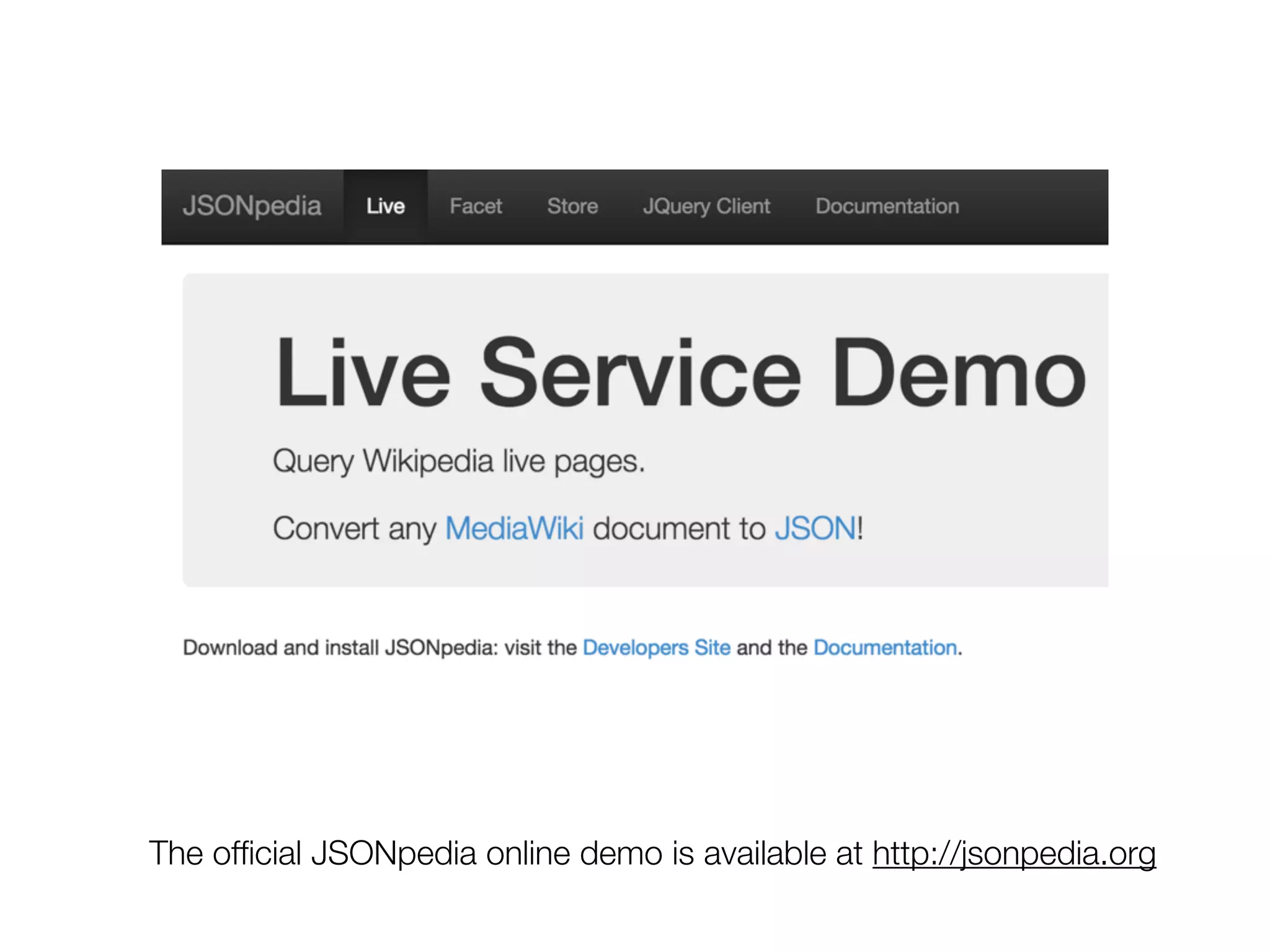
The official JSONpedia online demo is available at http://jsonpedia.org
Web UI
JSONpedia Web UI allows to interact with the
REST services providing a comfortable UX.
The REST query is build interactively by selecting
parameters and flags.
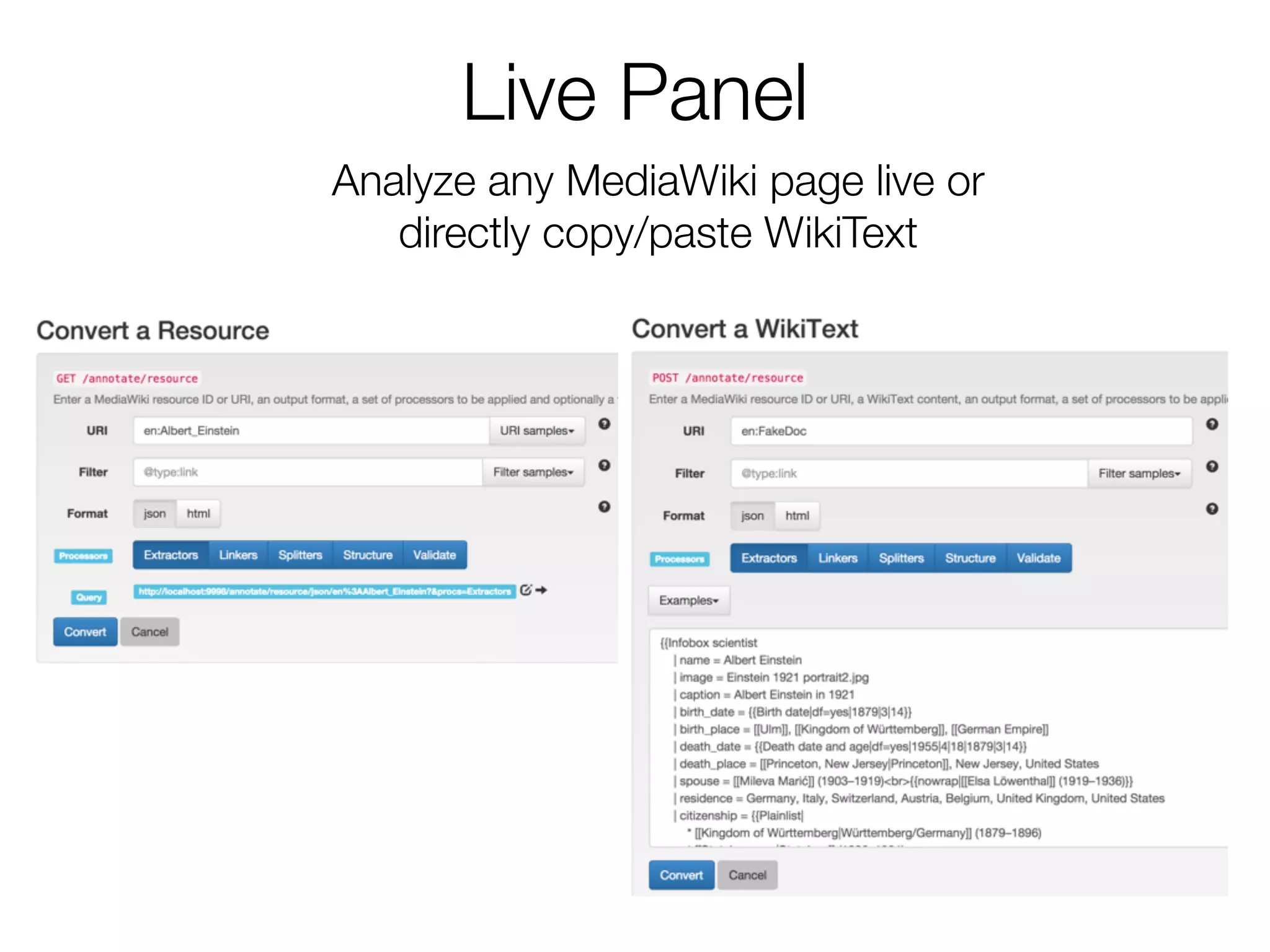
Live Panel
Analyze any MediaWiki page live or
directly copy/paste WikiText
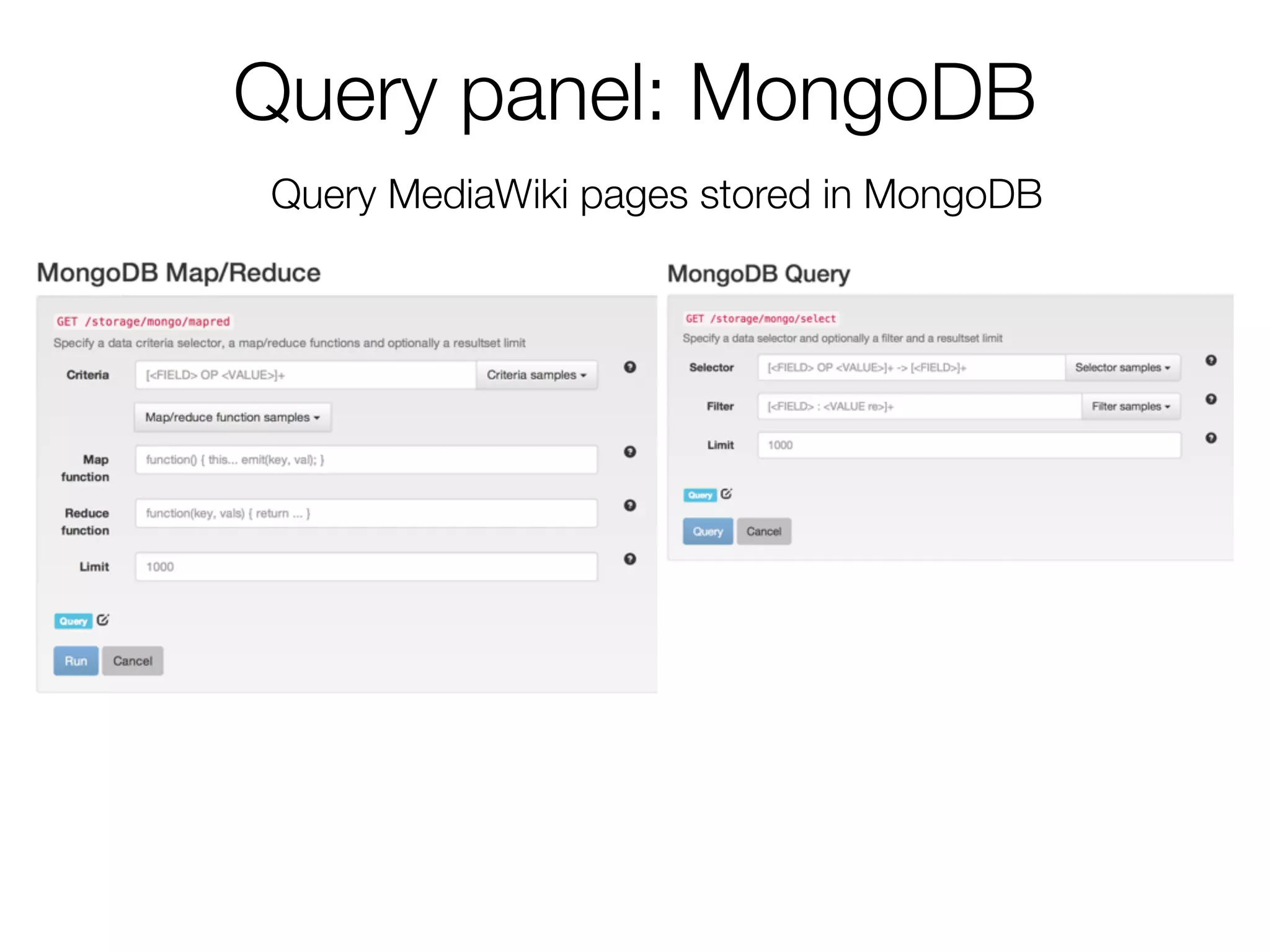
Query MediaWiki pages stored in MongoDB
Query panel: MongoDB
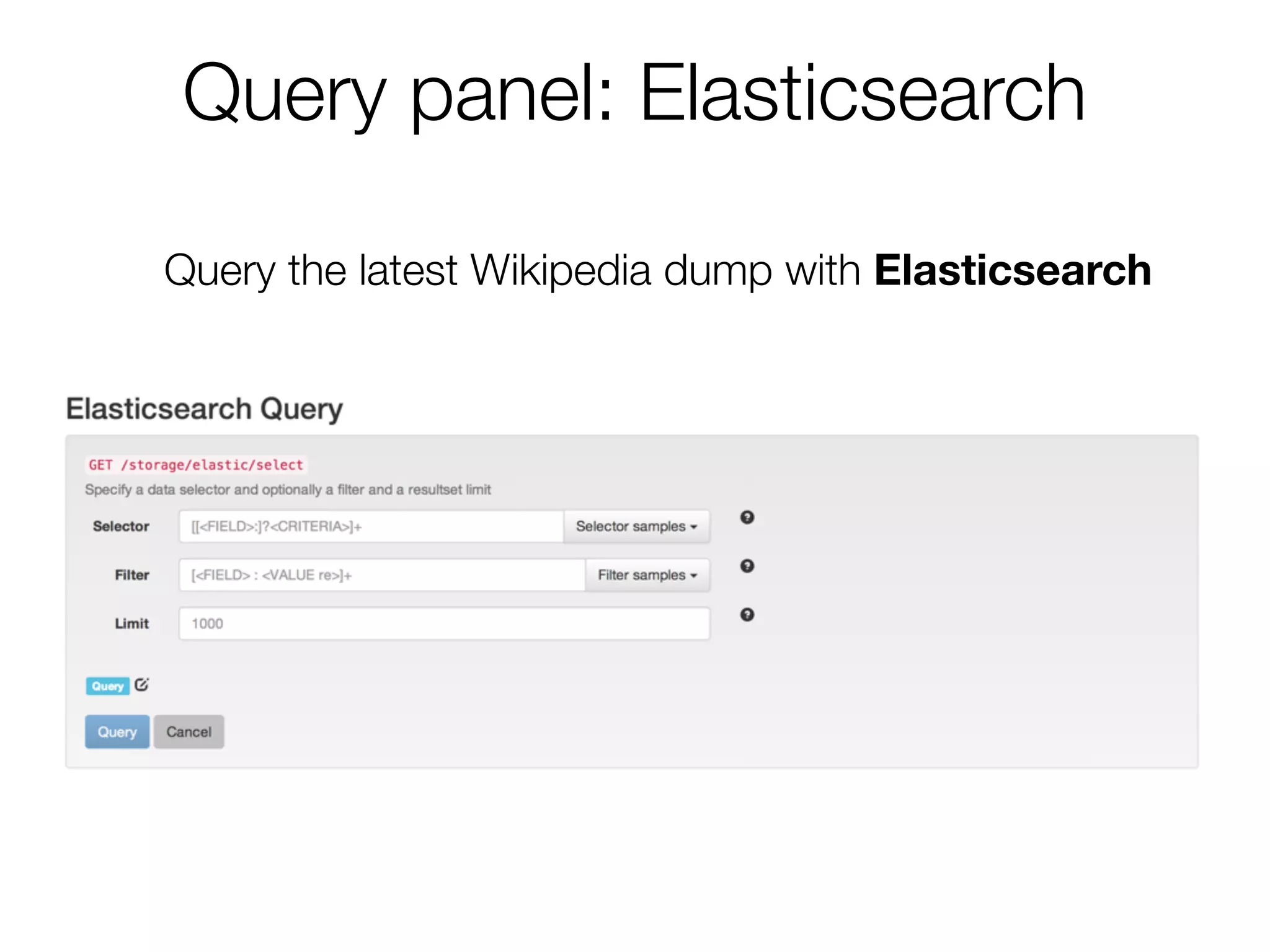
Query the latest Wikipedia dump with Elasticsearch
Query panel: Elasticsearch
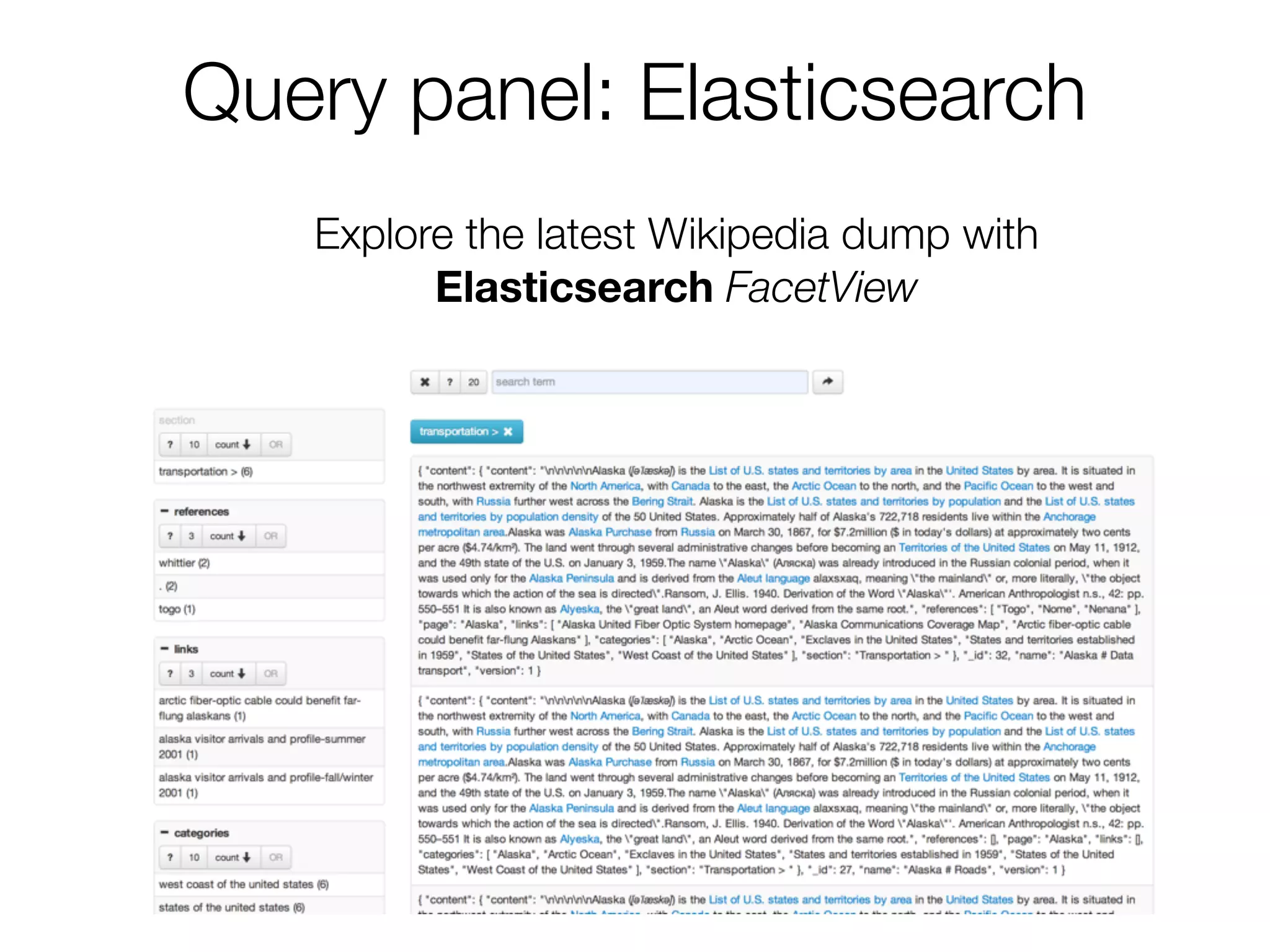
Explore the latest Wikipedia dump with
Elasticsearch FacetView
Query panel: Elasticsearch
REST API
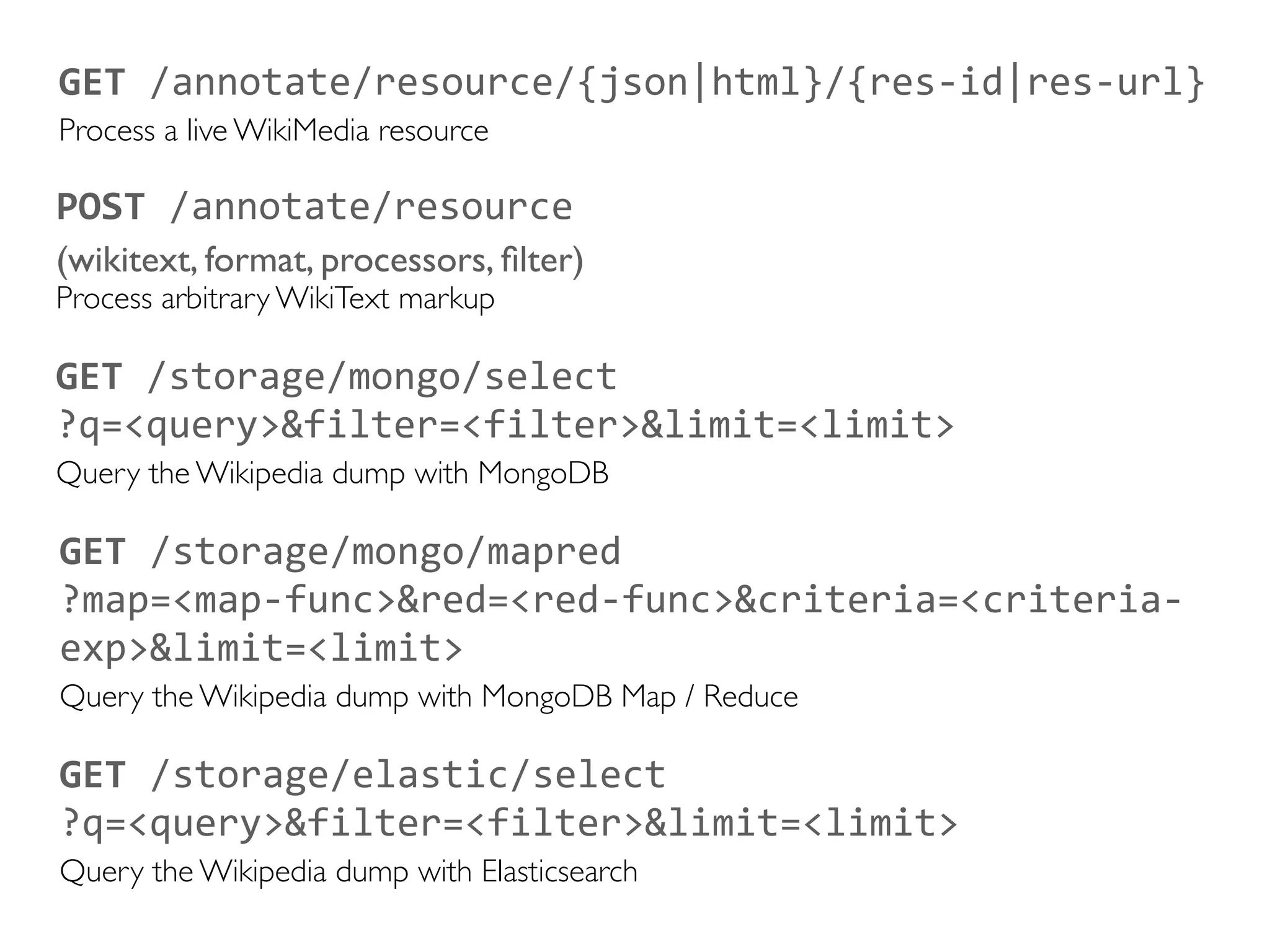
GET	/storage/mongo/select	
?q=<query>&filter=<filter>&limit=<limit>	
Query the JSONpedia dump with MongoDB
GET	/storage/mongo/mapred	
?map=<map-func>&red=<red-func>&criteria=<criteria-
exp>&limit=<limit>	
Query the JSONpedia dump with MongoDB Map / Reduce
GET	/storage/elastic/select	
?q=<query>&filter=<filter>&limit=<limit>	
Query the JSONpedia dump with Elasticsearch
GET	/annotate/resource/{json|html}/{res-id|res-url}	
Process a live MediaWiki resource
POST	/annotate/resource		
(wikitext,	format,	processors,	filter)	
Process arbitrary WikiText markup
jQuery Plugin
http://jsonpedia.org/frontend/js/jsonpedia.js
JSONpedia comes with a jQuery 1.8 plugin
providing facilitated access to the REST service.
Programmatic Usage
Example:
retrieve content of page London from English
Wikipedia, extract the DOM structure, filter nodes of
type “section”, get first of them and render as HTML.
import com.machinelinking.main.JSONpedia;
import org.codehaus.jackson.JsonNode;
JSONpedia jsonpedia = JSONpedia.instance();
JsonNode root = jsonpedia.process("en:London").flags("Structure").json();
JsonNode[] sections = jsonpedia.applyFilter("@type:section", root);
String firstSectionHTML = jsonpedia.render("en:London", sections[0]);
Internals
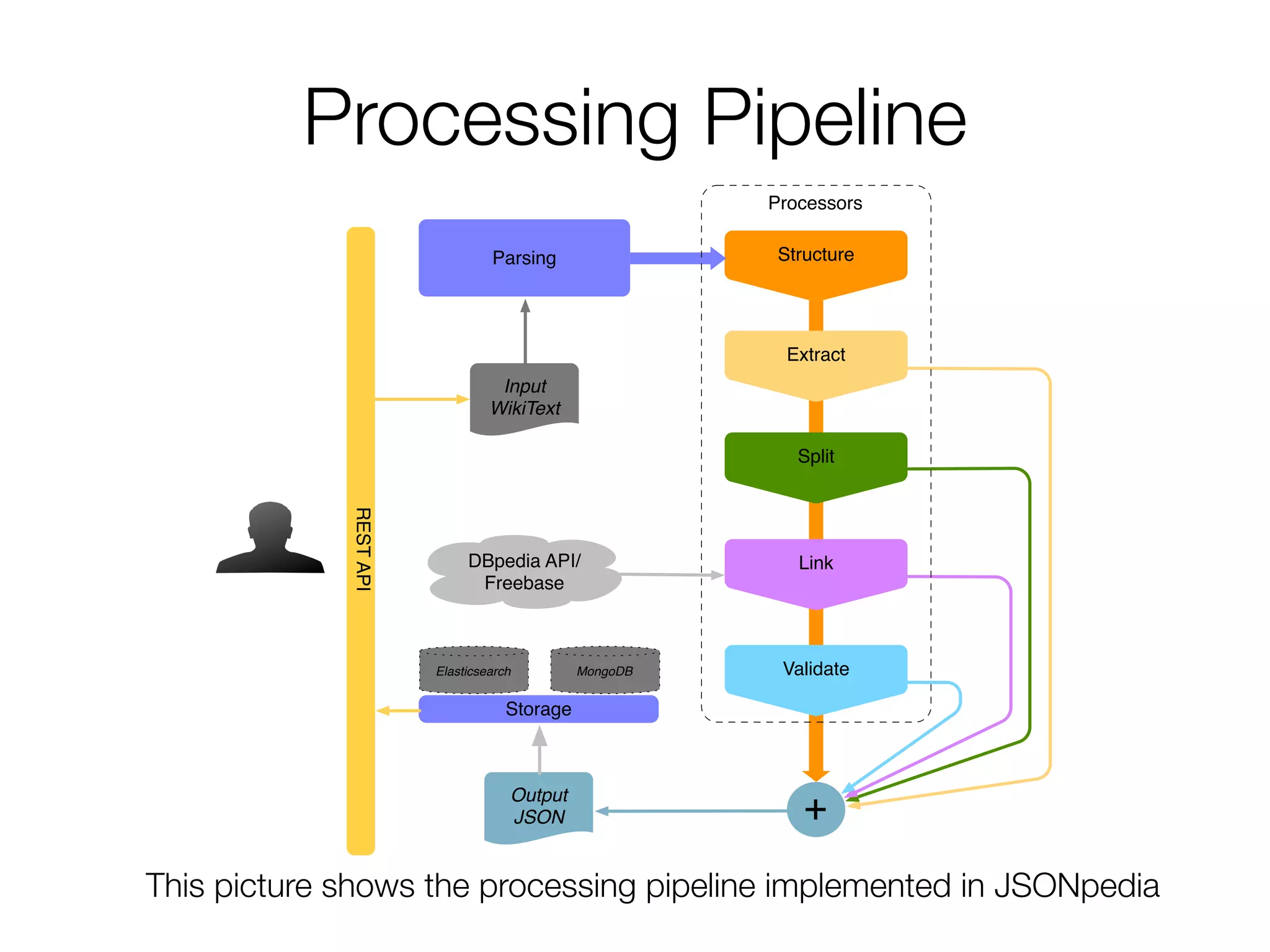
Processing Pipeline
This picture shows the processing pipeline implemented in JSONpedia
Parsing
Input
WikiText
Structure
Extract
Split
Link
Validate
DBpedia API/
Freebase
Output
JSON
Elasticsearch MongoDB
Storage
RESTAPI
+
Processors
Processor Types
‣ Structure
‣ Extractors
‣ Linkers
‣ Splitters
‣ Validator
A Processor receives a stream of events generated by
parser and perform data enrichment and transformation.
Structure
The Structure Processor receives a stream of
WikiText parsing events and builds a 1-1 JSON
representation of the document DOM.
Extract
Extractors are specific Processors that collect
a certain type of data from the event stream.
For example the SectionsExtractor collects a list
of all sections declared in the document stream.
Split
A Splitter is a Processor cutting sub-trees
of the JSON document built by the
Structure processor.
An example of Splitter is the TableSplitter
which collects the JSON nodes
representing all tables found in document.
Link
A Linker is a Processor which links the
detected document entities to other
information acquired from external sources.
An example of Linker is the FreebaseLinker
which connects an entity to the same
representation in Freebase if any.
Validate
A Validator is a Processor performing the
check of data structures parsed from a
document.
WikiText event based parser messages
// Document bounding.
void beginDocument(URL document);
void endDocument();
// Error handling.
void parseWarning(String msg,
ParserLocation location);
void parseError(Exception e,
ParserLocation location);
// Tag handling.
void beginTag(String node, Attribute[]
attributes);
void endTag(String node);
void inlineTag(String node,
Attribute[] attributes);
void commentTag(String comment);
// Sections
void section(String title, int level);
// References
void beginReference(String label);
void endReference(String label);
// Links
void beginLink(String url);
void endLink(String url);
// lists
void beginList();
void listItem();
void endList();
// Templates
void beginTemplate(String name);
void endTemplate(String name);
// Tables
void beginTable();
void headCell(int row, int col);
void bodyCell(int row, int col);
void endTable();
// Generic parameter
void parameter(String param);
// Plain text
void text(String content);
JSONpedia @Google
Summer of Code
2014
Project:
JSONpedia Extractor
Organization:
DBpedia & DBpedia Spotlight
Student:
Roberto Bampi
Mentor:
Michele Mostarda
Description:
Create a general infrastructure to create DBpedia
extractors based on JSONpedia.
Public Repo:
https://github.com/dbpedia/jsonpedia-extractor/
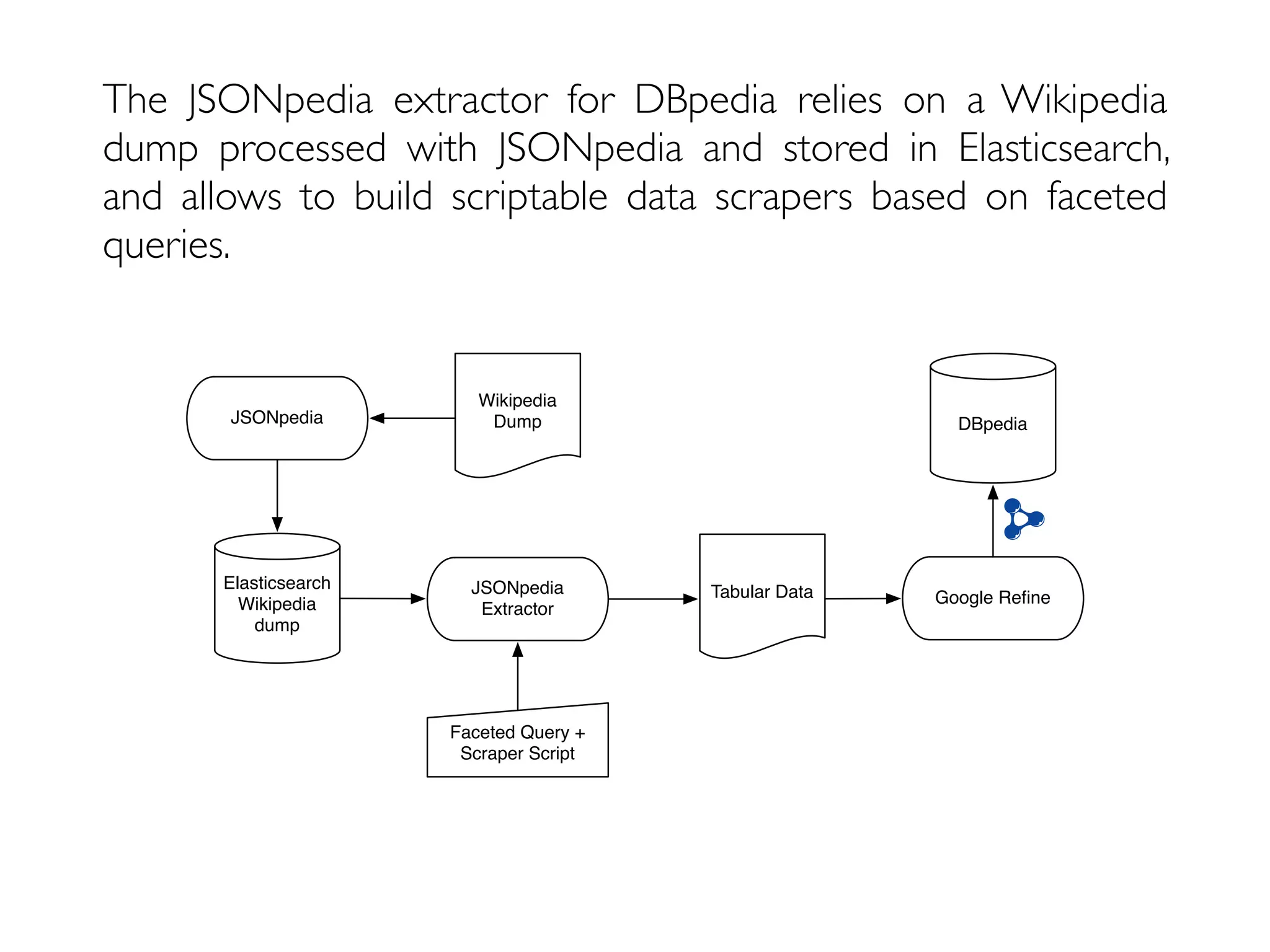
The JSONpedia extractor for DBpedia relies on a Wikipedia
dump processed with JSONpedia and stored in Elasticsearch,
and allows to build scriptable data scrapers based on faceted
queries.
Wikipedia
DumpJSONpedia
Elasticsearch
Wikipedia
dump
JSONpedia
Extractor
Faceted Query +
Scraper Script
DBpedia
Tabular Data Google Refine
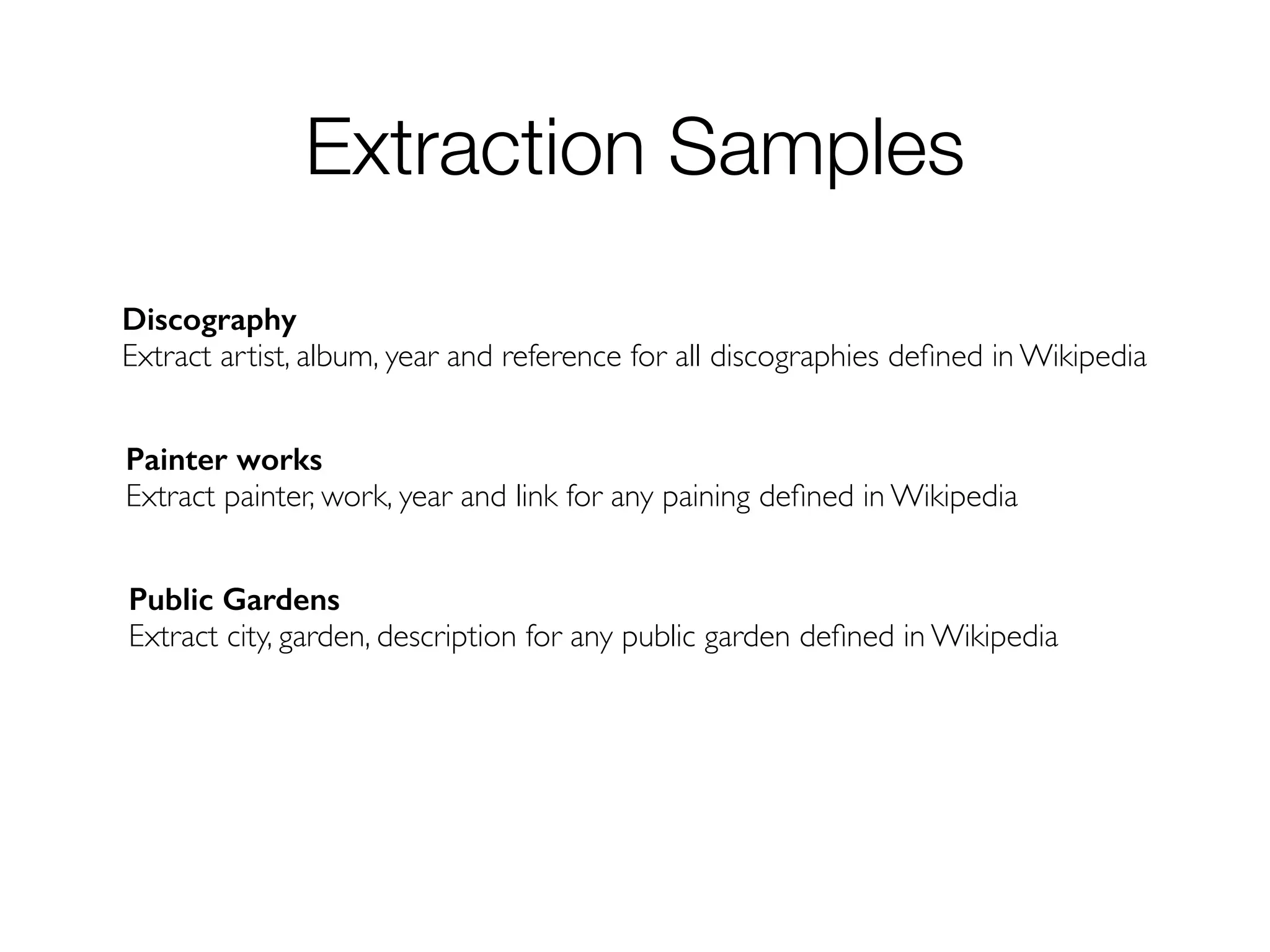
Extraction Samples
Discography
Extract artist, album, year and reference for all discographies defined in Wikipedia.
Public Gardens
Extract city, garden, description for any public garden defined in Wikipedia.
Painter works
Extract painter, work, year and link for any paining defined in Wikipedia.
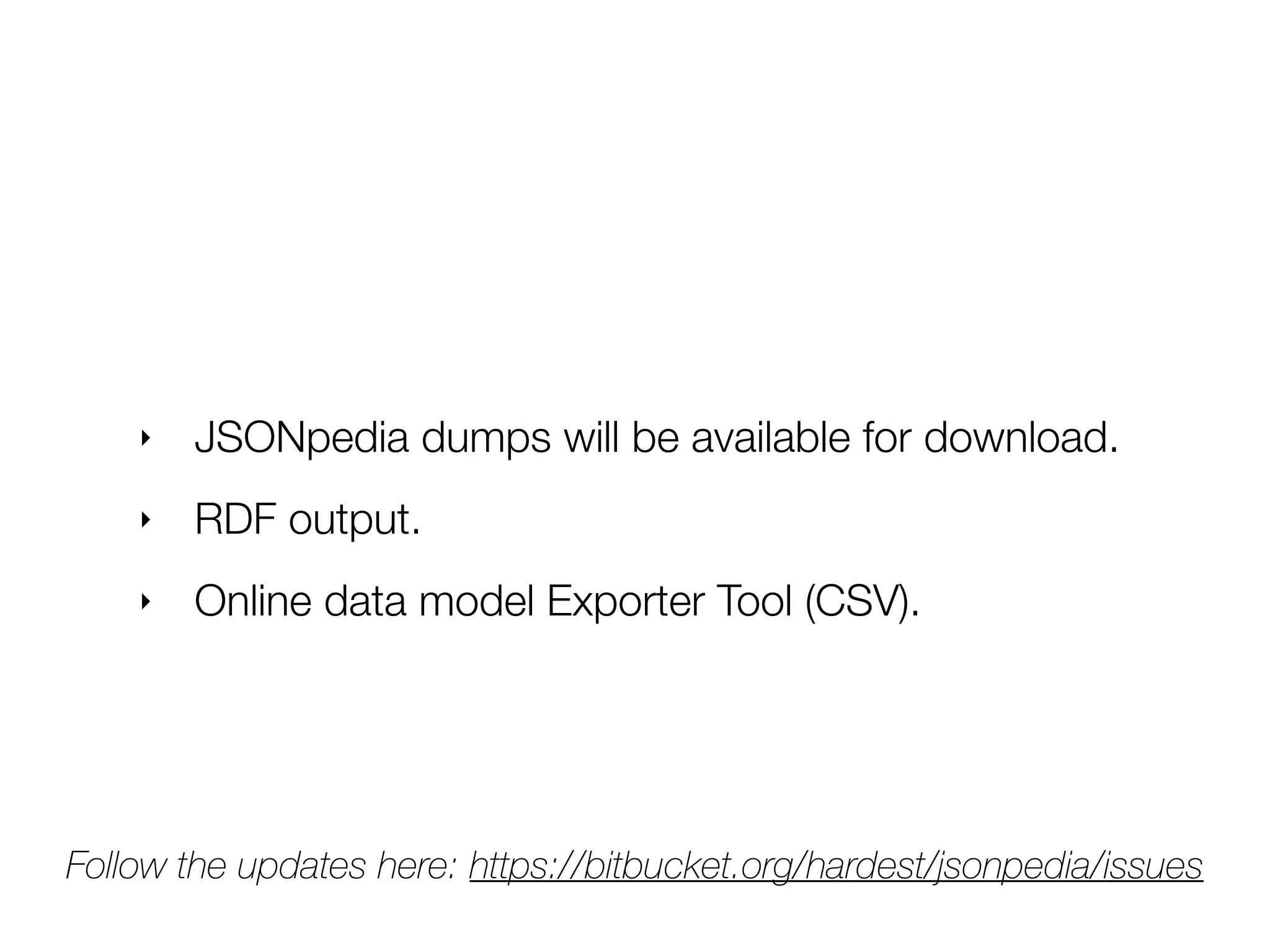
Forthcoming Features
‣ JSONpedia dumps will be available for download.
‣ RDF output.
‣ Online data model Exporter Tool (CSV).
Follow the updates here: https://bitbucket.org/hardest/jsonpedia/issues
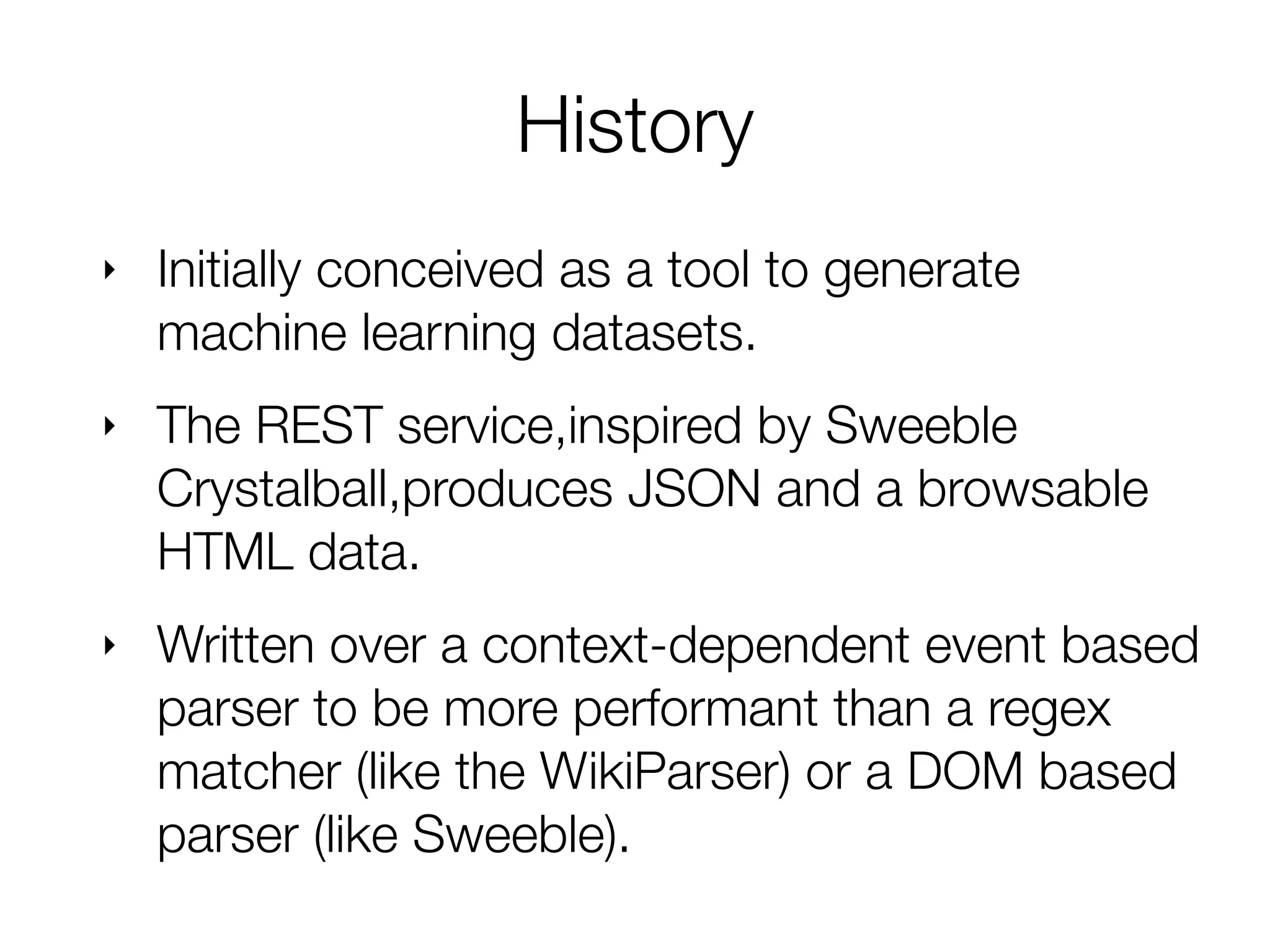
History & Previous Work
‣ Initially conceived as a tool to generate
Machine Learning training datasets.
‣ The REST service,inspired by Sweeble
Crystalball,produces JSON and a browsable
HTML data.
‣ Written over a context-dependent event based
parser to be more performant than a regex
matcher (like the WikiParser) or a DOM based
parser (like Sweeble).
History
‣ JSONpedia produces JSON, DBpedia RDF.
‣ JSONpedia includes all the structural elements of
a page: links, references, lists, sections, template,
tables, XML markup.
‣ JSONpedia produces low-refined data which
requires further processing to be consumed,
DBpedia produces ready to use high quality data.
‣ JSONpedia is a not competitor of DBpedia but
rather a complement.
Differences with DBpedia
‣ Lightweight Event based parser vs DOM
parser.
‣ More tolerant to frequent syntax errors
present within WikiText pages.
‣ Serializes to JSON output which is easier
to consume!
Differences with Sweeble
live demo:
http://jsonpedia.org/
source code:
https://bitbucket.org/hardest/jsonpedia
Online resources
Roberto Bampi - SpazioDati, Backend Developer, JSONpedia contributor
and student in GSoC 2014.
Acknowledgements
@hjfocs
@BampiRoberto
Marco Fossati - FBK WeD, PhD student, DBpedia community member.
DBpedia Association for supporting JSONpedia
in GSoC 2014 and 2015.
SpazioDati for hosting the JSONpedia online
demo.
Fondazione Bruno Kessler for sponsoring part
of the development effort.
Michele Mostarda <me@michelemostarda.it>, Twitter: @micmos
Thanks for
reading!

JSONpedia - Facilitating consumption of MediaWiki content

  • 1.
    Michele Mostarda <me@michelemostarda.it>,Twitter: @micmos v1.3 JSONpedia Facilitating consumption of MediaWiki content
  • 2.
    ‣ What isJSONpedia ‣ Use cases ‣ Main features ‣ Online demo ‣ Web UI ‣ REST API ‣ jQuery plugin ‣ Programmatic Usage ‣ Internals ‣ GSoC 2014 ‣ History & previous work ‣ Forthcoming features ‣ Next release ‣ Online resources ‣ Support up ‣ Acknowledgements Outline
  • 3.
  • 4.
    JSONpedia is aJava library and a REST service meant to read MediaWiki pages as JSON. JSONpedia is also able to enrich the retrieved content with other datasources like DBpedia.
  • 5.
  • 6.
    • A usercan perform a Live Query Request providing plain WikiText or a reference to a Wikipedia page. • A user can perform a Storage Query over the Data Store that has been pre-populated with a Wikipedia dump. • A user can perform a Faceted Storage Query over the Data Store pre-populated with a Wikipedia dump. • A user can perform a Faceted Storage Query over the data storage pre- populated with a Wikipedia dump. • A user can perform a Map/Reduce Storage Query over the data storage pre- populated with the Wikipedia dump. • Any provided WikiText is parsed (Parse Data),Wiki Templates are expanded and new Metadata is generated (Transform Data), external data sources are linked (Enrich Data), the final model is serialized in JSON and stored into the Data Store. Input Wikitext Parse Data Transform Data Enrich Data Data Store (Elasticsearch + MongoDB) Wikipedia dump LiveQueryRequest DBpedia Mappings Apply mappings Store documentsQuery Response Storage Query Faceted Storage Query Map/Reduce Query Template Index Wikipedia API example: en:London
  • 7.
  • 8.
    ‣ WikiText event-basedparser ‣ Configurable page processing pipeline ‣ MediaWiki template processing support ‣ DBpedia mapping integration ‣ RESTful interface ‣ MongoDB storage and Map/Reduce support ‣ Elasticsearch query support ‣ Elasticsearch faceting support ‣ Web frontend ‣ HTML data rendering (experimental) ‣ CLI
  • 9.
  • 10.
    The official JSONpediaonline demo is available at http://jsonpedia.org
  • 11.
  • 12.
    JSONpedia Web UIallows to interact with the REST services providing a comfortable UX. The REST query is build interactively by selecting parameters and flags.
  • 13.
    Live Panel Analyze anyMediaWiki page live or directly copy/paste WikiText
  • 14.
    Query MediaWiki pagesstored in MongoDB Query panel: MongoDB
  • 15.
    Query the latestWikipedia dump with Elasticsearch Query panel: Elasticsearch
  • 16.
    Explore the latestWikipedia dump with Elasticsearch FacetView Query panel: Elasticsearch
  • 17.
  • 18.
    GET /storage/mongo/select ?q=<query>&filter=<filter>&limit=<limit> Query the JSONpediadump with MongoDB GET /storage/mongo/mapred ?map=<map-func>&red=<red-func>&criteria=<criteria- exp>&limit=<limit> Query the JSONpedia dump with MongoDB Map / Reduce GET /storage/elastic/select ?q=<query>&filter=<filter>&limit=<limit> Query the JSONpedia dump with Elasticsearch GET /annotate/resource/{json|html}/{res-id|res-url} Process a live MediaWiki resource POST /annotate/resource (wikitext, format, processors, filter) Process arbitrary WikiText markup
  • 19.
    jQuery Plugin http://jsonpedia.org/frontend/js/jsonpedia.js JSONpedia comeswith a jQuery 1.8 plugin providing facilitated access to the REST service.
  • 20.
  • 21.
    Example: retrieve content ofpage London from English Wikipedia, extract the DOM structure, filter nodes of type “section”, get first of them and render as HTML. import com.machinelinking.main.JSONpedia; import org.codehaus.jackson.JsonNode; JSONpedia jsonpedia = JSONpedia.instance(); JsonNode root = jsonpedia.process("en:London").flags("Structure").json(); JsonNode[] sections = jsonpedia.applyFilter("@type:section", root); String firstSectionHTML = jsonpedia.render("en:London", sections[0]);
  • 22.
  • 23.
    Processing Pipeline This pictureshows the processing pipeline implemented in JSONpedia Parsing Input WikiText Structure Extract Split Link Validate DBpedia API/ Freebase Output JSON Elasticsearch MongoDB Storage RESTAPI + Processors
  • 24.
    Processor Types ‣ Structure ‣Extractors ‣ Linkers ‣ Splitters ‣ Validator A Processor receives a stream of events generated by parser and perform data enrichment and transformation.
  • 25.
    Structure The Structure Processorreceives a stream of WikiText parsing events and builds a 1-1 JSON representation of the document DOM.
  • 26.
    Extract Extractors are specificProcessors that collect a certain type of data from the event stream. For example the SectionsExtractor collects a list of all sections declared in the document stream.
  • 27.
    Split A Splitter isa Processor cutting sub-trees of the JSON document built by the Structure processor. An example of Splitter is the TableSplitter which collects the JSON nodes representing all tables found in document.
  • 28.
    Link A Linker isa Processor which links the detected document entities to other information acquired from external sources. An example of Linker is the FreebaseLinker which connects an entity to the same representation in Freebase if any.
  • 29.
    Validate A Validator isa Processor performing the check of data structures parsed from a document.
  • 30.
    WikiText event basedparser messages // Document bounding. void beginDocument(URL document); void endDocument(); // Error handling. void parseWarning(String msg, ParserLocation location); void parseError(Exception e, ParserLocation location); // Tag handling. void beginTag(String node, Attribute[] attributes); void endTag(String node); void inlineTag(String node, Attribute[] attributes); void commentTag(String comment); // Sections void section(String title, int level); // References void beginReference(String label); void endReference(String label); // Links void beginLink(String url); void endLink(String url); // lists void beginList(); void listItem(); void endList(); // Templates void beginTemplate(String name); void endTemplate(String name); // Tables void beginTable(); void headCell(int row, int col); void bodyCell(int row, int col); void endTable(); // Generic parameter void parameter(String param); // Plain text void text(String content);
  • 31.
  • 32.
    Project: JSONpedia Extractor Organization: DBpedia &DBpedia Spotlight Student: Roberto Bampi Mentor: Michele Mostarda Description: Create a general infrastructure to create DBpedia extractors based on JSONpedia. Public Repo: https://github.com/dbpedia/jsonpedia-extractor/
  • 33.
    The JSONpedia extractorfor DBpedia relies on a Wikipedia dump processed with JSONpedia and stored in Elasticsearch, and allows to build scriptable data scrapers based on faceted queries. Wikipedia DumpJSONpedia Elasticsearch Wikipedia dump JSONpedia Extractor Faceted Query + Scraper Script DBpedia Tabular Data Google Refine
  • 34.
    Extraction Samples Discography Extract artist,album, year and reference for all discographies defined in Wikipedia. Public Gardens Extract city, garden, description for any public garden defined in Wikipedia. Painter works Extract painter, work, year and link for any paining defined in Wikipedia.
  • 35.
  • 36.
    ‣ JSONpedia dumpswill be available for download. ‣ RDF output. ‣ Online data model Exporter Tool (CSV). Follow the updates here: https://bitbucket.org/hardest/jsonpedia/issues
  • 37.
  • 38.
    ‣ Initially conceivedas a tool to generate Machine Learning training datasets. ‣ The REST service,inspired by Sweeble Crystalball,produces JSON and a browsable HTML data. ‣ Written over a context-dependent event based parser to be more performant than a regex matcher (like the WikiParser) or a DOM based parser (like Sweeble). History
  • 39.
    ‣ JSONpedia producesJSON, DBpedia RDF. ‣ JSONpedia includes all the structural elements of a page: links, references, lists, sections, template, tables, XML markup. ‣ JSONpedia produces low-refined data which requires further processing to be consumed, DBpedia produces ready to use high quality data. ‣ JSONpedia is a not competitor of DBpedia but rather a complement. Differences with DBpedia
  • 40.
    ‣ Lightweight Eventbased parser vs DOM parser. ‣ More tolerant to frequent syntax errors present within WikiText pages. ‣ Serializes to JSON output which is easier to consume! Differences with Sweeble
  • 41.
  • 42.
    Roberto Bampi -SpazioDati, Backend Developer, JSONpedia contributor and student in GSoC 2014. Acknowledgements @hjfocs @BampiRoberto Marco Fossati - FBK WeD, PhD student, DBpedia community member. DBpedia Association for supporting JSONpedia in GSoC 2014 and 2015. SpazioDati for hosting the JSONpedia online demo. Fondazione Bruno Kessler for sponsoring part of the development effort.
  • 43.
    Michele Mostarda <me@michelemostarda.it>,Twitter: @micmos Thanks for reading!