JSON API Do’s & Don’ts
Jan Varljen, Productive CTO
01JSON API
json:api is a specification for
building APIs in JSON
HTTP://JSONAPI.ORG/
CONCEPTS
1. Document structure
2. Fetching
3. CRUD
4. Errors
5. Do’s
6. Don’ts
02DOCUMENT STRUCTURE
JSON STRUCTURE
• data
• included
• links
• meta
EXAMPLE
http://api.productive.io.dev/api/v2/1/projects?token=abc
RESOURCE
• id
• type
• attributes
• relationships
EXAMPLE
http://api.productive.io.dev/api/v2/1/projects/363?token=abc
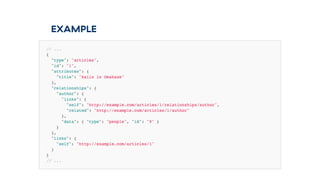
RELATIONSHIPS
• data
• link
EXAMPLE
INCLUDED
• related resources included inside the same response
EXAMPLE
http://api.productive.io.dev/api/v2/1/projects/363?token=abc
LINKS & META
• pagination links
• pagination metadata
• any other provisional metadata
EXAMPLE
http://api.productive.io.dev/api/v2/1/projects?token=abc
03FETCHING
INCLUDING RELATED RESOURCES
• API may return related resources by default
• API may support the include request parameter
INCLUDE PARAMETER
• GET /projects/1?include=company
• GET /projects/1?include=project_manager
• GET /projects/1?include=company,project_manager
• GET /projects/1?include=project_manager.company
FILTERING RESOURCES
• use the filter query parameter for filtering resources
• JSON API is agnostic about the strategies supported by a server
FILTER PARAMETER
• GET /projects?filter[company_id]=41
• http://api.productive.io.dev/api/v2/1/projects?
filter%5Bcompany_id%5D=41&token=abc
FRACTIONAL ATTRIBUTES
• API may return only specified attributes in the response
• use the fields query parameter for filtering attributes
FIELDS PARAMETER
• GET /projects/1?fields[projects]=name
• GET /projects/1?fields[projects]=name,currency
• GET /projects/1?fields[projects]=name,currency&fields[company]=name
SORTING RESOURCES
• API may support sorting resources
• use the sort query parameter for sorting
SORT PARAMETER
• GET /projects?sort=name
• GET /projects?sort=profit,name
• GET /projects?sort=-profit,name
PAGINATION
• API endpoint may be paginated
• pagination links are in the links part of the response
• http://api.productive.io.dev/api/v2/1/projects?token=abc
04C( R )UD
CREATE
• POST /projects
• JSON:API request body
• 201 Created/202 Accepted/204 No content
EXAMPLE
UPDATE
• PATCH /projects/1
• JSON:API request body
• partial updates
• 200 OK/202 Accepted/204 No content
EXAMPLE
DELETE
• DELETE /projects/1
• no request body
• 200 OK/202 Accepted/204 No content
05ERRORS
ERRORS STRUCTURE
• errors (array)
ERROR STRUCTURE
• status
• title
• details
• source
• meta
EXAMPLE
http://api.productive.io.dev/api/v2/1/projects/363
http://api.productive.io.dev/api/v2/1/projects/99999?token=abc
EXAMPLE
06DO’S
FLAT STRUCTURE
• /projects/363/comments vs /comments?filter[project_id]=363
• every resource on own endpoint:
• people/1/comments
• companies/1/comments
• invoices/1/comments
• ….
• becomes /comments?filter[x]
FLAT STRUCTURE
• less code duplications
• you need /comments route either way:
• PATCH /comments/1
• DELETE /comments/1
• more flexible:
• /comments?filter[project_id][]=363&filter[project_id][]=364
PAGINATE EVERY ENDPOINT
• /projects
• returns 10 projects
• /projects
• returns 1000 projects
• slow, blocking
• always paginate every endpoint
MAX PER PAGE
• /projects?page[size]=1_000_000
• boom!
• always have a max_per_page defined
• max_per_page = 100
• add info to meta
• have a system to override it by resource
• /tags → max_per_page=300
• /projects → max_per_page=50
POST CREATE RESPONSE
• return 201 instead of 204 on POST create
• 201 Created
• resource included in the response
• 204 No content
• response empty
• consider the resource sent in the request is accepted by the server
• almost never identical
• think about timestamp columns like (created_at)
• always return 201 if possible
CUSTOM ACTIONS
• archive project
• project.archived_at = 2017-04-18 10:25:49
• this should be set by the server not client
• PATCH with archived_at: {time_on_client} is wrong
• PATCH /projects/:id/archive
• server sets timestamps and returns 200 OK with updated resource
EXTRACT RESOURCES
• update user password
• password_reset_token
• password_token_sent_at
• password_token_valid_for
• …
• usually columns in the users table
• PATCH /users/1
• bunch of “magic” attributes pollute the user resource
• used only for password reset (rarely)
• API resources != database structure
EXTRACT RESOURCES
• password becomes first-class citizen → independent resource
• CREATE /passwords
• create new reset password token
• GET /passwords/:token
• get a password reset token
• PATCH /passwords/:token
• make the password change (if token still valid)
CACHING
• cache every resource individually
• cache key example:
• /{resource_name}/{object_key}/{serializer_file_digest}
• /projects/363-20170413144717638000000/7c4eba8cd5a6cd89d6e07ce1a51cc23f
• http://api.productive.io.dev/api/v2/1/projects/363?token=abc
CACHE READ MULTI
• http://api.productive.io.dev/api/v2/1/projects?token=abc
• 30 projects + 17 included resources → 47 cache store hits
• JSON API is agnostic about caching implementation
• write you’re own caching layer
• use read multi from cache (ideally only 1 cache request)
• solve application specific problems (Productive has roles)
NANOSECONDS FOR CACHE
• many frameworks use timestamp in seconds for cache
• “2017-04-18 10:25:26”
• multiple updates in single second - happens all the time
• invalid responses
• use milliseconds or nanoseconds for cache
SEPARATION OF CONCERNS
• ProjectsController
• handles authentication and authorization
• ProjectFilter
• handles filter and sort param and filtering
• ProjectSerializer
• handles fields param and fractional attributes
• ProjectPreloader
• handles includes param and preloading relationships
• ProjectForm
• handles validations and saving resources
• …
07DON’TS
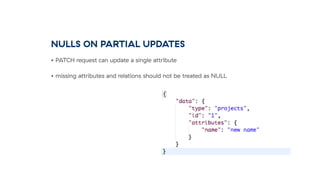
NULLS ON PARTIAL UPDATES
• PATCH request can update a single attribute
• missing attributes and relations should not be treated as NULL
ABUSE DELETE VERB
• archive project
• DELETE /projects/363
• archive touches a timestamp - does not actually REMOVE the resource
• DELETE is intended to REMOVE the resource
• response is 204 No content
• archiving using DELETE will work but problems happen afterwards
• compliant clients will remove the resource
BREAK CACHE
• resources are cached individually
• misplaced attributes can break cache
• company_name
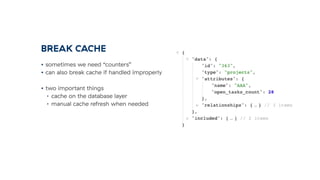
BREAK CACHE
• sometimes we need “counters”
• can also break cache if handled improperly
• two important things
• cache on the database layer
• manual cache refresh when needed
NEVER INCLUDE HAS-MANY RELATIONS
• big responses
• pagination problems
• filtering problems
• sorting problems
• prefer separate calls
• /tasks?filter[project_id]=11
Thank you!
JAN@PRODUCTIVE.IO
Visit productive.io.

Json api dos and dont's