Consumer identification with fashion
cycle ,adoption of fashion
Submitted by
T. Tamil selvan.
STYLE:
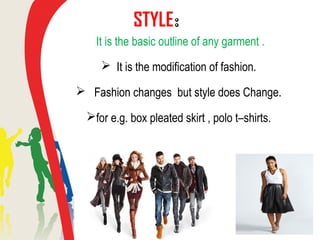
It is the basic outline of any garment .
 It is the modification of fashion.
 Fashion changes but style does Change.
for e.g. box pleated skirt , polo t–shirts.
CHANGE
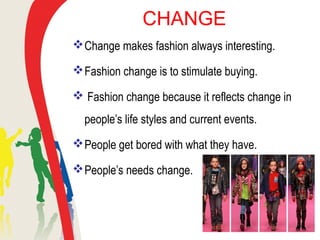
Change makes fashion always interesting.
Fashion change is to stimulate buying.
 Fashion change because it reflects change in
people’s life styles and current events.
People get bored with what they have.
People’s needs change.
Acceptance
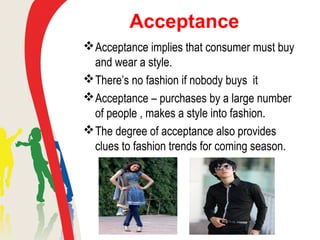
Acceptance implies that consumer must buy
and wear a style.
There’s no fashion if nobody buys it
Acceptance – purchases by a large number
of people , makes a style into fashion.
The degree of acceptance also provides
clues to fashion trends for coming season.
Taste
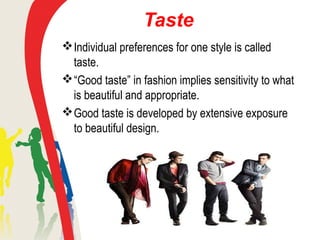
Individual preferences for one style is called
taste.
“Good taste” in fashion implies sensitivity to what
is beautiful and appropriate.
Good taste is developed by extensive exposure
to beautiful design.
Classic:
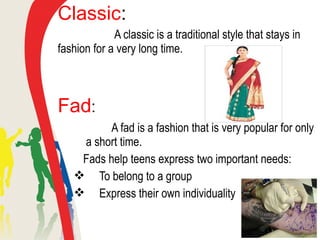
A classic is a traditional style that stays in
fashion for a very long time.
Fad:
A fad is a fashion that is very popular for only
a short time.
Fads help teens express two important needs:
 To belong to a group
 Express their own individuality
Collection:
A manufacture or designer's group of garments for a
specific season.
The season's total number of styles or designs,
accumulated for presentation comprises a collection.
Design:
An arrangement of parts, form, color, and line, for
developing a style, idea, plan or drawing, a concept, a
combination of details executed with artistry.
FASHION EVOLUTION
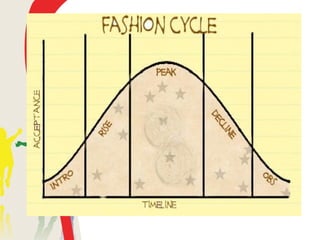
Fashion acceptance is usually described
as a fashion cycle.
 Fashion cycle is depicted as a bell shaped curve
encompassing five stages.
 Introduction
 Rise in popularity
 Peak in popularity
 Decline in popularity
 Rejection
Introduction Stage
Designs and styles previewed at major design centers
Limited acceptance by consumers
Fashion leaders
Higher prices
Small quantities produced
New styles are priced high.
Talented designers may be given financial backing to
create new apparel.
They create new apparel by combining the art and
design principle.
Produced in small quantities gives space for creativity.
Increase in popularity
 New styles worn by celebrities on television,
attract the attention of the general public.
 So they bring out adaptation.
Rise Stage
 Manufacturers adopt designs and styles to
produce with less expensive fabrics or less detail.
 More affordable and more availability.
 Acceptance by more people.
 Adaptations and changes.
 Mass production.
Peak in popularity
 When fashion is at the height of popularity – more
demand - adaptations at many price levels.
 Due to mass acceptance the production reaches
peak.
 Fashion most popular and accepted
 Variety of fashion versions
 Variety of price levels
 Length at this stage determines if fashion
becomes a classic.
Decline in popularity
Mass production finally end up in fashion conscious
people gets bore of the style and they look for
something new.
Retail stores put declining styles on racks, hoping to
make room for new merchandise.
Decreasing demand for the fashion
Fashion has “oversaturated” or flooded the market
Consumers won’t pay high price for the fashion
Rejection
 Last phase of the cycle.
 Discarding the style
 Beginning of the new style.
 Consumers no longer interested.
 Low price.
 Retailers not restocking.
 Manufacturers not producing.
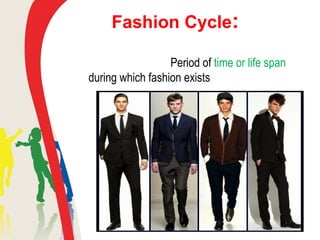
Fashion Cycle:
Period of time or life span
during which fashion exists
Consumers Identification with
fashion cycle
Consumer can be identified with various stages of
the fashion cycle.
Fashion Leaders buy and wear new style at the
beginning of their cycle other tend to imitate .
People who look for new fashion and wear it
before it becomes generally acceptable.
They dare to be different, and they attract the
attention.
Adoption of fashion …
Adoption of fashion is basically there are
three variation of the fashion adoption process :
 Traditional adoption
 Reverse adoption
 Mass dissemination .
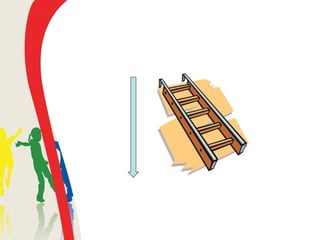
Traditional Adoption- (Trickle-
Down Theory)
 Oldest and most accepted theory.
 The trickle –down theory is based on the
traditional process of copying and adapting
trendsetting fashion from Paris , Milan , London,
and New York designer.
 Fashion is copied , modified and sold at lower
and lower prices it loses its newness ,quality and
other essential design elements.
Fashion trendsetters
Fashion adopters
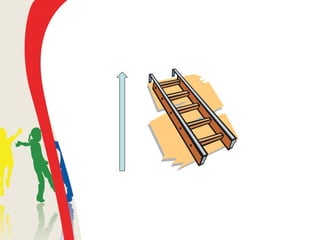
Reverse adoption –(Trickle-
Up Theory)
Fashion movement starts with lower socio-
economic levels.
since the 1960s, manufacturers and retailers pay
more attention to consumer innovation .
They watch people on the streets to find ideas .
some of these ideas eventually reach the designer
market.
 Acceptance by consumers with higher incomes
 Athletic apparel style
 Jeans e.g. cargo
 Hair style
 Punk style
Fashion trendsetters
Fashion adopters
Mass disemination – (Trickle-Across
Theory)
 Fashion acceptance begins among several socio
-economic groups.
 Increased diversity means that many different styles
can be acceptable at the same time.
 Various designer and manufacturer labels appeal to
various market segments at different price point .
 Most prevalent in 21st
century – technology.
Joyce Banda Arrest: Adaption-Of-Fashion

Joyce Banda Arrest: Adaption-Of-Fashion

  • 1.
    Consumer identification withfashion cycle ,adoption of fashion
  • 2.
  • 4.
    STYLE: It is thebasic outline of any garment .  It is the modification of fashion.  Fashion changes but style does Change. for e.g. box pleated skirt , polo t–shirts.
  • 5.
    CHANGE Change makes fashionalways interesting. Fashion change is to stimulate buying.  Fashion change because it reflects change in people’s life styles and current events. People get bored with what they have. People’s needs change.
  • 6.
    Acceptance Acceptance implies thatconsumer must buy and wear a style. There’s no fashion if nobody buys it Acceptance – purchases by a large number of people , makes a style into fashion. The degree of acceptance also provides clues to fashion trends for coming season.
  • 7.
    Taste Individual preferences forone style is called taste. “Good taste” in fashion implies sensitivity to what is beautiful and appropriate. Good taste is developed by extensive exposure to beautiful design.
  • 8.
    Classic: A classic isa traditional style that stays in fashion for a very long time. Fad: A fad is a fashion that is very popular for only a short time. Fads help teens express two important needs:  To belong to a group  Express their own individuality
  • 9.
    Collection: A manufacture ordesigner's group of garments for a specific season. The season's total number of styles or designs, accumulated for presentation comprises a collection. Design: An arrangement of parts, form, color, and line, for developing a style, idea, plan or drawing, a concept, a combination of details executed with artistry.
  • 11.
    FASHION EVOLUTION Fashion acceptanceis usually described as a fashion cycle.  Fashion cycle is depicted as a bell shaped curve encompassing five stages.  Introduction  Rise in popularity  Peak in popularity  Decline in popularity  Rejection
  • 13.
    Introduction Stage Designs andstyles previewed at major design centers Limited acceptance by consumers Fashion leaders Higher prices Small quantities produced New styles are priced high. Talented designers may be given financial backing to create new apparel. They create new apparel by combining the art and design principle. Produced in small quantities gives space for creativity.
  • 14.
    Increase in popularity New styles worn by celebrities on television, attract the attention of the general public.  So they bring out adaptation.
  • 15.
    Rise Stage  Manufacturersadopt designs and styles to produce with less expensive fabrics or less detail.  More affordable and more availability.  Acceptance by more people.  Adaptations and changes.  Mass production.
  • 16.
    Peak in popularity When fashion is at the height of popularity – more demand - adaptations at many price levels.  Due to mass acceptance the production reaches peak.  Fashion most popular and accepted  Variety of fashion versions  Variety of price levels  Length at this stage determines if fashion becomes a classic.
  • 17.
    Decline in popularity Massproduction finally end up in fashion conscious people gets bore of the style and they look for something new. Retail stores put declining styles on racks, hoping to make room for new merchandise. Decreasing demand for the fashion Fashion has “oversaturated” or flooded the market Consumers won’t pay high price for the fashion
  • 18.
    Rejection  Last phaseof the cycle.  Discarding the style  Beginning of the new style.  Consumers no longer interested.  Low price.  Retailers not restocking.  Manufacturers not producing.
  • 20.
    Fashion Cycle: Period oftime or life span during which fashion exists
  • 21.
    Consumers Identification with fashioncycle Consumer can be identified with various stages of the fashion cycle. Fashion Leaders buy and wear new style at the beginning of their cycle other tend to imitate . People who look for new fashion and wear it before it becomes generally acceptable. They dare to be different, and they attract the attention.
  • 23.
  • 24.
    Adoption of fashionis basically there are three variation of the fashion adoption process :  Traditional adoption  Reverse adoption  Mass dissemination .
  • 25.
    Traditional Adoption- (Trickle- DownTheory)  Oldest and most accepted theory.  The trickle –down theory is based on the traditional process of copying and adapting trendsetting fashion from Paris , Milan , London, and New York designer.  Fashion is copied , modified and sold at lower and lower prices it loses its newness ,quality and other essential design elements.
  • 26.
  • 27.
    Reverse adoption –(Trickle- UpTheory) Fashion movement starts with lower socio- economic levels. since the 1960s, manufacturers and retailers pay more attention to consumer innovation . They watch people on the streets to find ideas . some of these ideas eventually reach the designer market.  Acceptance by consumers with higher incomes  Athletic apparel style  Jeans e.g. cargo  Hair style  Punk style
  • 28.
  • 29.
    Mass disemination –(Trickle-Across Theory)  Fashion acceptance begins among several socio -economic groups.  Increased diversity means that many different styles can be acceptable at the same time.  Various designer and manufacturer labels appeal to various market segments at different price point .  Most prevalent in 21st century – technology.