























JOURNALISM
JOURNALISM
Once upon a time,
in the pre-internet
world…
…publishers
discovered that
readers…
I have
an idea!
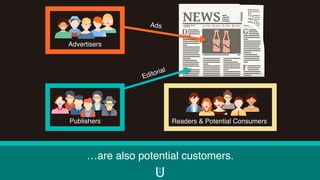
…are also potential customers.
Advertisers
Publishers Readers & Potential Consumers
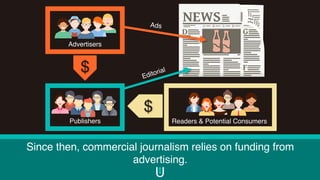
Since then, commercial journalism relies on funding from
advertising.
Advertisers
Publishers Readers & Potential Consumers
$
$
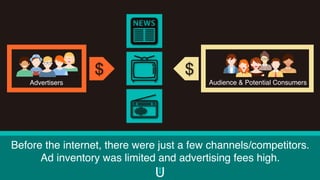
Before the internet, there were just a few channels/competitors.
Ad inventory was limited and advertising fees high.
Advertisers Audience & Potential Consumers
$$
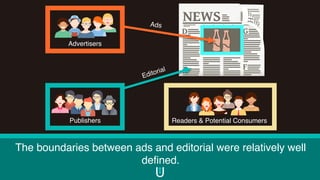
The boundaries between ads and editorial were relatively well
defined.
Publishers Readers & Potential Consumers
Advertisers
Facts were
checked
and sources
verified.
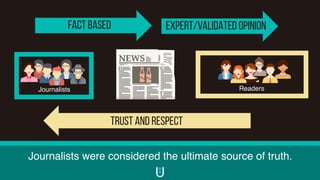
Journalists were considered the ultimate source of truth.
Journalists Readers
FACT Based Expert/validated Opinion
Trust AND RESPECT
Consumers paid
daily for serious,
public-interest
journalism.
But,
It wasn’t all
roses and sunshine.
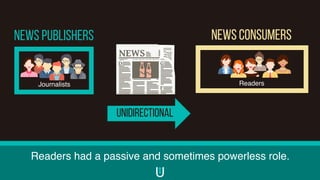
Readers had a passive and sometimes powerless role.
Journalists Readers
News PUBLISHERS News Consumers
Unidirectional
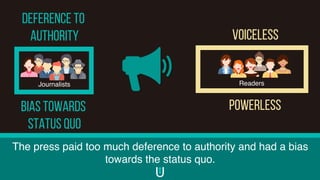
The press paid too much deference to authority and had a bias
towards the status quo.
Journalists Readers
DEFERENCE TO
AUTHORITY
BIAS TOWARDS
STATUS QUO
Voiceless
Powerless
The birth of the internet changed everything.
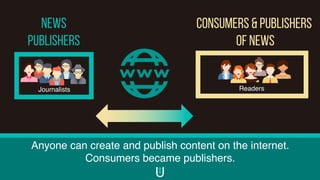
Anyone can create and publish content on the internet.
Consumers became publishers.
Journalists Readers
News
PUBLISHERS
CONSUMERS & PUBLISHERS
OF NEWS
The internet
empowered the
people, giving
them a voice and
unfiltered access
to information.
New advertising channels
emerged.
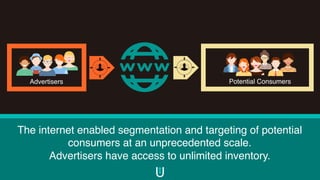
The internet enabled segmentation and targeting of potential
consumers at an unprecedented scale.
Advertisers have access to unlimited inventory.
Advertisers Potential Consumers
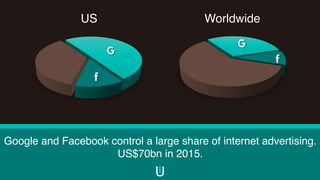
Google and Facebook control a large share of internet advertising.
US$70bn in 2015.
US Worldwide
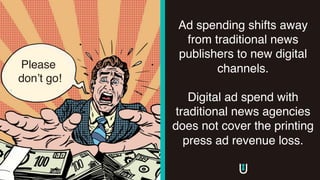
Ad spending shifts away
from traditional news
publishers to new digital
channels.
Digital ad spend with
traditional news agencies
does not cover the printing
press ad revenue loss.
Please
don’t go!
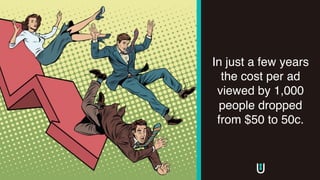
In just a few years
the cost per ad
viewed by 1,000
people dropped
from $50 to 50c.
New digital publishers
emerge using new
techniques to attract
eyeballs and
advertisers.
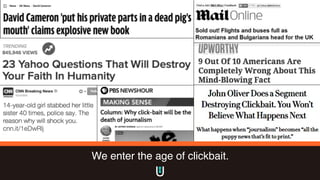
We enter the age of clickbait.
We attract readers with cute
cats and celebrity clickbait
with the hope that they
might stay around for the
“serious” news.
How’s that
working for you?
We also enter the age of sponsored content.
Freelancers, citizen
journalists, bloggers and
vloggers replace
traditional journalists.
Some publishers expect
content for free.
The
image
part
with
Social media attracts the
masses.
Like
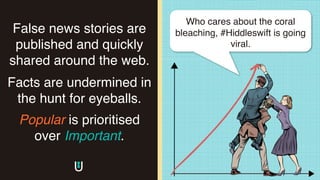
False news stories are
published and quickly
shared around the web.
Facts are undermined in
the hunt for eyeballs.
Popular is prioritised
over Important.
The
image
part
with
Who cares about the coral
bleaching, #Hiddleswift is going
viral.
Digital News Report.
Key findings across
26 countries.
digitalnewsreport.org
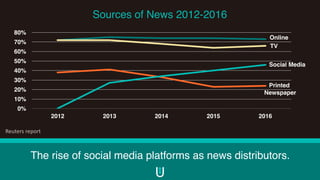
The rise of social media platforms as news distributors.
0%
10%
20%
30%
40%
50%
60%
70%
80%
2012 2013 2014 2015 2016
Online
TV
Social Media
Printed
Newspaper
Sources of News 2012-2016
Reuters	report
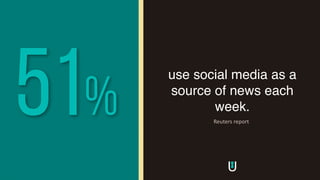
use social media as a
source of news each
week.51% Reuters	report
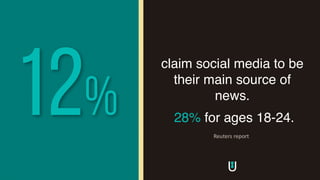
claim social media to be
their main source of
news.
28% for ages 18-24.
12% Reuters	report
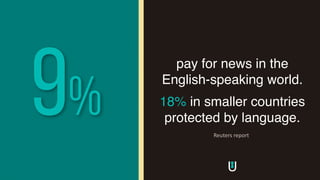
pay for news in the
English-speaking world.
18% in smaller countries
protected by language.
9% Reuters	report
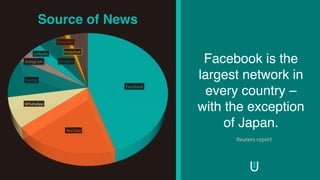
Facebook is the
largest network in
every country –
with the exception
of Japan.
Facebook
YouTube
WhatsApp
Twitter
Instagram
LinkedIn
Google+
Pinterest
Snapchat
Source of News
Reuters	report
“People want
personalised
recommendations
(even as they
worry about the
consequences)”
Rasmus Kleis Nielsen
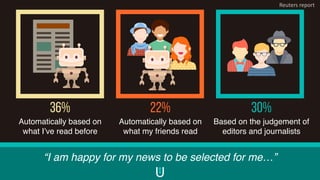
“I am happy for my news to be selected for me…”
36%
Automatically based on
what I’ve read before
22%
Automatically based on
what my friends read
30%
Based on the judgement of
editors and journalists
Reuters	report
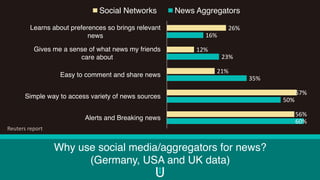
Why use social media/aggregators for news?
(Germany, USA and UK data)
60%
50%
35%
23%
16%
56%
57%
21%
12%
26%
Alerts and Breaking news
Simple way to access variety of news sources
Easy to comment and share news
Gives me a sense of what news my friends
care about
Learns about preferences so brings relevant
news
Social Networks News Aggregators
Reuters	report
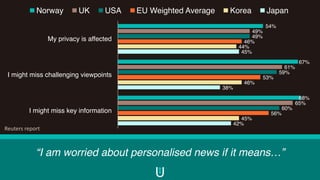
“I am worried about personalised news if it means…”
42%
38%
45%
45%
46%
44%
56%
53%
46%
60%
59%
49%
65%
61%
49%
68%
67%
54%
I might miss key information
I might miss challenging viewpoints
My privacy is affected
Norway UK USA EU Weighted Average Korea Japan
Reuters	report
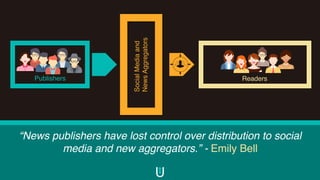
“News publishers have lost control over distribution to social
media and new aggregators.” - Emily Bell
Publishers Readers
SocialMediaand
NewsAggregators
“Now the news is
filtered through
algorithms and
platforms which are
opaque and
unpredictable.”
Emily Bell
143
adjustable
settings
???
I’m totally
in control.
Wait!
What?
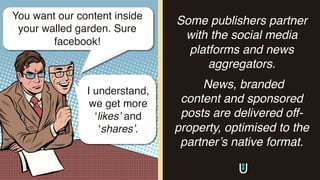
Some publishers partner
with the social media
platforms and news
aggregators.
News, branded
content and sponsored
posts are delivered off-
property, optimised to the
partner’s native format.
You want our content inside
your walled garden. Sure
facebook!
I understand,
we get more
‘likes’ and
‘shares’.
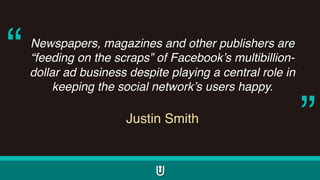
Newspapers, magazines and other publishers are
“feeding on the scraps” of Facebook’s multibillion-
dollar ad business despite playing a central role in
keeping the social network’s users happy.
Justin Smith
“
”
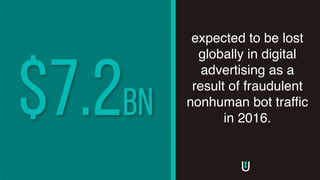
The increasing
diversity and number
of intermediaries
emerging in the
adtech space
escalates issues
related to viewability
and ad fraud.
expected to be lost
globally in digital
advertising as a
result of fraudulent
nonhuman bot traffic
in 2016.
$7.2bn
The future of news is
mobile and
personalised.
85% of users prefer
native mobile apps to
mobile websites.
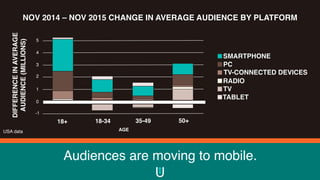
Audiences are moving to mobile.
USA data
DIFFERENCEINAVERAGE
AUDIENCE(MILLIONS)
-1
0
1
2
3
4
5
18+ 18-34 35-49 50+
AGE
SMARTPHONE
PC
TV-CONNECTED DEVICES
RADIO
TV
TABLET
NOV 2014 – NOV 2015 CHANGE IN AVERAGE AUDIENCE BY PLATFORM
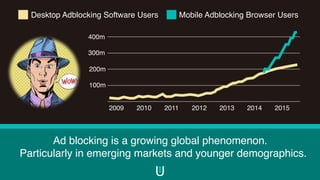
Ad blocking is a growing global phenomenon.
Particularly in emerging markets and younger demographics.
2015201420132012201120102009
Desktop Adblocking Software Users Mobile Adblocking Browser Users
100m
200m
300m
400m
Ad Blockers are
used for more
than blocking ads.
Users are
protecting
themselves
against malware.
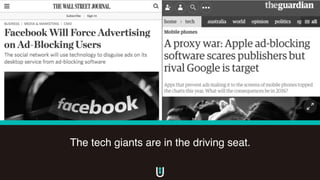
The tech giants are in the driving seat.
missed targets
cost-cutting
job losses
JOURNALISM
JOURNALISM
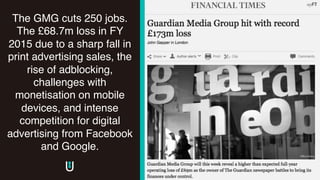
The GMG cuts 250 jobs.
The £68.7m loss in FY
2015 due to a sharp fall in
print advertising sales, the
rise of adblocking,
challenges with
monetisation on mobile
devices, and intense
competition for digital
advertising from Facebook
and Google.
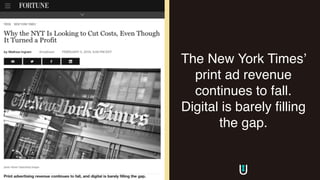
The New York Times’
print ad revenue
continues to fall.
Digital is barely filling
the gap.
Public broadcasting
services are
impacted by budget
cuts.
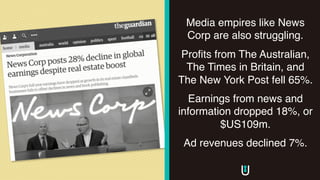
Media empires like News
Corp are also struggling.
Profits from The Australian,
The Times in Britain, and
The New York Post fell 65%.
Earnings from news and
information dropped 18%, or
$US109m.
Ad revenues declined 7%.
The digital-first publishers
are also not having a
great time.
Serious, public-interest journalism is demanding,
and there is more of a need for it than ever. It helps
keep the powerful honest; it helps people make
sense of the world and their place in it. Facts and
reliable information are essential for the functioning
of democracy – and the digital era has made that
even more obvious.
Katharine Viner
“
”
It’s time for
business model
innovation
JOURNALISM
JOURNALISM

Journalism in Crisis

  • 1.
  • 2.
    Once upon atime, in the pre-internet world…
  • 3.
  • 4.
    …are also potentialcustomers. Advertisers Publishers Readers & Potential Consumers
  • 5.
    Since then, commercialjournalism relies on funding from advertising. Advertisers Publishers Readers & Potential Consumers $ $
  • 6.
    Before the internet,there were just a few channels/competitors. Ad inventory was limited and advertising fees high. Advertisers Audience & Potential Consumers $$
  • 7.
    The boundaries betweenads and editorial were relatively well defined. Publishers Readers & Potential Consumers Advertisers
  • 8.
  • 9.
    Journalists were consideredthe ultimate source of truth. Journalists Readers FACT Based Expert/validated Opinion Trust AND RESPECT
  • 10.
    Consumers paid daily forserious, public-interest journalism.
  • 11.
  • 12.
    Readers had apassive and sometimes powerless role. Journalists Readers News PUBLISHERS News Consumers Unidirectional
  • 13.
    The press paidtoo much deference to authority and had a bias towards the status quo. Journalists Readers DEFERENCE TO AUTHORITY BIAS TOWARDS STATUS QUO Voiceless Powerless
  • 14.
    The birth ofthe internet changed everything.
  • 15.
    Anyone can createand publish content on the internet. Consumers became publishers. Journalists Readers News PUBLISHERS CONSUMERS & PUBLISHERS OF NEWS
  • 16.
    The internet empowered the people,giving them a voice and unfiltered access to information.
  • 17.
  • 18.
    The internet enabledsegmentation and targeting of potential consumers at an unprecedented scale. Advertisers have access to unlimited inventory. Advertisers Potential Consumers
  • 19.
    Google and Facebookcontrol a large share of internet advertising. US$70bn in 2015. US Worldwide
  • 20.
    Ad spending shiftsaway from traditional news publishers to new digital channels. Digital ad spend with traditional news agencies does not cover the printing press ad revenue loss. Please don’t go!
  • 21.
    In just afew years the cost per ad viewed by 1,000 people dropped from $50 to 50c.
  • 22.
    New digital publishers emergeusing new techniques to attract eyeballs and advertisers.
  • 23.
    We enter theage of clickbait.
  • 24.
    We attract readerswith cute cats and celebrity clickbait with the hope that they might stay around for the “serious” news.
  • 25.
  • 26.
    We also enterthe age of sponsored content.
  • 27.
    Freelancers, citizen journalists, bloggersand vloggers replace traditional journalists. Some publishers expect content for free. The image part with
  • 28.
    Social media attractsthe masses. Like
  • 29.
    False news storiesare published and quickly shared around the web. Facts are undermined in the hunt for eyeballs. Popular is prioritised over Important. The image part with Who cares about the coral bleaching, #Hiddleswift is going viral.
  • 30.
    Digital News Report. Keyfindings across 26 countries. digitalnewsreport.org
  • 31.
    The rise ofsocial media platforms as news distributors. 0% 10% 20% 30% 40% 50% 60% 70% 80% 2012 2013 2014 2015 2016 Online TV Social Media Printed Newspaper Sources of News 2012-2016 Reuters report
  • 32.
    use social mediaas a source of news each week.51% Reuters report
  • 33.
    claim social mediato be their main source of news. 28% for ages 18-24. 12% Reuters report
  • 34.
    pay for newsin the English-speaking world. 18% in smaller countries protected by language. 9% Reuters report
  • 35.
    Facebook is the largestnetwork in every country – with the exception of Japan. Facebook YouTube WhatsApp Twitter Instagram LinkedIn Google+ Pinterest Snapchat Source of News Reuters report
  • 36.
    “People want personalised recommendations (even asthey worry about the consequences)” Rasmus Kleis Nielsen
  • 37.
    “I am happyfor my news to be selected for me…” 36% Automatically based on what I’ve read before 22% Automatically based on what my friends read 30% Based on the judgement of editors and journalists Reuters report
  • 38.
    Why use socialmedia/aggregators for news? (Germany, USA and UK data) 60% 50% 35% 23% 16% 56% 57% 21% 12% 26% Alerts and Breaking news Simple way to access variety of news sources Easy to comment and share news Gives me a sense of what news my friends care about Learns about preferences so brings relevant news Social Networks News Aggregators Reuters report
  • 39.
    “I am worriedabout personalised news if it means…” 42% 38% 45% 45% 46% 44% 56% 53% 46% 60% 59% 49% 65% 61% 49% 68% 67% 54% I might miss key information I might miss challenging viewpoints My privacy is affected Norway UK USA EU Weighted Average Korea Japan Reuters report
  • 40.
    “News publishers havelost control over distribution to social media and new aggregators.” - Emily Bell Publishers Readers SocialMediaand NewsAggregators
  • 41.
    “Now the newsis filtered through algorithms and platforms which are opaque and unpredictable.” Emily Bell 143 adjustable settings ??? I’m totally in control. Wait! What?
  • 42.
    Some publishers partner withthe social media platforms and news aggregators. News, branded content and sponsored posts are delivered off- property, optimised to the partner’s native format. You want our content inside your walled garden. Sure facebook! I understand, we get more ‘likes’ and ‘shares’.
  • 43.
    Newspapers, magazines andother publishers are “feeding on the scraps” of Facebook’s multibillion- dollar ad business despite playing a central role in keeping the social network’s users happy. Justin Smith “ ”
  • 44.
    The increasing diversity andnumber of intermediaries emerging in the adtech space escalates issues related to viewability and ad fraud.
  • 45.
    expected to belost globally in digital advertising as a result of fraudulent nonhuman bot traffic in 2016. $7.2bn
  • 46.
    The future ofnews is mobile and personalised. 85% of users prefer native mobile apps to mobile websites.
  • 47.
    Audiences are movingto mobile. USA data DIFFERENCEINAVERAGE AUDIENCE(MILLIONS) -1 0 1 2 3 4 5 18+ 18-34 35-49 50+ AGE SMARTPHONE PC TV-CONNECTED DEVICES RADIO TV TABLET NOV 2014 – NOV 2015 CHANGE IN AVERAGE AUDIENCE BY PLATFORM
  • 48.
    Ad blocking isa growing global phenomenon. Particularly in emerging markets and younger demographics. 2015201420132012201120102009 Desktop Adblocking Software Users Mobile Adblocking Browser Users 100m 200m 300m 400m
  • 49.
    Ad Blockers are usedfor more than blocking ads. Users are protecting themselves against malware.
  • 50.
    The tech giantsare in the driving seat.
  • 51.
  • 52.
    The GMG cuts250 jobs. The £68.7m loss in FY 2015 due to a sharp fall in print advertising sales, the rise of adblocking, challenges with monetisation on mobile devices, and intense competition for digital advertising from Facebook and Google.
  • 53.
    The New YorkTimes’ print ad revenue continues to fall. Digital is barely filling the gap.
  • 54.
  • 55.
    Media empires likeNews Corp are also struggling. Profits from The Australian, The Times in Britain, and The New York Post fell 65%. Earnings from news and information dropped 18%, or $US109m. Ad revenues declined 7%.
  • 56.
    The digital-first publishers arealso not having a great time.
  • 57.
    Serious, public-interest journalismis demanding, and there is more of a need for it than ever. It helps keep the powerful honest; it helps people make sense of the world and their place in it. Facts and reliable information are essential for the functioning of democracy – and the digital era has made that even more obvious. Katharine Viner “ ”
  • 58.
    It’s time for businessmodel innovation JOURNALISM JOURNALISM