Effect of Ekakala Bhojana
in patients of Agnimandya
PRESENTED BY
DR.ANAMIKA YADAV
JUNIOR RESIDENT 1
DEPARTMENT OF KRIYA SHARIR
FACULTY OF AYURVEDA
IMS,BHU
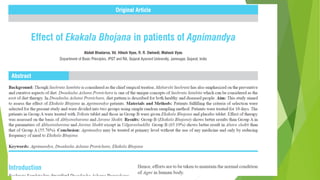
 NAME OF JOURNAL – AYU JOURNAL
 YEAR OF PUBLICATION – 2018
 AUTHER(S) DETAILS-
Abdeli Bhadarva,
Vd. Hitesh Vyas,
R. R. Dwivedi, Mahesh Vyas
Department of Basic Principles,
IPGT and RA, Gujarat Ayurved University,
Jamnagar, Gujarat, India
Introduction
 Sushruta Samhita has described Dwadasha Ashana Pravichara in Swasthavritta
Adhyaya of Uttaratantra, which is the major contribution in the field of dietetics
 There are 12 different kinds of dietary patterns which are helpful in different disease
conditions and in healthy state too.
 Ekakala Bhojana is one among them, which means meal once in a day.
 Acharya had suggested this dietetic regimen in persons having weak Agni (digestive
fire).
 According to ayurvedic philosophy, Agni is said to be
responsible for Bala (strength), Varna (complexion), and
Sukhayu (healthy life).
 All these depend on Agni and by properly maintaining
Agni, one can get long and healthy life.
 Mandagni is considered as root cause for most of the
diseases.
 Loss of function or malfunctioning can be considered
as Agnimandya. Weakened Agni cannot make enough
nutritive Rasa Dhatu which provides nutrition for
subsequent Dhatu and the person gets easily diseased.
 Agnimandya may occur as a symptom or a disease
itself and may provide background for further disease
progression.
 If Agni is in normal physiology, the body is maintained
in homeostasis and if the condition of the Agni is
abnormal, the person may have to face pathological or
diseased condition.
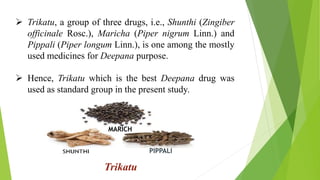
 Trikatu, a group of three drugs, i.e., Shunthi (Zingiber
officinale Rosc.), Maricha (Piper nigrum Linn.) and
Pippali (Piper longum Linn.), is one among the mostly
used medicines for Deepana purpose.
 Hence, Trikatu which is the best Deepana drug was
used as standard group in the present study.
Trikatu
MARICH
PIPPALI
Materials and Methods
Source of data
Individuals attending the outpatient department(OPD) and inpatient
department (IPD) of the Department of Basic Principles
fulfilling the criteria of selection, were selected for the present
study. A special proforma was prepared as per Ayurvedic
guidelines to assess the effect of therapy.
Inclusion criteria
1. Patients suffering from sign and symptoms of Adnimandya.
2. Patients having age between 25 and 50 years
3. Chronicity not more than 1 month.
Exclusion criteria
1. Patients having age <25 years and >50 years
2.Patients suffering from any major systemic
diseases such as diabetes, heart disease and hypertension
3. Pregnant women.
4. Conditions where Trikatu or Ekakala bhojana is
contraindicated.
Investigations
To rule out any other existing pathology, hematological investigation
(routine), liver function test and fasting blood sugar, postprandial blood
sugar and urine (routine and microscopic) examination were carried out.
This project has been approved by Institutional Ethics Committee vide
its letter No. PGT/7-A/2012-2013/1964, dated: 21/09/2012. This trial
was also registered in Clinical Trial Registry of India (CTRI), Reg. no.
CTRI/2013/10/004059 (trial registered retrospectively on 14/10/2013).
Drug and posology
The patients fulfilling the criteria were divided into two groups-
GROUP A
 The patients in Group A were
treated with Trikatu tablet
500 mg 2 tablets with
lukewarm water at
Pragbhakta Kala (before
meal) for 10 days.
GROUP B
 Group B patients were treated
with Ekakala Bhojana and
placebo tablet 500 mg 2
tablets with lukewarm water
at Pragbhakta Kala (before
meal) for 10 days.
 An assessment was made on Abhyavaharana Shakti
(food intake capacity) and Jarana Shakti (digestion
capacity) before and after treatment.
 The scoring was given to each criterion ranging
from 0 to 3. The following criteria were made to
assess the effect of therapy
Statistical analysis
The obtained data, on the basis of the observation, were
subjected to statistical analysis in terms of mean, standard
deviation, and standard error. The Student’s t-test conceded at a
level of
 P > 0.05 (insignificant),
 P < 0.05 and P < 0.01 (significant), and
 P < 0.001 (highly significant) for the final results
Results and Observations
 The symptoms of Agnimandya observed in more than 50% of patients
 Udaragaurava in 95% (heaviness in abdomen)
 Kshudhamandya in 60% (lack of appetite)
 Shirogaurava in 52.5% (heaviness in head)
 47.5% patients had Udarashoola (abdominal pain)
 40% had Gatrasadana (malaise)
 37.5% patients had both Shirahshoola (headache) and Udgarabahulya
(excessive eructation).
 The symptoms of Agnimandya observed in more than 50% of
patients
 Udaragaurava in 95% (heaviness in abdomen)
 Kshudhamandya in 60% (lack of appetite)
 Shirogaurava in 52.5% (heaviness in head)
 47.5% patients had Udarashoola (abdominal pain) and 40%
had Gatrasadana (malaise)
 37.5% patients had both Shirahshoola (headache) and
Udgarabahulya (excessive eructation).
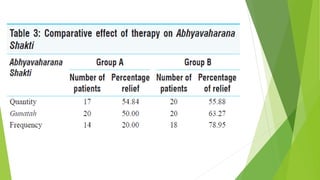
 In all parameters of Abhyavaharana Shakti (quantity of food
and quality and frequency of meal), Group B had better
result than Group A.
 Abhyavaharana Shakti in Group A was 46.81% and in
Group B it was 63.73%, which is statistically highly
significant .
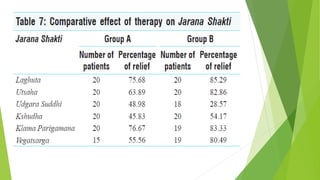
 In all parameters of Jarana Shakti (Laghuta, Utsaha, Udgara
Shuddhi, Kshudha, Klama Parigamanad and Vegotsarga), both the
groups had highly significant result, but percentage wise, Group B
had better result except in Udgarashuddhi.
 Overall, improvement in Jarana Shakti was 59.32% in Group A and
65.82% in Group B. Statistically highly significant result was found
in both the groups.
 The total effect of therapy in Ahara Shakti shows that both the
groups have highly significant result. Better improvement (65.19%)
was found in Group B than Group A (55.76%) .
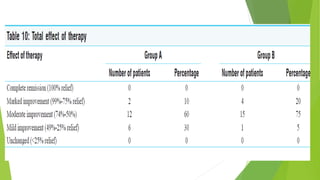
 Complete remission was found in none of the patients in both
the groups. Marked improvement was found in 20% of
patients in Group B and 10% of patients in Group A
 Moderate improvement was found in 75% of patients in
Group B and 60% of patients in Group A.
 Mild improvement was found in 30% of patients in Group A
and 5% of patients in Group B.
Discussion
 As per the study, 40% of the patients of Agnimandya
were between 31 and 40 years of age. This is the age
group of Pitta predominance.
 Moreover, the other causative factors of Agnimandya are
also found commonly during this age group such as
stress regarding job security, financial constraints
 Viruddhahara and family problem so that they might be
not following the proper diet regulations. Viruddhahara,
Ratrijagarana and other irregularities are also common
in this age group.
 Thus, the population of this age generally does not follow the correct
dietetic and behavioral regimens which eventually impair the status of
their Agni. Persons having self-business (30%) may be prone to the
disease because of their habits of Akala Bhojana (meal at improper
time) and Adhyashana (intake of food before digestion of prior meal),
street food, irregularity in diet, hurriedness in taking meal, lack of
exercise, stress, tension, etc.
 Housewives (40%) are performing the duties due to their responsibility
toward family and thus they are careless about their own health status.
They are irregular in their diet and are more prone to emotional factors
which are the etiological factors for Agnimandya.
It was reported that-
 55% of the total patients were taking Madhura Rasa,predominantly
ahar.
 Madhura Rasa causes Agnidaurbalya (weakness of digestive
power) and Anannabhilasha (aversion to food)
 47.5% of the patients were taking Ushna-Tikshna Pradhana Ahara,
 45% were taking Snigdha Pradhana and 40% were taking Guru
Pradhana Ahara.
 Atiushna-Tikshna Ahara causes Drava Gunayukta Pitta Prakopa
and Atisnigdha and Atiguru Ahara takes long time to digest and
increases Kapha which also causes Agnimandya.
 The quantity of the food determines the stimulation of Agni. It was
revealed that 82.5%, 75% and 45% of the patients were having the
habit of Adhayshana, Vishamashana, and Viruddhahara respectively.
 These dietary patterns are responsible for many diseases.
 Nearly 55% of patients had the habit of more water intake. More
water intake is again a causative factor for Agnimandya.
 82.5% of patients were having the habit of Amatrashana(improper
quantity of food)
 Around 77.5%, 72.5%, and 62.5% of patients had the habit of water intake after
meal, at sleeping time and in the morning respectively
 45% of patients had the habit of excessive sleep.
 Almost 65% and 62.5% of patients had the habit of Ratrijagarana (night
awakening) and Diwasvapna (day sleep) respectively.
 It shows that Swapnaviparyaya is one of the important causes found for
Agnimandya in the study as elaborated in classics.
 Nearly 15% of patients were found with Ati Mutrapravritti (polyuria) due to
Ama formation which is sequel of Agnimandya.
 It was found that 62.5% of patients had unsatisfactory Mala Pravritti, while
50% and 40% patients had Durgandhita and Pichhila Mala Pravritti
respectively, which suggests that food is incompletely digested by weakened
Agni .
Probable mode of action
 Trikatu is having Katu Rasa, Katu Vipaka, and Ushna Veerya
along with Deepana Karma. It alleviates Vata-Kapha Dosha.
Kapha is the main Dosha in Agnimandya and it is pacified by
Trikatu. Katu Rasa also acts as a Deepana drug and causes
Pachana by Ushna Veerya.
 Ekakala Bhojana works as a medicine for Agnimandya by
modification in regular diet in its frequency, quantity and quality.
As Mandagni is unable to digest even small quantity of food, it
needs much time for digestion.
 By giving Ekakala Bhojana, enough time is given to the Agni for
complete digestion. Time is one of the important factors for Ahara
Parinamakara Bhava.
 Though all the Aharaparinamakara Bhava works properly,
if enough time is not given to Agni, food cannot be digested
properly and produces undigested or intermediate products
called as Ama.
 The rest is given to the Agni by skipping one-time meal and
thus Ama is being digested in the absence of food by Agni.
As Ama is digested, Agni becomes strong and stable that
can digest food taken in regular amount.
Less amont of food takes less time for digestion by Agni.
Laghu Ahara was given in this group qualitatively. Agni is
stimulated by Laghu Ahara by its Agnisandhukshanakara
Swabhava as Laghu Ahara takes less time to get digested
 In addition to that, in Ekakala bhojana, amount is also
reduced which Agni can digest easily.
Conclusion
 Maharshi Sushruta has described a key of dietetics under the
heading of “Dwadasha Ashana Pravichara.” Agnimadya may be
treated at primary level without use of any medicine and only by
reducing the frequency of meal.
 By prescribing one-time meal, organs of digestive system get
some rest and they can digest one-time light meal.
 Group B (Ekakala Bhojana) shows better results than Group A in
the parameters of Abhyavaharana and Jarana Shakti except in
Udgarashuddhi.
 Group B shows better result in Ahara shakti than Group A.
LACUNA
 Questionniare for assesment of agnimandya is not
mentioned
 Sign and symptoms of agnimandya is not
mentioned
 Description regarding collection of drug is not
mentioned
Journal club

Journal club

  • 1.
    Effect of EkakalaBhojana in patients of Agnimandya PRESENTED BY DR.ANAMIKA YADAV JUNIOR RESIDENT 1 DEPARTMENT OF KRIYA SHARIR FACULTY OF AYURVEDA IMS,BHU
  • 2.
     NAME OFJOURNAL – AYU JOURNAL  YEAR OF PUBLICATION – 2018  AUTHER(S) DETAILS- Abdeli Bhadarva, Vd. Hitesh Vyas, R. R. Dwivedi, Mahesh Vyas Department of Basic Principles, IPGT and RA, Gujarat Ayurved University, Jamnagar, Gujarat, India
  • 4.
    Introduction  Sushruta Samhitahas described Dwadasha Ashana Pravichara in Swasthavritta Adhyaya of Uttaratantra, which is the major contribution in the field of dietetics  There are 12 different kinds of dietary patterns which are helpful in different disease conditions and in healthy state too.  Ekakala Bhojana is one among them, which means meal once in a day.  Acharya had suggested this dietetic regimen in persons having weak Agni (digestive fire).
  • 5.
     According toayurvedic philosophy, Agni is said to be responsible for Bala (strength), Varna (complexion), and Sukhayu (healthy life).  All these depend on Agni and by properly maintaining Agni, one can get long and healthy life.  Mandagni is considered as root cause for most of the diseases.
  • 6.
     Loss offunction or malfunctioning can be considered as Agnimandya. Weakened Agni cannot make enough nutritive Rasa Dhatu which provides nutrition for subsequent Dhatu and the person gets easily diseased.  Agnimandya may occur as a symptom or a disease itself and may provide background for further disease progression.  If Agni is in normal physiology, the body is maintained in homeostasis and if the condition of the Agni is abnormal, the person may have to face pathological or diseased condition.
  • 7.
     Trikatu, agroup of three drugs, i.e., Shunthi (Zingiber officinale Rosc.), Maricha (Piper nigrum Linn.) and Pippali (Piper longum Linn.), is one among the mostly used medicines for Deepana purpose.  Hence, Trikatu which is the best Deepana drug was used as standard group in the present study. Trikatu MARICH PIPPALI
  • 8.
    Materials and Methods Sourceof data Individuals attending the outpatient department(OPD) and inpatient department (IPD) of the Department of Basic Principles fulfilling the criteria of selection, were selected for the present study. A special proforma was prepared as per Ayurvedic guidelines to assess the effect of therapy.
  • 9.
    Inclusion criteria 1. Patientssuffering from sign and symptoms of Adnimandya. 2. Patients having age between 25 and 50 years 3. Chronicity not more than 1 month.
  • 10.
    Exclusion criteria 1. Patientshaving age <25 years and >50 years 2.Patients suffering from any major systemic diseases such as diabetes, heart disease and hypertension 3. Pregnant women. 4. Conditions where Trikatu or Ekakala bhojana is contraindicated.
  • 11.
    Investigations To rule outany other existing pathology, hematological investigation (routine), liver function test and fasting blood sugar, postprandial blood sugar and urine (routine and microscopic) examination were carried out. This project has been approved by Institutional Ethics Committee vide its letter No. PGT/7-A/2012-2013/1964, dated: 21/09/2012. This trial was also registered in Clinical Trial Registry of India (CTRI), Reg. no. CTRI/2013/10/004059 (trial registered retrospectively on 14/10/2013).
  • 12.
    Drug and posology Thepatients fulfilling the criteria were divided into two groups- GROUP A  The patients in Group A were treated with Trikatu tablet 500 mg 2 tablets with lukewarm water at Pragbhakta Kala (before meal) for 10 days. GROUP B  Group B patients were treated with Ekakala Bhojana and placebo tablet 500 mg 2 tablets with lukewarm water at Pragbhakta Kala (before meal) for 10 days.
  • 13.
     An assessmentwas made on Abhyavaharana Shakti (food intake capacity) and Jarana Shakti (digestion capacity) before and after treatment.  The scoring was given to each criterion ranging from 0 to 3. The following criteria were made to assess the effect of therapy
  • 14.
    Statistical analysis The obtaineddata, on the basis of the observation, were subjected to statistical analysis in terms of mean, standard deviation, and standard error. The Student’s t-test conceded at a level of  P > 0.05 (insignificant),  P < 0.05 and P < 0.01 (significant), and  P < 0.001 (highly significant) for the final results
  • 15.
    Results and Observations The symptoms of Agnimandya observed in more than 50% of patients  Udaragaurava in 95% (heaviness in abdomen)  Kshudhamandya in 60% (lack of appetite)  Shirogaurava in 52.5% (heaviness in head)  47.5% patients had Udarashoola (abdominal pain)  40% had Gatrasadana (malaise)  37.5% patients had both Shirahshoola (headache) and Udgarabahulya (excessive eructation).
  • 16.
     The symptomsof Agnimandya observed in more than 50% of patients  Udaragaurava in 95% (heaviness in abdomen)  Kshudhamandya in 60% (lack of appetite)  Shirogaurava in 52.5% (heaviness in head)  47.5% patients had Udarashoola (abdominal pain) and 40% had Gatrasadana (malaise)  37.5% patients had both Shirahshoola (headache) and Udgarabahulya (excessive eructation).
  • 17.
     In allparameters of Abhyavaharana Shakti (quantity of food and quality and frequency of meal), Group B had better result than Group A.  Abhyavaharana Shakti in Group A was 46.81% and in Group B it was 63.73%, which is statistically highly significant .
  • 18.
     In allparameters of Jarana Shakti (Laghuta, Utsaha, Udgara Shuddhi, Kshudha, Klama Parigamanad and Vegotsarga), both the groups had highly significant result, but percentage wise, Group B had better result except in Udgarashuddhi.  Overall, improvement in Jarana Shakti was 59.32% in Group A and 65.82% in Group B. Statistically highly significant result was found in both the groups.  The total effect of therapy in Ahara Shakti shows that both the groups have highly significant result. Better improvement (65.19%) was found in Group B than Group A (55.76%) .
  • 19.
     Complete remissionwas found in none of the patients in both the groups. Marked improvement was found in 20% of patients in Group B and 10% of patients in Group A  Moderate improvement was found in 75% of patients in Group B and 60% of patients in Group A.  Mild improvement was found in 30% of patients in Group A and 5% of patients in Group B.
  • 23.
    Discussion  As perthe study, 40% of the patients of Agnimandya were between 31 and 40 years of age. This is the age group of Pitta predominance.  Moreover, the other causative factors of Agnimandya are also found commonly during this age group such as stress regarding job security, financial constraints  Viruddhahara and family problem so that they might be not following the proper diet regulations. Viruddhahara, Ratrijagarana and other irregularities are also common in this age group.
  • 24.
     Thus, thepopulation of this age generally does not follow the correct dietetic and behavioral regimens which eventually impair the status of their Agni. Persons having self-business (30%) may be prone to the disease because of their habits of Akala Bhojana (meal at improper time) and Adhyashana (intake of food before digestion of prior meal), street food, irregularity in diet, hurriedness in taking meal, lack of exercise, stress, tension, etc.  Housewives (40%) are performing the duties due to their responsibility toward family and thus they are careless about their own health status. They are irregular in their diet and are more prone to emotional factors which are the etiological factors for Agnimandya.
  • 25.
    It was reportedthat-  55% of the total patients were taking Madhura Rasa,predominantly ahar.  Madhura Rasa causes Agnidaurbalya (weakness of digestive power) and Anannabhilasha (aversion to food)  47.5% of the patients were taking Ushna-Tikshna Pradhana Ahara,  45% were taking Snigdha Pradhana and 40% were taking Guru Pradhana Ahara.  Atiushna-Tikshna Ahara causes Drava Gunayukta Pitta Prakopa and Atisnigdha and Atiguru Ahara takes long time to digest and increases Kapha which also causes Agnimandya.
  • 26.
     The quantityof the food determines the stimulation of Agni. It was revealed that 82.5%, 75% and 45% of the patients were having the habit of Adhayshana, Vishamashana, and Viruddhahara respectively.  These dietary patterns are responsible for many diseases.  Nearly 55% of patients had the habit of more water intake. More water intake is again a causative factor for Agnimandya.  82.5% of patients were having the habit of Amatrashana(improper quantity of food)
  • 27.
     Around 77.5%,72.5%, and 62.5% of patients had the habit of water intake after meal, at sleeping time and in the morning respectively  45% of patients had the habit of excessive sleep.  Almost 65% and 62.5% of patients had the habit of Ratrijagarana (night awakening) and Diwasvapna (day sleep) respectively.  It shows that Swapnaviparyaya is one of the important causes found for Agnimandya in the study as elaborated in classics.  Nearly 15% of patients were found with Ati Mutrapravritti (polyuria) due to Ama formation which is sequel of Agnimandya.  It was found that 62.5% of patients had unsatisfactory Mala Pravritti, while 50% and 40% patients had Durgandhita and Pichhila Mala Pravritti respectively, which suggests that food is incompletely digested by weakened Agni .
  • 28.
    Probable mode ofaction  Trikatu is having Katu Rasa, Katu Vipaka, and Ushna Veerya along with Deepana Karma. It alleviates Vata-Kapha Dosha. Kapha is the main Dosha in Agnimandya and it is pacified by Trikatu. Katu Rasa also acts as a Deepana drug and causes Pachana by Ushna Veerya.  Ekakala Bhojana works as a medicine for Agnimandya by modification in regular diet in its frequency, quantity and quality. As Mandagni is unable to digest even small quantity of food, it needs much time for digestion.  By giving Ekakala Bhojana, enough time is given to the Agni for complete digestion. Time is one of the important factors for Ahara Parinamakara Bhava.
  • 29.
     Though allthe Aharaparinamakara Bhava works properly, if enough time is not given to Agni, food cannot be digested properly and produces undigested or intermediate products called as Ama.  The rest is given to the Agni by skipping one-time meal and thus Ama is being digested in the absence of food by Agni. As Ama is digested, Agni becomes strong and stable that can digest food taken in regular amount.
  • 30.
    Less amont offood takes less time for digestion by Agni. Laghu Ahara was given in this group qualitatively. Agni is stimulated by Laghu Ahara by its Agnisandhukshanakara Swabhava as Laghu Ahara takes less time to get digested  In addition to that, in Ekakala bhojana, amount is also reduced which Agni can digest easily.
  • 31.
    Conclusion  Maharshi Sushrutahas described a key of dietetics under the heading of “Dwadasha Ashana Pravichara.” Agnimadya may be treated at primary level without use of any medicine and only by reducing the frequency of meal.  By prescribing one-time meal, organs of digestive system get some rest and they can digest one-time light meal.  Group B (Ekakala Bhojana) shows better results than Group A in the parameters of Abhyavaharana and Jarana Shakti except in Udgarashuddhi.  Group B shows better result in Ahara shakti than Group A.
  • 32.
    LACUNA  Questionniare forassesment of agnimandya is not mentioned  Sign and symptoms of agnimandya is not mentioned  Description regarding collection of drug is not mentioned