Happy Chinese New
Year !
How many things do you know about Chinese New Year?
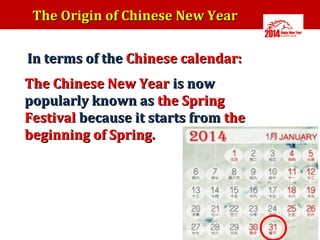
The Origin of Chinese New Year
In terms of the Chinese calendar:
The Chinese New Year is now
popularly known as the Spring
Festival because it starts from the
beginning of Spring.
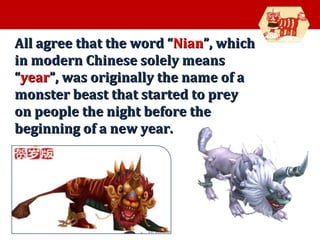
All agree that the word “Nian”, which
in modern Chinese solely means
“year”, was originally the name of a
monster beast that started to prey
on people the night before the
beginning of a new year.
Legend

•

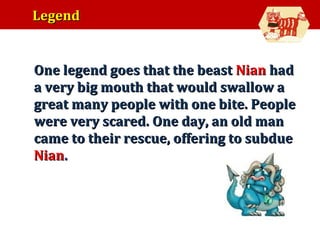
One legend goes that the beast Nian had
a very big mouth that would swallow a
great many people with one bite. People
were very scared. One day, an old man
came to their rescue, offering to subdue
Nian.
Legend
•

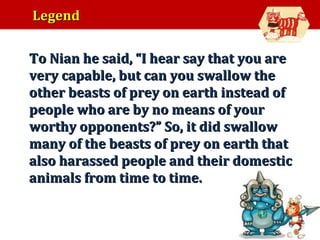
To Nian he said, “I hear say that you are
very capable, but can you swallow the
other beasts of prey on earth instead of
people who are by no means of your
worthy opponents?” So, it did swallow
many of the beasts of prey on earth that
also harassed people and their domestic
animals from time to time.
Legend

•

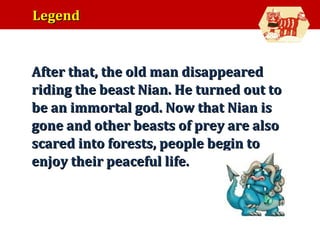
After that, the old man disappeared
riding the beast Nian. He turned out to
be an immortal god. Now that Nian is
gone and other beasts of prey are also
scared into forests, people begin to
enjoy their peaceful life.
Legend
•

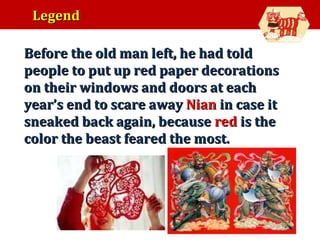
Before the old man left, he had told
people to put up red paper decorations
on their windows and doors at each
year’s end to scare away Nian in case it
sneaked back again, because red is the
color the beast feared the most.
Legend

•

From then on, the tradition of observing
the conquest of Nian is carried on from
generation to generation. The term “Guo
Nian”, which may mean “Survive the
Nian” becomes today “Celebrate the
(New) Year” as the word “guo”in Chinese
having both the meaning of “pass-over”
and “observe”.
•

•

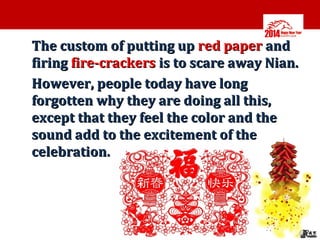
The custom of putting up red paper and
firing fire-crackers is to scare away Nian.
However, people today have long
forgotten why they are doing all this,
except that they feel the color and the
sound add to the excitement of the
celebration.
Traditions of Chinese New Year
•

•

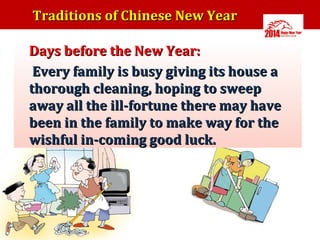
Days before the New Year:
Every family is busy giving its house a
thorough cleaning, hoping to sweep
away all the ill-fortune there may have
been in the family to make way for the
wishful in-coming good luck.
•

Traditions of Chinese New Year
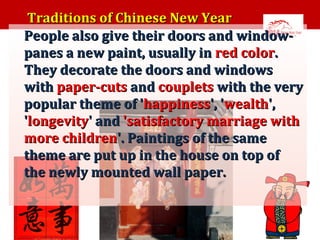
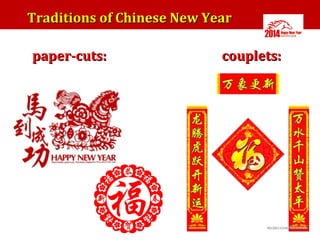
People also give their doors and windowpanes a new paint, usually in red color.
They decorate the doors and windows
with paper-cuts and couplets with the very
popular theme of 'happiness', 'wealth',
'longevity' and 'satisfactory marriage with
more children'. Paintings of the same
theme are put up in the house on top of
the newly mounted wall paper.
Traditions of Chinese New Year
paper-cuts:

couplets:
The Eve of the New Year
•

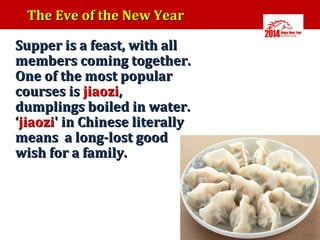
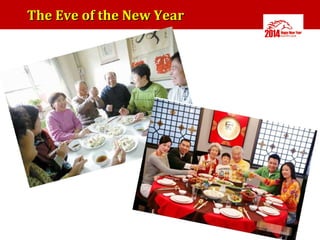
Supper is a feast, with all
members coming together.
One of the most popular
courses is jiaozi,
dumplings boiled in water.
‘jiaozi' in Chinese literally
means a long-lost good
wish for a family.
The Eve of the New Year
•

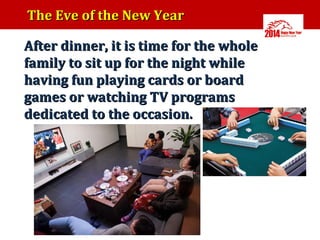
After dinner, it is time for the whole
family to sit up for the night while
having fun playing cards or board
games or watching TV programs
dedicated to the occasion.
Very early the next morning

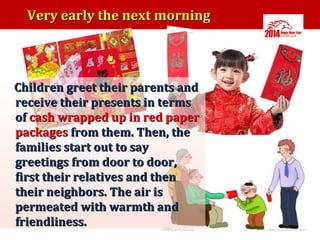
Children greet their parents and
receive their presents in terms
of cash wrapped up in red paper
packages from them. Then, the
families start out to say
greetings from door to door,
first their relatives and then
their neighbors. The air is
permeated with warmth and
friendliness.
Several days following the New Year's day
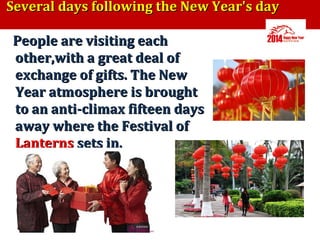
People are visiting each
other,with a great deal of
exchange of gifts. The New
Year atmosphere is brought
to an anti-climax fifteen days
away where the Festival of
Lanterns sets in.
Lantern festival: the end of New Year celebrations
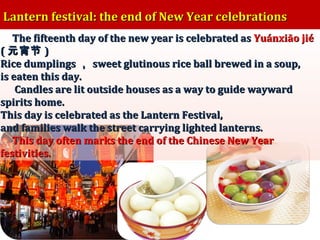
The fifteenth day of the new year is celebrated as Yuánxiāo jié
( 元宵节 )
Rice dumplings , sweet glutinous rice ball brewed in a soup,
is eaten this day.
Candles are lit outside houses as a way to guide wayward
spirits home.
This day is celebrated as the Lantern Festival,
and families walk the street carrying lighted lanterns.
This day often marks the end of the Chinese New Year
festivities.
mă
Greetings for Chinese New Year

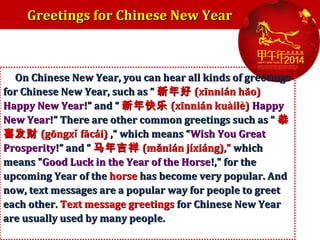
On Chinese New Year, you can hear all kinds of greetings
for Chinese New Year, such as “ 新年好 (xīnnián hăo)
Happy New Year!” and “ 新年快乐 (xīnnián kuàilè) Happy
New Year!” There are other common greetings such as “ 恭
喜发财 (gōngxǐ fācái) ,” which means “Wish You Great
Prosperity!” and “ 马年吉祥 (mănián jíxiáng)," which
means "Good Luck in the Year of the Horse!," for the
upcoming Year of the horse has become very popular. And
now, text messages are a popular way for people to greet
each other. Text message greetings for Chinese New Year
are usually used by many people.
Greetings for Chinese New Year

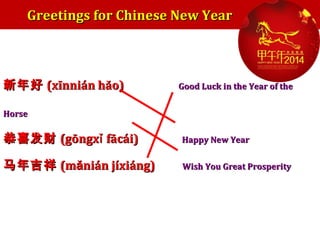
新年好 (xīnnián hăo)

Good Luck in the Year of the

Horse

恭喜发财 (gōngxǐ fācái)

Happy New Year

马年吉祥 (mănián jíxiáng)

Wish You Great Prosperity
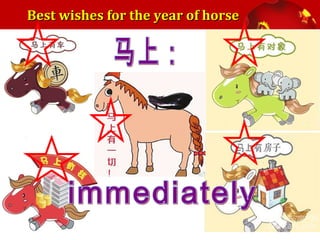
Best wishes for the year of horse
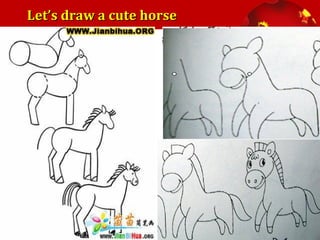
Let’s draw a cute horse
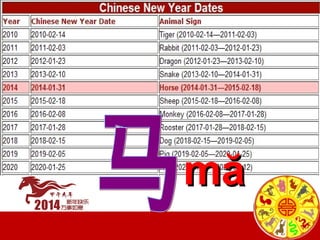
2014 chinese new years day

2014 chinese new years day

  • 1.
  • 2.
    How many thingsdo you know about Chinese New Year?
  • 3.
    The Origin ofChinese New Year In terms of the Chinese calendar: The Chinese New Year is now popularly known as the Spring Festival because it starts from the beginning of Spring.
  • 4.
    All agree thatthe word “Nian”, which in modern Chinese solely means “year”, was originally the name of a monster beast that started to prey on people the night before the beginning of a new year.
  • 5.
    Legend • One legend goesthat the beast Nian had a very big mouth that would swallow a great many people with one bite. People were very scared. One day, an old man came to their rescue, offering to subdue Nian.
  • 6.
    Legend • To Nian hesaid, “I hear say that you are very capable, but can you swallow the other beasts of prey on earth instead of people who are by no means of your worthy opponents?” So, it did swallow many of the beasts of prey on earth that also harassed people and their domestic animals from time to time.
  • 7.
    Legend • After that, theold man disappeared riding the beast Nian. He turned out to be an immortal god. Now that Nian is gone and other beasts of prey are also scared into forests, people begin to enjoy their peaceful life.
  • 8.
    Legend • Before the oldman left, he had told people to put up red paper decorations on their windows and doors at each year’s end to scare away Nian in case it sneaked back again, because red is the color the beast feared the most.
  • 9.
    Legend • From then on,the tradition of observing the conquest of Nian is carried on from generation to generation. The term “Guo Nian”, which may mean “Survive the Nian” becomes today “Celebrate the (New) Year” as the word “guo”in Chinese having both the meaning of “pass-over” and “observe”.
  • 10.
    • • The custom ofputting up red paper and firing fire-crackers is to scare away Nian. However, people today have long forgotten why they are doing all this, except that they feel the color and the sound add to the excitement of the celebration.
  • 11.
    Traditions of ChineseNew Year • • Days before the New Year: Every family is busy giving its house a thorough cleaning, hoping to sweep away all the ill-fortune there may have been in the family to make way for the wishful in-coming good luck.
  • 12.
    • Traditions of ChineseNew Year People also give their doors and windowpanes a new paint, usually in red color. They decorate the doors and windows with paper-cuts and couplets with the very popular theme of 'happiness', 'wealth', 'longevity' and 'satisfactory marriage with more children'. Paintings of the same theme are put up in the house on top of the newly mounted wall paper.
  • 13.
    Traditions of ChineseNew Year paper-cuts: couplets:
  • 14.
    The Eve ofthe New Year • Supper is a feast, with all members coming together. One of the most popular courses is jiaozi, dumplings boiled in water. ‘jiaozi' in Chinese literally means a long-lost good wish for a family.
  • 15.
    The Eve ofthe New Year
  • 16.
    The Eve ofthe New Year • After dinner, it is time for the whole family to sit up for the night while having fun playing cards or board games or watching TV programs dedicated to the occasion.
  • 17.
    Very early thenext morning Children greet their parents and receive their presents in terms of cash wrapped up in red paper packages from them. Then, the families start out to say greetings from door to door, first their relatives and then their neighbors. The air is permeated with warmth and friendliness.
  • 18.
    Several days followingthe New Year's day People are visiting each other,with a great deal of exchange of gifts. The New Year atmosphere is brought to an anti-climax fifteen days away where the Festival of Lanterns sets in.
  • 19.
    Lantern festival: theend of New Year celebrations The fifteenth day of the new year is celebrated as Yuánxiāo jié ( 元宵节 ) Rice dumplings , sweet glutinous rice ball brewed in a soup, is eaten this day. Candles are lit outside houses as a way to guide wayward spirits home. This day is celebrated as the Lantern Festival, and families walk the street carrying lighted lanterns. This day often marks the end of the Chinese New Year festivities.
  • 20.
  • 21.
    Greetings for ChineseNew Year On Chinese New Year, you can hear all kinds of greetings for Chinese New Year, such as “ 新年好 (xīnnián hăo) Happy New Year!” and “ 新年快乐 (xīnnián kuàilè) Happy New Year!” There are other common greetings such as “ 恭 喜发财 (gōngxǐ fācái) ,” which means “Wish You Great Prosperity!” and “ 马年吉祥 (mănián jíxiáng)," which means "Good Luck in the Year of the Horse!," for the upcoming Year of the horse has become very popular. And now, text messages are a popular way for people to greet each other. Text message greetings for Chinese New Year are usually used by many people.
  • 22.
    Greetings for ChineseNew Year 新年好 (xīnnián hăo) Good Luck in the Year of the Horse 恭喜发财 (gōngxǐ fācái) Happy New Year 马年吉祥 (mănián jíxiáng) Wish You Great Prosperity
  • 23.
    Best wishes forthe year of horse
  • 24.
    Let’s draw acute horse