Education
School Subjects
Easy
Useful Today
Difficult
Boring
Interesting
Useless
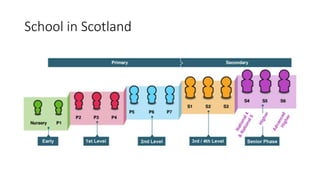
School in Scotland
School in England
English Schools
• School leaving age- 16 years old
• Education leaving age- 18 years old
• 93% of children between 3 and 18 years old attend government
funded schools.
• Obligatory subjects- Physical Education, Religious Education, Careers
Education and Guidance, English Language, English Literature, Maths
and a science.
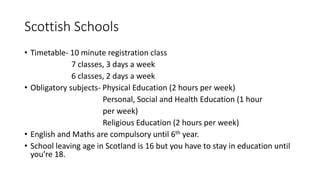
Scottish Schools
• Timetable- 10 minute registration class
7 classes, 3 days a week
6 classes, 2 days a week
• Obligatory subjects- Physical Education (2 hours per week)
Personal, Social and Health Education (1 hour
per week)
Religious Education (2 hours per week)
• English and Maths are compulsory until 6th year.
• School leaving age in Scotland is 16 but you have to stay in education until
you’re 18.
School Uniform
Shirt
Tie Blazer
Skirt
Trousers Jumper
Are these suitable for wearing to school?
• Mini skirts
• Bikini tops
• Body piercings
• Tattoos
• Jeans with holes
• Tight jeans
• Fur coats
• Cropped tops
• Brightly coloured hair
• Jewellery
• High heels
• Make up
• Designer trainers
• Tracksuits
• Loose long hair (boys and girls)
• Uniforms make pupils look tidy and smart.
• Uniforms are ugly and old-fashioned.
• Uniforms stop unfair comparisons between rich or poorer students.
• Uniforms make choosing your clothes in the morning easier.
• Uniforms do not allow teenagers to express their individual
personalities.
• Uniforms are good for discipline and give a serious tone to the school.
Sports at School
• All pupils in the UK have to do Physical Education at school until they
are 16.
• The sports you can do at school depend on your school as each one
offers different activities.
• The most popular sport at school is football, played by girls and boys.
Pupils play other traditional team games such as rugby, field hockey,
netball and rounders.
• Today, some schools offer more modern sports and physical activities
such as dance, dodgeball or Ultimate Frisbee.
• Netball
• This sport is played between two teams. There are seven players on each team and
you score goals by throwing the ball into a net. It is similar to basketball, but you
can’t run with the ball. At UK schools mainly girls play this sport.
• Rounders
• This team sport is similar to baseball or softball. One team hits the ball with a bat
and runs around four posts or bases in the field. The other team throws the ball and
tries to catch it or touch the post with the ball.
• Dodgeball
• In this team sport, players throw the ball at the players on the other team and try to
hit them with the ball. If the ball hits you, you are out! The balls are soft and many
balls are used at the same time.
• Ultimate Frisbee
• A game played by two teams of seven players on a field. You score goals by throwing
the Frisbee (a plastic disc) into the ‘endzone’, but be careful, you can’t run with the
Frisbee!
School Dinners
• Some people think that school dinners (that means ‘lunch’) are
unhealthy, some people say that they are much better than in the
past and others say that midday meals should be free for all school
children.
• What is a school dinner?
• A typical school dinner costs about £2 a day for a secondary school pupil in
the UK. There is usually a main course, a dessert and a drink. Parents often
pay online. School dinners must include food groups such as fruit and
vegetables, protein (for example meat, fish or cheese) and carbohydrate (for
example rice or pasta). There are rules about how the food is prepared, for
example there are limits on the quantity of fried food.
Bad Behaviour
• Playing truant (not coming to school without permission from
parents)
• Smoking, swearing, hitting, kissing, running
• Not doing homework
• Cheating in exams (copying from secret notes or another pupil)
• Calling a teacher or another pupil bad names (bullying)
• Not listening or not paying attention in lessons
• Wearing unsuitable clothes for school
Punishments
• Exclusion: a pupil is excluded from the school and cannot come back. The
pupil has to find a new school.
• Suspension: when a pupil is suspended they cannot enter the building or
go to lessons until the school has a meeting about them. Suspension can
last from 1 to 45 days in a school term. The school usually gives work to do
at home with a tutor (special teacher).
• Detention: a pupil is detained. This means he or she is asked to stay at
school at the end of the school day. The pupil must work for 30 minutes or
an hour more before they are allowed to leave the school.
• Lines: a pupil has to write a sentence many times (100 times) on a sheet of
paper: An example sentence: I must not shout in class. This punishment is
sometimes given during detention too.
Do you agree?
• School uniform is essential.
• Pupils are not given enough homework.
• A good teacher is a strict teacher.
• Exams are getting easier.
• School should be three days a week.
• Education should be free.
• All pupils should study cookery and sewing.
Roleplay
Student A
• You are wearing something
totally unsuitable for school (you
decide what). Try to justify your
choice to the teacher. You must
try to avoid being sent home to
change.
Student B
• You are an angry teacher.
Student A is wearing something
totally unsuitable at school
today (they will tell you what).
Ask him or her to go home and
get changed. Explain your
reasons.

Education in Scotland

  • 1.
  • 2.
  • 3.
  • 4.
  • 5.
    English Schools • Schoolleaving age- 16 years old • Education leaving age- 18 years old • 93% of children between 3 and 18 years old attend government funded schools. • Obligatory subjects- Physical Education, Religious Education, Careers Education and Guidance, English Language, English Literature, Maths and a science.
  • 6.
    Scottish Schools • Timetable-10 minute registration class 7 classes, 3 days a week 6 classes, 2 days a week • Obligatory subjects- Physical Education (2 hours per week) Personal, Social and Health Education (1 hour per week) Religious Education (2 hours per week) • English and Maths are compulsory until 6th year. • School leaving age in Scotland is 16 but you have to stay in education until you’re 18.
  • 7.
  • 8.
    Are these suitablefor wearing to school? • Mini skirts • Bikini tops • Body piercings • Tattoos • Jeans with holes • Tight jeans • Fur coats • Cropped tops • Brightly coloured hair • Jewellery • High heels • Make up • Designer trainers • Tracksuits • Loose long hair (boys and girls)
  • 9.
    • Uniforms makepupils look tidy and smart. • Uniforms are ugly and old-fashioned. • Uniforms stop unfair comparisons between rich or poorer students. • Uniforms make choosing your clothes in the morning easier. • Uniforms do not allow teenagers to express their individual personalities. • Uniforms are good for discipline and give a serious tone to the school.
  • 10.
    Sports at School •All pupils in the UK have to do Physical Education at school until they are 16. • The sports you can do at school depend on your school as each one offers different activities. • The most popular sport at school is football, played by girls and boys. Pupils play other traditional team games such as rugby, field hockey, netball and rounders. • Today, some schools offer more modern sports and physical activities such as dance, dodgeball or Ultimate Frisbee.
  • 11.
    • Netball • Thissport is played between two teams. There are seven players on each team and you score goals by throwing the ball into a net. It is similar to basketball, but you can’t run with the ball. At UK schools mainly girls play this sport. • Rounders • This team sport is similar to baseball or softball. One team hits the ball with a bat and runs around four posts or bases in the field. The other team throws the ball and tries to catch it or touch the post with the ball. • Dodgeball • In this team sport, players throw the ball at the players on the other team and try to hit them with the ball. If the ball hits you, you are out! The balls are soft and many balls are used at the same time. • Ultimate Frisbee • A game played by two teams of seven players on a field. You score goals by throwing the Frisbee (a plastic disc) into the ‘endzone’, but be careful, you can’t run with the Frisbee!
  • 13.
    School Dinners • Somepeople think that school dinners (that means ‘lunch’) are unhealthy, some people say that they are much better than in the past and others say that midday meals should be free for all school children. • What is a school dinner? • A typical school dinner costs about £2 a day for a secondary school pupil in the UK. There is usually a main course, a dessert and a drink. Parents often pay online. School dinners must include food groups such as fruit and vegetables, protein (for example meat, fish or cheese) and carbohydrate (for example rice or pasta). There are rules about how the food is prepared, for example there are limits on the quantity of fried food.
  • 14.
    Bad Behaviour • Playingtruant (not coming to school without permission from parents) • Smoking, swearing, hitting, kissing, running • Not doing homework • Cheating in exams (copying from secret notes or another pupil) • Calling a teacher or another pupil bad names (bullying) • Not listening or not paying attention in lessons • Wearing unsuitable clothes for school
  • 15.
    Punishments • Exclusion: apupil is excluded from the school and cannot come back. The pupil has to find a new school. • Suspension: when a pupil is suspended they cannot enter the building or go to lessons until the school has a meeting about them. Suspension can last from 1 to 45 days in a school term. The school usually gives work to do at home with a tutor (special teacher). • Detention: a pupil is detained. This means he or she is asked to stay at school at the end of the school day. The pupil must work for 30 minutes or an hour more before they are allowed to leave the school. • Lines: a pupil has to write a sentence many times (100 times) on a sheet of paper: An example sentence: I must not shout in class. This punishment is sometimes given during detention too.
  • 16.
    Do you agree? •School uniform is essential. • Pupils are not given enough homework. • A good teacher is a strict teacher. • Exams are getting easier. • School should be three days a week. • Education should be free. • All pupils should study cookery and sewing.
  • 17.
    Roleplay Student A • Youare wearing something totally unsuitable for school (you decide what). Try to justify your choice to the teacher. You must try to avoid being sent home to change. Student B • You are an angry teacher. Student A is wearing something totally unsuitable at school today (they will tell you what). Ask him or her to go home and get changed. Explain your reasons.

Editor's Notes

  • #11 Uniforms stop unfair comparisons between rich or poorer students.