Download free for 30 days
Sign in
Upload
Language (EN)
Support
Business
Mobile
Social Media
Marketing
Technology
Art & Photos
Career
Design
Education
Presentations & Public Speaking
Government & Nonprofit
Healthcare
Internet
Law
Leadership & Management
Automotive
Engineering
Software
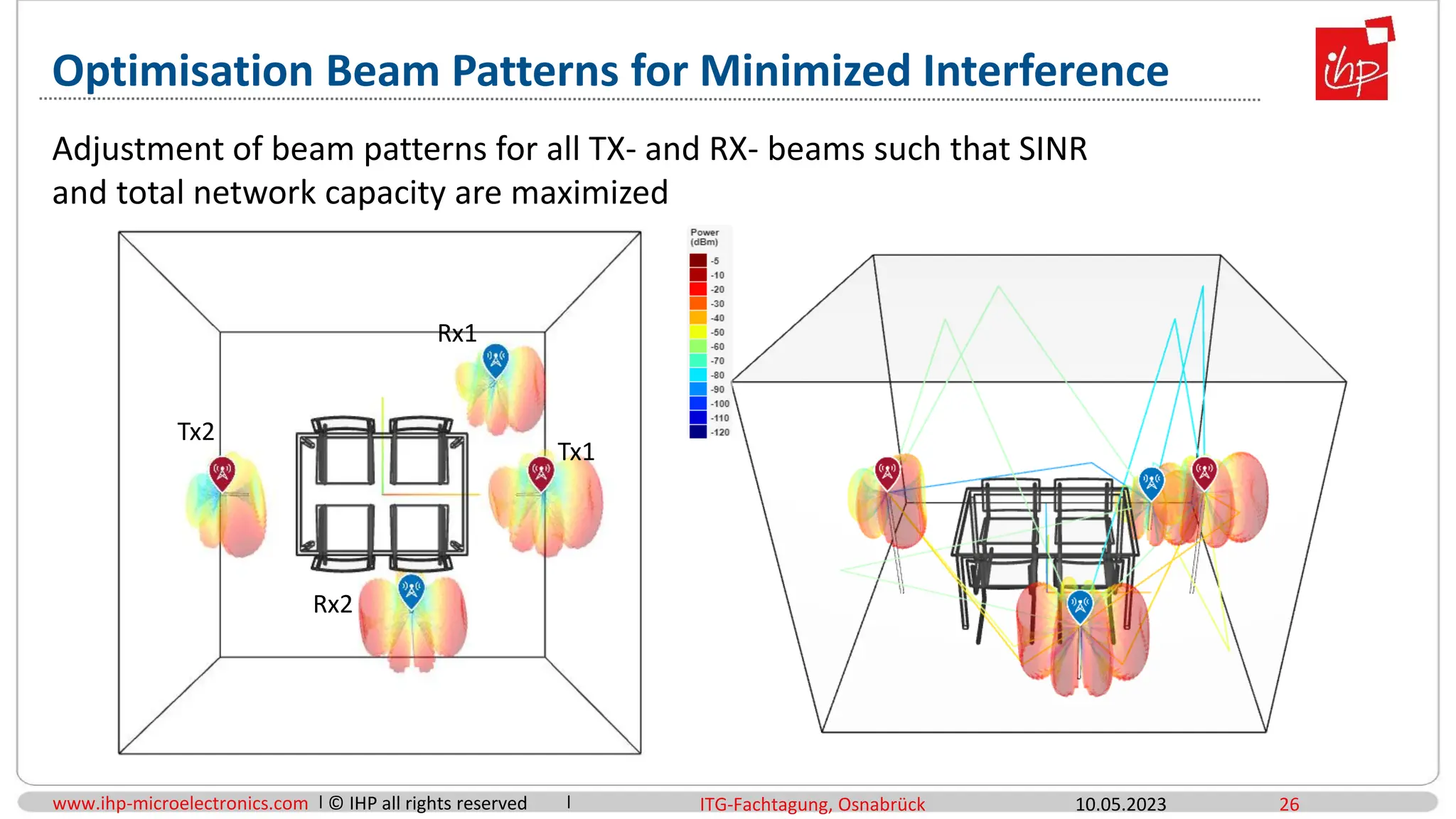
Recruiting & HR
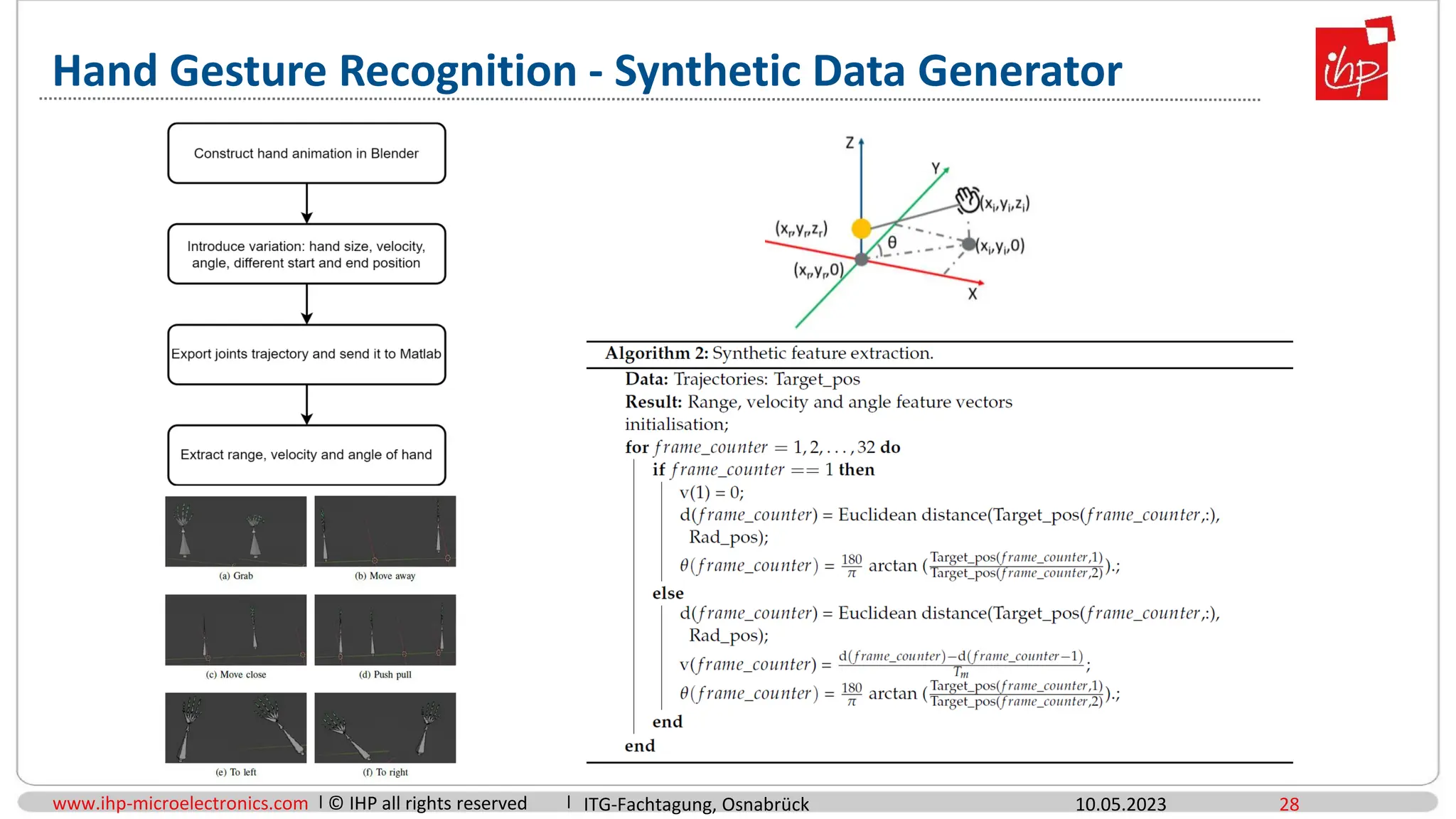
Retail
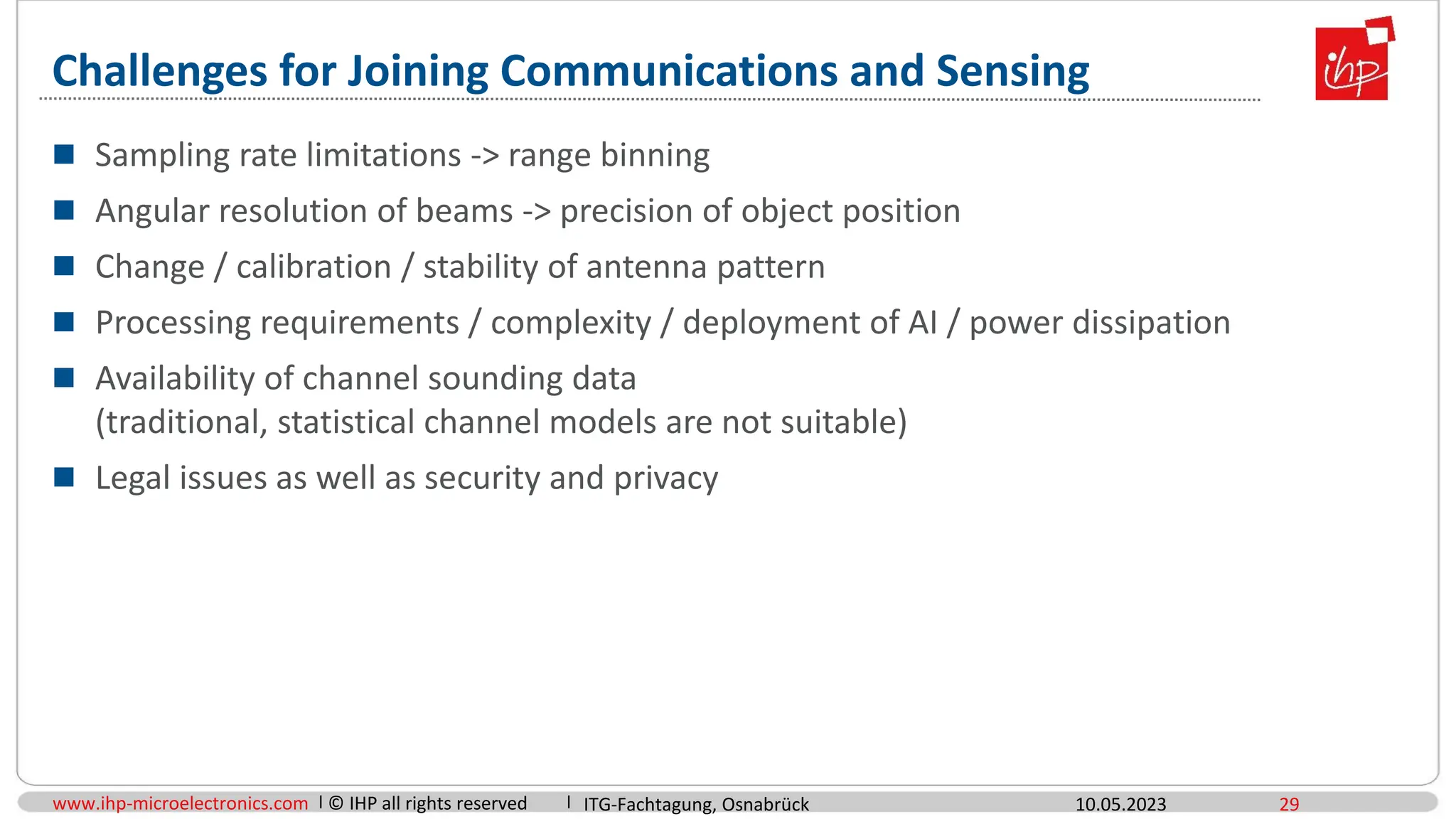
Sales
Services
Science
Small Business & Entrepreneurship
Food
Environment
Economy & Finance
Data & Analytics
Investor Relations
Sports
Spiritual
News & Politics
Travel
Self Improvement
Real Estate
Entertainment & Humor
Health & Medicine
Devices & Hardware
Lifestyle
Change Language
Language
English
Español
Português
Français
Deutsche
Cancel
Save
Submit search
EN
Uploaded by
dgofficesameer
9 views
JOINT SENSING RADAR AND SENSING USING RADAR
COMMUNICATION AND SENSING
Technology
◦
Read more
0
Save
Share
Embed
Embed presentation
Download
Download to read offline
1
/ 34
2
/ 34
3
/ 34
4
/ 34
5
/ 34
6
/ 34
7
/ 34
8
/ 34
9
/ 34
10
/ 34
11
/ 34
12
/ 34
13
/ 34
14
/ 34
15
/ 34
16
/ 34
17
/ 34
18
/ 34
19
/ 34
20
/ 34
21
/ 34
22
/ 34
23
/ 34
24
/ 34
25
/ 34
26
/ 34
27
/ 34
28
/ 34
29
/ 34
30
/ 34
31
/ 34
32
/ 34
33
/ 34
34
/ 34
More Related Content
PDF
Real Time Location Systems (RTLS)
by
Jeffrey Dungen
PDF
Kv2518941899
by
IJERA Editor
PDF
Kv2518941899
by
IJERA Editor
PPT
Overview
by
ajsatienza
PPT
Overview
by
ajsatienza
PDF
IRJET- IoT based Industrial Level Sensor Data Acquisition & Monitoring
by
IRJET Journal
PDF
Implementation of a Localization System for Sensor Networks-berkley
by
Farhad Gholami
PPT
[CONTEXTS'11] A bayesian strategy to enhance the performance of indoor locali...
by
Josué Freelance
Real Time Location Systems (RTLS)
by
Jeffrey Dungen
Kv2518941899
by
IJERA Editor
Kv2518941899
by
IJERA Editor
Overview
by
ajsatienza
Overview
by
ajsatienza
IRJET- IoT based Industrial Level Sensor Data Acquisition & Monitoring
by
IRJET Journal
Implementation of a Localization System for Sensor Networks-berkley
by
Farhad Gholami
[CONTEXTS'11] A bayesian strategy to enhance the performance of indoor locali...
by
Josué Freelance
Similar to JOINT SENSING RADAR AND SENSING USING RADAR
PDF
A 79GHz 2X2 MIMO PMCW Radar SoC in 28 nm CMOS
by
Dr. Jianying Guo
PPTX
MCube_slides_20min.pptx
by
ManishSharma846413
PDF
transforming-wireless-system-design-with-matlab-and-ni.pdf
by
JunaidKhan188662
PDF
Design of an efficient binary phase-shift keying based IEEE 802.15.4 transce...
by
IJECEIAES
PPTX
ESP8266 MICROCONTROLLER APPLICATION IN WIRELESS SYNCHRONIZATION TASKS.pptx
by
VenkateshVenkatesh96
PPTX
IOT technology-standards
by
sadiqFakheraldian
PDF
"Understanding Automotive Radar: Present and Future," a Presentation from NXP...
by
Edge AI and Vision Alliance
PDF
Indoor Localization Using Local Node Density In Ad Hoc WSNs
by
joaquin_gonzalez
RTF
A Multistatic Microwave Radar Sensor for Short Range Anticollision Warning
by
Luigi Giubbolini
PPT
UHF/VHFEnergy Harvesting Radio System Physical and MAC Layer Consideration
by
xiaohuzhang
PDF
matdid473708.pdf
by
ssuser3b7a36
PDF
Space Awareness Technologies for Service Discovery in Mobile Computing
by
Yurong (Kevin) Xu
PDF
Wireless_Connectivity_BASIC_Linkedin
by
Robert Russell
PDF
Next Generation Positioning T181063, ETE, IIUC
by
chaaderchayaa69
PPTX
Company overview 130405
by
Adaptive Wireless Solutions Ltd
PDF
Level-Headedness in Wireless Sensor Networks
by
rahulmonikasharma
PPTX
Indoor Wireless Localization - Zigbee
by
Alex Salim
PDF
IJERD (www.ijerd.com) International Journal of Engineering Research and Devel...
by
IJERD Editor
PDF
IJERD (www.ijerd.com) International Journal of Engineering Research and Devel...
by
IJERD Editor
PDF
IJERD (www.ijerd.com) International Journal of Engineering Research and Devel...
by
IJERD Editor
A 79GHz 2X2 MIMO PMCW Radar SoC in 28 nm CMOS
by
Dr. Jianying Guo
MCube_slides_20min.pptx
by
ManishSharma846413
transforming-wireless-system-design-with-matlab-and-ni.pdf
by
JunaidKhan188662
Design of an efficient binary phase-shift keying based IEEE 802.15.4 transce...
by
IJECEIAES
ESP8266 MICROCONTROLLER APPLICATION IN WIRELESS SYNCHRONIZATION TASKS.pptx
by
VenkateshVenkatesh96
IOT technology-standards
by
sadiqFakheraldian
"Understanding Automotive Radar: Present and Future," a Presentation from NXP...
by
Edge AI and Vision Alliance
Indoor Localization Using Local Node Density In Ad Hoc WSNs
by
joaquin_gonzalez
A Multistatic Microwave Radar Sensor for Short Range Anticollision Warning
by
Luigi Giubbolini
UHF/VHFEnergy Harvesting Radio System Physical and MAC Layer Consideration
by
xiaohuzhang
matdid473708.pdf
by
ssuser3b7a36
Space Awareness Technologies for Service Discovery in Mobile Computing
by
Yurong (Kevin) Xu
Wireless_Connectivity_BASIC_Linkedin
by
Robert Russell
Next Generation Positioning T181063, ETE, IIUC
by
chaaderchayaa69
Company overview 130405
by
Adaptive Wireless Solutions Ltd
Level-Headedness in Wireless Sensor Networks
by
rahulmonikasharma
Indoor Wireless Localization - Zigbee
by
Alex Salim
IJERD (www.ijerd.com) International Journal of Engineering Research and Devel...
by
IJERD Editor
IJERD (www.ijerd.com) International Journal of Engineering Research and Devel...
by
IJERD Editor
IJERD (www.ijerd.com) International Journal of Engineering Research and Devel...
by
IJERD Editor
Recently uploaded
PDF
100 Insights After the 200th Issue of NewMind AI Journal
by
NewMind AI
PDF
Workshop on Sustaining & Growing Open Source Communities - GAS2025
by
Sammy Fung
PPTX
Emancipatory Information Retrieval: Radically Reorienting Information Retriev...
by
Bhaskar Mitra
PPTX
Session 2 - Solving Unstructured & Complex Documents with UiPath IXP
by
DianaGray10
PDF
Cross-Cultural Agile Development -Challenges and Strategies for Overcoming Them-
by
Takashi Makino
PPTX
UiPath Autonomous Agents | Building and Orchestrating Agents End-to-End
by
UiPathCommunity
PPTX
DYNAMICALLY.pptx good for the teachers or students to do seminars and for tea...
by
mpoorvika031
PPTX
Conversational Agents – Building Intelligent Assistants [Virtual Hands-on Wor...
by
UiPathCommunity
PPTX
Technology Consulting _ by Slidesgo.pptx
by
fh82277
PDF
DevFest El Jadida 2025 - Product Thinking
by
Elmehdi AMLOU
PPTX
Top _HR Technology Trends _for 2026_.pptx
by
AutomationEdge Technologies
PDF
Real-Time Data Insight Using Microsoft Forms for Business
by
Elevate
PDF
Day 4 - Access, Deployments, and Monitoring - 2nd Sight Lab Cloud Security Class
by
2nd Sight Lab
PDF
Is It Possible to Have Wi-Fi Without an Internet Provider
by
Sidra Jefferi
PPTX
Software Analysis &Design ethiopia chap-2.pptx
by
Abbas484771
PDF
WHITE PAPER_ Ransomware Payment Policy and Resilience Strategy_ A Framework f...
by
ssuser0d171c
PDF
Day 5 - Red Team + Blue Team in the Cloud - 2nd Sight Lab Cloud Security Class
by
2nd Sight Lab
PDF
Unlocking the Power of Salesforce Architecture: Frameworks for Effective Solu...
by
varsha30tiwari
DOCX
iRobot Post‑Mortem and Alternative Paths - Discussion Document for Boards and...
by
Dave Litwiller
PDF
TrustArc Webinar - Looking Ahead: The 2026 Privacy Landscape
by
TrustArc
100 Insights After the 200th Issue of NewMind AI Journal
by
NewMind AI
Workshop on Sustaining & Growing Open Source Communities - GAS2025
by
Sammy Fung
Emancipatory Information Retrieval: Radically Reorienting Information Retriev...
by
Bhaskar Mitra
Session 2 - Solving Unstructured & Complex Documents with UiPath IXP
by
DianaGray10
Cross-Cultural Agile Development -Challenges and Strategies for Overcoming Them-
by
Takashi Makino
UiPath Autonomous Agents | Building and Orchestrating Agents End-to-End
by
UiPathCommunity
DYNAMICALLY.pptx good for the teachers or students to do seminars and for tea...
by
mpoorvika031
Conversational Agents – Building Intelligent Assistants [Virtual Hands-on Wor...
by
UiPathCommunity
Technology Consulting _ by Slidesgo.pptx
by
fh82277
DevFest El Jadida 2025 - Product Thinking
by
Elmehdi AMLOU
Top _HR Technology Trends _for 2026_.pptx
by
AutomationEdge Technologies
Real-Time Data Insight Using Microsoft Forms for Business
by
Elevate
Day 4 - Access, Deployments, and Monitoring - 2nd Sight Lab Cloud Security Class
by
2nd Sight Lab
Is It Possible to Have Wi-Fi Without an Internet Provider
by
Sidra Jefferi
Software Analysis &Design ethiopia chap-2.pptx
by
Abbas484771
WHITE PAPER_ Ransomware Payment Policy and Resilience Strategy_ A Framework f...
by
ssuser0d171c
Day 5 - Red Team + Blue Team in the Cloud - 2nd Sight Lab Cloud Security Class
by
2nd Sight Lab
Unlocking the Power of Salesforce Architecture: Frameworks for Effective Solu...
by
varsha30tiwari
iRobot Post‑Mortem and Alternative Paths - Discussion Document for Boards and...
by
Dave Litwiller
TrustArc Webinar - Looking Ahead: The 2026 Privacy Landscape
by
TrustArc
JOINT SENSING RADAR AND SENSING USING RADAR
1.
IHP – Leibniz-Institut
für innovative Mikroelektronik Joint Communication and Sensing (JCAS) for 6G Wireless Systems Keynote Presentation Eckhard Grass, Lara Wimmer, Ekaterina Sedunova, Vladica Sark, Yanhua Zhao, Parmida Geranmayeh 10.05.2023
2.
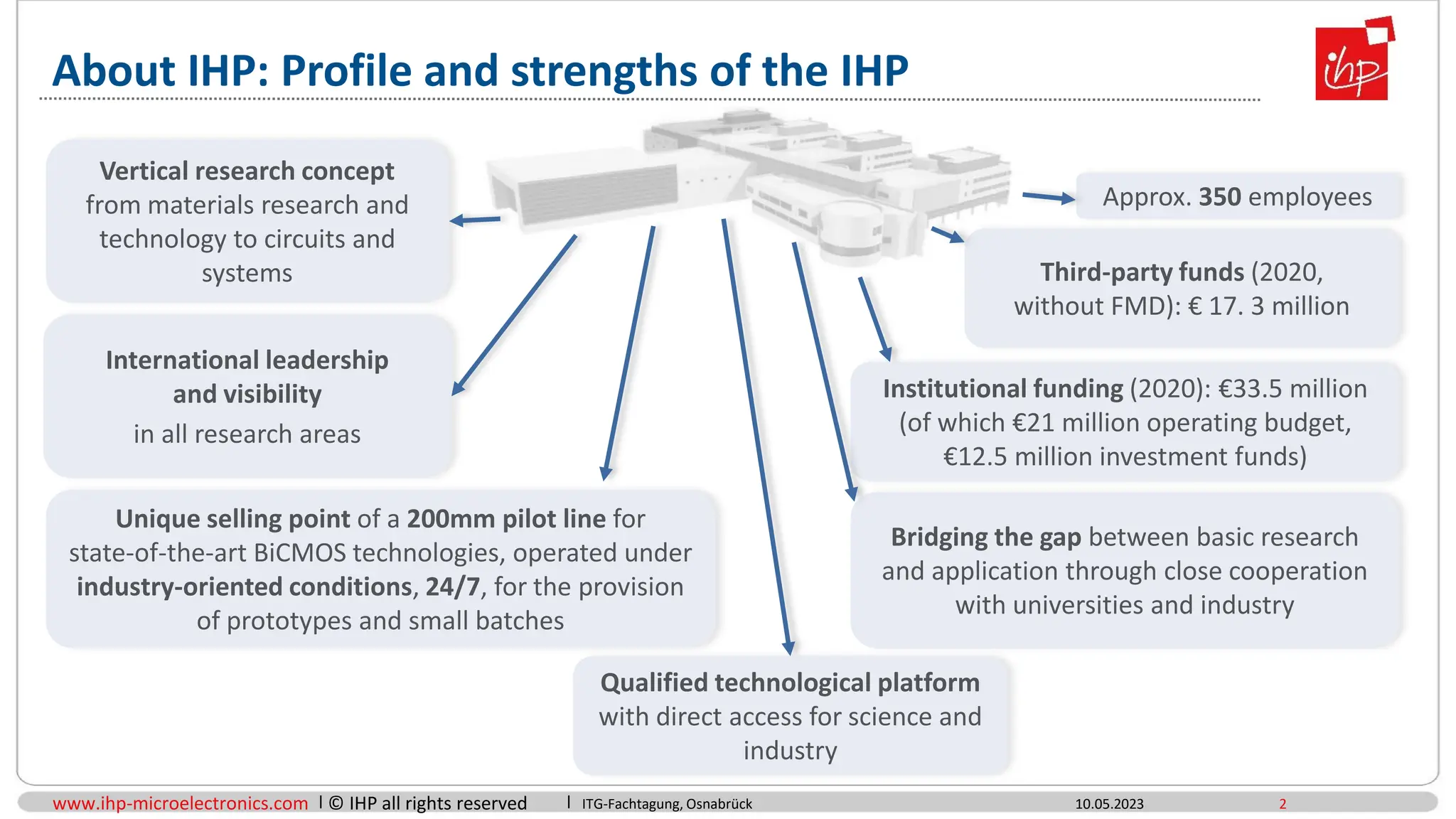
www.ihp-microelectronics.com © IHP
all rights reserved About IHP: Profile and strengths of the IHP 10.05.2023 2 Vertical research concept from materials research and technology to circuits and systems International leadership and visibility in all research areas Unique selling point of a 200mm pilot line for state-of-the-art BiCMOS technologies, operated under industry-oriented conditions, 24/7, for the provision of prototypes and small batches Qualified technological platform with direct access for science and industry Bridging the gap between basic research and application through close cooperation with universities and industry Approx. 350 employees Institutional funding (2020): €33.5 million (of which €21 million operating budget, €12.5 million investment funds) Third-party funds (2020, without FMD): € 17. 3 million ITG-Fachtagung, Osnabrück
3.
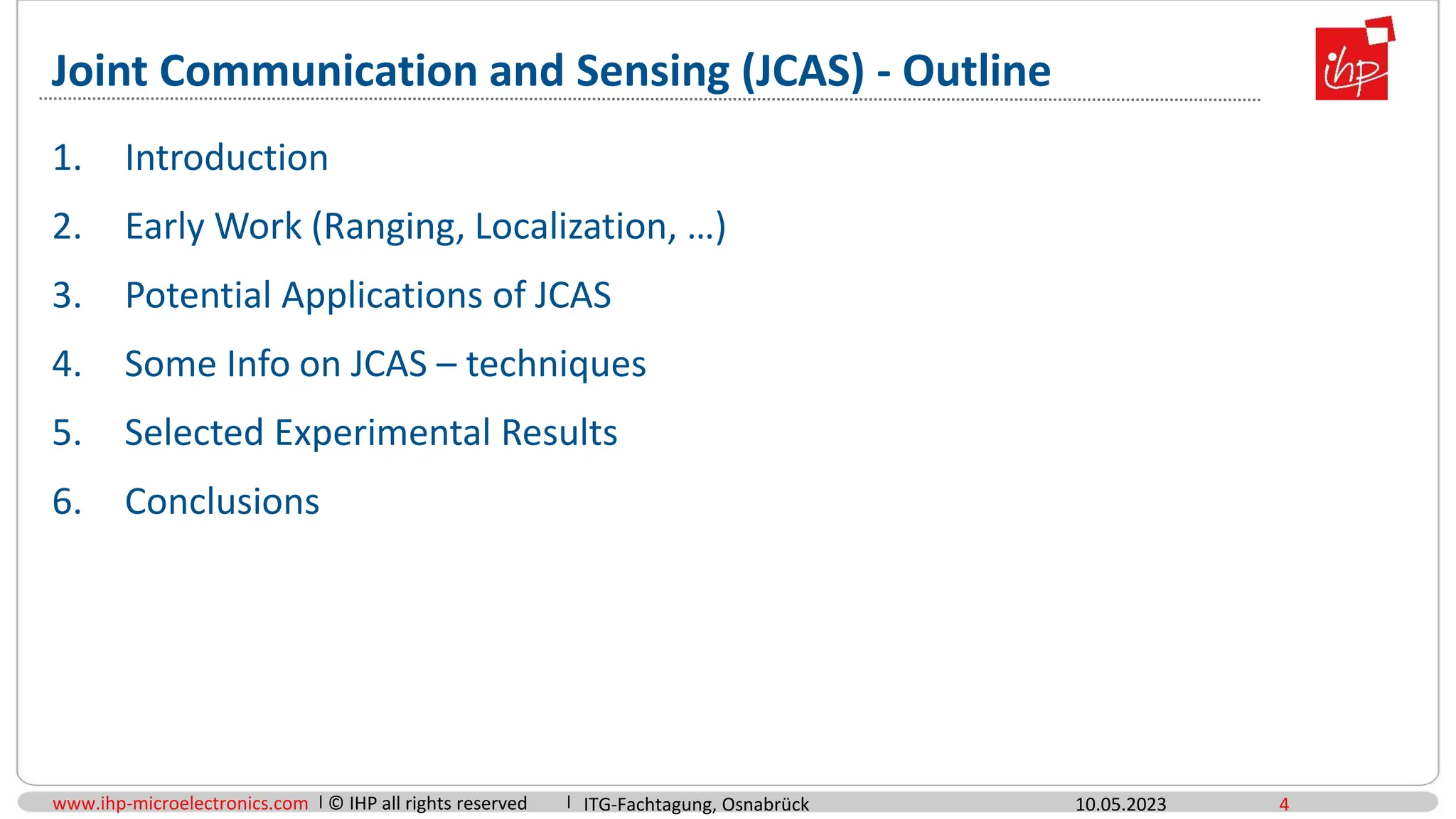
www.ihp-microelectronics.com © IHP
all rights reserved Joint Communication and Sensing (JCAS) - Outline 10.05.2023 4 1. Introduction 2. Early Work (Ranging, Localization, …) 3. Potential Applications of JCAS 4. Some Info on JCAS – techniques 5. Selected Experimental Results 6. Conclusions ITG-Fachtagung, Osnabrück
4.
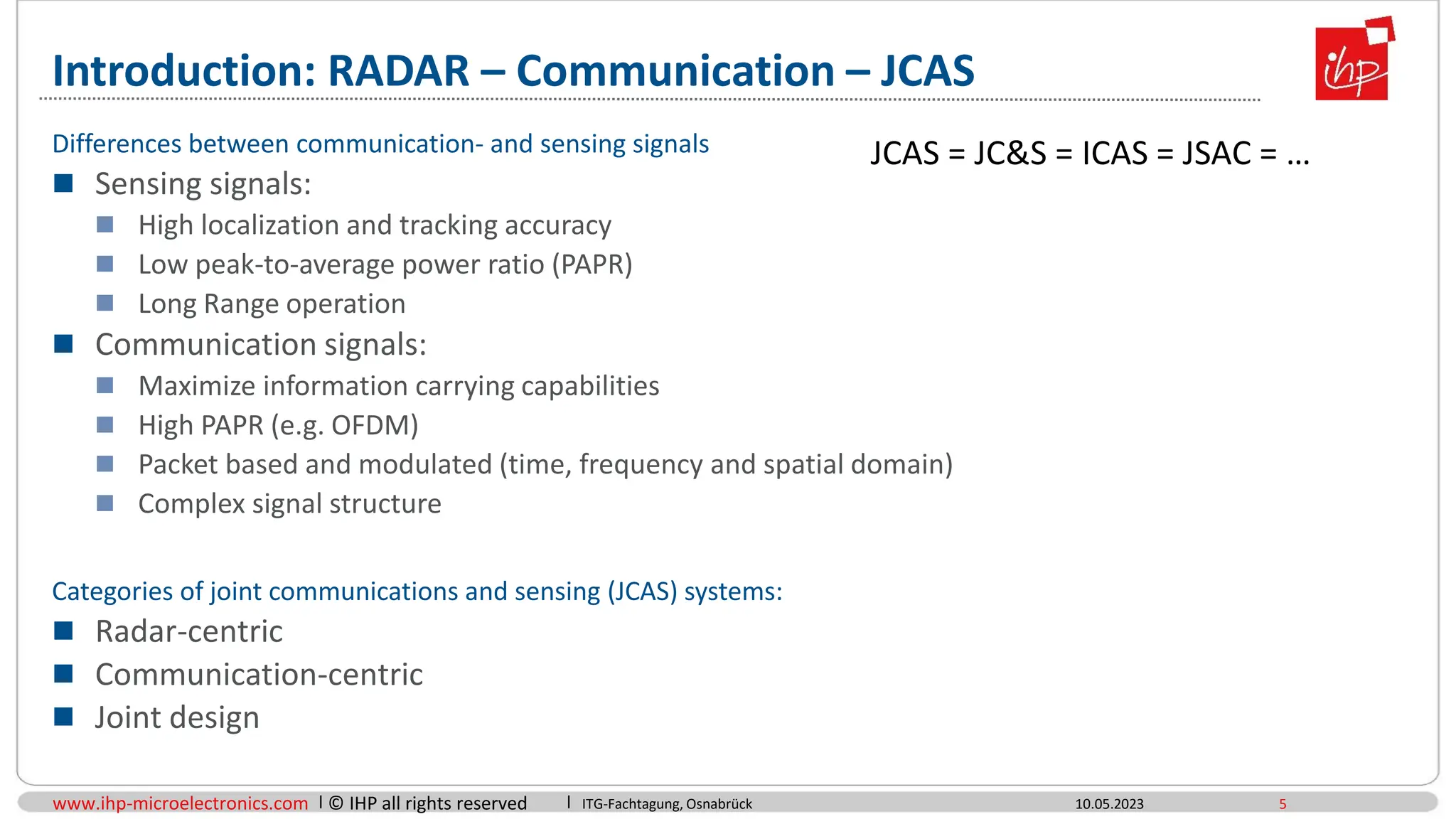
www.ihp-microelectronics.com © IHP
all rights reserved Introduction: RADAR – Communication – JCAS 10.05.2023 5 Differences between communication- and sensing signals Sensing signals: High localization and tracking accuracy Low peak-to-average power ratio (PAPR) Long Range operation Communication signals: Maximize information carrying capabilities High PAPR (e.g. OFDM) Packet based and modulated (time, frequency and spatial domain) Complex signal structure Categories of joint communications and sensing (JCAS) systems: Radar-centric Communication-centric Joint design ITG-Fachtagung, Osnabrück JCAS = JC&S = ICAS = JSAC = …
5.
www.ihp-microelectronics.com © IHP
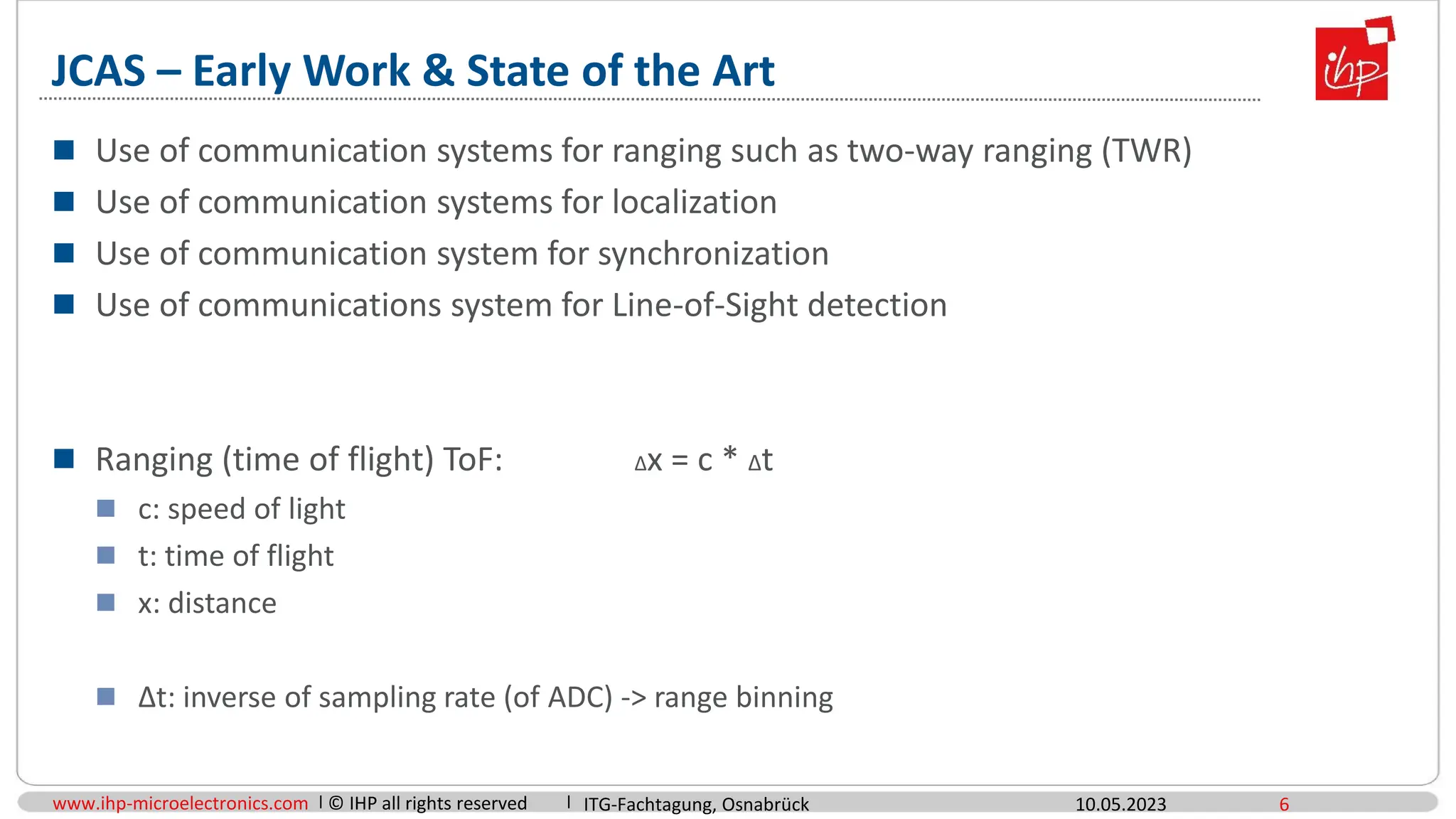
all rights reserved JCAS – Early Work & State of the Art Use of communication systems for ranging such as two-way ranging (TWR) Use of communication systems for localization Use of communication system for synchronization Use of communications system for Line-of-Sight detection Ranging (time of flight) ToF: Δx = c * Δt c: speed of light t: time of flight x: distance Δt: inverse of sampling rate (of ADC) -> range binning 10.05.2023 6 ITG-Fachtagung, Osnabrück
6.
www.ihp-microelectronics.com © IHP
all rights reserved Two Way Ranging (TWR) TWR typically uses PN-Sequences TPB has to be know and stable Time critical tasks and precise time measurement is implemented on FPGA available in the SDR platform Non time critical tasks, e.g. distance estimation from obtained samples, is implemented in software on a host computer Localization is achieved by performing TWR with 3 anchor nodes + trilateration TWR is performed with each anchor node in a round robin fashion Using trilateration and the obtained distances, the position of the node is estimated 10.05.2023 7 ITG-Fachtagung, Osnabrück
7.
www.ihp-microelectronics.com © IHP
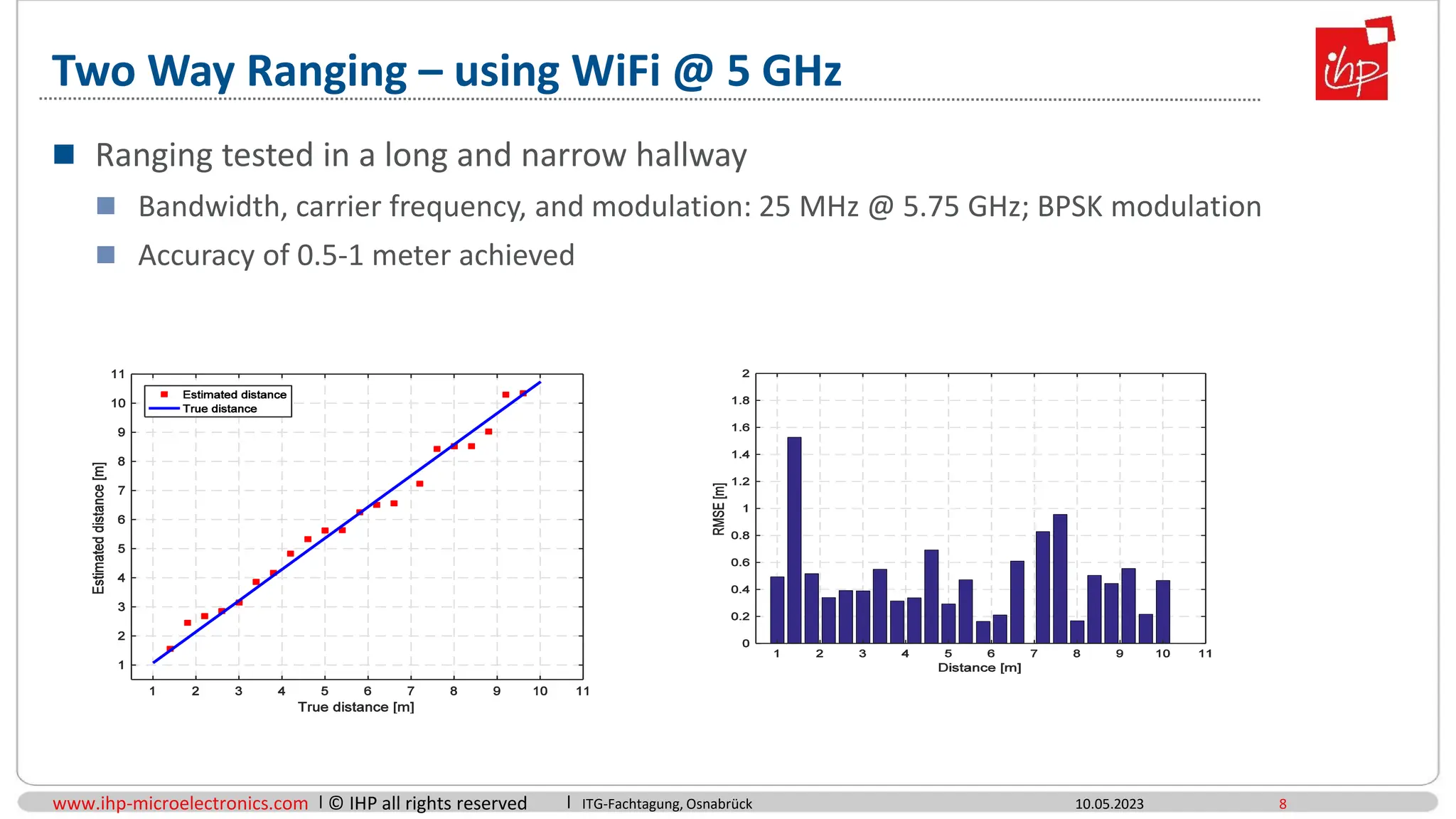
all rights reserved Two Way Ranging – using WiFi @ 5 GHz 10.05.2023 ITG-Fachtagung, Osnabrück 8 Ranging tested in a long and narrow hallway Bandwidth, carrier frequency, and modulation: 25 MHz @ 5.75 GHz; BPSK modulation Accuracy of 0.5-1 meter achieved
8.
www.ihp-microelectronics.com © IHP
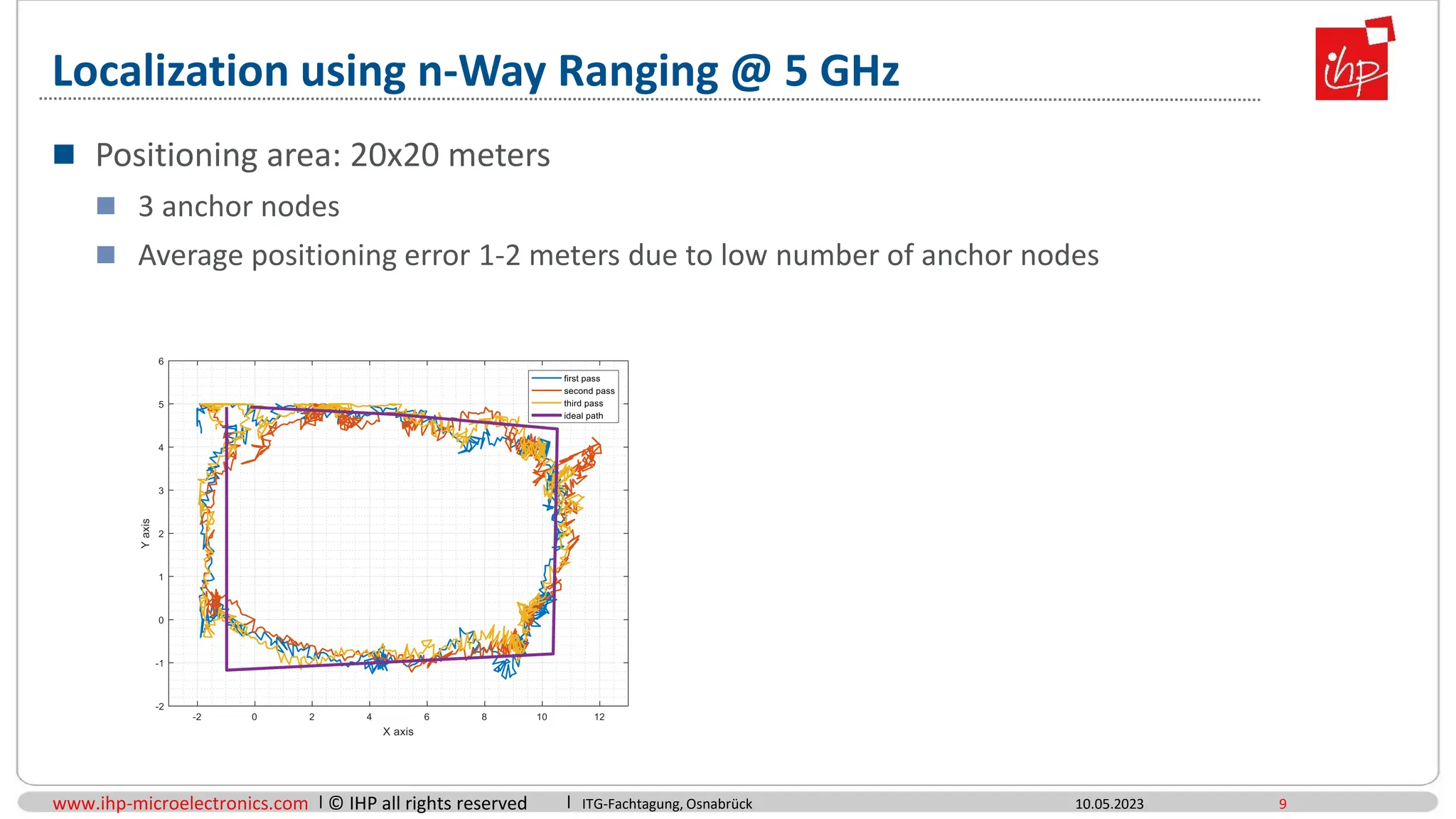
all rights reserved Localization using n-Way Ranging @ 5 GHz 10.05.2023 ITG-Fachtagung, Osnabrück 9 Positioning area: 20x20 meters 3 anchor nodes Average positioning error 1-2 meters due to low number of anchor nodes
9.
www.ihp-microelectronics.com © IHP
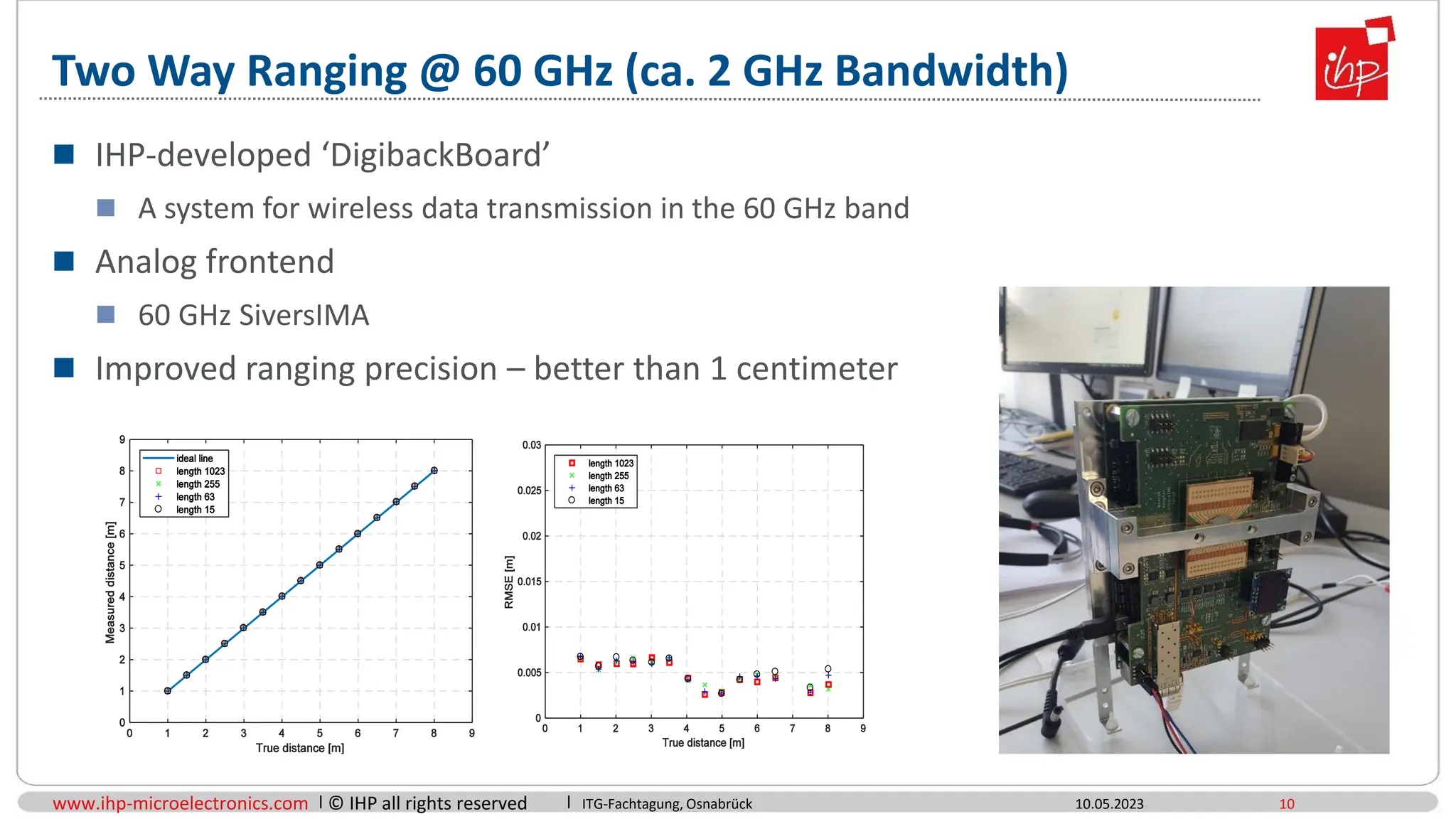
all rights reserved Two Way Ranging @ 60 GHz (ca. 2 GHz Bandwidth) 10.05.2023 ITG-Fachtagung, Osnabrück 10 IHP-developed ‘DigibackBoard’ A system for wireless data transmission in the 60 GHz band Analog frontend 60 GHz SiversIMA Improved ranging precision – better than 1 centimeter
10.
www.ihp-microelectronics.com © IHP
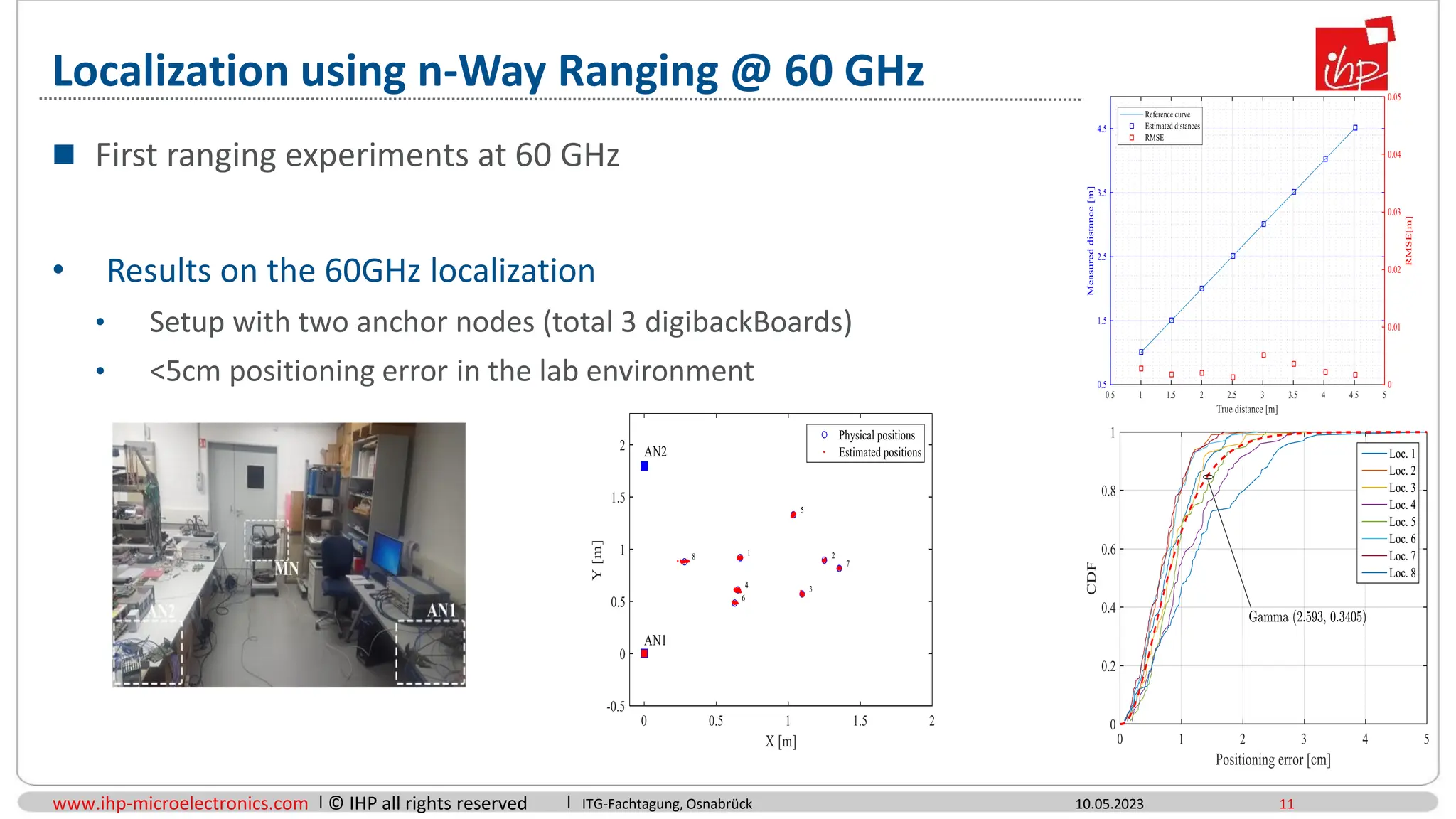
all rights reserved Localization using n-Way Ranging @ 60 GHz 10.05.2023 ITG-Fachtagung, Osnabrück 11 First ranging experiments at 60 GHz • Results on the 60GHz localization • Setup with two anchor nodes (total 3 digibackBoards) • <5cm positioning error in the lab environment
11.
www.ihp-microelectronics.com © IHP
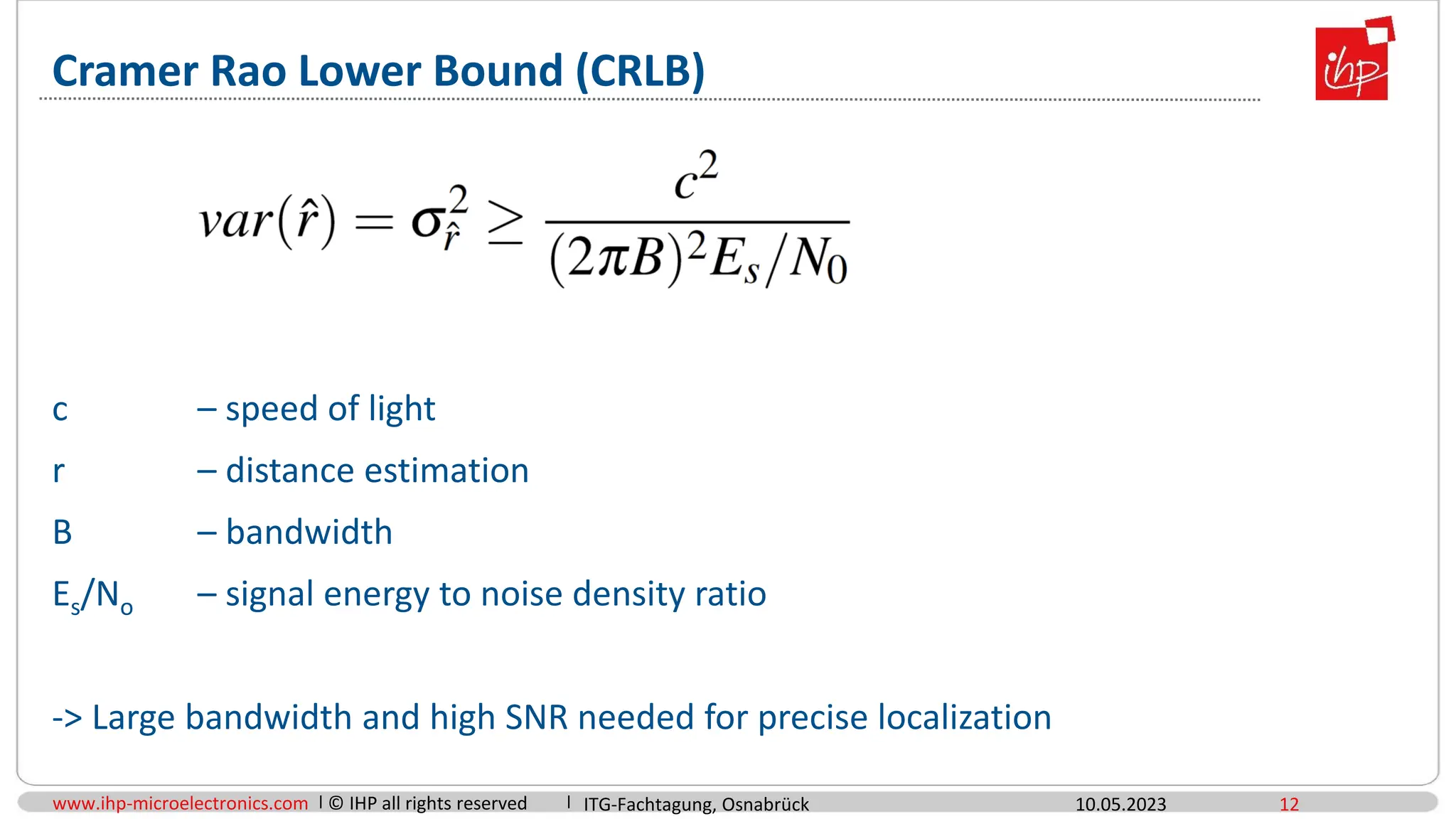
all rights reserved Cramer Rao Lower Bound (CRLB) c – speed of light r – distance estimation B – bandwidth Es/No – signal energy to noise density ratio -> Large bandwidth and high SNR needed for precise localization 10.05.2023 12 ITG-Fachtagung, Osnabrück
12.
www.ihp-microelectronics.com © IHP
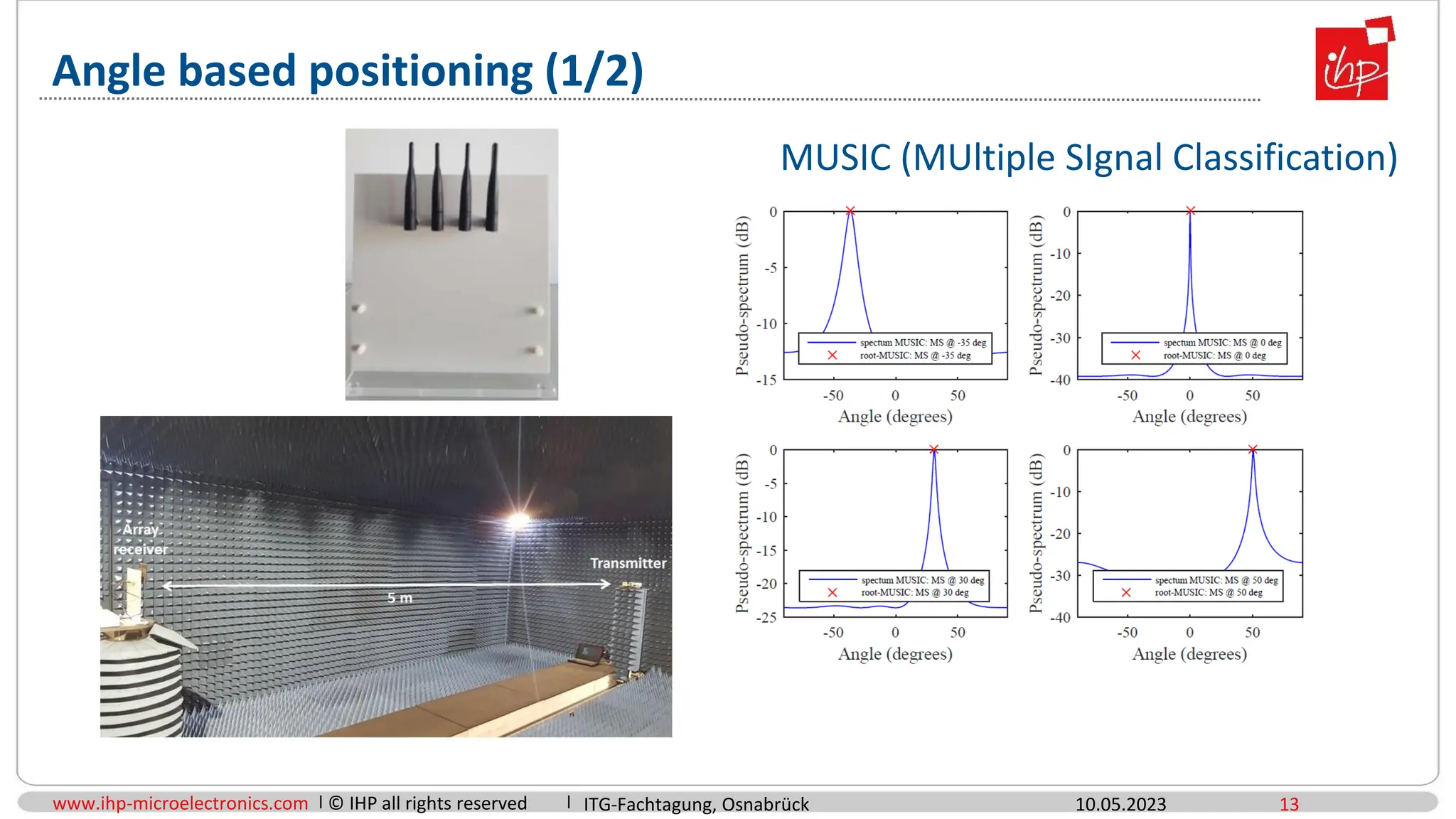
all rights reserved Angle based positioning (1/2) 10.05.2023 13 MUSIC (MUltiple SIgnal Classification) ITG-Fachtagung, Osnabrück
13.
www.ihp-microelectronics.com © IHP
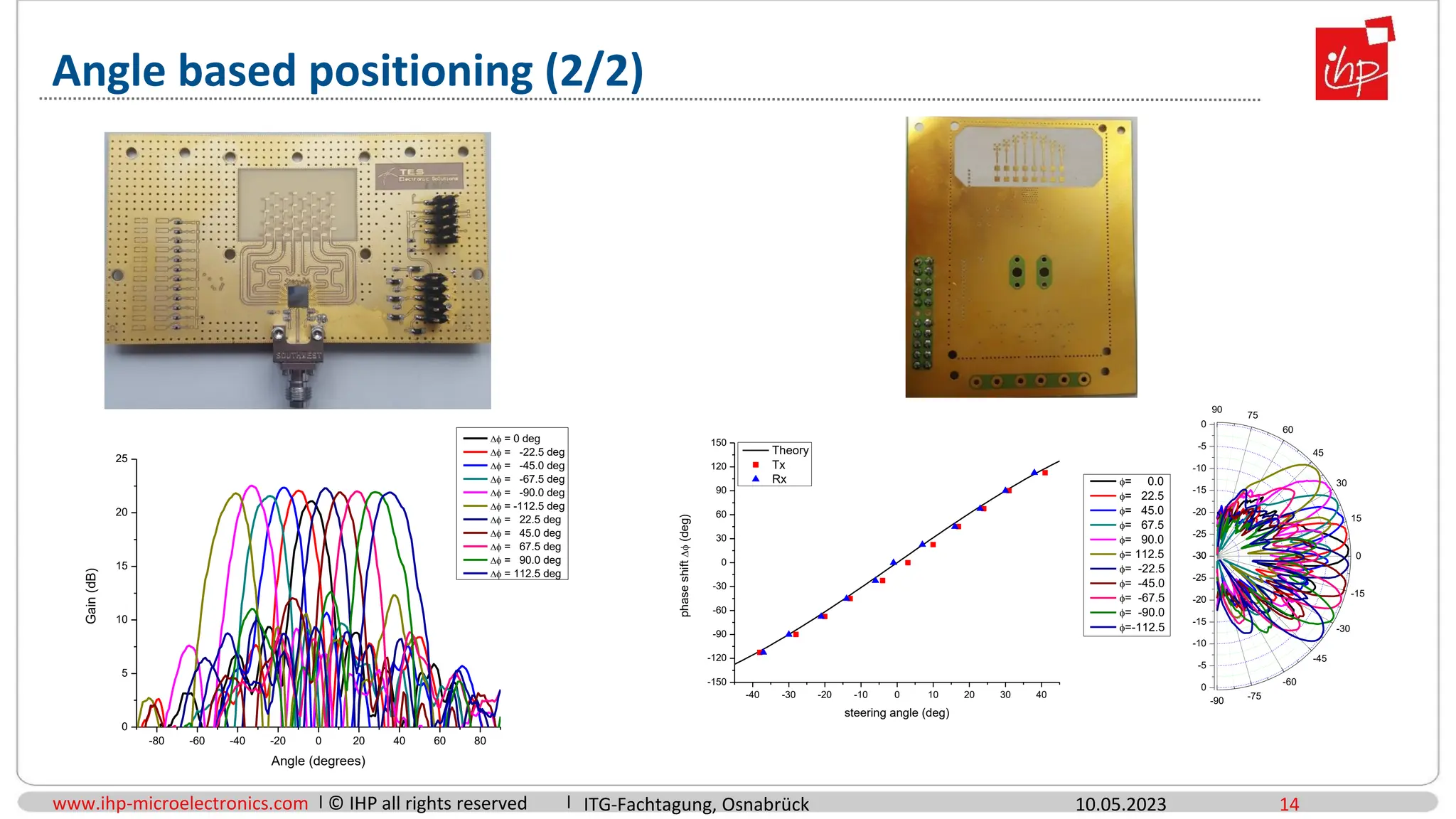
all rights reserved Angle based positioning (2/2) 10.05.2023 14 -80 -60 -40 -20 0 20 40 60 80 0 5 10 15 20 25 Gain (dB) Angle (degrees) = 0 deg = -22.5 deg = -45.0 deg = -67.5 deg = -90.0 deg = -112.5 deg = 22.5 deg = 45.0 deg = 67.5 deg = 90.0 deg = 112.5 deg -30 -25 -20 -15 -10 -5 0 -90 -75 -60 -45 -30 -15 0 15 30 45 60 75 90 -30 -25 -20 -15 -10 -5 0 = 0.0 = 22.5 = 45.0 = 67.5 = 90.0 = 112.5 = -22.5 = -45.0 = -67.5 = -90.0 =-112.5 -40 -30 -20 -10 0 10 20 30 40 -150 -120 -90 -60 -30 0 30 60 90 120 150 phase shift (deg) steering angle (deg) Theory Tx Rx ITG-Fachtagung, Osnabrück
14.
www.ihp-microelectronics.com © IHP
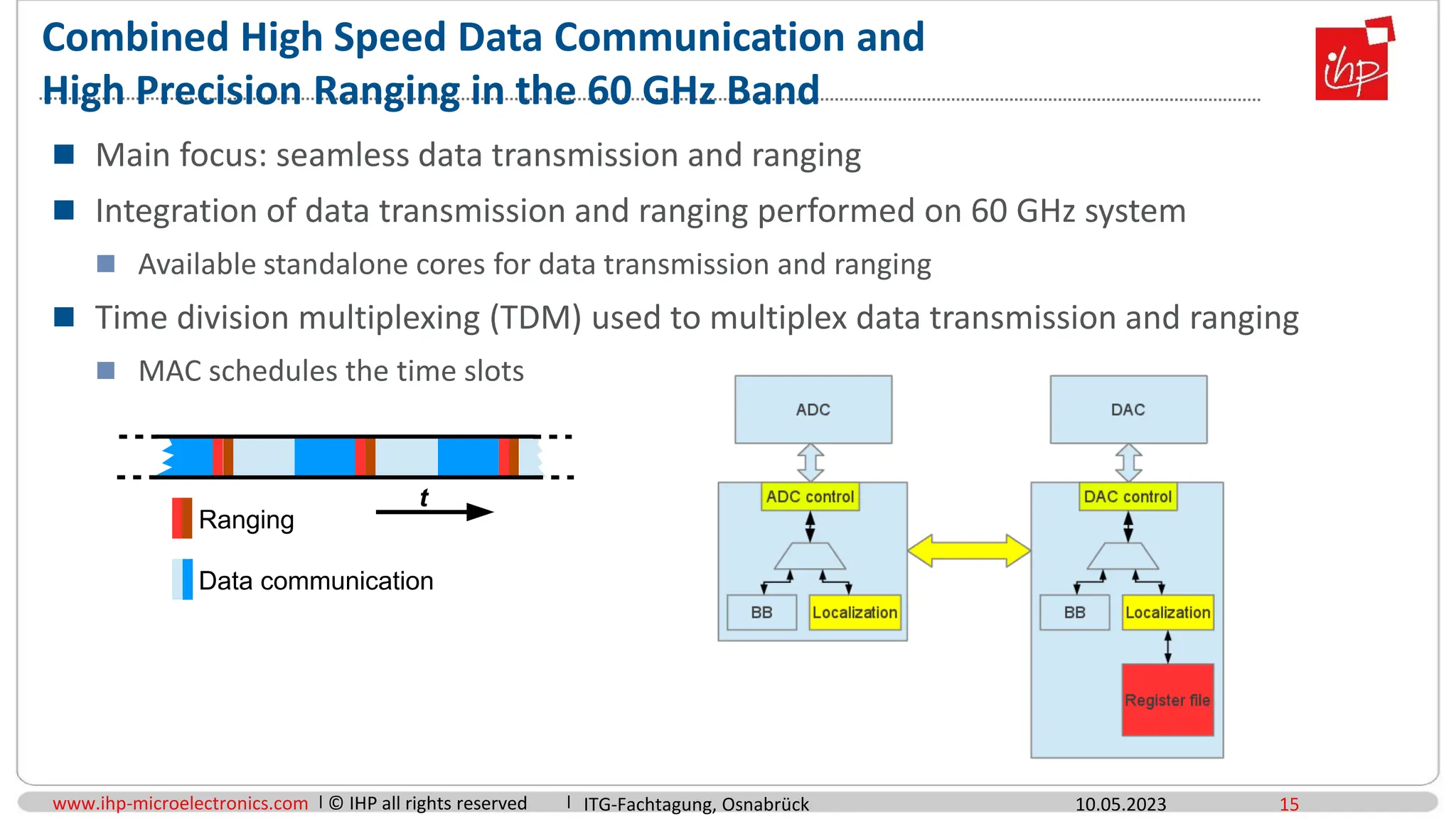
all rights reserved Combined High Speed Data Communication and High Precision Ranging in the 60 GHz Band 10.05.2023 15 Main focus: seamless data transmission and ranging Integration of data transmission and ranging performed on 60 GHz system Available standalone cores for data transmission and ranging Time division multiplexing (TDM) used to multiplex data transmission and ranging MAC schedules the time slots ITG-Fachtagung, Osnabrück
15.
www.ihp-microelectronics.com © IHP
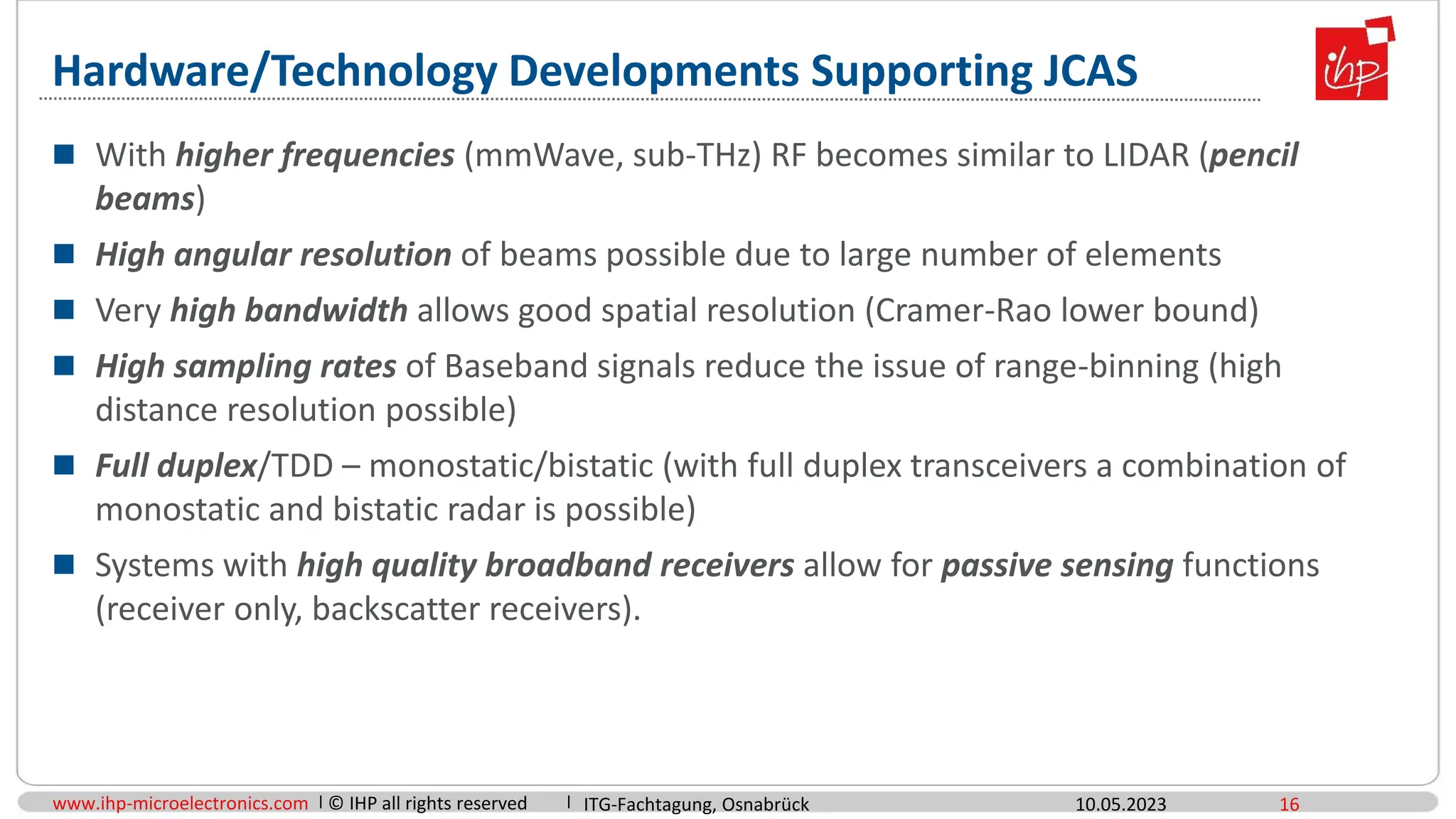
all rights reserved Hardware/Technology Developments Supporting JCAS With higher frequencies (mmWave, sub-THz) RF becomes similar to LIDAR (pencil beams) High angular resolution of beams possible due to large number of elements Very high bandwidth allows good spatial resolution (Cramer-Rao lower bound) High sampling rates of Baseband signals reduce the issue of range-binning (high distance resolution possible) Full duplex/TDD – monostatic/bistatic (with full duplex transceivers a combination of monostatic and bistatic radar is possible) Systems with high quality broadband receivers allow for passive sensing functions (receiver only, backscatter receivers). 10.05.2023 16 ITG-Fachtagung, Osnabrück
16.
www.ihp-microelectronics.com © IHP
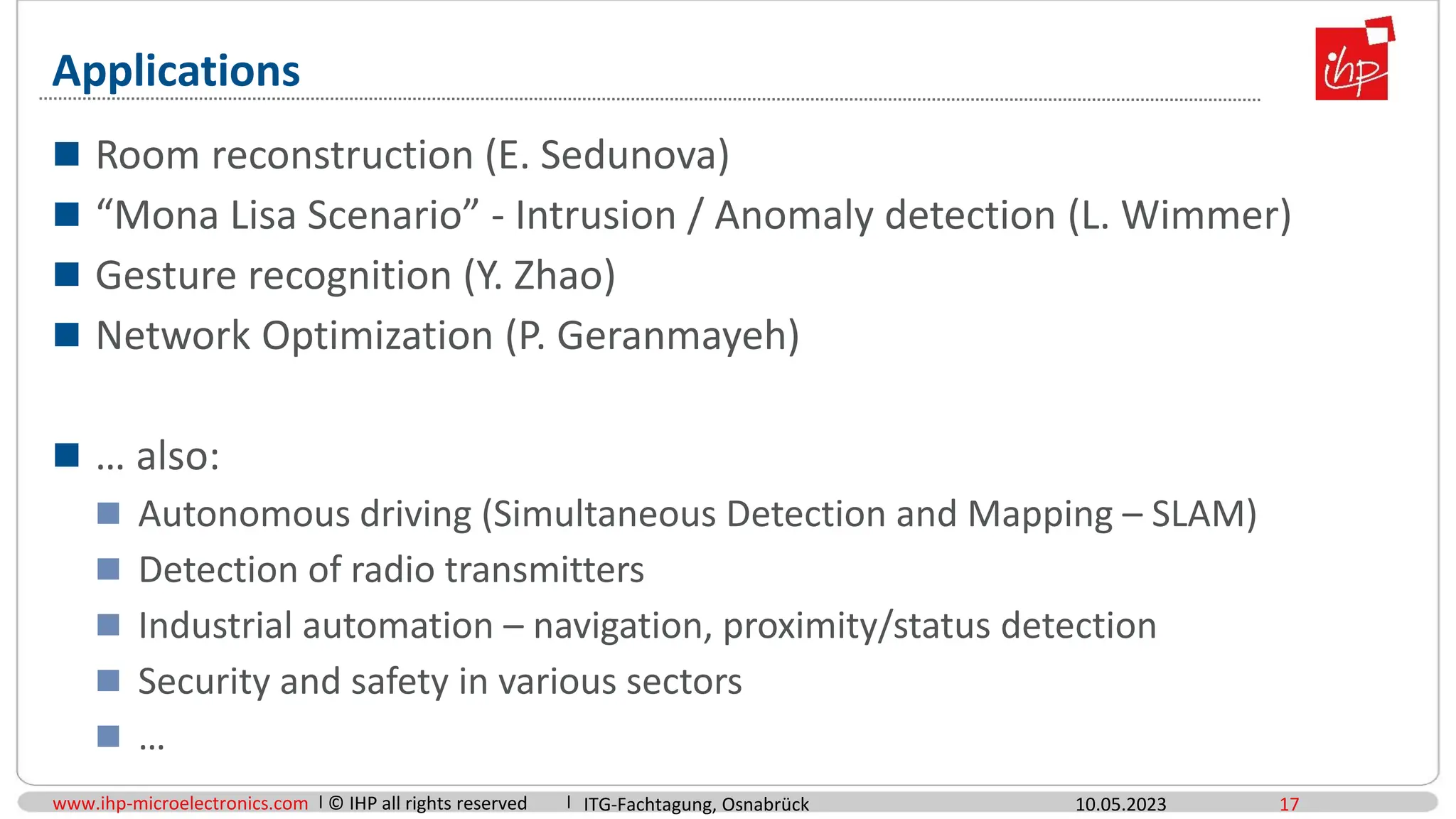
all rights reserved Applications Room reconstruction (E. Sedunova) “Mona Lisa Scenario” - Intrusion / Anomaly detection (L. Wimmer) Gesture recognition (Y. Zhao) Network Optimization (P. Geranmayeh) … also: Autonomous driving (Simultaneous Detection and Mapping – SLAM) Detection of radio transmitters Industrial automation – navigation, proximity/status detection Security and safety in various sectors … 10.05.2023 17 ITG-Fachtagung, Osnabrück
17.
www.ihp-microelectronics.com © IHP
all rights reserved Open 6G Hub: Industrial Application Scenario 10.05.2023 18 A resilient communication & sensing system with multi-technology nodes Self-awareness & awareness of local surrounding Dynamic nodes & dynamic environment Resilience by Design in all layers Funded by BMBF L. Wimmer ITG-Fachtagung, Osnabrück
18.
www.ihp-microelectronics.com © IHP
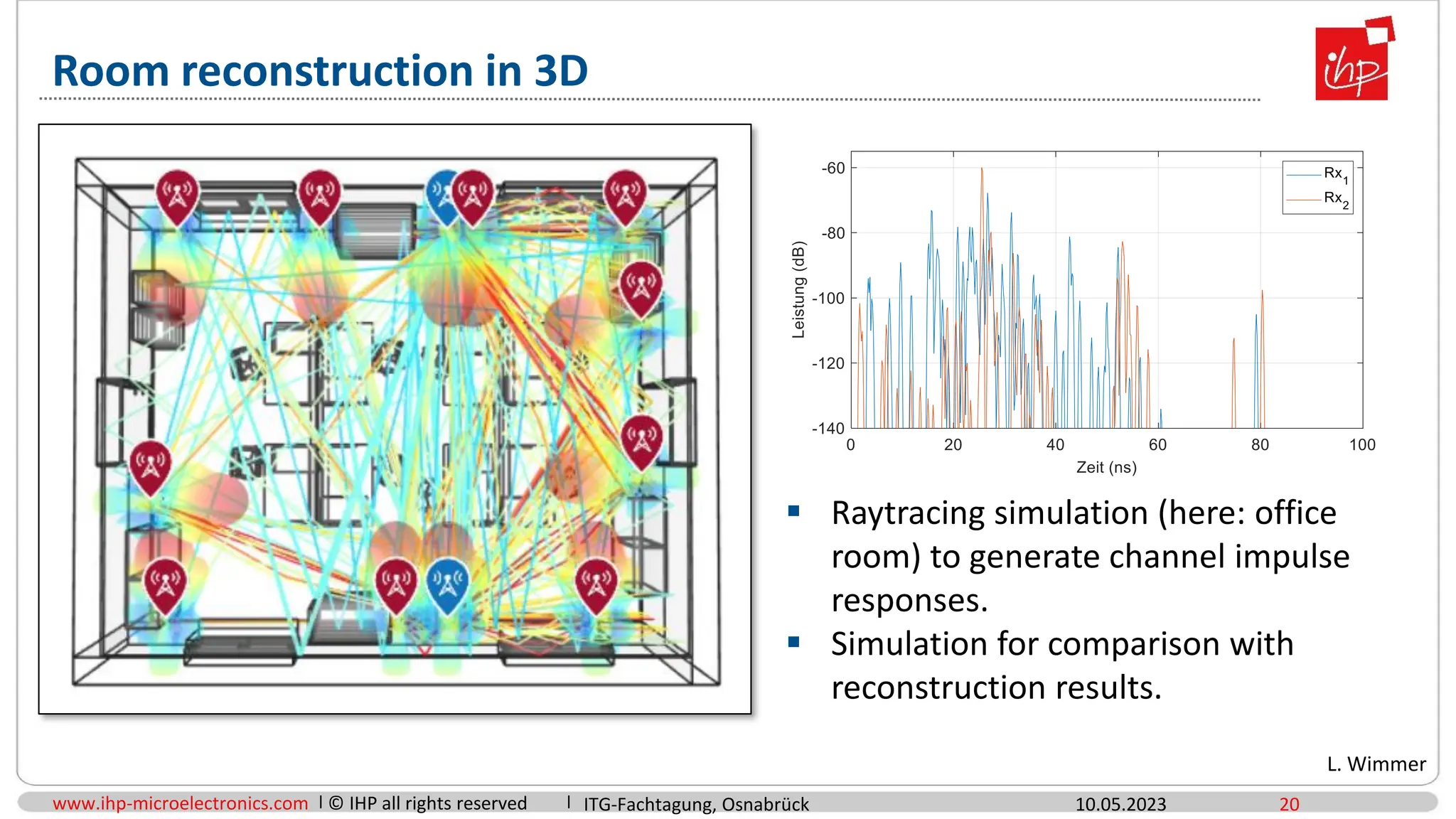
all rights reserved Room reconstruction in 3D 10.05.2023 20 Raytracing simulation (here: office room) to generate channel impulse responses. Simulation for comparison with reconstruction results. L. Wimmer ITG-Fachtagung, Osnabrück
19.
www.ihp-microelectronics.com © IHP
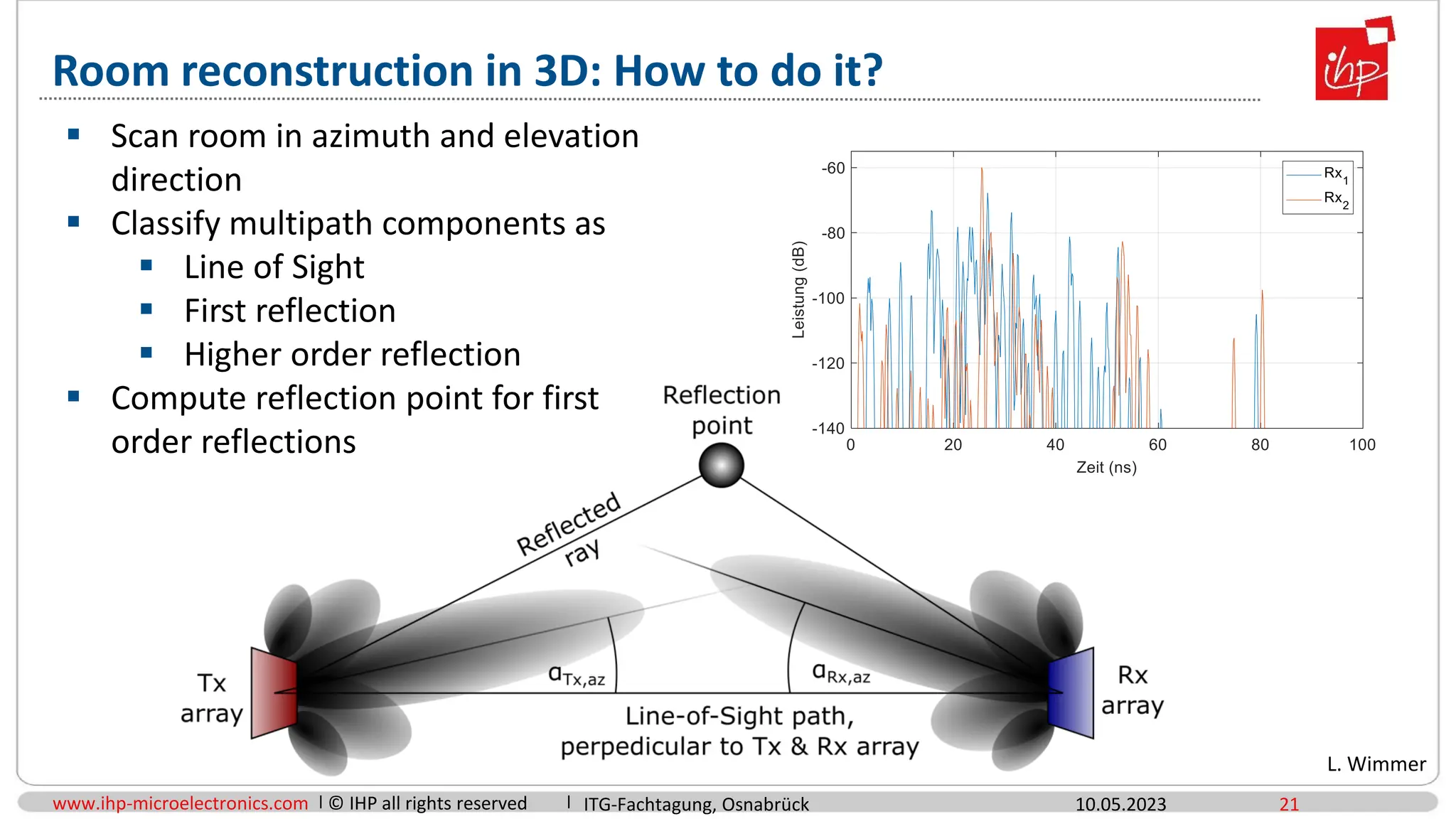
all rights reserved Room reconstruction in 3D: How to do it? 10.05.2023 21 Scan room in azimuth and elevation direction Classify multipath components as Line of Sight First reflection Higher order reflection Compute reflection point for first order reflections L. Wimmer ITG-Fachtagung, Osnabrück
20.
www.ihp-microelectronics.com © IHP
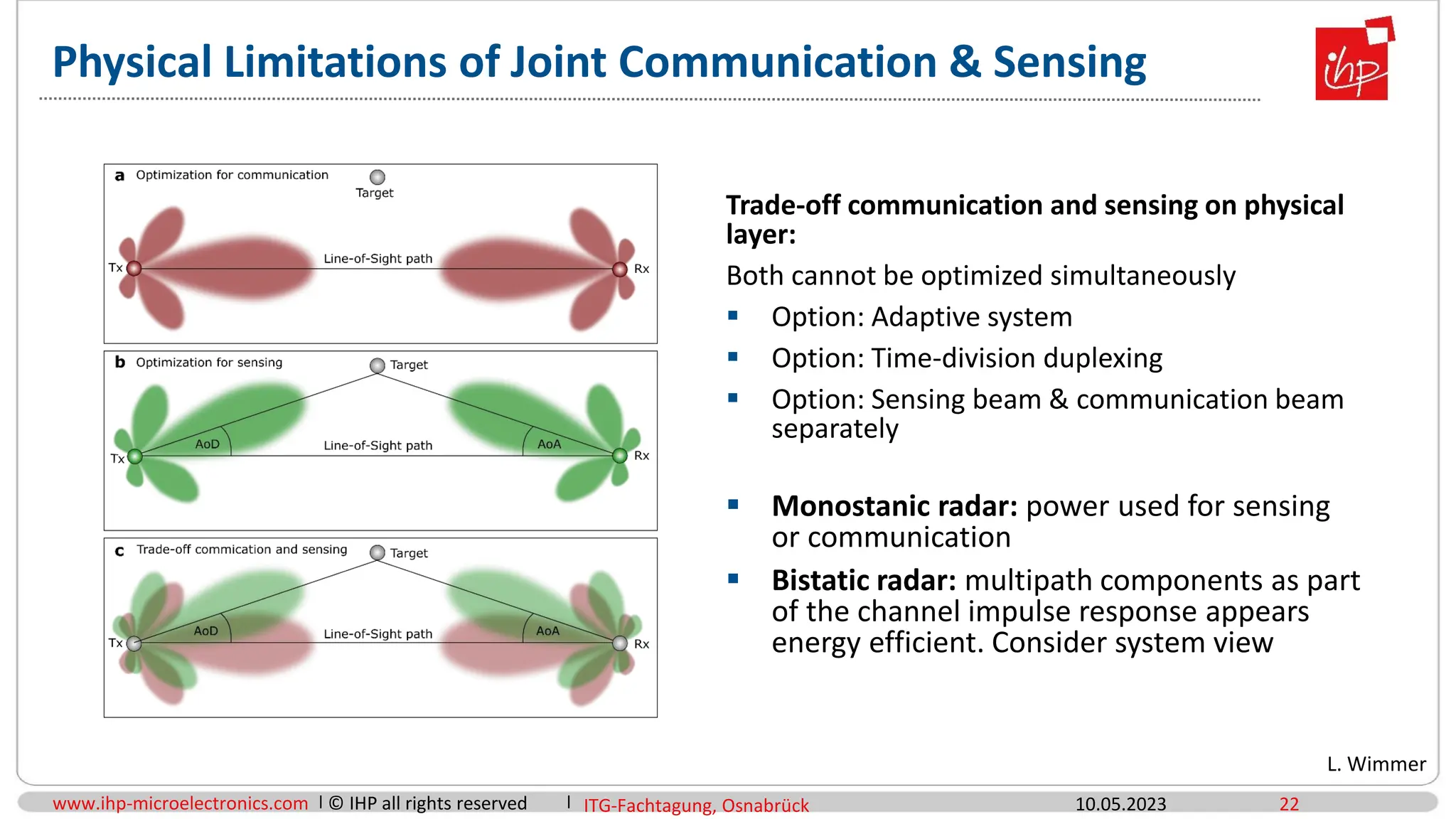
all rights reserved 22 Trade-off communication and sensing on physical layer: Both cannot be optimized simultaneously Option: Adaptive system Option: Time-division duplexing Option: Sensing beam & communication beam separately Monostanic radar: power used for sensing or communication Bistatic radar: multipath components as part of the channel impulse response appears energy efficient. Consider system view 10.05.2023 Physical Limitations of Joint Communication & Sensing L. Wimmer ITG-Fachtagung, Osnabrück
21.
www.ihp-microelectronics.com © IHP
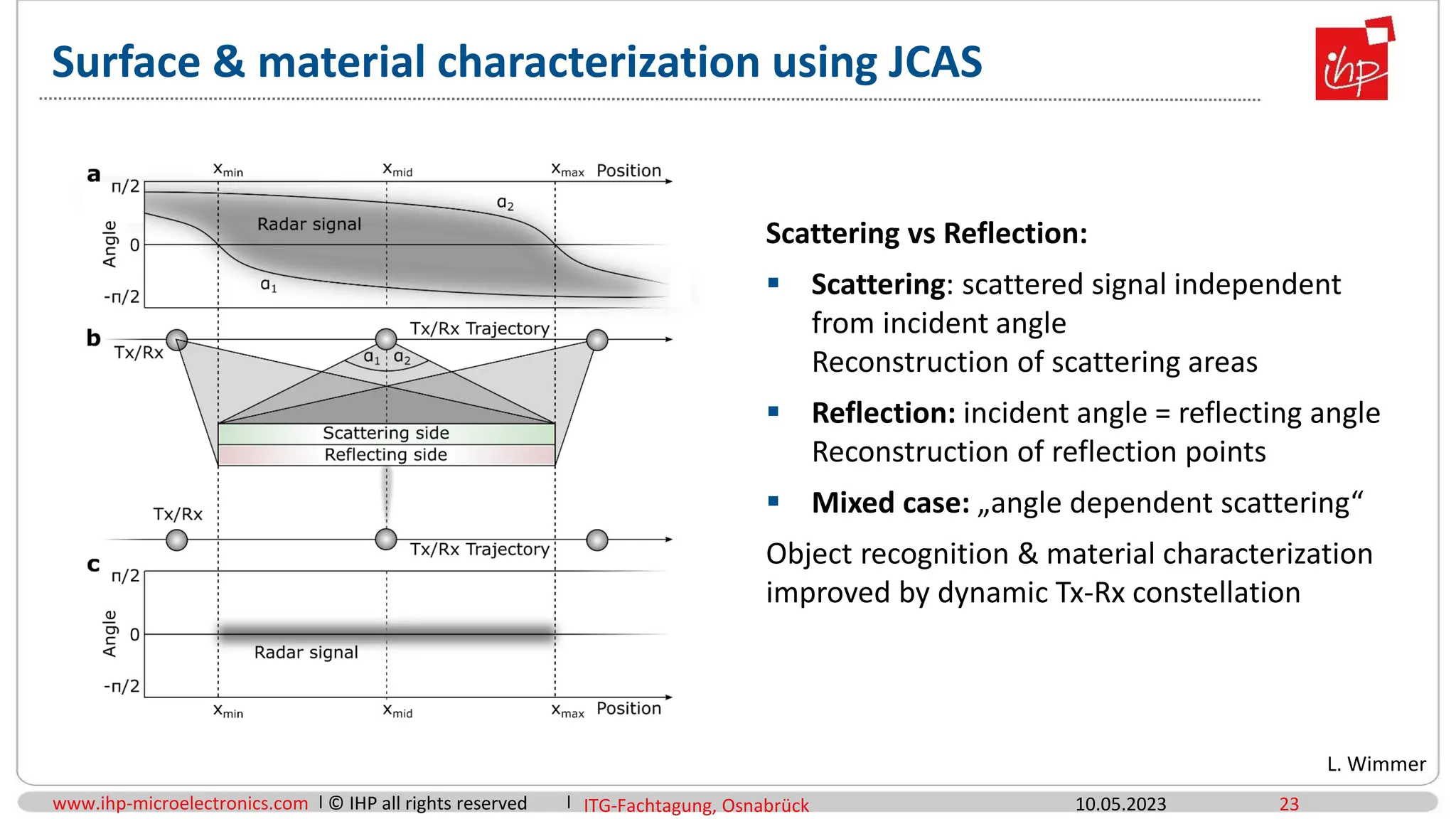
all rights reserved 23 Scattering vs Reflection: Scattering: scattered signal independent from incident angle Reconstruction of scattering areas Reflection: incident angle = reflecting angle Reconstruction of reflection points Mixed case: „angle dependent scattering“ Object recognition & material characterization improved by dynamic Tx-Rx constellation 10.05.2023 Surface & material characterization using JCAS L. Wimmer ITG-Fachtagung, Osnabrück
22.
www.ihp-microelectronics.com © IHP
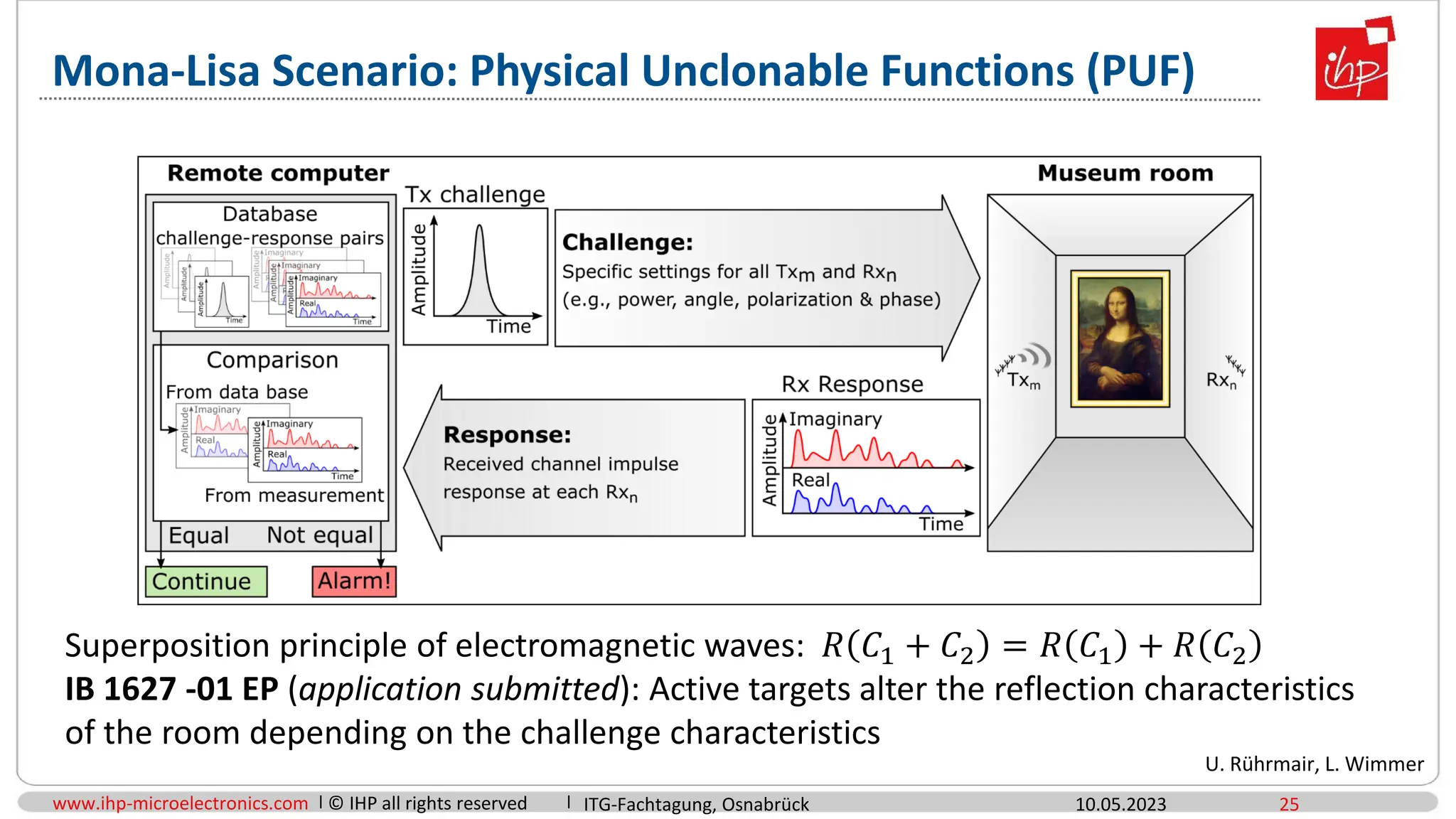
all rights reserved Mona-Lisa Scenario: Physical Unclonable Functions (PUF) 10.05.2023 25 U. Rührmair, L. Wimmer Superposition principle of electromagnetic waves: 𝑅 𝐶1 + 𝐶2 = 𝑅 𝐶1 + 𝑅 𝐶2 IB 1627 -01 EP (application submitted): Active targets alter the reflection characteristics of the room depending on the challenge characteristics ITG-Fachtagung, Osnabrück
23.
www.ihp-microelectronics.com © IHP
all rights reserved Optimisation Beam Patterns for Minimized Interference 10.05.2023 26 ITG-Fachtagung, Osnabrück Tx1 Tx2 Rx1 Rx2 Adjustment of beam patterns for all TX- and RX- beams such that SINR and total network capacity are maximized
24.
www.ihp-microelectronics.com © IHP
all rights reserved Hand Gesture Recognition - Synthetic Data Generator 10.05.2023 28 ITG-Fachtagung, Osnabrück
25.
www.ihp-microelectronics.com © IHP
all rights reserved Challenges for Joining Communications and Sensing Sampling rate limitations -> range binning Angular resolution of beams -> precision of object position Change / calibration / stability of antenna pattern Processing requirements / complexity / deployment of AI / power dissipation Availability of channel sounding data (traditional, statistical channel models are not suitable) Legal issues as well as security and privacy 10.05.2023 29 ITG-Fachtagung, Osnabrück
26.
www.ihp-microelectronics.com © IHP
all rights reserved Some Results of Experimental Work Room reconstruction (E. Sedunova, L. Wimmer) Gesture recognition (Y. Zhao) 10.05.2023 30 ITG-Fachtagung, Osnabrück
27.
www.ihp-microelectronics.com © IHP
all rights reserved Room Reconstruction Results from Experimental Data A B S B A S Setup 1 Setup 2 The figures show the results of different methods based on the two measurements setups in an anechoic chamber. The red and blue ellipses represent the power map and enhanced method [1] The area represented by shadows are based on the approach that is inspired by bistatic radars. [1] E. Sedunova, N. Maletic, L. Wimmer, D. Cvetkovski, E. Grass, and B. Lankl, “Utilizing Beamsteering at Millimeter Waves for Indoor Object and Room Geometry Detection,” 10.05.2023 31 ITG-Fachtagung, Osnabrück
28.
www.ihp-microelectronics.com © IHP
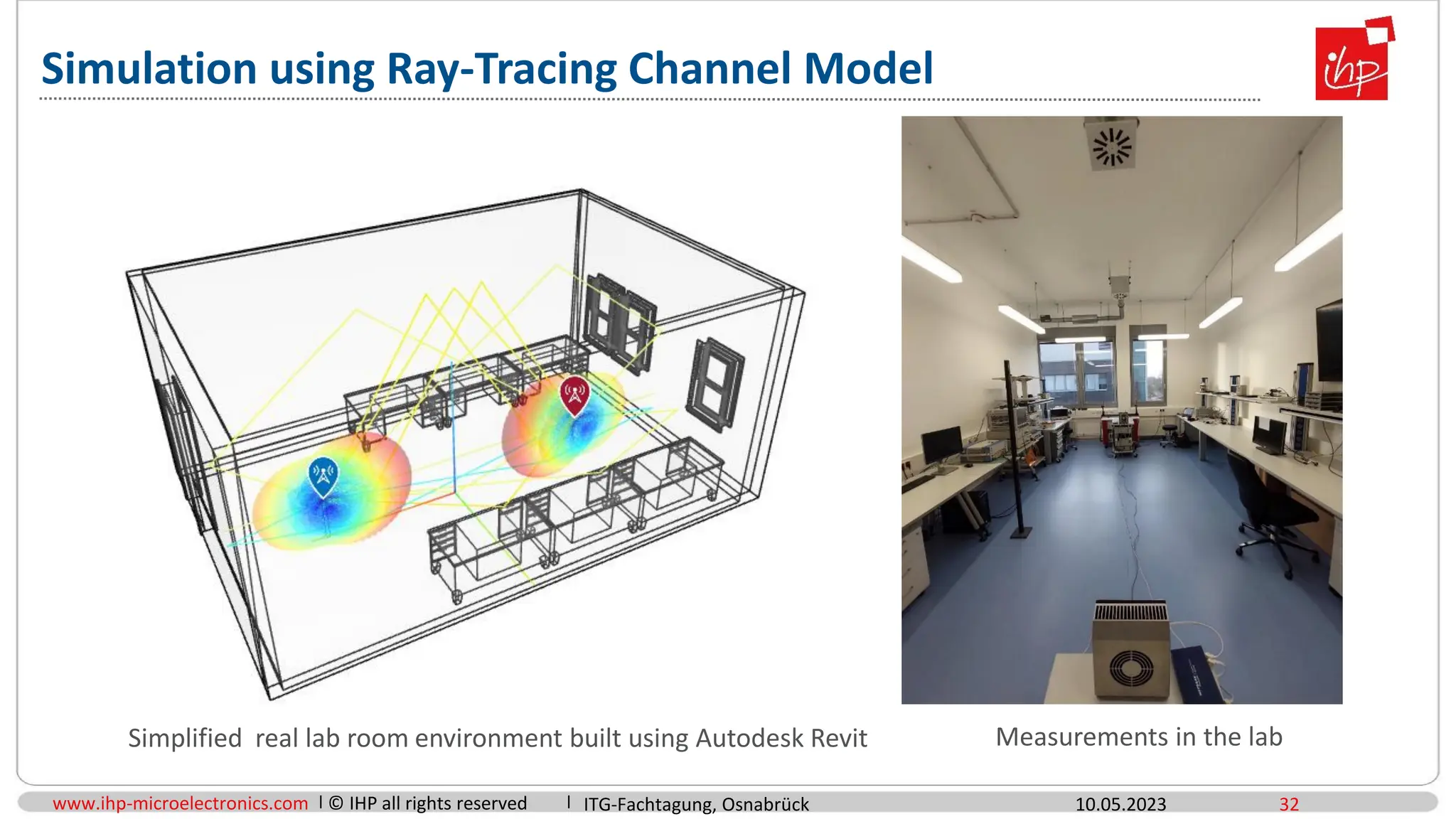
all rights reserved Simulation using Ray-Tracing Channel Model Simplified real lab room environment built using Autodesk Revit Measurements in the lab 10.05.2023 32 ITG-Fachtagung, Osnabrück
29.
www.ihp-microelectronics.com © IHP
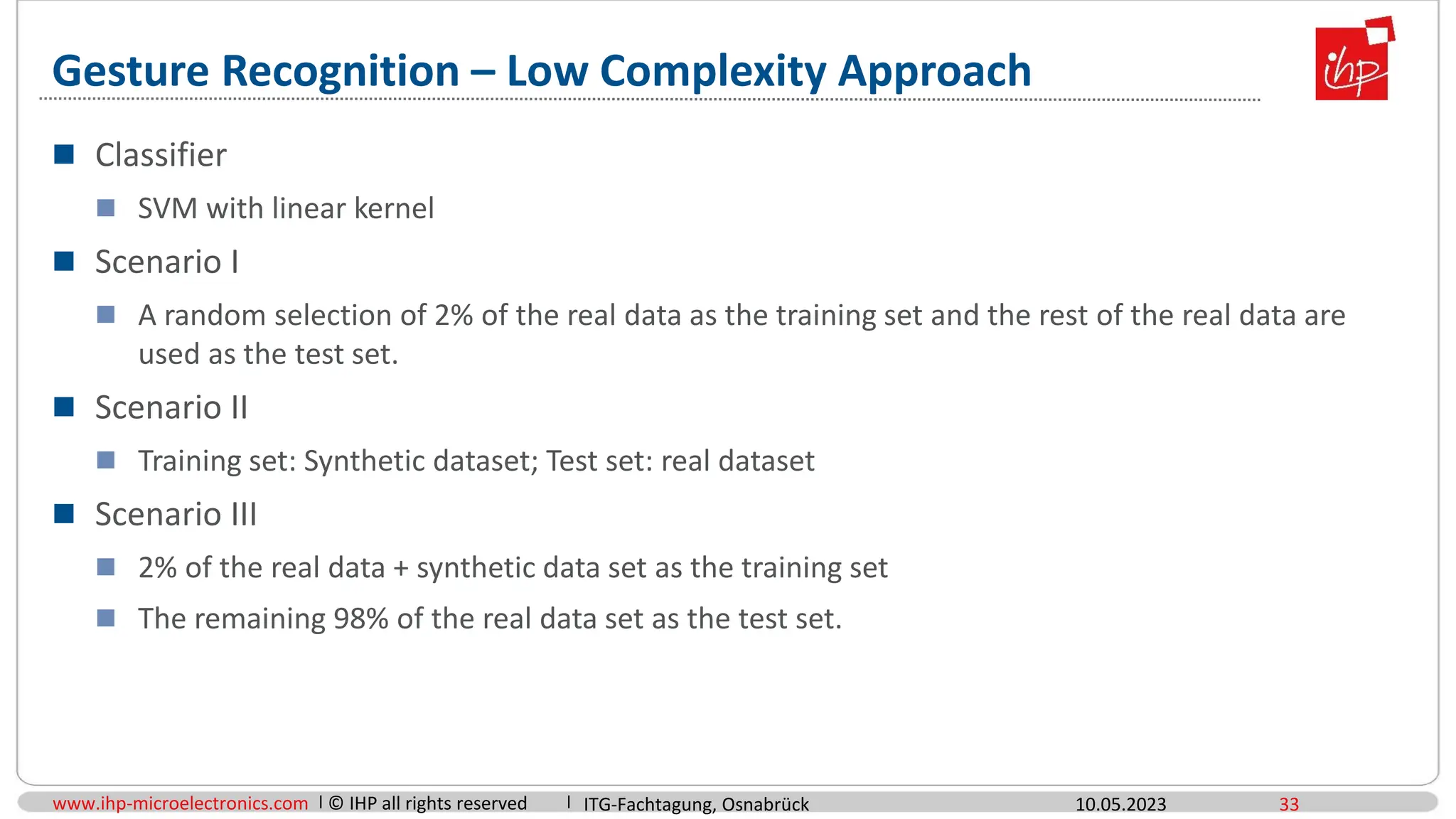
all rights reserved Gesture Recognition – Low Complexity Approach 10.05.2023 33 Classifier SVM with linear kernel Scenario I A random selection of 2% of the real data as the training set and the rest of the real data are used as the test set. Scenario II Training set: Synthetic dataset; Test set: real dataset Scenario III 2% of the real data + synthetic data set as the training set The remaining 98% of the real data set as the test set. ITG-Fachtagung, Osnabrück
30.
www.ihp-microelectronics.com © IHP
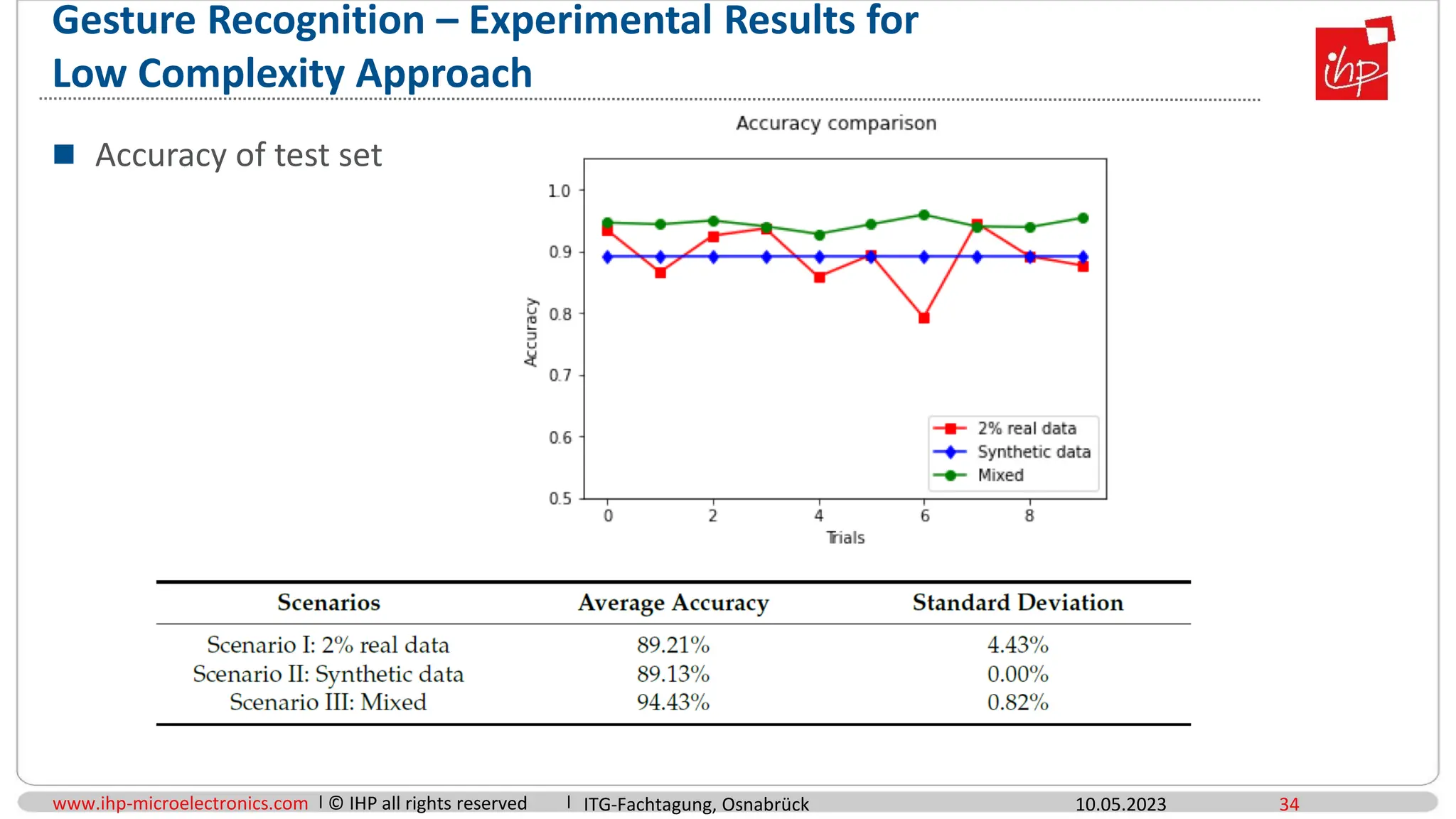
all rights reserved Gesture Recognition – Experimental Results for Low Complexity Approach 10.05.2023 34 Accuracy of test set ITG-Fachtagung, Osnabrück
31.
www.ihp-microelectronics.com © IHP
all rights reserved Some Learnings 10.05.2023 35 1. Reconstructing basic features of a room is possible using angular resolved CIRs 2. The varying antenna patterns of beamsteering systems represent a significant additional challenge for processing the measurement data 3. Wide beams and complex antenna patterns can be compensated using deconvolution, if the angular step-size of the measured CIRs is small 4. The unavailabilty of suitable experimental channel sounding data is a significant obstacle for developing efficient algorithms 5. The unavailability of objective quality measures for the results of room reconstruction etc. is a major problem of optimising the algorithms 6. As yet, it is unclear if classical signal processing or AI techniques are best for processing the obtained CIRs (in terms of complexity and quality of results) ITG-Fachtagung, Osnabrück
32.
www.ihp-microelectronics.com © IHP
all rights reserved 6G-Technologies and their Potential (Very Personal!) 10.05.2023 36 - Reconfigurable Intelligent Surfaces (RIS, IRS) (0) - (sub-)THz Communications (+) - openRAN / disaggregated Architectures (0) - Joint Communication and Sensing (JCAS) (++) - Cell-free communication network (+) - Joint Access and Transport (+) - Quantum Communications (Security) (+) - Post-Shannon Communications (identification channel) (0) - ML and AI for PHY-Layer processing (0) - ML and AI in Network Control and Optimisation (includ. dig. Twin) (++) - Visible Light Communications / Free space optical comms. (0) - Orbital Angular Momentum Multiplexing (OAM) (+) - Backscatter Communications/sensing (using ambient RF signals) (+) ITG-Fachtagung, Osnabrück
33.
www.ihp-microelectronics.com © IHP
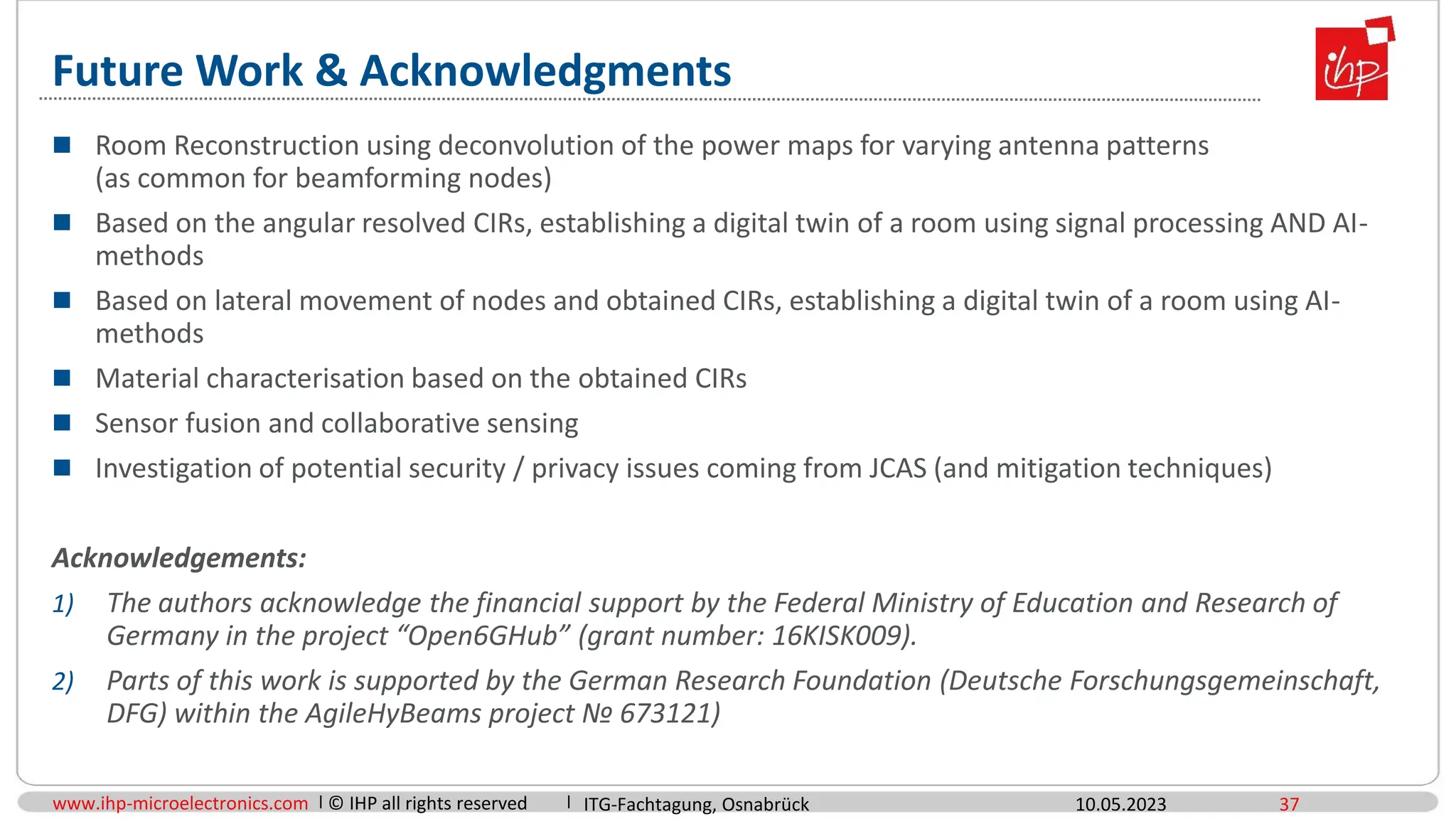
all rights reserved Future Work & Acknowledgments Room Reconstruction using deconvolution of the power maps for varying antenna patterns (as common for beamforming nodes) Based on the angular resolved CIRs, establishing a digital twin of a room using signal processing AND AI- methods Based on lateral movement of nodes and obtained CIRs, establishing a digital twin of a room using AI- methods Material characterisation based on the obtained CIRs Sensor fusion and collaborative sensing Investigation of potential security / privacy issues coming from JCAS (and mitigation techniques) Acknowledgements: 1) The authors acknowledge the financial support by the Federal Ministry of Education and Research of Germany in the project “Open6GHub” (grant number: 16KISK009). 2) Parts of this work is supported by the German Research Foundation (Deutsche Forschungsgemeinschaft, DFG) within the AgileHyBeams project № 673121) 10.05.2023 37 ITG-Fachtagung, Osnabrück
34.
IHP – Leibniz-Institut
für innovative Mikroelektronik Im Technologiepark 25 D – 15236 Frankfurt (Oder) www.ihp-microelectronics.com Phone: +49 (0) 335 5625 Fax: +49 (0) 335 5625 e-mail: Thank you for your attention! www.ihp-microelectronics.com Grass, Eckhard 731 grass@ihp-microelectronics.com 671
Download


![www.ihp-microelectronics.com © IHP all rights reserved
Room Reconstruction Results from Experimental Data
A
B
S
B
A
S
Setup 1
Setup 2
The figures show the results of different methods based on the two
measurements setups in an anechoic chamber.
The red and blue ellipses represent the power map and enhanced method [1]
The area represented by shadows are based on the approach that is inspired
by bistatic radars.
[1] E. Sedunova, N. Maletic, L. Wimmer, D. Cvetkovski, E. Grass, and B. Lankl, “Utilizing Beamsteering at Millimeter Waves for Indoor Object and Room Geometry Detection,”
10.05.2023 31
ITG-Fachtagung, Osnabrück](https://image.slidesharecdn.com/06veckhardgrass-251212111305-20be843f/75/JOINT-SENSING-RADAR-AND-SENSING-USING-RADAR-27-2048.jpg)




![[CONTEXTS'11] A bayesian strategy to enhance the performance of indoor locali...](https://cdn.slidesharecdn.com/ss_thumbnails/contexts11abayesianstrategytoenhancetheperformanceofindoorlocalizationsystems-120611064501-phpapp01-thumbnail.jpg?width=640&height=640&fit=bounds)


