Suggestions and Guidelines to address gap and challenge in the EEU
           for the participation in the ICT Research Domain

Introduction
Enterprise Interoperability and Enterprise Collaboration are among the main ingredients to support
collaboration between industrial partners. As a matter of fact SMEs and research organizations are
an essential part of EEU economies and form that important structural backbone integrating
research and industrial networks. In such context COIN EI / EC Services and applications are
extremely relevant for SMEs in a way they can stimulate the ICT related activity for new ideas and
project proposals leveraging that critical mass around COIN related domains.
To this extent the objective of reinforcement of the cooperation between research teams across the
EU and the integration of the European Research Area in ICT (especially in the Enlarged
European Union) can benefit with COIN leveraging its network and community starting from the
launch of new research initiatives in the enterprise interoperability and collaboration (and adjacent)
domains.

The Joint Action Plan includes propositions and guidelines derived from the adoption of COIN EI /
EC Services to EEU contexts with the global objective of addressing Enlarged European ICT
organizations for facilitating their involvement in the on-going and future EI / EC related research
developments by removing all that barriers that hampers a fully successful participation in the
European project calls.
The Joint Action Plan is addressed to:
    • Enlarged European Union Policy Makers, Governmental Institute (also at global European
        level) active in the launch and support of initiatives for the consolidation of the ICT research
        arena and its integration between eastern and western regions in Europe;
    • Research Centres, Universities and Organizations actively participating in European
        cooperation programmes in the ICT domains especially at enterprise interoperability and
        collaboration level.
Additional intention of the Joint Action Plan is finally to contribute to the reinforcement of
cooperation between research teams across the 27 Member States and the consolidation and
integration of the European Research Area for reducing the “digital divide” between companies
belonging to different regions and countries in Europe (so crucial for a balanced development of an
Enlarged European Union).

In the context of this Action Plan COIN Project makes available, for validation and testing, COIN
results to six EEU end-users (that extended the current portfolio of COIN pilots), to study, design
and implement simplified Enterprise Interoperability (EI) and Enterprise Collaboration (EC) services
close to EEU Member organizations requisites and needs.
This was done by observing and analyzing the activities conducted within six different pilots and
how these pilots are supported by local and national stakeholders; the experience achieved by the
six EEU partner organizations and their success factors, the adoption of COIN EI / EC services to
their specific scenarios and needs was useful to derive findings and path on how to fill the gap in
the Interoperability and Collaboration domains (key sector for the ICT research arena more in
general).
The six EEU Organizations carrying the COIN Pilots played also the role of contributing, thanks to
their experimentations results, in the definition and the identification of the gaps and barriers


                                                                     Support by the European Commission, DG
                                                                     INFSO within FP7 is acknowledged.
encountered in their research activity (namely in the Enterprise Collaboration and Interoperability
domains) and in their participation in the COIN research project.
Additional inputs for the definition of a Joint Action plan are:
-      EEU Research Organization network related Policy Makers and Stakeholders
-      COIN EEU Community Network
These network constituencies provided examples on initiatives, best practices and programmes in
support to the research Activity in the EEU and in the ICT Context (namely in the Collaboration and
Interoperability domains).

Finally the guidelines and propositions of this Joint Action Plan are addressed to Enlarged
European Union Research Organizations and stakeholders as a whole, considering however the
target Member States cover an area that is by definition and in practical facts non homogeneous in
terms of development of the economies, research needs, ICT Research organization legislation,
support initiatives and level of integration with Western Countries.


COIN Joint Action Plan Context and Strategy
The phases for the definition of the Joint Action Plan and the collection of inputs from COIN Project
activities and pilot experimentations can be summarized as follow:
    – Identification of EEU Policy Makers and stakeholders;
    – Collection of recommendations for perceived and known barriers for a first definition of
         the Joint Action Plan;
    – Discovery of additional initiatives, aimed to facilitate the reduction of barriers and
         difficulties in EEU Countries;
    – Identification of guidelines and harmonized views and approaches suitable for raising the
         awareness of policy makers in the Enlarged European Union;
    – Publication of the initiatives and initial suggestions and guideline for the Joint Action
         Plan;
    – Involvement of identified actors and stakeholder to:
              • validate and finalize contributions
              • Share contributions among the project community
              • Adopt guidelines and suggestions within the overall research activity
                   improvement objective (Joint Action Plan dissemination).

The COIN EEU six pilots acted as key elements not only in the networking aspect and in the
coordination of the local stakeholders and Policy Makers but also on the activities conducted and
on the support received by local and national initiatives and practices (to derive gaps and best
practices in ICT Research context).
All these elements were collected during a series of dedicated events involving both EEU
Research Organizations and relative stakeholders and Policy Makers summarized according to the
below definition schema:
    - Awareness and understanding of EEU Research organizations on Interoperability and
        Collaboration latest research results;
    - Collection of needs and barriers in the EEU Research arena and in the Interoperability and
        Collaboration domains and local Policy initiatives and instruments in support to specific
        research needs;


                                                                   Support by the European Commission, DG
                                                                   INFSO within FP7 is acknowledged.
-   Validation and consolidation of suggestions and guidelines collected;
   -   Adoption and implementation of suggestions and guidelines to be concretized in specific
       proposition for EU ICT calls (and initial dissemination of the final Joint Action Plan).

A graphics exemplification of the described rationale can be summarized also according to the
following schema:


Barriers and gaps were also evaluated in order to understand the potential impact for the required
actions in support to ICT EEU research organizations focusing on their active participation in
European funded projects.
In parallel with this methodology then, the assessment of gaps was integrated with the model
process for a successful participation in a European project. This approach was also useful to
foster the awareness on all the required steps and but also the difficulties EEU organizations faces
in their research activity at wide level (from administrative to networking procedures).

Four phases were finally exemplified:
   1. Intelligence and Lobbing: including all these processes and activities directed to
       understand, follow and promote the correct and successful participation to EU call for
       proposals.
   2. Networking: including either the activities to attract and find new partners and the action to
       participate to events and meetings in order to contribute to improve quality and quantity
       level of network contacts.
   3. Proposal drafting including all these activities and information relevance to write good
       proposals.


                                                                   Support by the European Commission, DG
                                                                   INFSO within FP7 is acknowledged.
4. Project administration including all these skills and tools to manage the project in term of
      required procedures and partner coordination ability.


The following schema clearly exemplifies the classification approach just described:

      Gaps and Barriers                         Category/Phase Description

                                                Processes and activities directed to understand,
      Intelligence and Lobbing                  follow and promote the correct and successful
                                                participation to EU call for proposals


                                                Activities to attract and find new partners and the
                                                action to participate to events and meetings in
      Networking
                                                order to contribute to improve contact (quality
                                                and quantity)

                                                Activities and information relevance to write
      Proposal drafting
                                                good project proposals

                                                Skills and tools to manage the project in term of
      Project administration                    required procedures and partner coordination
                                                ability

                                                Local contextual situation/culture - cross related
      Cross-cultural aspects                    to the project proposal phases gaps


                                                Industrial relevance of launched initiatives
      Other gaps
                                                Other gaps non included in the previous
                                                categories


This approach was useful to categorize the different steps of this Action Plan; nonetheless the
model was reinforced by introducing also transversal aspects common to the all the “project
proposal models” phases. The model included also:
   - Cross-cultural aspects and elements
   - Industrial Relevance of launched initiatives and other gaps not included in the previous
       categories.


COIN Joint Action Plan: stakeholders and roles
The methodology adopted identified and framed the current situation with the consequent
delineation of relevant correlated gaps.


                                                                     Support by the European Commission, DG
                                                                     INFSO within FP7 is acknowledged.
The definition of the Action Plan based on these gaps is addressed to the Stakeholders
 identified in the introduction of this document belonging to Policy Makers (both at EEU and
 global EU level) category from one side and to ICT Research organization to the other.
 Their role of taking active actions in their initiatives and in framing their activities based on the
 suggestions and guidelines identified by this Plan will be detailed identified action by action in
 the following paragraph (where the final Plan is reported and related to the Project proposal
 model described).
 The additional benefits from stakeholders from the adoption of such guidelines can be
 summarized as follow:
     - Stimulate investment in innovation and Research Activity;
     - Building and improving synergies between different players and actors in the innovation
          and research arena;
     - Improve synergies with EU players and Western Union Research industrial players (also
          at “giant” level);
     - Facilitate inclusion of new organizations in new projects;
     - Facilitate adoption of best practices at EEU Policy Level;
     - Increase overall performances of research / innovation projects with the additional
          benefit of shorter the term for Research Organizations to produce innovation for the
          Industry.


 COIN Joint Action Plan
 The framework, in which this approach was conducted (and introduced at the beginning of this
 paragraph), originates from the analysis of the emerged gaps affecting Enlarged European
 Countries and related ICT research organizations. Consequently guidelines and recommendations
 for Policy Makers and Stakeholders on how to overcome these gaps, starting from the lesson
 learnt of the COIN project pilot experiences, were derived and are illustrated as follow:

Recommendation                    Addressed Stakeholder(s)            Project proposal model phase
Stimulate the creation of         Research centres                    Intelligence and Lobbing
Community       of   Excellence   Universities                        Networking
through which retain and
attract ICT Resources (at
Human,        technical     and
Knowledge base level) in a
way compatible with the level
of competitiveness, investment
and factor remuneration of
local markets
Reinforce cooperation with        Universities                        Networking
relevant Communities and          ICT     Communities,        other
improve visibility to powerful    networks
and      winning    consortium,
success         cases       and
cooperation initiatives in ICT
research arena.
Facilitate the creation of        SMEs and ICT Organizations          Local context situation and cross-
Business Ecosystems and                                               cultural aspects


                                                                       Support by the European Commission, DG
                                                                       INFSO within FP7 is acknowledged.
collaborative clusters at EEU
level involving all the different
actors in the ICT Research
local arena
Promote        and      improve      Policy Makers                 Industrial relevance of proposed
programmes for innovation            Regional incubators           initiatives
support       and     facilitation
(including regional incubation
centres) suggesting to adopt
more       focused     research
stimulation mechanisms such
as Innovation Prizes and
Business Contests and similar
instruments to allow proposals
and initiatives to reach a
concrete level of development
for success
Reinforcement of Training            Research Centres              Project administration
Initiatives to raise level of        Universities                  Industrial relevance of proposed
awareness of EEU research
                                     Local             Governments initiatives
organizations     to    organise
                                     (educational programmes)
proposals for target domains


     1) Stimulate the creation of Community of Excellence through which retain and attract
         ICT Resources (at Human, technical and Knowledge base level) in a way compatible
         with the level of competitiveness, investment and factor remuneration of local
         markets
 From the gaps analyzed at EEU level the inability of retain and attract ICT Resources in Research
 Context from Oriented Enterprise Organizations (characterized by insufficient competitiveness of
 ICT investment and development on Knowledge base ICT technologies) emerged in a prominent
 way.
 The EEU Research arena suffers a sort of “Brain drain”, especially in the private sector, for
 resources attracted by better salary level in the ICT Research Industry. Private sector in the EEU is
 mainly formed by foreign branches of other Countries companies and the University is then the
 main instrument at disposal to local government to refrain such kind of trend. Unfortunately this
 statement of fact is often associated with a lack of long term, sustainable national policies,
 strategies, priorities and programs related to ICT research.
 The creation of such Communities of Excellence can be focused on the active and important role
 Universities are playing at EEU level both at:
     - Centres for ICT Human Resources formation and intensification;
     - Bridge between public and private sectors to strengthen public funding intervention.
 In such context at local practices and government intervention some EEU Countries are putting
 strong attention on increasing Human resources capital.
 Is the case of the European Social Fund Project for improving human capital (Romania); the fund
 has the target to improve the Competitiveness and the Sustainable Development of Enterprises in
 the Knowledge-Based Society by Training Human Resources in New ICT Technologies; improve


                                                                    Support by the European Commission, DG
                                                                    INFSO within FP7 is acknowledged.
the Quality and Leadership for The Romanian Higher Education Project in order to ground medium
and long term policies; promote Doctorate in Universities of Excellence.
Slovenia adopt instead National calls for research centres, competence centres and innovation
centres, with the aim to concentrate competences and resource in the country on a particular
research topic and build critical mass around which retain qualified Human Resources.


     2) Reinforce cooperation with relevant Communities and improve visibility to powerful
        and winning consortium, success cases and cooperation initiatives in ICT research
        arena
It was observed a lack of essential experience and confidence that impedes the involvement of
EEU research organizations in relation to EU-12 countries.
The development and adoption of platforms to share research results among industry research,
business and academia can contribute to the reinforcement of that culture (more streamlined to EU
successful related organizations) improving the diffusion of successful cases in Research context.
These platforms can contribute also in the development of dedicated Communities important to
foster and maintain mechanisms for the involvement in successful networking trends and ICT
research support.1
Is the case of COIN Virtual Professional Community that starting from the experiences and the
results achieved by the adoption of its EI / EC Services can foster a fertile ground to launch future
successful proposals and projects in the Domain. It will network EEU ICT Research Organizations
through the participation in dedicated events and the organization of Conferences in the form of an
Open Knowledge Platform (with contribution and level of involvement from partners based on
voluntary basis).2
In the case of COIN end users research organizations it was again registered the importance of
EEU dedicated calls (such as SP7) in the need of have a continuity of such opportunities to
participate in large cooperation projects in the ICT domains (reducing the gap in this strategic field
in the European overall market).
COIN training programme (VideoLecture) could cover an additional role of disseminating good
experiences from EI / EC service adoption adding hosting option for best practices, success stories
but also people curricula in an integrated training dedicated environment.


    3) Facilitate the creation of Business Ecosystems and collaborative clusters at EEU
        level involving all the different actors in the ICT Research local arena
This action was considered important to address that lack of synergies between academia,
Research and the Industry (identified also by a non-homogeneous effort in coordinating
competencies and innovation support at national initiative level).
Relations between academia, research and the Industry are always not so strong and the two
sides of the research arena are often facing different challenges and perspective (“mixing oil and
water”).

1
  In the example of COIN EEU end-users experience it was observed a positive feedback in the
Project platform adoption as instrument of thinking and identifying new form of initiatives based
on research project.
2
   In this direction we can register also the need of identifying the channels where present
successful ideas (not only their support) underlined by COIN end-users.

                                                                    Support by the European Commission, DG
                                                                    INFSO within FP7 is acknowledged.
In the case of Bulgaria it was registered an inadequate role of the academia as main driver of the
ICT arena in favour of the Industry and the big foreign Players whose initiatives on the market are
in most cases the result of strategies adopted away from the local context. This situation reinforce
the need of having well balanced ecosystems where Industry and Academia are playing their
correct role and are operating starting from the needs of the internal research arena.
This trend is particular important because the creation of successful ecosystem in a specific
domain can act as success case and best example to be propagated in other domains (not
necessarily related).3
Some EEU governments are adopting taxes and incentives in support of the development and
maturity of ICT Research Arena (as the case of Turkey). In addition dedicated governmental
instruments, again adopted to address competitiveness of private ICT sector can redirect the effort
in building such critical mass around ICT Research actors (i.e. Turkey “State Planning
Organization” or “Research & Development and Innovation support in ICT”).


    4) Promote and improve programmes for innovation support and facilitation (including
        regional incubation centres) suggesting to adopt more focused research stimulation
        mechanisms such as Innovation Prizes and Business Contests and similar
        instruments to allow proposals and initiatives to reach a concrete level of
        development for success
The analysis of the gaps was useful to derive a low coordination of governmental based initiatives
causing an inability to drive forces available at SMEs level for participating in the “European
Research context”.
In reinforcement to this the fact that in the EEU there is no critical mass in terms of large enterprise
or advanced cluster culture to support some of the potential developable ideas (except for the
public sector where, however, adopted model and mentality are often not efficient in terms of
successful results).
In a market, as said, characterized by a widespread SMEs ground layer this situation is the cause
of individual SMEs insufficient economic power to push and succeed in their ideas (also due to the
level of development required to boost and lead these ideas to the market).
As consequent result SMEs often play the role of start-up but, due to a lack of support in the
innovation process (additional gap), they have to hang over the idea development in early stage in
favour of big players.
The lack of initiatives (lead by “good leaders”) that could be able to drag innovation and exploit
what is done at SME level can be considered a deeper analysis of such specific inadequate
performance.
In such context the COIN project features 6 EEU cases (plus 6 original cases) composing a sort of
core community built around these success cases and potentially able to act as catalyst in view of
coming ICT calls. The identified key role of success cases and mechanisms on how make this
achieved results and knowledge available to interested Research Organizations is important also
in the low effectiveness role of contact points registered in some EEU Countries (not able to
address research activity over specific and important themes).
In the same direction (spreading best practices and effectively address research activity) the case
of Turkey that employs some dedicated programmes in support to Research and Innovation

3
 Is the case of COIN Czech Republic end-user whose results in the Agricultural ecosystem were
adopted to derive new initiatives in different domains (i.e. Enterprise Interoperability and
Collaboration, Internet of Things etc).

                                                                     Support by the European Commission, DG
                                                                     INFSO within FP7 is acknowledged.
context: “Research and Development Grant Programme for Industry and SMEs” by TUBITAK,
TTGV Technology Development Loans for Industry and “Research and Development Projects
Grant“ by KOSGEB, Techno-Entrepreneurship Capital Programme” and R&D Activities and R&D
Centers Incentives by Ministry of Industry and EUREKA/EUROSTARS and other Business
Incubation Programmes.


    5) Reinforcement of Training Initiatives to raise level of awareness of EEU research
        organizations to organise proposals for target domains
Training initiatives both for companies and individuals is an important point to focus the
development of ICT and research culture in the EEU. In such context however it was observed
how training was often too generic and not necessary research oriented.
The experience of COIN could again be useful in adopting the maturity model applied to assess
organizations to join FP proposals and personnel resources for a more successful activity in this
context. This is particularly true also because of missing structures in the EEU for idea promotion,
selection and refinement (and lack of dedicated business infrastructures).
For what concern this aspect Slovenia largely adopts training programmes but also info days
organized by Ministries and leading RTD organizations to improve the level of research and
maturity of its organizations. In such direction Slovenia promotes also financial support from the
“Ministry of Science and Ministry of Trade” for European project proposal preparation.


                                                                   Support by the European Commission, DG
                                                                   INFSO within FP7 is acknowledged.
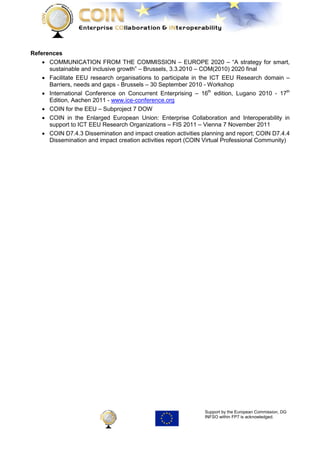
The resulting definition of a Joint Action Plans in support of EEU ICT research organizations can
be summarized by the following schema including actual situation, vision and improvements
with the experience of COIN pilot adoption at enterprise collaboration and interoperability level:


                                                                   Support by the European Commission, DG
                                                                   INFSO within FP7 is acknowledged.
References
    • COMMUNICATION FROM THE COMMISSION – EUROPE 2020 – “A strategy for smart,
      sustainable and inclusive growth” – Brussels, 3.3.2010 – COM(2010) 2020 final
    • Facilitate EEU research organisations to participate in the ICT EEU Research domain –
      Barriers, needs and gaps - Brussels – 30 September 2010 - Workshop
    • International Conference on Concurrent Enterprising – 16th edition, Lugano 2010 - 17th
      Edition, Aachen 2011 - www.ice-conference.org
    • COIN for the EEU – Subproject 7 DOW
    • COIN in the Enlarged European Union: Enterprise Collaboration and Interoperability in
      support to ICT EEU Research Organizations – FIS 2011 – Vienna 7 November 2011
    • COIN D7.4.3 Dissemination and impact creation activities planning and report; COIN D7.4.4
      Dissemination and impact creation activities report (COIN Virtual Professional Community)


                                                               Support by the European Commission, DG
                                                               INFSO within FP7 is acknowledged.

Joint action-plan

  • 1.
    Suggestions and Guidelinesto address gap and challenge in the EEU for the participation in the ICT Research Domain Introduction Enterprise Interoperability and Enterprise Collaboration are among the main ingredients to support collaboration between industrial partners. As a matter of fact SMEs and research organizations are an essential part of EEU economies and form that important structural backbone integrating research and industrial networks. In such context COIN EI / EC Services and applications are extremely relevant for SMEs in a way they can stimulate the ICT related activity for new ideas and project proposals leveraging that critical mass around COIN related domains. To this extent the objective of reinforcement of the cooperation between research teams across the EU and the integration of the European Research Area in ICT (especially in the Enlarged European Union) can benefit with COIN leveraging its network and community starting from the launch of new research initiatives in the enterprise interoperability and collaboration (and adjacent) domains. The Joint Action Plan includes propositions and guidelines derived from the adoption of COIN EI / EC Services to EEU contexts with the global objective of addressing Enlarged European ICT organizations for facilitating their involvement in the on-going and future EI / EC related research developments by removing all that barriers that hampers a fully successful participation in the European project calls. The Joint Action Plan is addressed to: • Enlarged European Union Policy Makers, Governmental Institute (also at global European level) active in the launch and support of initiatives for the consolidation of the ICT research arena and its integration between eastern and western regions in Europe; • Research Centres, Universities and Organizations actively participating in European cooperation programmes in the ICT domains especially at enterprise interoperability and collaboration level. Additional intention of the Joint Action Plan is finally to contribute to the reinforcement of cooperation between research teams across the 27 Member States and the consolidation and integration of the European Research Area for reducing the “digital divide” between companies belonging to different regions and countries in Europe (so crucial for a balanced development of an Enlarged European Union). In the context of this Action Plan COIN Project makes available, for validation and testing, COIN results to six EEU end-users (that extended the current portfolio of COIN pilots), to study, design and implement simplified Enterprise Interoperability (EI) and Enterprise Collaboration (EC) services close to EEU Member organizations requisites and needs. This was done by observing and analyzing the activities conducted within six different pilots and how these pilots are supported by local and national stakeholders; the experience achieved by the six EEU partner organizations and their success factors, the adoption of COIN EI / EC services to their specific scenarios and needs was useful to derive findings and path on how to fill the gap in the Interoperability and Collaboration domains (key sector for the ICT research arena more in general). The six EEU Organizations carrying the COIN Pilots played also the role of contributing, thanks to their experimentations results, in the definition and the identification of the gaps and barriers Support by the European Commission, DG INFSO within FP7 is acknowledged.
  • 2.
    encountered in theirresearch activity (namely in the Enterprise Collaboration and Interoperability domains) and in their participation in the COIN research project. Additional inputs for the definition of a Joint Action plan are: - EEU Research Organization network related Policy Makers and Stakeholders - COIN EEU Community Network These network constituencies provided examples on initiatives, best practices and programmes in support to the research Activity in the EEU and in the ICT Context (namely in the Collaboration and Interoperability domains). Finally the guidelines and propositions of this Joint Action Plan are addressed to Enlarged European Union Research Organizations and stakeholders as a whole, considering however the target Member States cover an area that is by definition and in practical facts non homogeneous in terms of development of the economies, research needs, ICT Research organization legislation, support initiatives and level of integration with Western Countries. COIN Joint Action Plan Context and Strategy The phases for the definition of the Joint Action Plan and the collection of inputs from COIN Project activities and pilot experimentations can be summarized as follow: – Identification of EEU Policy Makers and stakeholders; – Collection of recommendations for perceived and known barriers for a first definition of the Joint Action Plan; – Discovery of additional initiatives, aimed to facilitate the reduction of barriers and difficulties in EEU Countries; – Identification of guidelines and harmonized views and approaches suitable for raising the awareness of policy makers in the Enlarged European Union; – Publication of the initiatives and initial suggestions and guideline for the Joint Action Plan; – Involvement of identified actors and stakeholder to: • validate and finalize contributions • Share contributions among the project community • Adopt guidelines and suggestions within the overall research activity improvement objective (Joint Action Plan dissemination). The COIN EEU six pilots acted as key elements not only in the networking aspect and in the coordination of the local stakeholders and Policy Makers but also on the activities conducted and on the support received by local and national initiatives and practices (to derive gaps and best practices in ICT Research context). All these elements were collected during a series of dedicated events involving both EEU Research Organizations and relative stakeholders and Policy Makers summarized according to the below definition schema: - Awareness and understanding of EEU Research organizations on Interoperability and Collaboration latest research results; - Collection of needs and barriers in the EEU Research arena and in the Interoperability and Collaboration domains and local Policy initiatives and instruments in support to specific research needs; Support by the European Commission, DG INFSO within FP7 is acknowledged.
  • 3.
    - Validation and consolidation of suggestions and guidelines collected; - Adoption and implementation of suggestions and guidelines to be concretized in specific proposition for EU ICT calls (and initial dissemination of the final Joint Action Plan). A graphics exemplification of the described rationale can be summarized also according to the following schema: Barriers and gaps were also evaluated in order to understand the potential impact for the required actions in support to ICT EEU research organizations focusing on their active participation in European funded projects. In parallel with this methodology then, the assessment of gaps was integrated with the model process for a successful participation in a European project. This approach was also useful to foster the awareness on all the required steps and but also the difficulties EEU organizations faces in their research activity at wide level (from administrative to networking procedures). Four phases were finally exemplified: 1. Intelligence and Lobbing: including all these processes and activities directed to understand, follow and promote the correct and successful participation to EU call for proposals. 2. Networking: including either the activities to attract and find new partners and the action to participate to events and meetings in order to contribute to improve quality and quantity level of network contacts. 3. Proposal drafting including all these activities and information relevance to write good proposals. Support by the European Commission, DG INFSO within FP7 is acknowledged.
  • 4.
    4. Project administrationincluding all these skills and tools to manage the project in term of required procedures and partner coordination ability. The following schema clearly exemplifies the classification approach just described: Gaps and Barriers Category/Phase Description Processes and activities directed to understand, Intelligence and Lobbing follow and promote the correct and successful participation to EU call for proposals Activities to attract and find new partners and the action to participate to events and meetings in Networking order to contribute to improve contact (quality and quantity) Activities and information relevance to write Proposal drafting good project proposals Skills and tools to manage the project in term of Project administration required procedures and partner coordination ability Local contextual situation/culture - cross related Cross-cultural aspects to the project proposal phases gaps Industrial relevance of launched initiatives Other gaps Other gaps non included in the previous categories This approach was useful to categorize the different steps of this Action Plan; nonetheless the model was reinforced by introducing also transversal aspects common to the all the “project proposal models” phases. The model included also: - Cross-cultural aspects and elements - Industrial Relevance of launched initiatives and other gaps not included in the previous categories. COIN Joint Action Plan: stakeholders and roles The methodology adopted identified and framed the current situation with the consequent delineation of relevant correlated gaps. Support by the European Commission, DG INFSO within FP7 is acknowledged.
  • 5.
    The definition ofthe Action Plan based on these gaps is addressed to the Stakeholders identified in the introduction of this document belonging to Policy Makers (both at EEU and global EU level) category from one side and to ICT Research organization to the other. Their role of taking active actions in their initiatives and in framing their activities based on the suggestions and guidelines identified by this Plan will be detailed identified action by action in the following paragraph (where the final Plan is reported and related to the Project proposal model described). The additional benefits from stakeholders from the adoption of such guidelines can be summarized as follow: - Stimulate investment in innovation and Research Activity; - Building and improving synergies between different players and actors in the innovation and research arena; - Improve synergies with EU players and Western Union Research industrial players (also at “giant” level); - Facilitate inclusion of new organizations in new projects; - Facilitate adoption of best practices at EEU Policy Level; - Increase overall performances of research / innovation projects with the additional benefit of shorter the term for Research Organizations to produce innovation for the Industry. COIN Joint Action Plan The framework, in which this approach was conducted (and introduced at the beginning of this paragraph), originates from the analysis of the emerged gaps affecting Enlarged European Countries and related ICT research organizations. Consequently guidelines and recommendations for Policy Makers and Stakeholders on how to overcome these gaps, starting from the lesson learnt of the COIN project pilot experiences, were derived and are illustrated as follow: Recommendation Addressed Stakeholder(s) Project proposal model phase Stimulate the creation of Research centres Intelligence and Lobbing Community of Excellence Universities Networking through which retain and attract ICT Resources (at Human, technical and Knowledge base level) in a way compatible with the level of competitiveness, investment and factor remuneration of local markets Reinforce cooperation with Universities Networking relevant Communities and ICT Communities, other improve visibility to powerful networks and winning consortium, success cases and cooperation initiatives in ICT research arena. Facilitate the creation of SMEs and ICT Organizations Local context situation and cross- Business Ecosystems and cultural aspects Support by the European Commission, DG INFSO within FP7 is acknowledged.
  • 6.
    collaborative clusters atEEU level involving all the different actors in the ICT Research local arena Promote and improve Policy Makers Industrial relevance of proposed programmes for innovation Regional incubators initiatives support and facilitation (including regional incubation centres) suggesting to adopt more focused research stimulation mechanisms such as Innovation Prizes and Business Contests and similar instruments to allow proposals and initiatives to reach a concrete level of development for success Reinforcement of Training Research Centres Project administration Initiatives to raise level of Universities Industrial relevance of proposed awareness of EEU research Local Governments initiatives organizations to organise (educational programmes) proposals for target domains 1) Stimulate the creation of Community of Excellence through which retain and attract ICT Resources (at Human, technical and Knowledge base level) in a way compatible with the level of competitiveness, investment and factor remuneration of local markets From the gaps analyzed at EEU level the inability of retain and attract ICT Resources in Research Context from Oriented Enterprise Organizations (characterized by insufficient competitiveness of ICT investment and development on Knowledge base ICT technologies) emerged in a prominent way. The EEU Research arena suffers a sort of “Brain drain”, especially in the private sector, for resources attracted by better salary level in the ICT Research Industry. Private sector in the EEU is mainly formed by foreign branches of other Countries companies and the University is then the main instrument at disposal to local government to refrain such kind of trend. Unfortunately this statement of fact is often associated with a lack of long term, sustainable national policies, strategies, priorities and programs related to ICT research. The creation of such Communities of Excellence can be focused on the active and important role Universities are playing at EEU level both at: - Centres for ICT Human Resources formation and intensification; - Bridge between public and private sectors to strengthen public funding intervention. In such context at local practices and government intervention some EEU Countries are putting strong attention on increasing Human resources capital. Is the case of the European Social Fund Project for improving human capital (Romania); the fund has the target to improve the Competitiveness and the Sustainable Development of Enterprises in the Knowledge-Based Society by Training Human Resources in New ICT Technologies; improve Support by the European Commission, DG INFSO within FP7 is acknowledged.
  • 7.
    the Quality andLeadership for The Romanian Higher Education Project in order to ground medium and long term policies; promote Doctorate in Universities of Excellence. Slovenia adopt instead National calls for research centres, competence centres and innovation centres, with the aim to concentrate competences and resource in the country on a particular research topic and build critical mass around which retain qualified Human Resources. 2) Reinforce cooperation with relevant Communities and improve visibility to powerful and winning consortium, success cases and cooperation initiatives in ICT research arena It was observed a lack of essential experience and confidence that impedes the involvement of EEU research organizations in relation to EU-12 countries. The development and adoption of platforms to share research results among industry research, business and academia can contribute to the reinforcement of that culture (more streamlined to EU successful related organizations) improving the diffusion of successful cases in Research context. These platforms can contribute also in the development of dedicated Communities important to foster and maintain mechanisms for the involvement in successful networking trends and ICT research support.1 Is the case of COIN Virtual Professional Community that starting from the experiences and the results achieved by the adoption of its EI / EC Services can foster a fertile ground to launch future successful proposals and projects in the Domain. It will network EEU ICT Research Organizations through the participation in dedicated events and the organization of Conferences in the form of an Open Knowledge Platform (with contribution and level of involvement from partners based on voluntary basis).2 In the case of COIN end users research organizations it was again registered the importance of EEU dedicated calls (such as SP7) in the need of have a continuity of such opportunities to participate in large cooperation projects in the ICT domains (reducing the gap in this strategic field in the European overall market). COIN training programme (VideoLecture) could cover an additional role of disseminating good experiences from EI / EC service adoption adding hosting option for best practices, success stories but also people curricula in an integrated training dedicated environment. 3) Facilitate the creation of Business Ecosystems and collaborative clusters at EEU level involving all the different actors in the ICT Research local arena This action was considered important to address that lack of synergies between academia, Research and the Industry (identified also by a non-homogeneous effort in coordinating competencies and innovation support at national initiative level). Relations between academia, research and the Industry are always not so strong and the two sides of the research arena are often facing different challenges and perspective (“mixing oil and water”). 1 In the example of COIN EEU end-users experience it was observed a positive feedback in the Project platform adoption as instrument of thinking and identifying new form of initiatives based on research project. 2 In this direction we can register also the need of identifying the channels where present successful ideas (not only their support) underlined by COIN end-users. Support by the European Commission, DG INFSO within FP7 is acknowledged.
  • 8.
    In the caseof Bulgaria it was registered an inadequate role of the academia as main driver of the ICT arena in favour of the Industry and the big foreign Players whose initiatives on the market are in most cases the result of strategies adopted away from the local context. This situation reinforce the need of having well balanced ecosystems where Industry and Academia are playing their correct role and are operating starting from the needs of the internal research arena. This trend is particular important because the creation of successful ecosystem in a specific domain can act as success case and best example to be propagated in other domains (not necessarily related).3 Some EEU governments are adopting taxes and incentives in support of the development and maturity of ICT Research Arena (as the case of Turkey). In addition dedicated governmental instruments, again adopted to address competitiveness of private ICT sector can redirect the effort in building such critical mass around ICT Research actors (i.e. Turkey “State Planning Organization” or “Research & Development and Innovation support in ICT”). 4) Promote and improve programmes for innovation support and facilitation (including regional incubation centres) suggesting to adopt more focused research stimulation mechanisms such as Innovation Prizes and Business Contests and similar instruments to allow proposals and initiatives to reach a concrete level of development for success The analysis of the gaps was useful to derive a low coordination of governmental based initiatives causing an inability to drive forces available at SMEs level for participating in the “European Research context”. In reinforcement to this the fact that in the EEU there is no critical mass in terms of large enterprise or advanced cluster culture to support some of the potential developable ideas (except for the public sector where, however, adopted model and mentality are often not efficient in terms of successful results). In a market, as said, characterized by a widespread SMEs ground layer this situation is the cause of individual SMEs insufficient economic power to push and succeed in their ideas (also due to the level of development required to boost and lead these ideas to the market). As consequent result SMEs often play the role of start-up but, due to a lack of support in the innovation process (additional gap), they have to hang over the idea development in early stage in favour of big players. The lack of initiatives (lead by “good leaders”) that could be able to drag innovation and exploit what is done at SME level can be considered a deeper analysis of such specific inadequate performance. In such context the COIN project features 6 EEU cases (plus 6 original cases) composing a sort of core community built around these success cases and potentially able to act as catalyst in view of coming ICT calls. The identified key role of success cases and mechanisms on how make this achieved results and knowledge available to interested Research Organizations is important also in the low effectiveness role of contact points registered in some EEU Countries (not able to address research activity over specific and important themes). In the same direction (spreading best practices and effectively address research activity) the case of Turkey that employs some dedicated programmes in support to Research and Innovation 3 Is the case of COIN Czech Republic end-user whose results in the Agricultural ecosystem were adopted to derive new initiatives in different domains (i.e. Enterprise Interoperability and Collaboration, Internet of Things etc). Support by the European Commission, DG INFSO within FP7 is acknowledged.
  • 9.
    context: “Research andDevelopment Grant Programme for Industry and SMEs” by TUBITAK, TTGV Technology Development Loans for Industry and “Research and Development Projects Grant“ by KOSGEB, Techno-Entrepreneurship Capital Programme” and R&D Activities and R&D Centers Incentives by Ministry of Industry and EUREKA/EUROSTARS and other Business Incubation Programmes. 5) Reinforcement of Training Initiatives to raise level of awareness of EEU research organizations to organise proposals for target domains Training initiatives both for companies and individuals is an important point to focus the development of ICT and research culture in the EEU. In such context however it was observed how training was often too generic and not necessary research oriented. The experience of COIN could again be useful in adopting the maturity model applied to assess organizations to join FP proposals and personnel resources for a more successful activity in this context. This is particularly true also because of missing structures in the EEU for idea promotion, selection and refinement (and lack of dedicated business infrastructures). For what concern this aspect Slovenia largely adopts training programmes but also info days organized by Ministries and leading RTD organizations to improve the level of research and maturity of its organizations. In such direction Slovenia promotes also financial support from the “Ministry of Science and Ministry of Trade” for European project proposal preparation. Support by the European Commission, DG INFSO within FP7 is acknowledged.
  • 10.
    The resulting definitionof a Joint Action Plans in support of EEU ICT research organizations can be summarized by the following schema including actual situation, vision and improvements with the experience of COIN pilot adoption at enterprise collaboration and interoperability level: Support by the European Commission, DG INFSO within FP7 is acknowledged.
  • 11.
    References • COMMUNICATION FROM THE COMMISSION – EUROPE 2020 – “A strategy for smart, sustainable and inclusive growth” – Brussels, 3.3.2010 – COM(2010) 2020 final • Facilitate EEU research organisations to participate in the ICT EEU Research domain – Barriers, needs and gaps - Brussels – 30 September 2010 - Workshop • International Conference on Concurrent Enterprising – 16th edition, Lugano 2010 - 17th Edition, Aachen 2011 - www.ice-conference.org • COIN for the EEU – Subproject 7 DOW • COIN in the Enlarged European Union: Enterprise Collaboration and Interoperability in support to ICT EEU Research Organizations – FIS 2011 – Vienna 7 November 2011 • COIN D7.4.3 Dissemination and impact creation activities planning and report; COIN D7.4.4 Dissemination and impact creation activities report (COIN Virtual Professional Community) Support by the European Commission, DG INFSO within FP7 is acknowledged.