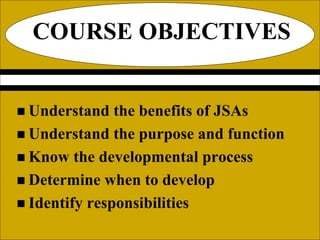
COURSE OBJECTIVES
 Understand the benefits of JSAs
 Understand the purpose and function
 Know the developmental process
 Determine when to develop
 Identify responsibilities
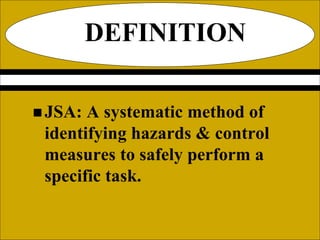
DEFINITION
 JSA: A systematic method of
identifying hazards & control
measures to safely perform a
specific task.
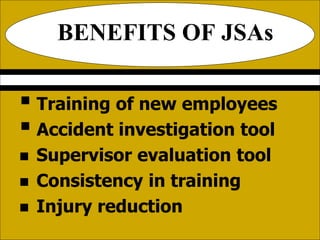
BENEFITS OF JSAs
 Training of new employees
 Accident investigation tool
 Supervisor evaluation tool
 Consistency in training
 Injury reduction
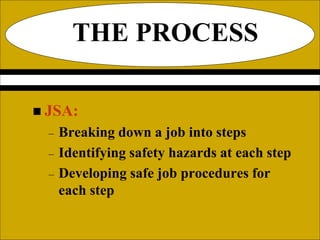
THE PROCESS
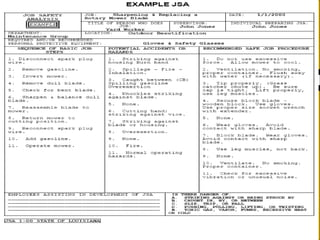
 JSA:
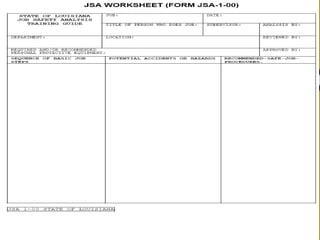
– Breaking down a job into steps
– Identifying safety hazards at each step
– Developing safe job procedures for
each step
JSA PROCEDURE
 STEP 1:
– Select the job
JSA PROCEDURE
 STEP 2:
– Perform the Analysis
 STEP 3:
– IDENTIFY HAZARDS
PROCEDURE Cont’d
PROCEDURE Cont’d
 STEP 4:
– DEVELOP SOLUTIONS
PROCEDURE Cont’d
 STEP 5:
– Conduct a Follow-up Analysis
PROCEDURE Cont’d
 STEP 6:
– Use of the Job Safety Analysis
PROCEDURE Cont’d
 STEP 7:
– Recordkeeping
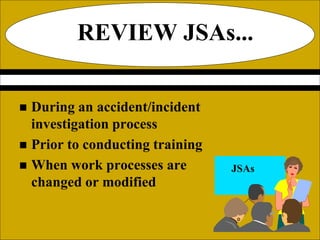
REVIEW JSAs...
 During an accident/incident
investigation process
 Prior to conducting training
 When work processes are
changed or modified
JSAs
Practical Exercise
 Complete a JSA on changing a tire
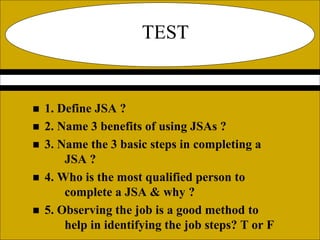
TEST
 1. Define JSA ?
 2. Name 3 benefits of using JSAs ?
 3. Name the 3 basic steps in completing a
JSA ?
 4. Who is the most qualified person to
complete a JSA & why ?
 5. Observing the job is a good method to
help in identifying the job steps? T or F
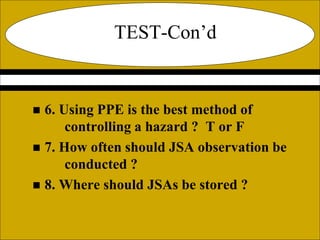
TEST-Con’d
 6. Using PPE is the best method of
controlling a hazard ? T or F
 7. How often should JSA observation be
conducted ?
 8. Where should JSAs be stored ?
QUESTIONS???
VISIT OUR WEBSITE:
http://www.doa.louisiana.gov/orm/lp.htm
END OF PROGRAM

job-safety-training.ppt