JTBD
for customer
centric
products
MARK OPANASIUK
"Jobs to be done" theory
SECTION 1
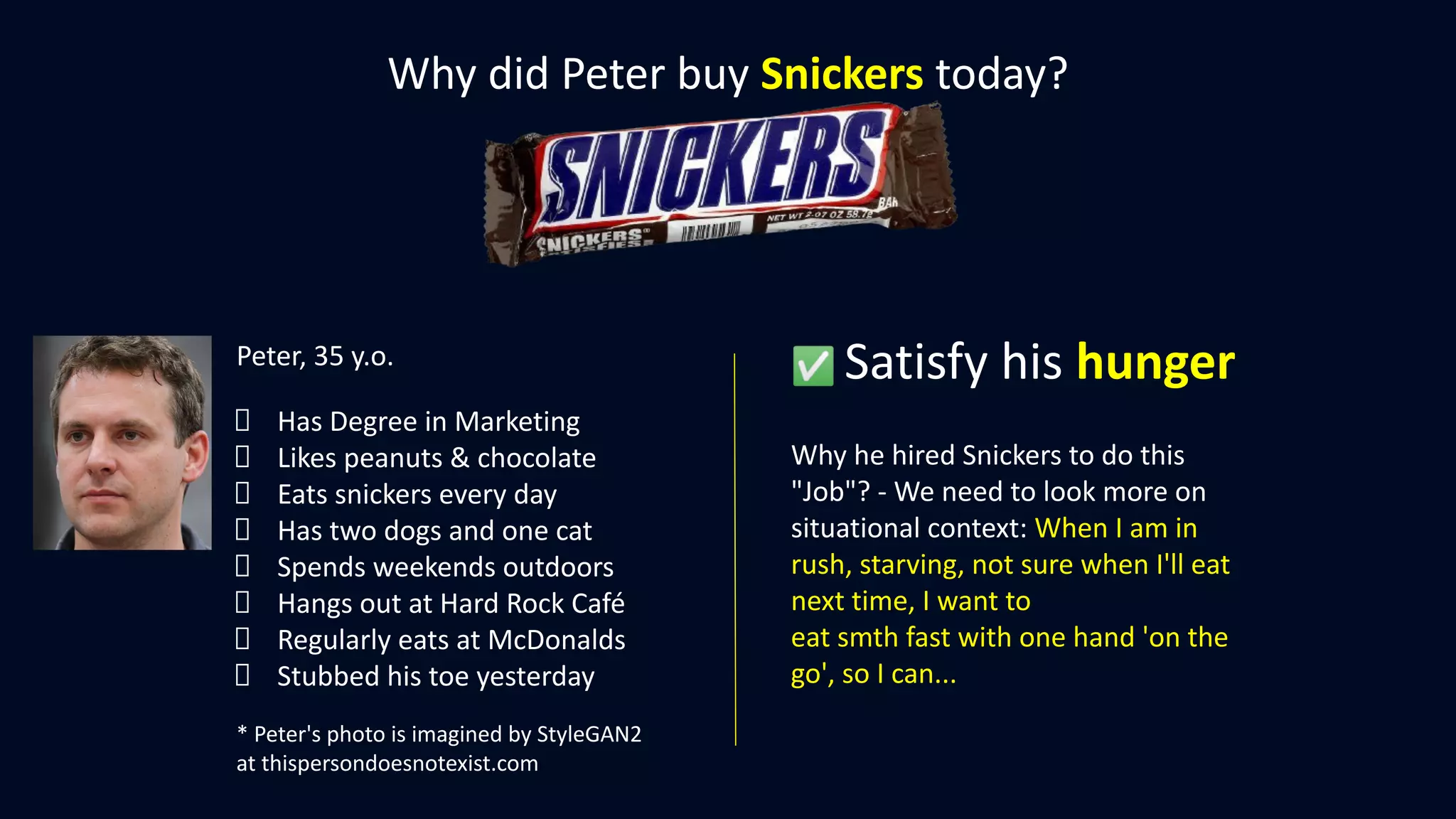
Peter, 35 y.o.
Has Degree in Marketing
Likes peanuts & chocolate
Eats snickers every day
Has two dogs and one cat
Spends weekends outdoors
Hangs out at Hard Rock Café
Regularly eats at McDonalds
Stubbed his toe yesterday
* Peter's photo is imagined by StyleGAN2
at thispersondoesnotexist.com
Why did Peter buy Snickers today?
✅ Satisfy his hunger
Why he hired Snickers to do this
"Job"? - We need to look more on
situational context: When I am in
rush, starving, not sure when I'll eat
next time, I want to
eat smth fast with one hand 'on the
go', so I can...
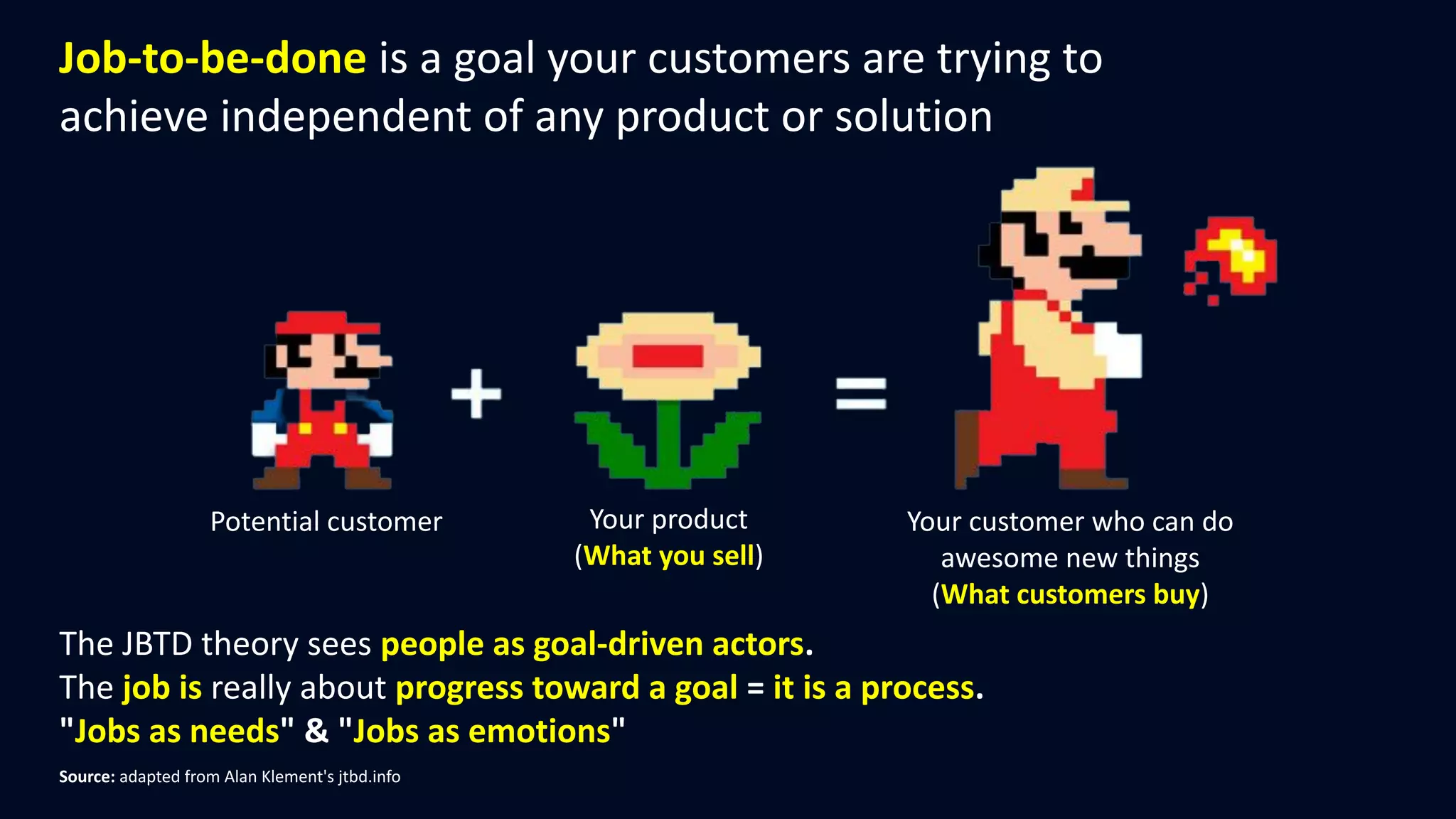
The JBTD theory sees people as goal-driven actors.
The job is really about progress toward a goal = it is a process.
"Jobs as needs" & "Jobs as emotions"
Potential customer Your product
(What you sell)
Your customer who can do
awesome new things
(What customers buy)
Source: adapted from Alan Klement's jtbd.info
Job-to-be-done is a goal your customers are trying to
achieve independent of any product or solution
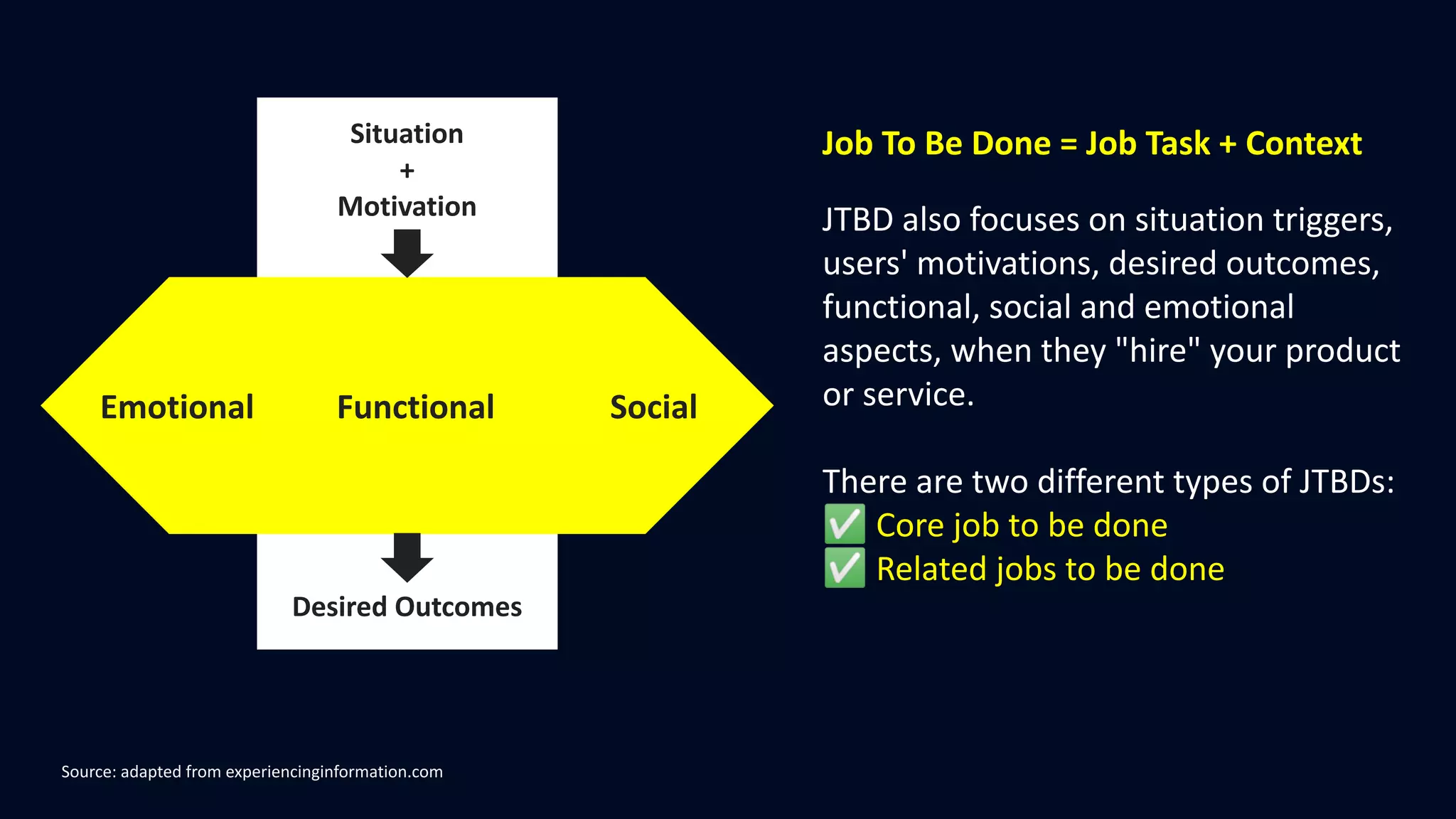
JTBD also focuses on situation triggers,
users' motivations, desired outcomes,
functional, social and emotional
aspects, when they "hire" your product
or service.
There are two different types of JTBDs:
✅ Core job to be done
✅ Related jobs to be done
Job To Be Done = Job Task + Context
Source: adapted from experiencinginformation.com
Situation
+
Motivation
Desired Outcomes
Emotional Functional Social
Source: adapted from Intercom on Jobs-To-Be-Done, 2017
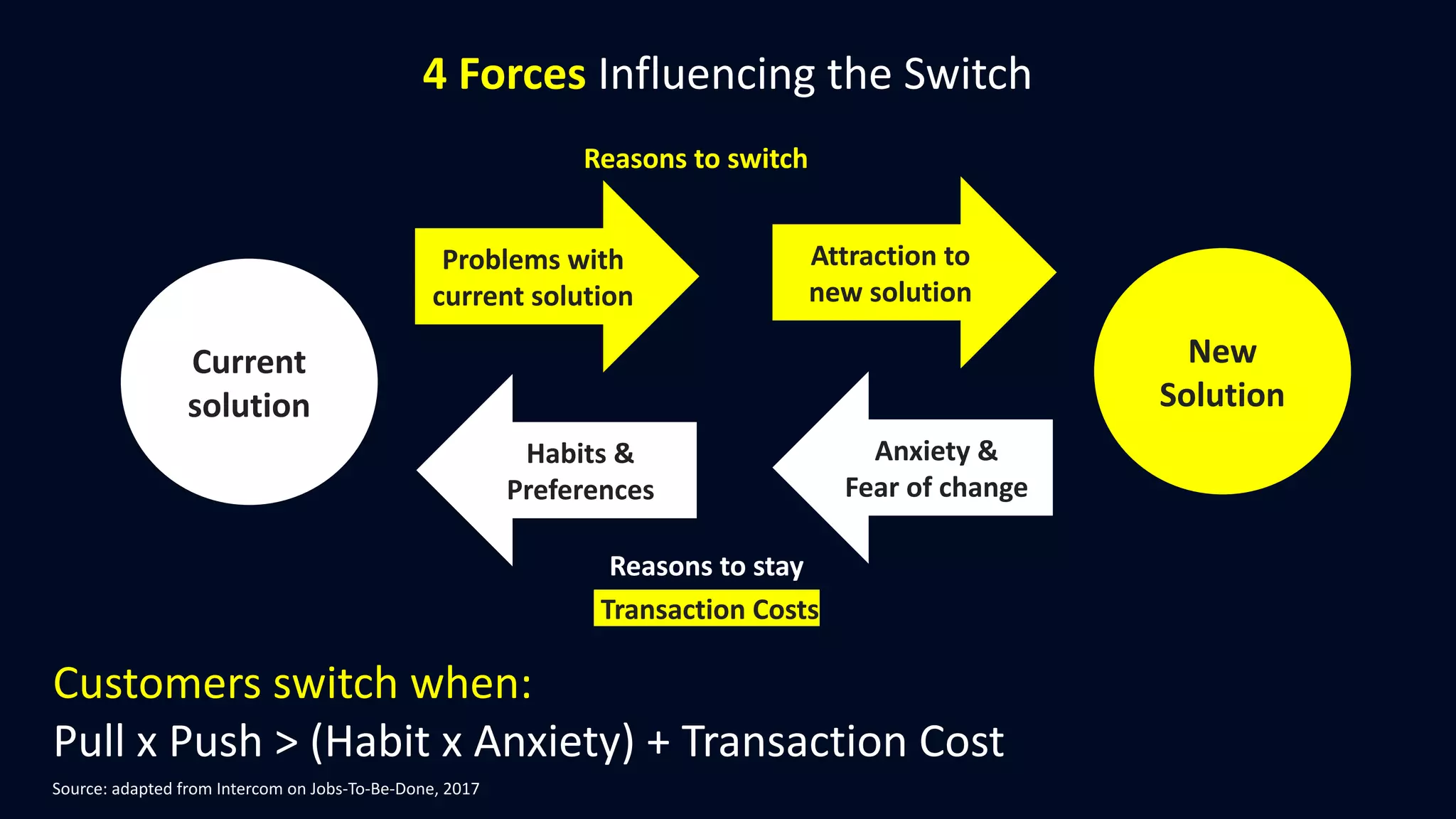
4 Forces Influencing the Switch
Customers switch when:
Pull x Push > (Habit x Anxiety) + Transaction Cost
Current
solution
New
Solution
Reasons to switch
Reasons to stay
Transaction Costs
Attraction to
new solution
Problems with
current solution
Habits &
Preferences
Anxiety &
Fear of change
Source: "Outcome-Driven Innovation: JTBD Theory in Practice by Anthony W. Ulwick, 2018"
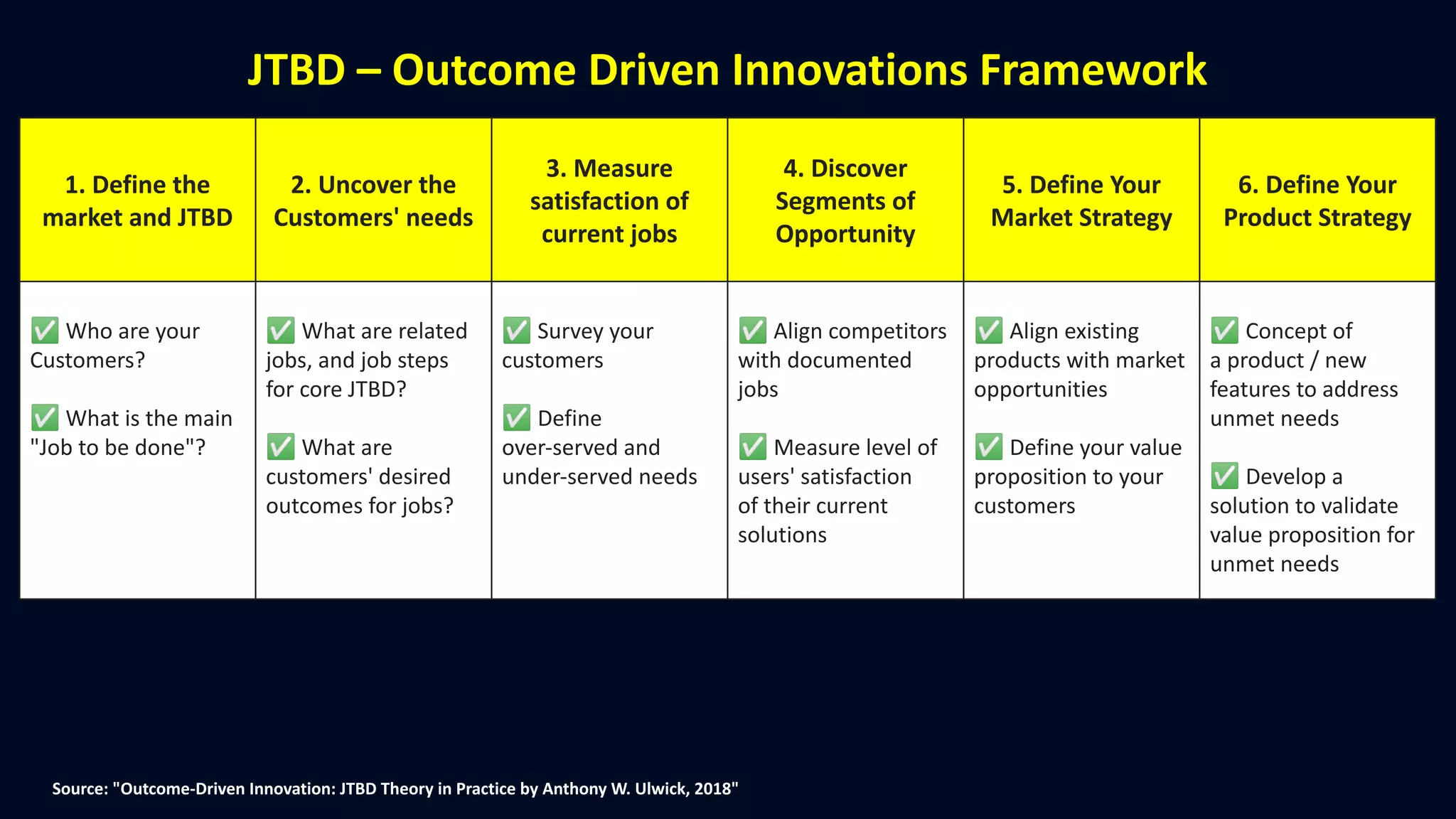
JTBD – Outcome Driven Innovations Framework
1. Define the
market and JTBD
2. Uncover the
Customers' needs
3. Measure
satisfaction of
current jobs
4. Discover
Segments of
Opportunity
5. Define Your
Market Strategy
6. Define Your
Product Strategy
✅ Who are your
Customers?
✅ What is the main
"Job to be done"?
✅ What are related
jobs, and job steps
for core JTBD?
✅ What are
customers' desired
outcomes for jobs?
✅ Survey your
customers
✅ Define
over-served and
under-served needs
✅ Align competitors
with documented
jobs
✅ Measure level of
users' satisfaction
of their current
solutions
✅ Align existing
products with market
opportunities
✅ Define your value
proposition to your
customers
✅ Concept of
a product / new
features to address
unmet needs
✅ Develop a
solution to validate
value proposition for
unmet needs
Define the market via core JTBD
SECTION 2
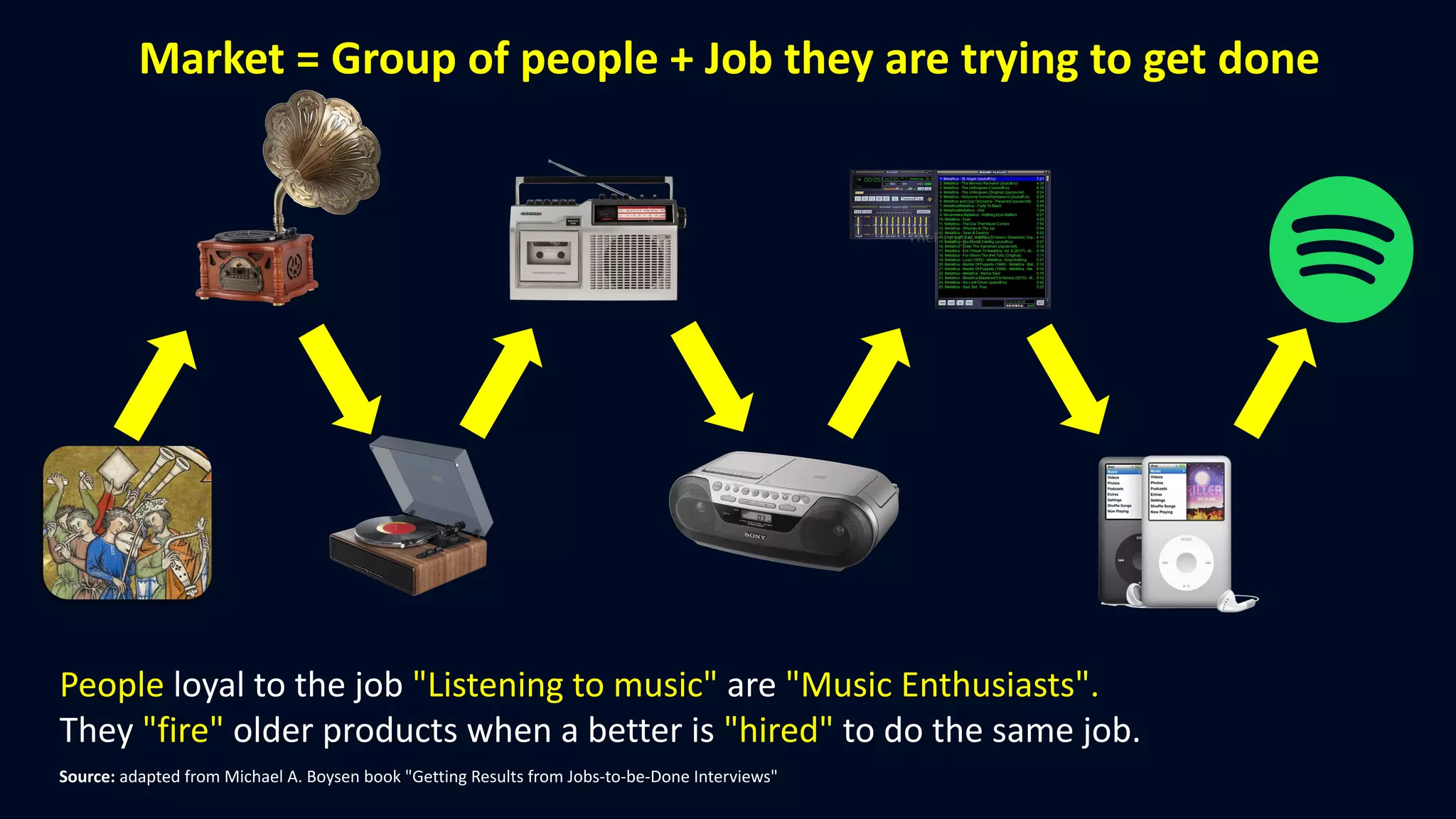
People loyal to the job "Listening to music" are "Music Enthusiasts".
They "fire" older products when a better is "hired" to do the same job.
Source: adapted from Michael A. Boysen book "Getting Results from Jobs-to-be-Done Interviews"
Market = Group of people + Job they are trying to get done
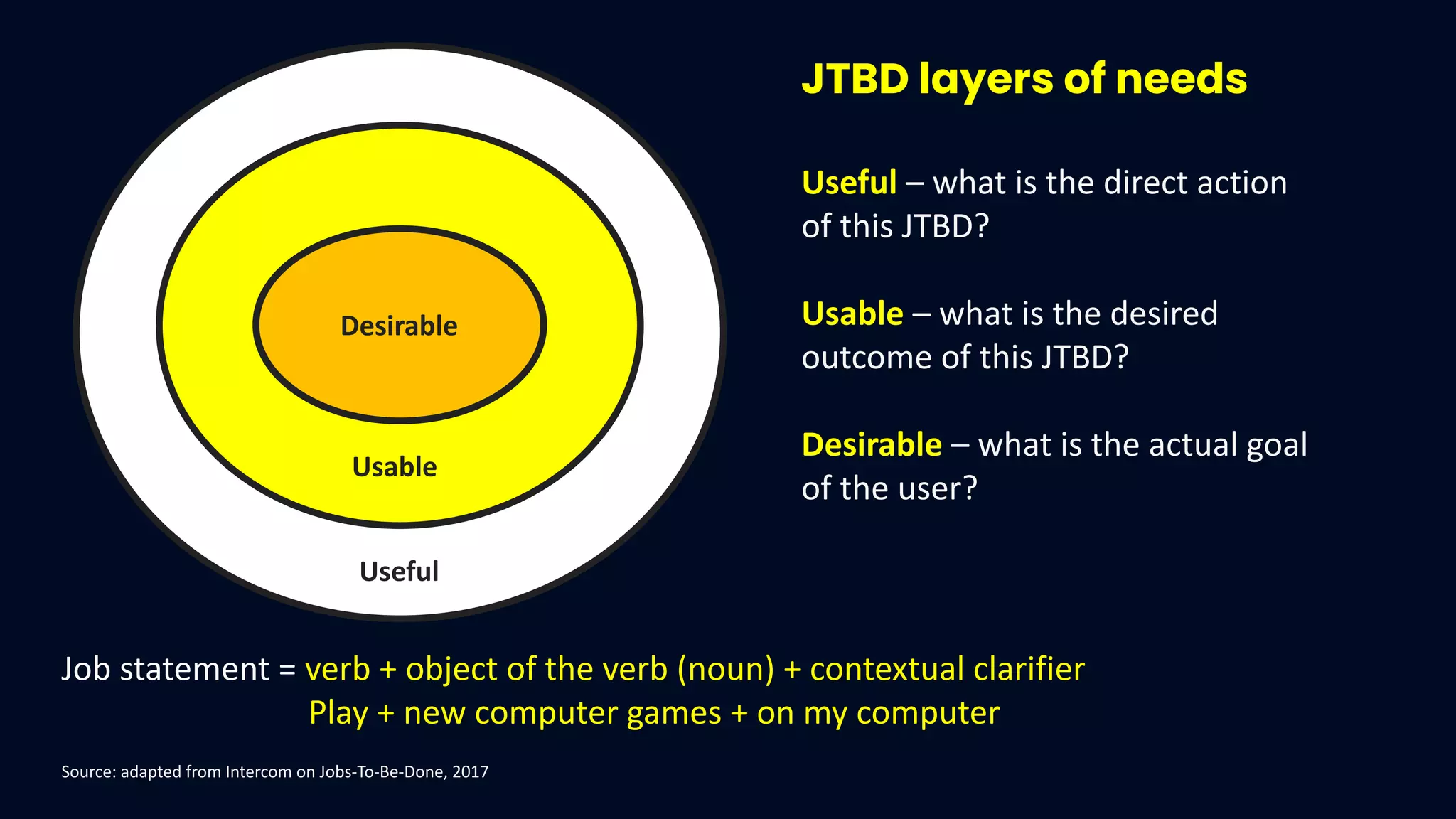
Useful – what is the direct action
of this JTBD?
Usable – what is the desired
outcome of this JTBD?
Desirable – what is the actual goal
of the user?
Desirable
Usable
Useful
Source: adapted from Intercom on Jobs-To-Be-Done, 2017
JTBD layers of needs
Job statement = verb + object of the verb (noun) + contextual clarifier
Play + new computer games + on my computer
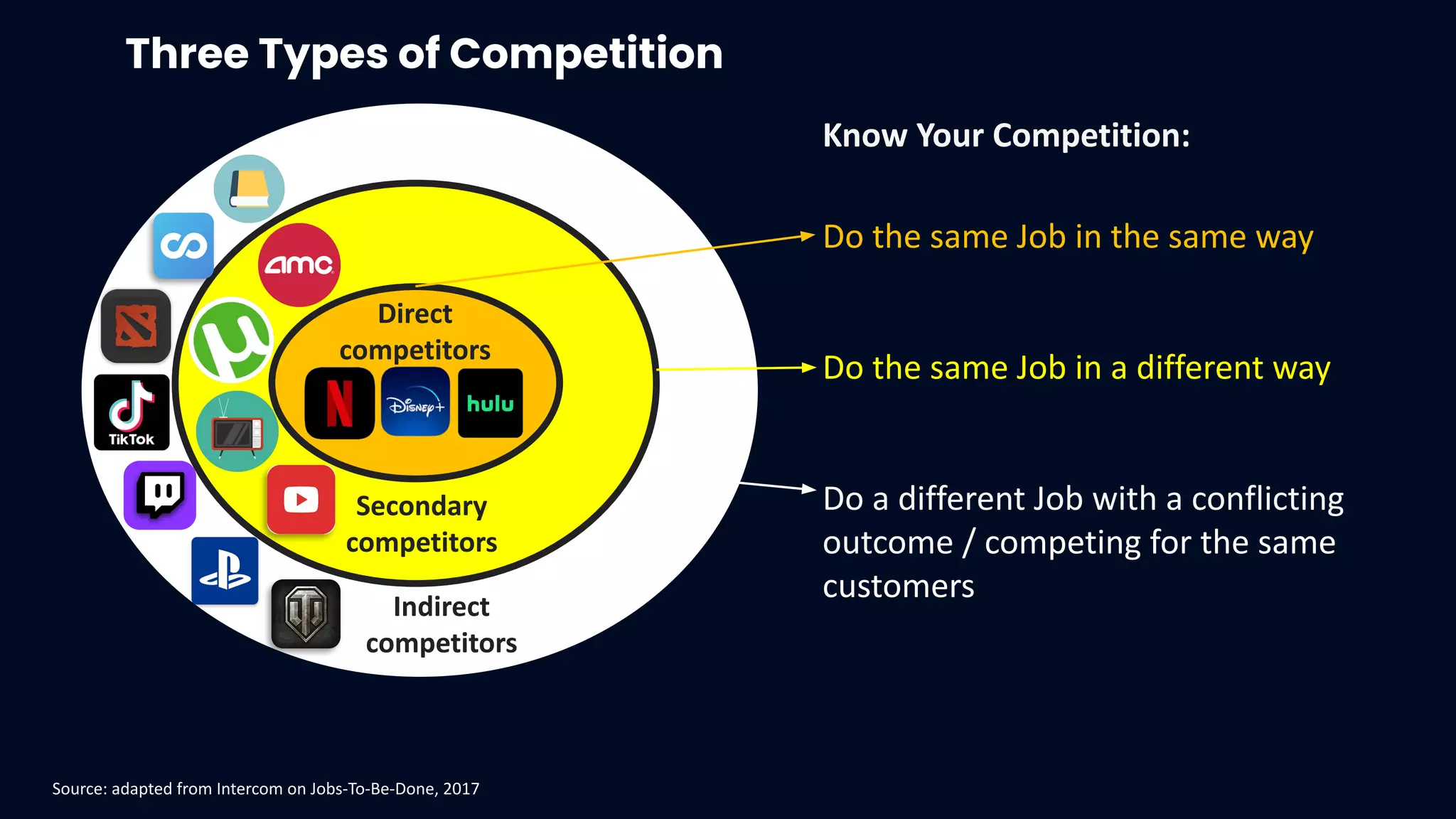
Do the same Job in the same way
Do the same Job in a different way
Do a different Job with a conflicting
outcome / competing for the same
customers
Know Your Competition:
Direct
competitors
Secondary
competitors
Indirect
competitors
Source: adapted from Intercom on Jobs-To-Be-Done, 2017
Three Types of Competition
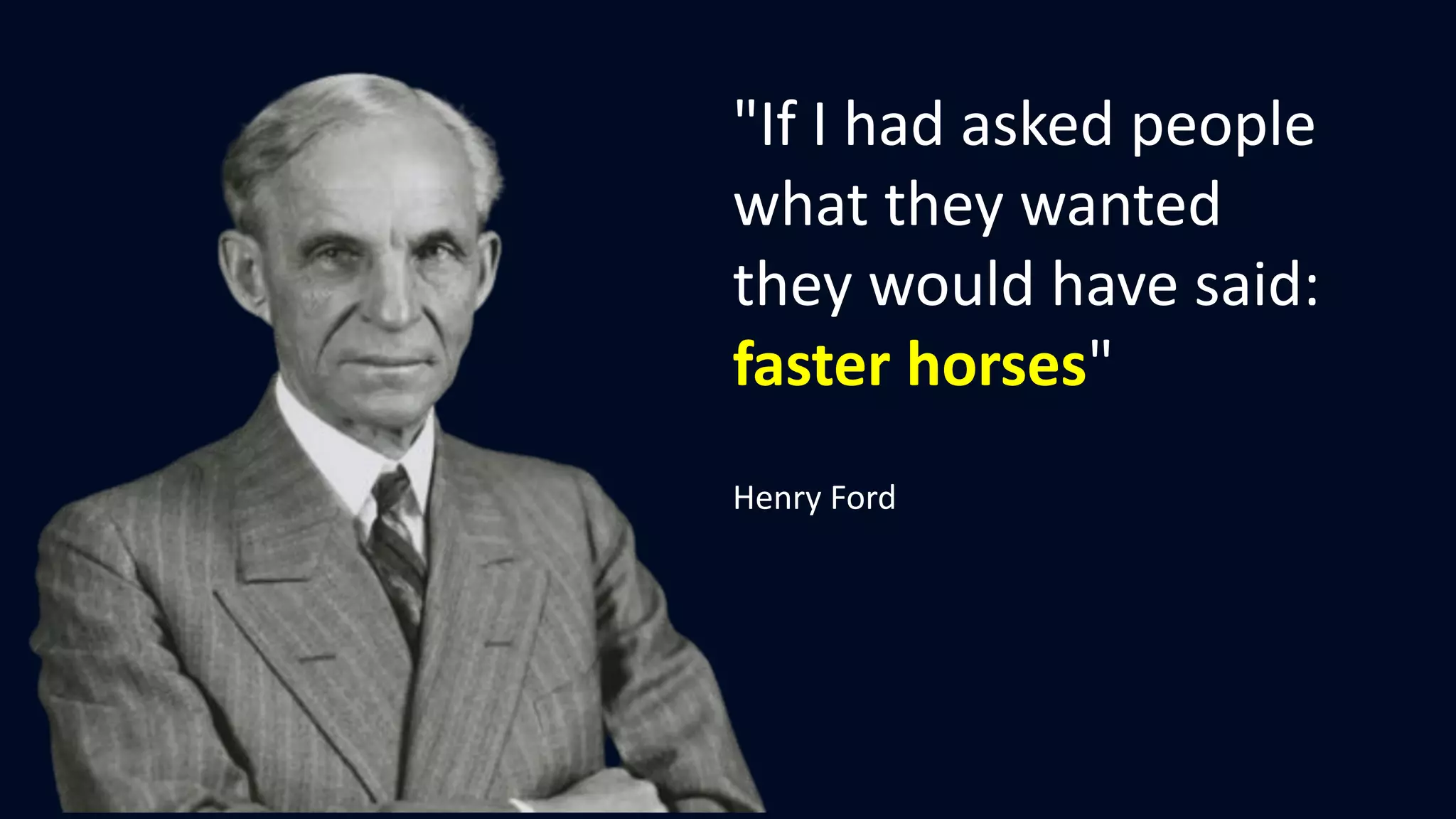
"If I had asked people
what they wanted
they would have said:
faster horses"
Henry Ford
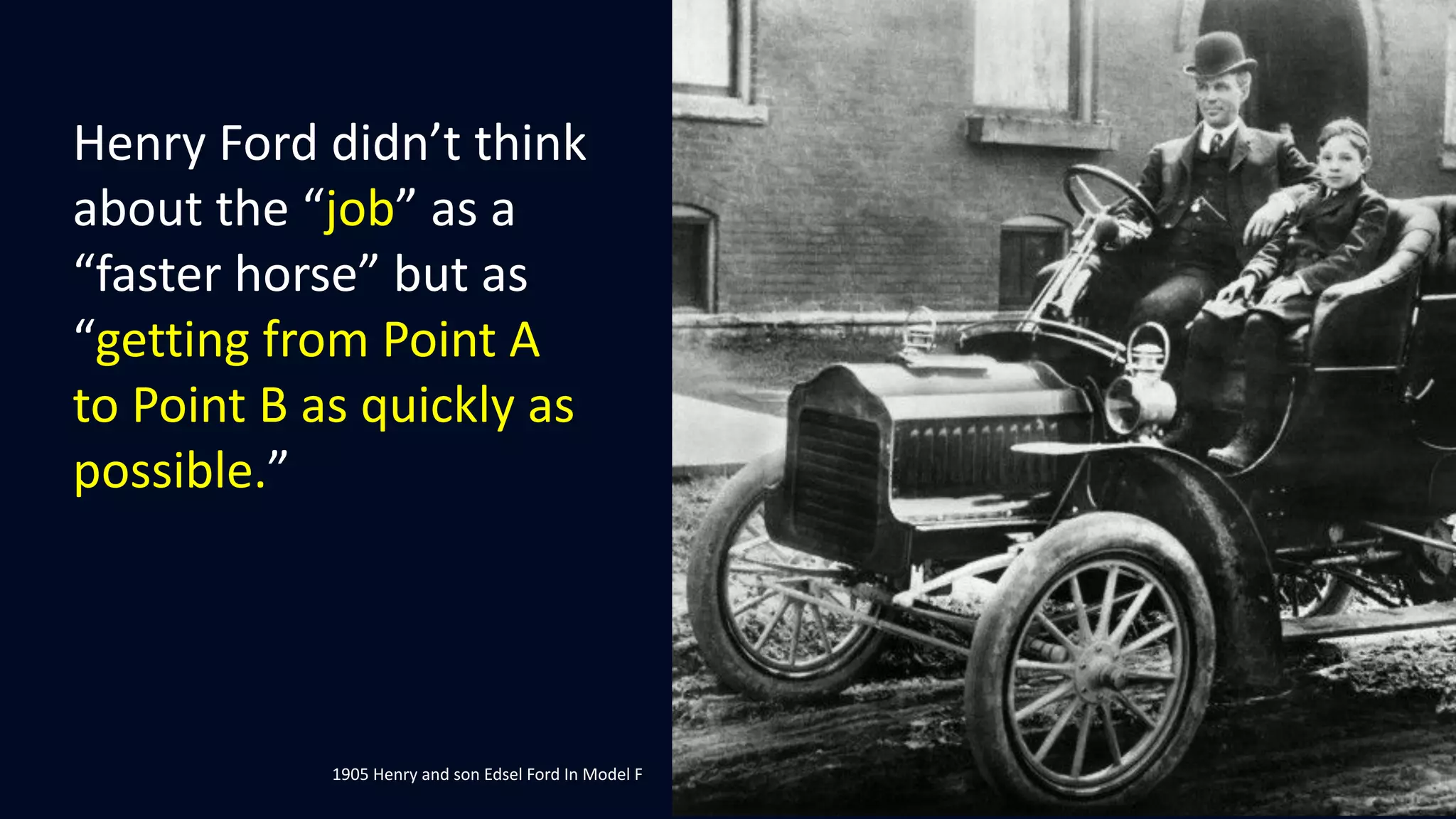
Henry Ford didn’t think
about the “job” as a
“faster horse” but as
“getting from Point A
to Point B as quickly as
possible.”
1905 Henry and son Edsel Ford In Model F
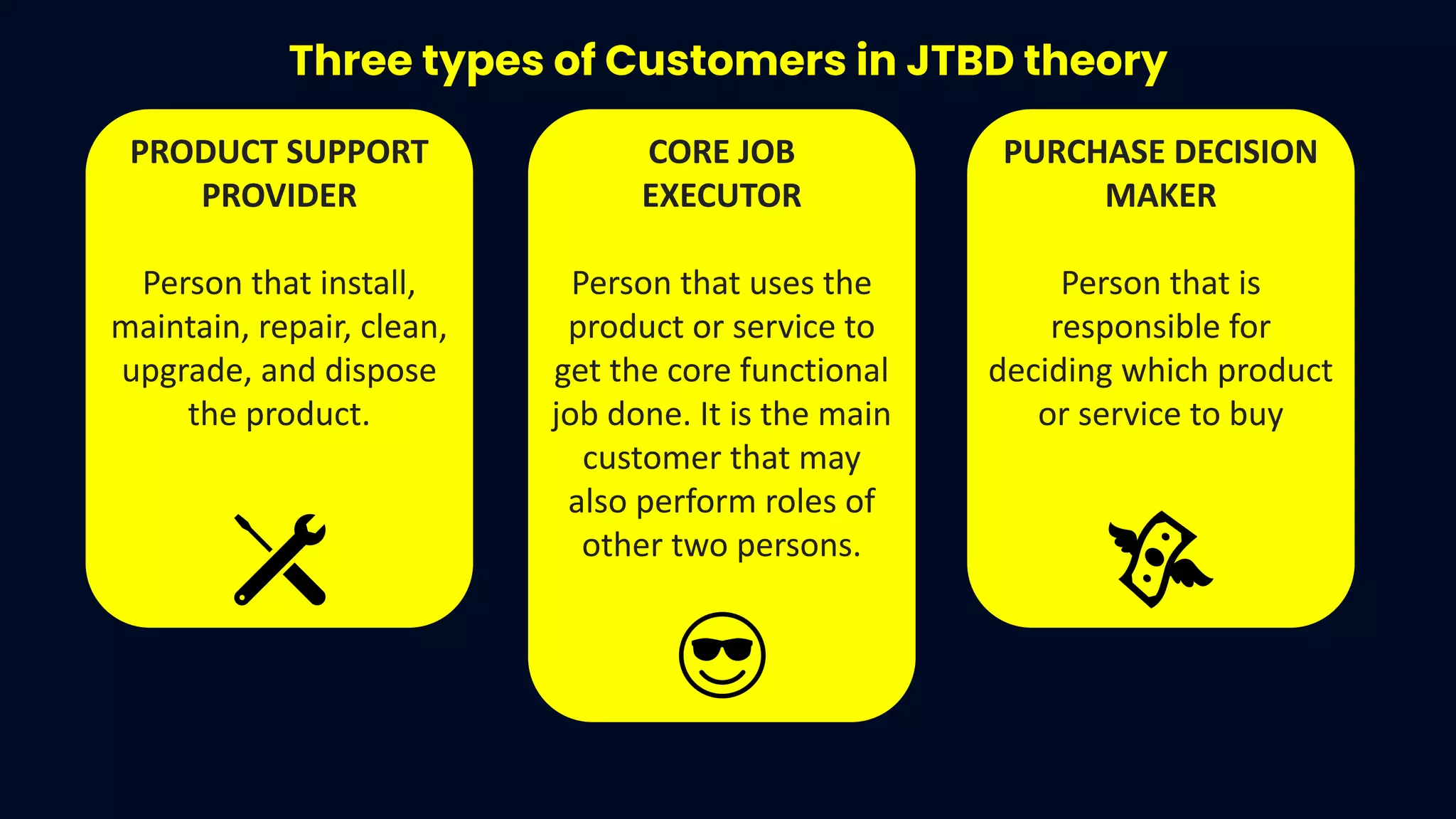
Three types of Customers in JTBD theory
CORE JOB
EXECUTOR
Person that uses the
product or service to
get the core functional
job done. It is the main
customer that may
also perform roles of
other two persons.
PRODUCT SUPPORT
PROVIDER
Person that install,
maintain, repair, clean,
upgrade, and dispose
the product.
PURCHASE DECISION
MAKER
Person that is
responsible for
deciding which product
or service to buy
Uncover customers' needs via JTBD
SECTION 3
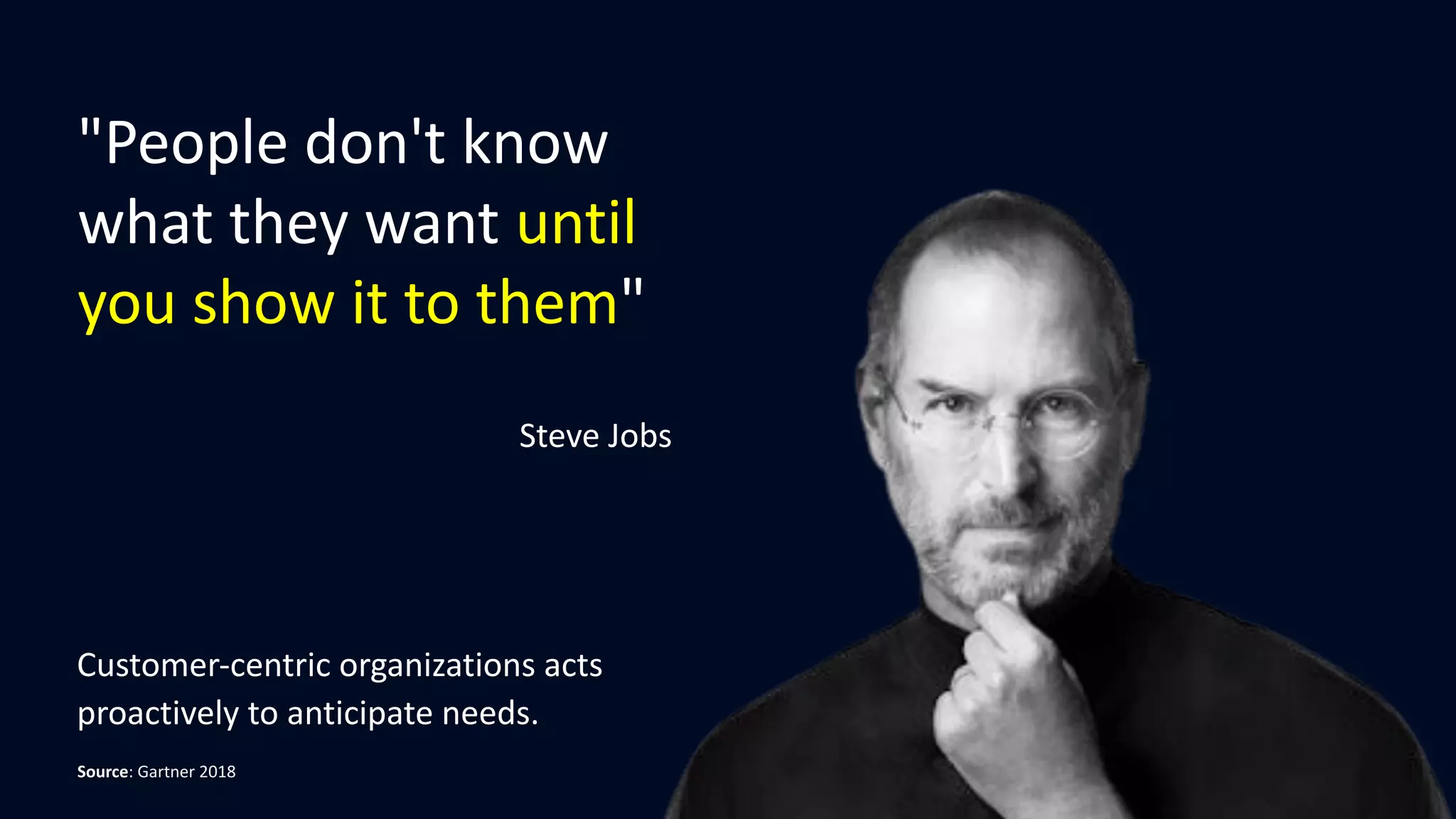
Customer-centric organizations acts
proactively to anticipate needs.
Source: Gartner 2018
"People don't know
what they want until
you show it to them"
Steve Jobs
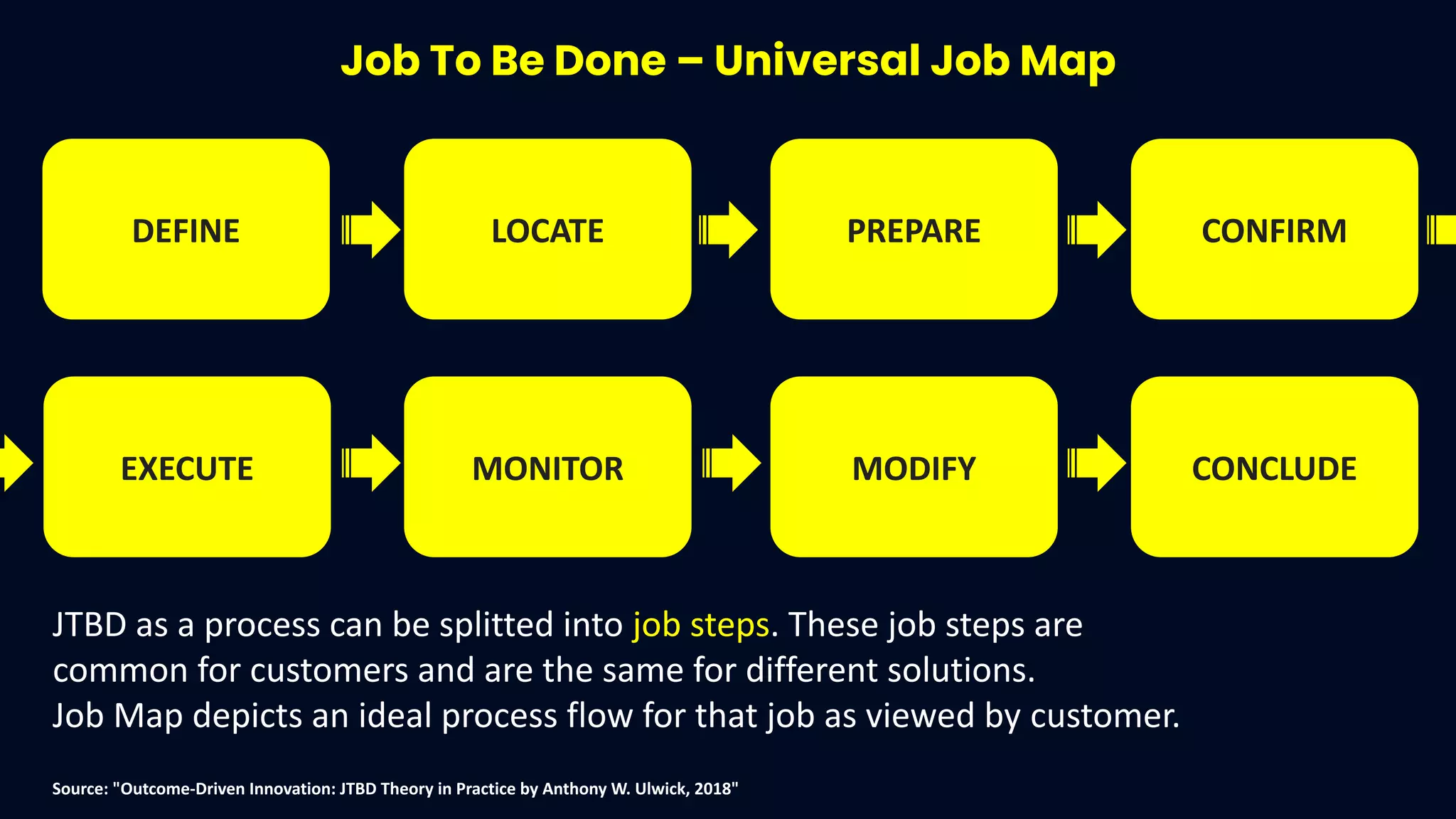
Job To Be Done – Universal Job Map
DEFINE LOCATE PREPARE CONFIRM
EXECUTE MONITOR MODIFY CONCLUDE
Source: "Outcome-Driven Innovation: JTBD Theory in Practice by Anthony W. Ulwick, 2018"
JTBD as a process can be splitted into job steps. These job steps are
common for customers and are the same for different solutions.
Job Map depicts an ideal process flow for that job as viewed by customer.
Source: adapted from Intercom on Jobs-To-Be-Done, 2017
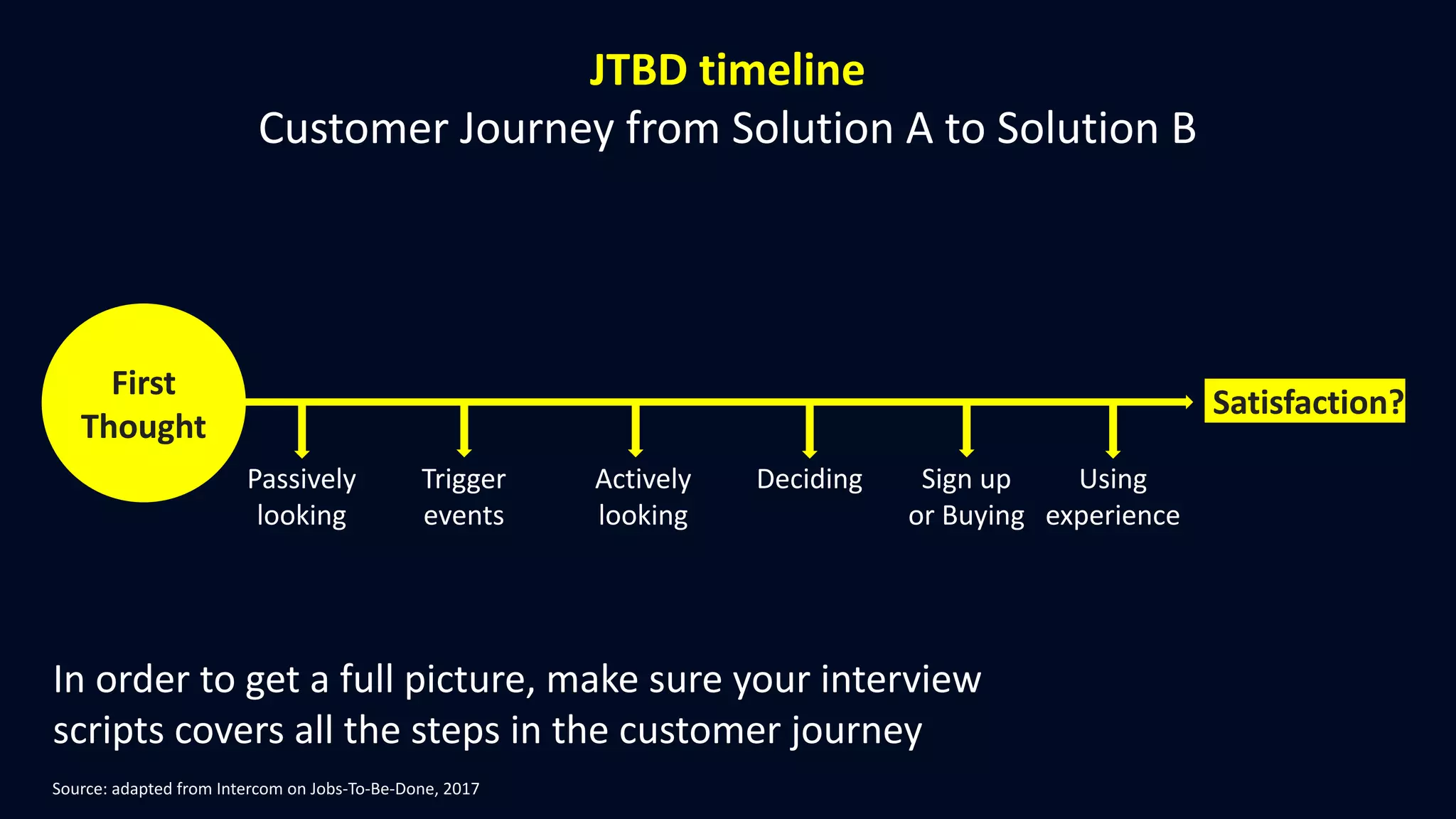
JTBD timeline
Customer Journey from Solution A to Solution B
In order to get a full picture, make sure your interview
scripts covers all the steps in the customer journey
First
Thought
Passively
looking
Trigger
events
Actively
looking
Deciding Sign up
or Buying
Using
experience
Satisfaction?
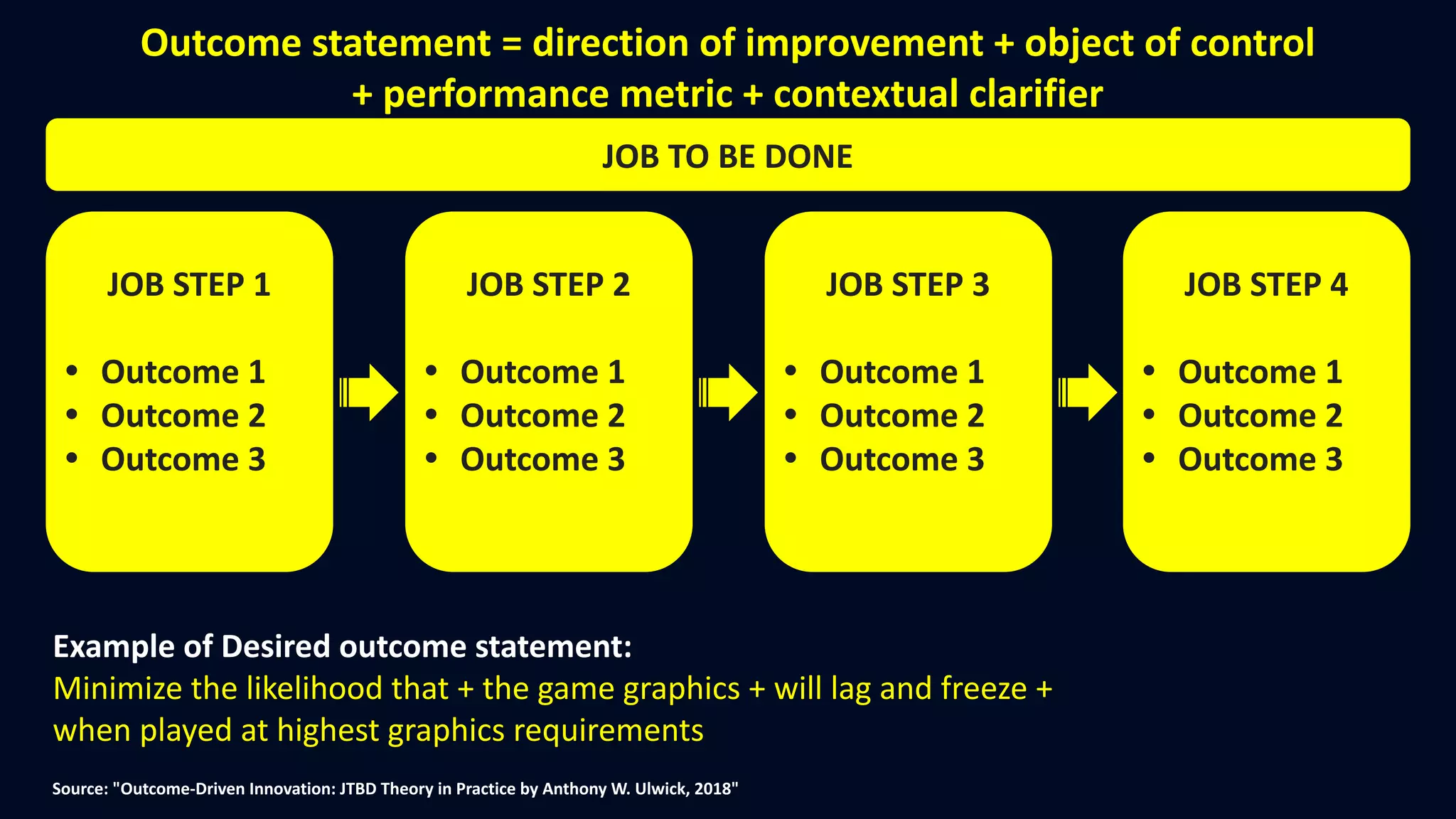
Outcome statement = direction of improvement + object of control
+ performance metric + contextual clarifier
Source: "Outcome-Driven Innovation: JTBD Theory in Practice by Anthony W. Ulwick, 2018"
Example of Desired outcome statement:
Minimize the likelihood that + the game graphics + will lag and freeze +
when played at highest graphics requirements
JOB TO BE DONE
JOB STEP 1
• Outcome 1
• Outcome 2
• Outcome 3
JOB STEP 2
• Outcome 1
• Outcome 2
• Outcome 3
JOB STEP 3
• Outcome 1
• Outcome 2
• Outcome 3
JOB STEP 4
• Outcome 1
• Outcome 2
• Outcome 3
Evaluate competition via JTBD
SECTION 4
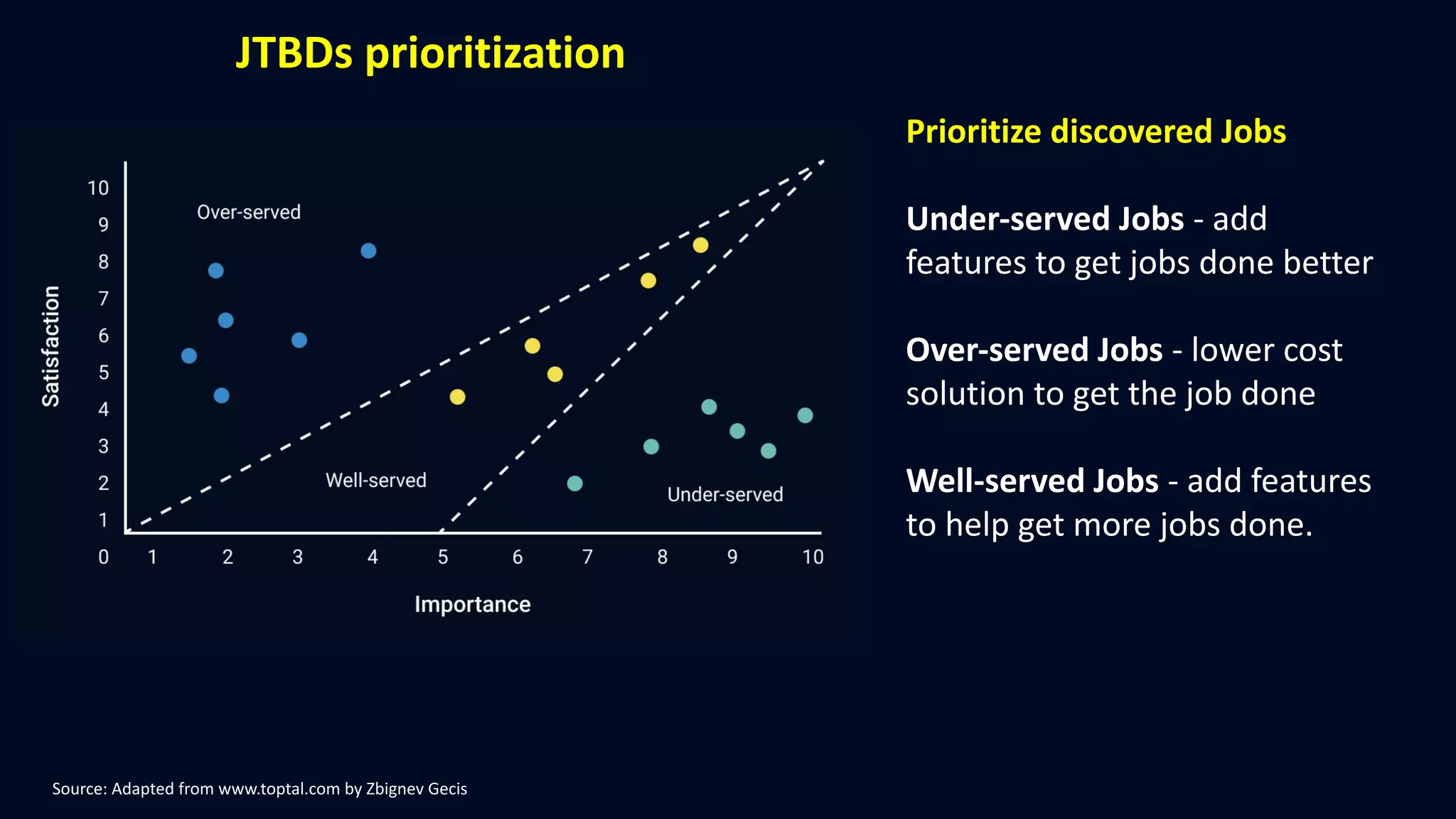
Source: Adapted from www.toptal.com by Zbignev Gecis
JTBDs prioritization survey question example
Use a prioritisation survey to uncover the underserved and
overserved jobs on the market so you can focus on developing
solutions that are going to make a difference to users.
Outcome 1
Outcome 2
When [job step], how important is it
to you that you are able to:
When using [solution] how satisfied
are you with your ability to [job step]:
Not important >>>>>>>>> Important Not satisfied >>>>>>>>>> Satisfied
1 2 3 4 5 1 2 3 4 5
1 2 3 4 5 1 2 3 4 5
Source: Adapted from www.toptal.com by Zbignev Gecis
JTBDs prioritization
Prioritize discovered Jobs
Under-served Jobs - add
features to get jobs done better
Over-served Jobs - lower cost
solution to get the job done
Well-served Jobs - add features
to help get more jobs done.
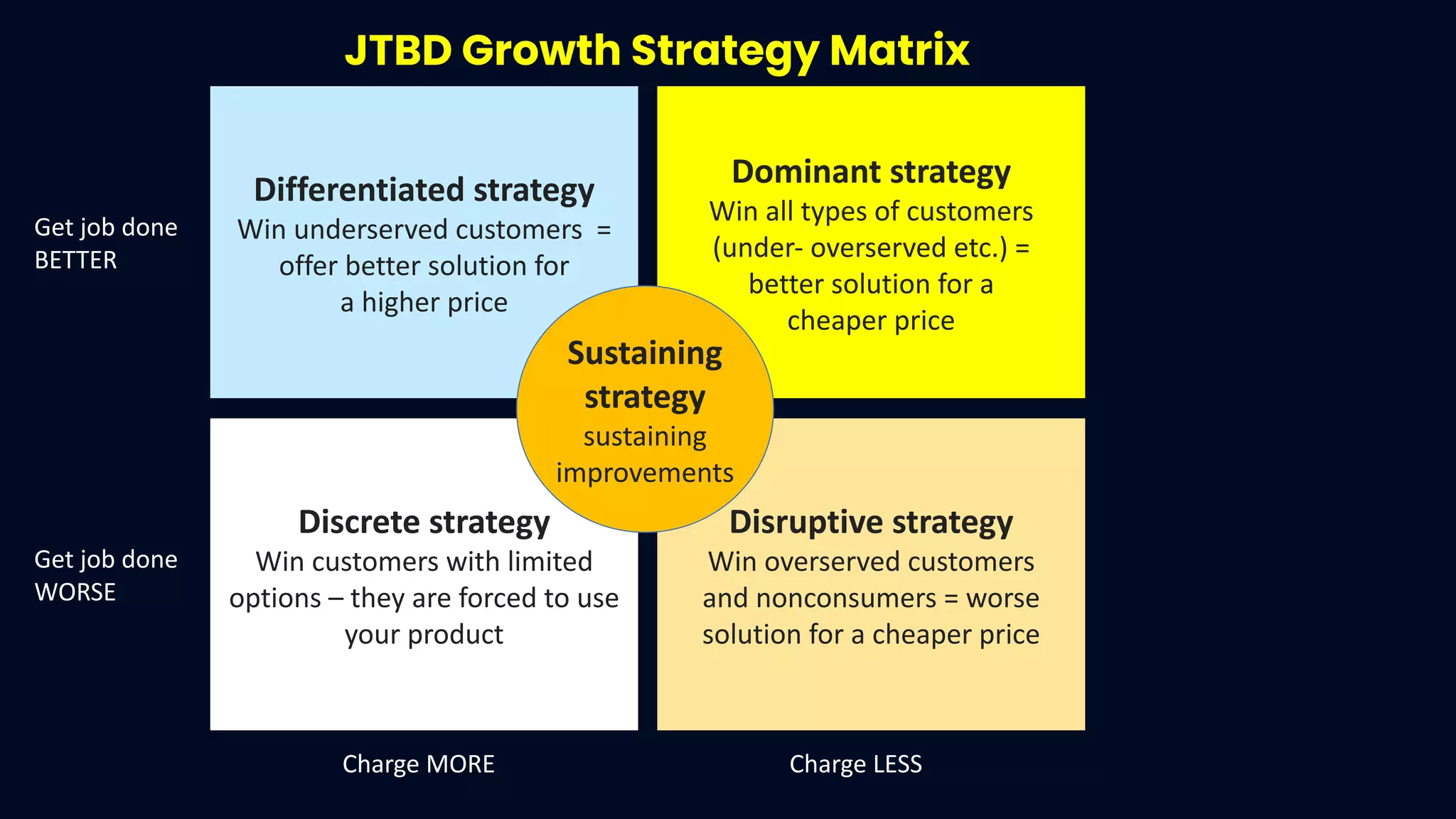
JTBD Growth Strategy Matrix
Differentiated strategy
Win underserved customers =
offer better solution for
a higher price
Discrete strategy
Win customers with limited
options – they are forced to use
your product
Dominant strategy
Win all types of customers
(under- overserved etc.) =
better solution for a
cheaper price
Disruptive strategy
Win overserved customers
and nonconsumers = worse
solution for a cheaper price
Get job done
BETTER
Get job done
WORSE
Charge MORE Charge LESS
Sustaining
strategy
sustaining
improvements
Product delivery vith JTBD
SECTION 5
User Story is based on User Personas & Assumptions
User Story – focuses on functions and solutions. Situation context, user
motivation and anxieties are ignored. Explains Who users are (roles and
atributes) and What they do (actions) but may miss Why they do...
As a [user persona], I want to [user action], So that [action outcome].
Too many assumptions
Who? - May be irrelevant
What? - Are we sure this is
the best action to do... Expected result
Source: Adapted from Jobs-to-be-done book by Intercom
Job Story focused on Context & Motivation
Job story focuses on the triggering event or situation, the
motivation and goal, and the intended outcome.
Job Stories can only come from real customer interviews.
When [trigger], I want to [goal], So I can [desired outcome].
Situation or Event User motivation Expected result
Source: Adapted from Jobs-to-be-done book by Intercom
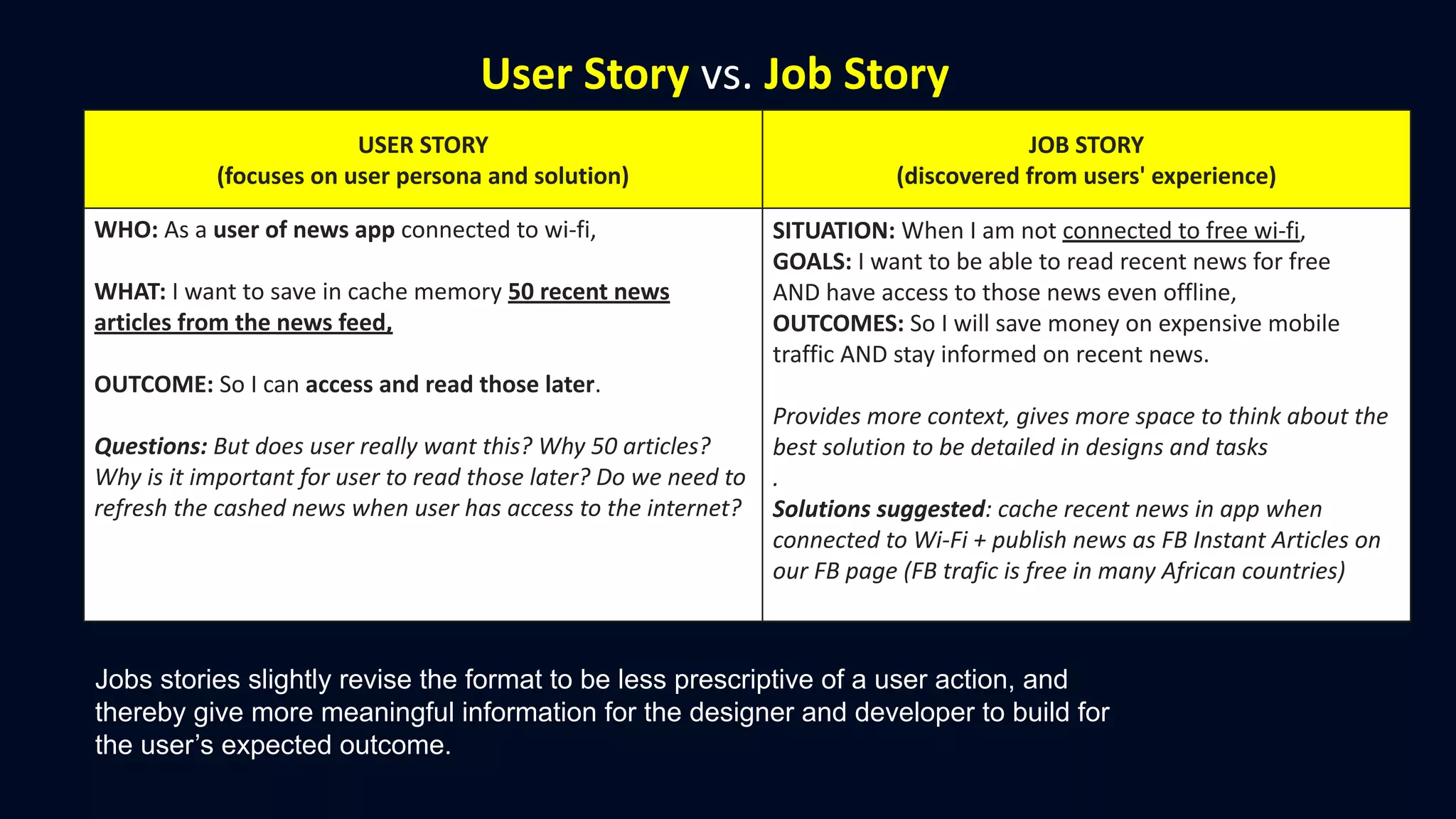
User Story vs. Job Story
USER STORY
(focuses on user persona and solution)
JOB STORY
(discovered from users' experience)
WHO: As a user of news app connected to wi-fi,
WHAT: I want to save in cache memory 50 recent news
articles from the news feed,
OUTCOME: So I can access and read those later.
Questions: But does user really want this? Why 50 articles?
Why is it important for user to read those later? Do we need to
refresh the cashed news when user has access to the internet?
SITUATION: When I am not connected to free wi-fi,
GOALS: I want to be able to read recent news for free
AND have access to those news even offline,
OUTCOMES: So I will save money on expensive mobile
traffic AND stay informed on recent news.
Provides more context, gives more space to think about the
best solution to be detailed in designs and tasks
.
Solutions suggested: cache recent news in app when
connected to Wi-Fi + publish news as FB Instant Articles on
our FB page (FB trafic is free in many African countries)
Jobs stories slightly revise the format to be less prescriptive of a user action, and
thereby give more meaningful information for the designer and developer to build for
the user’s expected outcome.
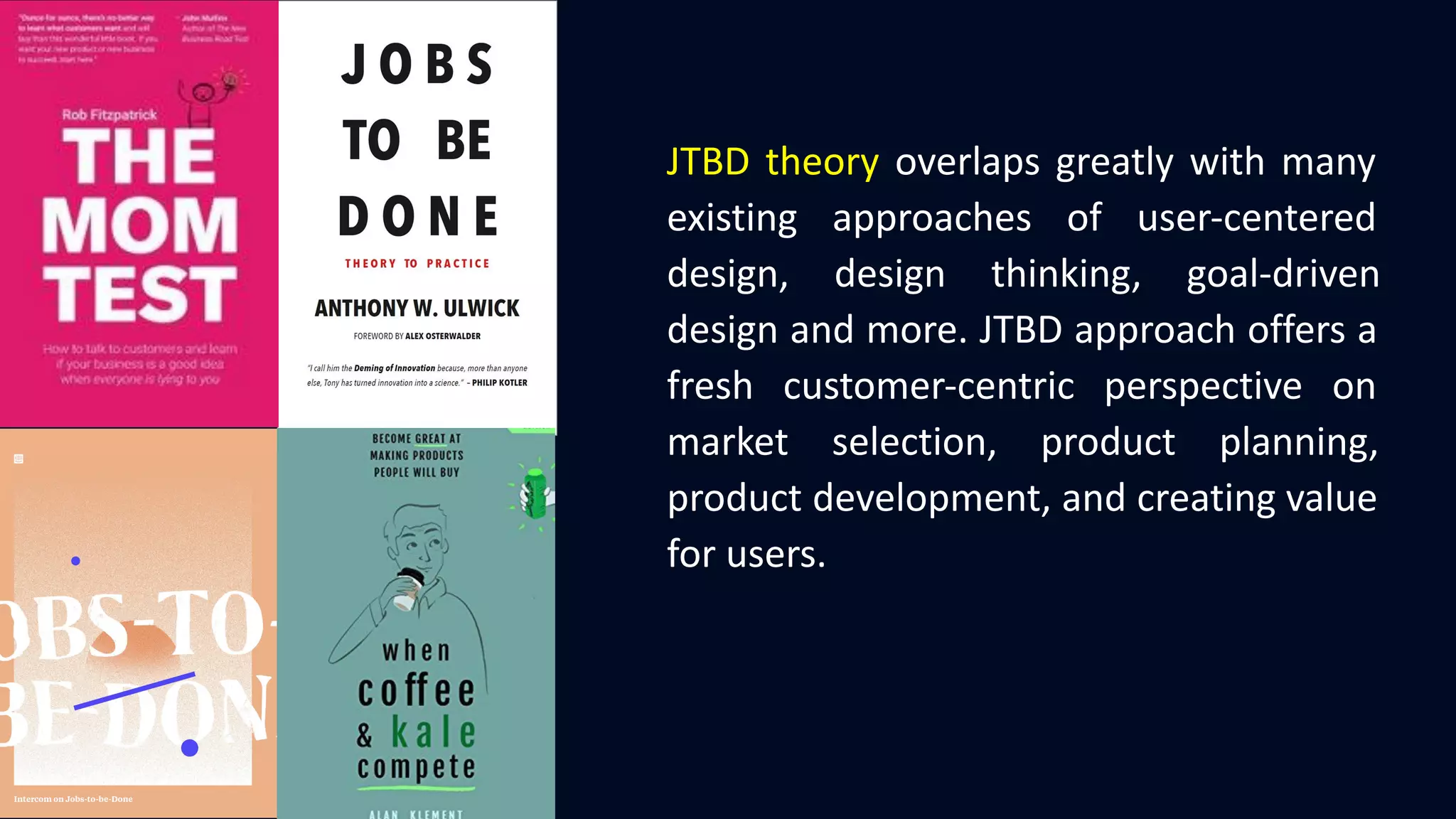
JTBD theory overlaps greatly with many
existing approaches of user-centered
design, design thinking, goal-driven
design and more. JTBD approach offers a
fresh customer-centric perspective on
market selection, product planning,
product development, and creating value
for users.
Mark Opanasiuk
Product Manager
Telegram: @wtf_is_pmf
Product Market Fat Podcast
Kyiv, Ukraine

Jobs To Be Done - framework explained by Mark Opanasiuk.pdf

  • 1.
  • 2.
    "Jobs to bedone" theory SECTION 1
  • 3.
    Peter, 35 y.o. HasDegree in Marketing Likes peanuts & chocolate Eats snickers every day Has two dogs and one cat Spends weekends outdoors Hangs out at Hard Rock Café Regularly eats at McDonalds Stubbed his toe yesterday * Peter's photo is imagined by StyleGAN2 at thispersondoesnotexist.com Why did Peter buy Snickers today? ✅ Satisfy his hunger Why he hired Snickers to do this "Job"? - We need to look more on situational context: When I am in rush, starving, not sure when I'll eat next time, I want to eat smth fast with one hand 'on the go', so I can...
  • 4.
    The JBTD theorysees people as goal-driven actors. The job is really about progress toward a goal = it is a process. "Jobs as needs" & "Jobs as emotions" Potential customer Your product (What you sell) Your customer who can do awesome new things (What customers buy) Source: adapted from Alan Klement's jtbd.info Job-to-be-done is a goal your customers are trying to achieve independent of any product or solution
  • 5.
    JTBD also focuseson situation triggers, users' motivations, desired outcomes, functional, social and emotional aspects, when they "hire" your product or service. There are two different types of JTBDs: ✅ Core job to be done ✅ Related jobs to be done Job To Be Done = Job Task + Context Source: adapted from experiencinginformation.com Situation + Motivation Desired Outcomes Emotional Functional Social
  • 6.
    Source: adapted fromIntercom on Jobs-To-Be-Done, 2017 4 Forces Influencing the Switch Customers switch when: Pull x Push > (Habit x Anxiety) + Transaction Cost Current solution New Solution Reasons to switch Reasons to stay Transaction Costs Attraction to new solution Problems with current solution Habits & Preferences Anxiety & Fear of change
  • 7.
    Source: "Outcome-Driven Innovation:JTBD Theory in Practice by Anthony W. Ulwick, 2018" JTBD – Outcome Driven Innovations Framework 1. Define the market and JTBD 2. Uncover the Customers' needs 3. Measure satisfaction of current jobs 4. Discover Segments of Opportunity 5. Define Your Market Strategy 6. Define Your Product Strategy ✅ Who are your Customers? ✅ What is the main "Job to be done"? ✅ What are related jobs, and job steps for core JTBD? ✅ What are customers' desired outcomes for jobs? ✅ Survey your customers ✅ Define over-served and under-served needs ✅ Align competitors with documented jobs ✅ Measure level of users' satisfaction of their current solutions ✅ Align existing products with market opportunities ✅ Define your value proposition to your customers ✅ Concept of a product / new features to address unmet needs ✅ Develop a solution to validate value proposition for unmet needs
  • 8.
    Define the marketvia core JTBD SECTION 2
  • 9.
    People loyal tothe job "Listening to music" are "Music Enthusiasts". They "fire" older products when a better is "hired" to do the same job. Source: adapted from Michael A. Boysen book "Getting Results from Jobs-to-be-Done Interviews" Market = Group of people + Job they are trying to get done
  • 10.
    Useful – whatis the direct action of this JTBD? Usable – what is the desired outcome of this JTBD? Desirable – what is the actual goal of the user? Desirable Usable Useful Source: adapted from Intercom on Jobs-To-Be-Done, 2017 JTBD layers of needs Job statement = verb + object of the verb (noun) + contextual clarifier Play + new computer games + on my computer
  • 11.
    Do the sameJob in the same way Do the same Job in a different way Do a different Job with a conflicting outcome / competing for the same customers Know Your Competition: Direct competitors Secondary competitors Indirect competitors Source: adapted from Intercom on Jobs-To-Be-Done, 2017 Three Types of Competition
  • 12.
    "If I hadasked people what they wanted they would have said: faster horses" Henry Ford
  • 13.
    Henry Ford didn’tthink about the “job” as a “faster horse” but as “getting from Point A to Point B as quickly as possible.” 1905 Henry and son Edsel Ford In Model F
  • 14.
    Three types ofCustomers in JTBD theory CORE JOB EXECUTOR Person that uses the product or service to get the core functional job done. It is the main customer that may also perform roles of other two persons. PRODUCT SUPPORT PROVIDER Person that install, maintain, repair, clean, upgrade, and dispose the product. PURCHASE DECISION MAKER Person that is responsible for deciding which product or service to buy
  • 15.
    Uncover customers' needsvia JTBD SECTION 3
  • 16.
    Customer-centric organizations acts proactivelyto anticipate needs. Source: Gartner 2018 "People don't know what they want until you show it to them" Steve Jobs
  • 17.
    Job To BeDone – Universal Job Map DEFINE LOCATE PREPARE CONFIRM EXECUTE MONITOR MODIFY CONCLUDE Source: "Outcome-Driven Innovation: JTBD Theory in Practice by Anthony W. Ulwick, 2018" JTBD as a process can be splitted into job steps. These job steps are common for customers and are the same for different solutions. Job Map depicts an ideal process flow for that job as viewed by customer.
  • 18.
    Source: adapted fromIntercom on Jobs-To-Be-Done, 2017 JTBD timeline Customer Journey from Solution A to Solution B In order to get a full picture, make sure your interview scripts covers all the steps in the customer journey First Thought Passively looking Trigger events Actively looking Deciding Sign up or Buying Using experience Satisfaction?
  • 19.
    Outcome statement =direction of improvement + object of control + performance metric + contextual clarifier Source: "Outcome-Driven Innovation: JTBD Theory in Practice by Anthony W. Ulwick, 2018" Example of Desired outcome statement: Minimize the likelihood that + the game graphics + will lag and freeze + when played at highest graphics requirements JOB TO BE DONE JOB STEP 1 • Outcome 1 • Outcome 2 • Outcome 3 JOB STEP 2 • Outcome 1 • Outcome 2 • Outcome 3 JOB STEP 3 • Outcome 1 • Outcome 2 • Outcome 3 JOB STEP 4 • Outcome 1 • Outcome 2 • Outcome 3
  • 20.
  • 21.
    Source: Adapted fromwww.toptal.com by Zbignev Gecis JTBDs prioritization survey question example Use a prioritisation survey to uncover the underserved and overserved jobs on the market so you can focus on developing solutions that are going to make a difference to users. Outcome 1 Outcome 2 When [job step], how important is it to you that you are able to: When using [solution] how satisfied are you with your ability to [job step]: Not important >>>>>>>>> Important Not satisfied >>>>>>>>>> Satisfied 1 2 3 4 5 1 2 3 4 5 1 2 3 4 5 1 2 3 4 5
  • 22.
    Source: Adapted fromwww.toptal.com by Zbignev Gecis JTBDs prioritization Prioritize discovered Jobs Under-served Jobs - add features to get jobs done better Over-served Jobs - lower cost solution to get the job done Well-served Jobs - add features to help get more jobs done.
  • 23.
    JTBD Growth StrategyMatrix Differentiated strategy Win underserved customers = offer better solution for a higher price Discrete strategy Win customers with limited options – they are forced to use your product Dominant strategy Win all types of customers (under- overserved etc.) = better solution for a cheaper price Disruptive strategy Win overserved customers and nonconsumers = worse solution for a cheaper price Get job done BETTER Get job done WORSE Charge MORE Charge LESS Sustaining strategy sustaining improvements
  • 24.
    Product delivery vithJTBD SECTION 5
  • 25.
    User Story isbased on User Personas & Assumptions User Story – focuses on functions and solutions. Situation context, user motivation and anxieties are ignored. Explains Who users are (roles and atributes) and What they do (actions) but may miss Why they do... As a [user persona], I want to [user action], So that [action outcome]. Too many assumptions Who? - May be irrelevant What? - Are we sure this is the best action to do... Expected result Source: Adapted from Jobs-to-be-done book by Intercom
  • 26.
    Job Story focusedon Context & Motivation Job story focuses on the triggering event or situation, the motivation and goal, and the intended outcome. Job Stories can only come from real customer interviews. When [trigger], I want to [goal], So I can [desired outcome]. Situation or Event User motivation Expected result Source: Adapted from Jobs-to-be-done book by Intercom
  • 27.
    User Story vs.Job Story USER STORY (focuses on user persona and solution) JOB STORY (discovered from users' experience) WHO: As a user of news app connected to wi-fi, WHAT: I want to save in cache memory 50 recent news articles from the news feed, OUTCOME: So I can access and read those later. Questions: But does user really want this? Why 50 articles? Why is it important for user to read those later? Do we need to refresh the cashed news when user has access to the internet? SITUATION: When I am not connected to free wi-fi, GOALS: I want to be able to read recent news for free AND have access to those news even offline, OUTCOMES: So I will save money on expensive mobile traffic AND stay informed on recent news. Provides more context, gives more space to think about the best solution to be detailed in designs and tasks . Solutions suggested: cache recent news in app when connected to Wi-Fi + publish news as FB Instant Articles on our FB page (FB trafic is free in many African countries) Jobs stories slightly revise the format to be less prescriptive of a user action, and thereby give more meaningful information for the designer and developer to build for the user’s expected outcome.
  • 28.
    JTBD theory overlapsgreatly with many existing approaches of user-centered design, design thinking, goal-driven design and more. JTBD approach offers a fresh customer-centric perspective on market selection, product planning, product development, and creating value for users.
  • 29.
    Mark Opanasiuk Product Manager Telegram:@wtf_is_pmf Product Market Fat Podcast Kyiv, Ukraine