Job Analysis And
Talent Management Process
1. Muhammad Fais Lutfi Nuryadin 6032222091
2. Muhammad Ali Mahdi 6032222074
3. Anisa Maya Aulia Rahma 6032222102
4. Muhammad Harisul Baihaqi 6032222001
Job Analysis dan Talent
Management Process
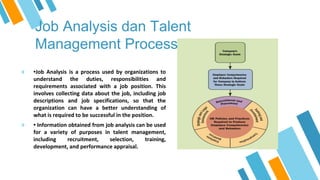
» •Job Analysis is a process used by organizations to
understand the duties, responsibilities and
requirements associated with a job position. This
involves collecting data about the job, including job
descriptions and job specifications, so that the
organization can have a better understanding of
what is required to be successful in the position.
» • Information obtained from job analysis can be used
for a variety of purposes in talent management,
including recruitment, selection, training,
development, and performance appraisal.
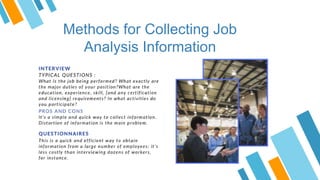
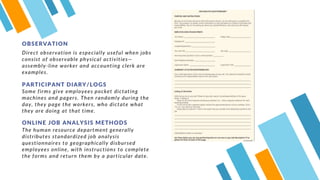
Methods for Collecting Job
Analysis Information
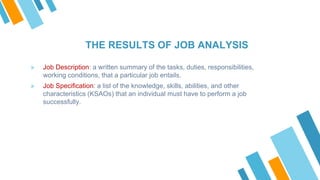
THE RESULTS OF JOB ANALYSIS
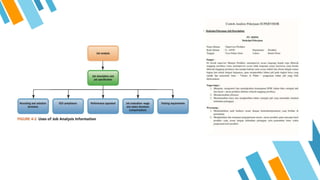
Âť Job Description: a written summary of the tasks, duties, responsibilities,
working conditions, that a particular job entails.
Âť Job Specification: a list of the knowledge, skills, abilities, and other
characteristics (KSAOs) that an individual must have to perform a job
successfully.
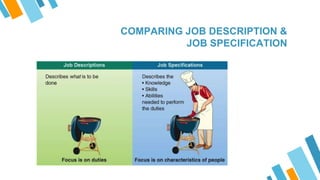
COMPARING JOB DESCRIPTION &
JOB SPECIFICATION
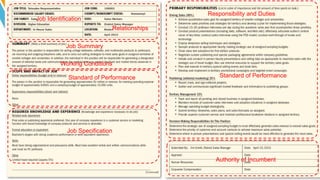
JOB DESCRIPTION contains section of:
1) Job identification
2) Job summary
3) Responsibilities and duties
4) Authority of incumbent
5) Standards of performance
6) Working conditions
7) Job specification
Job Identification
Job Summary
Responsibility and Duties
Job Specification
Standard of Performance
Authority of Incumbent
Working Conditions
Relationships
WRITING JOB
SPESIFICATIONS
What Human Traits and Experience are required to do this job effectively?
Judgment
Subjective
Statistical
Analysis
Terms of Education, Intelligence, Training, and
how is do the job well
Employers identify the job’s human requirements either through
a
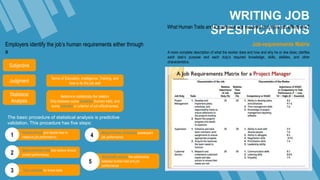
Job-requirements Matrix
A more complete description of what the worker does and how and why he or she does; clarifies
each task’s purpose and each duty’s required knowledge, skills, abilities, and other
characteristics.
Analyze the job and decide how to
measure job performance
1
Select personal traits that believe should
predict performance
2
Test candidate for these traits
3
Measure these candidates subsequent
job performance
4
Statistically analyze the relationship
between human trait and job
performance
5
determine statistically the relation
Ship between some predictor (human trait), and
some indicator or criterion of job effectiveness
The basic procedure of statistical analysis is predictive
validation. This procedure has five steps:
USING COMPETENCIES
MODEL
Each job’s profile then becomes the benchmark for creating recruitment, selection, training,
evaluation, and development plans for each job
With competencies models and profiles, the aim is to create descriptions of what is required for
exceptional performance in a given role or job, in terms of required competencies, knowledge, and
experience
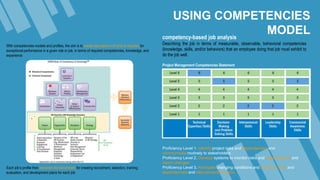
Project Management Competencies Statement
competency-based job analysis
Describing the job in terms of measurable, observable, behavioral competencies
(knowledge, skills, and/or behaviors) that an employee doing that job must exhibit to
do the job well.
Proficiency Level 1. Identify project risks and dependencies and
communicate routinely to stakeholders
Proficiency Level 2. Develop systems to monitor risks and dependencies and
report changes
Proficiency Level 3. Anticipate changing conditions and impact to risks and
dependencies and take preventive action
Thank You
Let's Discuss...
1. Muhammad Fais Lutfi Nuryadin 6032222091
2. Muhammad Ali Mahdi 6032222074
3. Anisa Maya Aulia Rahma 6032222102
4. Muhammad Harisul Baihaqi 6032222001

Job Analysis and Talent Management Process.pptx

  • 1.
    Job Analysis And TalentManagement Process 1. Muhammad Fais Lutfi Nuryadin 6032222091 2. Muhammad Ali Mahdi 6032222074 3. Anisa Maya Aulia Rahma 6032222102 4. Muhammad Harisul Baihaqi 6032222001
  • 2.
    Job Analysis danTalent Management Process » •Job Analysis is a process used by organizations to understand the duties, responsibilities and requirements associated with a job position. This involves collecting data about the job, including job descriptions and job specifications, so that the organization can have a better understanding of what is required to be successful in the position. » • Information obtained from job analysis can be used for a variety of purposes in talent management, including recruitment, selection, training, development, and performance appraisal.
  • 4.
    Methods for CollectingJob Analysis Information
  • 6.
    THE RESULTS OFJOB ANALYSIS Âť Job Description: a written summary of the tasks, duties, responsibilities, working conditions, that a particular job entails. Âť Job Specification: a list of the knowledge, skills, abilities, and other characteristics (KSAOs) that an individual must have to perform a job successfully.
  • 7.
    COMPARING JOB DESCRIPTION& JOB SPECIFICATION
  • 8.
    JOB DESCRIPTION containssection of: 1) Job identification 2) Job summary 3) Responsibilities and duties 4) Authority of incumbent 5) Standards of performance 6) Working conditions 7) Job specification
  • 9.
    Job Identification Job Summary Responsibilityand Duties Job Specification Standard of Performance Standard of Performance Authority of Incumbent Working Conditions Relationships
  • 10.
    WRITING JOB SPESIFICATIONS What HumanTraits and Experience are required to do this job effectively? Judgment Subjective Statistical Analysis Terms of Education, Intelligence, Training, and how is do the job well Employers identify the job’s human requirements either through a Job-requirements Matrix A more complete description of what the worker does and how and why he or she does; clarifies each task’s purpose and each duty’s required knowledge, skills, abilities, and other characteristics. Analyze the job and decide how to measure job performance 1 Select personal traits that believe should predict performance 2 Test candidate for these traits 3 Measure these candidates subsequent job performance 4 Statistically analyze the relationship between human trait and job performance 5 determine statistically the relation Ship between some predictor (human trait), and some indicator or criterion of job effectiveness The basic procedure of statistical analysis is predictive validation. This procedure has five steps:
  • 11.
    USING COMPETENCIES MODEL Each job’sprofile then becomes the benchmark for creating recruitment, selection, training, evaluation, and development plans for each job With competencies models and profiles, the aim is to create descriptions of what is required for exceptional performance in a given role or job, in terms of required competencies, knowledge, and experience Project Management Competencies Statement competency-based job analysis Describing the job in terms of measurable, observable, behavioral competencies (knowledge, skills, and/or behaviors) that an employee doing that job must exhibit to do the job well. Proficiency Level 1. Identify project risks and dependencies and communicate routinely to stakeholders Proficiency Level 2. Develop systems to monitor risks and dependencies and report changes Proficiency Level 3. Anticipate changing conditions and impact to risks and dependencies and take preventive action
  • 12.
    Thank You Let's Discuss... 1.Muhammad Fais Lutfi Nuryadin 6032222091 2. Muhammad Ali Mahdi 6032222074 3. Anisa Maya Aulia Rahma 6032222102 4. Muhammad Harisul Baihaqi 6032222001