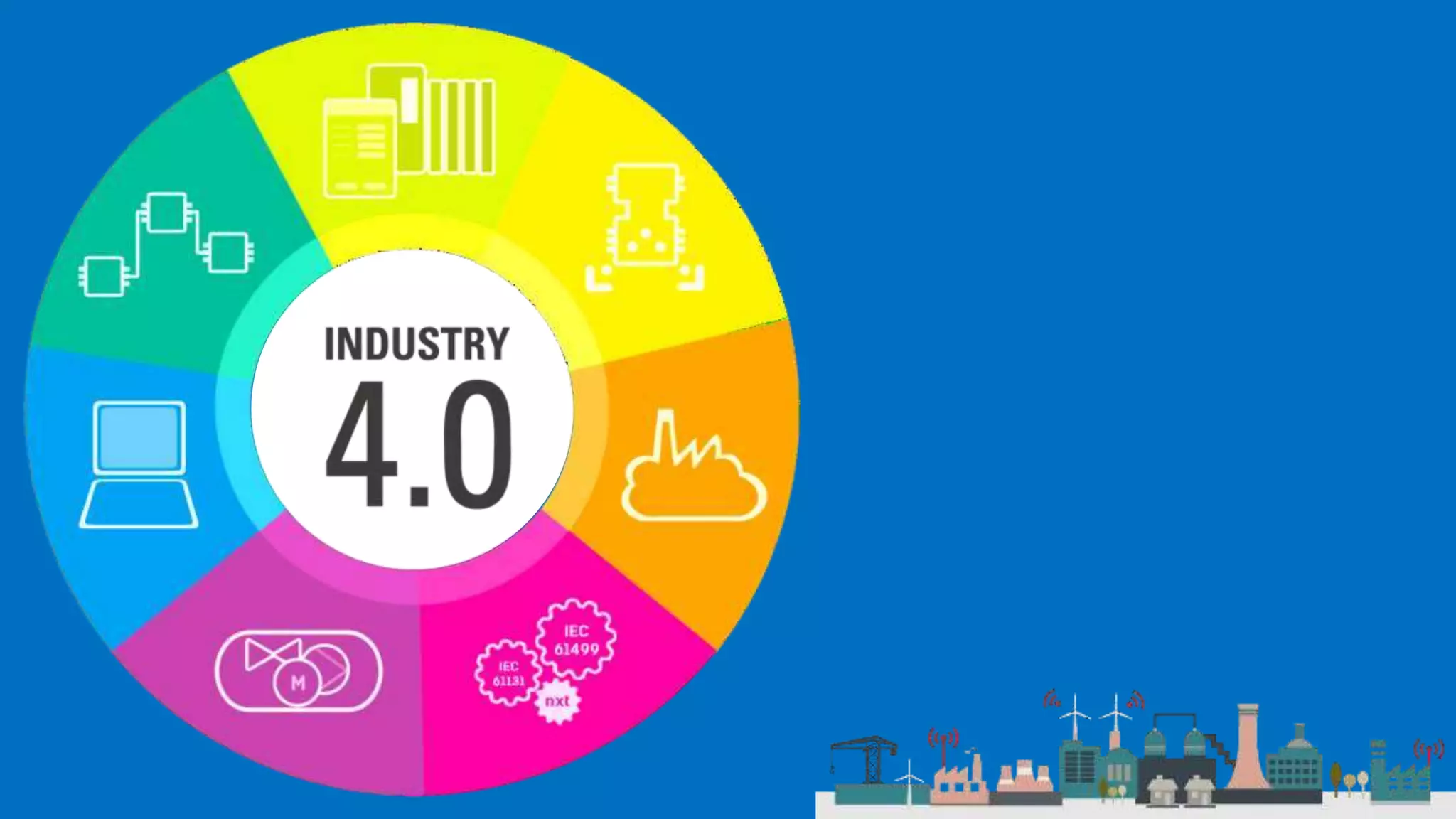
Industry 4.0
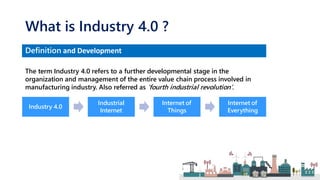
Industrial
Internet
Internet of
Things
Internet of
Everything
What is Industry 4.0 ?
Definition and Development
The term Industry 4.0 refers to a further developmental stage in the
organization and management of the entire value chain process involved in
manufacturing industry. Also referred as ‘fourth industrial revolution’.
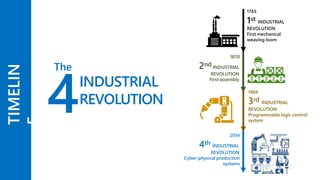
1870
2nd INDUSTRIAL
REVOLUTION
First assembly
4
TIMELIN
E
The
INDUSTRIAL
REVOLUTION
1765
1st INDUSTRIAL
REVOLUTION
First mechanical
weaving loom
1969
3rd INDUSTRIAL
REVOLUTION
Programmable logic control
system
2014
4th INDUSTRIAL
REVOLUTION
Cyber-physical production
systems
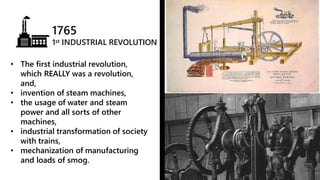
1765
1st INDUSTRIAL REVOLUTION
• The first industrial revolution,
which REALLY was a revolution,
and,
• invention of steam machines,
• the usage of water and steam
power and all sorts of other
machines,
• industrial transformation of society
with trains,
• mechanization of manufacturing
and loads of smog.
File:Power loom weaving. Wellcome L0011293.jpg
Wikimedia Commons
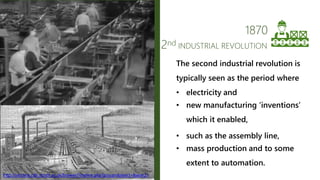
1870
2nd INDUSTRIAL REVOLUTION
The second industrial revolution is
typically seen as the period where
• electricity and
• new manufacturing ‘inventions’
which it enabled,
• such as the assembly line,
• mass production and to some
extent to automation.
http://victoria.cdlr.strath.ac.uk/browseTimeline.php?group=&year1=&year2=
File:Power loom weaving. Wellcome L0011293.jpg
Wikimedia Commons
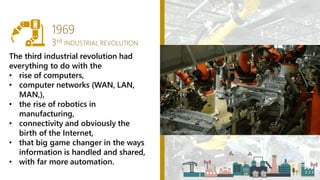
1969
3rd INDUSTRIAL REVOLUTION
The third industrial revolution had
everything to do with the
• rise of computers,
• computer networks (WAN, LAN,
MAN,),
• the rise of robotics in
manufacturing,
• connectivity and obviously the
birth of the Internet,
• that big game changer in the ways
information is handled and shared,
• with far more automation.
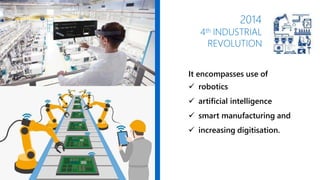
2014
4th INDUSTRIAL
REVOLUTION
It encompasses use of
 robotics
 artificial intelligence
 smart manufacturing and
 increasing digitisation.
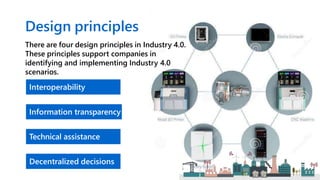
Design principles
There are four design principles in Industry 4.0.
These principles support companies in
identifying and implementing Industry 4.0
scenarios.
Interoperability
Information transparency
Technical assistance
Decentralized decisions
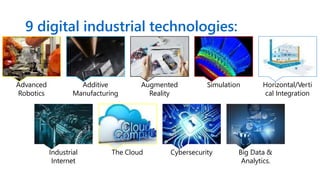
Advanced
Robotics
Additive
Manufacturing
Augmented
Reality
Simulation Horizontal/Verti
cal Integration
Industrial
Internet
The Cloud Cybersecurity Big Data &
Analytics.
9 digital industrial technologies:
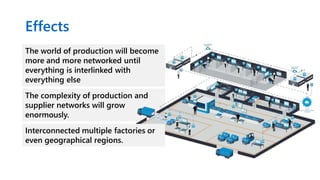
Effects
The world of production will become
more and more networked until
everything is interlinked with
everything else
The complexity of production and
supplier networks will grow
enormously.
Interconnected multiple factories or
even geographical regions.
Challenges
• IT security issues,
• Reliability and stability needed for critical M2M communication,
• Need to avoid any IT snags,
• Need to protect industrial know how
• Lack of adequate skill-sets
• Threat of redundancy of the corporate IT department
• Loss of many jobs to automatic processes and IT-controlled processes
• Low top management commitment
• Unclear legal issues and data security
• Unclear economic benefits/ Excessive investment
• Lack of regulation, standard and forms of certifications
• Insufficient qualification of employees
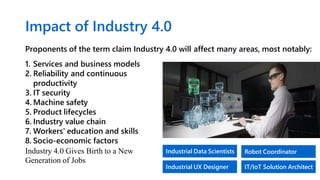
Impact of Industry 4.0
Proponents of the term claim Industry 4.0 will affect many areas, most notably:
1. Services and business models
2. Reliability and continuous
productivity
3. IT security
4. Machine safety
5. Product lifecycles
6. Industry value chain
7. Workers' education and skills
8. Socio-economic factors
Industry 4.0 Gives Birth to a New
Generation of Jobs
Industrial Data Scientists Robot Coordinator
Industrial UX Designer IT/IoT Solution Architect
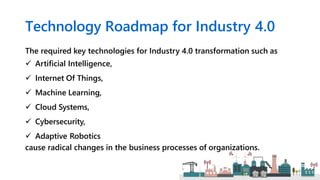
Technology Roadmap for Industry 4.0
The required key technologies for Industry 4.0 transformation such as
 Artificial Intelligence,
 Internet Of Things,
 Machine Learning,
 Cloud Systems,
 Cybersecurity,
 Adaptive Robotics
cause radical changes in the business processes of organizations.
References
1. Hermann, Pentek, Otto, 2016: Design Principles for Industrie 4.0 Scenarios, 4 May 2016
2. Jürgen Jasperneite:Was hinter Begriffen wie Industrie 4.0 steckt in Computer & Automation, 19 December 2012.
3. Kagermann, H., W. Wahlster and J. Helbig, eds., 2013: Recommendations for implementing the strategic
initiative Industrie 4.0: Final report of the Industrie 4.0 Working Group
4. Heiner Lasi, Hans-Georg Kemper, Peter Fettke, Thomas Feld, Michael Hoffmann: Industry 4.0. In: Business &
Information Systems Engineering 4 (6), pp. 239-242
5. Marr, Bernard. "Why Everyone Must Get Ready For The 4th Industrial Revolution". Forbes. Retrieved 2018-02-
14.
6. BMBF-Internetredaktion (21 January 2016). "Zukunftsprojekt Industrie 4.0 - BMBF". Bmbf.de. Retrieved 2016-
11-30.
7. "Industrie 4.0: Mit dem Internet der Dinge auf dem Weg zur 4. industriellen Revolution". Vdi-nachrichten.com
(in German). 1 April 2011. Retrieved 2016-11-30.
THANK YOU

JLLm9aHhpdGkHmJK793.pptx

  • 2.
    Industry 4.0 Industrial Internet Internet of Things Internetof Everything What is Industry 4.0 ? Definition and Development The term Industry 4.0 refers to a further developmental stage in the organization and management of the entire value chain process involved in manufacturing industry. Also referred as ‘fourth industrial revolution’.
  • 3.
    1870 2nd INDUSTRIAL REVOLUTION First assembly 4 TIMELIN E The INDUSTRIAL REVOLUTION 1765 1stINDUSTRIAL REVOLUTION First mechanical weaving loom 1969 3rd INDUSTRIAL REVOLUTION Programmable logic control system 2014 4th INDUSTRIAL REVOLUTION Cyber-physical production systems
  • 4.
    1765 1st INDUSTRIAL REVOLUTION •The first industrial revolution, which REALLY was a revolution, and, • invention of steam machines, • the usage of water and steam power and all sorts of other machines, • industrial transformation of society with trains, • mechanization of manufacturing and loads of smog. File:Power loom weaving. Wellcome L0011293.jpg Wikimedia Commons
  • 5.
    1870 2nd INDUSTRIAL REVOLUTION Thesecond industrial revolution is typically seen as the period where • electricity and • new manufacturing ‘inventions’ which it enabled, • such as the assembly line, • mass production and to some extent to automation. http://victoria.cdlr.strath.ac.uk/browseTimeline.php?group=&year1=&year2=
  • 6.
    File:Power loom weaving.Wellcome L0011293.jpg Wikimedia Commons 1969 3rd INDUSTRIAL REVOLUTION The third industrial revolution had everything to do with the • rise of computers, • computer networks (WAN, LAN, MAN,), • the rise of robotics in manufacturing, • connectivity and obviously the birth of the Internet, • that big game changer in the ways information is handled and shared, • with far more automation.
  • 7.
    2014 4th INDUSTRIAL REVOLUTION It encompassesuse of  robotics  artificial intelligence  smart manufacturing and  increasing digitisation.
  • 8.
    Design principles There arefour design principles in Industry 4.0. These principles support companies in identifying and implementing Industry 4.0 scenarios. Interoperability Information transparency Technical assistance Decentralized decisions
  • 9.
  • 10.
    Effects The world ofproduction will become more and more networked until everything is interlinked with everything else The complexity of production and supplier networks will grow enormously. Interconnected multiple factories or even geographical regions.
  • 11.
    Challenges • IT securityissues, • Reliability and stability needed for critical M2M communication, • Need to avoid any IT snags, • Need to protect industrial know how • Lack of adequate skill-sets • Threat of redundancy of the corporate IT department • Loss of many jobs to automatic processes and IT-controlled processes • Low top management commitment • Unclear legal issues and data security • Unclear economic benefits/ Excessive investment • Lack of regulation, standard and forms of certifications • Insufficient qualification of employees
  • 12.
    Impact of Industry4.0 Proponents of the term claim Industry 4.0 will affect many areas, most notably: 1. Services and business models 2. Reliability and continuous productivity 3. IT security 4. Machine safety 5. Product lifecycles 6. Industry value chain 7. Workers' education and skills 8. Socio-economic factors Industry 4.0 Gives Birth to a New Generation of Jobs Industrial Data Scientists Robot Coordinator Industrial UX Designer IT/IoT Solution Architect
  • 13.
    Technology Roadmap forIndustry 4.0 The required key technologies for Industry 4.0 transformation such as  Artificial Intelligence,  Internet Of Things,  Machine Learning,  Cloud Systems,  Cybersecurity,  Adaptive Robotics cause radical changes in the business processes of organizations.
  • 14.
    References 1. Hermann, Pentek,Otto, 2016: Design Principles for Industrie 4.0 Scenarios, 4 May 2016 2. Jürgen Jasperneite:Was hinter Begriffen wie Industrie 4.0 steckt in Computer & Automation, 19 December 2012. 3. Kagermann, H., W. Wahlster and J. Helbig, eds., 2013: Recommendations for implementing the strategic initiative Industrie 4.0: Final report of the Industrie 4.0 Working Group 4. Heiner Lasi, Hans-Georg Kemper, Peter Fettke, Thomas Feld, Michael Hoffmann: Industry 4.0. In: Business & Information Systems Engineering 4 (6), pp. 239-242 5. Marr, Bernard. "Why Everyone Must Get Ready For The 4th Industrial Revolution". Forbes. Retrieved 2018-02- 14. 6. BMBF-Internetredaktion (21 January 2016). "Zukunftsprojekt Industrie 4.0 - BMBF". Bmbf.de. Retrieved 2016- 11-30. 7. "Industrie 4.0: Mit dem Internet der Dinge auf dem Weg zur 4. industriellen Revolution". Vdi-nachrichten.com (in German). 1 April 2011. Retrieved 2016-11-30.
  • 15.