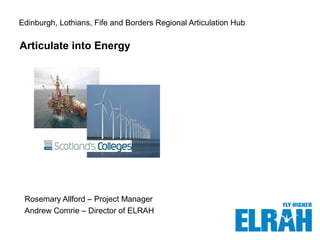
Edinburgh, Lothians, Fife and Borders Regional Articulation Hub
Rosemary Allford – Project Manager
Andrew Comrie – Director of ELRAH
Insert image here
Articulate into Energy
The principal driver for this proposal arises from the need for
workforce development and capacity building to drive economic
development;
Powering the UK 2 – Ernst & Young with Energy UK
Direct employment grew from 80,000 to 137,000 between 2008 and 2011
Strong job creation across regions most needing them.
Expected to continue to create jobs and drive value creation. By 2024 the
Sector will have to Recruit 35,000 new employees
Total direct and indirect jobs now Over 654,000
Integrated offering of training interventions from introductory to
professional qualifications (Modern Apprenticeship to Graduate)
and beyond
Energy Skills Action Group for Scotland March 2013 (Scottish Power)
Education and Skills Providers will need to increase by 80% to meet these
demands
Over this time there will be an 80% loss of the existing workforce
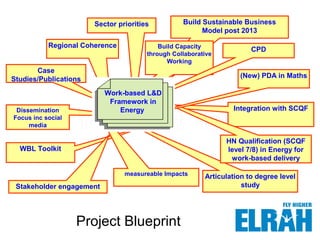
Project Blueprint
WBL Toolkit
Build Sustainable Business
Model post 2013
Sector priorities
Stakeholder engagement
Build Capacity
through Collaborative
Working
Articulation to degree level
study
Integration with SCQF
HN Qualification (SCQF
level 7/8) in Energy for
work-based delivery
CPD
Case
Studies/Publications
Dissemination
Focus inc social
media
Regional Coherence
measureable Impacts
(New) PDA in Maths
Work-based L&D
Framework in
Energy
Strategic Project Aims
Collaborative Partnership between Colleges, HEIs,
employers, and industry bodies.
Embed the SCQF to underpin the Workforce
Development Framework
Capacity building through a part-time work based
learning route.
Gain academic credit through a cumulative approach to
CPD and credit rated units
Articulation to degree level study from SCQF level 7/ 8
Technological Innovation emergent from the College,
HE, Employer Partnership
Key Project Objectives
Mapping of articulation and WBL routes from HN
Systems Engineering into Year 3 BA (Hons)
Engineering and Environmental Technology
(Edinburgh Napier University)
re-design of existing relevant Engineering
degrees for work-based delivery
Development of Specialist Professional
Development Awards
Maths for Engineering (based on prior ELRAH-
funded work progressed by Forth Valley College
and Heriot-Watt University) credit rated into the
SCQF at Levels 7 and 8
Key Outputs
Articulation mapping of degree level study from
HN Qualifications in Engineering which can be
continued in the workplace.
Effective collaborative working between
college, HEI and industry partners.
WBL Model that is transferrable.
New provision at SCQF Level 7 PDA in
Process Optimisation accredited by SQA and
aligned to industry needs.
Enhanced mathematics to address deficiencies
identified for success in study at degree level
and entry to workplace.
What we have achieved
Project Board established with employer, HEI
and College representation.
Funding has been secured for the development
of:
PDA Process Optimisation (SCQF funded)
Additional maths units/PDA (ESP funded)
Mapping of degree and college delivered HNC/
Engineering Systems to Edinburgh Napier’s BA (Hons)
Engineering and Environmental Technology (Edinburgh
Napier University) for 2+2 and work-based delivery.
(Edinburgh Napier University).
New Maths Units/PDA has been produced
New PDA in Process Optimisation has been
produced
What is still in progress
Mapping of HN Engineering Systems to the BA
(Hons) Engineering and Environmental Technology
offered by Edinburgh Napier University.
Final framework for WBL delivery
These are due to be completed by September 2013.
Challenges Faced during Pilot
Level of complexity
Producing a business case for the original
proposed WBL model that provided a
compelling case to gain support from the
qualifications authority.
Changing Operating Environment as a result of
College Merger, announcement of additional
places for articulation in December 2012 with a
focus on 2+2 developments.
Securing funding for development activities
Sustainable Employer Engagement
WBL Toolkit
Institutional/School Readiness: has informed the
creation of Project Board.
Programme Design: used to inform the design of
the new PDA qualifications developed by the College
partners and where PDAs agree developed and
validated by HEI partners.
Revised Toolkit: Resource dedicated to the
development of the revised version of the WBL model
and the viewpoints cards.

JISC Maturity Toolkit ELRAH Presentation Skye, April 2013 [original: Rosemary Allford]

  • 1.
    Edinburgh, Lothians, Fifeand Borders Regional Articulation Hub Rosemary Allford – Project Manager Andrew Comrie – Director of ELRAH Insert image here Articulate into Energy
  • 2.
    The principal driverfor this proposal arises from the need for workforce development and capacity building to drive economic development; Powering the UK 2 – Ernst & Young with Energy UK Direct employment grew from 80,000 to 137,000 between 2008 and 2011 Strong job creation across regions most needing them. Expected to continue to create jobs and drive value creation. By 2024 the Sector will have to Recruit 35,000 new employees Total direct and indirect jobs now Over 654,000 Integrated offering of training interventions from introductory to professional qualifications (Modern Apprenticeship to Graduate) and beyond Energy Skills Action Group for Scotland March 2013 (Scottish Power) Education and Skills Providers will need to increase by 80% to meet these demands Over this time there will be an 80% loss of the existing workforce
  • 3.
    Project Blueprint WBL Toolkit BuildSustainable Business Model post 2013 Sector priorities Stakeholder engagement Build Capacity through Collaborative Working Articulation to degree level study Integration with SCQF HN Qualification (SCQF level 7/8) in Energy for work-based delivery CPD Case Studies/Publications Dissemination Focus inc social media Regional Coherence measureable Impacts (New) PDA in Maths Work-based L&D Framework in Energy
  • 4.
    Strategic Project Aims CollaborativePartnership between Colleges, HEIs, employers, and industry bodies. Embed the SCQF to underpin the Workforce Development Framework Capacity building through a part-time work based learning route. Gain academic credit through a cumulative approach to CPD and credit rated units Articulation to degree level study from SCQF level 7/ 8 Technological Innovation emergent from the College, HE, Employer Partnership
  • 5.
    Key Project Objectives Mappingof articulation and WBL routes from HN Systems Engineering into Year 3 BA (Hons) Engineering and Environmental Technology (Edinburgh Napier University) re-design of existing relevant Engineering degrees for work-based delivery Development of Specialist Professional Development Awards Maths for Engineering (based on prior ELRAH- funded work progressed by Forth Valley College and Heriot-Watt University) credit rated into the SCQF at Levels 7 and 8
  • 6.
    Key Outputs Articulation mappingof degree level study from HN Qualifications in Engineering which can be continued in the workplace. Effective collaborative working between college, HEI and industry partners. WBL Model that is transferrable. New provision at SCQF Level 7 PDA in Process Optimisation accredited by SQA and aligned to industry needs. Enhanced mathematics to address deficiencies identified for success in study at degree level and entry to workplace.
  • 7.
    What we haveachieved Project Board established with employer, HEI and College representation. Funding has been secured for the development of: PDA Process Optimisation (SCQF funded) Additional maths units/PDA (ESP funded) Mapping of degree and college delivered HNC/ Engineering Systems to Edinburgh Napier’s BA (Hons) Engineering and Environmental Technology (Edinburgh Napier University) for 2+2 and work-based delivery. (Edinburgh Napier University). New Maths Units/PDA has been produced New PDA in Process Optimisation has been produced
  • 8.
    What is stillin progress Mapping of HN Engineering Systems to the BA (Hons) Engineering and Environmental Technology offered by Edinburgh Napier University. Final framework for WBL delivery These are due to be completed by September 2013.
  • 9.
    Challenges Faced duringPilot Level of complexity Producing a business case for the original proposed WBL model that provided a compelling case to gain support from the qualifications authority. Changing Operating Environment as a result of College Merger, announcement of additional places for articulation in December 2012 with a focus on 2+2 developments. Securing funding for development activities Sustainable Employer Engagement
  • 10.
    WBL Toolkit Institutional/School Readiness:has informed the creation of Project Board. Programme Design: used to inform the design of the new PDA qualifications developed by the College partners and where PDAs agree developed and validated by HEI partners. Revised Toolkit: Resource dedicated to the development of the revised version of the WBL model and the viewpoints cards.