© 2022 JETIR January 2022, Volume 9, Issue 1 www.jetir.org (ISSN-2349-5162)
JETIR2201285 Journal of Emerging Technologies and Innovative Research (JETIR) www.jetir.org c657
Dye Degradation with suitable spinel processed by
microwave assisted solution combustion synthesis
RAHUL JARARIYA
Department of Chemical Engineering, Vishwakarma Government Engineering College, Chandkheda, Gujarat, India
*Author details: rudrakashj47@gmail.com ; +91-9131025109
Abstract: Dye waste water is the big concern from Industries after discharges high amount of water, it's effective from aquatic life
to humans. Most parts of textile industrial dye impact to the environment like allergic reaction, respiratory, skin problems, irritation
to mucous membrane and the upper respiratory tract have to the fore. In the textile sector, intoxicated dye chemicals are surrounded,
it is problem for workers who do their job in this process. After the process, approximately 10 – 15 % dye is released into the
environment. So, it is necessary to do the degrade dye and maintain TDS (Total Dissolved Solids) of water its necessary. In AOP
(Advance oxidation process) gained attention in past decades, in photocatalyst is the simple activity to degrade dye by breaking rigid
bond structure with suitable spinel. Tracking such parameters pH, irradiation time, initial dye concentration, contact time etc.
Ferrite spinel gained huge attention due to their wide application area from biomedical to wastewater treatment, pharmaceuticals,
biomedical, electronic devices, and photocatalyst etc. The common ferrite spinal formula is M-Fe2O4 where M is Fe, Co, Mn, Zn,
Cu, and Ni. Spinel Ferrite can be synthesized by conventional methods i.e., Sol-gel methods, Co-precipitation, Hydrothermal, which
are slow and need more equipment facilities while the Microwave solution combustion (MSC) method is the promising method for
the catalytic activity or any solid material. This method is fast, energy-efficient and needs lesser equipment than any others i.e., Sol-
gel or Co-precipitation.
Herein microwave solution combustion method is reviewed in detail with insight into the effect of parameters. In this process,
microwave irradiation is used to keep precursors at an excited state and make them highly reactive. Normally 2.45 GHz frequency
microwave is used for this process. As this process is a solvent-free process. The most commonly used metal sources are nitrates of
metals and fuel precursors are urea, L-arginine, glycerol etc. Urea is the most commonly used fuel because it gives less particle size.
Different parameters such as fuel to oxidizer ratio, irradiation time, power of microwave and temperature and pressure can be
optimized to get faster and better yield. This process does not need further calcination unlike sol-gel and co-precipitation but needs
several items of washing with ethanol or n-butanol for purification of the final product. Finally, Characterize the sample by SEM,
TEM, XRD, TGA, BET.
Though it is a novel process, in the end, it generates a large volume of gases produced during the combustion process. And this
process can be used only for laboratory purposes till yet and some research is awaited.
© 2022 JETIR January 2022, Volume 9, Issue 1 www.jetir.org (ISSN-2349-5162)
JETIR2201285 Journal of Emerging Technologies and Innovative Research (JETIR) www.jetir.org c658
n
Key words: Microwave Solution Combustion method, Ferrites, Spinels, Doped Spinels, dyes.
1. INTRODUCTION:
One of the major concerns from textile effluent dyes as waste product source produces carcinogenic effects into environment and
human beings. Due to the huge wastage some allergic reactions occur into environment like skin irritation, eye problems, allergic
diseases etc. Various types of Chemical Industries generated wastewater or pollutants such as textile and dye, food processing, iron
and steel, Nuclear, pulp and paper industries. Dye waste water from industries produces 40-50 tons waste that is mix dye included
Methylene blue, anthraquinone dye, Reactive blue 19, Rhodamine B, Reactive Blue 21, Methyl orange, Congo red, crystal violet,
and many more. Our survey concluded that these dyes are attaining obstacles for an industry and life cycle. It also disturbed BOD
and COD by toxicity in water. We all know that water is the natural source in our life. It is important for living. Highly toxic
benzidine based dispersed dyes causes for aquatic life last year. Heavy metals complex dyes suffer the gills of the fishes. Further it
is promising to degrade organic compounds to degrade dyes by the AOPs (Advance oxidation process). Researchers have generated
interest overcome these details from dye effluents to protect our environment and health concerns. So, this issue motivated our work
to ensure and collect all information on dye wastewater. Degradation strategies in terms of COD and reduce color without formation
of by product.
Today’s burning issue faced by waste water. The pollution of water resources by the dyes has become a major issue in environment
problems. In textile dye effluent reactive dyes are the most problematic compound. Many industries discharges waste water which
contain pollutant that are harmful. Removal of dyes from effluents before discharge into natural water bodies becomes environmental
important.
There is a need to find alternative or modification in treatments which are effective in removing dyes from large volumes of effluents
and are also effective. Various treatment or advance treatment methods are developed for the dyes degradation. Many processes for
the wastewater treatment like chemical, physical and biological are used and these processes are not feasible. So advanced
wastewater treatments are developed among which membrane technology as an advance separation technology has gained popularity
and has become an important technology to treat and even reuse wastewater. Membrane processes such as microfiltration (MF),
Ultrafiltration (UF), Nanofiltration (NF), and reverse osmosis (RO) have been adopted. In order to treat wastewater to improve the
treatment efficiency and quality of water to meet the requirement of stringent legislations on water membrane treatment is widely
used. Many conventional methods have been proposed to treat dye effluent which are very effective nor environmentally compatible
and have shown to pose certain operational limitations and shortcomings. One of the method as best attentions for dye degradation
© 2022 JETIR January 2022, Volume 9, Issue 1 www.jetir.org (ISSN-2349-5162)
JETIR2201285 Journal of Emerging Technologies and Innovative Research (JETIR) www.jetir.org c659
is that photocatalyst. It is promising technique with high efficiency and low cost in visible light. Photocatalyst is the greatest interest
has developed. Solar energy active photocatalyst has been a promising material for an environment purification processes. Some
efforts have been made to synthesize materials capable of utilizing solar spectrum for the photo degradation of industrial waste
pollutants and dyes. The modification methods of photocatalyst involve noble metal deposition, transition metal ions doping, couple
semiconductor etc. Photocatalyst utilize light energy to carry out oxidation and reduction reactions. When irradiated with light
energy, an electron is excited from the valence band to the conduction band of the photocatalyst leaving a photo generated holes
(h+).
Semiconductors are widely used for photocatalysts process. In semiconductors like TiO2, ZnO, Fe2O3, CdS, GaP, ZnS. And multi
component oxides as the catalyst to degrade azo dye by attractive attention. But some kind of demerits by processing because it
works only in Ultra violet source, requires high amount of dosage, separation problem and extensive sludge disposal problems.
Several studies shows that ZnO is nearly equal to TiO2 because it generates H2O2 efficiency to degrade dyes. On the other hand
spinel catalyst with magnetic property has been investigated to overcome the drawback of semiconductor. Generally, we known
spinel forms are AB2O4 – Transition metal cation and theses novelty of catalyst shows better magnetic and electrical properties.
Class Characteristics Fibre Method of application
Acid Anionic water soluble Nylon, wool, silk Neutral to acidic dry bath
Basic Cationic water soluble Modified nylon, polyester Acidic dye bath
Direct Anionic water soluble
Cotton, rayon, nylon,
leather
Neutral or alkaline bath
containing
Disperse Very low water soluble
Polyester, polyamide,
acetate, plastic, plastic
acrylic.
High temperature pressure
Sulphur Colloidal, insoluble Cotton, rayon
Aromatic substrate vetted
sodium sulphate or re-
oxidized to insoluble
sulfur containing products
on fire.
Vat Colloidal or insoluble Cotton, rayon
Water insoluble dye
solubilized by reducing
with sodium hydro-
sulphite on fibre or re-
oxidised.
Table1: Classification of Different dyes from textile industries and its application
1.1 Industrial limits for waste water:
The large quantity of dye produced in the world and discharge to the environment are not available, so estimated production rates is
10,000 tons/ year and losses around 1 to 2 % during production. Environmental problems is huge concern generated by central
pollution control board in prevention act. Approximately 1.1 billion people drinking unsafe water and this issue shows by
government or by scientists. The formation in 1974 of ecological and toxicological association of dyestuffs manufacturing industry,
aims to minimize environment damage, protect users, consumers and to cooperate fully with government and public concerns over
© 2022 JETIR January 2022, Volume 9, Issue 1 www.jetir.org (ISSN-2349-5162)
JETIR2201285 Journal of Emerging Technologies and Innovative Research (JETIR) www.jetir.org c660
impacts of products. Thus textile in India release maximum wastewater and these textile are in Surat, Ahmedabad, Mumbai, Kanpur,
Coimbatore. Due to the increase of wastewater discharge increasingly stringent legislation on priority the search for the appropriate
technologies. Even below 1 ppm of dye in waste can be visible than organic substances so it is more important to remove from
environment.
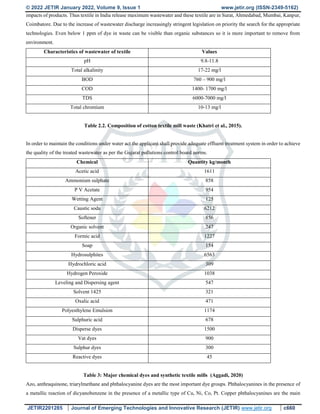
Characteristics of wastewater of textile Values
pH 9.8-11.8
Total alkalinity 17-22 mg/l
BOD 760 – 900 mg/l
COD 1400- 1700 mg/l
TDS 6000-7000 mg/l
Total chromium 10-13 mg/l
Table 2.2. Composition of cotton textile mill waste (Khatri et al., 2015).
In order to maintain the conditions under water act the applicant shall provide adequate effluent treatment system in order to achieve
the quality of the treated wastewater as per the Gujarat pollutions control board norms.
Chemical Quantity kg/month
Acetic acid 1611
Ammonium sulphate 858
P V Acetate 954
Wetting Agent 125
Caustic soda 6212
Softener 856
Organic solvent 247
Formic acid 1227
Soap 154
Hydrosulphites 6563
Hydrochloric acid 309
Hydrogen Peroxide 1038
Leveling and Dispersing agent 547
Solvent 1425 321
Oxalic acid 471
Polyesthylene Emulsion 1174
Sulphuric acid 678
Disperse dyes 1500
Vat dyes 900
Sulphur dyes 300
Reactive dyes 45
Table 3: Major chemical dyes and synthetic textile mills (Aggadi, 2020)
Azo, anthraquinone, triarylmethane and phthalocyanine dyes are the most important dye groups. Phthalocyanines in the presence of
a metallic reaction of dicyanobenzene in the presence of a metallic type of Cu, Ni, Co, Pt. Copper phthalocyanines are the main
© 2022 JETIR January 2022, Volume 9, Issue 1 www.jetir.org (ISSN-2349-5162)
JETIR2201285 Journal of Emerging Technologies and Innovative Research (JETIR) www.jetir.org c661
derivative of this dye class, due to their beautiful blue to green shades, high dyeing resistance, excellent chemical stability, light
fastness and resistant to bacterial stability, light fastness and resistant to bacterial degradation under aerobic or anerobic conditions.
(Aggadi, 2020).
Many preparation techniques or method are sol gel, co-precipitation, solid -state, hydrothermal, microwave solution combustion.
But some conventional method limitations high heating rate, emitting poisonous gases, long time requirement, higher gain size, time
consumptions etc. But Microwave solution combustion overcome limitations, its effective and energy efficient and time saving
method.
1.2 Dye removal technologies
Dye removal technologies
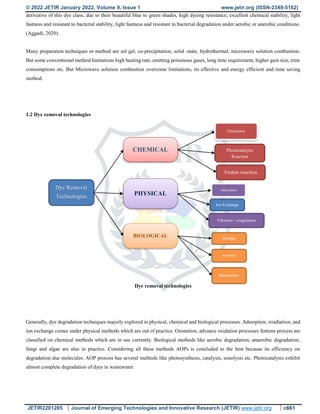
Generally, dye degradation techniques majorly explored in physical, chemical and biological processes. Adsorption, irradiation, and
ion exchange comes under physical methods which are out of practice. Ozonation, advance oxidation processes fentons process are
classified on chemical methods which are in use currently. Biological methods like aerobic degradation, anaerobic degradation,
fungi and algae are also in practice. Considering all these methods AOPs is concluded to the best because its efficiency on
degradation due molecules. AOP process has several methods like photosynthesis, catalysis, sonolysis etc. Photocatalysis exhibit
almost complete degradation of dyes in wastewater.
CHEMICAL
PHYSICAL
BIOLOGICAL
Ozonation
Photocatalytic
Reaction
Fenton reaction
Ion Exchange
Aerobic
Anerobic
Biosorption
Adsorption
Filtration / coagulation
Dye Removal
Technologies
© 2022 JETIR January 2022, Volume 9, Issue 1 www.jetir.org (ISSN-2349-5162)
JETIR2201285 Journal of Emerging Technologies and Innovative Research (JETIR) www.jetir.org c662
2. METHODS FOR CATALYST PREPARATION:
2.1 Microwave solution combustion Method:
2.1.1 Materials:
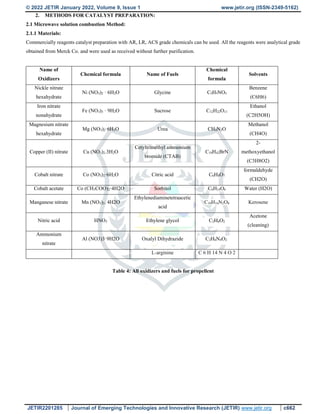
Commercially reagents catalyst preparation with AR, LR, ACS grade chemicals can be used. All the reagents were analytical grade
obtained from Merck Co. and were used as received without further purification.
Name of
Oxidizers
Chemical formula Name of Fuels
Chemical
formula
Solvents
Nickle nitrate
hexahydrate
Ni (NO3)2 · 6H2O Glycine C₂H₅NO₂
Benzene
(C6H6)
Iron nitrate
nonahydrate
Fe (NO3)3 · 9H2O Sucrose C12H22O11
Ethanol
(C2H5OH)
Magnesium nitrate
hexahydrate
Mg (NO3)2·6H2O Urea CH4N2O
Methanol
(CH4O)
Copper (II) nitrate Cu (NO3)2.3H2O
Cetyltrimethyl ammonium
bromide (CTAB)
C19H42BrN
2-
methoxyethanol
(C3H8O2)
Cobalt nitrate Co (NO3)2·6H2O Citric acid C6H8O7
formaldehyde
(CH2O)
Cobalt acetate Co (CH3COO)2·4H2O Sorbitol C6H14O6 Water (H2O)
Manganese nitrate Mn (NO3)2. 4H2O
Ethylenediaminetetraacetic
acid
C10H16N2O8 Kerosene
Nitric acid HNO3 Ethylene glycol C2H6O2
Acetone
(cleaning)
Ammonium
nitrate
Al (NO3)3·9H2O Oxalyl Dihydrazide C2H6N4O2
L-arginine C 6 H 14 N 4 O 2
Table 4: All oxidizers and fuels for propellent
© 2022 JETIR January 2022, Volume 9, Issue 1 www.jetir.org (ISSN-2349-5162)
JETIR2201285 Journal of Emerging Technologies and Innovative Research (JETIR) www.jetir.org c663
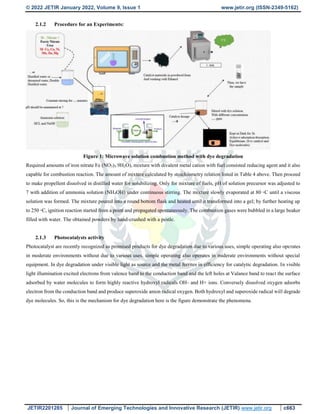
2.1.2 Procedure for an Experiments:
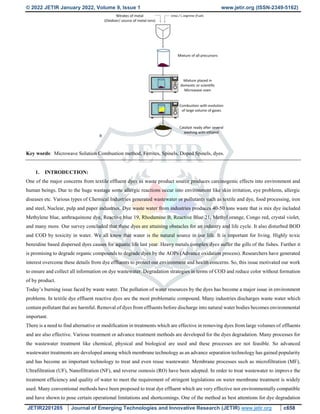
Figure 1: Microwave solution combustion method with dye degradation
Required amounts of iron nitrate Fe (NO3)3.9H2O), mixture with divalent metal cation with fuel consisted reducing agent and it also
capable for combustion reaction. The amount of mixture calculated by stoichiometry relation listed in Table 4 above. Then proceed
to make propellent dissolved in distilled water for solubilizing. Only for mixture of fuels, pH of solution precursor was adjusted to
7 with addition of ammonia solution (NH4OH) under continuous stirring. The mixture slowly evaporated at 80 ◦C until a viscous
solution was formed. The mixture poured into a round bottom flask and heated until it transformed into a gel; by further heating up
to 250 ◦C, ignition reaction started from a point and propagated spontaneously. The combustion gases were bubbled in a large beaker
filled with water. The obtained powders by hand-crushed with a pestle.
2.1.3 Photocatalysts activity
Photocatalyst are recently recognized as promised products for dye degradation due to various uses, simple operating also operates
in moderate environments without due to various uses, simple operating also operates in miderate environments without special
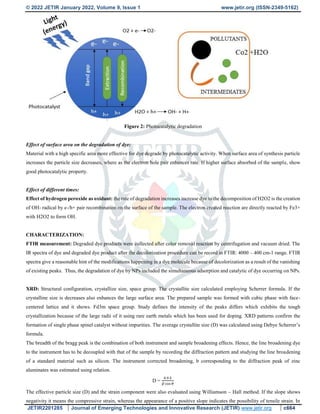
equipment. In dye degradation under visible light as source and the metal ferrites in efficiency for catalytic degradation. In visible
light illumination excited electrons from valence band to the conduction band and the left holes at Valance band to react the surface
adsorbed by water molecules to form highly reactive hydroxyl radicals OH- and H+ ions. Conversely dissolved oxygen adsorbs
electron from the conduction band and produce superoxide anion radical oxygen. Both hydroxyl and superoxide radical will degrade
dye molecules. So, this is the mechanism for dye degradation here is the figure demonstrate the phenomena.
© 2022 JETIR January 2022, Volume 9, Issue 1 www.jetir.org (ISSN-2349-5162)
JETIR2201285 Journal of Emerging Technologies and Innovative Research (JETIR) www.jetir.org c664
Figure 2: Photocatalytic degradation
Effect of surface area on the degradation of dye:
Material with a high specific area more effective for dye degrade by photocatalytic activity. When surface area of synthesis particle
increases the particle size decreases, where as the electron hole pair enhances rate. If higher surface absorbed of the sample, show
good photocatalytic property.
Effect of different times:
Effect of hydrogen peroxide as oxidant: the rate of degradation increases increase dye to the decomposition of H2O2 is the creation
of OH- radical by e-/h+ pair recombination on the surface of the sample. The electron created reaction are directly reacted by Fe3+
with H2O2 to form OH.
CHARACTERIZATION:
FTIR measurement: Degraded dye products were collected after color removal reaction by centrifugation and vacuum dried. The
IR spectra of dye and degraded dye product after the decolorization procedure can be record in FTIR: 4000 – 400 cm-1 range. FTIR
spectra give a reasonable hint of the modifications happening in a dye molecule because of decolorization as a result of the vanishing
of existing peaks. Thus, the degradation of dye by NPs included the simultaneous adsorption and catalytic of dye occurring on NPs.
XRD: Structural configuration, crystallize size, space group. The crystallite size calculated employing Scherrer formula. If the
crystalline size is decreases also enhances the large surface area. The prepared sample was formed with cubic phase with face-
centered lattice and it shows. Fd3m space group. Study defines the intensity of the peaks differs which exhibits the tough
crystallization because of the large radii of it using rare earth metals which has been used for doping. XRD patterns confirm the
formation of single phase spinel catalyst without impurities. The average crystallite size (D) was calculated using Debye Scherrer’s
formula.
The breadth of the bragg peak is the combination of both instrument and sample broadening effects. Hence, the line broadening dye
to the instrument has to be decoupled with that of the sample by recording the diffraction pattern and studying the line broadening
of a standard material such as silicon. The instrument corrected broadening, b corresponding to the diffraction peak of zinc
aluminates was estimated using relation.
D =
0.9 𝜆
𝛽 cos 𝜃
The effective particle size (D) and the strain component were also evaluated using Williamson – Hall method. If the slope shows
negativity it means the compressive strain, whereas the appearance of a positive slope indicates the possibility of tensile strain. In
© 2022 JETIR January 2022, Volume 9, Issue 1 www.jetir.org (ISSN-2349-5162)
JETIR2201285 Journal of Emerging Technologies and Innovative Research (JETIR) www.jetir.org c665
the present study, a positive slope for all the samples revels the presence of tensile strain in the composites. The X-ray density (dx)
for each sample was calculated by the relation.
dx = ZM / NV
where, Z is the number of molecules per unit cell of spinel lattice (Z=8), M is the molecular weight, V is the unit cell volume, and
N the Avogadro’s number.
The percentage porosity (P) of the spinel was calculated by using the formula
P = 1 – [Bulk density/X ray density] * 100
The reduce in bandgap energy will make the catalyst capable of having efficiency in visible light which is present largely in solar
light and can give good photocatalytic efficiency.
The vibrational, rotational and lattice defects present on the samples were clearly found by Raman analysis.
Scanning electron microscopy:
Morphological, development of clear nanoparticles with reduce in size is also evident from the image. The particles at 500 nm scale
shows better grown nanoparticles with less agglomeration on the surface of the grown nanoparticles. While doping agglomeration
completely reduced the nanoparticles grown and more clear surfaces. At 500 nm scale, the image will clear support.
EDAX: It confirms the elemental configuration.
Thermal gravimetric analysis (TGA): It is widely used to investigate the thermal decomposition of NPs to determine the thermal
decomposition kinetic parameter. These parameters can be used to obtain a better understanding of thermal stability of catalyst.
Magnetization: The magnetization behavior of catalyst or doped catalyst can investigation with VSM (vibrational sample
magnetometry) by seeping the external magnetic field. Magnetization plotted against, applied field (H) behavior plots. The values
of coercivity and retentivity obtained from the M-H curves, the low values are attributed to the characteristic of magnetic NPs where
thermal fluctuations are sufficient to overcome the anisotropy energy barrier, thus allowing the magnetization to spontaneously
reverse the direction, Upon increasing the amount of doping as tends to super magnetization behavior, However increase in the
doping concentration by a decrease in the coercivity value decreased due to the thermal fluctuations can be, it assisting the
overcoming of anisotropy energy barrier. The smaller values of squareness ration Mr / Ms less than 0.5, according to stoner –
wolfarth indicate the nanoparticals process uniaxial anisotropy. The squareness ratio classifies the materials to having cubic
anisotropy. The magneto crystalline anisotropy constant (K) of the NPs obeying uniaxial anisotropy is calculate using Browns
relation.
K1 =
𝐻𝑐 𝑀𝑠
0.985
It has been observed that anisot-ropy constant (k1) decreases at higher calculations temperature (˚C).
Uv visible spectroscopy: It shown absorbance as part of visible region 500-780 nm. The performance should be attributed to the
efficiency transfer of photosensitivity from highly conjugate organic linker. The optical band gaps found by Tauc plot. Generally
the bang gaps play a important role in determining their photocatalyst degradation efficiencies towards the organic pollutant
decontamination. Narrow band gaps towards more conductive to the visible light absorption of catalysts to generate charge separated
excited states, which is crucial state to determining the efficiency chemical energy from solar energy. The Eg (band gap) values
determine by Kubleka munk equation F(R) = α = (1-R)2
/ 2 R and transformed formula [F(R)hν]2 = A (hν – Eg).
Where,
R = Reflected light
α = optical absorption coefficient
© 2022 JETIR January 2022, Volume 9, Issue 1 www.jetir.org (ISSN-2349-5162)
JETIR2201285 Journal of Emerging Technologies and Innovative Research (JETIR) www.jetir.org c666
hν = energy of incident proton
Eg = Band gap energy
A = transition probability rate constants
The band gap energy constructed in Tauc plot of Kubelka−Munk function [F(R)hν]2 (ordinate) versus hν (abscissa) (Qing Li a,
2018) and precisely determined as the abscissa values of intersection between the tangent line of energy axis and the line extrapolated
from the linear portion of the adsorption edge (Qing Li a, 2018).
CONCLUSION:
Microwave solution combustion or solution combustion method both works collimated each other. The great propellent discovery
found in microwave and easy reaction with less contact time to product suitable catalyst for dye degradation. Our study shown
microwave comes drawback in large number of gases produce during exothermic reaction with spinel ferrites but its produce good
magnetization for easy separation with dye. Solution combustion assisted work the catalyst for reduce particle size with certain
amount to temperature life in muffle furnace during calcination and produce crucial separation. Saturation magnetism is good results
shown by our study. So the microwave is very effective work for dye degradation as application.
References:
1. Hadadian, S., Masoudpanah, S.M. and Alamolhoda, S., 2019. Solution combustion synthesis of Fe 3 O 4 powders using
mixture of CTAB and citric acid fuels. Journal of Superconductivity and Novel Magnetism, 32(2), pp.353-360.
2. Astaraki, H., Masoudpanah, S.M. and Alamolhoda, S., 2020. Effects of fuel contents on physicochemical properties and
photocatalytic activity of CuFe2O4/reduced graphene oxide (RGO) nanocomposites synthesized by solution combustion
method. Journal of Materials Research and Technology, 9(6), pp.13402-13410.
3. Martinson, K.D., Sakhno, D.Y.D., Belyak, V.E.E., Panteleev, I.B., Kochurov, I.V. and Popkov, V.I., 2020. Synthesis of
Ni0. 4Zn0. 6Fe2O4 spinel ferrite and microwave adsorption of related polymer composite. Наносистемы: физика, химия,
математика, 11(5).
4. Heidari, P. and Masoudpanah, S.M., 2020. Structural and magnetic properties of MgFe2O4 powders synthesized by
solution combustion method: the effect of fuel type. Journal of Materials Research and Technology, 9(3), pp.4469-4475.
5. Martinson, K.D., Cherepkova, I.A., Panteleev, I.B. and Popkov, V.I., 2019. Single-step solution-combustion synthesis of
magnetically soft NiFe 2 O 4 nanopowders with controllable parameters. International Journal of Self-Propagating High-
Temperature Synthesis, 28(4), pp.266-270.
6. Bera, P., Lakshmi, R.V., Prakash, B.H., Tiwari, K., Shukla, A., Kundu, A.K., Biswas, K. and Barshilia, H.C., 2020. Solution
combustion synthesis, characterization, magnetic, and dielectric properties of CoFe 2 O 4 and Co 0.5 M 0.5 Fe 2 O 4 (M=
Mn, Ni, and Zn). Physical Chemistry Chemical Physics, 22(35), pp.20087-20106.
7. Nguyen, L.T., Nguyen, L.T., Manh, N.C., Quoc, D.N., Quang, H.N., Nguyen, H.T., Nguyen, D.C. and Bach, L.G., 2019.
A facile synthesis, characterization, and photocatalytic activity of magnesium ferrite nanoparticles via the solution
combustion method. Journal of Chemistry, 2019.
8. Habib, I.Y., Burhan, J., Jaladi, F., Lim, C.M., Usman, A., Kumara, N.T.R.N., Tsang, S.C.E. and Mahadi, A.H., 2021. Effect
of Cr doping in CeO2 nanostructures on photocatalysis and H2O2 assisted methylene blue dye degradation. Catalysis
Today, 375, pp.506-513.
9. Keerthana, S.P., Yuvakkumar, R., Kumar, P.S., Ravi, G., Vo, D.V.N. and Velauthapillai, D., 2021. Influence of tin (Sn)
doping on Co3O4 for enhanced photocatalytic dye degradation. Chemosphere, 277, p.130325.
10. Rambabu, K., Bharath, G., Banat, F. and Show, P.L., 2021. Green synthesis of zinc oxide nanoparticles using Phoenix
dactylifera waste as bioreductant for effective dye degradation and antibacterial performance in wastewater
treatment. Journal of hazardous materials, 402, p.123560.
© 2022 JETIR January 2022, Volume 9, Issue 1 www.jetir.org (ISSN-2349-5162)
JETIR2201285 Journal of Emerging Technologies and Innovative Research (JETIR) www.jetir.org c667
11. Zhang, J., Yan, M., Sun, G., Li, X. and Liu, K., 2022. Visible-light photo-Fenton catalytic MgFe2O4 spinel: Reaction
sintering synthesis and DFT study. Journal of Alloys and Compounds, 889, p.161673.
12. Vijayaraghavan, T., Althaf, R., Babu, P., Parida, K.M., Vadivel, S. and Ashok, A.M., 2021. Visible light active LaFeO3
nano perovskite-RGO-NiO composite for efficient H2 evolution by photocatalytic water splitting and textile dye
degradation. Journal of Environmental Chemical Engineering, 9(1), p.104675.
13. Katoch, V., Sharma, N., Sharma, M., Baghoria, M., Panda, J.J., Singh, M. and Prakash, B., 2021. Microflow synthesis and
enhanced photocatalytic dye degradation performance of antibacterial Bi 2 O 3 nanoparticles. Environmental Science and
Pollution Research, 28(15), pp.19155-19165.
14. Mishra, S., Sahoo, S.S., Debnath, A.K., Muthe, K.P., Das, N. and Parhi, P., 2020. Cobalt ferrite nanoparticles prepared by
microwave hydrothermal synthesis and adsorption efficiency for organic dyes: isotherms, thermodynamics and kinetic
studies. Advanced Powder Technology, 31(11), pp.4552-4562.
15. Vasantharaj, S., Sathiyavimal, S., Saravanan, M., Senthilkumar, P., Gnanasekaran, K., Shanmugavel, M., Manikandan, E.
and Pugazhendhi, A., 2019. Synthesis of ecofriendly copper oxide nanoparticles for fabrication over textile fabrics:
characterization of antibacterial activity and dye degradation potential. Journal of Photochemistry and Photobiology B:
Biology, 191, pp.143-149.
16. Naik, M.M., Naik, H.B., Nagaraju, G., Vinuth, M., Vinu, K. and Viswanath, R., 2019. Green synthesis of zinc doped cobalt
ferrite nanoparticles: Structural, optical, photocatalytic and antibacterial studies. Nano-Structures & Nano-Objects, 19,
p.100322.
17. Kafshgari, L.A., Ghorbani, M. and Azizi, A., 2018. Synthesis and characterization of manganese ferrite nanostructure by
co-precipitation, sol-gel, and hydrothermal methods. Particulate Science and Technology.
18. Moradnia, F., Fardood, S.T., Ramazani, A. and Gupta, V.K., 2020. Green synthesis of recyclable MgFeCrO4 spinel
nanoparticles for rapid photodegradation of direct black 122 dye. Journal of Photochemistry and Photobiology A:
Chemistry, 392, p.112433.
19. Iqbal, M., Fatima, M., Javed, T., Anam, A., Nazir, A., Kanwal, Q., Shehzadi, Z., Khan, M.I., Nisar, J., Abbas, M. and Naz,
S., 2020. Microwave assisted synthesis of zinc vanadate nanoparticles and photocatalytic application. Materials Research
Express, 7(1), p.015070.
20. Atrak, K., Ramazani, A. and Taghavi Fardood, S., 2020. Green synthesis of Zn0. 5Ni0. 5AlFeO4 magnetic nanoparticles
and investigation of their photocatalytic activity for degradation of reactive blue 21 dye. Environmental technology, 41(21),
pp.2760-2770.
21. Borade, R.M., Somvanshi, S.B., Kale, S.B., Pawar, R.P. and Jadhav, K.M., 2020. Spinel zinc ferrite nanoparticles: an active
nanocatalyst for microwave irradiated solvent free synthesis of chalcones. Materials Research Express, 7(1), p.016116.
22. Kafshgari, L.A., Ghorbani, M. and Azizi, A., 2018. Synthesis and characterization of manganese ferrite nanostructure by
co-precipitation, sol-gel, and hydrothermal methods. Particulate Science and Technology.
23. Amiri, M., Eskandari, K. and Salavati-Niasari, M., 2019. Magnetically retrievable ferrite nanoparticles in the catalysis
application. Advances in colloid and interface science, 271, p.101982.

JETIR2201285.pdf

  • 1.
    © 2022 JETIRJanuary 2022, Volume 9, Issue 1 www.jetir.org (ISSN-2349-5162) JETIR2201285 Journal of Emerging Technologies and Innovative Research (JETIR) www.jetir.org c657 Dye Degradation with suitable spinel processed by microwave assisted solution combustion synthesis RAHUL JARARIYA Department of Chemical Engineering, Vishwakarma Government Engineering College, Chandkheda, Gujarat, India *Author details: rudrakashj47@gmail.com ; +91-9131025109 Abstract: Dye waste water is the big concern from Industries after discharges high amount of water, it's effective from aquatic life to humans. Most parts of textile industrial dye impact to the environment like allergic reaction, respiratory, skin problems, irritation to mucous membrane and the upper respiratory tract have to the fore. In the textile sector, intoxicated dye chemicals are surrounded, it is problem for workers who do their job in this process. After the process, approximately 10 – 15 % dye is released into the environment. So, it is necessary to do the degrade dye and maintain TDS (Total Dissolved Solids) of water its necessary. In AOP (Advance oxidation process) gained attention in past decades, in photocatalyst is the simple activity to degrade dye by breaking rigid bond structure with suitable spinel. Tracking such parameters pH, irradiation time, initial dye concentration, contact time etc. Ferrite spinel gained huge attention due to their wide application area from biomedical to wastewater treatment, pharmaceuticals, biomedical, electronic devices, and photocatalyst etc. The common ferrite spinal formula is M-Fe2O4 where M is Fe, Co, Mn, Zn, Cu, and Ni. Spinel Ferrite can be synthesized by conventional methods i.e., Sol-gel methods, Co-precipitation, Hydrothermal, which are slow and need more equipment facilities while the Microwave solution combustion (MSC) method is the promising method for the catalytic activity or any solid material. This method is fast, energy-efficient and needs lesser equipment than any others i.e., Sol- gel or Co-precipitation. Herein microwave solution combustion method is reviewed in detail with insight into the effect of parameters. In this process, microwave irradiation is used to keep precursors at an excited state and make them highly reactive. Normally 2.45 GHz frequency microwave is used for this process. As this process is a solvent-free process. The most commonly used metal sources are nitrates of metals and fuel precursors are urea, L-arginine, glycerol etc. Urea is the most commonly used fuel because it gives less particle size. Different parameters such as fuel to oxidizer ratio, irradiation time, power of microwave and temperature and pressure can be optimized to get faster and better yield. This process does not need further calcination unlike sol-gel and co-precipitation but needs several items of washing with ethanol or n-butanol for purification of the final product. Finally, Characterize the sample by SEM, TEM, XRD, TGA, BET. Though it is a novel process, in the end, it generates a large volume of gases produced during the combustion process. And this process can be used only for laboratory purposes till yet and some research is awaited.
  • 2.
    © 2022 JETIRJanuary 2022, Volume 9, Issue 1 www.jetir.org (ISSN-2349-5162) JETIR2201285 Journal of Emerging Technologies and Innovative Research (JETIR) www.jetir.org c658 n Key words: Microwave Solution Combustion method, Ferrites, Spinels, Doped Spinels, dyes. 1. INTRODUCTION: One of the major concerns from textile effluent dyes as waste product source produces carcinogenic effects into environment and human beings. Due to the huge wastage some allergic reactions occur into environment like skin irritation, eye problems, allergic diseases etc. Various types of Chemical Industries generated wastewater or pollutants such as textile and dye, food processing, iron and steel, Nuclear, pulp and paper industries. Dye waste water from industries produces 40-50 tons waste that is mix dye included Methylene blue, anthraquinone dye, Reactive blue 19, Rhodamine B, Reactive Blue 21, Methyl orange, Congo red, crystal violet, and many more. Our survey concluded that these dyes are attaining obstacles for an industry and life cycle. It also disturbed BOD and COD by toxicity in water. We all know that water is the natural source in our life. It is important for living. Highly toxic benzidine based dispersed dyes causes for aquatic life last year. Heavy metals complex dyes suffer the gills of the fishes. Further it is promising to degrade organic compounds to degrade dyes by the AOPs (Advance oxidation process). Researchers have generated interest overcome these details from dye effluents to protect our environment and health concerns. So, this issue motivated our work to ensure and collect all information on dye wastewater. Degradation strategies in terms of COD and reduce color without formation of by product. Today’s burning issue faced by waste water. The pollution of water resources by the dyes has become a major issue in environment problems. In textile dye effluent reactive dyes are the most problematic compound. Many industries discharges waste water which contain pollutant that are harmful. Removal of dyes from effluents before discharge into natural water bodies becomes environmental important. There is a need to find alternative or modification in treatments which are effective in removing dyes from large volumes of effluents and are also effective. Various treatment or advance treatment methods are developed for the dyes degradation. Many processes for the wastewater treatment like chemical, physical and biological are used and these processes are not feasible. So advanced wastewater treatments are developed among which membrane technology as an advance separation technology has gained popularity and has become an important technology to treat and even reuse wastewater. Membrane processes such as microfiltration (MF), Ultrafiltration (UF), Nanofiltration (NF), and reverse osmosis (RO) have been adopted. In order to treat wastewater to improve the treatment efficiency and quality of water to meet the requirement of stringent legislations on water membrane treatment is widely used. Many conventional methods have been proposed to treat dye effluent which are very effective nor environmentally compatible and have shown to pose certain operational limitations and shortcomings. One of the method as best attentions for dye degradation
  • 3.
    © 2022 JETIRJanuary 2022, Volume 9, Issue 1 www.jetir.org (ISSN-2349-5162) JETIR2201285 Journal of Emerging Technologies and Innovative Research (JETIR) www.jetir.org c659 is that photocatalyst. It is promising technique with high efficiency and low cost in visible light. Photocatalyst is the greatest interest has developed. Solar energy active photocatalyst has been a promising material for an environment purification processes. Some efforts have been made to synthesize materials capable of utilizing solar spectrum for the photo degradation of industrial waste pollutants and dyes. The modification methods of photocatalyst involve noble metal deposition, transition metal ions doping, couple semiconductor etc. Photocatalyst utilize light energy to carry out oxidation and reduction reactions. When irradiated with light energy, an electron is excited from the valence band to the conduction band of the photocatalyst leaving a photo generated holes (h+). Semiconductors are widely used for photocatalysts process. In semiconductors like TiO2, ZnO, Fe2O3, CdS, GaP, ZnS. And multi component oxides as the catalyst to degrade azo dye by attractive attention. But some kind of demerits by processing because it works only in Ultra violet source, requires high amount of dosage, separation problem and extensive sludge disposal problems. Several studies shows that ZnO is nearly equal to TiO2 because it generates H2O2 efficiency to degrade dyes. On the other hand spinel catalyst with magnetic property has been investigated to overcome the drawback of semiconductor. Generally, we known spinel forms are AB2O4 – Transition metal cation and theses novelty of catalyst shows better magnetic and electrical properties. Class Characteristics Fibre Method of application Acid Anionic water soluble Nylon, wool, silk Neutral to acidic dry bath Basic Cationic water soluble Modified nylon, polyester Acidic dye bath Direct Anionic water soluble Cotton, rayon, nylon, leather Neutral or alkaline bath containing Disperse Very low water soluble Polyester, polyamide, acetate, plastic, plastic acrylic. High temperature pressure Sulphur Colloidal, insoluble Cotton, rayon Aromatic substrate vetted sodium sulphate or re- oxidized to insoluble sulfur containing products on fire. Vat Colloidal or insoluble Cotton, rayon Water insoluble dye solubilized by reducing with sodium hydro- sulphite on fibre or re- oxidised. Table1: Classification of Different dyes from textile industries and its application 1.1 Industrial limits for waste water: The large quantity of dye produced in the world and discharge to the environment are not available, so estimated production rates is 10,000 tons/ year and losses around 1 to 2 % during production. Environmental problems is huge concern generated by central pollution control board in prevention act. Approximately 1.1 billion people drinking unsafe water and this issue shows by government or by scientists. The formation in 1974 of ecological and toxicological association of dyestuffs manufacturing industry, aims to minimize environment damage, protect users, consumers and to cooperate fully with government and public concerns over
  • 4.
    © 2022 JETIRJanuary 2022, Volume 9, Issue 1 www.jetir.org (ISSN-2349-5162) JETIR2201285 Journal of Emerging Technologies and Innovative Research (JETIR) www.jetir.org c660 impacts of products. Thus textile in India release maximum wastewater and these textile are in Surat, Ahmedabad, Mumbai, Kanpur, Coimbatore. Due to the increase of wastewater discharge increasingly stringent legislation on priority the search for the appropriate technologies. Even below 1 ppm of dye in waste can be visible than organic substances so it is more important to remove from environment. Characteristics of wastewater of textile Values pH 9.8-11.8 Total alkalinity 17-22 mg/l BOD 760 – 900 mg/l COD 1400- 1700 mg/l TDS 6000-7000 mg/l Total chromium 10-13 mg/l Table 2.2. Composition of cotton textile mill waste (Khatri et al., 2015). In order to maintain the conditions under water act the applicant shall provide adequate effluent treatment system in order to achieve the quality of the treated wastewater as per the Gujarat pollutions control board norms. Chemical Quantity kg/month Acetic acid 1611 Ammonium sulphate 858 P V Acetate 954 Wetting Agent 125 Caustic soda 6212 Softener 856 Organic solvent 247 Formic acid 1227 Soap 154 Hydrosulphites 6563 Hydrochloric acid 309 Hydrogen Peroxide 1038 Leveling and Dispersing agent 547 Solvent 1425 321 Oxalic acid 471 Polyesthylene Emulsion 1174 Sulphuric acid 678 Disperse dyes 1500 Vat dyes 900 Sulphur dyes 300 Reactive dyes 45 Table 3: Major chemical dyes and synthetic textile mills (Aggadi, 2020) Azo, anthraquinone, triarylmethane and phthalocyanine dyes are the most important dye groups. Phthalocyanines in the presence of a metallic reaction of dicyanobenzene in the presence of a metallic type of Cu, Ni, Co, Pt. Copper phthalocyanines are the main
  • 5.
    © 2022 JETIRJanuary 2022, Volume 9, Issue 1 www.jetir.org (ISSN-2349-5162) JETIR2201285 Journal of Emerging Technologies and Innovative Research (JETIR) www.jetir.org c661 derivative of this dye class, due to their beautiful blue to green shades, high dyeing resistance, excellent chemical stability, light fastness and resistant to bacterial stability, light fastness and resistant to bacterial degradation under aerobic or anerobic conditions. (Aggadi, 2020). Many preparation techniques or method are sol gel, co-precipitation, solid -state, hydrothermal, microwave solution combustion. But some conventional method limitations high heating rate, emitting poisonous gases, long time requirement, higher gain size, time consumptions etc. But Microwave solution combustion overcome limitations, its effective and energy efficient and time saving method. 1.2 Dye removal technologies Dye removal technologies Generally, dye degradation techniques majorly explored in physical, chemical and biological processes. Adsorption, irradiation, and ion exchange comes under physical methods which are out of practice. Ozonation, advance oxidation processes fentons process are classified on chemical methods which are in use currently. Biological methods like aerobic degradation, anaerobic degradation, fungi and algae are also in practice. Considering all these methods AOPs is concluded to the best because its efficiency on degradation due molecules. AOP process has several methods like photosynthesis, catalysis, sonolysis etc. Photocatalysis exhibit almost complete degradation of dyes in wastewater. CHEMICAL PHYSICAL BIOLOGICAL Ozonation Photocatalytic Reaction Fenton reaction Ion Exchange Aerobic Anerobic Biosorption Adsorption Filtration / coagulation Dye Removal Technologies
  • 6.
    © 2022 JETIRJanuary 2022, Volume 9, Issue 1 www.jetir.org (ISSN-2349-5162) JETIR2201285 Journal of Emerging Technologies and Innovative Research (JETIR) www.jetir.org c662 2. METHODS FOR CATALYST PREPARATION: 2.1 Microwave solution combustion Method: 2.1.1 Materials: Commercially reagents catalyst preparation with AR, LR, ACS grade chemicals can be used. All the reagents were analytical grade obtained from Merck Co. and were used as received without further purification. Name of Oxidizers Chemical formula Name of Fuels Chemical formula Solvents Nickle nitrate hexahydrate Ni (NO3)2 · 6H2O Glycine C₂H₅NO₂ Benzene (C6H6) Iron nitrate nonahydrate Fe (NO3)3 · 9H2O Sucrose C12H22O11 Ethanol (C2H5OH) Magnesium nitrate hexahydrate Mg (NO3)2·6H2O Urea CH4N2O Methanol (CH4O) Copper (II) nitrate Cu (NO3)2.3H2O Cetyltrimethyl ammonium bromide (CTAB) C19H42BrN 2- methoxyethanol (C3H8O2) Cobalt nitrate Co (NO3)2·6H2O Citric acid C6H8O7 formaldehyde (CH2O) Cobalt acetate Co (CH3COO)2·4H2O Sorbitol C6H14O6 Water (H2O) Manganese nitrate Mn (NO3)2. 4H2O Ethylenediaminetetraacetic acid C10H16N2O8 Kerosene Nitric acid HNO3 Ethylene glycol C2H6O2 Acetone (cleaning) Ammonium nitrate Al (NO3)3·9H2O Oxalyl Dihydrazide C2H6N4O2 L-arginine C 6 H 14 N 4 O 2 Table 4: All oxidizers and fuels for propellent
  • 7.
    © 2022 JETIRJanuary 2022, Volume 9, Issue 1 www.jetir.org (ISSN-2349-5162) JETIR2201285 Journal of Emerging Technologies and Innovative Research (JETIR) www.jetir.org c663 2.1.2 Procedure for an Experiments: Figure 1: Microwave solution combustion method with dye degradation Required amounts of iron nitrate Fe (NO3)3.9H2O), mixture with divalent metal cation with fuel consisted reducing agent and it also capable for combustion reaction. The amount of mixture calculated by stoichiometry relation listed in Table 4 above. Then proceed to make propellent dissolved in distilled water for solubilizing. Only for mixture of fuels, pH of solution precursor was adjusted to 7 with addition of ammonia solution (NH4OH) under continuous stirring. The mixture slowly evaporated at 80 ◦C until a viscous solution was formed. The mixture poured into a round bottom flask and heated until it transformed into a gel; by further heating up to 250 ◦C, ignition reaction started from a point and propagated spontaneously. The combustion gases were bubbled in a large beaker filled with water. The obtained powders by hand-crushed with a pestle. 2.1.3 Photocatalysts activity Photocatalyst are recently recognized as promised products for dye degradation due to various uses, simple operating also operates in moderate environments without due to various uses, simple operating also operates in miderate environments without special equipment. In dye degradation under visible light as source and the metal ferrites in efficiency for catalytic degradation. In visible light illumination excited electrons from valence band to the conduction band and the left holes at Valance band to react the surface adsorbed by water molecules to form highly reactive hydroxyl radicals OH- and H+ ions. Conversely dissolved oxygen adsorbs electron from the conduction band and produce superoxide anion radical oxygen. Both hydroxyl and superoxide radical will degrade dye molecules. So, this is the mechanism for dye degradation here is the figure demonstrate the phenomena.
  • 8.
    © 2022 JETIRJanuary 2022, Volume 9, Issue 1 www.jetir.org (ISSN-2349-5162) JETIR2201285 Journal of Emerging Technologies and Innovative Research (JETIR) www.jetir.org c664 Figure 2: Photocatalytic degradation Effect of surface area on the degradation of dye: Material with a high specific area more effective for dye degrade by photocatalytic activity. When surface area of synthesis particle increases the particle size decreases, where as the electron hole pair enhances rate. If higher surface absorbed of the sample, show good photocatalytic property. Effect of different times: Effect of hydrogen peroxide as oxidant: the rate of degradation increases increase dye to the decomposition of H2O2 is the creation of OH- radical by e-/h+ pair recombination on the surface of the sample. The electron created reaction are directly reacted by Fe3+ with H2O2 to form OH. CHARACTERIZATION: FTIR measurement: Degraded dye products were collected after color removal reaction by centrifugation and vacuum dried. The IR spectra of dye and degraded dye product after the decolorization procedure can be record in FTIR: 4000 – 400 cm-1 range. FTIR spectra give a reasonable hint of the modifications happening in a dye molecule because of decolorization as a result of the vanishing of existing peaks. Thus, the degradation of dye by NPs included the simultaneous adsorption and catalytic of dye occurring on NPs. XRD: Structural configuration, crystallize size, space group. The crystallite size calculated employing Scherrer formula. If the crystalline size is decreases also enhances the large surface area. The prepared sample was formed with cubic phase with face- centered lattice and it shows. Fd3m space group. Study defines the intensity of the peaks differs which exhibits the tough crystallization because of the large radii of it using rare earth metals which has been used for doping. XRD patterns confirm the formation of single phase spinel catalyst without impurities. The average crystallite size (D) was calculated using Debye Scherrer’s formula. The breadth of the bragg peak is the combination of both instrument and sample broadening effects. Hence, the line broadening dye to the instrument has to be decoupled with that of the sample by recording the diffraction pattern and studying the line broadening of a standard material such as silicon. The instrument corrected broadening, b corresponding to the diffraction peak of zinc aluminates was estimated using relation. D = 0.9 𝜆 𝛽 cos 𝜃 The effective particle size (D) and the strain component were also evaluated using Williamson – Hall method. If the slope shows negativity it means the compressive strain, whereas the appearance of a positive slope indicates the possibility of tensile strain. In
  • 9.
    © 2022 JETIRJanuary 2022, Volume 9, Issue 1 www.jetir.org (ISSN-2349-5162) JETIR2201285 Journal of Emerging Technologies and Innovative Research (JETIR) www.jetir.org c665 the present study, a positive slope for all the samples revels the presence of tensile strain in the composites. The X-ray density (dx) for each sample was calculated by the relation. dx = ZM / NV where, Z is the number of molecules per unit cell of spinel lattice (Z=8), M is the molecular weight, V is the unit cell volume, and N the Avogadro’s number. The percentage porosity (P) of the spinel was calculated by using the formula P = 1 – [Bulk density/X ray density] * 100 The reduce in bandgap energy will make the catalyst capable of having efficiency in visible light which is present largely in solar light and can give good photocatalytic efficiency. The vibrational, rotational and lattice defects present on the samples were clearly found by Raman analysis. Scanning electron microscopy: Morphological, development of clear nanoparticles with reduce in size is also evident from the image. The particles at 500 nm scale shows better grown nanoparticles with less agglomeration on the surface of the grown nanoparticles. While doping agglomeration completely reduced the nanoparticles grown and more clear surfaces. At 500 nm scale, the image will clear support. EDAX: It confirms the elemental configuration. Thermal gravimetric analysis (TGA): It is widely used to investigate the thermal decomposition of NPs to determine the thermal decomposition kinetic parameter. These parameters can be used to obtain a better understanding of thermal stability of catalyst. Magnetization: The magnetization behavior of catalyst or doped catalyst can investigation with VSM (vibrational sample magnetometry) by seeping the external magnetic field. Magnetization plotted against, applied field (H) behavior plots. The values of coercivity and retentivity obtained from the M-H curves, the low values are attributed to the characteristic of magnetic NPs where thermal fluctuations are sufficient to overcome the anisotropy energy barrier, thus allowing the magnetization to spontaneously reverse the direction, Upon increasing the amount of doping as tends to super magnetization behavior, However increase in the doping concentration by a decrease in the coercivity value decreased due to the thermal fluctuations can be, it assisting the overcoming of anisotropy energy barrier. The smaller values of squareness ration Mr / Ms less than 0.5, according to stoner – wolfarth indicate the nanoparticals process uniaxial anisotropy. The squareness ratio classifies the materials to having cubic anisotropy. The magneto crystalline anisotropy constant (K) of the NPs obeying uniaxial anisotropy is calculate using Browns relation. K1 = 𝐻𝑐 𝑀𝑠 0.985 It has been observed that anisot-ropy constant (k1) decreases at higher calculations temperature (˚C). Uv visible spectroscopy: It shown absorbance as part of visible region 500-780 nm. The performance should be attributed to the efficiency transfer of photosensitivity from highly conjugate organic linker. The optical band gaps found by Tauc plot. Generally the bang gaps play a important role in determining their photocatalyst degradation efficiencies towards the organic pollutant decontamination. Narrow band gaps towards more conductive to the visible light absorption of catalysts to generate charge separated excited states, which is crucial state to determining the efficiency chemical energy from solar energy. The Eg (band gap) values determine by Kubleka munk equation F(R) = α = (1-R)2 / 2 R and transformed formula [F(R)hν]2 = A (hν – Eg). Where, R = Reflected light α = optical absorption coefficient
  • 10.
    © 2022 JETIRJanuary 2022, Volume 9, Issue 1 www.jetir.org (ISSN-2349-5162) JETIR2201285 Journal of Emerging Technologies and Innovative Research (JETIR) www.jetir.org c666 hν = energy of incident proton Eg = Band gap energy A = transition probability rate constants The band gap energy constructed in Tauc plot of Kubelka−Munk function [F(R)hν]2 (ordinate) versus hν (abscissa) (Qing Li a, 2018) and precisely determined as the abscissa values of intersection between the tangent line of energy axis and the line extrapolated from the linear portion of the adsorption edge (Qing Li a, 2018). CONCLUSION: Microwave solution combustion or solution combustion method both works collimated each other. The great propellent discovery found in microwave and easy reaction with less contact time to product suitable catalyst for dye degradation. Our study shown microwave comes drawback in large number of gases produce during exothermic reaction with spinel ferrites but its produce good magnetization for easy separation with dye. Solution combustion assisted work the catalyst for reduce particle size with certain amount to temperature life in muffle furnace during calcination and produce crucial separation. Saturation magnetism is good results shown by our study. So the microwave is very effective work for dye degradation as application. References: 1. Hadadian, S., Masoudpanah, S.M. and Alamolhoda, S., 2019. Solution combustion synthesis of Fe 3 O 4 powders using mixture of CTAB and citric acid fuels. Journal of Superconductivity and Novel Magnetism, 32(2), pp.353-360. 2. Astaraki, H., Masoudpanah, S.M. and Alamolhoda, S., 2020. Effects of fuel contents on physicochemical properties and photocatalytic activity of CuFe2O4/reduced graphene oxide (RGO) nanocomposites synthesized by solution combustion method. Journal of Materials Research and Technology, 9(6), pp.13402-13410. 3. Martinson, K.D., Sakhno, D.Y.D., Belyak, V.E.E., Panteleev, I.B., Kochurov, I.V. and Popkov, V.I., 2020. Synthesis of Ni0. 4Zn0. 6Fe2O4 spinel ferrite and microwave adsorption of related polymer composite. Наносистемы: физика, химия, математика, 11(5). 4. Heidari, P. and Masoudpanah, S.M., 2020. Structural and magnetic properties of MgFe2O4 powders synthesized by solution combustion method: the effect of fuel type. Journal of Materials Research and Technology, 9(3), pp.4469-4475. 5. Martinson, K.D., Cherepkova, I.A., Panteleev, I.B. and Popkov, V.I., 2019. Single-step solution-combustion synthesis of magnetically soft NiFe 2 O 4 nanopowders with controllable parameters. International Journal of Self-Propagating High- Temperature Synthesis, 28(4), pp.266-270. 6. Bera, P., Lakshmi, R.V., Prakash, B.H., Tiwari, K., Shukla, A., Kundu, A.K., Biswas, K. and Barshilia, H.C., 2020. Solution combustion synthesis, characterization, magnetic, and dielectric properties of CoFe 2 O 4 and Co 0.5 M 0.5 Fe 2 O 4 (M= Mn, Ni, and Zn). Physical Chemistry Chemical Physics, 22(35), pp.20087-20106. 7. Nguyen, L.T., Nguyen, L.T., Manh, N.C., Quoc, D.N., Quang, H.N., Nguyen, H.T., Nguyen, D.C. and Bach, L.G., 2019. A facile synthesis, characterization, and photocatalytic activity of magnesium ferrite nanoparticles via the solution combustion method. Journal of Chemistry, 2019. 8. Habib, I.Y., Burhan, J., Jaladi, F., Lim, C.M., Usman, A., Kumara, N.T.R.N., Tsang, S.C.E. and Mahadi, A.H., 2021. Effect of Cr doping in CeO2 nanostructures on photocatalysis and H2O2 assisted methylene blue dye degradation. Catalysis Today, 375, pp.506-513. 9. Keerthana, S.P., Yuvakkumar, R., Kumar, P.S., Ravi, G., Vo, D.V.N. and Velauthapillai, D., 2021. Influence of tin (Sn) doping on Co3O4 for enhanced photocatalytic dye degradation. Chemosphere, 277, p.130325. 10. Rambabu, K., Bharath, G., Banat, F. and Show, P.L., 2021. Green synthesis of zinc oxide nanoparticles using Phoenix dactylifera waste as bioreductant for effective dye degradation and antibacterial performance in wastewater treatment. Journal of hazardous materials, 402, p.123560.
  • 11.
    © 2022 JETIRJanuary 2022, Volume 9, Issue 1 www.jetir.org (ISSN-2349-5162) JETIR2201285 Journal of Emerging Technologies and Innovative Research (JETIR) www.jetir.org c667 11. Zhang, J., Yan, M., Sun, G., Li, X. and Liu, K., 2022. Visible-light photo-Fenton catalytic MgFe2O4 spinel: Reaction sintering synthesis and DFT study. Journal of Alloys and Compounds, 889, p.161673. 12. Vijayaraghavan, T., Althaf, R., Babu, P., Parida, K.M., Vadivel, S. and Ashok, A.M., 2021. Visible light active LaFeO3 nano perovskite-RGO-NiO composite for efficient H2 evolution by photocatalytic water splitting and textile dye degradation. Journal of Environmental Chemical Engineering, 9(1), p.104675. 13. Katoch, V., Sharma, N., Sharma, M., Baghoria, M., Panda, J.J., Singh, M. and Prakash, B., 2021. Microflow synthesis and enhanced photocatalytic dye degradation performance of antibacterial Bi 2 O 3 nanoparticles. Environmental Science and Pollution Research, 28(15), pp.19155-19165. 14. Mishra, S., Sahoo, S.S., Debnath, A.K., Muthe, K.P., Das, N. and Parhi, P., 2020. Cobalt ferrite nanoparticles prepared by microwave hydrothermal synthesis and adsorption efficiency for organic dyes: isotherms, thermodynamics and kinetic studies. Advanced Powder Technology, 31(11), pp.4552-4562. 15. Vasantharaj, S., Sathiyavimal, S., Saravanan, M., Senthilkumar, P., Gnanasekaran, K., Shanmugavel, M., Manikandan, E. and Pugazhendhi, A., 2019. Synthesis of ecofriendly copper oxide nanoparticles for fabrication over textile fabrics: characterization of antibacterial activity and dye degradation potential. Journal of Photochemistry and Photobiology B: Biology, 191, pp.143-149. 16. Naik, M.M., Naik, H.B., Nagaraju, G., Vinuth, M., Vinu, K. and Viswanath, R., 2019. Green synthesis of zinc doped cobalt ferrite nanoparticles: Structural, optical, photocatalytic and antibacterial studies. Nano-Structures & Nano-Objects, 19, p.100322. 17. Kafshgari, L.A., Ghorbani, M. and Azizi, A., 2018. Synthesis and characterization of manganese ferrite nanostructure by co-precipitation, sol-gel, and hydrothermal methods. Particulate Science and Technology. 18. Moradnia, F., Fardood, S.T., Ramazani, A. and Gupta, V.K., 2020. Green synthesis of recyclable MgFeCrO4 spinel nanoparticles for rapid photodegradation of direct black 122 dye. Journal of Photochemistry and Photobiology A: Chemistry, 392, p.112433. 19. Iqbal, M., Fatima, M., Javed, T., Anam, A., Nazir, A., Kanwal, Q., Shehzadi, Z., Khan, M.I., Nisar, J., Abbas, M. and Naz, S., 2020. Microwave assisted synthesis of zinc vanadate nanoparticles and photocatalytic application. Materials Research Express, 7(1), p.015070. 20. Atrak, K., Ramazani, A. and Taghavi Fardood, S., 2020. Green synthesis of Zn0. 5Ni0. 5AlFeO4 magnetic nanoparticles and investigation of their photocatalytic activity for degradation of reactive blue 21 dye. Environmental technology, 41(21), pp.2760-2770. 21. Borade, R.M., Somvanshi, S.B., Kale, S.B., Pawar, R.P. and Jadhav, K.M., 2020. Spinel zinc ferrite nanoparticles: an active nanocatalyst for microwave irradiated solvent free synthesis of chalcones. Materials Research Express, 7(1), p.016116. 22. Kafshgari, L.A., Ghorbani, M. and Azizi, A., 2018. Synthesis and characterization of manganese ferrite nanostructure by co-precipitation, sol-gel, and hydrothermal methods. Particulate Science and Technology. 23. Amiri, M., Eskandari, K. and Salavati-Niasari, M., 2019. Magnetically retrievable ferrite nanoparticles in the catalysis application. Advances in colloid and interface science, 271, p.101982.