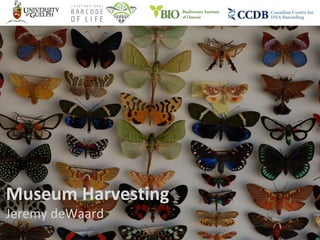
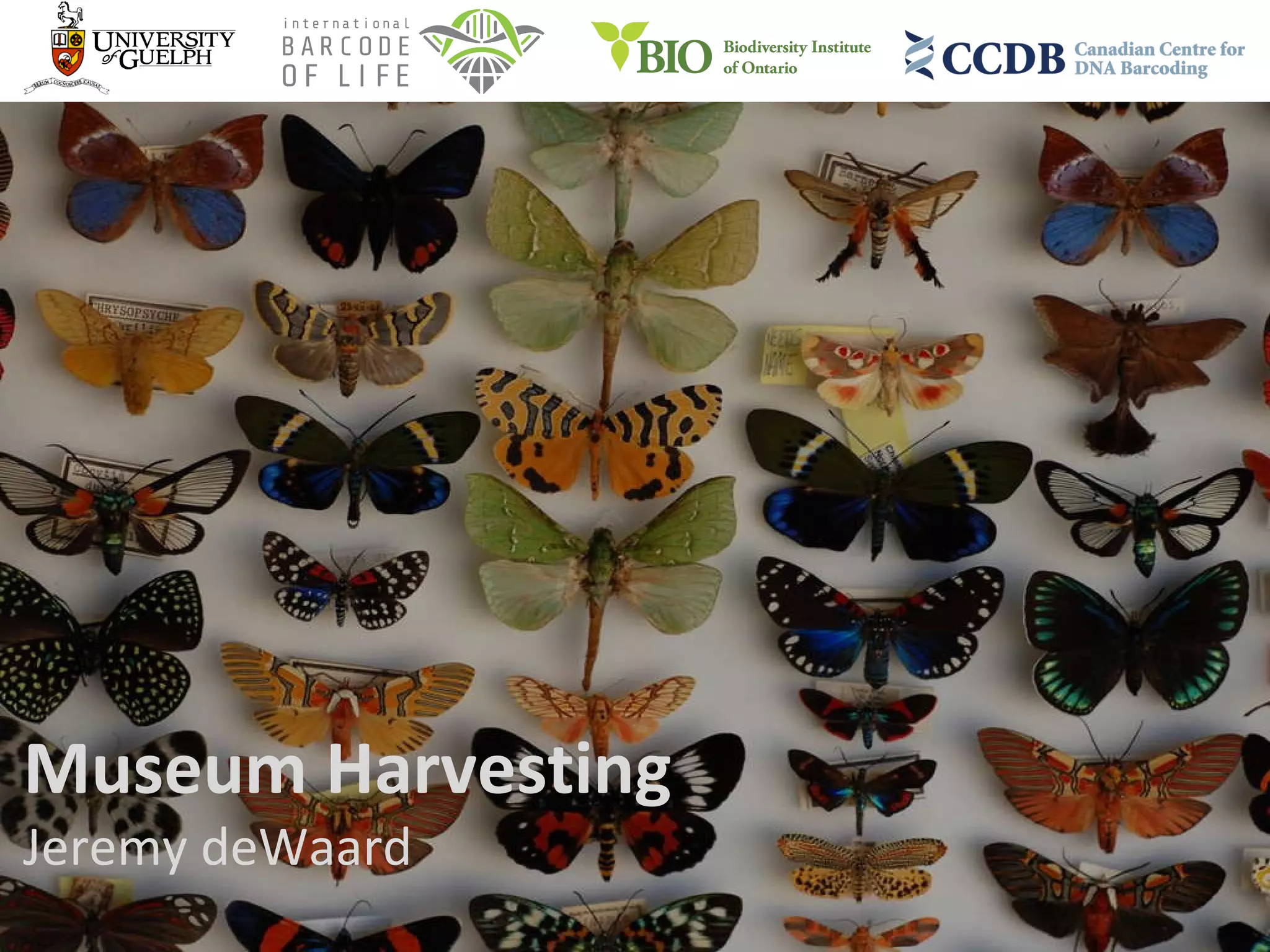

Museum Harvesting Jeremy deWaard
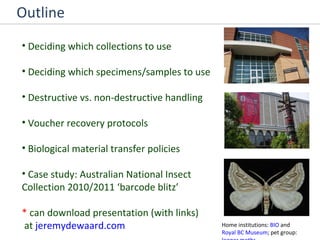
Outline Deciding which collections to use Deciding which specimens/samples to use Destructive vs. non-destructive handling Voucher recovery protocols Biological material transfer policies Case study: Australian National Insect Collection 2010/2011 ‘barcode blitz’ *  can download presentation (with links) at  jeremydewaard.com   Home institutions:  BIO  and  Royal BC Museum ; pet group:  looper moths
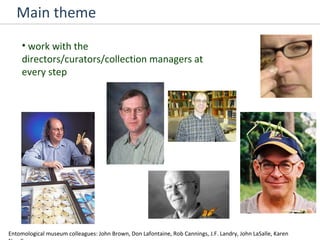
Main theme work with the directors/curators/collection managers at every step Entomological museum colleagues: John Brown, Don Lafontaine, Rob Cannings, J.F. Landry, John LaSalle, Karen Needham
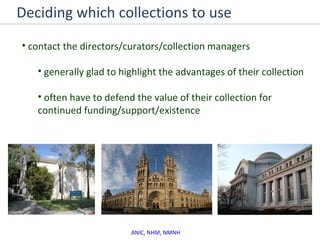
Deciding which collections to use contact the directors/curators/collection managers  generally glad to highlight the advantages of their collection often have to defend the value of their collection for continued funding/support/existence  ANIC ,  NHM ,  NMNH
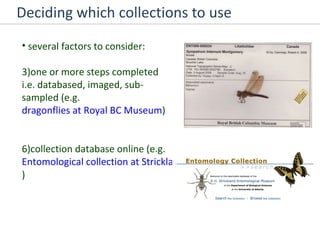
Deciding which collections to use several factors to consider: one or more steps completed i.e. databased, imaged, sub-sampled (e.g.  dragonflies at Royal BC Museum ) collection database online (e.g.  Entomological collection at Strickland )
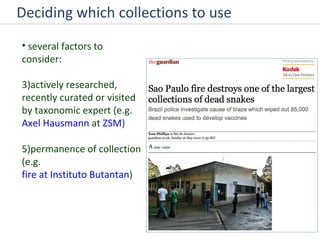
Deciding which collections to use several factors to consider: actively researched, recently curated or visited by taxonomic expert (e.g.  Axel Hausmann  at  ZSM ) permanence of collection (e.g.  fire at Instituto Butantan )
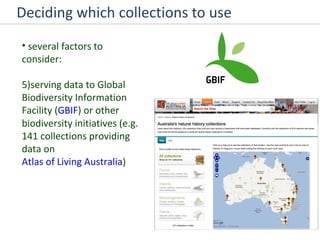
Deciding which collections to use several factors to consider: 5)serving data to Global Biodiversity Information Facility ( GBIF ) or other biodiversity initiatives (e.g. 141 collections providing data on  Atlas of Living Australia )
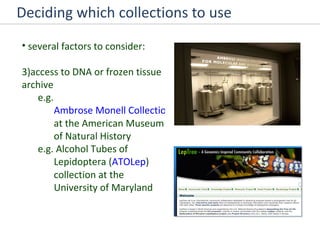
Deciding which collections to use several factors to consider: access to DNA or frozen tissue archive  e.g.  Ambrose Monell Collection for Molecular and Microbial Research  at the American Museum of Natural History e.g. Alcohol Tubes of Lepidoptera ( ATOLep ) collection at the University of Maryland
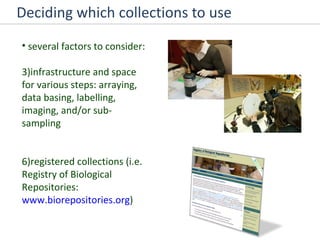
Deciding which collections to use several factors to consider: infrastructure and space for various steps: arraying, data basing, labelling, imaging, and/or sub-sampling registered collections (i.e. Registry of Biological Repositories:  www.biorepositories.org )
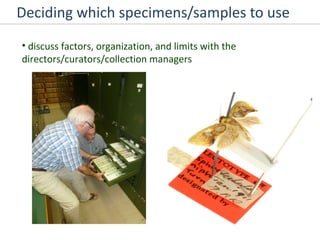
Deciding which specimens/samples to use discuss factors, organization, and limits with the directors/curators/collection managers
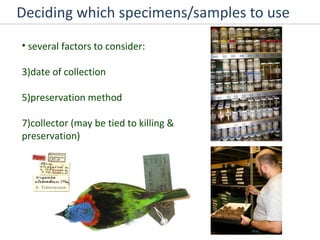
Deciding which specimens/samples to use several factors to consider: date of collection preservation method collector (may be tied to killing & preservation)
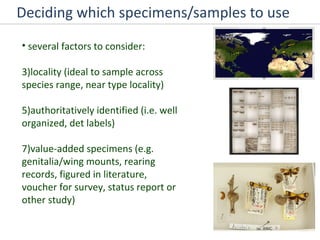
Deciding which specimens/samples to use several factors to consider: locality (ideal to sample across species range, near type locality) authoritatively identified (i.e. well organized, det labels) value-added specimens (e.g. genitalia/wing mounts, rearing records, figured in literature, voucher for survey, status report or other study)
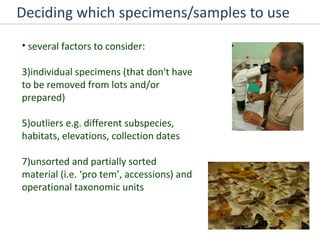
Deciding which specimens/samples to use several factors to consider: individual specimens (that don't have to be removed from lots and/or prepared) outliers e.g. different subspecies, habitats, elevations, collection dates unsorted and partially sorted material (i.e. ‘pro tem’, accessions) and operational taxonomic units
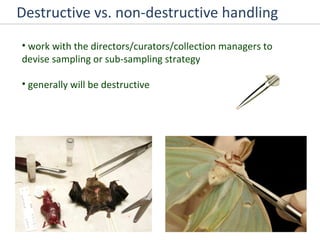
Destructive vs. non-destructive handling work with the directors/curators/collection managers to devise sampling or sub-sampling strategy generally will be destructive
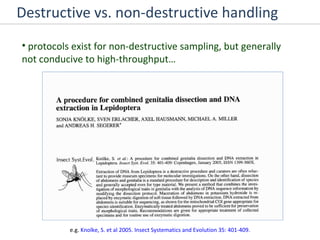
Destructive vs. non-destructive handling protocols exist for non-destructive sampling, but generally not conducive to high-throughput… e.g.  Knolke, S. et al 2005. Insect Systematics and Evolution 35: 401-409.
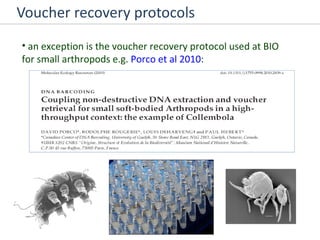
Voucher recovery protocols an exception is the voucher recovery protocol used at BIO for small arthropods e.g.  Porco et al 2010 :
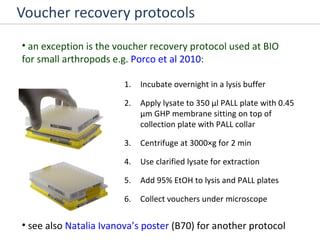
Voucher recovery protocols Incubate overnight in a lysis buffer Apply lysate to 350 µl PALL plate with 0.45 µm GHP membrane sitting on top of collection plate with PALL collar Centrifuge at 3000×g for 2 min Use clarified lysate for extraction Add 95% EtOH to lysis and PALL plates Collect vouchers under microscope an exception is the voucher recovery protocol used at BIO for small arthropods e.g.  Porco et al 2010 : see also  Natalia Ivanova’s poster  (B70) for another protocol
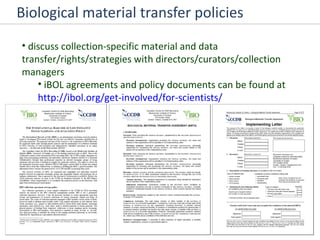
Biological material transfer policies discuss collection-specific material and data transfer/rights/strategies with directors/curators/collection managers iBOL agreements and policy documents can be found at  http://ibol.org/get-involved/for-scientists/
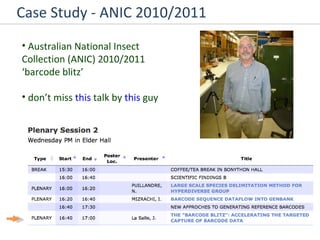
Case Study - ANIC 2010/2011 Australian National Insect Collection (ANIC) 2010/2011 ‘barcode blitz’ don’t miss  this  talk by  this  guy
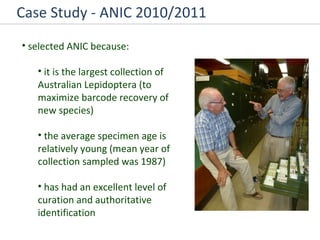
Case Study - ANIC 2010/2011 selected ANIC because: it is the largest collection of Australian Lepidoptera (to maximize barcode recovery of new species) the average specimen age is relatively young (mean year of  collection sampled was 1987) has had an excellent level of curation and authoritative identification
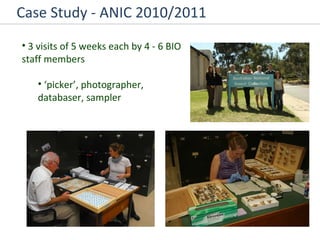
Case Study - ANIC 2010/2011 3 visits of 5 weeks each by 4 - 6 BIO staff members ‘ picker’, photographer, databaser, sampler
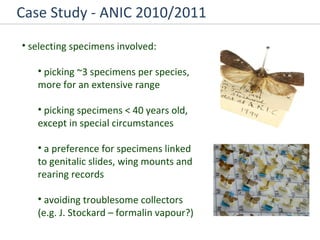
Case Study - ANIC 2010/2011 selecting specimens involved: picking ~3 specimens per species, more for an extensive range picking specimens < 40 years old, except in special circumstances  a preference for specimens linked to genitalic slides, wing mounts and rearing records avoiding troublesome collectors (e.g. J. Stockard – formalin vapour?)
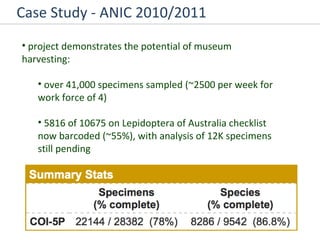
Case Study - ANIC 2010/2011 project demonstrates the potential of museum harvesting:  over 41,000 specimens sampled (~2500 per week for work force of 4) 5816 of 10675 on Lepidoptera of Australia checklist now barcoded (~55%), with analysis of 12K specimens still pending
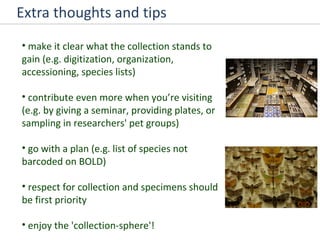
Extra thoughts and tips make it clear what the collection stands to gain (e.g. digitization, organization, accessioning, species lists)  contribute even more when you’re visiting (e.g. by giving a seminar, providing plates, or sampling in researchers' pet groups) go with a plan (e.g. list of species not barcoded on BOLD) respect for collection and specimens should be first priority enjoy the 'collection-sphere'!
 
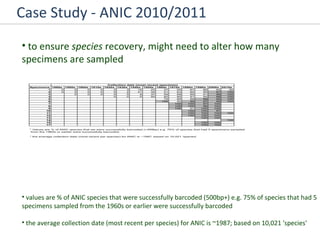
Case Study - ANIC 2010/2011 to ensure  species  recovery, might need to alter how many specimens are sampled values are % of ANIC species that were successfully barcoded (500bp+) e.g. 75% of species that had 5 specimens sampled from the 1960s or earlier were successfully barcoded  the average collection date (most recent per species) for ANIC is ~1987; based on 10,021 'species'
Case Study - ANIC 2010/2011 Trip breakdown:  ANIC-1 (Oct 2010) 12031 specimens 4334 species ANIC-2 (April 2011) 16351 specimens 5253 species ANIC-3 (Oct 2011) 12635 specimens 4721 species
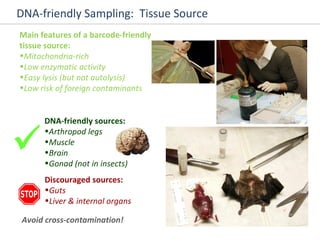
DNA-friendly Sampling:  Tissue Source  DNA-friendly sources: Arthropod legs Muscle Brain Gonad (not in insects) Discouraged sources: Guts Liver & internal organs Main features of a barcode-friendly  tissue source: Mitochondria-rich Low enzymatic activity Easy lysis (but not autolysis) Low risk of foreign contaminants  Avoid cross-contamination!
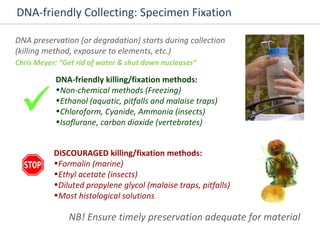
DNA-friendly Collecting: Specimen Fixation DNA preservation (or degradation) starts during collection  (killing method, exposure to elements, etc.)  Chris Meyer: “Get rid of water & shut down nucleases” DNA-friendly killing/fixation methods: Non-chemical methods (Freezing) Ethanol (aquatic, pitfalls and malaise traps) Chloroform, Cyanide, Ammonia (insects) Isoflurane, carbon dioxide (vertebrates) DISCOURAGED killing/fixation methods: Formalin (marine) Ethyl acetate (insects) Diluted propylene glycol (malaise traps, pitfalls) Most histological solutions  NB! Ensure timely preservation adequate for material
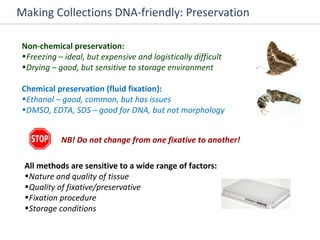
Making Collections DNA-friendly: Preservation Non-chemical preservation: Freezing – ideal, but expensive and logistically difficult Drying – good, but sensitive to storage environment NB! Do not change from one fixative to another! Chemical preservation (fluid fixation): Ethanol – good, common, but has issues DMSO, EDTA, SDS – good for DNA, but not morphology  All methods are sensitive to a wide range of factors: Nature and quality of tissue  Quality of fixative/preservative Fixation procedure Storage conditions
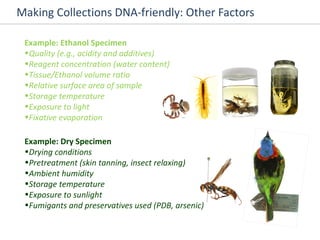
Making Collections DNA-friendly: Other Factors  Example: Ethanol Specimen Quality (e.g., acidity and additives) Reagent concentration (water content) Tissue/Ethanol volume ratio Relative surface area of sample Storage temperature Exposure to light Fixative evaporation Example: Dry Specimen Drying conditions Pretreatment (skin tanning, insect relaxing) Ambient humidity Storage temperature Exposure to sunlight Fumigants and preservatives used (PDB, arsenic)

Jeremy deWaard - Museum Harvesting

  • 1.
  • 2.
    Outline Deciding whichcollections to use Deciding which specimens/samples to use Destructive vs. non-destructive handling Voucher recovery protocols Biological material transfer policies Case study: Australian National Insect Collection 2010/2011 ‘barcode blitz’ * can download presentation (with links) at jeremydewaard.com Home institutions: BIO and Royal BC Museum ; pet group: looper moths
  • 3.
    Main theme workwith the directors/curators/collection managers at every step Entomological museum colleagues: John Brown, Don Lafontaine, Rob Cannings, J.F. Landry, John LaSalle, Karen Needham
  • 4.
    Deciding which collectionsto use contact the directors/curators/collection managers generally glad to highlight the advantages of their collection often have to defend the value of their collection for continued funding/support/existence ANIC , NHM , NMNH
  • 5.
    Deciding which collectionsto use several factors to consider: one or more steps completed i.e. databased, imaged, sub-sampled (e.g. dragonflies at Royal BC Museum ) collection database online (e.g. Entomological collection at Strickland )
  • 6.
    Deciding which collectionsto use several factors to consider: actively researched, recently curated or visited by taxonomic expert (e.g. Axel Hausmann at ZSM ) permanence of collection (e.g. fire at Instituto Butantan )
  • 7.
    Deciding which collectionsto use several factors to consider: 5)serving data to Global Biodiversity Information Facility ( GBIF ) or other biodiversity initiatives (e.g. 141 collections providing data on Atlas of Living Australia )
  • 8.
    Deciding which collectionsto use several factors to consider: access to DNA or frozen tissue archive e.g. Ambrose Monell Collection for Molecular and Microbial Research at the American Museum of Natural History e.g. Alcohol Tubes of Lepidoptera ( ATOLep ) collection at the University of Maryland
  • 9.
    Deciding which collectionsto use several factors to consider: infrastructure and space for various steps: arraying, data basing, labelling, imaging, and/or sub-sampling registered collections (i.e. Registry of Biological Repositories: www.biorepositories.org )
  • 10.
    Deciding which specimens/samplesto use discuss factors, organization, and limits with the directors/curators/collection managers
  • 11.
    Deciding which specimens/samplesto use several factors to consider: date of collection preservation method collector (may be tied to killing & preservation)
  • 12.
    Deciding which specimens/samplesto use several factors to consider: locality (ideal to sample across species range, near type locality) authoritatively identified (i.e. well organized, det labels) value-added specimens (e.g. genitalia/wing mounts, rearing records, figured in literature, voucher for survey, status report or other study)
  • 13.
    Deciding which specimens/samplesto use several factors to consider: individual specimens (that don't have to be removed from lots and/or prepared) outliers e.g. different subspecies, habitats, elevations, collection dates unsorted and partially sorted material (i.e. ‘pro tem’, accessions) and operational taxonomic units
  • 14.
    Destructive vs. non-destructivehandling work with the directors/curators/collection managers to devise sampling or sub-sampling strategy generally will be destructive
  • 15.
    Destructive vs. non-destructivehandling protocols exist for non-destructive sampling, but generally not conducive to high-throughput… e.g. Knolke, S. et al 2005. Insect Systematics and Evolution 35: 401-409.
  • 16.
    Voucher recovery protocolsan exception is the voucher recovery protocol used at BIO for small arthropods e.g. Porco et al 2010 :
  • 17.
    Voucher recovery protocolsIncubate overnight in a lysis buffer Apply lysate to 350 µl PALL plate with 0.45 µm GHP membrane sitting on top of collection plate with PALL collar Centrifuge at 3000×g for 2 min Use clarified lysate for extraction Add 95% EtOH to lysis and PALL plates Collect vouchers under microscope an exception is the voucher recovery protocol used at BIO for small arthropods e.g. Porco et al 2010 : see also Natalia Ivanova’s poster (B70) for another protocol
  • 18.
    Biological material transferpolicies discuss collection-specific material and data transfer/rights/strategies with directors/curators/collection managers iBOL agreements and policy documents can be found at http://ibol.org/get-involved/for-scientists/
  • 19.
    Case Study -ANIC 2010/2011 Australian National Insect Collection (ANIC) 2010/2011 ‘barcode blitz’ don’t miss this talk by this guy
  • 20.
    Case Study -ANIC 2010/2011 selected ANIC because: it is the largest collection of Australian Lepidoptera (to maximize barcode recovery of new species) the average specimen age is relatively young (mean year of collection sampled was 1987) has had an excellent level of curation and authoritative identification
  • 21.
    Case Study -ANIC 2010/2011 3 visits of 5 weeks each by 4 - 6 BIO staff members ‘ picker’, photographer, databaser, sampler
  • 22.
    Case Study -ANIC 2010/2011 selecting specimens involved: picking ~3 specimens per species, more for an extensive range picking specimens < 40 years old, except in special circumstances a preference for specimens linked to genitalic slides, wing mounts and rearing records avoiding troublesome collectors (e.g. J. Stockard – formalin vapour?)
  • 23.
    Case Study -ANIC 2010/2011 project demonstrates the potential of museum harvesting: over 41,000 specimens sampled (~2500 per week for work force of 4) 5816 of 10675 on Lepidoptera of Australia checklist now barcoded (~55%), with analysis of 12K specimens still pending
  • 24.
    Extra thoughts andtips make it clear what the collection stands to gain (e.g. digitization, organization, accessioning, species lists) contribute even more when you’re visiting (e.g. by giving a seminar, providing plates, or sampling in researchers' pet groups) go with a plan (e.g. list of species not barcoded on BOLD) respect for collection and specimens should be first priority enjoy the 'collection-sphere'!
  • 25.
  • 26.
    Case Study -ANIC 2010/2011 to ensure species recovery, might need to alter how many specimens are sampled values are % of ANIC species that were successfully barcoded (500bp+) e.g. 75% of species that had 5 specimens sampled from the 1960s or earlier were successfully barcoded the average collection date (most recent per species) for ANIC is ~1987; based on 10,021 'species'
  • 27.
    Case Study -ANIC 2010/2011 Trip breakdown: ANIC-1 (Oct 2010) 12031 specimens 4334 species ANIC-2 (April 2011) 16351 specimens 5253 species ANIC-3 (Oct 2011) 12635 specimens 4721 species
  • 28.
    DNA-friendly Sampling: Tissue Source DNA-friendly sources: Arthropod legs Muscle Brain Gonad (not in insects) Discouraged sources: Guts Liver & internal organs Main features of a barcode-friendly tissue source: Mitochondria-rich Low enzymatic activity Easy lysis (but not autolysis) Low risk of foreign contaminants  Avoid cross-contamination!
  • 29.
    DNA-friendly Collecting: SpecimenFixation DNA preservation (or degradation) starts during collection (killing method, exposure to elements, etc.) Chris Meyer: “Get rid of water & shut down nucleases” DNA-friendly killing/fixation methods: Non-chemical methods (Freezing) Ethanol (aquatic, pitfalls and malaise traps) Chloroform, Cyanide, Ammonia (insects) Isoflurane, carbon dioxide (vertebrates) DISCOURAGED killing/fixation methods: Formalin (marine) Ethyl acetate (insects) Diluted propylene glycol (malaise traps, pitfalls) Most histological solutions  NB! Ensure timely preservation adequate for material
  • 30.
    Making Collections DNA-friendly:Preservation Non-chemical preservation: Freezing – ideal, but expensive and logistically difficult Drying – good, but sensitive to storage environment NB! Do not change from one fixative to another! Chemical preservation (fluid fixation): Ethanol – good, common, but has issues DMSO, EDTA, SDS – good for DNA, but not morphology All methods are sensitive to a wide range of factors: Nature and quality of tissue Quality of fixative/preservative Fixation procedure Storage conditions
  • 31.
    Making Collections DNA-friendly:Other Factors Example: Ethanol Specimen Quality (e.g., acidity and additives) Reagent concentration (water content) Tissue/Ethanol volume ratio Relative surface area of sample Storage temperature Exposure to light Fixative evaporation Example: Dry Specimen Drying conditions Pretreatment (skin tanning, insect relaxing) Ambient humidity Storage temperature Exposure to sunlight Fumigants and preservatives used (PDB, arsenic)

Editor's Notes

  • #3 Expertise is in Nearctic looper moths, so most of my examples will be entomological, and biased towards North America and Australia.
  • #4 appears to be a recurring phenotype
  • #5 links
  • #7 want vouchers to exist in perpetuity
  • #9 Alcohol Tubes of Lepidoptera (ATOLep) collection
  • #10 You may not have your own imaging equipment, microscope, laptop, printer, etc. Unambiguous collection codes
  • #11 Paul Hebert discussing sampling the Lepidoptera in the Australian National Insect Collection with the head, John LaSalle. Of course one of the limits you may want to discuss is the access to sub-sample type specimens.
  • #12 Highly taxon-specific but I assume this will be covered this afternoon in module 4.
  • #14 if you’re trying to capture the full scope of genetic variation within a species, you may wish to sample the ‘outlier’ specimens
  • #16 http://www.mendeley.com/research/a-procedure-for-combined-genitalia-dissection-and-dna-extraction-in-lepidoptera/
  • #18 Microscopic examination of the specimens revealed that all diagnostic characters were intact after extraction including the presence and the position of chaeta, the tegument granulation and structures. inexpensive protocol involving voucher recovery
  • #19 links provider/recipient provide policies up front, avoid problems later
  • #20 Australian National Insect Collection 2010/2011 ‘barcode blitz’
  • #21 young in terms of specimen age You can see the head of ANIC, John LaSalle, laying out the ground rules
  • #22 Michelle will go through the various steps in the next talk
  • #23 Average age of specimens Formalin vapour?