Intellectual Property & Startups
• Dave Green
• Assistant General Counsel, IP
Policy
THE FOLLOWING MATERIALS DO NOT CONSTITUTE LEGAL
ADVICE, AND REPRESENT THE VIEWS OF THE PRESENTER ONLY,
AND MAY NOT REFLECT THE VIEWS OF MICROSOFT
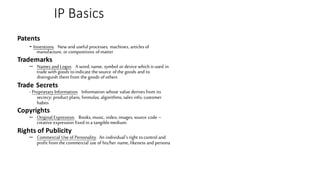
IP Basics
Patents
- Inventions. New and useful processes, machines, articlesof
manufacture, orcompositions ofmatter
Trademarks
– Names and Logos. A word, name, symbol ordevice whichisused in
trade withgoods toindicate thesource ofthe goods and to
distinguish themfrom the goods ofothers
Trade Secrets
- Proprietary Information. Information whose value derivesfrom its
secrecy: product plans, formulas, algorithms, sales info, customer
habits
Copyrights
– Original Expression. Books, music, video, images, source code –
creative expression fixed ina tangiblemedium.
Rights of Publicity
– Commercial Use of Personality. An individual'sright tocontrol and
profit fromthe commercial use of his/her name, likeness and persona
IP & Startups
Business
Case
IP
Ownership
IP
Diligence
IP Venture
Structures
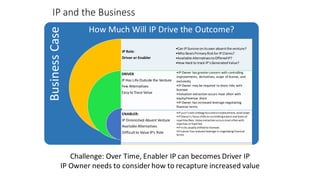
IP and the Business
BusinessCase
How Much Will IP Drive the Outcome?
IP Role:
Driver or Enabler
DRIVER
IP Has Life Outside the Venture
Few Alternatives
Easy to Trace Value
ENABLER:
IP Diminished Absent Venture
Available Alternatives
Difficult to Value IP’s Role
•Can IPSurvive onitsown absentthe venture?
•Who BearsPrimaryRiskfor IPClaims?
•Available AlternativestoOfferedIP?
•How Hard to track IP’sGeneratedValue?
•IP Owner has greater concern with controlling
improvements, derivatives, scope of license, and
exclusivity
•IP Owner may be required to share risks with
licensee
•Valuation extraction occurs most often with
equity/revenue share
•IP Owner has increased leverage negotiating
financial terms
•IPuser’s exit strategyfocusedonreplacement, wind down
•IPOwner’s focus shifts to controllingextent and basis of
royalties/fees. Value extractionoccurs most oftenwith
royalties or fixed fee
•IPrisks usuallyshiftedto licensee
•IPowner has reduced leverage in negotiating financial
terms
Challenge: Over Time, Enabler IP can becomes Driver IP
IP Owner needs to consider how to recapture increased value
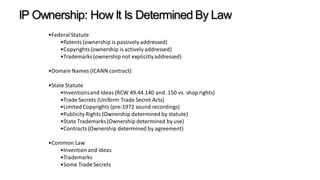
•Federal Statute
•Patents (ownership is passively addressed)
•Copyrights (ownership is actively addressed)
•Trademarks (ownership not explicitlyaddressed)
•Domain Names (ICANN contract)
•State Statute
•Inventionsand Ideas (RCW 49.44.140 and .150 vs. shop rights)
•Trade Secrets (Uniform Trade Secret Acts)
•Limited Copyrights (pre-1972 sound recordings)
•Publicity Rights (Ownership determined by statute)
•State Trademarks (Ownership determined by use)
•Contracts (Ownership determined by agreement)
•Common Law
•Inventionand Ideas
•Trademarks
•Some Trade Secrets
IP Ownership: How It Is Determined By Law
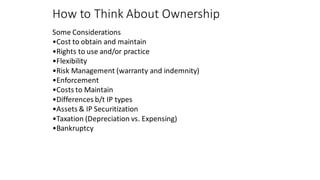
How to Think About Ownership
Some Considerations
•Cost to obtain and maintain
•Rights to use and/or practice
•Flexibility
•Risk Management (warranty and indemnity)
•Enforcement
•Costs to Maintain
•Differences b/t IP types
•Assets & IP Securitization
•Taxation (Depreciation vs. Expensing)
•Bankruptcy
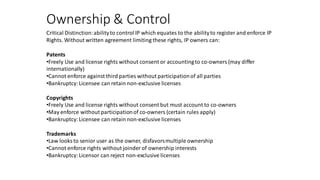
Ownership & Control
Critical Distinction:abilityto control IP which equates to the abilityto register and enforce IP
Rights. Without written agreement limiting these rights, IP owners can:
Patents
•Freely Use and license rights without consent or accountingto co-owners (may differ
internationally)
•Cannot enforce against third parties without participationof all parties
•Bankruptcy:Licensee can retain non-exclusive licenses
Copyrights
•Freely Use and license rights without consent but must account to co-owners
•May enforce without participationof co-owners (certain rules apply)
•Bankruptcy:Licensee can retain non-exclusive licenses
Trademarks
•Law looks to senior user as the owner, disfavorsmultiple ownership
•Cannot enforce rights without joinder of ownership interests
•Bankruptcy:Licensor can reject non-exclusive licenses
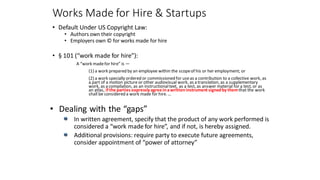
Works Made for Hire & Startups
• Default Under US Copyright Law:
• Authors own their copyright
• Employers own © for works made for hire
• § 101 (“work made for hire”):
A “work madefor hire” is —
(1) a work prepared by an employee within the scopeof his or her employment; or
(2) a work specially ordered or commissioned for useas a contribution to a collective work, as
a part of a motion picture or other audiovisual work, as a translation, as a supplementary
work, as a compilation, as an instructionaltext, as a test, as answer material for a test, or as
an atlas, if the parties expressly agree inawritteninstrument signedby themthat the work
shall be considered a work made for hire. …
• Dealing with the “gaps”
In written agreement, specify that the product of any work performed is
considered a “work made for hire”, and if not, is hereby assigned.
Additional provisions: require party to execute future agreements,
consider appointment of “power of attorney”
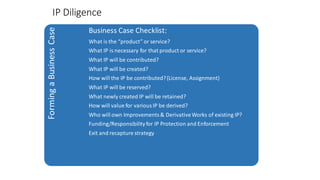
IP Diligence
FormingaBusinessCase
Business Case Checklist:
What is the “product” or service?
What IP is necessary for that product or service?
What IP will be contributed?
What IP will be created?
How will the IP be contributed?(License, Assignment)
What IP will be reserved?
What newly created IP will be retained?
How will value for various IP be derived?
Who will own Improvements & DerivativeWorks of existing IP?
Funding/Responsibilityfor IP Protection and Enforcement
Exit and recapture strategy
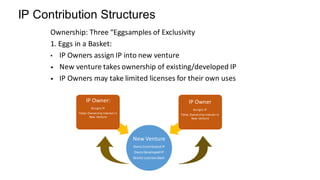
IP Contribution Structures
Ownership: Three “Eggsamples of Exclusivity
1. Eggs in a Basket:
• IP Owners assign IP into new venture
• New venture takes ownership of existing/developed IP
• IP Owners may take limited licenses for their own uses
New Venture
OwnsContributedIP
OwnsDevelopedIP
Grants LicensesBack
IP Owner:
Assigns IP
Takes Ownership Interest in
New Venture
IP Owner
Assigns IP
Takes Ownership Interest in
New Venture
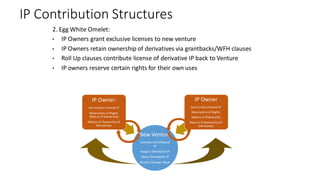
IP Contribution Structures
2. Egg White Omelet:
• IP Owners grant exclusive licenses to new venture
• IP Owners retain ownership of derivatives via grantbacks/WFH clauses
• Roll Up clauses contribute license of derivative IP back to Venture
• IP owners reserve certain rights for their own uses
New Venture
Licenses Contributed
IP
Assigns Derivative IP
Owns Developed IP
Grants Licenses Back
IP Owner:
Exclusively Licenses IP
Reservation of Rights
Retains IP Ownership
Retains IP Ownership of
Derivatives
IP Owner
Exclusively Licenses IP
Reservation of Rights
Retains IP Ownership
Retains IP Ownership of
Derivatives
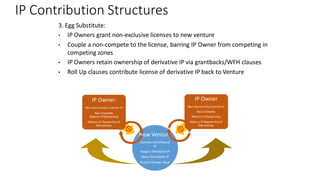
IP Contribution Structures
3. Egg Substitute:
• IP Owners grant non-exclusive licenses to new venture
• Couple a non-compete to the license, barring IP Owner from competing in
competing zones
• IP Owners retain ownership of derivative IP via grantbacks/WFH clauses
• Roll Up clauses contribute license of derivative IP back to Venture
New Venture
Licenses Contributed
IP
Assigns Derivative IP
Owns Developed IP
Grants Licenses Back
IP Owner:
Non-Exclusively Licenses IP
Non-Compete
Retains IP Ownership
Retains IP Ownership of
Derivatives
IP Owner
Non-Exclusively Licenses IP
Non-Compete
Retains IP Ownership
Retains IP Ownership of
Derivatives
IP Transactions
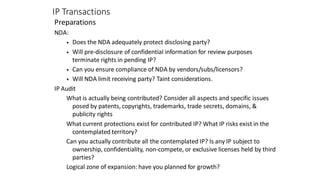
Preparations
NDA:
• Does the NDA adequately protect disclosing party?
• Will pre-disclosure of confidential information for review purposes
terminate rights in pending IP?
• Can you ensure compliance of NDA by vendors/subs/licensors?
• Will NDA limit receiving party? Taint considerations.
IP Audit
What is actually being contributed? Consider all aspects and specific issues
posed by patents, copyrights, trademarks, trade secrets, domains, &
publicity rights
What current protections exist for contributed IP? What IP risks exist in the
contemplated territory?
Can you actually contribute all the contemplated IP? Is any IP subject to
ownership, confidentiality, non-compete, or exclusive licenses held by third
parties?
Logical zone of expansion: have you planned for growth?
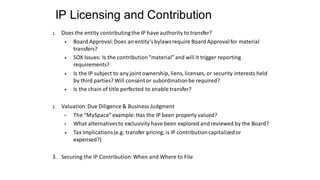
IP Licensing and Contribution
1. Does the entity contributingthe IP have authority to transfer?
• Board Approval:Does an entity’s bylaws require Board Approvalfor material
transfers?
• SOX Issues: Is the contribution“material”and will it trigger reporting
requirements?
• Is the IP subject to any joint ownership, liens, licenses, or security interests held
by third parties? Will consent or subordinationbe required?
• Is the chain of title perfected to enable transfer?
2. Valuation:Due Diligence & Business Judgment
• The “MySpace” example:Has the IP been properly valued?
• What alternativesto exclusivity have been explored and reviewed by the Board?
• Tax Implications(e.g. transfer pricing; is IP contributioncapitalizedor
expensed?)
3. Securing the IP Contribution:When and Where to File
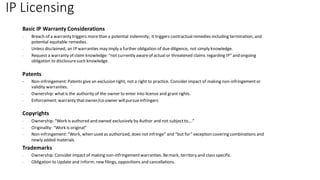
IP Licensing
Basic IP Warranty Considerations
- Breach of a warranty triggers morethan a potential indemnity; it triggers contractualremedies including termination, and
potential equitable remedies.
- Unless disclaimed, an IP warranties may imply a further obligation of due diligence, not simply knowledge.
- Request a warranty of claim knowledge: “not currently awareof actual or threatened claims regarding IP” and ongoing
obligation to disclosuresuch knowledge.
Patents
- Non-infringement: Patents give an exclusion right, not a right to practice. Consider impact of making non-infringementor
validity warranties.
- Ownership: whatis the authority of the owner to enter into license and grantrights.
- Enforcement: warranty thatowner/co-owner willpursueinfringers
Copyrights
- Ownership: “Work is authored and owned exclusively by Author and not subjectto….”
- Originality: “Work is original”
- Non-infringement: “Work, when used as authorized, does not infringe” and “but for” exception covering combinations and
newly added materials
Trademarks
- Ownership: Consider impactof making non-infringementwarranties. Bemark, territory and class specific.
- Obligation to Update and Inform: new filings, oppositions and cancellations.
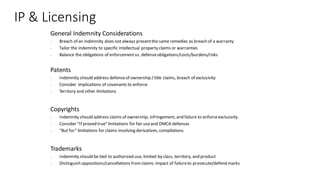
IP & Licensing
General Indemnity Considerations
- Breach of an indemnity does not always presentthe same remedies as breach of a warranty
- Tailor the indemnity to specific intellectual property claims or warranties
- Balance the obligations of enforcementvs. defenseobligations/costs/burdens/risks
Patents
- Indemnity should address defenseof ownership /title claims, breach of exclusivity
- Consider implications of covenants to enforce
- Territory and other limitations
Copyrights
- Indemnity should address claims of ownership, infringement, and failure to enforceexclusivity
- Consider “If proved true” limitations for fair useand DMCA defenses
- “But for” limitations for claims involving derivatives, compilations
Trademarks
- Indemnity should be tied to authorized use, limited by class, territory, and product
- Distinguish oppositions/cancellations fromclaims: impact of failureto prosecute/defend marks
IP & Aereo
A decade of mostly tech-friendly legal decisions
• Kelly: Ok to display thumbnail images in search results
• Perfect 10: displaying inline links to images within search results
• Amazon: providing online services to vendors who may turn out to sell
infringing content
• Veoh: hosting and modifying UGC videos that may be infringing
• YouTube: allowing users to upload and distribute online videos
• CableVision: providing remote cloud-based DVR, not licensed by studios
• Google Book Search: mass digitizing of books, portions made public for
transformational uses, not licensed by publishers
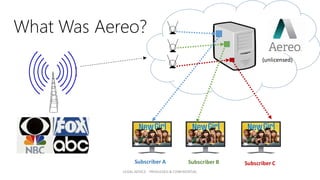
What Was Aereo?
Subscriber A Subscriber B Subscriber C
(unlicensed)
LEGAL ADVICE - PRIVILEGED & CONFIDENTIAL
Litigation with Broadcasters
Fox: Aereo infringes copyright because
• they “transmit . . . a performance [of TV]. . . to the public.”
• they have not paid for a retransmission license like cable companies
Aereo: We do not infringe copyright because:
• We don’t transmit anything; we rent equipment to subscribers who transmit
TV to themselves
• Each transmission is private, from a dedicated antenna to a dedicated
storage space to only one subscriber.
• No different than an online DVR, where a cable company’s cloud DVR
streamed discrete cloud copies of TV at each user’s direction.
Supreme Court’s Holding
• Aereo is like a cable company and Congress meant to stop cable companies
from transmitting TV signals without a license
• Aereo’s multi-antenna and multi-copy technical architecture does not
functionally distinguish it from being like a cable company
• Aereo’s technical architecture does not make a difference to users / UX
• Multiple discrete private streams of the same work could be aggregated as a
“performance” to “the public.”
“Noise” After Aereo
• Mike Masnick (TechDirt): “More I reread Aereo, more ridiculous it seems. Had hoped for a
narrow ruling. SCOTUS thinks it is. But it's not.”
• James Grimmelman(U Maryland Law): “Breyer's Aereo decision is functional rather than focused
on technical details. But it doesn't draw a clear line on ok/prohibited uses.”
• Timothy Lee (Washington Post): “the Supreme Court just blew up the Cablevision rule,
endangering cloud storage services.”
• Eric Goldman, Forbes,“Four Unanswered Questions From Aereo’s Supreme Court Loss”:
“intermediaries who think they are just user-driven technology providers might now find that
their actions are legally significant. Indeed, the implications of the ‘whodunit’ question ripple
throughout Internet Law.”
• John Bergmayer, Public Knowledge, “Uh oh, Aereo”: “[T]he Court uses reasoning that
could apply very easily to any number of online services—file hosting, cloud lockers,
even VPNs—as well as services that no one has even come up with yet. It then simply
declares that Aereo is different, because it looks so much like cable.”
Aereo Takeways
Expect that
• Rights owners will try to expand Aereo beyond TV retransmissions
(e.g. Fox v. DISH and “Sling” technology)
• Rights owners will fight to limit reach of prior tech-friendly cases
• Courts will grapple with how narrowly to apply Aereo
• Tech companies (or their investors) will shy away from solutions
designed solely to exploit perceived IP loopholes
• Tech companies won’t be deterred from innovation enabling access,
use, and sharing of content

Intellectual Property & Startups - Microsoft Ventures

  • 1.
    Intellectual Property &Startups • Dave Green • Assistant General Counsel, IP Policy THE FOLLOWING MATERIALS DO NOT CONSTITUTE LEGAL ADVICE, AND REPRESENT THE VIEWS OF THE PRESENTER ONLY, AND MAY NOT REFLECT THE VIEWS OF MICROSOFT
  • 2.
    IP Basics Patents - Inventions.New and useful processes, machines, articlesof manufacture, orcompositions ofmatter Trademarks – Names and Logos. A word, name, symbol ordevice whichisused in trade withgoods toindicate thesource ofthe goods and to distinguish themfrom the goods ofothers Trade Secrets - Proprietary Information. Information whose value derivesfrom its secrecy: product plans, formulas, algorithms, sales info, customer habits Copyrights – Original Expression. Books, music, video, images, source code – creative expression fixed ina tangiblemedium. Rights of Publicity – Commercial Use of Personality. An individual'sright tocontrol and profit fromthe commercial use of his/her name, likeness and persona
  • 3.
  • 4.
    IP and theBusiness BusinessCase How Much Will IP Drive the Outcome? IP Role: Driver or Enabler DRIVER IP Has Life Outside the Venture Few Alternatives Easy to Trace Value ENABLER: IP Diminished Absent Venture Available Alternatives Difficult to Value IP’s Role •Can IPSurvive onitsown absentthe venture? •Who BearsPrimaryRiskfor IPClaims? •Available AlternativestoOfferedIP? •How Hard to track IP’sGeneratedValue? •IP Owner has greater concern with controlling improvements, derivatives, scope of license, and exclusivity •IP Owner may be required to share risks with licensee •Valuation extraction occurs most often with equity/revenue share •IP Owner has increased leverage negotiating financial terms •IPuser’s exit strategyfocusedonreplacement, wind down •IPOwner’s focus shifts to controllingextent and basis of royalties/fees. Value extractionoccurs most oftenwith royalties or fixed fee •IPrisks usuallyshiftedto licensee •IPowner has reduced leverage in negotiating financial terms Challenge: Over Time, Enabler IP can becomes Driver IP IP Owner needs to consider how to recapture increased value
  • 5.
    •Federal Statute •Patents (ownershipis passively addressed) •Copyrights (ownership is actively addressed) •Trademarks (ownership not explicitlyaddressed) •Domain Names (ICANN contract) •State Statute •Inventionsand Ideas (RCW 49.44.140 and .150 vs. shop rights) •Trade Secrets (Uniform Trade Secret Acts) •Limited Copyrights (pre-1972 sound recordings) •Publicity Rights (Ownership determined by statute) •State Trademarks (Ownership determined by use) •Contracts (Ownership determined by agreement) •Common Law •Inventionand Ideas •Trademarks •Some Trade Secrets IP Ownership: How It Is Determined By Law
  • 6.
    How to ThinkAbout Ownership Some Considerations •Cost to obtain and maintain •Rights to use and/or practice •Flexibility •Risk Management (warranty and indemnity) •Enforcement •Costs to Maintain •Differences b/t IP types •Assets & IP Securitization •Taxation (Depreciation vs. Expensing) •Bankruptcy
  • 7.
    Ownership & Control CriticalDistinction:abilityto control IP which equates to the abilityto register and enforce IP Rights. Without written agreement limiting these rights, IP owners can: Patents •Freely Use and license rights without consent or accountingto co-owners (may differ internationally) •Cannot enforce against third parties without participationof all parties •Bankruptcy:Licensee can retain non-exclusive licenses Copyrights •Freely Use and license rights without consent but must account to co-owners •May enforce without participationof co-owners (certain rules apply) •Bankruptcy:Licensee can retain non-exclusive licenses Trademarks •Law looks to senior user as the owner, disfavorsmultiple ownership •Cannot enforce rights without joinder of ownership interests •Bankruptcy:Licensor can reject non-exclusive licenses
  • 8.
    Works Made forHire & Startups • Default Under US Copyright Law: • Authors own their copyright • Employers own © for works made for hire • § 101 (“work made for hire”): A “work madefor hire” is — (1) a work prepared by an employee within the scopeof his or her employment; or (2) a work specially ordered or commissioned for useas a contribution to a collective work, as a part of a motion picture or other audiovisual work, as a translation, as a supplementary work, as a compilation, as an instructionaltext, as a test, as answer material for a test, or as an atlas, if the parties expressly agree inawritteninstrument signedby themthat the work shall be considered a work made for hire. … • Dealing with the “gaps” In written agreement, specify that the product of any work performed is considered a “work made for hire”, and if not, is hereby assigned. Additional provisions: require party to execute future agreements, consider appointment of “power of attorney”
  • 9.
    IP Diligence FormingaBusinessCase Business CaseChecklist: What is the “product” or service? What IP is necessary for that product or service? What IP will be contributed? What IP will be created? How will the IP be contributed?(License, Assignment) What IP will be reserved? What newly created IP will be retained? How will value for various IP be derived? Who will own Improvements & DerivativeWorks of existing IP? Funding/Responsibilityfor IP Protection and Enforcement Exit and recapture strategy
  • 10.
    IP Contribution Structures Ownership:Three “Eggsamples of Exclusivity 1. Eggs in a Basket: • IP Owners assign IP into new venture • New venture takes ownership of existing/developed IP • IP Owners may take limited licenses for their own uses New Venture OwnsContributedIP OwnsDevelopedIP Grants LicensesBack IP Owner: Assigns IP Takes Ownership Interest in New Venture IP Owner Assigns IP Takes Ownership Interest in New Venture
  • 11.
    IP Contribution Structures 2.Egg White Omelet: • IP Owners grant exclusive licenses to new venture • IP Owners retain ownership of derivatives via grantbacks/WFH clauses • Roll Up clauses contribute license of derivative IP back to Venture • IP owners reserve certain rights for their own uses New Venture Licenses Contributed IP Assigns Derivative IP Owns Developed IP Grants Licenses Back IP Owner: Exclusively Licenses IP Reservation of Rights Retains IP Ownership Retains IP Ownership of Derivatives IP Owner Exclusively Licenses IP Reservation of Rights Retains IP Ownership Retains IP Ownership of Derivatives
  • 12.
    IP Contribution Structures 3.Egg Substitute: • IP Owners grant non-exclusive licenses to new venture • Couple a non-compete to the license, barring IP Owner from competing in competing zones • IP Owners retain ownership of derivative IP via grantbacks/WFH clauses • Roll Up clauses contribute license of derivative IP back to Venture New Venture Licenses Contributed IP Assigns Derivative IP Owns Developed IP Grants Licenses Back IP Owner: Non-Exclusively Licenses IP Non-Compete Retains IP Ownership Retains IP Ownership of Derivatives IP Owner Non-Exclusively Licenses IP Non-Compete Retains IP Ownership Retains IP Ownership of Derivatives
  • 13.
    IP Transactions Preparations NDA: • Doesthe NDA adequately protect disclosing party? • Will pre-disclosure of confidential information for review purposes terminate rights in pending IP? • Can you ensure compliance of NDA by vendors/subs/licensors? • Will NDA limit receiving party? Taint considerations. IP Audit What is actually being contributed? Consider all aspects and specific issues posed by patents, copyrights, trademarks, trade secrets, domains, & publicity rights What current protections exist for contributed IP? What IP risks exist in the contemplated territory? Can you actually contribute all the contemplated IP? Is any IP subject to ownership, confidentiality, non-compete, or exclusive licenses held by third parties? Logical zone of expansion: have you planned for growth?
  • 14.
    IP Licensing andContribution 1. Does the entity contributingthe IP have authority to transfer? • Board Approval:Does an entity’s bylaws require Board Approvalfor material transfers? • SOX Issues: Is the contribution“material”and will it trigger reporting requirements? • Is the IP subject to any joint ownership, liens, licenses, or security interests held by third parties? Will consent or subordinationbe required? • Is the chain of title perfected to enable transfer? 2. Valuation:Due Diligence & Business Judgment • The “MySpace” example:Has the IP been properly valued? • What alternativesto exclusivity have been explored and reviewed by the Board? • Tax Implications(e.g. transfer pricing; is IP contributioncapitalizedor expensed?) 3. Securing the IP Contribution:When and Where to File
  • 15.
    IP Licensing Basic IPWarranty Considerations - Breach of a warranty triggers morethan a potential indemnity; it triggers contractualremedies including termination, and potential equitable remedies. - Unless disclaimed, an IP warranties may imply a further obligation of due diligence, not simply knowledge. - Request a warranty of claim knowledge: “not currently awareof actual or threatened claims regarding IP” and ongoing obligation to disclosuresuch knowledge. Patents - Non-infringement: Patents give an exclusion right, not a right to practice. Consider impact of making non-infringementor validity warranties. - Ownership: whatis the authority of the owner to enter into license and grantrights. - Enforcement: warranty thatowner/co-owner willpursueinfringers Copyrights - Ownership: “Work is authored and owned exclusively by Author and not subjectto….” - Originality: “Work is original” - Non-infringement: “Work, when used as authorized, does not infringe” and “but for” exception covering combinations and newly added materials Trademarks - Ownership: Consider impactof making non-infringementwarranties. Bemark, territory and class specific. - Obligation to Update and Inform: new filings, oppositions and cancellations.
  • 16.
    IP & Licensing GeneralIndemnity Considerations - Breach of an indemnity does not always presentthe same remedies as breach of a warranty - Tailor the indemnity to specific intellectual property claims or warranties - Balance the obligations of enforcementvs. defenseobligations/costs/burdens/risks Patents - Indemnity should address defenseof ownership /title claims, breach of exclusivity - Consider implications of covenants to enforce - Territory and other limitations Copyrights - Indemnity should address claims of ownership, infringement, and failure to enforceexclusivity - Consider “If proved true” limitations for fair useand DMCA defenses - “But for” limitations for claims involving derivatives, compilations Trademarks - Indemnity should be tied to authorized use, limited by class, territory, and product - Distinguish oppositions/cancellations fromclaims: impact of failureto prosecute/defend marks
  • 17.
    IP & Aereo Adecade of mostly tech-friendly legal decisions • Kelly: Ok to display thumbnail images in search results • Perfect 10: displaying inline links to images within search results • Amazon: providing online services to vendors who may turn out to sell infringing content • Veoh: hosting and modifying UGC videos that may be infringing • YouTube: allowing users to upload and distribute online videos • CableVision: providing remote cloud-based DVR, not licensed by studios • Google Book Search: mass digitizing of books, portions made public for transformational uses, not licensed by publishers
  • 18.
    What Was Aereo? SubscriberA Subscriber B Subscriber C (unlicensed) LEGAL ADVICE - PRIVILEGED & CONFIDENTIAL
  • 19.
    Litigation with Broadcasters Fox:Aereo infringes copyright because • they “transmit . . . a performance [of TV]. . . to the public.” • they have not paid for a retransmission license like cable companies Aereo: We do not infringe copyright because: • We don’t transmit anything; we rent equipment to subscribers who transmit TV to themselves • Each transmission is private, from a dedicated antenna to a dedicated storage space to only one subscriber. • No different than an online DVR, where a cable company’s cloud DVR streamed discrete cloud copies of TV at each user’s direction.
  • 20.
    Supreme Court’s Holding •Aereo is like a cable company and Congress meant to stop cable companies from transmitting TV signals without a license • Aereo’s multi-antenna and multi-copy technical architecture does not functionally distinguish it from being like a cable company • Aereo’s technical architecture does not make a difference to users / UX • Multiple discrete private streams of the same work could be aggregated as a “performance” to “the public.”
  • 21.
    “Noise” After Aereo •Mike Masnick (TechDirt): “More I reread Aereo, more ridiculous it seems. Had hoped for a narrow ruling. SCOTUS thinks it is. But it's not.” • James Grimmelman(U Maryland Law): “Breyer's Aereo decision is functional rather than focused on technical details. But it doesn't draw a clear line on ok/prohibited uses.” • Timothy Lee (Washington Post): “the Supreme Court just blew up the Cablevision rule, endangering cloud storage services.” • Eric Goldman, Forbes,“Four Unanswered Questions From Aereo’s Supreme Court Loss”: “intermediaries who think they are just user-driven technology providers might now find that their actions are legally significant. Indeed, the implications of the ‘whodunit’ question ripple throughout Internet Law.” • John Bergmayer, Public Knowledge, “Uh oh, Aereo”: “[T]he Court uses reasoning that could apply very easily to any number of online services—file hosting, cloud lockers, even VPNs—as well as services that no one has even come up with yet. It then simply declares that Aereo is different, because it looks so much like cable.”
  • 22.
    Aereo Takeways Expect that •Rights owners will try to expand Aereo beyond TV retransmissions (e.g. Fox v. DISH and “Sling” technology) • Rights owners will fight to limit reach of prior tech-friendly cases • Courts will grapple with how narrowly to apply Aereo • Tech companies (or their investors) will shy away from solutions designed solely to exploit perceived IP loopholes • Tech companies won’t be deterred from innovation enabling access, use, and sharing of content