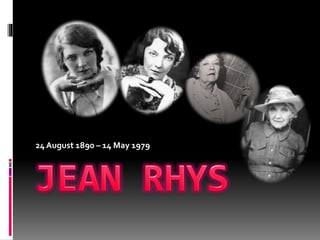
24 August 1890 – 14 May 1979
 Ella Gwendolyn ReesWilliams.
 She was a mid-20th-century novelist from
the Caribbean island of Dominica.
 She is best known for her novel Wide
Sargasso Sea (1966), written as a prequel
to Charlotte Brontë's Jane Eyre.
Early life
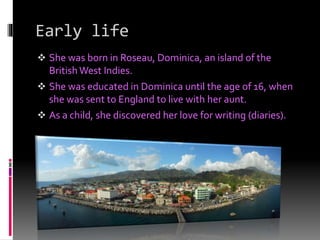
 She was born in Roseau, Dominica, an island of the
British West Indies.
 She was educated in Dominica until the age of 16, when
she was sent to England to live with her aunt.
 As a child, she discovered her love for writing (diaries).
Alcoholism
Prostitution
Abandonment
Abortion
Contradiction
Feminism
“The little girl who wouldn't grow up, yet whose work
depended, ultimately, upon the maturity of experience.”
Writing career
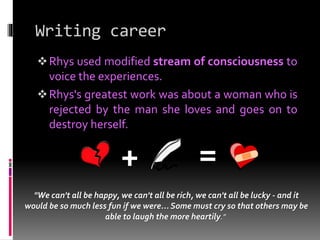
Rhys used modified stream of consciousness to
voice the experiences.
Rhys's greatest work was about a woman who is
rejected by the man she loves and goes on to
destroy herself.
"We can't all be happy, we can't all be rich, we can't all be lucky - and it
would be so much less fun if we were... Some must cry so that others may be
able to laugh the more heartily.”
+ =
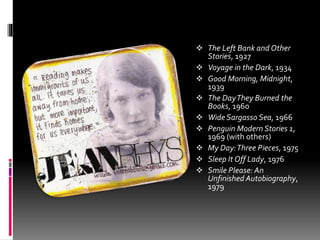
 The Left Bank and Other
Stories, 1927
 Voyage in the Dark, 1934
 Good Morning, Midnight,
1939
 The DayThey Burned the
Books, 1960
 Wide Sargasso Sea, 1966
 Penguin Modern Stories 1,
1969 (with others)
 My Day:Three Pieces, 1975
 Sleep It Off Lady, 1976
 Smile Please: An
Unfinished Autobiography,
1979
Rhys's life was profoundly marked
by a sense of exile, loss, and
alienation-dominant themes in her
novels and short stories. Despite
critical acclaim at the end of her
life, Rhys died in 1979 still
doubting the merit of her work.
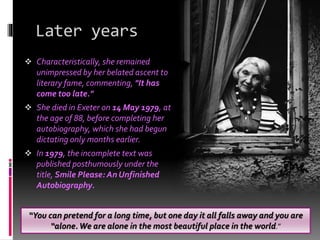
Later years
 Characteristically, she remained
unimpressed by her belated ascent to
literary fame, commenting, "It has
come too late."
 She died in Exeter on 14 May 1979, at
the age of 88, before completing her
autobiography, which she had begun
dictating only months earlier.
 In 1979, the incomplete text was
published posthumously under the
title, Smile Please: An Unfinished
Autobiography.
“You can pretend for a long time, but one day it all falls away and you are
“alone.We are alone in the most beautiful place in the world.”
1976
1. Tell a short summary of the
tale "I used to live here" from
the denotative aspect.
2. Why does the story begin with
such a long description of the
stones? What do you think
each stone refers to, in real
life?
3. What guesses can you make
about how the woman feels
about this place? What her
relationship to the place is
like?
4. How does the mood of the
story change as the woman
gets closer to the house?
5. Why do you think the children
ignore the woman in the story?
6. How do you think the woman
feels about the changes she
sees in the place she's
reaching?
7. Do you think the woman is
alive or not? Why? Tell
examples from the story that
support your thoughts.
8. What do you think the next
fragment from the story refers to?
"Very fair children, as Europeans born in the
West Indies so often are: as if the white
blood is asserting itself against all the
odds."
9. What do you think she “knows
for the first time” at the end of
the story?
10. Is there any relationship
between the story and Jean
Rhys' life?
Jean Rhys biography.

Jean Rhys biography.

  • 1.
    24 August 1890– 14 May 1979
  • 2.
     Ella GwendolynReesWilliams.  She was a mid-20th-century novelist from the Caribbean island of Dominica.  She is best known for her novel Wide Sargasso Sea (1966), written as a prequel to Charlotte Brontë's Jane Eyre.
  • 3.
    Early life  Shewas born in Roseau, Dominica, an island of the British West Indies.  She was educated in Dominica until the age of 16, when she was sent to England to live with her aunt.  As a child, she discovered her love for writing (diaries).
  • 4.
    Alcoholism Prostitution Abandonment Abortion Contradiction Feminism “The little girlwho wouldn't grow up, yet whose work depended, ultimately, upon the maturity of experience.”
  • 5.
    Writing career Rhys usedmodified stream of consciousness to voice the experiences. Rhys's greatest work was about a woman who is rejected by the man she loves and goes on to destroy herself. "We can't all be happy, we can't all be rich, we can't all be lucky - and it would be so much less fun if we were... Some must cry so that others may be able to laugh the more heartily.” + =
  • 7.
     The LeftBank and Other Stories, 1927  Voyage in the Dark, 1934  Good Morning, Midnight, 1939  The DayThey Burned the Books, 1960  Wide Sargasso Sea, 1966  Penguin Modern Stories 1, 1969 (with others)  My Day:Three Pieces, 1975  Sleep It Off Lady, 1976  Smile Please: An Unfinished Autobiography, 1979
  • 8.
    Rhys's life wasprofoundly marked by a sense of exile, loss, and alienation-dominant themes in her novels and short stories. Despite critical acclaim at the end of her life, Rhys died in 1979 still doubting the merit of her work.
  • 9.
    Later years  Characteristically,she remained unimpressed by her belated ascent to literary fame, commenting, "It has come too late."  She died in Exeter on 14 May 1979, at the age of 88, before completing her autobiography, which she had begun dictating only months earlier.  In 1979, the incomplete text was published posthumously under the title, Smile Please: An Unfinished Autobiography. “You can pretend for a long time, but one day it all falls away and you are “alone.We are alone in the most beautiful place in the world.”
  • 11.
  • 13.
    1. Tell ashort summary of the tale "I used to live here" from the denotative aspect.
  • 14.
    2. Why doesthe story begin with such a long description of the stones? What do you think each stone refers to, in real life?
  • 15.
    3. What guessescan you make about how the woman feels about this place? What her relationship to the place is like?
  • 16.
    4. How doesthe mood of the story change as the woman gets closer to the house?
  • 17.
    5. Why doyou think the children ignore the woman in the story?
  • 18.
    6. How doyou think the woman feels about the changes she sees in the place she's reaching?
  • 19.
    7. Do youthink the woman is alive or not? Why? Tell examples from the story that support your thoughts.
  • 20.
    8. What doyou think the next fragment from the story refers to? "Very fair children, as Europeans born in the West Indies so often are: as if the white blood is asserting itself against all the odds."
  • 21.
    9. What doyou think she “knows for the first time” at the end of the story?
  • 22.
    10. Is thereany relationship between the story and Jean Rhys' life?