D E E P A K V E R M A
JDA Transportation and
Logistics Management
Part 1
Agenda
 Functions of JDA TLM
 What information does TLM need for planning
 Setting up data in TLM
 How JDA TLM calculates Rates
 Setting up Accessorial
Functions
JDA Transportation and Logistics Management is an
enterprise-wide, multi-user application that helps
Plan, Execute, and Analyze your company's
transportation activities. The JDA Transportation and
Logistics Management solution supports two key
business activities:
 Planning freight movements
 Managing the execution of those planned
movements
Planning Functions
 Consolidates orders and shipments into loads
 Determines the best shipping mode (such as TL,
LTL, parcel, express)
 Builds routes that meet delivery time requirements
and other constraints
 Identifies lowest cost resources (common carrier or
private fleet) to make planned freight movements
Management Functions
 Carrier notification and load acceptance
 Store/plant notification
 Trailer assignment
 Carrier performance tracking
 Private fleet performance tracking
 Equipment tracking
What information does JDA Transportation
Planning need?
 Static Components
 Static information is environmental and does not change often.
As such, it requires input infrequently.
 Shipping Requirements
 This information often takes the form of individual orders,
where each order represents the need to move a certain
quantity of goods from one location to another.
 These orders can be outbound freight, intermediate pickups
and drop-offs, or inbound freight
Static Components
 System parameters
 It includes trailer types and capacities, commitments of carriers that use a specific type of
equipment, maximum allowable times for drivers, and layover constraints.
 Distance and time information
 Distance and time information is supplied from each shipping point to the nearest points
that can be used for routing purposes
 Locations
 Locations are designated points where goods are picked up and/or delivered. They include
customer, distributor, and vendor locations
 Carrier and their costing information
 It is represented by the zone or zones carriers service, their commitment to service, and their
specific costing information
 Yard slot information
 Yard slots are slots within a shipping location lot that are used to place and locate trailers
 Commodities
 Standard Transportation Commodity Code (STCC) enables the system to use class rate data
when it makes routing decisions.
 Status flags
 These are placed on trailer, carrier, and order indicators within the system to track the status
and freight movements
Shipping Requirements
 JDA Transportation Planning uses this information
to generate trips, each of which contains a sequence
of stops and a list of orders associated with each stop
 A detailed schedule including dispatch, return, and wait-time
occurrences
 Dispatch times (calculated transit times that adhere to
customer delivery, windows, and unload rate parameters)
 Expected arrival times at each stop
 Planned travel distances and times between stops
T R A N S P O R T A T I O N P L A N N I N G
Setting up the Data
Setting up data in JDA Transportation Planning
 JDA Transportation Planning operates on the
integration of four data elements:
 Locations
 Carriers
 Rates
 Orders
 Using either the Problem Solver or the
Transportation Smart-bench, you can derive a
transportation solution for a given set of orders,
provided the other three elements are in place.
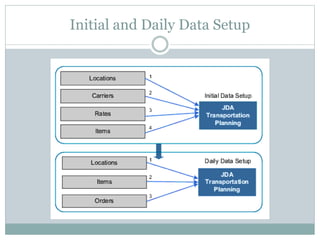
Initial and Daily Data Setup
Loading Locations
 Locations are places that trucks drive to and from in
the process of picking up and dropping off orders.
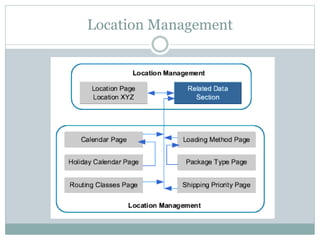
 Modular information such as hours of operation
(calendars), package types(Pack Configuration) used
in creating loading methods (which really means the
pace at which orders are loaded/unloaded), routing
preferences, and the priority a location can receive
for trip planning should be added to fully create a
location in JDA Transportation Planning
Location Management
Loading Carriers and Rates
 Carriers transport orders from one location to
another. The Problem Solver assumes that any
carriers meeting the transportation needs of the
orders being planned are eligible for the job. JDA
Transportation Planning will choose the carrier with
the best available rate.
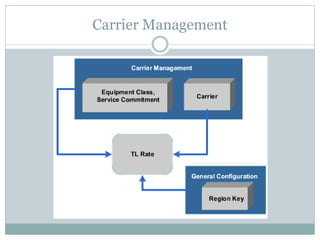
 Each rate is defined by a carrier, service
commitment, lane, effective date, invalid date, and
rate structure. The rate structure varies depending
on the mode of transportation (TL, LTL, intermodal,
and so on).
Carrier Management
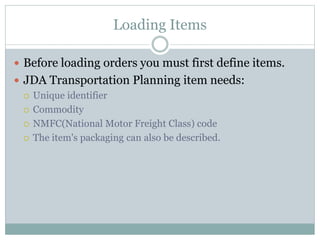
Loading Items
 Before loading orders you must first define items.
 JDA Transportation Planning item needs:
 Unique identifier
 Commodity
 NMFC(National Motor Freight Class) code
 The item's packaging can also be described.
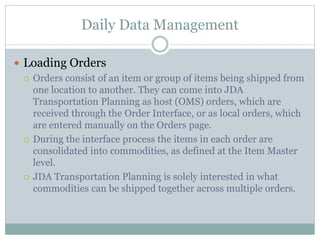
Daily Data Management
 Loading Orders
 Orders consist of an item or group of items being shipped from
one location to another. They can come into JDA
Transportation Planning as host (OMS) orders, which are
received through the Order Interface, or as local orders, which
are entered manually on the Orders page.
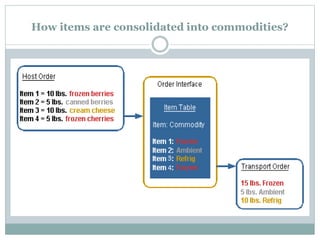
 During the interface process the items in each order are
consolidated into commodities, as defined at the Item Master
level.
 JDA Transportation Planning is solely interested in what
commodities can be shipped together across multiple orders.
How items are consolidated into commodities?
T R A N S P O R T A T I O N P L A N N I N G
Rates Calculation
Rate Types & Qualification
 Truck Load (TL) Rates
 TL Rate Qualification
 LTL Rates
 LTL Rate Qualification
 Parcel / Express Rates
 Parcel Rate Qualification
 Additional Charges
Truck Load (TL) Rates
 JDA Transportation Planning performs two tasks
when costing a truckload (TL) freight movement:
 The most qualified rate is picked based on carrier, lane,
equipment class, maximum number of stops, compatibility,
effective dates, and service commitment.
 The cost of the trip is calculated based on the rate type,
distance traveled, quantity of the load, and number and
location of stops.
TL Rate Types
 Distance
 Greater of either the Minimum Charge or the trip distance multiplied by
the Loaded Distance Rate. Empty legs of a trip (usually fleet-only) will be
calculated with the Unloaded Distance Rate
 Unit
 Greater of the Minimum Charge or the per unit cost. The Per Unit
Charge applies to a load matching the Unit Size per Unit Type
 Flat
 Flat Charge
 Fixed / Variable
 The freight cost is calculated using the Fixed Charge plus the amount
determined by multiplying the Variable Rate by the distance traveled
 Radial
 The freight cost is calculated using the Radial Rate assigned in the Radial
Rate ID field (Slab based)
TL Rate Qualification
 Lane
 Every TL rate has an associated lane, which represents the
geographic area for that rate. Region keys define the
geographic level of specificity for each lane. A lane consists of
two regions: a "from" region and a "to" region:
 Country
 Zone
 State
 Zip (user-defined number of digits)
 SPLC (Standard Point Location Code)
 ID
 Trade area
TL Rate Qualification
 Equipment Class
 Equipment Class (such as DRY, FROZEN, REFRIG etc.) must
be assigned to a carrier.
 This allows JDA Transportation Planning to choose a rate
based on available equipment type when a carrier's lane and
service commitment match.
 Service Commitment
 This allows differing rates to be assigned per driver allocation,
given the same carrier, equipment class, and lane
 Single : DOT times must be obeyed and layovers may occur
 Team : :Layovers are not an issue
TL Rate Qualification
 Maximum Stops
 The maximum number of stops on a TL trip must be less than
or equal to the maximum number of stops allowed for a given
Rate Type (Distance Rate, Unit Rate, Radial Rate, Flat Rate,
and Fixed/Variable Rate).
 Commodity Compatibility
 If JDA Transportation Planning finds incompatibilities
between commodities and equipment type, the rate associated
with the equipment class containing the incompatible
equipment type may be excluded.
 Effective/Invalid Dates
Additional Charges
 After a Rate Type has been chosen, additional
charges may apply. Example:
 Stop Off :The first Stop-Off Charge applies to the first trip
above the number in the Stops Included in Rate field.
 Unloading Cost
 Out-of-Route charge
 Layover
 Surcharge
Less than Truck Load (LTL) Rates
 LTL shipments are costed by matching LTL Bases
and LTL Rates. LTL Bases are non-carrier-specific,
lane-based tariffs. LTL Rates are the carrier-based
discounts on a base rate according to lane and tariff.
LTL Base & LTL Rates
An LTL Rate is identified by Carrier, LTL Tariff, Effective Date,
Service Commitment, and Lane. The rate will qualify as long as it
meets the following criteria:
 The shipment falls within an LTL Rate's Lane.
 The service commitment allows feasible delivery.
 The tariff matches the freight class of the commodities on the
shipment.
 The effective date of the rate is compatible with the schedule's
horizon start date.
 JDA Transportation Planning matches qualifying LTL Rates and
LTL Bases with the same tariff to calculate the freight cost
Costing an LTL Trip
 LTL Base Per Unit
 The cost per unit of capacity is determined by the rates set for
each weight break and freight class
 LTL Base Flat
 LTL Base is set to Flat, the rates entered for each Weight Break
and Freight Class reflects a flat charge to be applied to the
shipment
 LTL Rate Discount
 When an LTL Rate is matched to an LTL Base, JDA
Transportation Planning calculates both the Minimum and
CWT (cent-weight) Discount, compares the difference, and
picks the higher cost
Parcel / Express Rates
 Parcel and Express carriers have identical rate
structures.
 Together, they are called “Package" rates. Package
rates are identified by their Carrier, Package Zone,
and Service Commitment.
 These rates are always based on weight.
Package Rate Qualification
Package Zone
 Each package zone has an ID and is defined using a
from-region and to-region key and a list of
corresponding values.
 Package Zones are similar to lanes for other rates.
 JDA Transportation Planning determines into which
package zones a shipment falls. There should only be
one package zone per carrier/service commitment.
Package Rate Qualification
 Service Commitment
 A carrier must be able to feasibly deliver within the service
commitment time
 Maximum weight
 A rate can be set to be invalid for any shipment weighing more
than the largest weight break set for a given package rate
Costing Package Rates
Package shipments are rated as either Flat or
Incremental. Both are subject to the Average Carton
Size function, which can be configured.
If the Average Carton size is 30 weight units and the
shipment's total weight is 70 weight units, the
shipment cost will be calculated as follows:
(Cost of a 30 weight unit shipment x 2) + Cost of a 10
weight unit shipment = Total cost of shipment.
Costing Package Rates
 Package flat rate
 Each shipment weight will have a corresponding flat charge
 Package incremental rate
 Once the maximum weight for a Flat charge has been reached,
any additional weight of a shipment will be costed per weight
break.
T R A N S P O R T A T I O N P L A N N I N G
Setup Planned Accessorial
Accessorial
 Accessorials define expected, independent charges
applied to the cost of a freight movement, regardless
of mode of travel.
 The accessorial charge must be attached to the
carrier moving the load and match the region
traveled by the load before it applies to the cost of
the freight movement.
 Like in-transit handling fees, fuel surcharges, and
import/export charges
THANKS
 Any Questions?
 More in PPT Part 2

JDA Transportation and Logistics Management-1.pptx

  • 1.
    D E EP A K V E R M A JDA Transportation and Logistics Management Part 1
  • 2.
    Agenda  Functions ofJDA TLM  What information does TLM need for planning  Setting up data in TLM  How JDA TLM calculates Rates  Setting up Accessorial
  • 3.
    Functions JDA Transportation andLogistics Management is an enterprise-wide, multi-user application that helps Plan, Execute, and Analyze your company's transportation activities. The JDA Transportation and Logistics Management solution supports two key business activities:  Planning freight movements  Managing the execution of those planned movements
  • 4.
    Planning Functions  Consolidatesorders and shipments into loads  Determines the best shipping mode (such as TL, LTL, parcel, express)  Builds routes that meet delivery time requirements and other constraints  Identifies lowest cost resources (common carrier or private fleet) to make planned freight movements
  • 5.
    Management Functions  Carriernotification and load acceptance  Store/plant notification  Trailer assignment  Carrier performance tracking  Private fleet performance tracking  Equipment tracking
  • 6.
    What information doesJDA Transportation Planning need?  Static Components  Static information is environmental and does not change often. As such, it requires input infrequently.  Shipping Requirements  This information often takes the form of individual orders, where each order represents the need to move a certain quantity of goods from one location to another.  These orders can be outbound freight, intermediate pickups and drop-offs, or inbound freight
  • 7.
    Static Components  Systemparameters  It includes trailer types and capacities, commitments of carriers that use a specific type of equipment, maximum allowable times for drivers, and layover constraints.  Distance and time information  Distance and time information is supplied from each shipping point to the nearest points that can be used for routing purposes  Locations  Locations are designated points where goods are picked up and/or delivered. They include customer, distributor, and vendor locations  Carrier and their costing information  It is represented by the zone or zones carriers service, their commitment to service, and their specific costing information  Yard slot information  Yard slots are slots within a shipping location lot that are used to place and locate trailers  Commodities  Standard Transportation Commodity Code (STCC) enables the system to use class rate data when it makes routing decisions.  Status flags  These are placed on trailer, carrier, and order indicators within the system to track the status and freight movements
  • 8.
    Shipping Requirements  JDATransportation Planning uses this information to generate trips, each of which contains a sequence of stops and a list of orders associated with each stop  A detailed schedule including dispatch, return, and wait-time occurrences  Dispatch times (calculated transit times that adhere to customer delivery, windows, and unload rate parameters)  Expected arrival times at each stop  Planned travel distances and times between stops
  • 9.
    T R AN S P O R T A T I O N P L A N N I N G Setting up the Data
  • 10.
    Setting up datain JDA Transportation Planning  JDA Transportation Planning operates on the integration of four data elements:  Locations  Carriers  Rates  Orders  Using either the Problem Solver or the Transportation Smart-bench, you can derive a transportation solution for a given set of orders, provided the other three elements are in place.
  • 11.
  • 12.
    Loading Locations  Locationsare places that trucks drive to and from in the process of picking up and dropping off orders.  Modular information such as hours of operation (calendars), package types(Pack Configuration) used in creating loading methods (which really means the pace at which orders are loaded/unloaded), routing preferences, and the priority a location can receive for trip planning should be added to fully create a location in JDA Transportation Planning
  • 13.
  • 14.
    Loading Carriers andRates  Carriers transport orders from one location to another. The Problem Solver assumes that any carriers meeting the transportation needs of the orders being planned are eligible for the job. JDA Transportation Planning will choose the carrier with the best available rate.  Each rate is defined by a carrier, service commitment, lane, effective date, invalid date, and rate structure. The rate structure varies depending on the mode of transportation (TL, LTL, intermodal, and so on).
  • 15.
  • 16.
    Loading Items  Beforeloading orders you must first define items.  JDA Transportation Planning item needs:  Unique identifier  Commodity  NMFC(National Motor Freight Class) code  The item's packaging can also be described.
  • 17.
    Daily Data Management Loading Orders  Orders consist of an item or group of items being shipped from one location to another. They can come into JDA Transportation Planning as host (OMS) orders, which are received through the Order Interface, or as local orders, which are entered manually on the Orders page.  During the interface process the items in each order are consolidated into commodities, as defined at the Item Master level.  JDA Transportation Planning is solely interested in what commodities can be shipped together across multiple orders.
  • 18.
    How items areconsolidated into commodities?
  • 19.
    T R AN S P O R T A T I O N P L A N N I N G Rates Calculation
  • 20.
    Rate Types &Qualification  Truck Load (TL) Rates  TL Rate Qualification  LTL Rates  LTL Rate Qualification  Parcel / Express Rates  Parcel Rate Qualification  Additional Charges
  • 21.
    Truck Load (TL)Rates  JDA Transportation Planning performs two tasks when costing a truckload (TL) freight movement:  The most qualified rate is picked based on carrier, lane, equipment class, maximum number of stops, compatibility, effective dates, and service commitment.  The cost of the trip is calculated based on the rate type, distance traveled, quantity of the load, and number and location of stops.
  • 22.
    TL Rate Types Distance  Greater of either the Minimum Charge or the trip distance multiplied by the Loaded Distance Rate. Empty legs of a trip (usually fleet-only) will be calculated with the Unloaded Distance Rate  Unit  Greater of the Minimum Charge or the per unit cost. The Per Unit Charge applies to a load matching the Unit Size per Unit Type  Flat  Flat Charge  Fixed / Variable  The freight cost is calculated using the Fixed Charge plus the amount determined by multiplying the Variable Rate by the distance traveled  Radial  The freight cost is calculated using the Radial Rate assigned in the Radial Rate ID field (Slab based)
  • 23.
    TL Rate Qualification Lane  Every TL rate has an associated lane, which represents the geographic area for that rate. Region keys define the geographic level of specificity for each lane. A lane consists of two regions: a "from" region and a "to" region:  Country  Zone  State  Zip (user-defined number of digits)  SPLC (Standard Point Location Code)  ID  Trade area
  • 24.
    TL Rate Qualification Equipment Class  Equipment Class (such as DRY, FROZEN, REFRIG etc.) must be assigned to a carrier.  This allows JDA Transportation Planning to choose a rate based on available equipment type when a carrier's lane and service commitment match.  Service Commitment  This allows differing rates to be assigned per driver allocation, given the same carrier, equipment class, and lane  Single : DOT times must be obeyed and layovers may occur  Team : :Layovers are not an issue
  • 25.
    TL Rate Qualification Maximum Stops  The maximum number of stops on a TL trip must be less than or equal to the maximum number of stops allowed for a given Rate Type (Distance Rate, Unit Rate, Radial Rate, Flat Rate, and Fixed/Variable Rate).  Commodity Compatibility  If JDA Transportation Planning finds incompatibilities between commodities and equipment type, the rate associated with the equipment class containing the incompatible equipment type may be excluded.  Effective/Invalid Dates
  • 26.
    Additional Charges  Aftera Rate Type has been chosen, additional charges may apply. Example:  Stop Off :The first Stop-Off Charge applies to the first trip above the number in the Stops Included in Rate field.  Unloading Cost  Out-of-Route charge  Layover  Surcharge
  • 27.
    Less than TruckLoad (LTL) Rates  LTL shipments are costed by matching LTL Bases and LTL Rates. LTL Bases are non-carrier-specific, lane-based tariffs. LTL Rates are the carrier-based discounts on a base rate according to lane and tariff.
  • 28.
    LTL Base &LTL Rates An LTL Rate is identified by Carrier, LTL Tariff, Effective Date, Service Commitment, and Lane. The rate will qualify as long as it meets the following criteria:  The shipment falls within an LTL Rate's Lane.  The service commitment allows feasible delivery.  The tariff matches the freight class of the commodities on the shipment.  The effective date of the rate is compatible with the schedule's horizon start date.  JDA Transportation Planning matches qualifying LTL Rates and LTL Bases with the same tariff to calculate the freight cost
  • 29.
    Costing an LTLTrip  LTL Base Per Unit  The cost per unit of capacity is determined by the rates set for each weight break and freight class  LTL Base Flat  LTL Base is set to Flat, the rates entered for each Weight Break and Freight Class reflects a flat charge to be applied to the shipment  LTL Rate Discount  When an LTL Rate is matched to an LTL Base, JDA Transportation Planning calculates both the Minimum and CWT (cent-weight) Discount, compares the difference, and picks the higher cost
  • 30.
    Parcel / ExpressRates  Parcel and Express carriers have identical rate structures.  Together, they are called “Package" rates. Package rates are identified by their Carrier, Package Zone, and Service Commitment.  These rates are always based on weight.
  • 31.
    Package Rate Qualification PackageZone  Each package zone has an ID and is defined using a from-region and to-region key and a list of corresponding values.  Package Zones are similar to lanes for other rates.  JDA Transportation Planning determines into which package zones a shipment falls. There should only be one package zone per carrier/service commitment.
  • 32.
    Package Rate Qualification Service Commitment  A carrier must be able to feasibly deliver within the service commitment time  Maximum weight  A rate can be set to be invalid for any shipment weighing more than the largest weight break set for a given package rate
  • 33.
    Costing Package Rates Packageshipments are rated as either Flat or Incremental. Both are subject to the Average Carton Size function, which can be configured. If the Average Carton size is 30 weight units and the shipment's total weight is 70 weight units, the shipment cost will be calculated as follows: (Cost of a 30 weight unit shipment x 2) + Cost of a 10 weight unit shipment = Total cost of shipment.
  • 34.
    Costing Package Rates Package flat rate  Each shipment weight will have a corresponding flat charge  Package incremental rate  Once the maximum weight for a Flat charge has been reached, any additional weight of a shipment will be costed per weight break.
  • 35.
    T R AN S P O R T A T I O N P L A N N I N G Setup Planned Accessorial
  • 36.
    Accessorial  Accessorials defineexpected, independent charges applied to the cost of a freight movement, regardless of mode of travel.  The accessorial charge must be attached to the carrier moving the load and match the region traveled by the load before it applies to the cost of the freight movement.  Like in-transit handling fees, fuel surcharges, and import/export charges
  • 37.