What's all the buzz about? Tim Fox Messaging Lead JBoss 03 Sep 2009
Change of plan This presentation was scheduled to be about JBoss messaging This presentation is actually about  “ HornetQ” http://jboss.org/hornetq
H HornetQ is the new name for JBoss Messaging 2 HornetQ is an open source community project to build a multi-protocol asynchronous messaging system HornetQ is designed for performance HornetQ is designed with usability in mind HornetQ is full featured See the wiki for more information: http://www.jboss.org/community/wiki/HornetQGeneralFAQs
How does HornetQ relate to JBoss Messaging? We decided to rename JBoss Messaging 2 to HornetQ JBM 1.x and 2.x code bases 95%+ different. HornetQ is a different beast to JBM 1.x HornetQ is not tightly coupled to JBoss Application Server
How is HornetQ licenced? Most of HornetQ is licenced using ASL 2.0 A few files still under LGPL Why ASL, not LGPL?
Usability is critical! Key design goal of HornetQ is ease of use Simple API Clear and simple to configure Great docs Ships with over 65 fully runnable examples out of the box Minimal third party dependencies
Both standalone and JEE messaging HornetQ is a fully functional stand-alone messaging server – if you don't want an app server, don't use an app server HornetQ can also be integrated with any JEE application server, e.g. JBoss Application Server 5.0, using its JCA adaptor HornetQ can also be used with any dependency injection framework, e.g. JBoss MC, Spring, Google Guice
Elegant generic architecture Fully functional JMS agnostic messaging system No dependencies on JMX, JNDI, JCA, etc. Just a set of simple POJOs JMS functionality applied as thin facade on the client side Much, much more than just JMS! Can be embedded in an application that requires messaging internally.
Generic core and JMS facade Server side Client side Core HornetQ client is fully functional HornetQ Client HornetQ Server JMS Facade
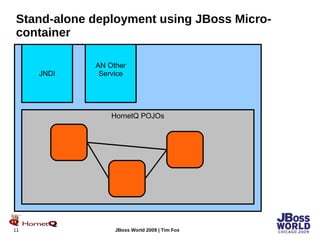
Stand-alone deployment using JBoss Micro-container JNDI HornetQ POJOs AN Other Service
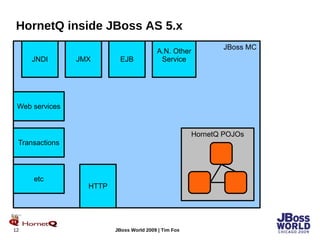
HornetQ inside JBoss AS 5.x JBoss MC JMX JNDI HornetQ POJOs A.N. Other Service EJB Transactions Web services etc HTTP
HornetQ embedded in 3 rd  party application User application (process) HornetQ POJOs User application classes
HornetQ embedded code example 01. MessagingServer server = new MessagingServerImpl(); 02. server.start(); 03. ClientSessionFactory sf = new ClientSessionFactoryImpl(...); 04. ClientSession sess = sf.createSession(); 05. sess.createQueue("address1", "queue1"); 06. sess.start(); 07. ClientProducer prod = sess.createProducer("address1"); 08. Message message = new ClientMessageImpl(false); 09. message.getBody().writeString("hello world"); 10. prod.send(message); 11. ClientConsumer cons = sess.createConsumer("queue1"); 12. Message received = cons.receive(); 13. System.out.println("Got message " + received.getBody().readString()); 14. sess.close(); 15. server.stop();
HornetQ features Very high performance journal Support for huge queues and huge messages with small server and client footprint Pluggable transport system Seamless High Availability (HA) Massively flexible clustering Extensive management API Lots, lots, more, but no time here! See the wiki for a full list: http://www.jboss.org/community/wiki/HornetQFeatures
Ultra high performance journal HornetQ persistence is very fast Very fast store using Linux asynchronous IO. Up to 100+ MiB/s on a single node! JNI interface to aio library (libaio), encapsulated in Java package. Automatic switches to Java NIO when not running on Linux
Asynchronous IO on Linux OS Asynch store Client Send 1 Send 2 Send 3 Disc Ack 1 Send 4 Ack 2 Ack 3 Send 5 Time JNI
Huge queues and messages HornetQ supports huge queues – far bigger than can fit in available RAM Run Terabyte queues while the server is only running in 50MiB of RAM! Send and receive huge multi-gigabyte messages with all the normal transactional semantics Effectively, only limit to message size is available disk space. We have tested messages up to 8 GiB in size.
Configurable Transport system Fully pluggable transport Ships with default implementation using JBoss Netty http://jboss.org/netty/ TCP transport SSL transport HTTP transport Servlet transport In-VM transport
HornetQ High Availability Transparent reconnection on failure 100% guaranteed no loss or duplication of messages Fail-over via store on SAN Replicated journal (Shared nothing approach)
HornetQ Clusters HornetQ servers can be grouped into clusters Clusters are a way of balancing message processing across several nodes. Messages arriving on cluster are balanced to different nodes to spread the load – default balancing is round robin. Balancing takes into account selectors and consumers on each node
Clusters Messages Node A Node B Node C Messages balanced according to number of matching consumers C C C C C C
HornetQ Core Bridges Core bridges take messages from one queue and forward them to another remote address Core bridges can use filters to select only certain messages Core bridges can apply transformations Core bridges are high performance Core bridges can work with unreliable connections Core bridges are not JMS bridges
Core bridges Filter messages Send to address Node A Node B messages Internet, WAN, etc Queue Core bridge Queue Queue Queue Divert
HornetQ diverts Diverts are a  routing table  for messaging Diverts take messages destined for one address and divert them to another address Diverts can be exclusive or not. Non exclusive diverts copy messages. Diverts can use filters to only select certain messages Diverts are high performance
Diverts Filter Transform Filter Transform Exclusive diverts can be used to “divert” Non exclusive diverts can be used to “siphon” or “snoop” Queue A Exclusive divert Queue B Queue C Queue D Non exclusive divert Queue F Queue E
Global scale messaging fabric Combine clusters, bridges and diverts and you can create a  massively configurable global messaging fabric to run your business. All with zero message loss and zero message duplication guarantee. Add HA to provide unbroken up-time. Use HornetQ as the messaging fabric together with JBoss ESB, and benefit from all the 3 rd  party connectors provided by JBoss ESB.
Going ahead Interoperability – REST, AMQP, STOMP, XMPP, Ajax/Comet Server-less mode Performance bench-marks See the road map here: http://www.jboss.org/community/wiki/Roadmap
Interoperability REST Provide a simple RESTful interface for HornetQ over HTTP. See REST-* project AMQP – HornetQ will implement the AMQP protocol STOMP Native STOMP support provides access to HornetQ by many STOMP clients written in different languages XMPP Async web support (Ajax/comet/bayeaux)
Join us! HornetQ is a community project - come and get involved! We are always looking for new developers to help out – there is a lot of cool new stuff to implement. Find us on irc: irc://freenode.net:6667#hornetq
Check out the  HornetQ web site: http://jboss.org/hornetq Follow HornetQ on twitter: http://twitter.com/hornetq Visit the blog: http://hornetq.blogspot.com

Jbw chicago

  • 1.
  • 2.
    What's all thebuzz about? Tim Fox Messaging Lead JBoss 03 Sep 2009
  • 3.
    Change of planThis presentation was scheduled to be about JBoss messaging This presentation is actually about “ HornetQ” http://jboss.org/hornetq
  • 4.
    H HornetQ isthe new name for JBoss Messaging 2 HornetQ is an open source community project to build a multi-protocol asynchronous messaging system HornetQ is designed for performance HornetQ is designed with usability in mind HornetQ is full featured See the wiki for more information: http://www.jboss.org/community/wiki/HornetQGeneralFAQs
  • 5.
    How does HornetQrelate to JBoss Messaging? We decided to rename JBoss Messaging 2 to HornetQ JBM 1.x and 2.x code bases 95%+ different. HornetQ is a different beast to JBM 1.x HornetQ is not tightly coupled to JBoss Application Server
  • 6.
    How is HornetQlicenced? Most of HornetQ is licenced using ASL 2.0 A few files still under LGPL Why ASL, not LGPL?
  • 7.
    Usability is critical!Key design goal of HornetQ is ease of use Simple API Clear and simple to configure Great docs Ships with over 65 fully runnable examples out of the box Minimal third party dependencies
  • 8.
    Both standalone andJEE messaging HornetQ is a fully functional stand-alone messaging server – if you don't want an app server, don't use an app server HornetQ can also be integrated with any JEE application server, e.g. JBoss Application Server 5.0, using its JCA adaptor HornetQ can also be used with any dependency injection framework, e.g. JBoss MC, Spring, Google Guice
  • 9.
    Elegant generic architectureFully functional JMS agnostic messaging system No dependencies on JMX, JNDI, JCA, etc. Just a set of simple POJOs JMS functionality applied as thin facade on the client side Much, much more than just JMS! Can be embedded in an application that requires messaging internally.
  • 10.
    Generic core andJMS facade Server side Client side Core HornetQ client is fully functional HornetQ Client HornetQ Server JMS Facade
  • 11.
    Stand-alone deployment usingJBoss Micro-container JNDI HornetQ POJOs AN Other Service
  • 12.
    HornetQ inside JBossAS 5.x JBoss MC JMX JNDI HornetQ POJOs A.N. Other Service EJB Transactions Web services etc HTTP
  • 13.
    HornetQ embedded in3 rd party application User application (process) HornetQ POJOs User application classes
  • 14.
    HornetQ embedded codeexample 01. MessagingServer server = new MessagingServerImpl(); 02. server.start(); 03. ClientSessionFactory sf = new ClientSessionFactoryImpl(...); 04. ClientSession sess = sf.createSession(); 05. sess.createQueue("address1", "queue1"); 06. sess.start(); 07. ClientProducer prod = sess.createProducer("address1"); 08. Message message = new ClientMessageImpl(false); 09. message.getBody().writeString("hello world"); 10. prod.send(message); 11. ClientConsumer cons = sess.createConsumer("queue1"); 12. Message received = cons.receive(); 13. System.out.println("Got message " + received.getBody().readString()); 14. sess.close(); 15. server.stop();
  • 15.
    HornetQ features Veryhigh performance journal Support for huge queues and huge messages with small server and client footprint Pluggable transport system Seamless High Availability (HA) Massively flexible clustering Extensive management API Lots, lots, more, but no time here! See the wiki for a full list: http://www.jboss.org/community/wiki/HornetQFeatures
  • 16.
    Ultra high performancejournal HornetQ persistence is very fast Very fast store using Linux asynchronous IO. Up to 100+ MiB/s on a single node! JNI interface to aio library (libaio), encapsulated in Java package. Automatic switches to Java NIO when not running on Linux
  • 17.
    Asynchronous IO onLinux OS Asynch store Client Send 1 Send 2 Send 3 Disc Ack 1 Send 4 Ack 2 Ack 3 Send 5 Time JNI
  • 18.
    Huge queues andmessages HornetQ supports huge queues – far bigger than can fit in available RAM Run Terabyte queues while the server is only running in 50MiB of RAM! Send and receive huge multi-gigabyte messages with all the normal transactional semantics Effectively, only limit to message size is available disk space. We have tested messages up to 8 GiB in size.
  • 19.
    Configurable Transport systemFully pluggable transport Ships with default implementation using JBoss Netty http://jboss.org/netty/ TCP transport SSL transport HTTP transport Servlet transport In-VM transport
  • 20.
    HornetQ High AvailabilityTransparent reconnection on failure 100% guaranteed no loss or duplication of messages Fail-over via store on SAN Replicated journal (Shared nothing approach)
  • 21.
    HornetQ Clusters HornetQservers can be grouped into clusters Clusters are a way of balancing message processing across several nodes. Messages arriving on cluster are balanced to different nodes to spread the load – default balancing is round robin. Balancing takes into account selectors and consumers on each node
  • 22.
    Clusters Messages NodeA Node B Node C Messages balanced according to number of matching consumers C C C C C C
  • 23.
    HornetQ Core BridgesCore bridges take messages from one queue and forward them to another remote address Core bridges can use filters to select only certain messages Core bridges can apply transformations Core bridges are high performance Core bridges can work with unreliable connections Core bridges are not JMS bridges
  • 24.
    Core bridges Filtermessages Send to address Node A Node B messages Internet, WAN, etc Queue Core bridge Queue Queue Queue Divert
  • 25.
    HornetQ diverts Divertsare a routing table for messaging Diverts take messages destined for one address and divert them to another address Diverts can be exclusive or not. Non exclusive diverts copy messages. Diverts can use filters to only select certain messages Diverts are high performance
  • 26.
    Diverts Filter TransformFilter Transform Exclusive diverts can be used to “divert” Non exclusive diverts can be used to “siphon” or “snoop” Queue A Exclusive divert Queue B Queue C Queue D Non exclusive divert Queue F Queue E
  • 27.
    Global scale messagingfabric Combine clusters, bridges and diverts and you can create a massively configurable global messaging fabric to run your business. All with zero message loss and zero message duplication guarantee. Add HA to provide unbroken up-time. Use HornetQ as the messaging fabric together with JBoss ESB, and benefit from all the 3 rd party connectors provided by JBoss ESB.
  • 28.
    Going ahead Interoperability– REST, AMQP, STOMP, XMPP, Ajax/Comet Server-less mode Performance bench-marks See the road map here: http://www.jboss.org/community/wiki/Roadmap
  • 29.
    Interoperability REST Providea simple RESTful interface for HornetQ over HTTP. See REST-* project AMQP – HornetQ will implement the AMQP protocol STOMP Native STOMP support provides access to HornetQ by many STOMP clients written in different languages XMPP Async web support (Ajax/comet/bayeaux)
  • 30.
    Join us! HornetQis a community project - come and get involved! We are always looking for new developers to help out – there is a lot of cool new stuff to implement. Find us on irc: irc://freenode.net:6667#hornetq
  • 31.
    Check out the HornetQ web site: http://jboss.org/hornetq Follow HornetQ on twitter: http://twitter.com/hornetq Visit the blog: http://hornetq.blogspot.com