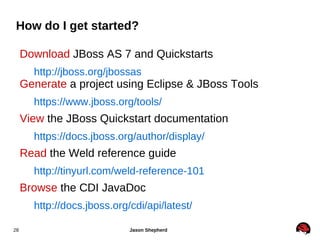
JBoss Application Server (AS) 7 Jason Shepherd Middleware Support Engineer, Red Hat November 17 th , 2011
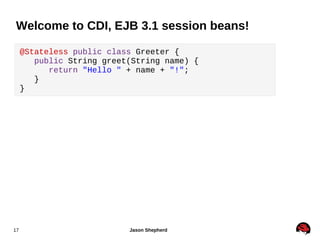
Introducing JBoss AS 7 Application Server Key features Java Enterprise Edition (JEE) 6 EJB 3.1
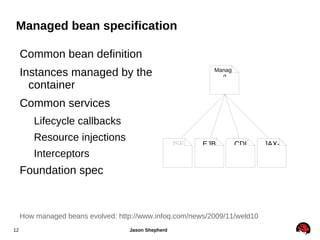
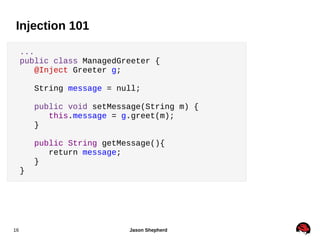
Managed Beans
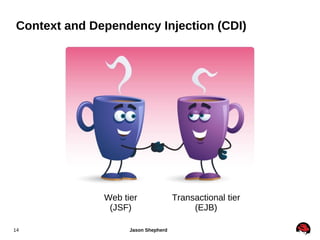
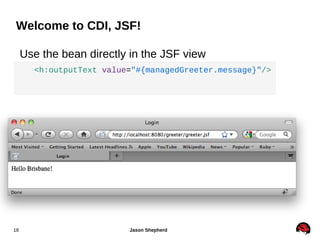
Context and Dependency Injection Integration Testing with Arquallian demo
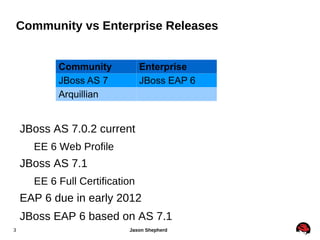
Community vs Enterprise Releases JBoss AS 7.0.2 current  EE 6 Web Profile JBoss AS 7.1 EE 6 Full Certification EAP 6 due in early 2012
JBoss EAP 6 based on AS 7.1
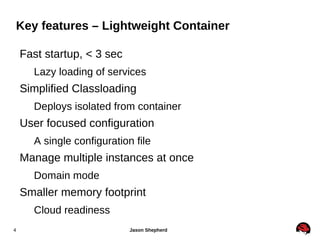
Key features – Lightweight Container  Fast startup, < 3 sec Lazy loading of services Simplified Classloading Deploys isolated from container User focused configuration A single configuration file Manage multiple instances at once Domain mode Smaller memory footprint Cloud readiness
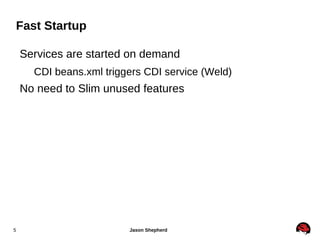
Fast Startup Services are started on demand CDI beans.xml triggers CDI service (Weld) No need to Slim unused features
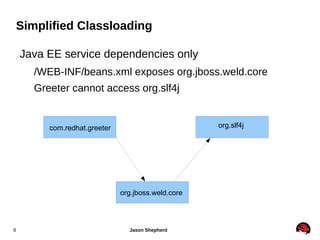
Simplified Classloading Java EE service dependencies only /WEB-INF/beans.xml exposes org.jboss.weld.core
Greeter cannot access org.slf4j  com.redhat.greeter org.slf4j org.jboss.weld.core
Benefits of Java EE? Standard platform comprised of managed components & services Write business logic as components Less code
Higher signal-to-noise ratio
Powerful mechanisms for free
Portable knowledge
Drawbacks of Java EE 5 @Local and @Remote interfaces
Non Embeddable EJB container
Complex packaging
Verbose XML configuration
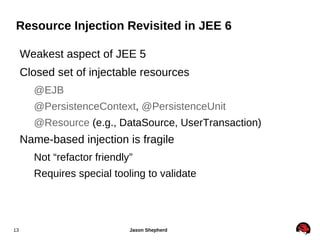
Boilerplate JNDI lookups
EJB 3.1 to the rescue! No more @Local and @Remote
Embeddable EJB container
EJBs in WAR
Annotation based configuration
EJB in light weight Web Profile
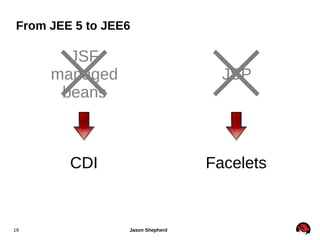
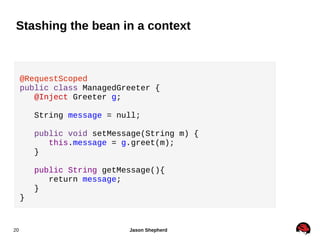
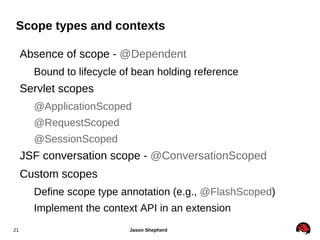
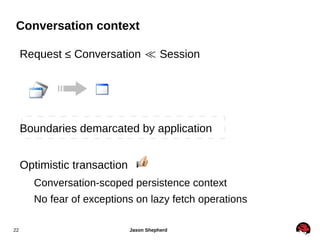
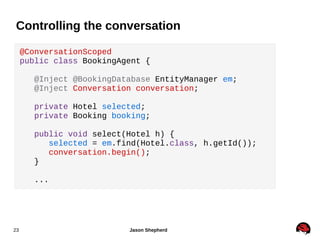
EE 6 Web profile– Key components Managed Beans (JSR-330) Google and SpringSource submitted JSR-330 with the aim of standardising &quot;a proven, non-controversial set of annotations that make injectable classes portable across frameworks&quot; Context and Dependency Injection (CDI) Implemented with WELD on AS 7 EJB 3.1 No Local and Remote Interfaces
EJBs in WAR archives!
What are managed beans? Everyone throwing around this term  “bean” JSF
EJB
Seam
Spring
Guice

JBoss AS7 OSDC 2011