HEALTHY BEGINNINGS:
Impacts of School Location and Design
Jay Renkens, AICP,
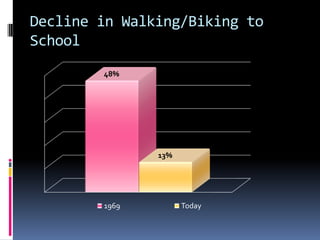
Decline in Walking/Biking to
School
48%
13%
1969 Today
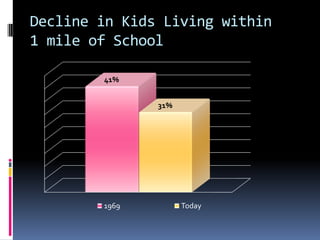
Decline in Kids Living within
1 mile of School
41%
31%
1969 Today
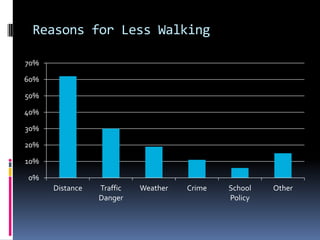
Reasons for Less Walking
0%
10%
20%
30%
40%
50%
60%
70%
Distance Traffic
Danger
Weather Crime School
Policy
Other
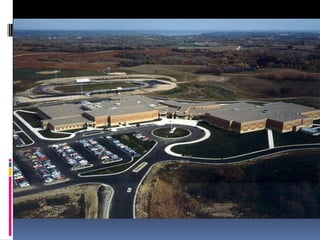
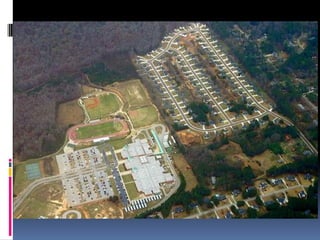
Larger School Sites, Less
Walkable Schools
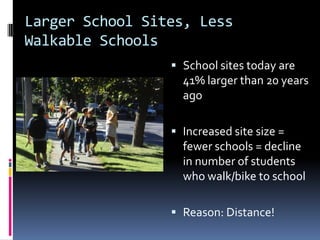
 School sites today are
41% larger than 20 years
ago
 Increased site size =
fewer schools = decline
in number of students
who walk/bike to school
 Reason: Distance!
Reasons for Large Schools on
Edge of Communities
 Out-of-date Council of Educational Facilities
Planners (CEFPI) recommendations
 Parking requirements
 Demand for recreation/sport spaces
 Land values
 School funding formulas
 Disregard for transportation costs
 School consolidation
 Existing land use patterns
Impacts
Smaller schools integrated into
neighborhoods contribute to:
 Reduction in traffic
 A 13 percent increase in walking and biking
 At least 15 percent decrease in emissions
 Higher test scores
 More parent and neighborhood
involvement
 Higher likelihood of passing bond issues
Lewis and Clark High School
(Spokane, WA)
Lewis and Clark High School
(Spokane, WA)
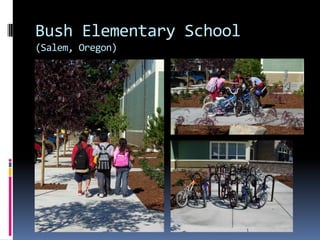
Bush Elementary School
(Salem, Oregon)
Bush Elementary School
(Salem, Oregon)
Hood River Middle School
(Hood River, Oregon)
Banks Middle School
(Banks, Oregon)
Banks Middle School
(Banks, Oregon)
Lessons Learned
 Engage local jurisdiction early in the
conversation
 Explore partnership opportunities
 Involve community members in evaluation
and decision making
 Consider full cost of capital investment, O&M
and transportation
 Don’t forget fencing, entries and end-of-trip
facilities
Resources
 OregonTransportation and Growth Management
Program’s Cool Planning: A Handbook on Local
Strategies to Slow Climate Change
 EPA’s Travel and Environmental Guide to School Siting
 CDC’s Adolescent and School Health
Jay Renkens, AICP
Director of Urban Planning Services
MIG, Inc.; Portland, Oregon
www.migcom.com
jayr@migcom.com

ATS14- Healthy beginnings – Or how to build active transportation into your community by starting with kids - Jay Renkins

  • 1.
    HEALTHY BEGINNINGS: Impacts ofSchool Location and Design Jay Renkens, AICP,
  • 6.
    Decline in Walking/Bikingto School 48% 13% 1969 Today
  • 7.
    Decline in KidsLiving within 1 mile of School 41% 31% 1969 Today
  • 8.
    Reasons for LessWalking 0% 10% 20% 30% 40% 50% 60% 70% Distance Traffic Danger Weather Crime School Policy Other
  • 9.
    Larger School Sites,Less Walkable Schools  School sites today are 41% larger than 20 years ago  Increased site size = fewer schools = decline in number of students who walk/bike to school  Reason: Distance!
  • 10.
    Reasons for LargeSchools on Edge of Communities  Out-of-date Council of Educational Facilities Planners (CEFPI) recommendations  Parking requirements  Demand for recreation/sport spaces  Land values  School funding formulas  Disregard for transportation costs  School consolidation  Existing land use patterns
  • 11.
    Impacts Smaller schools integratedinto neighborhoods contribute to:  Reduction in traffic  A 13 percent increase in walking and biking  At least 15 percent decrease in emissions  Higher test scores  More parent and neighborhood involvement  Higher likelihood of passing bond issues
  • 12.
    Lewis and ClarkHigh School (Spokane, WA)
  • 13.
    Lewis and ClarkHigh School (Spokane, WA)
  • 14.
  • 15.
  • 16.
    Hood River MiddleSchool (Hood River, Oregon)
  • 17.
  • 18.
  • 19.
    Lessons Learned  Engagelocal jurisdiction early in the conversation  Explore partnership opportunities  Involve community members in evaluation and decision making  Consider full cost of capital investment, O&M and transportation  Don’t forget fencing, entries and end-of-trip facilities
  • 20.
    Resources  OregonTransportation andGrowth Management Program’s Cool Planning: A Handbook on Local Strategies to Slow Climate Change  EPA’s Travel and Environmental Guide to School Siting  CDC’s Adolescent and School Health Jay Renkens, AICP Director of Urban Planning Services MIG, Inc.; Portland, Oregon www.migcom.com jayr@migcom.com