JavaScript 101
André Odendaal
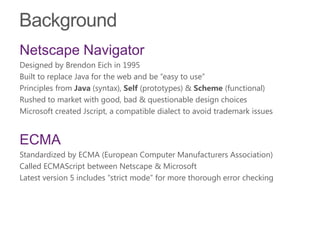
Background
Netscape Navigator
Designed by Brendon Eich in 1995
Built to replace Java for the web and be “easy to use”
Principles from Java (syntax), Self (prototypes) & Scheme (functional)
Rushed to market with good, bad & questionable design choices
Microsoft created Jscript, a compatible dialect to avoid trademark issues

ECMA
Standardized by ECMA (European Computer Manufacturers Association)
Called ECMAScript between Netscape & Microsoft
Latest version 5 includes “strict mode” for more thorough error checking
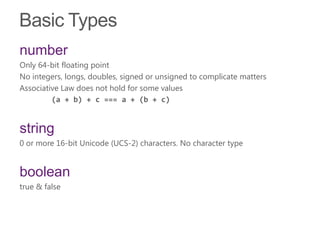
Basic Types
number
Only 64-bit floating point
No integers, longs, doubles, signed or unsigned to complicate matters
Associative Law does not hold for some values
(a + b) + c === a + (b + c)

string
0 or more 16-bit Unicode (UCS-2) characters. No character type

boolean
true & false
Objects
Object Literals
Dynamic (not based on pre-defined class) collection of properties
Property names must be a unique string within the object

Basic Operations – Get, Set & Delete
object.name | object[name]
object.name = value | object[name] = value
delete object.name | delete object[name]

Property
Named collection of attributes
ES5 added functionality to define properties and added Get, Set functions
Attributes: value, writable, configurable, enumerable, get, set
Demo – Objects
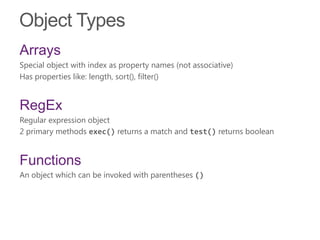
Object Types
Arrays
Special object with index as property names (not associative)
Has properties like: length, sort(), filter()

RegEx
Regular expression object
2 primary methods exec() returns a match and test() returns boolean

Functions
An object which can be invoked with parentheses ()
Demo – Objects
Revisited
Other Types
null
Nothing

undefined
Less than nothing
Functions
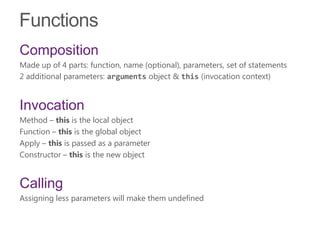
Composition
Made up of 4 parts: function, name (optional), parameters, set of statements
2 additional parameters: arguments object & this (invocation context)

Invocation
Method – this is the local object
Function – this is the global object
Apply – this is passed as a parameter
Constructor – this is the new object

Calling
Assigning less parameters will make them undefined
Demo – Invoking Functions
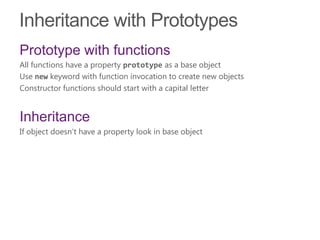
Inheritance with Prototypes
Prototype with functions
All functions have a property prototype as a base object
Use new keyword with function invocation to create new objects
Constructor functions should start with a capital letter

Inheritance
If object doesn’t have a property look in base object
Demo - Prototyping
Questions?

JavaScript fundamental data types and functions

  • 1.
  • 2.
    Background Netscape Navigator Designed byBrendon Eich in 1995 Built to replace Java for the web and be “easy to use” Principles from Java (syntax), Self (prototypes) & Scheme (functional) Rushed to market with good, bad & questionable design choices Microsoft created Jscript, a compatible dialect to avoid trademark issues ECMA Standardized by ECMA (European Computer Manufacturers Association) Called ECMAScript between Netscape & Microsoft Latest version 5 includes “strict mode” for more thorough error checking
  • 3.
    Basic Types number Only 64-bitfloating point No integers, longs, doubles, signed or unsigned to complicate matters Associative Law does not hold for some values (a + b) + c === a + (b + c) string 0 or more 16-bit Unicode (UCS-2) characters. No character type boolean true & false
  • 4.
    Objects Object Literals Dynamic (notbased on pre-defined class) collection of properties Property names must be a unique string within the object Basic Operations – Get, Set & Delete object.name | object[name] object.name = value | object[name] = value delete object.name | delete object[name] Property Named collection of attributes ES5 added functionality to define properties and added Get, Set functions Attributes: value, writable, configurable, enumerable, get, set
  • 5.
  • 6.
    Object Types Arrays Special objectwith index as property names (not associative) Has properties like: length, sort(), filter() RegEx Regular expression object 2 primary methods exec() returns a match and test() returns boolean Functions An object which can be invoked with parentheses ()
  • 7.
  • 8.
  • 9.
    Functions Composition Made up of4 parts: function, name (optional), parameters, set of statements 2 additional parameters: arguments object & this (invocation context) Invocation Method – this is the local object Function – this is the global object Apply – this is passed as a parameter Constructor – this is the new object Calling Assigning less parameters will make them undefined
  • 10.
  • 11.
    Inheritance with Prototypes Prototypewith functions All functions have a property prototype as a base object Use new keyword with function invocation to create new objects Constructor functions should start with a capital letter Inheritance If object doesn’t have a property look in base object
  • 12.
  • 13.

Editor's Notes

  • #5 Value defaults to undefinedWritable defaults to falseConfigurable defaults to falseEnumerable defaults to falseGet defaults to undefinedSet defaults to undefined
  • #16 Method: local objectFunction: global object // mistake, should be outer function this objectthat work-aroundConstructor: new objectApply: choose, list of parameters