This document summarizes key concepts from an introduction to Java programming textbook chapter. It describes the anatomy of a Java program, including classes, methods, statements, and other elements. It also covers programming style guidelines, different types of errors, and includes examples of Java code.
![Liang, Introduction to Java Programming, Tenth Edition, (c) 2015 Pearson Education, Inc. All
rights reserved.
3
// This program prints Welcome to Java!
public class Welcome {
public static void main(String[] args) {
System.out.println("Welcome to Java!");
}
}
Class Name
Every Java program must have at least one class.
Each class has a name. By convention, class names
start with an uppercase letter. In this example, the
class name is Welcome.](https://image.slidesharecdn.com/01bslide-220917162506-5fa3358d/85/Java-Programming-3-320.jpg)
![Liang, Introduction to Java Programming, Tenth Edition, (c) 2015 Pearson Education, Inc. All
rights reserved.
4
// This program prints Welcome to Java!
public class Welcome {
public static void main(String[] args) {
System.out.println("Welcome to Java!");
}
}
Main Method
Line 2 defines the main method. In order to run a
class, the class must contain a method named main.
The program is executed from the main method.](https://image.slidesharecdn.com/01bslide-220917162506-5fa3358d/85/Java-Programming-4-320.jpg)
![Liang, Introduction to Java Programming, Tenth Edition, (c) 2015 Pearson Education, Inc. All
rights reserved.
5
// This program prints Welcome to Java!
public class Welcome {
public static void main(String[] args) {
System.out.println("Welcome to Java!");
}
}
Statement
A statement represents an action or a sequence of actions.
The statement System.out.println("Welcome to Java!") in
the program in Listing 1.1 is a statement to display the
greeting "Welcome to Java!“.](https://image.slidesharecdn.com/01bslide-220917162506-5fa3358d/85/Java-Programming-5-320.jpg)
![Liang, Introduction to Java Programming, Tenth Edition, (c) 2015 Pearson Education, Inc. All
rights reserved.
6
// This program prints Welcome to Java!
public class Welcome {
public static void main(String[] args) {
System.out.println("Welcome to Java!");
}
}
Statement Terminator
Every statement in Java ends with a semicolon (;).](https://image.slidesharecdn.com/01bslide-220917162506-5fa3358d/85/Java-Programming-6-320.jpg)
![Liang, Introduction to Java Programming, Tenth Edition, (c) 2015 Pearson Education, Inc. All
rights reserved.
7
// This program prints Welcome to Java!
public class Welcome {
public static void main(String[] args) {
System.out.println("Welcome to Java!");
}
}
Reserved words
Reserved words or keywords are words that have a
specific meaning to the compiler and cannot be used for
other purposes in the program. For example, when the
compiler sees the word class, it understands that the word
after class is the name for the class.](https://image.slidesharecdn.com/01bslide-220917162506-5fa3358d/85/Java-Programming-7-320.jpg)
![Liang, Introduction to Java Programming, Tenth Edition, (c) 2015 Pearson Education, Inc. All
rights reserved.
8
Blocks
A pair of braces in a program forms a block that groups
components of a program.
public class Test {
public static void main(String[] args) {
System.out.println("Welcome to Java!");
}
}
Class block
Method block](https://image.slidesharecdn.com/01bslide-220917162506-5fa3358d/85/Java-Programming-8-320.jpg)
![Liang, Introduction to Java Programming, Tenth Edition, (c) 2015 Pearson Education, Inc. All
rights reserved.
9
Special Symbols
Character Name Description
{}
()
[]
//
" "
;
Opening and closing
braces
Opening and closing
parentheses
Opening and closing
brackets
Double slashes
Opening and closing
quotation marks
Semicolon
Denotes a block to enclose statements.
Used with methods.
Denotes an array.
Precedes a comment line.
Enclosing a string (i.e., sequence of characters).
Marks the end of a statement.](https://image.slidesharecdn.com/01bslide-220917162506-5fa3358d/85/Java-Programming-9-320.jpg)
![Liang, Introduction to Java Programming, Tenth Edition, (c) 2015 Pearson Education, Inc. All
rights reserved.
10
// This program prints Welcome to Java!
public class Welcome {
public static void main(String[] args) {
System.out.println("Welcome to Java!");
}
}
{ … }](https://image.slidesharecdn.com/01bslide-220917162506-5fa3358d/85/Java-Programming-10-320.jpg)
![Liang, Introduction to Java Programming, Tenth Edition, (c) 2015 Pearson Education, Inc. All
rights reserved.
11
// This program prints Welcome to Java!
public class Welcome {
public static void main(String[] args) {
System.out.println("Welcome to Java!");
}
}
( … )](https://image.slidesharecdn.com/01bslide-220917162506-5fa3358d/85/Java-Programming-11-320.jpg)
![Liang, Introduction to Java Programming, Tenth Edition, (c) 2015 Pearson Education, Inc. All
rights reserved.
12
// This program prints Welcome to Java!
public class Welcome {
public static void main(String[] args) {
System.out.println("Welcome to Java!");
}
}
;](https://image.slidesharecdn.com/01bslide-220917162506-5fa3358d/85/Java-Programming-12-320.jpg)
![Liang, Introduction to Java Programming, Tenth Edition, (c) 2015 Pearson Education, Inc. All
rights reserved.
13
// This program prints Welcome to Java!
public class Welcome {
public static void main(String[] args) {
System.out.println("Welcome to Java!");
}
}
// …](https://image.slidesharecdn.com/01bslide-220917162506-5fa3358d/85/Java-Programming-13-320.jpg)
![Liang, Introduction to Java Programming, Tenth Edition, (c) 2015 Pearson Education, Inc. All
rights reserved.
14
// This program prints Welcome to Java!
public class Welcome {
public static void main(String[] args) {
System.out.println("Welcome to Java!");
}
}
" … "](https://image.slidesharecdn.com/01bslide-220917162506-5fa3358d/85/Java-Programming-14-320.jpg)
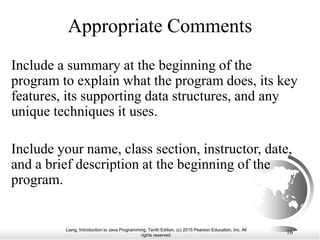
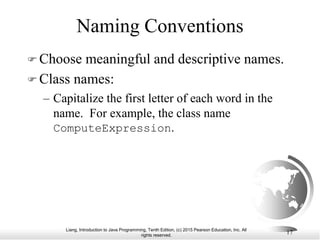
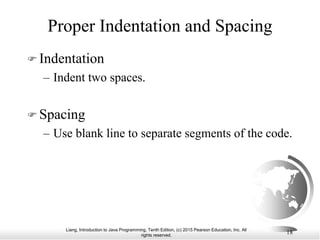
![Liang, Introduction to Java Programming, Tenth Edition, (c) 2015 Pearson Education, Inc. All
rights reserved.
19
Block Styles
Use end-of-line style for braces.
public class Test
{
public static void main(String[] args)
{
System.out.println("Block Styles");
}
}
public class Test {
public static void main(String[] args) {
System.out.println("Block Styles");
}
}
End-of-line
style
Next-line
style](https://image.slidesharecdn.com/01bslide-220917162506-5fa3358d/85/Java-Programming-19-320.jpg)
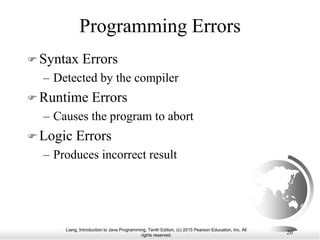
![Liang, Introduction to Java Programming, Tenth Edition, (c) 2015 Pearson Education, Inc. All
rights reserved.
21
Syntax Errors
public class ShowSyntaxErrors {
public static main(String[] args) {
System.out.println("Welcome to Java);
}
}
Run
ShowSyntaxErrors](https://image.slidesharecdn.com/01bslide-220917162506-5fa3358d/85/Java-Programming-21-320.jpg)
![Liang, Introduction to Java Programming, Tenth Edition, (c) 2015 Pearson Education, Inc. All
rights reserved.
22
Syntax Errors
public class ShowSyntaxErrors {
public static main(String[] args) {
System.out.println("Welcome to Java")
}
}
Run
ShowSyntaxErrors](https://image.slidesharecdn.com/01bslide-220917162506-5fa3358d/85/Java-Programming-22-320.jpg)
![Liang, Introduction to Java Programming, Tenth Edition, (c) 2015 Pearson Education, Inc. All
rights reserved.
23
Syntax Errors
public class ShowSyntaxErrors {
public static main(String[] args) {
system.out.println("Welcome to Java");
}
}
Run
ShowSyntaxErrors
"](https://image.slidesharecdn.com/01bslide-220917162506-5fa3358d/85/Java-Programming-23-320.jpg)
![Liang, Introduction to Java Programming, Tenth Edition, (c) 2015 Pearson Education, Inc. All
rights reserved.
24
Runtime Errors
public class ShowRuntimeErrors {
public static void main(String[] args) {
System.out.println(1 / 0);
}
}
Run
ShowRuntimeErrors](https://image.slidesharecdn.com/01bslide-220917162506-5fa3358d/85/Java-Programming-24-320.jpg)
![Liang, Introduction to Java Programming, Tenth Edition, (c) 2015 Pearson Education, Inc. All
rights reserved.
25
Logic Errors
public class ShowLogicErrors {
public static void main(String[] args) {
System.out.println("Celsius 35 is Fahrenheit degree ");
System.out.println((9 / 5) * 35 + 32);
}
}
Run
ShowLogicErrors](https://image.slidesharecdn.com/01bslide-220917162506-5fa3358d/85/Java-Programming-25-320.jpg)
![Liang, Introduction to Java Programming, Tenth Edition, (c) 2015 Pearson Education, Inc. All
rights reserved.
26
Compute Perimeter Area
// page 31 #1.8
public class Circle{
public static void main(String[] args) {
// TODO Auto-generated method stub
System.out.println("perimeter: ");
System.out.println(2 * 5.5 * 3.14159);
System.out.println("area: ");
System.out.println( 5.5 * 5.5 * 3.14159);
}
}
Run
ShowLogicErrors](https://image.slidesharecdn.com/01bslide-220917162506-5fa3358d/85/Java-Programming-26-320.jpg)


![Getting Started with Apache Spark: Big Data Made Simple [Free Meetup]](https://cdn.slidesharecdn.com/ss_thumbnails/apachesparkgettingstarted-260203175547-8361bcc3-thumbnail.jpg?width=640&height=640&fit=bounds)


