By: Victor Szoltysek
March 27 / 2025
Java Usergroup Meetup - Toronto
Fast Builds, Cheap Deploys, No
Kubernetes
JAVA ON AWS WITHOUT
THE HEADACHES
WHY YOU SHOULD LISTEN TO ME
(AT LEAST A LITTLE)
• 20+ years in Java and cloud — startups,
enterprises, Silicon Valley.
• Lots of time spent
fi
re
fi
ghting and
fi
xing what
doesn’t scale.
• AWS Gold Jacket holder — all AWS certs, one of
~5 in Canada.
• Advice is for the 95% of Java shops in Toronto
— not Net
fl
ix.
• Generalizations? Yes. But you should still
follow them.
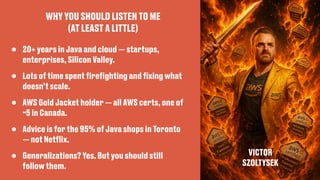
VICTOR
SZOLTYSEK
YOU WERE PROMISED THIS WOULD BE EASIER
• CI/CD was supposed to be simple. Cloud was supposed to
be cheap. Kubernetes was supposed to help.
• Instead, builds are slow, deploys are painful, and cloud
costs are out of control.
• Somewhere along the way, we forgot the point: Delivering
value quickly, without unnecessary complexity.
CI/CD, Cloud, and Kubernetes Have Let You Down
IT CAN BE CHEAP. IT CAN BE EASY. IT CAN BE FAST.
• Stop chasing trends and buzzwords you don’t need.
• Stop maintaining infrastructure you don’t need.
• $10/month AWS costs for a Java apps is possible.
• 15-minute Lead Time to Production is possible.
• You just need to drop the obsession with cargo culting and
buzzwords — and focus on what actually delivers value.
You Just Need To Focus on What Matters
HOW FAST CAN YOU ACTUALLY GET TO PROD?
• Congrats on your pipelines. But can you get a code change live in under 15 minutes?
• “We deploy on Fridays at 9pm” = broken.
• If you’re scared of production, your process sucks.
• Lead Time to Deploy is the only CI/CD metric that matters. Everything else is cargo cult.
• You don't
fi
x delivery speed by throwing buzzwords at it — you pro
fi
le, you experiment,
and you iterate.
• So how do we get there ? …
“CI/CD” Is Meaningless if Feedback Is Hours Away.
USE ALL YOUR CAPACITY
• Use Maven or Gradle Wrapper — your Java build should run on any agent. It shouldn’t
need Python, Ruby, or a PhD in DevOps.
• Modern laptops have 16 CPUs. So do your runners. Why are you still building with one?
• In Maven use -T1C
fl
ag, in Gradle use —parrallel
fl
ag.
• Parallel tests, parallel steps, parallel builds — yes, all of it. Pretty pipelines don’t ship
features. Fast ones do.

• If your build system is single-threaded in 2025, that’s not technical debt — that’s
sabotage.
Why Do Your Agents Sit Idle While Builds Take Forever?
STOP DOING POINTLESS WORK
• Don’t build on README edits. Don’t build on random document changes.
• You don’t need containers just to deploy a JAR. Seriously.
• A fat JAR is 30MB. A container is 300MB, plus layers, registries, signing, scanning...
• Strip out tests that don’t add value — blindly chasing coverage numbers only adds
noise.
• Code coverage can be gamed. Code Coverage will be gamed. The real goal is fast
feedback: detect issues quickly,
fi
x them even faster.
Your Build Is Slow Because You’re Doing 5x More Than You Need To.
DON'T REPEAT YOURSELF
• One artifact. One build. Promote it.
• PR build is redundant if you're already synced with trunk.
• No snapshots. One build for all environments. Every build is a release candidate.
• Use dependency caching to avoid rebuilding the world every time.
• Use Gradle’s incremental builds and build caching (especially in CI).
• Gradle gives you speed, caching, and
fl
exibility. Maven gives you XML.
Stop Wasting Time Doing the Same Work Over and Over.
SLIM DOWN YOUR BUILD ARTIFACTS
• Stop using containers for “hello world.”
• Consider lighter alternatives like Micronaut or Quarkus.
• Consider GraalVM — native builds are a cheat code for performance, but
not always worth it.
• Clean out your pom.xml. You don’t need six logging libraries.
• If your Lambda takes 30 seconds to cold start, look at AWS Lambda Layers.
You Could Run This on a Raspberry Pi, but Your Docker Image Needs a GPU.
MAKE DEPLOYMENTS EASY AND DAYTIME-FRIENDLY
• One-line automated deploys. No rituals. No playbooks. No ceremonies.
• Include deploy scripts as part of your codebase — easier to debug and
version (Gradle).
• Allow developers to deploy from their local machines (lower environments).
• Zero-downtime deploys are a solved problem — rolling, blue/green,
whatever.
• Rollbacks should be instant. Not a crisis plan. A button.
If Your Deploys Need a War Room, You’ve Already Failed.
STOP RELYING ON MANUAL GATES
• Mandatory PRs for every single change? Even spelling
fi
xes? Stop.
• Manual QA signo
ff
s? XCAB/TCAB meetings? Stop pretending meetings ship
code. They were cute in 2006.
• Security, SBOMs, tests — run them in parallel, automatically, and early.
• Use CODEOWNERS to assign ownership clearly, not bureaucratically.
• Want real quality? Make your teams own their stu
ff
. Embedded QA,
embedded DevOps, “you build it, you run it.” The end.
You’re Not Improving Quality — You’re Just Slowing Everyone Down.
STOP THINKING IN TERMS OF PIPELINES
• Pipelines are the new XML — bloated, overcomplicated, and revered for no reason.
• Minimize logic in pipelines — keep it in your build scripts where it's easier to debug,
version, and reuse.
• YAML is not a strategy. Bespoke plugins are not velocity. Reusability doesn’t equal speed.
• Most pipelines serialize things that should run in parallel.
• Think in terms of dependency trees and not pipelines.
• End of the day: does this get value to users faster? If not, it’s noise.
It's the New Cargo Cult.
BE CAREFUL WITH INTERNAL DEVOPS FRAMEWORKS
• If your “platform” requires a wiki to understand, you’ve already failed.
• Developers don’t need a golden path — they need golden guardrails.
• GitHub Actions is dead simple. Let devs de
fi
ne their own work
fl
ows.
• Mandates kill
fl
exibility. If your tool requires onboarding, it’s too complex.
• Teams move faster when they own their build and deploy lifecycle — 'you
build it, you run it' works here too.
More Often Than Not They Make Things Worse
SUMMARY: WHAT YOU SHOULD BE DOING:
• Use All Your Capacity
• Stop Doing Pointless Work
• Stop Building the Same Thing Twice
• Slim Down Your Build Artifacts
• Make Deployments Easy and Daytime-Friendly
• Stop Relying on Manual Gates
• Stop Thinking in Terms of Pipelines
• Be Careful With Internal DevOps Frameworks
HOW CHEAP CAN YOU ACTUALLY RUN YOUR APP?
• You’re probably spending more on engineers managing complexity
than on actual compute.
• The two biggest costs in cloud: what you pay, and what time you waste.
• If your simple CRUD app dev environment has $1,000/month AWS bill
and an entire DevOps team to manage, you're probably doing it wrong.
• You can run Java apps in the cloud for $10/month with minimal
overhead. Seriously.
Cloud Cost Isn’t Just About Dollars — It’s About Wasted Time.
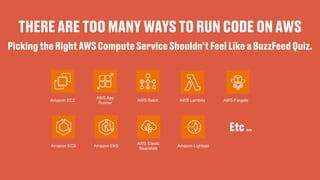
THERE ARE TOO MANY WAYS TO RUN CODE ON AWS
Picking the Right AWS Compute Service Shouldn’t Feel Like a BuzzFeed Quiz.
Amazon EC2 AWS Lambda
Amazon Lightsail
AWS Elastic
Beanstalk
AWS App
Runner
AWS Batch
Amazon EKS
Amazon ECS
AWS Fargate
Etc ..
ELASTIC COMPUTE CLOUD (EC2)
• You manage the OS, the patches, and the scaling.
• Great
fl
exibility, terrible simplicity.
• Not cost-optimized unless you tune it manually.
• Undi
ff
erentiated heavy lifting: o
ff
loaded entirely to
you.
The OG. Still Solid — and Still Way Too Low-Level.
ELASTIC KUBERNETES SERVICE (EKS)
• Huge operational overhead for questionable ROI.
• You’ll need to manage pods, YAML, Helm charts, and pain.
• Requires ECR, IAM gymnastics, and observability setup.
• You’re on the hook for everything from networking to node groups.
• Undi
ff
erentiated heavy lifting: basically all of it, plus you get to
manage Kubernetes too.
Kubernetes: a Solution Looking for Your Problem.
ELASTIC CONTAINER SERVICE (ECS)
• Requires Docker
fi
le, Task De
fi
nitions, Service
con
fi
gs, etc.
• You manage scaling, logs, registry, and networking.
• Still tightly coupled to AWS-only patterns.
• Undi
ff
erentiated heavy lifting: still signi
fi
cant.
Slightly Easier Than EKS, but Still Too Much Ceremony.
APP RUNNER
• PaaS feel with container
fl
exibility.
• Autoscaling, HTTPS, and monitoring built-in.
• Still requires you to build and manage Docker containers — no magic here.
• Regional limitations (not in Canada... yet).
• Undi
ff
erentiated heavy lifting: low/moderate — better than ECS, but not
exactly push-button.
Almost Perfect — Except It’s Missing in Canada.
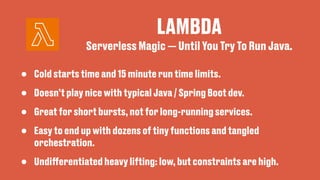
LAMBDA
• Cold starts time and 15 minute run time limits.
• Doesn’t play nice with typical Java / Spring Boot dev.
• Great for short bursts, not for long-running services.
• Easy to end up with dozens of tiny functions and tangled
orchestration.
• Undi
ff
erentiated heavy lifting: low, but constraints are high.
Serverless Magic — Until You Try To Run Java.
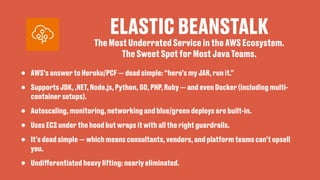
ELASTIC BEANSTALK
• AWS’s answer to Heroku/PCF — dead simple: “here’s my JAR, run it.”
• Supports JDK, .NET, Node.js, Python, GO, PHP, Ruby — and even Docker (including multi-
container setups).
• Autoscaling, monitoring, networking and blue/green deploys are built-in.
• Uses EC2 under the hood but wraps it with all the right guardrails.
• It’s dead simple — which means consultants, vendors, and platform teams can’t upsell
you.
• Undi
ff
erentiated heavy lifting: nearly eliminated.
The Most Underrated Service in the AWS Ecosystem.
The Sweet Spot for Most Java Teams.
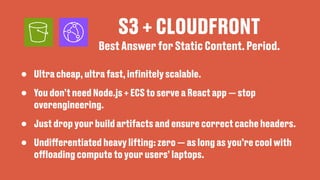
S3 + CLOUDFRONT
• Ultra cheap, ultra fast, in
fi
nitely scalable.
• You don’t need Node.js + ECS to serve a React app — stop
overengineering.
• Just drop your build artifacts and ensure correct cache headers.
• Undi
ff
erentiated heavy lifting: zero — as long as you’re cool with
o
ff
loading compute to your users’ laptops.
Best Answer for Static Content. Period.
REDUCING COSTS
REDUCING COSTS
• Tag everything, track everything — from day one.
• Give teams real visibility into what they’re spending.
• Treat costs like bugs: if it slips, it spreads.
• Budget alerts + AWS Cost Anomaly Detection = instant red
fl
ags.
• Use AWS Cost Explorer and AWS Budgets to proactively manage and forecast
spend.
• Celebrate teams that reduce cost without reducing quality.
Adopt a Cost-First Engineering Mindset
RIGHT-SIZE YOUR RESOURCES
• Most services don’t need multi-AZ redundancy.
• Dev/Test can run on t3.micro just
fi
ne.
• Use AWS Compute Optimizer to auto-tune.
• Use Graviton (ARM) for even cheaper compute.
• Spot, Reserved, On-Demand, and Savings Plans exist — use them
like a grown-up.
You’re Over-Provisioned and You Know It.
STOP PAYING FOR THINGS YOU DON’T NEED
• Monoliths are cheaper. Microservices multiply cost, complexity, and
failure modes.
• Containers come with hidden costs — ECR, K8s, orchestration, startup lag.
• Serverless isn’t magic. It only saves money with erratic tra
ff
ic.
• You likely don’t need: Service Mesh, Service Discovery, Envoy, Istio,
AppCon
fi
g, Sidecars, Step Functions, or 17 types of logs.
• Keep it boring. Keep it simple. Save money. Sleep better.
You’re Not Net
fl
ix. You Don’t Need 50 Microservices and 8 Clusters.
CLEAN UP YOUR DATA SPRAWL
• Audit and delete old S3 buckets, snapshots, and AMIs.
• Use lifecycle policies for automatic cleanup.
• Glacier and Intelligent-Tiering help — but verify they're con
fi
gured
right.
• Don’t hoard logs, backups, and exports "just in case."
• Kill orphaned resources that nobody owns — you're tagging right?
Storage Creep Is Real — and Expensive.
LOG LESS, OBSERVE SMARTER
• Prefer metrics over verbose logs — especially in lower
environments.
• Log exceptions, not method calls like “entering method foo()."
• Use structured logs for fast indexing and insights.
• Too many logs = too many bills.
• Disable debug logs in prod unless actively troubleshooting.
Verbose Logging Doesn’t Help — It Just Adds Noise and Bills.
SUMMARY: WHAT YOU SHOULD BE DOING
• Use Elastic Beanstalk for traditional Java workloads — keep it
simple, keep it cheap.
• Use S3 + CloudFront for static sites and SPAs — fast, global, and
dirt cheap.
• Adopt a Cost-First Engineering Mindset
• Right-Size Your Resources
• Stop Paying for Things You Don’t Need
• Clean Up Your Data Sprawl
• Log Less, Observe Smarter
THE AI ADVANTAGE
THE AI ADVANTAGE
• AI coding tools (GitHub Copilot, Cursor, ChatGPT) are now table stakes.
• Modern ChatGPT has DeepResearch, IntelliJ integration, and team-focused
work
fl
ows — this isn’t just autocomplete anymore.
• Not giving devs access is like not giving them StackOver
fl
ow in 2010.
• They reduce friction, improve velocity, and unlock
fl
ow.
• Startups using AI are outpacing you. Enterprises adopting AI are cutting
time-to-delivery by 30%+.
AI Is Now a Baseline Expectation, Not a Luxury
AI ISN’T JUST CODE GENERATION
• Generate test cases and mocks.
• Explain error messages, stack traces.
• Draft pipeline YAML, IAM policies, and more.
• Brainstorm architectures, unblock solutioning, explore edge cases.
• Wrangle awful regex until it stops crying.
• Generate cover letters for TPS reports — with just the right amount of fake
enthusiasm.
Automate the Repetitive, Accelerate the Valuable
AMAZON DEVOPS GURU
• Automatic detection of anomalous behavior.
• Root cause analysis + recommendations.
• Integrated with CloudWatch, X-Ray, and more.
• Great
fi
t for ops-lite teams that don’t have time to dig
through dashboards.
AI-Powered Insights to Spot Issues Before Your Users Do.
AMAZON BEDROCK
• Access to top foundational models (Anthropic, Meta, Amazon
Titan).
• Fully managed + integrated with other AWS services.
• Use it for internal tools, chatbots, code generation, customer
support.
• Real value-add for orgs that want AI without spinning up GPUs.
Use LLMs Without Managing Infrastructure.
FINAL POINTS
FINAL POINTS
• Fast builds → Use all your cores/agents. Don’t rebuild nonsense.
• Cheap deploys → Beanstalk, not Kubernetes. Monoliths are
fi
ne.
• Less pain → Drop the cargo cult. Embrace boring.
• Competitive edge → Give every dev AI tools. Today
• Impact wins → Measurable improvements beat trendy stacks.
• The real goal → Faster delivery, better quality, lower cost. Full stop.
What Actually Works in 2025
victor_szoltysek@mac.com
www.victorszoltysek.com
Hiring for :
Cloud Architects
DevOps
.. reach me by email.

Java on AWS Without the Headaches - Fast Builds, Cheap Deploys, No Kubernetes

  • 1.
    By: Victor Szoltysek March27 / 2025 Java Usergroup Meetup - Toronto Fast Builds, Cheap Deploys, No Kubernetes JAVA ON AWS WITHOUT THE HEADACHES
  • 2.
    WHY YOU SHOULDLISTEN TO ME (AT LEAST A LITTLE) • 20+ years in Java and cloud — startups, enterprises, Silicon Valley. • Lots of time spent fi re fi ghting and fi xing what doesn’t scale. • AWS Gold Jacket holder — all AWS certs, one of ~5 in Canada. • Advice is for the 95% of Java shops in Toronto — not Net fl ix. • Generalizations? Yes. But you should still follow them. VICTOR SZOLTYSEK
  • 3.
    YOU WERE PROMISEDTHIS WOULD BE EASIER • CI/CD was supposed to be simple. Cloud was supposed to be cheap. Kubernetes was supposed to help. • Instead, builds are slow, deploys are painful, and cloud costs are out of control. • Somewhere along the way, we forgot the point: Delivering value quickly, without unnecessary complexity. CI/CD, Cloud, and Kubernetes Have Let You Down
  • 4.
    IT CAN BECHEAP. IT CAN BE EASY. IT CAN BE FAST. • Stop chasing trends and buzzwords you don’t need. • Stop maintaining infrastructure you don’t need. • $10/month AWS costs for a Java apps is possible. • 15-minute Lead Time to Production is possible. • You just need to drop the obsession with cargo culting and buzzwords — and focus on what actually delivers value. You Just Need To Focus on What Matters
  • 5.
    HOW FAST CANYOU ACTUALLY GET TO PROD?
  • 6.
    HOW FAST CANYOU ACTUALLY GET TO PROD? • Congrats on your pipelines. But can you get a code change live in under 15 minutes? • “We deploy on Fridays at 9pm” = broken. • If you’re scared of production, your process sucks. • Lead Time to Deploy is the only CI/CD metric that matters. Everything else is cargo cult. • You don't fi x delivery speed by throwing buzzwords at it — you pro fi le, you experiment, and you iterate. • So how do we get there ? … “CI/CD” Is Meaningless if Feedback Is Hours Away.
  • 7.
    USE ALL YOURCAPACITY • Use Maven or Gradle Wrapper — your Java build should run on any agent. It shouldn’t need Python, Ruby, or a PhD in DevOps. • Modern laptops have 16 CPUs. So do your runners. Why are you still building with one? • In Maven use -T1C fl ag, in Gradle use —parrallel fl ag. • Parallel tests, parallel steps, parallel builds — yes, all of it. Pretty pipelines don’t ship features. Fast ones do. • If your build system is single-threaded in 2025, that’s not technical debt — that’s sabotage. Why Do Your Agents Sit Idle While Builds Take Forever?
  • 8.
    STOP DOING POINTLESSWORK • Don’t build on README edits. Don’t build on random document changes. • You don’t need containers just to deploy a JAR. Seriously. • A fat JAR is 30MB. A container is 300MB, plus layers, registries, signing, scanning... • Strip out tests that don’t add value — blindly chasing coverage numbers only adds noise. • Code coverage can be gamed. Code Coverage will be gamed. The real goal is fast feedback: detect issues quickly, fi x them even faster. Your Build Is Slow Because You’re Doing 5x More Than You Need To.
  • 9.
    DON'T REPEAT YOURSELF •One artifact. One build. Promote it. • PR build is redundant if you're already synced with trunk. • No snapshots. One build for all environments. Every build is a release candidate. • Use dependency caching to avoid rebuilding the world every time. • Use Gradle’s incremental builds and build caching (especially in CI). • Gradle gives you speed, caching, and fl exibility. Maven gives you XML. Stop Wasting Time Doing the Same Work Over and Over.
  • 10.
    SLIM DOWN YOURBUILD ARTIFACTS • Stop using containers for “hello world.” • Consider lighter alternatives like Micronaut or Quarkus. • Consider GraalVM — native builds are a cheat code for performance, but not always worth it. • Clean out your pom.xml. You don’t need six logging libraries. • If your Lambda takes 30 seconds to cold start, look at AWS Lambda Layers. You Could Run This on a Raspberry Pi, but Your Docker Image Needs a GPU.
  • 11.
    MAKE DEPLOYMENTS EASYAND DAYTIME-FRIENDLY • One-line automated deploys. No rituals. No playbooks. No ceremonies. • Include deploy scripts as part of your codebase — easier to debug and version (Gradle). • Allow developers to deploy from their local machines (lower environments). • Zero-downtime deploys are a solved problem — rolling, blue/green, whatever. • Rollbacks should be instant. Not a crisis plan. A button. If Your Deploys Need a War Room, You’ve Already Failed.
  • 12.
    STOP RELYING ONMANUAL GATES • Mandatory PRs for every single change? Even spelling fi xes? Stop. • Manual QA signo ff s? XCAB/TCAB meetings? Stop pretending meetings ship code. They were cute in 2006. • Security, SBOMs, tests — run them in parallel, automatically, and early. • Use CODEOWNERS to assign ownership clearly, not bureaucratically. • Want real quality? Make your teams own their stu ff . Embedded QA, embedded DevOps, “you build it, you run it.” The end. You’re Not Improving Quality — You’re Just Slowing Everyone Down.
  • 13.
    STOP THINKING INTERMS OF PIPELINES • Pipelines are the new XML — bloated, overcomplicated, and revered for no reason. • Minimize logic in pipelines — keep it in your build scripts where it's easier to debug, version, and reuse. • YAML is not a strategy. Bespoke plugins are not velocity. Reusability doesn’t equal speed. • Most pipelines serialize things that should run in parallel. • Think in terms of dependency trees and not pipelines. • End of the day: does this get value to users faster? If not, it’s noise. It's the New Cargo Cult.
  • 14.
    BE CAREFUL WITHINTERNAL DEVOPS FRAMEWORKS • If your “platform” requires a wiki to understand, you’ve already failed. • Developers don’t need a golden path — they need golden guardrails. • GitHub Actions is dead simple. Let devs de fi ne their own work fl ows. • Mandates kill fl exibility. If your tool requires onboarding, it’s too complex. • Teams move faster when they own their build and deploy lifecycle — 'you build it, you run it' works here too. More Often Than Not They Make Things Worse
  • 15.
    SUMMARY: WHAT YOUSHOULD BE DOING: • Use All Your Capacity • Stop Doing Pointless Work • Stop Building the Same Thing Twice • Slim Down Your Build Artifacts • Make Deployments Easy and Daytime-Friendly • Stop Relying on Manual Gates • Stop Thinking in Terms of Pipelines • Be Careful With Internal DevOps Frameworks
  • 16.
    HOW CHEAP CANYOU ACTUALLY RUN YOUR APP?
  • 17.
    HOW CHEAP CANYOU ACTUALLY RUN YOUR APP? • You’re probably spending more on engineers managing complexity than on actual compute. • The two biggest costs in cloud: what you pay, and what time you waste. • If your simple CRUD app dev environment has $1,000/month AWS bill and an entire DevOps team to manage, you're probably doing it wrong. • You can run Java apps in the cloud for $10/month with minimal overhead. Seriously. Cloud Cost Isn’t Just About Dollars — It’s About Wasted Time.
  • 18.
    THERE ARE TOOMANY WAYS TO RUN CODE ON AWS
  • 19.
    THERE ARE TOOMANY WAYS TO RUN CODE ON AWS Picking the Right AWS Compute Service Shouldn’t Feel Like a BuzzFeed Quiz. Amazon EC2 AWS Lambda Amazon Lightsail AWS Elastic Beanstalk AWS App Runner AWS Batch Amazon EKS Amazon ECS AWS Fargate Etc ..
  • 20.
    ELASTIC COMPUTE CLOUD(EC2) • You manage the OS, the patches, and the scaling. • Great fl exibility, terrible simplicity. • Not cost-optimized unless you tune it manually. • Undi ff erentiated heavy lifting: o ff loaded entirely to you. The OG. Still Solid — and Still Way Too Low-Level.
  • 21.
    ELASTIC KUBERNETES SERVICE(EKS) • Huge operational overhead for questionable ROI. • You’ll need to manage pods, YAML, Helm charts, and pain. • Requires ECR, IAM gymnastics, and observability setup. • You’re on the hook for everything from networking to node groups. • Undi ff erentiated heavy lifting: basically all of it, plus you get to manage Kubernetes too. Kubernetes: a Solution Looking for Your Problem.
  • 22.
    ELASTIC CONTAINER SERVICE(ECS) • Requires Docker fi le, Task De fi nitions, Service con fi gs, etc. • You manage scaling, logs, registry, and networking. • Still tightly coupled to AWS-only patterns. • Undi ff erentiated heavy lifting: still signi fi cant. Slightly Easier Than EKS, but Still Too Much Ceremony.
  • 23.
    APP RUNNER • PaaSfeel with container fl exibility. • Autoscaling, HTTPS, and monitoring built-in. • Still requires you to build and manage Docker containers — no magic here. • Regional limitations (not in Canada... yet). • Undi ff erentiated heavy lifting: low/moderate — better than ECS, but not exactly push-button. Almost Perfect — Except It’s Missing in Canada.
  • 24.
    LAMBDA • Cold startstime and 15 minute run time limits. • Doesn’t play nice with typical Java / Spring Boot dev. • Great for short bursts, not for long-running services. • Easy to end up with dozens of tiny functions and tangled orchestration. • Undi ff erentiated heavy lifting: low, but constraints are high. Serverless Magic — Until You Try To Run Java.
  • 25.
    ELASTIC BEANSTALK • AWS’sanswer to Heroku/PCF — dead simple: “here’s my JAR, run it.” • Supports JDK, .NET, Node.js, Python, GO, PHP, Ruby — and even Docker (including multi- container setups). • Autoscaling, monitoring, networking and blue/green deploys are built-in. • Uses EC2 under the hood but wraps it with all the right guardrails. • It’s dead simple — which means consultants, vendors, and platform teams can’t upsell you. • Undi ff erentiated heavy lifting: nearly eliminated. The Most Underrated Service in the AWS Ecosystem. The Sweet Spot for Most Java Teams.
  • 26.
    S3 + CLOUDFRONT •Ultra cheap, ultra fast, in fi nitely scalable. • You don’t need Node.js + ECS to serve a React app — stop overengineering. • Just drop your build artifacts and ensure correct cache headers. • Undi ff erentiated heavy lifting: zero — as long as you’re cool with o ff loading compute to your users’ laptops. Best Answer for Static Content. Period.
  • 27.
  • 28.
    REDUCING COSTS • Tageverything, track everything — from day one. • Give teams real visibility into what they’re spending. • Treat costs like bugs: if it slips, it spreads. • Budget alerts + AWS Cost Anomaly Detection = instant red fl ags. • Use AWS Cost Explorer and AWS Budgets to proactively manage and forecast spend. • Celebrate teams that reduce cost without reducing quality. Adopt a Cost-First Engineering Mindset
  • 29.
    RIGHT-SIZE YOUR RESOURCES •Most services don’t need multi-AZ redundancy. • Dev/Test can run on t3.micro just fi ne. • Use AWS Compute Optimizer to auto-tune. • Use Graviton (ARM) for even cheaper compute. • Spot, Reserved, On-Demand, and Savings Plans exist — use them like a grown-up. You’re Over-Provisioned and You Know It.
  • 30.
    STOP PAYING FORTHINGS YOU DON’T NEED • Monoliths are cheaper. Microservices multiply cost, complexity, and failure modes. • Containers come with hidden costs — ECR, K8s, orchestration, startup lag. • Serverless isn’t magic. It only saves money with erratic tra ff ic. • You likely don’t need: Service Mesh, Service Discovery, Envoy, Istio, AppCon fi g, Sidecars, Step Functions, or 17 types of logs. • Keep it boring. Keep it simple. Save money. Sleep better. You’re Not Net fl ix. You Don’t Need 50 Microservices and 8 Clusters.
  • 31.
    CLEAN UP YOURDATA SPRAWL • Audit and delete old S3 buckets, snapshots, and AMIs. • Use lifecycle policies for automatic cleanup. • Glacier and Intelligent-Tiering help — but verify they're con fi gured right. • Don’t hoard logs, backups, and exports "just in case." • Kill orphaned resources that nobody owns — you're tagging right? Storage Creep Is Real — and Expensive.
  • 32.
    LOG LESS, OBSERVESMARTER • Prefer metrics over verbose logs — especially in lower environments. • Log exceptions, not method calls like “entering method foo()." • Use structured logs for fast indexing and insights. • Too many logs = too many bills. • Disable debug logs in prod unless actively troubleshooting. Verbose Logging Doesn’t Help — It Just Adds Noise and Bills.
  • 33.
    SUMMARY: WHAT YOUSHOULD BE DOING • Use Elastic Beanstalk for traditional Java workloads — keep it simple, keep it cheap. • Use S3 + CloudFront for static sites and SPAs — fast, global, and dirt cheap. • Adopt a Cost-First Engineering Mindset • Right-Size Your Resources • Stop Paying for Things You Don’t Need • Clean Up Your Data Sprawl • Log Less, Observe Smarter
  • 34.
  • 35.
    THE AI ADVANTAGE •AI coding tools (GitHub Copilot, Cursor, ChatGPT) are now table stakes. • Modern ChatGPT has DeepResearch, IntelliJ integration, and team-focused work fl ows — this isn’t just autocomplete anymore. • Not giving devs access is like not giving them StackOver fl ow in 2010. • They reduce friction, improve velocity, and unlock fl ow. • Startups using AI are outpacing you. Enterprises adopting AI are cutting time-to-delivery by 30%+. AI Is Now a Baseline Expectation, Not a Luxury
  • 36.
    AI ISN’T JUSTCODE GENERATION • Generate test cases and mocks. • Explain error messages, stack traces. • Draft pipeline YAML, IAM policies, and more. • Brainstorm architectures, unblock solutioning, explore edge cases. • Wrangle awful regex until it stops crying. • Generate cover letters for TPS reports — with just the right amount of fake enthusiasm. Automate the Repetitive, Accelerate the Valuable
  • 37.
    AMAZON DEVOPS GURU •Automatic detection of anomalous behavior. • Root cause analysis + recommendations. • Integrated with CloudWatch, X-Ray, and more. • Great fi t for ops-lite teams that don’t have time to dig through dashboards. AI-Powered Insights to Spot Issues Before Your Users Do.
  • 38.
    AMAZON BEDROCK • Accessto top foundational models (Anthropic, Meta, Amazon Titan). • Fully managed + integrated with other AWS services. • Use it for internal tools, chatbots, code generation, customer support. • Real value-add for orgs that want AI without spinning up GPUs. Use LLMs Without Managing Infrastructure.
  • 39.
  • 40.
    FINAL POINTS • Fastbuilds → Use all your cores/agents. Don’t rebuild nonsense. • Cheap deploys → Beanstalk, not Kubernetes. Monoliths are fi ne. • Less pain → Drop the cargo cult. Embrace boring. • Competitive edge → Give every dev AI tools. Today • Impact wins → Measurable improvements beat trendy stacks. • The real goal → Faster delivery, better quality, lower cost. Full stop. What Actually Works in 2025
  • 41.