Sagara	
  Gunathunga	
  
Architect	
  -­‐	
  WSO2	
  
Deep	
  dive	
  into	
  JAX-­‐RS	
  
2	


  REST	
  	
  
REpresentational State Transfer
“An architecture style of networked systems & uses
HTTP Protocol for data communication ”
3	


  REST	
  	
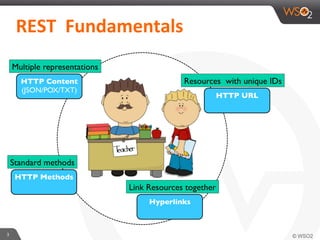
  Fundamentals	


Resources with unique IDs
Standard methods
Multiple representations
Link Resources together
HTTP Content
(JSON/POX/TXT)
HTTP URL
Hyperlinks
HTTP Methods
4	


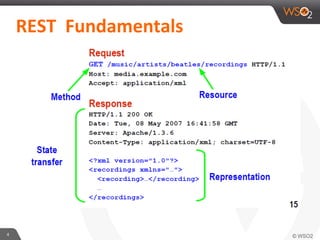
  REST	
  	
  Fundamentals	


5	


  REST	
  	
  Fundamentals	


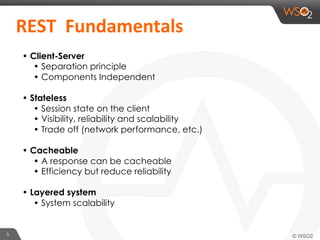
• Client-Server
• Separation principle
• Components Independent
• Stateless
• Session state on the client
• Visibility, reliability and scalability
• Trade off (network performance, etc.)
• Cacheable
• A response can be cacheable
• Efficiency but reduce reliability
• Layered system
• System scalability
6	
  
JAX-­‐RS	
  –	
  Java	
  API	
  for	
  RESTfull	


  WebServices	
  	
  
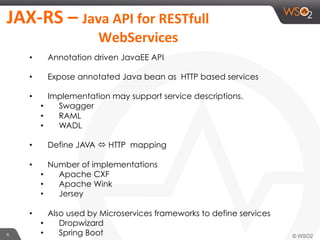
•  Annotation driven JavaEE API
•  Expose annotated Java bean as HTTP based services
•  Implementation may support service descriptions.
•  Swagger
•  RAML
•  WADL
•  Define JAVA ó HTTP mapping
•  Number of implementations
•  Apache CXF
•  Apache Wink
•  Jersey
•  Also used by Microservices frameworks to define services
•  Dropwizard
•  Spring Boot
7	
  
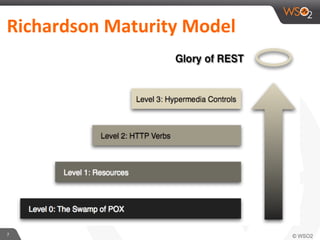
Richardson	
  Maturity	
  Model	
  
8	
  
RMM	
  –	
  Level	
  0	
  	
  
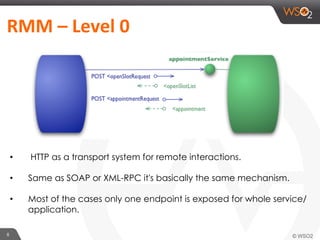
•  HTTP as a transport system for remote interactions.
•  Same as SOAP or XML-RPC it's basically the same mechanism.
•  Most of the cases only one endpoint is exposed for whole service/
application.
9	
  
RMM	
  –	
  Level	
  1	
  	
  
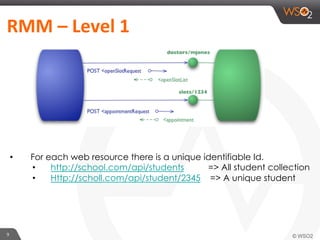
•  For each web resource there is a unique identifiable Id.
•  http://school.com/api/students => All student collection
•  Http://scholl.com/api/student/2345 => A unique student
10	
  
RMM	
  –	
  Level	
  2	
  	
  
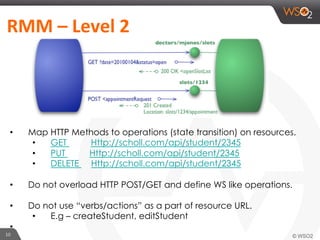
•  Map HTTP Methods to operations (state transition) on resources.
•  GET Http://scholl.com/api/student/2345
•  PUT Http://scholl.com/api/student/2345
•  DELETE Http://scholl.com/api/student/2345
•  Do not overload HTTP POST/GET and define WS like operations.
•  Do not use “verbs/actions” as a part of resource URL.
•  E.g – createStudent, editStudent
• 
11	
  
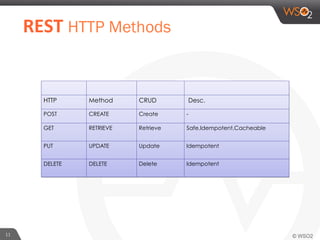
HTTP Method CRUD Desc.
POST CREATE Create -
GET RETRIEVE Retrieve Safe,Idempotent,Cacheable
PUT UPDATE Update Idempotent
DELETE DELETE Delete Idempotent
	
  	
  REST	
  HTTP Methods 	
  
12	
  
RMM	
  –	
  Level	
  3	
  	
  
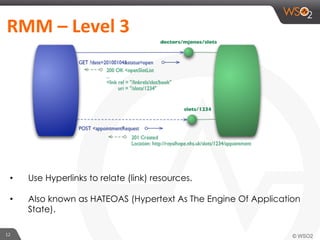
•  Use Hyperlinks to relate (link) resources.
•  Also known as HATEOAS (Hypertext As The Engine Of Application
State).
13	
  
JAX-­‐WS	
  AnnotaGons	
  	
  
•  @Path
•  @GET
•  @PUT
•  @POST
•  @DELETE
•  @Produces
•  @Consumes
•  @PathParam
•  @QueryParam
•  @MatrixParam
•  @HeaderParam
•  @CookieParam
•  @FormParam
•  @DefaultValue
•  @Context
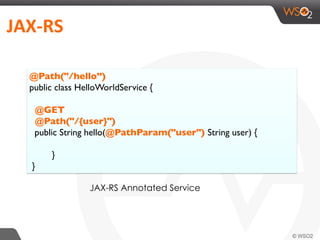
JAX-­‐RS	
  
JAX-RS Annotated Service
@Path("/hello”)
public class HelloWorldService {
@GET
@Path("/{user}")
public String hello(@PathParam("user") String user) {
}
}
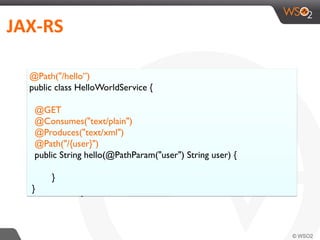
JAX-­‐RS	
  
JAX-RS Annotated Service
@Path("/hello”)
public class HelloWorldService {
@GET
@Consumes("text/plain")
@Produces("text/xml")
@Path("/{user}")
public String hello(@PathParam("user") String user) {
}
}
JAX-­‐RS	
  parameter	
  types	
  
•  @PathParam
•  @QueryParam
•  @HeaderParam
•  @CookieParam
•  @FormParam
•  @MatrixParam
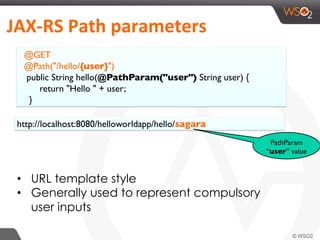
JAX-­‐RS	
  Path	
  parameters	
  
@GET
@Path("/hello/{user}")
public String hello(@PathParam("user") String user) {
return "Hello " + user;
}
http://localhost:8080/helloworldapp/hello/sagara
PathParam
“user” value
•  URL template style
•  Generally used to represent compulsory
user inputs
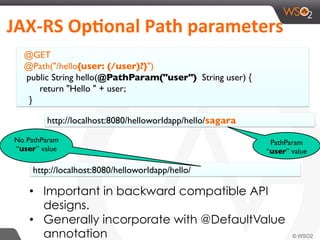
JAX-­‐RS	
  OpGonal	
  Path	
  parameters	
  
@GET
@Path("/hello{user: (/user)?}")
public String hello(@PathParam("user") String user) {
return "Hello " + user;
}
http://localhost:8080/helloworldapp/hello/sagara
PathParam
“user” value
•  Important in backward compatible API
designs.
•  Generally incorporate with @DefaultValue
annotation
http://localhost:8080/helloworldapp/hello/
No PathParam
“user” value
http://localhost:8080/helloworldapp/hello
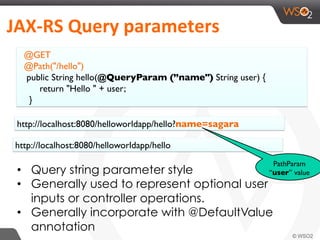
JAX-­‐RS	
  Query	
  parameters	
  
@GET
@Path("/hello")
public String hello(@QueryParam (”name") String user) {
return "Hello " + user;
}
http://localhost:8080/helloworldapp/hello?name=sagara
PathParam
“user” value•  Query string parameter style
•  Generally used to represent optional user
inputs or controller operations.
•  Generally incorporate with @DefaultValue
annotation
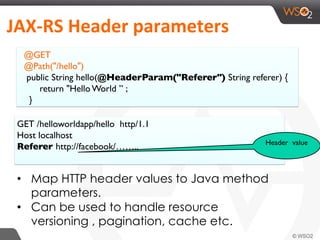
JAX-­‐RS	
  Header	
  parameters	
  
@GET
@Path("/hello")
public String hello(@HeaderParam("Referer") String referer) {
return "Hello World ” ;
}
GET /helloworldapp/hello http/1.1
Host localhost
Referer http://facebook/…….. Header value
•  Map HTTP header values to Java method
parameters.
•  Can be used to handle resource
versioning , pagination, cache etc.
21	
  
	
  Error	
  handling	
  	
  -­‐	
  Status	
  Codes	


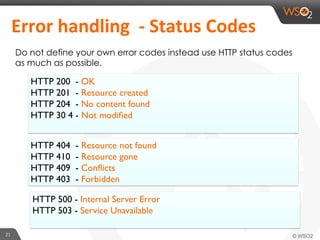
Do not define your own error codes instead use HTTP status codes
as much as possible.
HTTP 200 - OK
HTTP 201 - Resource created
HTTP 204 - No content found
HTTP 30 4 - Not modified
HTTP 404 - Resource not found
HTTP 410 - Resource gone
HTTP 409 - Conflicts
HTTP 403 - Forbidden
HTTP 500 - Internal Server Error
HTTP 503 - Service Unavailable
22	
  
	
  Error	
  handling	
  	
  -­‐	
  Status	
  Codes	


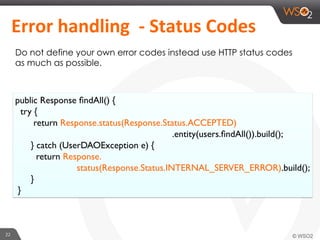
Do not define your own error codes instead use HTTP status codes
as much as possible.
public Response findAll() {
try {
return Response.status(Response.Status.ACCEPTED)
.entity(users.findAll()).build();
} catch (UserDAOException e) {
return Response.
status(Response.Status.INTERNAL_SERVER_ERROR).build();
}
}
23	
  
	
  Error	
  handling	
  -­‐	
  ExcepGonMapper	
  
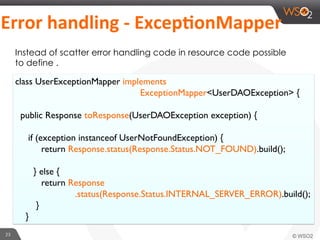
Instead of scatter error handling code in resource code possible
to define .
class UserExceptionMapper implements
ExceptionMapper<UserDAOException> {
public Response toResponse(UserDAOException exception) {
if (exception instanceof UserNotFoundException) {
return Response.status(Response.Status.NOT_FOUND).build();
} else {
return Response
.status(Response.Status.INTERNAL_SERVER_ERROR).build();
}
}
24	
  
Resource	
  Linking	
  
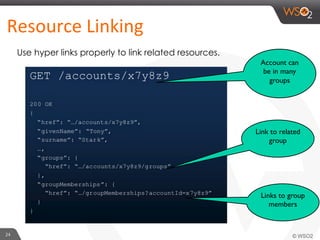
Use hyper links properly to link related resources.
Account can
be in many
groups
Link to related
group
Links to group
members
25	
  
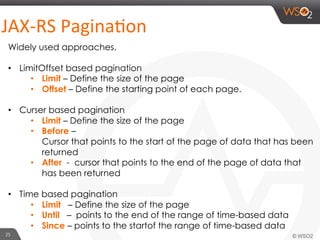
JAX-­‐RS	
  PaginaHon	
  
Widely used approaches.
•  LimitOffset based pagination
•  Limit – Define the size of the page
•  Offset – Define the starting point of each page.
•  Curser based pagination
•  Limit – Define the size of the page
•  Before –
Cursor that points to the start of the page of data that has been
returned
•  After - cursor that points to the end of the page of data that
has been returned
•  Time based pagination
•  Limit – Define the size of the page
•  Until – points to the end of the range of time-based data
•  Since – points to the startof the range of time-based data
26	
  
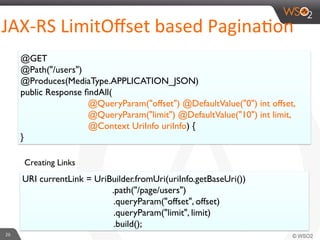
JAX-­‐RS	
  LimitOffset	
  based	
  PaginaHon	
  
@GET
@Path("/users")
@Produces(MediaType.APPLICATION_JSON)
public Response findAll(
@QueryParam("offset") @DefaultValue("0") int offset,
@QueryParam("limit") @DefaultValue("10") int limit,
@Context UriInfo uriInfo) {
}
URI currentLink = UriBuilder.fromUri(uriInfo.getBaseUri())
.path("/page/users")
.queryParam("offset", offset)
.queryParam("limit", limit)
.build();
Creating Links
27	
  
AuthenHcaHon	
  and	
  AuthorizaHon	
  	
  
Widely used approaches.
•  HTTP BasicAuth
•  OAuth2
28	
  
References	


•  https://github.com/sagara-gunathunga/jaxrs-java-colombo/
•  http://martinfowler.com/articles/richardsonMaturityModel.html
Contact	
  us	
  !	
  

Java colombo-deep-dive-into-jax-rs

  • 1.
    Sagara  Gunathunga   Architect  -­‐  WSO2   Deep  dive  into  JAX-­‐RS  
  • 2.
    2      REST     REpresentational State Transfer “An architecture style of networked systems & uses HTTP Protocol for data communication ”
  • 3.
    3      REST    Fundamentals       Resources with unique IDs Standard methods Multiple representations Link Resources together HTTP Content (JSON/POX/TXT) HTTP URL Hyperlinks HTTP Methods
  • 4.
    4      REST    Fundamentals      
  • 5.
    5      REST    Fundamentals       • Client-Server • Separation principle • Components Independent • Stateless • Session state on the client • Visibility, reliability and scalability • Trade off (network performance, etc.) • Cacheable • A response can be cacheable • Efficiency but reduce reliability • Layered system • System scalability
  • 6.
    6   JAX-­‐RS  –  Java  API  for  RESTfull                                                            WebServices     •  Annotation driven JavaEE API •  Expose annotated Java bean as HTTP based services •  Implementation may support service descriptions. •  Swagger •  RAML •  WADL •  Define JAVA ó HTTP mapping •  Number of implementations •  Apache CXF •  Apache Wink •  Jersey •  Also used by Microservices frameworks to define services •  Dropwizard •  Spring Boot
  • 7.
  • 8.
    8   RMM  –  Level  0     •  HTTP as a transport system for remote interactions. •  Same as SOAP or XML-RPC it's basically the same mechanism. •  Most of the cases only one endpoint is exposed for whole service/ application.
  • 9.
    9   RMM  –  Level  1     •  For each web resource there is a unique identifiable Id. •  http://school.com/api/students => All student collection •  Http://scholl.com/api/student/2345 => A unique student
  • 10.
    10   RMM  –  Level  2     •  Map HTTP Methods to operations (state transition) on resources. •  GET Http://scholl.com/api/student/2345 •  PUT Http://scholl.com/api/student/2345 •  DELETE Http://scholl.com/api/student/2345 •  Do not overload HTTP POST/GET and define WS like operations. •  Do not use “verbs/actions” as a part of resource URL. •  E.g – createStudent, editStudent • 
  • 11.
    11   HTTP MethodCRUD Desc. POST CREATE Create - GET RETRIEVE Retrieve Safe,Idempotent,Cacheable PUT UPDATE Update Idempotent DELETE DELETE Delete Idempotent    REST  HTTP Methods  
  • 12.
    12   RMM  –  Level  3     •  Use Hyperlinks to relate (link) resources. •  Also known as HATEOAS (Hypertext As The Engine Of Application State).
  • 13.
    13   JAX-­‐WS  AnnotaGons     •  @Path •  @GET •  @PUT •  @POST •  @DELETE •  @Produces •  @Consumes •  @PathParam •  @QueryParam •  @MatrixParam •  @HeaderParam •  @CookieParam •  @FormParam •  @DefaultValue •  @Context
  • 14.
    JAX-­‐RS   JAX-RS AnnotatedService @Path("/hello”) public class HelloWorldService { @GET @Path("/{user}") public String hello(@PathParam("user") String user) { } }
  • 15.
    JAX-­‐RS   JAX-RS AnnotatedService @Path("/hello”) public class HelloWorldService { @GET @Consumes("text/plain") @Produces("text/xml") @Path("/{user}") public String hello(@PathParam("user") String user) { } }
  • 16.
    JAX-­‐RS  parameter  types   •  @PathParam •  @QueryParam •  @HeaderParam •  @CookieParam •  @FormParam •  @MatrixParam
  • 17.
    JAX-­‐RS  Path  parameters   @GET @Path("/hello/{user}") public String hello(@PathParam("user") String user) { return "Hello " + user; } http://localhost:8080/helloworldapp/hello/sagara PathParam “user” value •  URL template style •  Generally used to represent compulsory user inputs
  • 18.
    JAX-­‐RS  OpGonal  Path  parameters   @GET @Path("/hello{user: (/user)?}") public String hello(@PathParam("user") String user) { return "Hello " + user; } http://localhost:8080/helloworldapp/hello/sagara PathParam “user” value •  Important in backward compatible API designs. •  Generally incorporate with @DefaultValue annotation http://localhost:8080/helloworldapp/hello/ No PathParam “user” value
  • 19.
    http://localhost:8080/helloworldapp/hello JAX-­‐RS  Query  parameters   @GET @Path("/hello") public String hello(@QueryParam (”name") String user) { return "Hello " + user; } http://localhost:8080/helloworldapp/hello?name=sagara PathParam “user” value•  Query string parameter style •  Generally used to represent optional user inputs or controller operations. •  Generally incorporate with @DefaultValue annotation
  • 20.
    JAX-­‐RS  Header  parameters   @GET @Path("/hello") public String hello(@HeaderParam("Referer") String referer) { return "Hello World ” ; } GET /helloworldapp/hello http/1.1 Host localhost Referer http://facebook/…….. Header value •  Map HTTP header values to Java method parameters. •  Can be used to handle resource versioning , pagination, cache etc.
  • 21.
    21    Error  handling    -­‐  Status  Codes       Do not define your own error codes instead use HTTP status codes as much as possible. HTTP 200 - OK HTTP 201 - Resource created HTTP 204 - No content found HTTP 30 4 - Not modified HTTP 404 - Resource not found HTTP 410 - Resource gone HTTP 409 - Conflicts HTTP 403 - Forbidden HTTP 500 - Internal Server Error HTTP 503 - Service Unavailable
  • 22.
    22    Error  handling    -­‐  Status  Codes       Do not define your own error codes instead use HTTP status codes as much as possible. public Response findAll() { try { return Response.status(Response.Status.ACCEPTED) .entity(users.findAll()).build(); } catch (UserDAOException e) { return Response. status(Response.Status.INTERNAL_SERVER_ERROR).build(); } }
  • 23.
    23    Error  handling  -­‐  ExcepGonMapper   Instead of scatter error handling code in resource code possible to define . class UserExceptionMapper implements ExceptionMapper<UserDAOException> { public Response toResponse(UserDAOException exception) { if (exception instanceof UserNotFoundException) { return Response.status(Response.Status.NOT_FOUND).build(); } else { return Response .status(Response.Status.INTERNAL_SERVER_ERROR).build(); } }
  • 24.
    24   Resource  Linking   Use hyper links properly to link related resources. Account can be in many groups Link to related group Links to group members
  • 25.
    25   JAX-­‐RS  PaginaHon   Widely used approaches. •  LimitOffset based pagination •  Limit – Define the size of the page •  Offset – Define the starting point of each page. •  Curser based pagination •  Limit – Define the size of the page •  Before – Cursor that points to the start of the page of data that has been returned •  After - cursor that points to the end of the page of data that has been returned •  Time based pagination •  Limit – Define the size of the page •  Until – points to the end of the range of time-based data •  Since – points to the startof the range of time-based data
  • 26.
    26   JAX-­‐RS  LimitOffset  based  PaginaHon   @GET @Path("/users") @Produces(MediaType.APPLICATION_JSON) public Response findAll( @QueryParam("offset") @DefaultValue("0") int offset, @QueryParam("limit") @DefaultValue("10") int limit, @Context UriInfo uriInfo) { } URI currentLink = UriBuilder.fromUri(uriInfo.getBaseUri()) .path("/page/users") .queryParam("offset", offset) .queryParam("limit", limit) .build(); Creating Links
  • 27.
    27   AuthenHcaHon  and  AuthorizaHon     Widely used approaches. •  HTTP BasicAuth •  OAuth2
  • 28.
    28   References       •  https://github.com/sagara-gunathunga/jaxrs-java-colombo/ •  http://martinfowler.com/articles/richardsonMaturityModel.html
  • 29.