Submitted To:
Department of Computer Science
RIMT-Institute of Engineering & Technology
Mandi-Gobindgarh
Punjab( India)
Developed By:
Shashi Kr. Singh (1150986)
Introduction to Java:
 Java is programming language. It is mainly designed to
develop internet application by providing platform
independency
 Java is very simple, high-level, secured ,multithreaded , object-
oriented programming language
 It was developed by James Gosling in Sun microsystem in
1990’s for developing internet application
 Its first version released in 23 January 1995
History of java
 1990 Sun Microsystems decided to develop special software
that could be used to manipulate consumer electronic devices.
A team of Sun Microsystems programmers headed by James
Gosling was formed to undertake this task.
 1991 After exploring the possibility of most Object Oriented
Programming Language C++, the team announced a new
language named “Oak”.
 1992 The team , known as a Green Project team by Sun
 1994 The team developed a web browser called “Hot Java”
to locate and run applet programs on Internet.
 1995 Oak was named “Java”, due to some legal issue. Java
is just a name and is not an acronym.
 1996 Java established itself not only a leader for Internet
Programming but also as a general-purpose, object oriented
programming language.
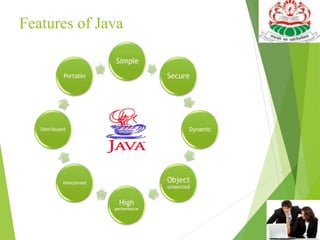
Features of Java
JVM,JDK & JRE
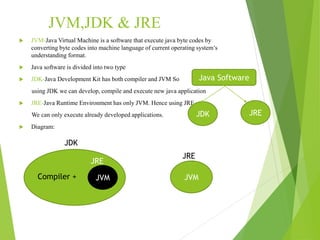
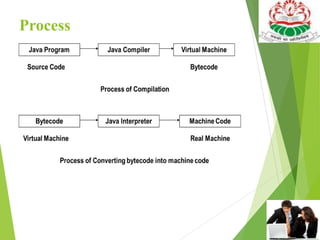
 JVM-Java Virtual Machine is a software that execute java byte codes by
converting byte codes into machine language of current operating system’s
understanding format.
 Java software is divided into two type
 JDK-Java Development Kit has both compiler and JVM So
using JDK we can develop, compile and execute new java application
 JRE-Java Runtime Environment has only JVM. Hence using JRE
We can only execute already developed applications.
 Diagram:
Java Software
JDK JRE
JVMCompiler +
JRE
JDK
JVM
JRE
Modules of Java:
Since java can be used to developed all kinds of software application. so
It is called as programming suite
Java can be divided into three modules there are :
 JSE –java standard edition
 JEE –java enterprise edition
 JME –java mobile/micro edition
JSE
 JSE means java standard edition
 It is installable software as JDK software
 Latest version is JDK8.0
 This module is given to develop standalone application, desktop etc.
 The application that specific to one computer and contain main() method is
called standalone application
 Standalone application that contains GUI is called as desktop application
JEE
 JEE means java Enterprise edition
 It is not installable software
 JEE specification contain rules guidelines to develop webserver and
application server software like weblogic,Tomcat server
 Using this we can be developed
i) Web Application(websites)
ii) Distributed Application
iii) N-tier Application
JME
 JME means java mobile/micro edition
 For JME module, JSE module is base module
 It is installable software
 To develop mobile application and micro application in java
environment like mobile games ,sim cards etc
Process
Principal of OOPs :
 Object Oriented Programming (OOP) attempts to emulate the
real world in software systems. The real world consists of
objects, categorized in classes. In Object Oriented
Programming, classes have attributes, represented by data
member.
Feature of Object Oriented Programming
 Class & object
 Information Encapsulation(Hiding)
 Abstraction
 Inheritance
 Polymorphism
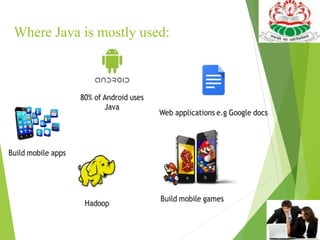
Where Java is mostly used:
An Example:
class First
{
int a=10;
Public static void main(String[] args)
{
System.out.println(“Welcome to JAVA”+a);
}
}
System Requirements:
 Basic programming knowledge
Core Java

Core Java

  • 1.
    Submitted To: Department ofComputer Science RIMT-Institute of Engineering & Technology Mandi-Gobindgarh Punjab( India) Developed By: Shashi Kr. Singh (1150986)
  • 2.
    Introduction to Java: Java is programming language. It is mainly designed to develop internet application by providing platform independency  Java is very simple, high-level, secured ,multithreaded , object- oriented programming language  It was developed by James Gosling in Sun microsystem in 1990’s for developing internet application  Its first version released in 23 January 1995
  • 3.
    History of java 1990 Sun Microsystems decided to develop special software that could be used to manipulate consumer electronic devices. A team of Sun Microsystems programmers headed by James Gosling was formed to undertake this task.  1991 After exploring the possibility of most Object Oriented Programming Language C++, the team announced a new language named “Oak”.  1992 The team , known as a Green Project team by Sun  1994 The team developed a web browser called “Hot Java” to locate and run applet programs on Internet.  1995 Oak was named “Java”, due to some legal issue. Java is just a name and is not an acronym.  1996 Java established itself not only a leader for Internet Programming but also as a general-purpose, object oriented programming language.
  • 4.
  • 5.
    JVM,JDK & JRE JVM-Java Virtual Machine is a software that execute java byte codes by converting byte codes into machine language of current operating system’s understanding format.  Java software is divided into two type  JDK-Java Development Kit has both compiler and JVM So using JDK we can develop, compile and execute new java application  JRE-Java Runtime Environment has only JVM. Hence using JRE We can only execute already developed applications.  Diagram: Java Software JDK JRE JVMCompiler + JRE JDK JVM JRE
  • 6.
    Modules of Java: Sincejava can be used to developed all kinds of software application. so It is called as programming suite Java can be divided into three modules there are :  JSE –java standard edition  JEE –java enterprise edition  JME –java mobile/micro edition
  • 7.
    JSE  JSE meansjava standard edition  It is installable software as JDK software  Latest version is JDK8.0  This module is given to develop standalone application, desktop etc.  The application that specific to one computer and contain main() method is called standalone application  Standalone application that contains GUI is called as desktop application
  • 8.
    JEE  JEE meansjava Enterprise edition  It is not installable software  JEE specification contain rules guidelines to develop webserver and application server software like weblogic,Tomcat server  Using this we can be developed i) Web Application(websites) ii) Distributed Application iii) N-tier Application
  • 9.
    JME  JME meansjava mobile/micro edition  For JME module, JSE module is base module  It is installable software  To develop mobile application and micro application in java environment like mobile games ,sim cards etc
  • 10.
  • 11.
    Principal of OOPs:  Object Oriented Programming (OOP) attempts to emulate the real world in software systems. The real world consists of objects, categorized in classes. In Object Oriented Programming, classes have attributes, represented by data member. Feature of Object Oriented Programming  Class & object  Information Encapsulation(Hiding)  Abstraction  Inheritance  Polymorphism
  • 12.
    Where Java ismostly used:
  • 13.
    An Example: class First { inta=10; Public static void main(String[] args) { System.out.println(“Welcome to JAVA”+a); } }
  • 14.
    System Requirements:  Basicprogramming knowledge