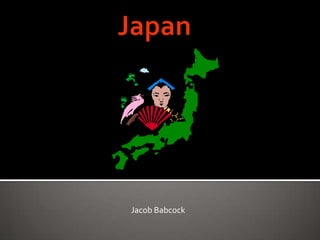
Japan       Jacob Babcock
Where in the world is Japan?
OverviewCapital – Tokyo 8 regions47 Prefectures Bodies larger than cities, towns, and villagesCurrency1  Dollar = 90.6 Yen3rd most traded after Euro and DollarGlobal Edge.msu.edu
HistoryAttack on Pearl Harbor, December 7th, 1945Atomic Bomb -  Hiroshima August 7th, 1945Occupied until 1951 under General MacarthurPeace treaty –45 Nations; 1951Ally with U.S. todayGlobaledge.msu.edu
Geography4 main IslandsOver 3,000 smaller onesEarthquakes – August 6.78 main areas65 % ForestsMountainsMount FujiCoastlines
Natural ResourcesAccess to ocean			RiceWoodWheatBarleyOatsApples
InfrastructurePorts
128 Major, 951 LocalJapan is known to have some of the most highly developed transportation systems in the world.
People
Religion2 % ChristianMost consider themselves Buddhist, Shinto, or both.Does not play big role in everyday life.
EducationElementary – 6 years Junior High – 3 yearsHigh school – 3 yearsCollegePublic school until Middle SchoolPrivate very popularPlayed big part in economic growth and recovery from WWII
LanguagePrimarily JapaneseKonichiwa!  Good day, or Good afternoonDo people in Japan speak English?It is a problem - Trying to increase English fluency
Values and AttitudesSaving Face Harmony – Work togetherNon verbal CommunicationsHierarachySchools – Address as senior (senpai) or junior (kohai)
Public BehaviorMeeting EtiquetteWait to get introduced, bow head slightlyGift GivingVery ritualisticDiningShoes off, Show on time – Toilet slippers!Table mannersWait to be seated, Chopsticks
Business DressBe conservative!
Men – Business Suits
Women – No pants, little or no accessories Business PracticesLow expectationsImpress them!Appointments RequiredListen – eyes closedNon – confrontationalYes or no answersBusiness CardsAddresses Prefecture, Municipal, City District , City Block, House Number
Hofstede’s DimensionsHigh MasculinityLow IndividualismHigh Uncertainty AvoidanceCollective culture that avoids risks and have little personal freedom.
Major IndustriesMotor VehiclesToyota, Nissan, HondaElectronic EquipmentMachine toolsShipsTextilesTelecommunications Construction
Labor Force20 % of Japanese 65 +…40 % by 2055Big concern for futureWill reduce number of workers
GovernmentMonarchy – Emperor (Akihito)(Power very limited) -Symbol of the state and unity of the people.Next in line – Prince NaruhitoPrime Minister of Japan - Yukio HatoyamaHouse of Representatives (480 )Prime Minister appointed by Emperor after being designated by the House.
Economic IndicatorsWorld’s 2nd largest economy & GDPStrive on relationship with U.S.Recession in 2008 – 2 % GDPJapanGDP (per capita) $34,200Inflation Rate1.4% Ease of Doing Business12/181 Global Competitiveness5/134United StatesGDP (per capita) $46,900Inflation Rate3.8% Ease of Doing Business3/181 Global Competitiveness1/134
Economic  AlliancesASEAN (Association of Southeast Asian Nations)WTO (World Trade Organization)APEC (Asia-Pacific Economic Cooperation)WIPO (World Intellectual Property Organization
Intellectual property protectionVery strongThe Patent Law of JapanProtection of Trade SecretsUnfair CompetitionCopyrightsUtility ModelDesign
Import RelationsGlobal Imports by JapanMarket Value:  543,884,000
Export RelationsGlobal Exports by Japan Market Value: 567,403,000
ReccomendationsRisk Rating – A2; Can still improveIndustries with potential growthRoboticsTremendous technologyHospitalsOld age will eventually need more health careWorkforceImmigrantsCoastlinesMaximize use

Japan

  • 1.
    Japan Jacob Babcock
  • 2.
    Where in theworld is Japan?
  • 4.
    OverviewCapital – Tokyo8 regions47 Prefectures Bodies larger than cities, towns, and villagesCurrency1 Dollar = 90.6 Yen3rd most traded after Euro and DollarGlobal Edge.msu.edu
  • 7.
    HistoryAttack on PearlHarbor, December 7th, 1945Atomic Bomb - Hiroshima August 7th, 1945Occupied until 1951 under General MacarthurPeace treaty –45 Nations; 1951Ally with U.S. todayGlobaledge.msu.edu
  • 8.
    Geography4 main IslandsOver3,000 smaller onesEarthquakes – August 6.78 main areas65 % ForestsMountainsMount FujiCoastlines
  • 10.
    Natural ResourcesAccess toocean RiceWoodWheatBarleyOatsApples
  • 11.
  • 12.
    128 Major, 951LocalJapan is known to have some of the most highly developed transportation systems in the world.
  • 13.
  • 14.
    Religion2 % ChristianMostconsider themselves Buddhist, Shinto, or both.Does not play big role in everyday life.
  • 15.
    EducationElementary – 6years Junior High – 3 yearsHigh school – 3 yearsCollegePublic school until Middle SchoolPrivate very popularPlayed big part in economic growth and recovery from WWII
  • 16.
    LanguagePrimarily JapaneseKonichiwa! Good day, or Good afternoonDo people in Japan speak English?It is a problem - Trying to increase English fluency
  • 17.
    Values and AttitudesSavingFace Harmony – Work togetherNon verbal CommunicationsHierarachySchools – Address as senior (senpai) or junior (kohai)
  • 18.
    Public BehaviorMeeting EtiquetteWaitto get introduced, bow head slightlyGift GivingVery ritualisticDiningShoes off, Show on time – Toilet slippers!Table mannersWait to be seated, Chopsticks
  • 19.
  • 20.
  • 21.
    Women – Nopants, little or no accessories Business PracticesLow expectationsImpress them!Appointments RequiredListen – eyes closedNon – confrontationalYes or no answersBusiness CardsAddresses Prefecture, Municipal, City District , City Block, House Number
  • 22.
    Hofstede’s DimensionsHigh MasculinityLowIndividualismHigh Uncertainty AvoidanceCollective culture that avoids risks and have little personal freedom.
  • 23.
    Major IndustriesMotor VehiclesToyota,Nissan, HondaElectronic EquipmentMachine toolsShipsTextilesTelecommunications Construction
  • 24.
    Labor Force20 %of Japanese 65 +…40 % by 2055Big concern for futureWill reduce number of workers
  • 25.
    GovernmentMonarchy – Emperor(Akihito)(Power very limited) -Symbol of the state and unity of the people.Next in line – Prince NaruhitoPrime Minister of Japan - Yukio HatoyamaHouse of Representatives (480 )Prime Minister appointed by Emperor after being designated by the House.
  • 26.
    Economic IndicatorsWorld’s 2ndlargest economy & GDPStrive on relationship with U.S.Recession in 2008 – 2 % GDPJapanGDP (per capita) $34,200Inflation Rate1.4% Ease of Doing Business12/181 Global Competitiveness5/134United StatesGDP (per capita) $46,900Inflation Rate3.8% Ease of Doing Business3/181 Global Competitiveness1/134
  • 27.
    Economic AlliancesASEAN(Association of Southeast Asian Nations)WTO (World Trade Organization)APEC (Asia-Pacific Economic Cooperation)WIPO (World Intellectual Property Organization
  • 28.
    Intellectual property protectionVerystrongThe Patent Law of JapanProtection of Trade SecretsUnfair CompetitionCopyrightsUtility ModelDesign
  • 29.
    Import RelationsGlobal Importsby JapanMarket Value: 543,884,000
  • 30.
    Export RelationsGlobal Exportsby Japan Market Value: 567,403,000
  • 31.
    ReccomendationsRisk Rating –A2; Can still improveIndustries with potential growthRoboticsTremendous technologyHospitalsOld age will eventually need more health careWorkforceImmigrantsCoastlinesMaximize use