Accelerating Inclusive Growth and
Competitiveness through the AEC:
Focus on the Manufacturing
Sector
Josef T. Yap
21 October 2013
Background
Lack of Economic Transformation
Share of Manufacturing in GDP (%)
1980
1990
China
43.9
36.5
Indonesia
13.5
23.0
Malaysia
21.6
22.7
Philippines
27.7
26.8
Thailand
21.5
24.9
Viet Nam
16.1
12.3

2000
40.4
27.7
29.9
24.5
33.6
18.6

2006
32.9
27.5
28.8
23.6
35.0
21.2

2011
32.2
24.3
24.6
21.1
29.9
19.4

Source: UN Statistics Division [http://unstats.un.org/unsd/dnlList.asp; accessed, 6 October 2013]
Main Outcome: Poverty Situation
in PH is dismal

PRC
Indonesia
Malaysia
Philippines
Thailand
Viet Nam

Poverty and Inequality in East Asia
Proportion of
Population
Population in
Gini Coefficient3/
Poverty (in
Below $1.25
percent)1/
(PPP) a Day2/
4.2 (2008)
11.8 (2009)
0.425 (2005)
12.0 (2012)
16.2 (2011)
0.381 (2011)
1.7 (2012)
0.0 (2009)
0.462 (2009)
26.5 (2009)
18.4 (2009)
0.430 (2009)
13.2 (2011)
0.4 (2010)
0.394 (2010)
20.7 (2010)
16.8 (2008)
0.356 (2008)

Sources/Notes:
1/

World Bank, WorldDevelopment Indicators accessed 6 October 2013

2/

Asian Development Bank, Statistical Database System accessed 6 October 2013

3/

http://www.adb.org/sites/default/files/pub/2013/ki2013.pdf accessed 6 October 2013
Role of Regional Production
Networks
Regional Integration Anchored on Regional Production Networks

Regional Economic
Integration

Regional Production
Networks
FDI
Manufacturing Sector
Structure of Regional Production and
Distribution Networks
200

Billions of US Dollars

160

China

120

ASEAN
80
South Korea
& Taipei,China
40
Japan
0
84

86

88

90

92

94

96

98

00

02

04

06

08

10

Intermediate Goods Exports from East Asia
as a Whole to Individual Countries or Regions.
Note: ASEAN includes Malaysia, the Philippines, Singapore, and Thailand.
Source: CEPII-CHELEM Database

Value of Intermediate Goods Imports of Individual East Asian Countries and Regions
from East Asia as a Whole (Billions of U.S. Dollars)
Region

1990

1995

2000

2005

2008

2009

2010

Japan

5.2

13.6

22.0

34.3

45.0

37.1

47.9

China

5.6

19.2

28.9

85.2

118.6

115.7

161.9

ASEAN 4

15.8

47.5

54.6

67.9

82.7

69.6

95.9

S.Korea+Taipei,China

13.2

31.8

41.7

59.2

74.0

64.2

86.1

Source: W. Thorbecke “Exchange Rates and Trade in East Asia”
Source: Cheewatrakoolpong, Sabhasri, and Bunditwattanawong (2013)
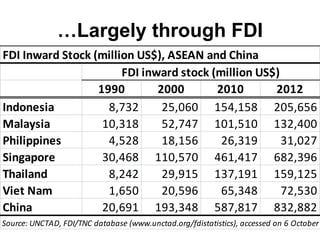
…Largely through FDI
FDI Inward Stock (million US$), ASEAN and China
FDI inward stock (million US$)
1990
2000
2010
2012
Indonesia
8,732
25,060 154,158 205,656
Malaysia
10,318
52,747 101,510 132,400
Philippines
4,528
18,156
26,319
31,027
Singapore
30,468 110,570 461,417 682,396
Thailand
8,242
29,915 137,191 159,125
Viet Nam
1,650
20,596
65,348
72,530
China
20,691 193,348 587,817 832,882
Source: UNCTAD, FDI/TNC database (www.unctad.org/fdistatistics), accessed on 6 October
PH export performance has lagged
behind that of other EA economies
Export of Goods and Services (in million US dollars)
1995
2000
2005
2012
Japan
441,538 479,323 595,697 798,937
Korea
125,058 172,268 284,419 547,870
Indonesia
45,418
62,124
85,660 190,032
Taipei, China
111,405 151,458 198,168 300,533
Philippines
17,447
38,078
41,255
51,995
Malaysia
73,865
98,229 141,595 227,334
Thailand
56,444
69,152 110,360 228,141
China
148,780 249,203 761,953 2,048,900
Hongkong
173,753 201,855 289,325 442,775
Viet Nam
5,449
14,483
32,447 114,573
Source: ADB Key Indicators for Asia and the Pacific 2013
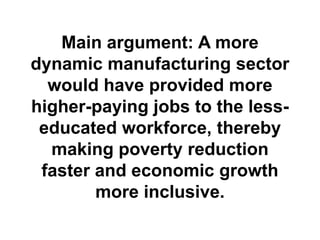
Main argument: A more
dynamic manufacturing sector
would have provided more
higher-paying jobs to the lesseducated workforce, thereby
making poverty reduction
faster and economic growth
more inclusive.
Policy Options for Inclusive Growth
• AEC is an opportunity to attract more FDI
• AEC will generate regional public goods,
especially in infrastructure
• Comprehensive Roadmap for Industry:
address horizontal and vertical constraints,
coordination failure
• Emphasis on facilitating involvement of
SMEs in regional production networks
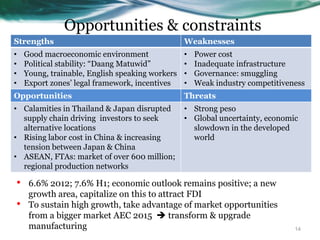
Opportunities & constraints
Strengths
•
•
•
•

Good macroeconomic environment
Political stability: “Daang Matuwid”
Young, trainable, English speaking workers
Export zones’ legal framework, incentives

Weaknesses
•
•
•
•

Power cost
Inadequate infrastructure
Governance: smuggling
Weak industry competitiveness

Opportunities

Threats

• Calamities in Thailand & Japan disrupted
supply chain driving investors to seek
alternative locations
• Rising labor cost in China & increasing
tension between Japan & China
• ASEAN, FTAs: market of over 600 million;
regional production networks

• Strong peso
• Global uncertainty, economic
slowdown in the developed
world

•
•

6.6% 2012; 7.6% H1; economic outlook remains positive; a new
growth area, capitalize on this to attract FDI
To sustain high growth, take advantage of market opportunities
from a bigger market AEC 2015  transform & upgrade
manufacturing

14
Classics, Emerging Champions
Classics (RCAs remain high)

Emerging Champions (low to hi)

Forest

copper ores & copper

scrap ferrous waste

Raw
materials

fuel wood, wood charcoal

Raw
materials

milk & cream

Cereal, etc

Unmanufactured tobacco
& vegetable textile fibers

Animal
prods.
Cereals, etc

Laborintensive

Knitted men, boys,
women, girls’ clothing;
other textile apparel

Manufactured
tobacco

Machinery

Capitalintensive

tulle, lace, embroidery

electric power
machinery, parts;
electric machinery
apparatus nes; parts
for tractors &
motor vehicles

Labor-int.

glass

Chemicals

metal salts, inorganic
acid

Machinery electric distribution
equipment, nes; radio
broadcast receiver;
transistors, valves
Chemicals

•
•

alcohol, phenol

Classics: maintain long term competitiveness
Emerging Champions: need to build on these products

15
Disappearances, marginals
Disappearances (high to low)

Marginals (RCAs remain low)

Raw
Stone, sand, gravel; non- Forest
materials ferrous waste, scrap

Pulp & paper*

Forest

veneers, plywood

Cereals

cereal prep’ns*, edible prod.*

Tropical
agri

sugars, molasses, cocoa,
natural rubber

Capitalintensive

furskins, tanned, dressed

Animal

fish, animal veg. fats,
oils, nes

Machinery ship, boat, float structures*
cycles, motorcycles;
aircraft, associated
equipment; medical
instruments; arms &
ammunitions

Labor
pottery, furniture,
intensive cushions, clothing
accessories, fabric

Cereals

•
•

animal feed stuff

Chemicals

soap, cleaners, polish, etc

Disappearances: declining competitiveness, move up the value chain,
product/technology ladder to more sophisticated products
Marginals: observe & let them grow to become exporter
16
Potential Growth areas: Nearby
Criteria

Leamer

Nearby: Detailed Commodity Group (SITC 4 digit)

Highest
level
sophisticat
ion
Highest
spillover
effect

Machinery

Complete digital processing machines; watches; photographic cameras;
TV, radio-broadcasting, transmitters; clocks; electrical line telephonic;
portable radio receivers; microphones; calculating, accounting machines;
sewing machines; domestic electromechanical appliances & parts

Capital

Fabrics, woven of continuous synthetic textile materials

Labor

Precious jewelry; porcelain or china house ware; pianos

Animal

Fish, dried, smoked; fish fillets frozen

Agriculture Refined sugar
Cereal
Labor

Synthetic or reconstructed precious or semi-precious stones; pianos; pens;
small wares & toilet articles; precious jewelry; porcelain

Capital

Knitted not elastic nor rubberized of fibers other than synthetic; Fabrics,
woven of continuous synthetic textile materials

Machinery

Highest
labor
intensity

Flours & meals, of meat , fish

Clocks; watches; photographic cameras; sewing machines

Source: Usui, N. 2012. Taking the Right road to Inclusive Growth. ADB. Manila.

•

Can be developed with relative ease, can utilize existing capabilities (inputs,
institutional/infrastructure, skills, technology) embedded in the current
export structure

17
Potential growth areas: Middle
Criteria

Leamer

Middle: Detailed Commodity Group (SITC 4 digit)

Highest
level
sophisticat
ion

Chemicals

hormones, natural, or reproduced by synthesis; other nitrogen-function
compounds; modified natural resins; oxygen function amino compounds;
epoxide resins; regenerated cellulose; salts of metallic acids

Metal

angles, shapes, sections & sheet filing of iron or steel

Labor

orthopedic appliances, heating aids; safety glass

Machinery

metal forming machine-tool; nonmechanical or electrical instruments;
aircraft of unladen weight from 2000kg to 15000kg

Machinery

cocks, valves for pipes boiler shells; air pumps, vacuum pumps & air or gas
compressors; other articles of rubber; other non-electric parts &
accessories of machinery, nes

Chemicals

phenoplasts; aminoplasts

Capital

felts, articles of felt; coated or impregnated textile fabrics & products;
bonded fiber fabrics

Raw
materials

slag, scaling, dross & similar waste; other natural abrasives; seeds, fruits,
spores, nes for planting

Forest

fiber building board of wood or other vegetable material

Highest
spillover
effect

Highest
labor
intensity

Source: Usui, N. 2012. Taking the Right road to Inclusive Growth. ADB. Manila.

• Can be developed with some difficulties, not all required
capabilities are in the country

18
Potential growth: far-away
Criteria

Leamer

Far-away: Detailed Commodity Group (SITC 4 digit)

Highest
level
sophisticat
ion

Chemicals

amide-function compounds exc. urea; other organo-inorganic compounds;
suphonamides, sultones

Forest

printing paper & writing paper

Machinery

chassis fitted with engines for vehicles; furnace burners mechanical
strokers etc & parts; other non-electrical machines & parts

Highest
spillover
effect

Machinery

electrical insulating equipment; furnace burners, mechanical stokers;
harvesting & threshing machines; engines & motors; other parts &
accessories of vehicles

Forest

paper & paperboard coated impregnated in rolls sheets

Chemicals

aldehyde, ketone, & quinone-function compounds; inorganic esters, salts
& derivatives; polyamides

Capital

special products of textile materials

Machinery

nuclear reactors & parts; bodies for vehicles; other parts &
accessories for vehicles; railway track fixtures; parts nes of aircraft hdg
792, mechanically propelled railway, tramway, trolleys

Capital

linoleum & similar floor covering, special products of textile material;
central heating equipment

Highest
labor
intensity

Source: Usui, N. 2012. Taking the Right road to Inclusive Growth. ADB. Manila.

• Need quite different capabilities that the country has not yet developed
19
Constraints to Growth
Major Area

Main Issues & Constraints

Infrastructure &
Logistics

High cost & unpredictability of power
High cost of domestic shipping

Governance &
Regulation

Smuggling, corruption, bureaucracy & red tape
Lack of streamlining/automation of business procedures

MSME
development

Access to finance, technology, inability to comply with
standards

Innovation

Lack of innovation

HRD

Lack of skilled workers

Supply chain gaps

Absence of upstream/downstream industries; weak parts
& components sector high cost of raw materials

Domestic &
export expansion

Lack of scale economies due to shrinking domestic base

•
•
•

Liberalization competition reduce firm survival
Crucial factors in a liberalized & highly competitive market: productivity,
export-orientation, foreign equity, firm size
How to address challenges & take advantage of opportunities arising from
AEC transform & upgrade manufacturing

20
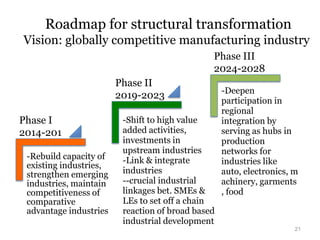
Roadmap for structural transformation
Vision: globally competitive manufacturing industry
Phase III
2024-2028

Phase II
2019-2023
Phase I
2014-201
-Rebuild capacity of
existing industries,
strengthen emerging
industries, maintain
competitiveness of
comparative
advantage industries

-Shift to high value
added activities,
investments in
upstream industries
-Link & integrate
industries
--crucial industrial
linkages bet. SMEs &
LEs to set off a chain
reaction of broad based
industrial development

-Deepen
participation in
regional
integration by
serving as hubs in
production
networks for
industries like
auto, electronics, m
achinery, garments
, food

21
Targets, Strategic actions, complementary measures
Coordination
mechanism
Vertical
measures

Horizontal
measures

•
•
•
•
•
•

HRD
SME development
Technology upgrading,
innovation
Power, smuggling, logistics
& infrastructure
Investment promotion
Competitive exchange rate

30% value
added; 15%
employment

• Close supply chain gaps
 access to raw materials: food
furniture, garments
 integration mechanism:
copper, iron & steel, chemicals
• Expand domestic market &
exports
 automotive & shipping

open trade regime, sustainable macro policies, sound tax policies &
administration, efficient bureaucracy, secure property rights
22
•
•
•

Industrial Upgrading & Transformation
CRITERIA for Industry Support
 Strong potential to generate employment
 Address missing gaps & linkages & spill-over effects
 Level of product sophistication; Competitive market environment

INDUSTRIES: Automotive, motorcycle, shipbuilding, chemicals & allied
industries, electronics & electrical appliances, food/agribusiness, garments, textiles, copper, pulp &
paper, rubber, furniture, jewelry, iron & steel

HORIZONTAL Programs to directly improve productivity


•

HORIZONTAL Programs to address coordination failures


•
•

Cluster-based intervention: increase supply of skilled workers, encourage
technology adoption, improve regulation & infrastructure
Implementation of legislations; strict enforcement of product quality
standards; provide access to raw materials, intermediate inputs & common
service facilities, R&D facilities; aggressive investment promotion &
marketing to attract investment; trainings, business & academe linkages

VERTICAL Program to attract investment in “middle” & “far-away”
 Temporary fiscal incentives to auto, ship-building, iron & steel

COORDINATION MECHANISM Industry councils/institutes:
 Auto, chemicals, garments &

textiles, electronics, food, motorcycle, shipbuilding, iron &
steel, copper, SME Institute

23
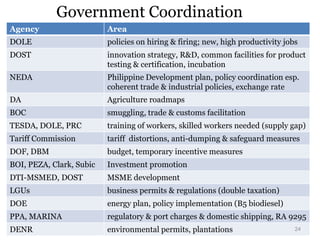
Government Coordination
Agency

Area

DOLE

policies on hiring & firing; new, high productivity jobs

DOST

innovation strategy, R&D, common facilities for product
testing & certification, incubation

NEDA

Philippine Development plan, policy coordination esp.
coherent trade & industrial policies, exchange rate

DA

Agriculture roadmaps

BOC

smuggling, trade & customs facilitation

TESDA, DOLE, PRC

training of workers, skilled workers needed (supply gap)

Tariff Commission

tariff distortions, anti-dumping & safeguard measures

DOF, DBM

budget, temporary incentive measures

BOI, PEZA, Clark, Subic

Investment promotion

DTI-MSMED, DOST

MSME development

LGUs

business permits & regulations (double taxation)

DOE

energy plan, policy implementation (B5 biodiesel)

PPA, MARINA

regulatory & port charges & domestic shipping, RA 9295

DENR

environmental permits, plantations

24
•
•
•
•
•
•
•
•

Maraming Salamat!!!
Dios ti Agngina!!!
Dios mamajes dinio!!!
Dacal a salamat!!!
Salamat tunon!!!
Saeamat kimo!!!
Daghang Salamat!!!
Thank YOU very much!!!!

J yap asean_us_oct21_2013_revised

  • 1.
    Accelerating Inclusive Growthand Competitiveness through the AEC: Focus on the Manufacturing Sector Josef T. Yap 21 October 2013
  • 2.
  • 3.
    Lack of EconomicTransformation Share of Manufacturing in GDP (%) 1980 1990 China 43.9 36.5 Indonesia 13.5 23.0 Malaysia 21.6 22.7 Philippines 27.7 26.8 Thailand 21.5 24.9 Viet Nam 16.1 12.3 2000 40.4 27.7 29.9 24.5 33.6 18.6 2006 32.9 27.5 28.8 23.6 35.0 21.2 2011 32.2 24.3 24.6 21.1 29.9 19.4 Source: UN Statistics Division [http://unstats.un.org/unsd/dnlList.asp; accessed, 6 October 2013]
  • 4.
    Main Outcome: PovertySituation in PH is dismal PRC Indonesia Malaysia Philippines Thailand Viet Nam Poverty and Inequality in East Asia Proportion of Population Population in Gini Coefficient3/ Poverty (in Below $1.25 percent)1/ (PPP) a Day2/ 4.2 (2008) 11.8 (2009) 0.425 (2005) 12.0 (2012) 16.2 (2011) 0.381 (2011) 1.7 (2012) 0.0 (2009) 0.462 (2009) 26.5 (2009) 18.4 (2009) 0.430 (2009) 13.2 (2011) 0.4 (2010) 0.394 (2010) 20.7 (2010) 16.8 (2008) 0.356 (2008) Sources/Notes: 1/ World Bank, WorldDevelopment Indicators accessed 6 October 2013 2/ Asian Development Bank, Statistical Database System accessed 6 October 2013 3/ http://www.adb.org/sites/default/files/pub/2013/ki2013.pdf accessed 6 October 2013
  • 5.
    Role of RegionalProduction Networks
  • 6.
    Regional Integration Anchoredon Regional Production Networks Regional Economic Integration Regional Production Networks FDI Manufacturing Sector
  • 7.
    Structure of RegionalProduction and Distribution Networks
  • 8.
    200 Billions of USDollars 160 China 120 ASEAN 80 South Korea & Taipei,China 40 Japan 0 84 86 88 90 92 94 96 98 00 02 04 06 08 10 Intermediate Goods Exports from East Asia as a Whole to Individual Countries or Regions. Note: ASEAN includes Malaysia, the Philippines, Singapore, and Thailand. Source: CEPII-CHELEM Database Value of Intermediate Goods Imports of Individual East Asian Countries and Regions from East Asia as a Whole (Billions of U.S. Dollars) Region 1990 1995 2000 2005 2008 2009 2010 Japan 5.2 13.6 22.0 34.3 45.0 37.1 47.9 China 5.6 19.2 28.9 85.2 118.6 115.7 161.9 ASEAN 4 15.8 47.5 54.6 67.9 82.7 69.6 95.9 S.Korea+Taipei,China 13.2 31.8 41.7 59.2 74.0 64.2 86.1 Source: W. Thorbecke “Exchange Rates and Trade in East Asia”
  • 9.
    Source: Cheewatrakoolpong, Sabhasri,and Bunditwattanawong (2013)
  • 10.
    …Largely through FDI FDIInward Stock (million US$), ASEAN and China FDI inward stock (million US$) 1990 2000 2010 2012 Indonesia 8,732 25,060 154,158 205,656 Malaysia 10,318 52,747 101,510 132,400 Philippines 4,528 18,156 26,319 31,027 Singapore 30,468 110,570 461,417 682,396 Thailand 8,242 29,915 137,191 159,125 Viet Nam 1,650 20,596 65,348 72,530 China 20,691 193,348 587,817 832,882 Source: UNCTAD, FDI/TNC database (www.unctad.org/fdistatistics), accessed on 6 October
  • 11.
    PH export performancehas lagged behind that of other EA economies Export of Goods and Services (in million US dollars) 1995 2000 2005 2012 Japan 441,538 479,323 595,697 798,937 Korea 125,058 172,268 284,419 547,870 Indonesia 45,418 62,124 85,660 190,032 Taipei, China 111,405 151,458 198,168 300,533 Philippines 17,447 38,078 41,255 51,995 Malaysia 73,865 98,229 141,595 227,334 Thailand 56,444 69,152 110,360 228,141 China 148,780 249,203 761,953 2,048,900 Hongkong 173,753 201,855 289,325 442,775 Viet Nam 5,449 14,483 32,447 114,573 Source: ADB Key Indicators for Asia and the Pacific 2013
  • 12.
    Main argument: Amore dynamic manufacturing sector would have provided more higher-paying jobs to the lesseducated workforce, thereby making poverty reduction faster and economic growth more inclusive.
  • 13.
    Policy Options forInclusive Growth • AEC is an opportunity to attract more FDI • AEC will generate regional public goods, especially in infrastructure • Comprehensive Roadmap for Industry: address horizontal and vertical constraints, coordination failure • Emphasis on facilitating involvement of SMEs in regional production networks
  • 14.
    Opportunities & constraints Strengths • • • • Goodmacroeconomic environment Political stability: “Daang Matuwid” Young, trainable, English speaking workers Export zones’ legal framework, incentives Weaknesses • • • • Power cost Inadequate infrastructure Governance: smuggling Weak industry competitiveness Opportunities Threats • Calamities in Thailand & Japan disrupted supply chain driving investors to seek alternative locations • Rising labor cost in China & increasing tension between Japan & China • ASEAN, FTAs: market of over 600 million; regional production networks • Strong peso • Global uncertainty, economic slowdown in the developed world • • 6.6% 2012; 7.6% H1; economic outlook remains positive; a new growth area, capitalize on this to attract FDI To sustain high growth, take advantage of market opportunities from a bigger market AEC 2015  transform & upgrade manufacturing 14
  • 15.
    Classics, Emerging Champions Classics(RCAs remain high) Emerging Champions (low to hi) Forest copper ores & copper scrap ferrous waste Raw materials fuel wood, wood charcoal Raw materials milk & cream Cereal, etc Unmanufactured tobacco & vegetable textile fibers Animal prods. Cereals, etc Laborintensive Knitted men, boys, women, girls’ clothing; other textile apparel Manufactured tobacco Machinery Capitalintensive tulle, lace, embroidery electric power machinery, parts; electric machinery apparatus nes; parts for tractors & motor vehicles Labor-int. glass Chemicals metal salts, inorganic acid Machinery electric distribution equipment, nes; radio broadcast receiver; transistors, valves Chemicals • • alcohol, phenol Classics: maintain long term competitiveness Emerging Champions: need to build on these products 15
  • 16.
    Disappearances, marginals Disappearances (highto low) Marginals (RCAs remain low) Raw Stone, sand, gravel; non- Forest materials ferrous waste, scrap Pulp & paper* Forest veneers, plywood Cereals cereal prep’ns*, edible prod.* Tropical agri sugars, molasses, cocoa, natural rubber Capitalintensive furskins, tanned, dressed Animal fish, animal veg. fats, oils, nes Machinery ship, boat, float structures* cycles, motorcycles; aircraft, associated equipment; medical instruments; arms & ammunitions Labor pottery, furniture, intensive cushions, clothing accessories, fabric Cereals • • animal feed stuff Chemicals soap, cleaners, polish, etc Disappearances: declining competitiveness, move up the value chain, product/technology ladder to more sophisticated products Marginals: observe & let them grow to become exporter 16
  • 17.
    Potential Growth areas:Nearby Criteria Leamer Nearby: Detailed Commodity Group (SITC 4 digit) Highest level sophisticat ion Highest spillover effect Machinery Complete digital processing machines; watches; photographic cameras; TV, radio-broadcasting, transmitters; clocks; electrical line telephonic; portable radio receivers; microphones; calculating, accounting machines; sewing machines; domestic electromechanical appliances & parts Capital Fabrics, woven of continuous synthetic textile materials Labor Precious jewelry; porcelain or china house ware; pianos Animal Fish, dried, smoked; fish fillets frozen Agriculture Refined sugar Cereal Labor Synthetic or reconstructed precious or semi-precious stones; pianos; pens; small wares & toilet articles; precious jewelry; porcelain Capital Knitted not elastic nor rubberized of fibers other than synthetic; Fabrics, woven of continuous synthetic textile materials Machinery Highest labor intensity Flours & meals, of meat , fish Clocks; watches; photographic cameras; sewing machines Source: Usui, N. 2012. Taking the Right road to Inclusive Growth. ADB. Manila. • Can be developed with relative ease, can utilize existing capabilities (inputs, institutional/infrastructure, skills, technology) embedded in the current export structure 17
  • 18.
    Potential growth areas:Middle Criteria Leamer Middle: Detailed Commodity Group (SITC 4 digit) Highest level sophisticat ion Chemicals hormones, natural, or reproduced by synthesis; other nitrogen-function compounds; modified natural resins; oxygen function amino compounds; epoxide resins; regenerated cellulose; salts of metallic acids Metal angles, shapes, sections & sheet filing of iron or steel Labor orthopedic appliances, heating aids; safety glass Machinery metal forming machine-tool; nonmechanical or electrical instruments; aircraft of unladen weight from 2000kg to 15000kg Machinery cocks, valves for pipes boiler shells; air pumps, vacuum pumps & air or gas compressors; other articles of rubber; other non-electric parts & accessories of machinery, nes Chemicals phenoplasts; aminoplasts Capital felts, articles of felt; coated or impregnated textile fabrics & products; bonded fiber fabrics Raw materials slag, scaling, dross & similar waste; other natural abrasives; seeds, fruits, spores, nes for planting Forest fiber building board of wood or other vegetable material Highest spillover effect Highest labor intensity Source: Usui, N. 2012. Taking the Right road to Inclusive Growth. ADB. Manila. • Can be developed with some difficulties, not all required capabilities are in the country 18
  • 19.
    Potential growth: far-away Criteria Leamer Far-away:Detailed Commodity Group (SITC 4 digit) Highest level sophisticat ion Chemicals amide-function compounds exc. urea; other organo-inorganic compounds; suphonamides, sultones Forest printing paper & writing paper Machinery chassis fitted with engines for vehicles; furnace burners mechanical strokers etc & parts; other non-electrical machines & parts Highest spillover effect Machinery electrical insulating equipment; furnace burners, mechanical stokers; harvesting & threshing machines; engines & motors; other parts & accessories of vehicles Forest paper & paperboard coated impregnated in rolls sheets Chemicals aldehyde, ketone, & quinone-function compounds; inorganic esters, salts & derivatives; polyamides Capital special products of textile materials Machinery nuclear reactors & parts; bodies for vehicles; other parts & accessories for vehicles; railway track fixtures; parts nes of aircraft hdg 792, mechanically propelled railway, tramway, trolleys Capital linoleum & similar floor covering, special products of textile material; central heating equipment Highest labor intensity Source: Usui, N. 2012. Taking the Right road to Inclusive Growth. ADB. Manila. • Need quite different capabilities that the country has not yet developed 19
  • 20.
    Constraints to Growth MajorArea Main Issues & Constraints Infrastructure & Logistics High cost & unpredictability of power High cost of domestic shipping Governance & Regulation Smuggling, corruption, bureaucracy & red tape Lack of streamlining/automation of business procedures MSME development Access to finance, technology, inability to comply with standards Innovation Lack of innovation HRD Lack of skilled workers Supply chain gaps Absence of upstream/downstream industries; weak parts & components sector high cost of raw materials Domestic & export expansion Lack of scale economies due to shrinking domestic base • • • Liberalization competition reduce firm survival Crucial factors in a liberalized & highly competitive market: productivity, export-orientation, foreign equity, firm size How to address challenges & take advantage of opportunities arising from AEC transform & upgrade manufacturing 20
  • 21.
    Roadmap for structuraltransformation Vision: globally competitive manufacturing industry Phase III 2024-2028 Phase II 2019-2023 Phase I 2014-201 -Rebuild capacity of existing industries, strengthen emerging industries, maintain competitiveness of comparative advantage industries -Shift to high value added activities, investments in upstream industries -Link & integrate industries --crucial industrial linkages bet. SMEs & LEs to set off a chain reaction of broad based industrial development -Deepen participation in regional integration by serving as hubs in production networks for industries like auto, electronics, m achinery, garments , food 21
  • 22.
    Targets, Strategic actions,complementary measures Coordination mechanism Vertical measures Horizontal measures • • • • • • HRD SME development Technology upgrading, innovation Power, smuggling, logistics & infrastructure Investment promotion Competitive exchange rate 30% value added; 15% employment • Close supply chain gaps  access to raw materials: food furniture, garments  integration mechanism: copper, iron & steel, chemicals • Expand domestic market & exports  automotive & shipping open trade regime, sustainable macro policies, sound tax policies & administration, efficient bureaucracy, secure property rights 22
  • 23.
    • • • Industrial Upgrading &Transformation CRITERIA for Industry Support  Strong potential to generate employment  Address missing gaps & linkages & spill-over effects  Level of product sophistication; Competitive market environment INDUSTRIES: Automotive, motorcycle, shipbuilding, chemicals & allied industries, electronics & electrical appliances, food/agribusiness, garments, textiles, copper, pulp & paper, rubber, furniture, jewelry, iron & steel HORIZONTAL Programs to directly improve productivity  • HORIZONTAL Programs to address coordination failures  • • Cluster-based intervention: increase supply of skilled workers, encourage technology adoption, improve regulation & infrastructure Implementation of legislations; strict enforcement of product quality standards; provide access to raw materials, intermediate inputs & common service facilities, R&D facilities; aggressive investment promotion & marketing to attract investment; trainings, business & academe linkages VERTICAL Program to attract investment in “middle” & “far-away”  Temporary fiscal incentives to auto, ship-building, iron & steel COORDINATION MECHANISM Industry councils/institutes:  Auto, chemicals, garments & textiles, electronics, food, motorcycle, shipbuilding, iron & steel, copper, SME Institute 23
  • 24.
    Government Coordination Agency Area DOLE policies onhiring & firing; new, high productivity jobs DOST innovation strategy, R&D, common facilities for product testing & certification, incubation NEDA Philippine Development plan, policy coordination esp. coherent trade & industrial policies, exchange rate DA Agriculture roadmaps BOC smuggling, trade & customs facilitation TESDA, DOLE, PRC training of workers, skilled workers needed (supply gap) Tariff Commission tariff distortions, anti-dumping & safeguard measures DOF, DBM budget, temporary incentive measures BOI, PEZA, Clark, Subic Investment promotion DTI-MSMED, DOST MSME development LGUs business permits & regulations (double taxation) DOE energy plan, policy implementation (B5 biodiesel) PPA, MARINA regulatory & port charges & domestic shipping, RA 9295 DENR environmental permits, plantations 24
  • 25.
    • • • • • • • • Maraming Salamat!!! Dios tiAgngina!!! Dios mamajes dinio!!! Dacal a salamat!!! Salamat tunon!!! Saeamat kimo!!! Daghang Salamat!!! Thank YOU very much!!!!

Editor's Notes

  • #22 VisionObjectivesStrategic Actions