Service users’ experiences of returning
                  to paid employment


                                 Jenny Secker
                    Professor of Mental Health
                     Anglia Ruskin University/
                 South Essex Partnership Trust
Overview

• Study context
• Aims and methods
• Participants and their jobs
• Results:
• Perceived barriers to work
• Experience of barriers
• Job satisfaction
• Impact of work on participants’ lives
• Conclusions
Study context
• SESAMI (Social Inclusion through Supported Employment for people with
    Mental Illness; Schneider J., Secker J., Floyd M. & Grove B.)

• 2-year naturalistic study designed to contribute to knowledge of what
    works to enable people with severe and enduring mental health problems
    find & keep a job

• Carried out in partnership with 6 of the largest employment support
    providers in England

• 5 main strands:
•   Assessment of fidelity to IPS principles & factors influencing this
•   Identification of work outcomes at 12 months
•   Predictors for moving into work
•   Exploration of clients’ and providers’ views about what works
•   In-depth study of the perceptions and experiences of those who had
    moved into work.
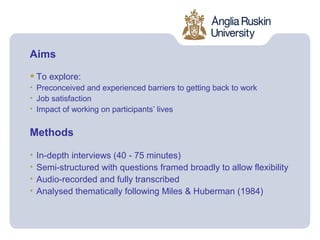
Aims

• To explore:
• Preconceived and experienced barriers to getting back to work
• Job satisfaction
• Impact of working on participants’ lives


Methods

•   In-depth interviews (40 - 75 minutes)
•   Semi-structured with questions framed broadly to allow flexibility
•   Audio-recorded and fully transcribed
•   Analysed thematically following Miles & Huberman (1984)
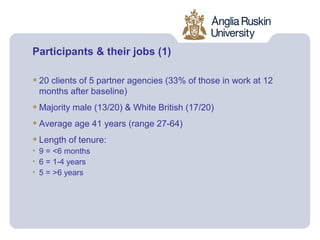
Participants & their jobs (1)

• 20 clients of 5 partner agencies (33% of those in work at 12
 months after baseline)
• Majority male (13/20) & White British (17/20)
• Average age 41 years (range 27-64)
• Length of tenure:
• 9 = <6 months
• 6 = 1-4 years
• 5 = >6 years
Participants & their jobs (2)

• Occupational categories:
•   5 = Professional /Associated professional & technical
•   5 = Administrative & secretarial
•   1 = Skilled trades
•   1 = Personal service
•   3 = Sales & customer service
•   1 = Process, plant and machine operatives
•   4 = Elementary occupations
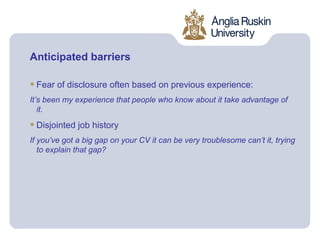
Anticipated barriers

• Fear of disclosure often based on previous experience:
It’s been my experience that people who know about it take advantage of
   it.

• Disjointed job history
If you’ve got a big gap on your CV it can be very troublesome can’t it, trying
   to explain that gap?
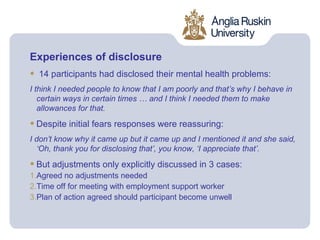
Experiences of disclosure
•   14 participants had disclosed their mental health problems:
I think I needed people to know that I am poorly and that’s why I behave in
   certain ways in certain times … and I think I needed them to make
   allowances for that.

• Despite initial fears responses were reassuring:
I don’t know why it came up but it came up and I mentioned it and she said,
  ‘Oh, thank you for disclosing that’, you know, ‘I appreciate that’.

• But adjustments only explicitly discussed in 3 cases:
1.Agreed no adjustments needed
2.Time off for meeting with employment support worker
3.Plan of action agreed should participant become unwell
Experiences of dealing with gaps in work history

•   Most received effective support to find constructive approaches:
    Because I’d been through the course and all that I was actually able to
    portray it in a positive light, ‘Well yeah, because I’ve had this time off work
    I now know I’m ready to go back and I’ve had a chance to really look at
    what I want to do’…

• Responses were again reassuring:
…They didn’t even ask me any more about it, what they were interested
 was how I was going to be able to deal with the job now.
Occupational health: an unanticipated barrier

•   Delays in obtaining clearance
The only thing that was holding it up was the occupational health. I mean I
 was really worried about that, that I was going to be told I couldn’t start. It
 annoyed me because they gave me this appointment which took weeks to
 come through.

• Focus on negatives
I had to go for an appointment with the occupational health doctor and he
  threw up just absolutely everything that was negative about my past. He
  didn’t look at it as, well you know you’ve just dome two months of very
  intensive work and you’ve come out of that, you’ve done voluntary work
  and you’ve done training before that, it was just, well you haven’t worked
  for 5 years, how do you think you can cope with a full time job.
Job satisfaction (1)

•   9 participants were very positive about their job:
• Right balance between work demands and sufficient challenge
• Supportive workplace

That’s what I enjoy. If you’re not thinking , you’re not alive are you?

She’s the type of person you could go to and just talk about anything…
it’s very relaxed and so if there’s a problem I can go and talk to her.

They are very supportive and the people are just the best.
Job satisfaction (2)
• Others enjoyed aspects but also described some problems:
• Working conditions
• Lack of control and role clarity
He just said when can you start, there are so many hours and I don’t
give breaks. I thought he’s got to be joking, not getting breaks, but he
wasn’t. And that was it, that was the interview.
It can get monotonous. Sometimes the worst thing is I have to request
lots of information from other people and if they don’t return it I get into
trouble… So it is stressful.
On a practical level, it would help if my boss gave me a job description
and we both stuck to it.

• But for most participants advantages outweighed disadvantages
Job satisfaction (3)
• 2 participants from one agency described experiences of
  discrimination in addition to other problems:


The odd comments that he has made have been snidey, rather than
 supportive and helpful, ‘you’re not the full shilling’ and things like that, all
 very hurtful.


I’m concerned about the levels of discrimination between what you would
  call the employer’s real staff and us, the [employment support agency]
  staff. When you’re equally qualified to do the job but someone’s getting
  £17,000 and you’re getting £11,000, you’re thinking. Does that qualify as
  discrimination?
Impact on participants’ lives (1)
• Improving mental health:
• Confidence
• Hope
I’m not as shy as I used to be, I’m more outgoing, I can talk to people,
  whereas before I just used to shy away and just sit in the house nearly all
  the time... I might not be here now if I hadn’t got a job.
I feel more stable in my head… to have a job now is very good and only
   more positive things can come out of it.
Impact on participants’ lives (2)
• Social recovery
• Structured day
• Sense of achievement
• A ‘normal’ identity
• Financial independence
It’s something to keep me going, I couldn’t stay at home. I’d get very very
   bored, I’d go backwards in my health.
I feel satisfied at the end of the day. It gives you something to live for really,
   doesn’t it?
It’s really good to feel normal. It’s such a difference. The world of the ill and
   the world of the sane. Two different worlds. Yeah, it feels great.
It’s great having the money coming in, earning you know, earning the
   money that I’m living on rather than getting it from the state.
Conclusions
• Much of participants’ experience no different from anyone else:
• A normal distribution of occupational categories
• Support, role clarity and appropriate control over workload all
     commonly associated with high levels of job satisfaction
•   Tolerance of less than ideal aspects in light of advantages
•   (The right) job brings mental health and social benefits

• Perceived barriers could be overcome through effective
    employment support
• ‘Toxic jobs’ could result from ineffective employment support
• Occupational health procedures an issue for vocational services?
Thank you for listening


   Any questions?

J. secker mhrn presentation

  • 1.
    Service users’ experiencesof returning to paid employment Jenny Secker Professor of Mental Health Anglia Ruskin University/ South Essex Partnership Trust
  • 2.
    Overview • Study context •Aims and methods • Participants and their jobs • Results: • Perceived barriers to work • Experience of barriers • Job satisfaction • Impact of work on participants’ lives • Conclusions
  • 3.
    Study context • SESAMI(Social Inclusion through Supported Employment for people with Mental Illness; Schneider J., Secker J., Floyd M. & Grove B.) • 2-year naturalistic study designed to contribute to knowledge of what works to enable people with severe and enduring mental health problems find & keep a job • Carried out in partnership with 6 of the largest employment support providers in England • 5 main strands: • Assessment of fidelity to IPS principles & factors influencing this • Identification of work outcomes at 12 months • Predictors for moving into work • Exploration of clients’ and providers’ views about what works • In-depth study of the perceptions and experiences of those who had moved into work.
  • 4.
    Aims • To explore: •Preconceived and experienced barriers to getting back to work • Job satisfaction • Impact of working on participants’ lives Methods • In-depth interviews (40 - 75 minutes) • Semi-structured with questions framed broadly to allow flexibility • Audio-recorded and fully transcribed • Analysed thematically following Miles & Huberman (1984)
  • 5.
    Participants & theirjobs (1) • 20 clients of 5 partner agencies (33% of those in work at 12 months after baseline) • Majority male (13/20) & White British (17/20) • Average age 41 years (range 27-64) • Length of tenure: • 9 = <6 months • 6 = 1-4 years • 5 = >6 years
  • 6.
    Participants & theirjobs (2) • Occupational categories: • 5 = Professional /Associated professional & technical • 5 = Administrative & secretarial • 1 = Skilled trades • 1 = Personal service • 3 = Sales & customer service • 1 = Process, plant and machine operatives • 4 = Elementary occupations
  • 7.
    Anticipated barriers • Fearof disclosure often based on previous experience: It’s been my experience that people who know about it take advantage of it. • Disjointed job history If you’ve got a big gap on your CV it can be very troublesome can’t it, trying to explain that gap?
  • 8.
    Experiences of disclosure • 14 participants had disclosed their mental health problems: I think I needed people to know that I am poorly and that’s why I behave in certain ways in certain times … and I think I needed them to make allowances for that. • Despite initial fears responses were reassuring: I don’t know why it came up but it came up and I mentioned it and she said, ‘Oh, thank you for disclosing that’, you know, ‘I appreciate that’. • But adjustments only explicitly discussed in 3 cases: 1.Agreed no adjustments needed 2.Time off for meeting with employment support worker 3.Plan of action agreed should participant become unwell
  • 9.
    Experiences of dealingwith gaps in work history • Most received effective support to find constructive approaches: Because I’d been through the course and all that I was actually able to portray it in a positive light, ‘Well yeah, because I’ve had this time off work I now know I’m ready to go back and I’ve had a chance to really look at what I want to do’… • Responses were again reassuring: …They didn’t even ask me any more about it, what they were interested was how I was going to be able to deal with the job now.
  • 10.
    Occupational health: anunanticipated barrier • Delays in obtaining clearance The only thing that was holding it up was the occupational health. I mean I was really worried about that, that I was going to be told I couldn’t start. It annoyed me because they gave me this appointment which took weeks to come through. • Focus on negatives I had to go for an appointment with the occupational health doctor and he threw up just absolutely everything that was negative about my past. He didn’t look at it as, well you know you’ve just dome two months of very intensive work and you’ve come out of that, you’ve done voluntary work and you’ve done training before that, it was just, well you haven’t worked for 5 years, how do you think you can cope with a full time job.
  • 11.
    Job satisfaction (1) • 9 participants were very positive about their job: • Right balance between work demands and sufficient challenge • Supportive workplace That’s what I enjoy. If you’re not thinking , you’re not alive are you? She’s the type of person you could go to and just talk about anything… it’s very relaxed and so if there’s a problem I can go and talk to her. They are very supportive and the people are just the best.
  • 12.
    Job satisfaction (2) •Others enjoyed aspects but also described some problems: • Working conditions • Lack of control and role clarity He just said when can you start, there are so many hours and I don’t give breaks. I thought he’s got to be joking, not getting breaks, but he wasn’t. And that was it, that was the interview. It can get monotonous. Sometimes the worst thing is I have to request lots of information from other people and if they don’t return it I get into trouble… So it is stressful. On a practical level, it would help if my boss gave me a job description and we both stuck to it. • But for most participants advantages outweighed disadvantages
  • 13.
    Job satisfaction (3) •2 participants from one agency described experiences of discrimination in addition to other problems: The odd comments that he has made have been snidey, rather than supportive and helpful, ‘you’re not the full shilling’ and things like that, all very hurtful. I’m concerned about the levels of discrimination between what you would call the employer’s real staff and us, the [employment support agency] staff. When you’re equally qualified to do the job but someone’s getting £17,000 and you’re getting £11,000, you’re thinking. Does that qualify as discrimination?
  • 14.
    Impact on participants’lives (1) • Improving mental health: • Confidence • Hope I’m not as shy as I used to be, I’m more outgoing, I can talk to people, whereas before I just used to shy away and just sit in the house nearly all the time... I might not be here now if I hadn’t got a job. I feel more stable in my head… to have a job now is very good and only more positive things can come out of it.
  • 15.
    Impact on participants’lives (2) • Social recovery • Structured day • Sense of achievement • A ‘normal’ identity • Financial independence It’s something to keep me going, I couldn’t stay at home. I’d get very very bored, I’d go backwards in my health. I feel satisfied at the end of the day. It gives you something to live for really, doesn’t it? It’s really good to feel normal. It’s such a difference. The world of the ill and the world of the sane. Two different worlds. Yeah, it feels great. It’s great having the money coming in, earning you know, earning the money that I’m living on rather than getting it from the state.
  • 16.
    Conclusions • Much ofparticipants’ experience no different from anyone else: • A normal distribution of occupational categories • Support, role clarity and appropriate control over workload all commonly associated with high levels of job satisfaction • Tolerance of less than ideal aspects in light of advantages • (The right) job brings mental health and social benefits • Perceived barriers could be overcome through effective employment support • ‘Toxic jobs’ could result from ineffective employment support • Occupational health procedures an issue for vocational services?
  • 17.
    Thank you forlistening Any questions?