5G-enabled healthcare:
The promise of big data,AI, and
communication for healthcare
Junaid Qadir
InformationTechnology
University (ITU), Pakistan
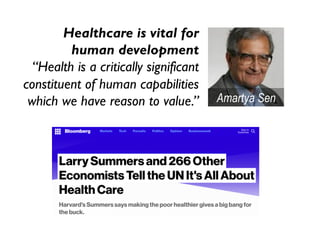
Healthcare is vital for
human development
“Health is a critically significant
constituent of human capabilities
which we have reason to value.” Amartya Sen
Outline
Deficiencies of current healthcare1
2 How technologies can help
3 5G and healthcare:
opportunities and challenges
Deficiencies of
current healthcare system
1
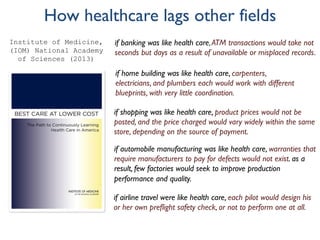
How healthcare lags other fields
if banking was like health care,ATM transactions would take not
seconds but days as a result of unavailable or misplaced records.
if home building was like health care, carpenters,
electricians, and plumbers each would work with different
blueprints, with very little coordination.
if shopping was like health care, product prices would not be
posted, and the price charged would vary widely within the same
store, depending on the source of payment.
if automobile manufacturing was like health care, warranties that
require manufacturers to pay for defects would not exist. as a
result, few factories would seek to improve production
performance and quality.
if airline travel were like health care, each pilot would design his
or her own preflight safety check, or not to perform one at all.
Institute of Medicine,
(IOM) National Academy
of Sciences (2013)
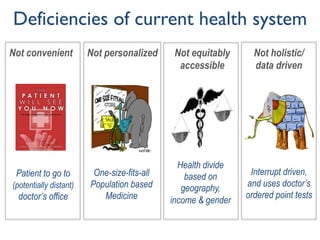
Deficiencies of current health system
Not convenient
Patient to go to
(potentially distant)
doctor’s office
Not personalized
One-size-fits-all
Population based
Medicine
Not equitably
accessible
Health divide
based on
geography,
income & gender
Not holistic/
data driven
Interrupt driven,
and uses doctor’s
ordered point tests
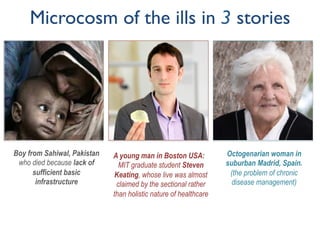
Microcosm of the ills in 3 stories
A young man in Boston USA:
MIT graduate student Steven
Keating, whose live was almost
claimed by the sectional rather
than holistic nature of healthcare
Boy from Sahiwal, Pakistan
who died because lack of
sufficient basic
infrastructure
Octogenarian woman in
suburban Madrid, Spain.
(the problem of chronic
disease management)
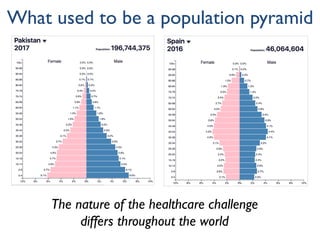
What used to be a population pyramid
The nature of the healthcare challenge
differs throughout the world
How technologies can fix the
current healthcare system
2
“80% of what doctors can be done
better through technology”
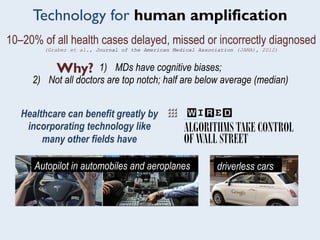
Healthcare can benefit greatly by
incorporating technology like
many other fields have
Autopilot in automobiles and aeroplanes
Technology for human amplification
driverless cars
10–20% of all health cases delayed, missed or incorrectly diagnosed
(Graber et al., Journal of the American Medical Association (JAMA), 2012)
1)  MDs have cognitive biases;
2)  Not all doctors are top notch; half are below average (median)
Why?
Technology to mitigate the scarcity and
imbalance of medical resource distribution
Number of imbalances:
•  Geographical (e.g., Urban vs. Rural)
•  Specialty based
•  Institutional/services based
•  Gender based
A striking example of health inequality:
Africa has 25% of the worldwide disease burden but
only 3% of the health workers.
How technologies can fix the
current healthcare system
2
2A—big data for development
2B—wireless connectivity
2C—AI, machine learning, algorithms
2D—disruptive health innovations
[the subsections]
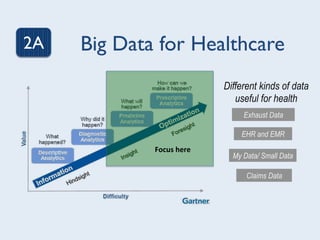
Big Data for Healthcare
My Data/ Small Data
Exhaust Data
Claims Data
EHR and EMR
Different kinds of data
useful for health
2A
Focus	here
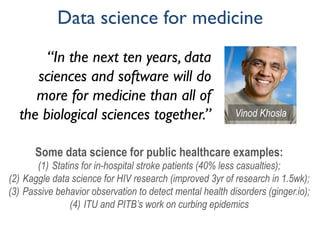
Data science for medicine
“In the next ten years, data
sciences and software will do
more for medicine than all of
the biological sciences together.’’ Vinod Khosla
Some data science for public healthcare examples:
(1)  Statins for in-hospital stroke patients (40% less casualties);
(2)  Kaggle data science for HIV research (improved 3yr of research in 1.5wk);
(3)  Passive behavior observation to detect mental health disorders (ginger.io);
(4)  ITU and PITB’s work on curbing epidemics
Connectivity
(Wireless)2B
Some applications:
Telemedicine
Tactile Internet
Remote Surgery
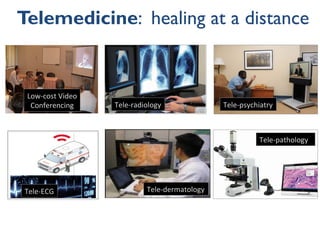
Telemedicine: healing at a distance
Low-cost	Video	
Conferencing	 Tele-radiology	
Tele-dermatology	
Tele-pathology	
Tele-ECG	
Tele-psychiatry
Artificial Intelligence/
Machine Learning/
Probabilistic modeling
2C
Some applications:
Personalized Medicine
—Data-Driven Diagnosis and Prognosis
—Collaborative Filtering for Similar Patient Finding
Cognitive Healthcare Solutions (e.g., IBM Watson)
Deep Learning Health Systems
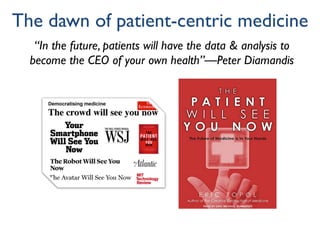
The dawn of patient-centric medicine
“In the future, patients will have the data & analysis to
become the CEO of your own health”—Peter Diamandis
Disruptive health innovations2D
Point of Care (POC)
Testing
Wearable Sensors
and Implantable
Nano Sensors
Open Source EHR/
EMR Systems
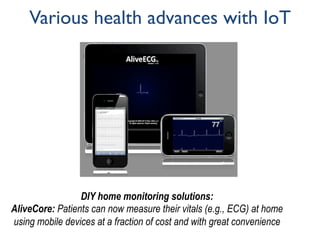
Various health advances with IoT
DIY home monitoring solutions:
AliveCore: Patients can now measure their vitals (e.g., ECG) at home
using mobile devices at a fraction of cost and with great convenience
5G and healthcare:
opportunities and challenges
3
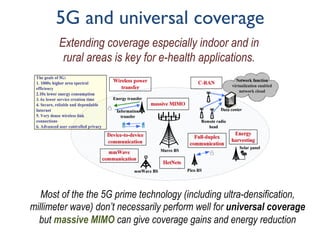
5G and universal coverage
Most of the the 5G prime technology (including ultra-densification,
millimeter wave) don’t necessarily perform well for universal coverage
but massive MIMO can give coverage gains and energy reduction
Extending coverage especially indoor and in
rural areas is key for e-health applications.
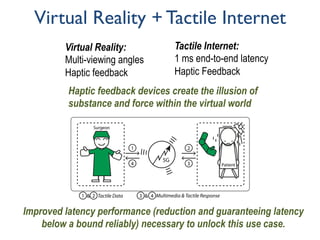
Virtual Reality + Tactile Internet
Virtual Reality:
Multi-viewing angles
Haptic feedback
Tactile Internet:
1 ms end-to-end latency
Haptic Feedback
Improved latency performance (reduction and guaranteeing latency
below a bound reliably) necessary to unlock this use case.
Haptic feedback devices create the illusion of
substance and force within the virtual world
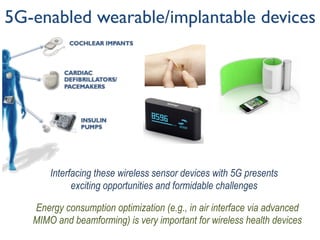
5G-enabled wearable/implantable devices
Energy consumption optimization (e.g., in air interface via advanced
MIMO and beamforming) is very important for wireless health devices
Interfacing these wireless sensor devices with 5G presents
exciting opportunities and formidable challenges
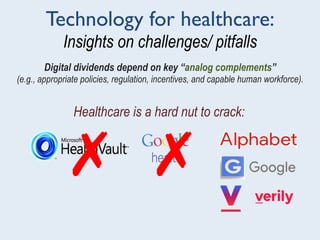
Technology for healthcare:
Insights on challenges/ pitfalls
✗ ✗
Healthcare is a hard nut to crack:
Digital dividends depend on key “analog complements”
(e.g., appropriate policies, regulation, incentives, and capable human workforce).
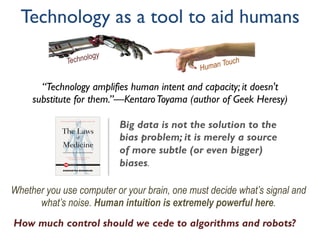
Technology as a tool to aid humans
Big data is not the solution to the
bias problem; it is merely a source
of more subtle (or even bigger)
biases.
Whether you use computer or your brain, one must decide what’s signal and
what’s noise. Human intuition is extremely powerful here.
Human TouchTechnology
“Technology amplifies human intent and capacity; it doesn't
substitute for them.”—KentaroToyama (author of Geek Heresy)
How much control should we cede to algorithms and robots?
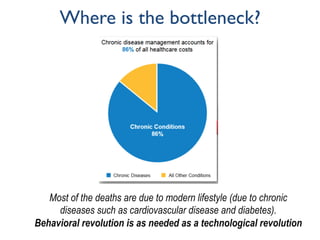
Where is the bottleneck?
Most of the deaths are due to modern lifestyle (due to chronic
diseases such as cardiovascular disease and diabetes).
Behavioral revolution is as needed as a technological revolution
Security and privacy
Hippocratic oath: “first, do no harm”
Iatrogenesis (n): harm or illness caused
by medical examination or treatment.
Some important objectives:
1.  Identity management
2.  Privacy protection
3.  Data and message encryption
and protection
4.  Update of security mechanisms
5.  Avoiding bioterrorism
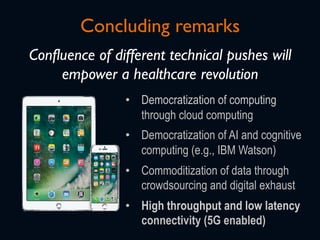
Concluding remarks
•  Democratization of computing
through cloud computing
•  Democratization of AI and cognitive
computing (e.g., IBM Watson)
•  Commoditization of data through
crowdsourcing and digital exhaust
•  High throughput and low latency
connectivity (5G enabled)
Confluence of different technical pushes will
empower a healthcare revolution
About 5G enabled healthcare
5G wireless will transform the field of healthcare by
augmenting human capacity and reach in a few years
by allowing:
—resource pooling
—virtualization
—high-performance and reliable telemedicine
—tactile Internet with haptic feedback
There are exciting research & implementation
opportunities in building this future of healthcare but
also substantial challenges and many pitfalls.
Books
Figures and Images:
Credits/ Acknowledgments
Various images used in Bertalan Meskó’s presentations
Mesko, Bertalan. “The Guide to the Future of Medicine: Technology And The Human Touch.”
Various images used from Wikipedia and through Google Image Search.
Various images used from IEEE/ACM papers
(Copyright retained by respective users; images are used for educational purposes)
Meskó, Bertalan. “My Health: Upgraded: Revolutionary Technologies To Bring A Healthier Future.”
Mukherjee, Siddhartha, “The Laws of Medicine.”
These resources have been used in these lecture slides for educational purpose under the fair use doctrine.
The ownership of these resources, if copyrighted, is retained by their respective copyright owners.
Topol, Eric, “The Patient Will See You Now.”
Topol, Eric, “Creative Destruction of Medicine.”

IWCMC Invited Talk for the E-5G Presentation

  • 1.
    5G-enabled healthcare: The promiseof big data,AI, and communication for healthcare Junaid Qadir InformationTechnology University (ITU), Pakistan
  • 2.
    Healthcare is vitalfor human development “Health is a critically significant constituent of human capabilities which we have reason to value.” Amartya Sen
  • 3.
    Outline Deficiencies of currenthealthcare1 2 How technologies can help 3 5G and healthcare: opportunities and challenges
  • 4.
  • 5.
    How healthcare lagsother fields if banking was like health care,ATM transactions would take not seconds but days as a result of unavailable or misplaced records. if home building was like health care, carpenters, electricians, and plumbers each would work with different blueprints, with very little coordination. if shopping was like health care, product prices would not be posted, and the price charged would vary widely within the same store, depending on the source of payment. if automobile manufacturing was like health care, warranties that require manufacturers to pay for defects would not exist. as a result, few factories would seek to improve production performance and quality. if airline travel were like health care, each pilot would design his or her own preflight safety check, or not to perform one at all. Institute of Medicine, (IOM) National Academy of Sciences (2013)
  • 6.
    Deficiencies of currenthealth system Not convenient Patient to go to (potentially distant) doctor’s office Not personalized One-size-fits-all Population based Medicine Not equitably accessible Health divide based on geography, income & gender Not holistic/ data driven Interrupt driven, and uses doctor’s ordered point tests
  • 7.
    Microcosm of theills in 3 stories A young man in Boston USA: MIT graduate student Steven Keating, whose live was almost claimed by the sectional rather than holistic nature of healthcare Boy from Sahiwal, Pakistan who died because lack of sufficient basic infrastructure Octogenarian woman in suburban Madrid, Spain. (the problem of chronic disease management)
  • 8.
    What used tobe a population pyramid The nature of the healthcare challenge differs throughout the world
  • 9.
    How technologies canfix the current healthcare system 2 “80% of what doctors can be done better through technology”
  • 10.
    Healthcare can benefitgreatly by incorporating technology like many other fields have Autopilot in automobiles and aeroplanes Technology for human amplification driverless cars 10–20% of all health cases delayed, missed or incorrectly diagnosed (Graber et al., Journal of the American Medical Association (JAMA), 2012) 1)  MDs have cognitive biases; 2)  Not all doctors are top notch; half are below average (median) Why?
  • 11.
    Technology to mitigatethe scarcity and imbalance of medical resource distribution Number of imbalances: •  Geographical (e.g., Urban vs. Rural) •  Specialty based •  Institutional/services based •  Gender based A striking example of health inequality: Africa has 25% of the worldwide disease burden but only 3% of the health workers.
  • 12.
    How technologies canfix the current healthcare system 2 2A—big data for development 2B—wireless connectivity 2C—AI, machine learning, algorithms 2D—disruptive health innovations [the subsections]
  • 13.
    Big Data forHealthcare My Data/ Small Data Exhaust Data Claims Data EHR and EMR Different kinds of data useful for health 2A Focus here
  • 14.
    Data science formedicine “In the next ten years, data sciences and software will do more for medicine than all of the biological sciences together.’’ Vinod Khosla Some data science for public healthcare examples: (1)  Statins for in-hospital stroke patients (40% less casualties); (2)  Kaggle data science for HIV research (improved 3yr of research in 1.5wk); (3)  Passive behavior observation to detect mental health disorders (ginger.io); (4)  ITU and PITB’s work on curbing epidemics
  • 15.
  • 16.
    Telemedicine: healing ata distance Low-cost Video Conferencing Tele-radiology Tele-dermatology Tele-pathology Tele-ECG Tele-psychiatry
  • 17.
    Artificial Intelligence/ Machine Learning/ Probabilisticmodeling 2C Some applications: Personalized Medicine —Data-Driven Diagnosis and Prognosis —Collaborative Filtering for Similar Patient Finding Cognitive Healthcare Solutions (e.g., IBM Watson) Deep Learning Health Systems
  • 18.
    The dawn ofpatient-centric medicine “In the future, patients will have the data & analysis to become the CEO of your own health”—Peter Diamandis
  • 19.
    Disruptive health innovations2D Pointof Care (POC) Testing Wearable Sensors and Implantable Nano Sensors Open Source EHR/ EMR Systems
  • 20.
    Various health advanceswith IoT DIY home monitoring solutions: AliveCore: Patients can now measure their vitals (e.g., ECG) at home using mobile devices at a fraction of cost and with great convenience
  • 21.
  • 22.
    5G and universalcoverage Most of the the 5G prime technology (including ultra-densification, millimeter wave) don’t necessarily perform well for universal coverage but massive MIMO can give coverage gains and energy reduction Extending coverage especially indoor and in rural areas is key for e-health applications.
  • 23.
    Virtual Reality +Tactile Internet Virtual Reality: Multi-viewing angles Haptic feedback Tactile Internet: 1 ms end-to-end latency Haptic Feedback Improved latency performance (reduction and guaranteeing latency below a bound reliably) necessary to unlock this use case. Haptic feedback devices create the illusion of substance and force within the virtual world
  • 24.
    5G-enabled wearable/implantable devices Energyconsumption optimization (e.g., in air interface via advanced MIMO and beamforming) is very important for wireless health devices Interfacing these wireless sensor devices with 5G presents exciting opportunities and formidable challenges
  • 25.
    Technology for healthcare: Insightson challenges/ pitfalls ✗ ✗ Healthcare is a hard nut to crack: Digital dividends depend on key “analog complements” (e.g., appropriate policies, regulation, incentives, and capable human workforce).
  • 26.
    Technology as atool to aid humans Big data is not the solution to the bias problem; it is merely a source of more subtle (or even bigger) biases. Whether you use computer or your brain, one must decide what’s signal and what’s noise. Human intuition is extremely powerful here. Human TouchTechnology “Technology amplifies human intent and capacity; it doesn't substitute for them.”—KentaroToyama (author of Geek Heresy) How much control should we cede to algorithms and robots?
  • 27.
    Where is thebottleneck? Most of the deaths are due to modern lifestyle (due to chronic diseases such as cardiovascular disease and diabetes). Behavioral revolution is as needed as a technological revolution
  • 28.
    Security and privacy Hippocraticoath: “first, do no harm” Iatrogenesis (n): harm or illness caused by medical examination or treatment. Some important objectives: 1.  Identity management 2.  Privacy protection 3.  Data and message encryption and protection 4.  Update of security mechanisms 5.  Avoiding bioterrorism
  • 29.
    Concluding remarks •  Democratizationof computing through cloud computing •  Democratization of AI and cognitive computing (e.g., IBM Watson) •  Commoditization of data through crowdsourcing and digital exhaust •  High throughput and low latency connectivity (5G enabled) Confluence of different technical pushes will empower a healthcare revolution
  • 30.
    About 5G enabledhealthcare 5G wireless will transform the field of healthcare by augmenting human capacity and reach in a few years by allowing: —resource pooling —virtualization —high-performance and reliable telemedicine —tactile Internet with haptic feedback There are exciting research & implementation opportunities in building this future of healthcare but also substantial challenges and many pitfalls.
  • 31.
    Books Figures and Images: Credits/Acknowledgments Various images used in Bertalan Meskó’s presentations Mesko, Bertalan. “The Guide to the Future of Medicine: Technology And The Human Touch.” Various images used from Wikipedia and through Google Image Search. Various images used from IEEE/ACM papers (Copyright retained by respective users; images are used for educational purposes) Meskó, Bertalan. “My Health: Upgraded: Revolutionary Technologies To Bring A Healthier Future.” Mukherjee, Siddhartha, “The Laws of Medicine.” These resources have been used in these lecture slides for educational purpose under the fair use doctrine. The ownership of these resources, if copyrighted, is retained by their respective copyright owners. Topol, Eric, “The Patient Will See You Now.” Topol, Eric, “Creative Destruction of Medicine.”