Integrating Care in Eastern Cheshire
IV Diuretics in the community
Dr Julie Walker
East Cheshire NHS Trust
Integrating Care in Eastern Cheshire
Background
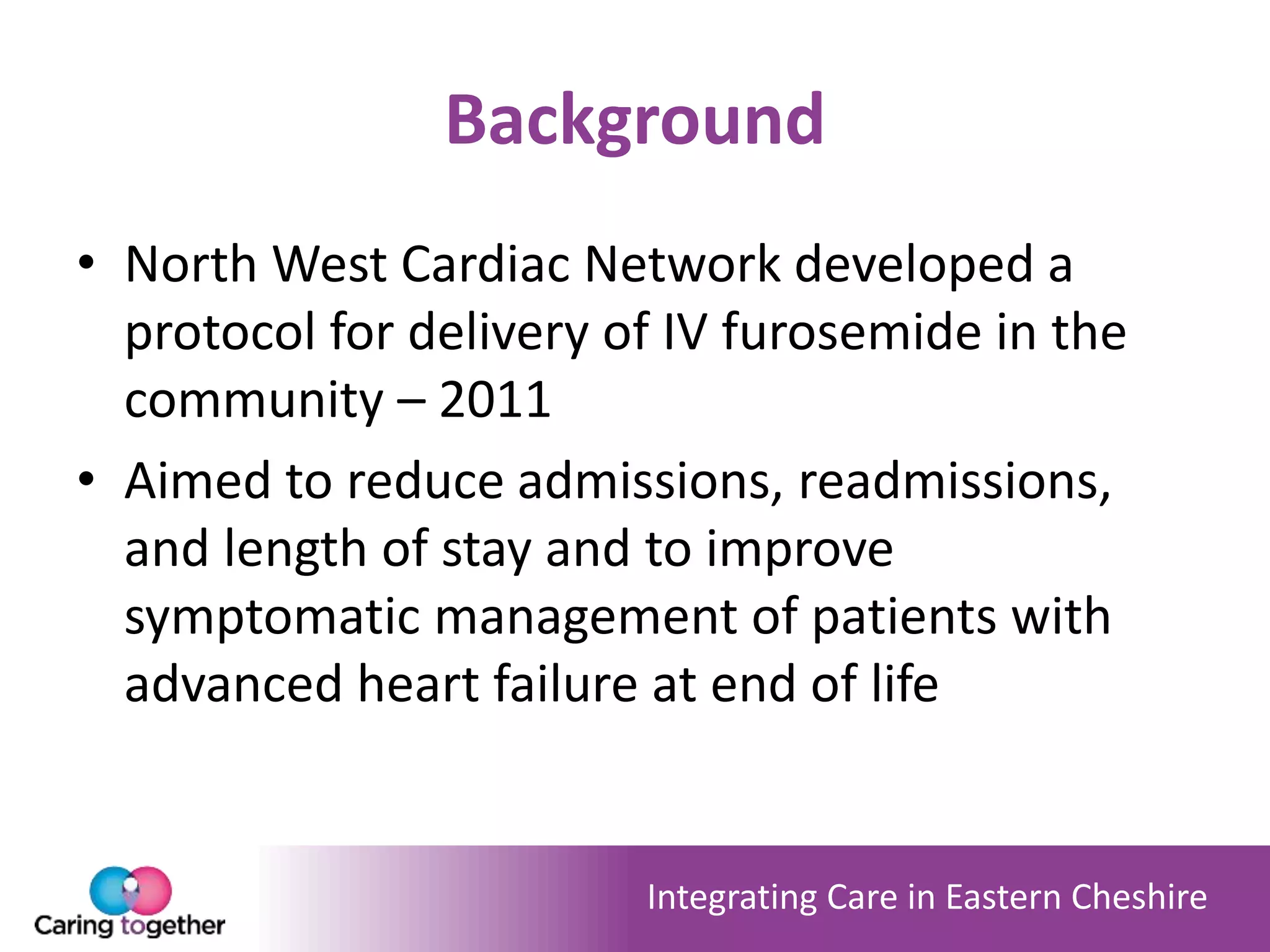
• North West Cardiac Network developed a
protocol for delivery of IV furosemide in the
community – 2011
• Aimed to reduce admissions, readmissions,
and length of stay and to improve
symptomatic management of patients with
advanced heart failure at end of life
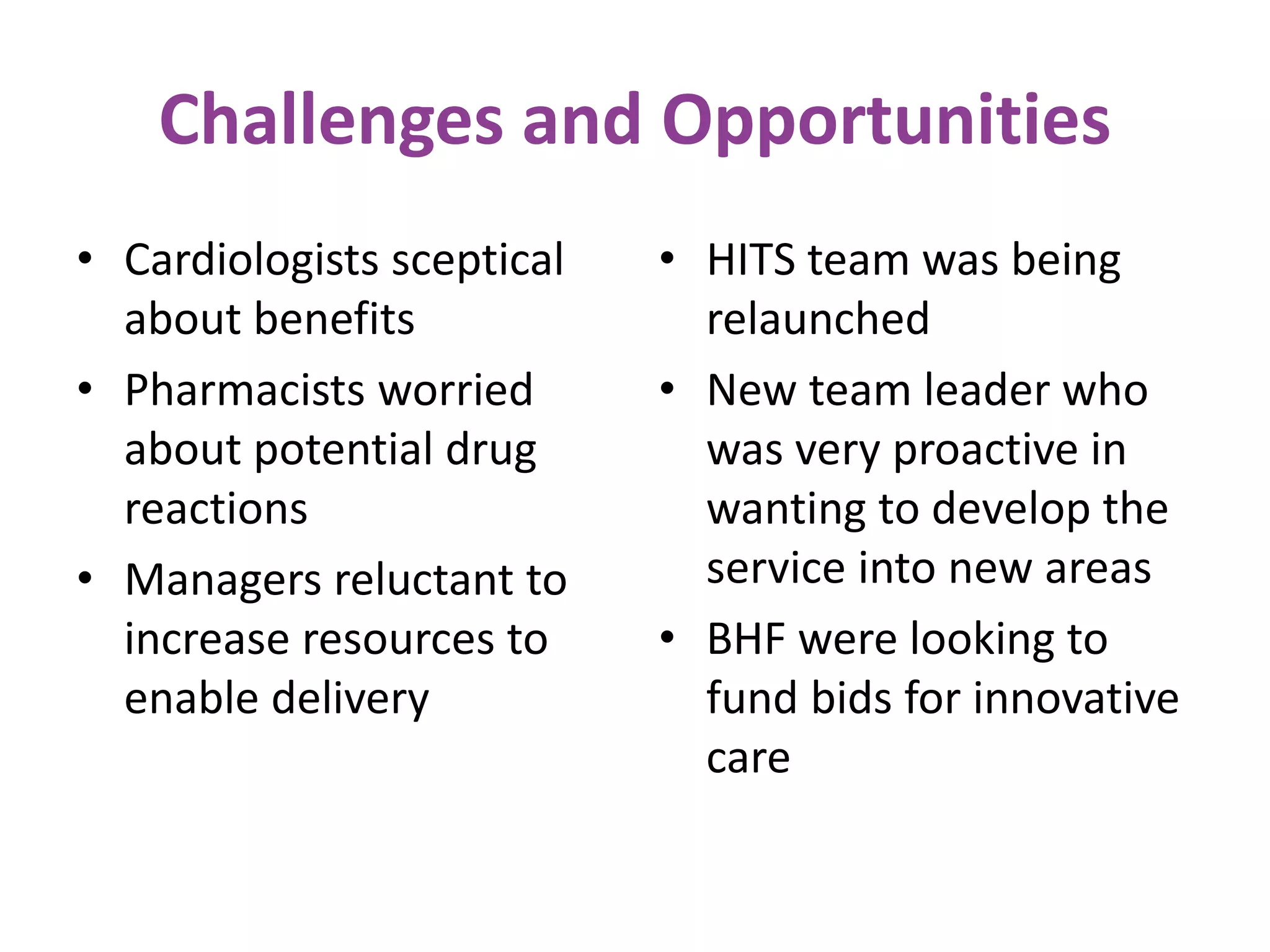
• Cardiologists sceptical
about benefits
• Pharmacists worried
about potential drug
reactions
• Managers reluctant to
increase resources to
enable delivery
• HITS team was being
relaunched
• New team leader who
was very proactive in
wanting to develop the
service into new areas
• BHF were looking to
fund bids for innovative
care
Challenges and Opportunities
Integrating Care in Eastern Cheshire
BHF project
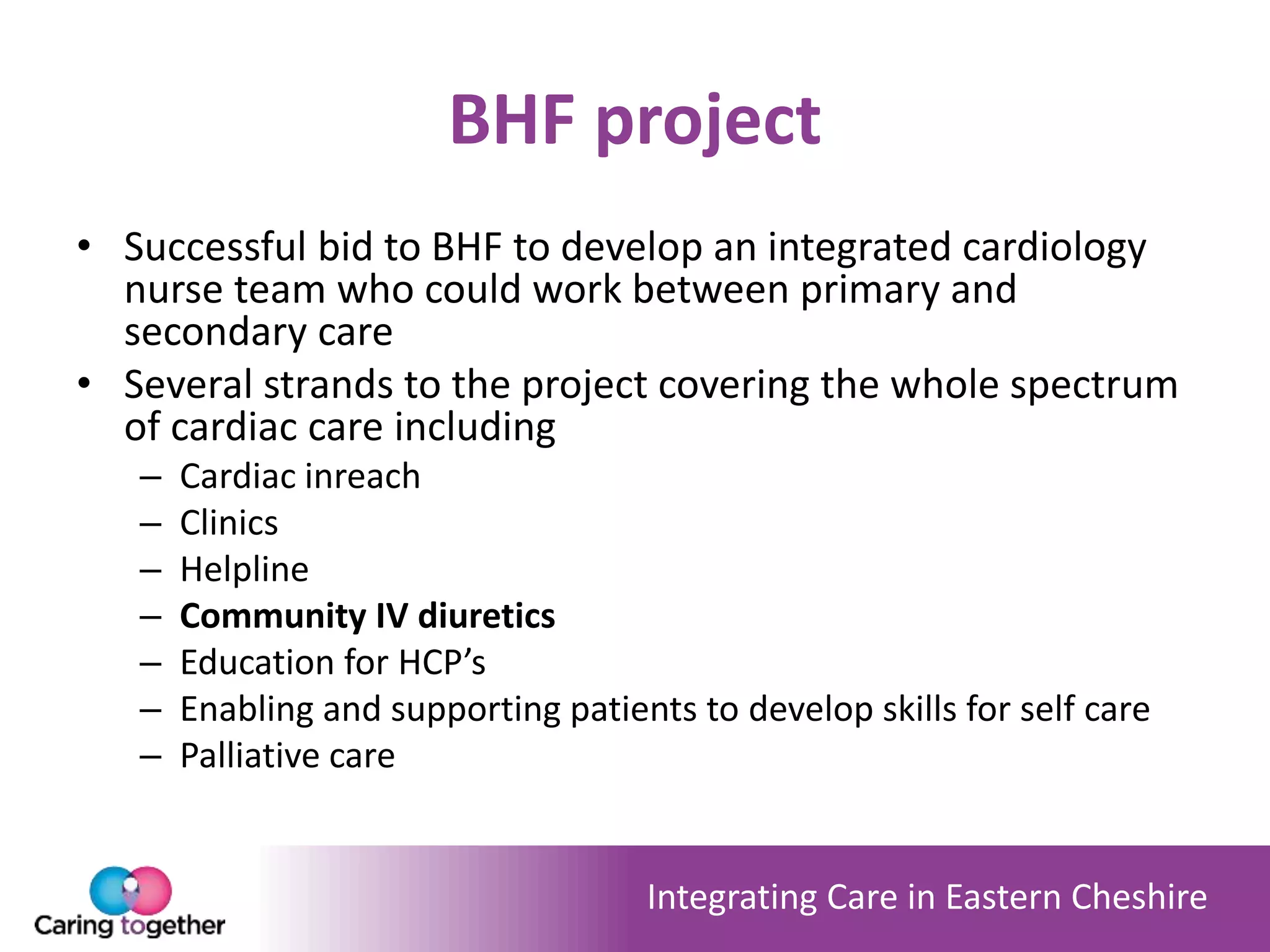
• Successful bid to BHF to develop an integrated cardiology
nurse team who could work between primary and
secondary care
• Several strands to the project covering the whole spectrum
of cardiac care including
– Cardiac inreach
– Clinics
– Helpline
– Community IV diuretics
– Education for HCP’s
– Enabling and supporting patients to develop skills for self care
– Palliative care
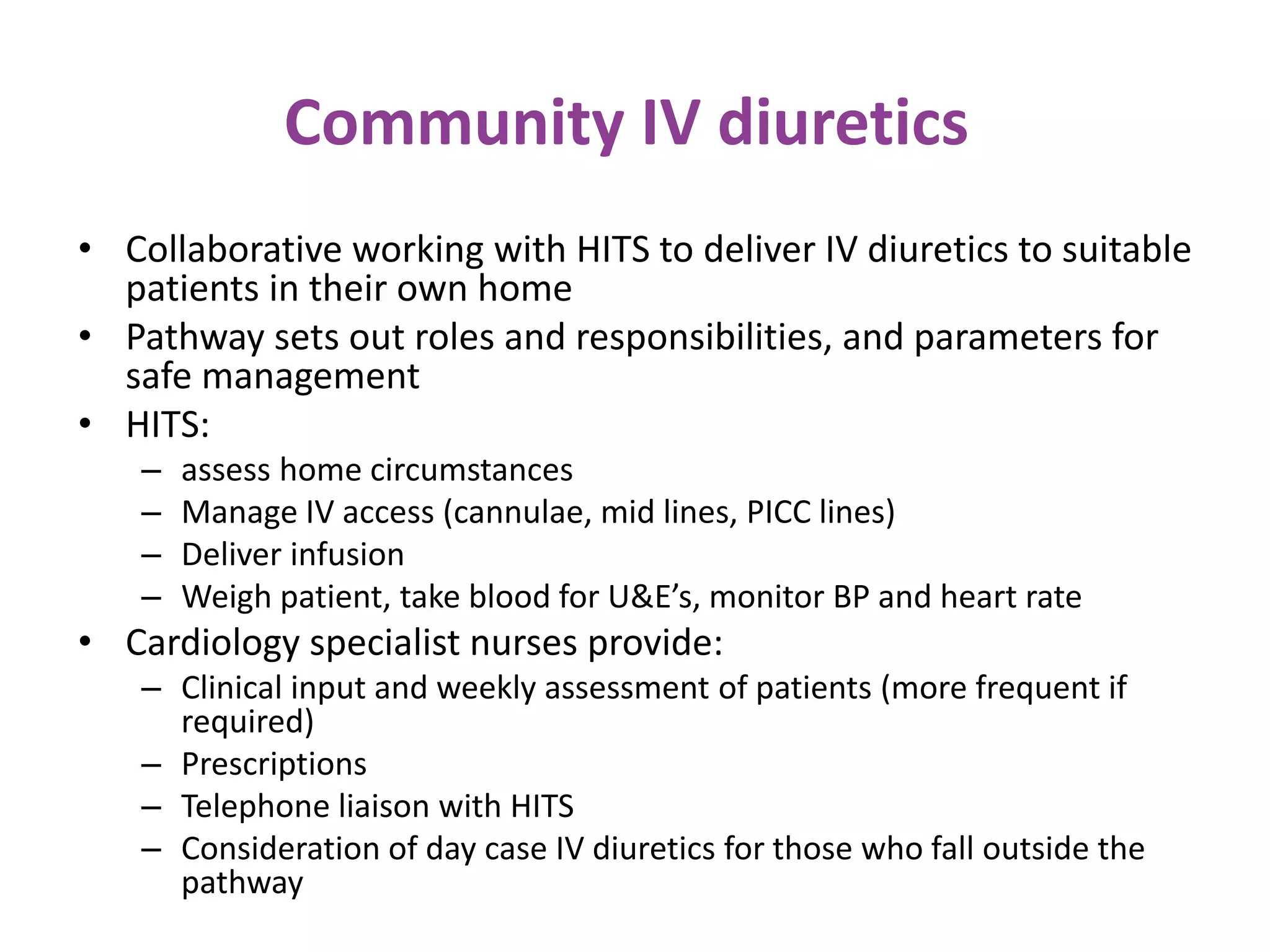
Community IV diuretics
• Collaborative working with HITS to deliver IV diuretics to suitable
patients in their own home
• Pathway sets out roles and responsibilities, and parameters for
safe management
• HITS:
– assess home circumstances
– Manage IV access (cannulae, mid lines, PICC lines)
– Deliver infusion
– Weigh patient, take blood for U&E’s, monitor BP and heart rate
• Cardiology specialist nurses provide:
– Clinical input and weekly assessment of patients (more frequent if
required)
– Prescriptions
– Telephone liaison with HITS
– Consideration of day case IV diuretics for those who fall outside the
pathway
Integrating Care in Eastern Cheshire
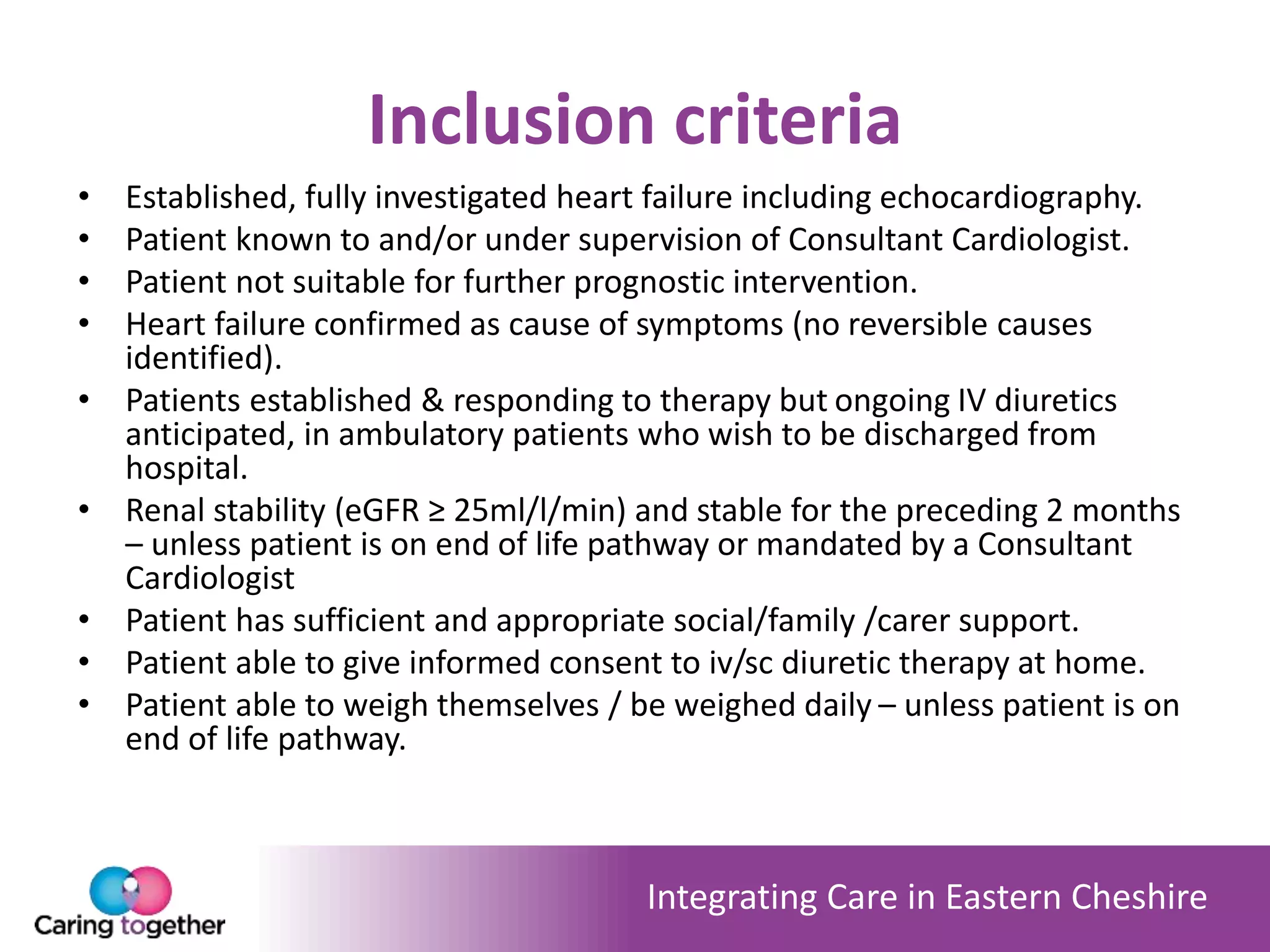
Inclusion criteria
• Established, fully investigated heart failure including echocardiography.
• Patient known to and/or under supervision of Consultant Cardiologist.
• Patient not suitable for further prognostic intervention.
• Heart failure confirmed as cause of symptoms (no reversible causes
identified).
• Patients established & responding to therapy but ongoing IV diuretics
anticipated, in ambulatory patients who wish to be discharged from
hospital.
• Renal stability (eGFR ≥ 25ml/l/min) and stable for the preceding 2 months
– unless patient is on end of life pathway or mandated by a Consultant
Cardiologist
• Patient has sufficient and appropriate social/family /carer support.
• Patient able to give informed consent to iv/sc diuretic therapy at home.
• Patient able to weigh themselves / be weighed daily – unless patient is on
end of life pathway.
Integrating Care in Eastern Cheshire
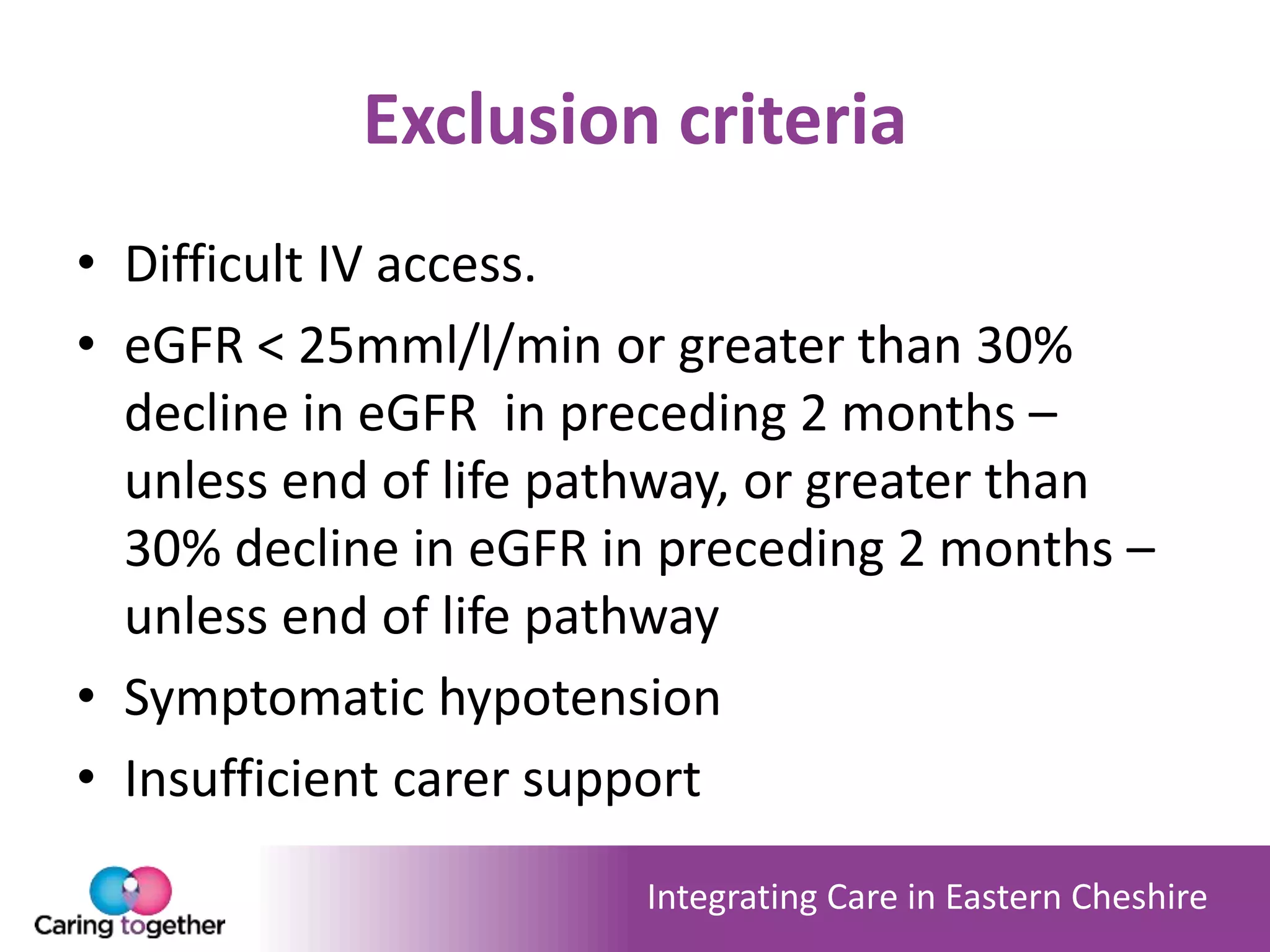
Exclusion criteria
• Difficult IV access.
• eGFR < 25mml/l/min or greater than 30%
decline in eGFR in preceding 2 months –
unless end of life pathway, or greater than
30% decline in eGFR in preceding 2 months –
unless end of life pathway
• Symptomatic hypotension
• Insufficient carer support
Integrating Care in Eastern Cheshire
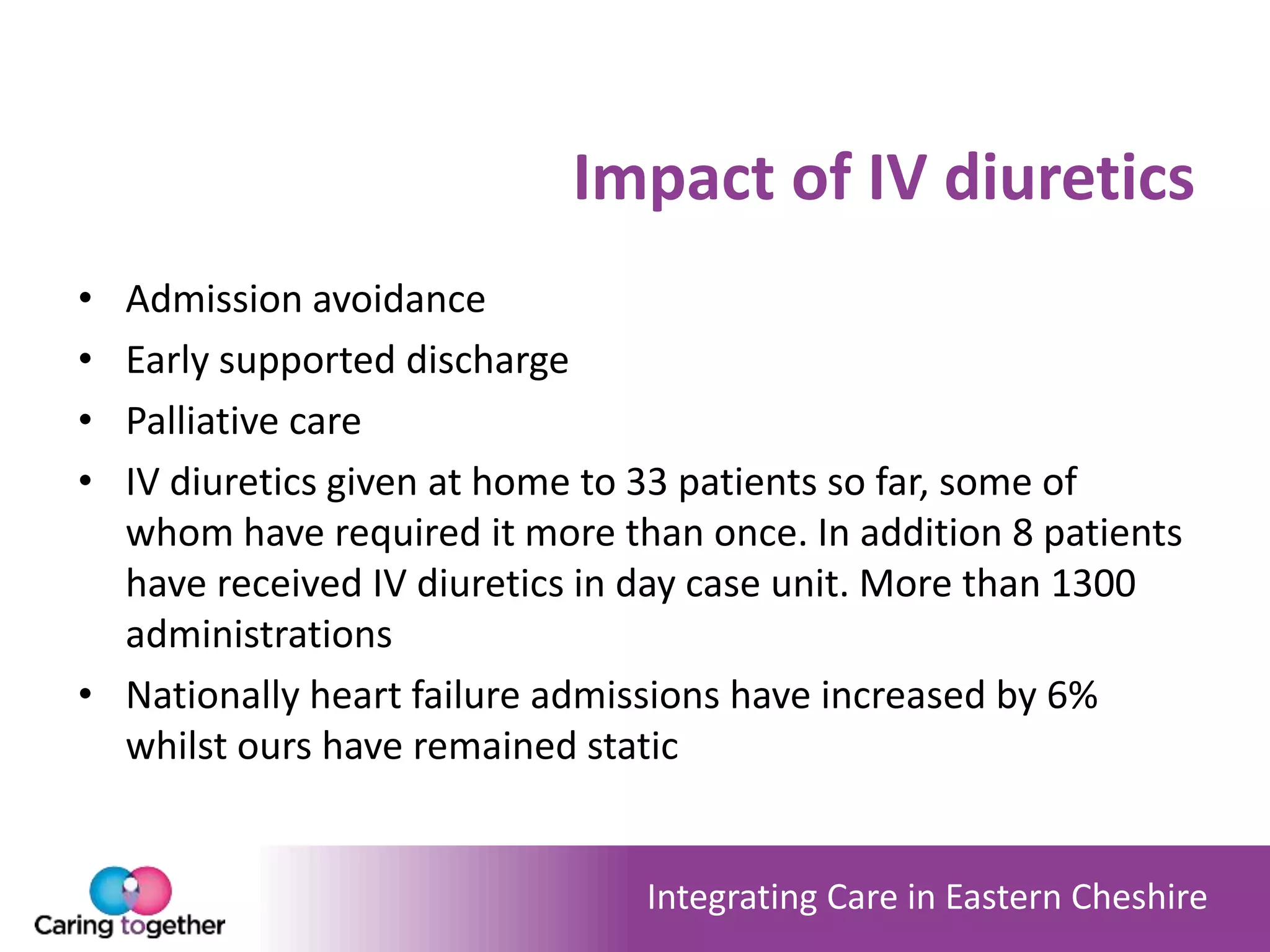
Impact of IV diuretics
• Admission avoidance
• Early supported discharge
• Palliative care
• IV diuretics given at home to 33 patients so far, some of
whom have required it more than once. In addition 8 patients
have received IV diuretics in day case unit. More than 1300
administrations
• Nationally heart failure admissions have increased by 6%
whilst ours have remained static
Integrating Care in Eastern Cheshire
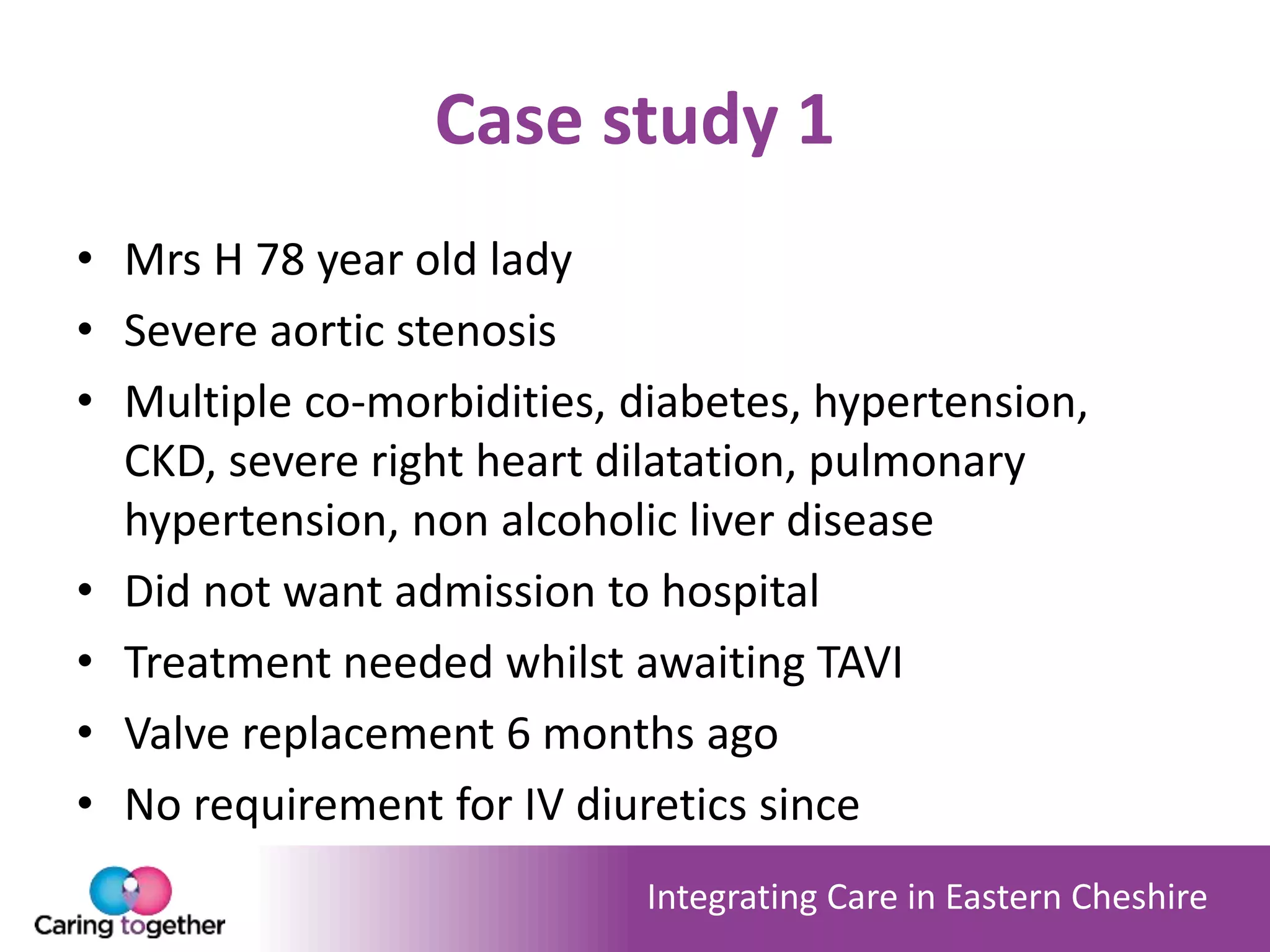
Case study 1
• Mrs H 78 year old lady
• Severe aortic stenosis
• Multiple co-morbidities, diabetes, hypertension,
CKD, severe right heart dilatation, pulmonary
hypertension, non alcoholic liver disease
• Did not want admission to hospital
• Treatment needed whilst awaiting TAVI
• Valve replacement 6 months ago
• No requirement for IV diuretics since
Integrating Care in Eastern Cheshire
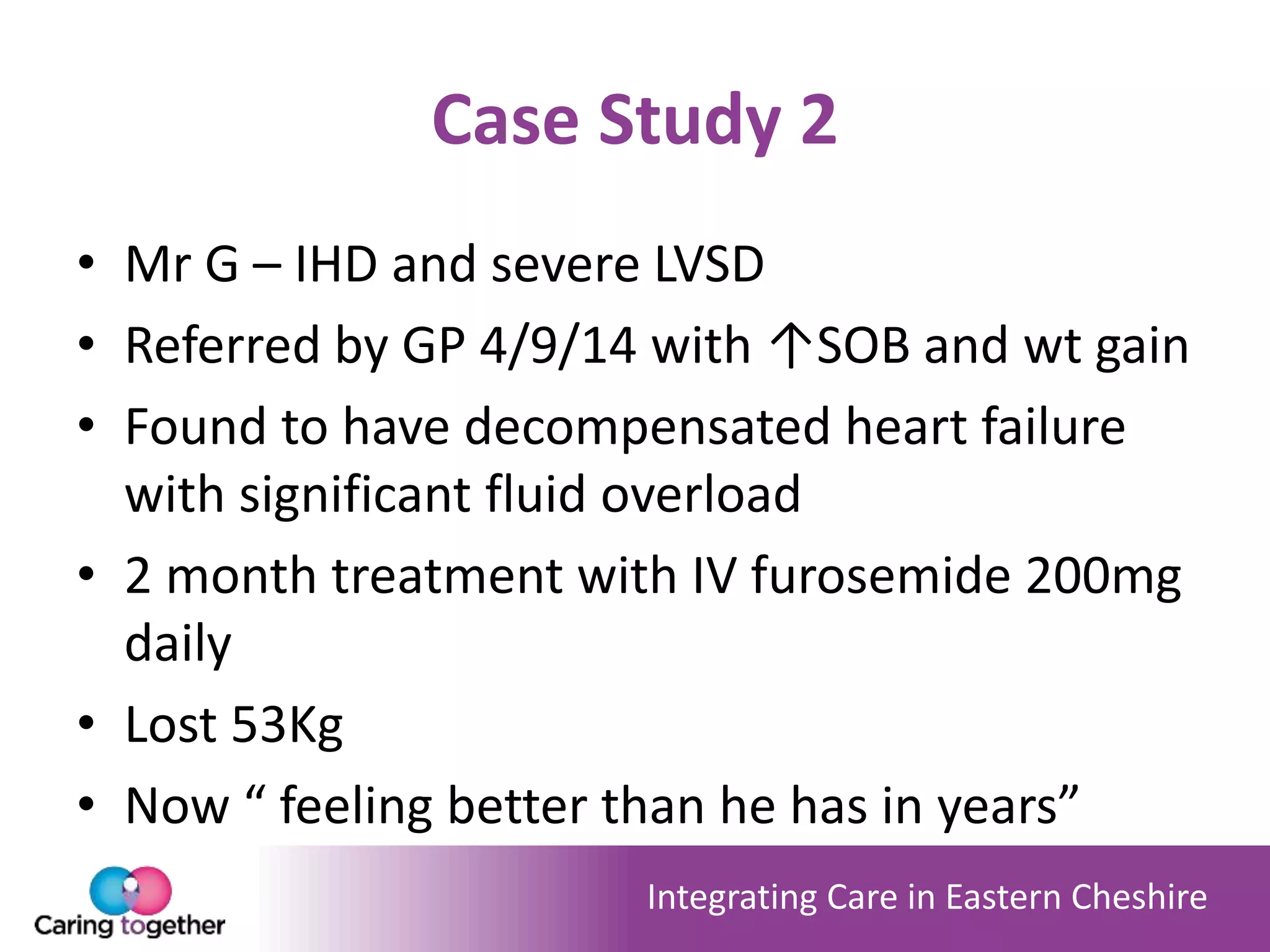
Case Study 2
• Mr G – IHD and severe LVSD
• Referred by GP 4/9/14 with ↑SOB and wt gain
• Found to have decompensated heart failure
with significant fluid overload
• 2 month treatment with IV furosemide 200mg
daily
• Lost 53Kg
• Now “ feeling better than he has in years”
Integrating Care in Eastern Cheshire
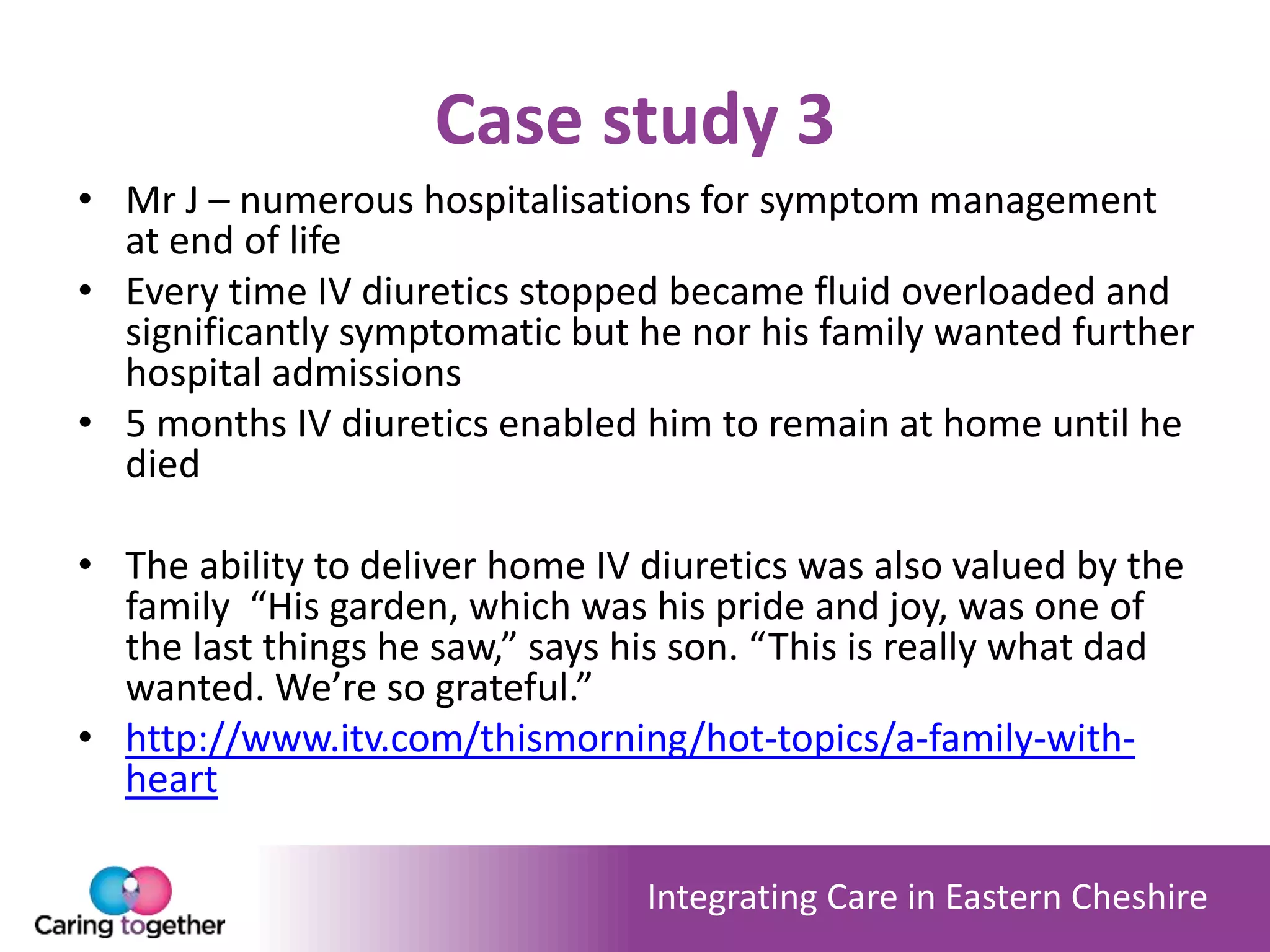
Case study 3
• Mr J – numerous hospitalisations for symptom management
at end of life
• Every time IV diuretics stopped became fluid overloaded and
significantly symptomatic but he nor his family wanted further
hospital admissions
• 5 months IV diuretics enabled him to remain at home until he
died
• The ability to deliver home IV diuretics was also valued by the
family “His garden, which was his pride and joy, was one of
the last things he saw,” says his son. “This is really what dad
wanted. We’re so grateful.”
• http://www.itv.com/thismorning/hot-topics/a-family-with-
heart
Integrating Care in Eastern Cheshire
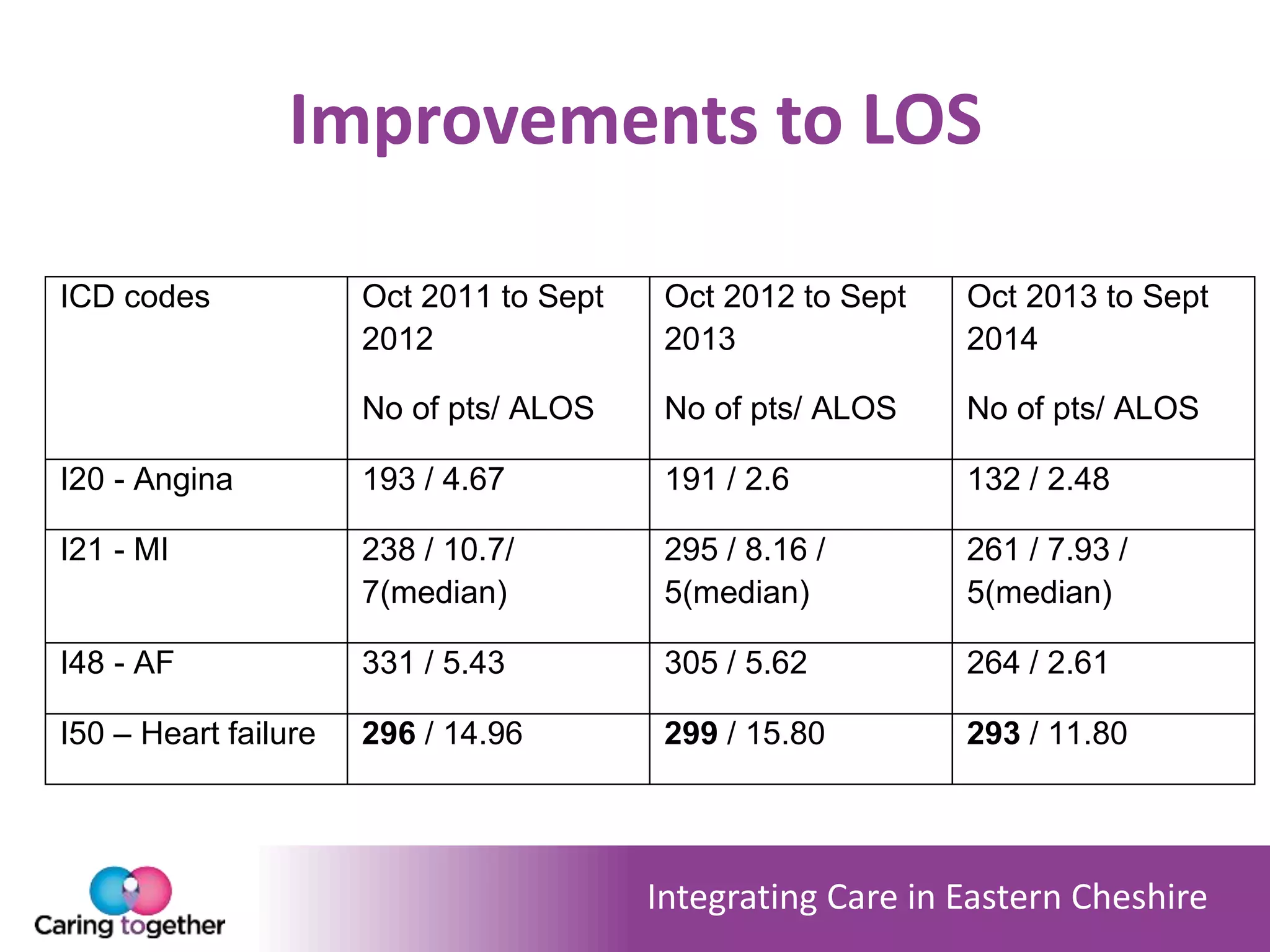
Improvements to LOS
ICD codes Oct 2011 to Sept
2012
No of pts/ ALOS
Oct 2012 to Sept
2013
No of pts/ ALOS
Oct 2013 to Sept
2014
No of pts/ ALOS
I20 - Angina 193 / 4.67 191 / 2.6 132 / 2.48
I21 - MI 238 / 10.7/
7(median)
295 / 8.16 /
5(median)
261 / 7.93 /
5(median)
I48 - AF 331 / 5.43 305 / 5.62 264 / 2.61
I50 – Heart failure 296 / 14.96 299 / 15.80 293 / 11.80
Integrating Care in Eastern Cheshire
Outcomes
• Our average length of stay for heart failure
had reduced by 3 days over 2 years
• The number of heart failure admissions has
remained stable despite increasing elderly
population and increased HF admissions
nationally (average 6%)
• Estimated cost savings from project over 2
years £1.2 million
Integrating Care in Eastern Cheshire
Things we have learned
• Need to create hospital environment at home
– Low salt diet
– Fluid restriction
– Rest
• Don’t assume compliance with these
Integrating Care in Eastern Cheshire
Self management
• AQuA self management and decision making pilot
project
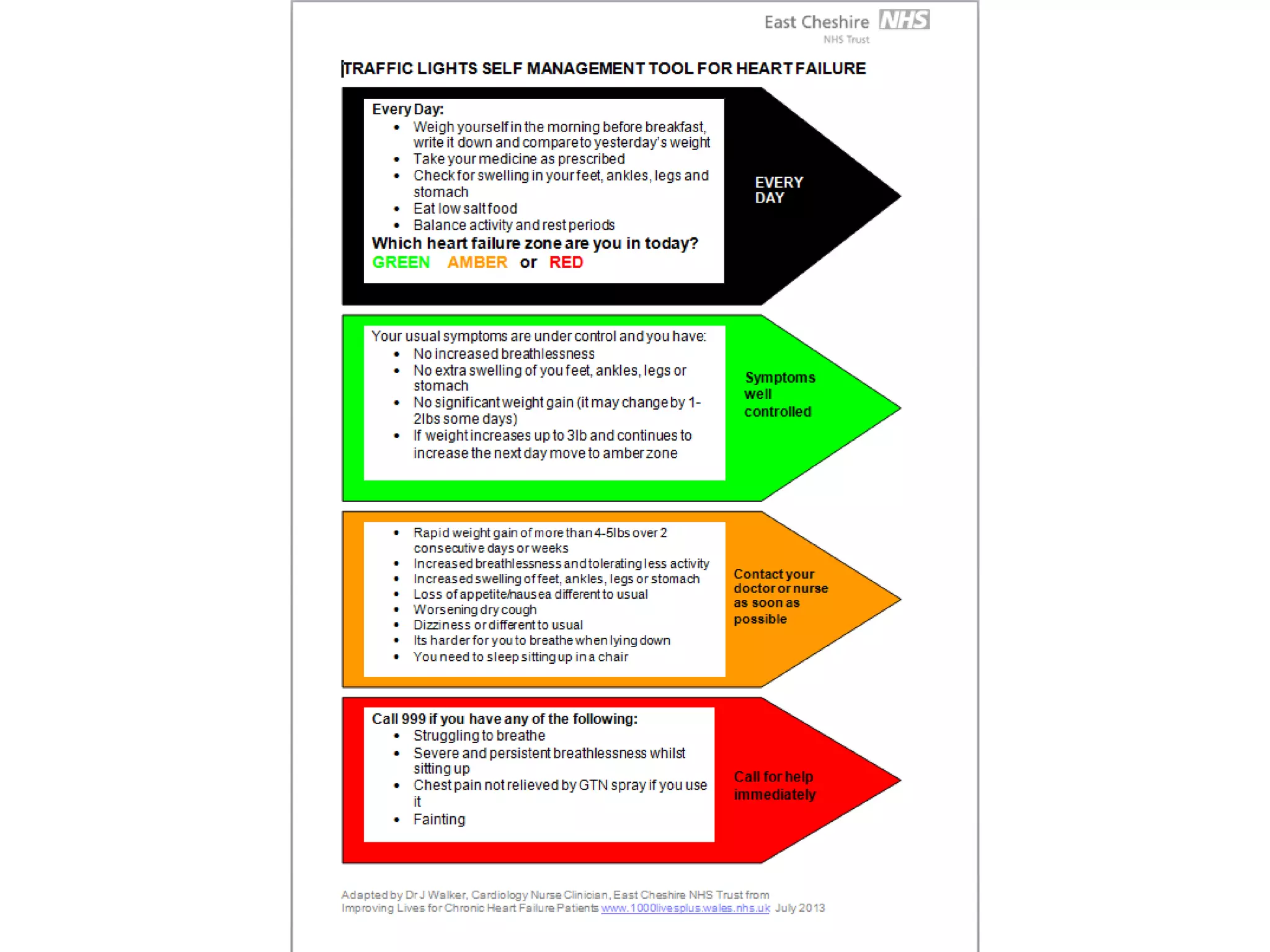
• The cardiology project created a type of “traffic-
light” self-management aid. The nurses show their
patients how to understand their own symptoms
with the help of three broad indicator levels (green,
amber and red)
• Patients take the lead in assessing themselves and
decide if they need to step up to the next level,
which might be a matter of increasing their home
oxygen or contacting the nurse or GP.
Integrating Care in Eastern Cheshire
Barriers to implementation
• Communication between primary and
secondary care including IT problems
• Acceptance by some consultants and other
health care professionals
• Patients
BUT
• Now have been largely overcome
• BHF nurses now have substantive posts
Integrating Care in Eastern Cheshire
In Conclusion
• A team of multiskilled cardiac nurses who can deliver
flexible care wherever required
• Accepted by other HCP’s
• Demonstrated reduction in admissions and length of
stay
• Improved self management
• Improved management in primary care
• Scope for model to be utilised in other DGH’s where
cardiology input is inadequate

IV diuretics in the community

  • 1.
    Integrating Care inEastern Cheshire IV Diuretics in the community Dr Julie Walker East Cheshire NHS Trust
  • 2.
    Integrating Care inEastern Cheshire Background • North West Cardiac Network developed a protocol for delivery of IV furosemide in the community – 2011 • Aimed to reduce admissions, readmissions, and length of stay and to improve symptomatic management of patients with advanced heart failure at end of life
  • 3.
    • Cardiologists sceptical aboutbenefits • Pharmacists worried about potential drug reactions • Managers reluctant to increase resources to enable delivery • HITS team was being relaunched • New team leader who was very proactive in wanting to develop the service into new areas • BHF were looking to fund bids for innovative care Challenges and Opportunities
  • 4.
    Integrating Care inEastern Cheshire BHF project • Successful bid to BHF to develop an integrated cardiology nurse team who could work between primary and secondary care • Several strands to the project covering the whole spectrum of cardiac care including – Cardiac inreach – Clinics – Helpline – Community IV diuretics – Education for HCP’s – Enabling and supporting patients to develop skills for self care – Palliative care
  • 5.
    Community IV diuretics •Collaborative working with HITS to deliver IV diuretics to suitable patients in their own home • Pathway sets out roles and responsibilities, and parameters for safe management • HITS: – assess home circumstances – Manage IV access (cannulae, mid lines, PICC lines) – Deliver infusion – Weigh patient, take blood for U&E’s, monitor BP and heart rate • Cardiology specialist nurses provide: – Clinical input and weekly assessment of patients (more frequent if required) – Prescriptions – Telephone liaison with HITS – Consideration of day case IV diuretics for those who fall outside the pathway
  • 6.
    Integrating Care inEastern Cheshire Inclusion criteria • Established, fully investigated heart failure including echocardiography. • Patient known to and/or under supervision of Consultant Cardiologist. • Patient not suitable for further prognostic intervention. • Heart failure confirmed as cause of symptoms (no reversible causes identified). • Patients established & responding to therapy but ongoing IV diuretics anticipated, in ambulatory patients who wish to be discharged from hospital. • Renal stability (eGFR ≥ 25ml/l/min) and stable for the preceding 2 months – unless patient is on end of life pathway or mandated by a Consultant Cardiologist • Patient has sufficient and appropriate social/family /carer support. • Patient able to give informed consent to iv/sc diuretic therapy at home. • Patient able to weigh themselves / be weighed daily – unless patient is on end of life pathway.
  • 7.
    Integrating Care inEastern Cheshire Exclusion criteria • Difficult IV access. • eGFR < 25mml/l/min or greater than 30% decline in eGFR in preceding 2 months – unless end of life pathway, or greater than 30% decline in eGFR in preceding 2 months – unless end of life pathway • Symptomatic hypotension • Insufficient carer support
  • 8.
    Integrating Care inEastern Cheshire Impact of IV diuretics • Admission avoidance • Early supported discharge • Palliative care • IV diuretics given at home to 33 patients so far, some of whom have required it more than once. In addition 8 patients have received IV diuretics in day case unit. More than 1300 administrations • Nationally heart failure admissions have increased by 6% whilst ours have remained static
  • 9.
    Integrating Care inEastern Cheshire Case study 1 • Mrs H 78 year old lady • Severe aortic stenosis • Multiple co-morbidities, diabetes, hypertension, CKD, severe right heart dilatation, pulmonary hypertension, non alcoholic liver disease • Did not want admission to hospital • Treatment needed whilst awaiting TAVI • Valve replacement 6 months ago • No requirement for IV diuretics since
  • 10.
    Integrating Care inEastern Cheshire Case Study 2 • Mr G – IHD and severe LVSD • Referred by GP 4/9/14 with ↑SOB and wt gain • Found to have decompensated heart failure with significant fluid overload • 2 month treatment with IV furosemide 200mg daily • Lost 53Kg • Now “ feeling better than he has in years”
  • 11.
    Integrating Care inEastern Cheshire Case study 3 • Mr J – numerous hospitalisations for symptom management at end of life • Every time IV diuretics stopped became fluid overloaded and significantly symptomatic but he nor his family wanted further hospital admissions • 5 months IV diuretics enabled him to remain at home until he died • The ability to deliver home IV diuretics was also valued by the family “His garden, which was his pride and joy, was one of the last things he saw,” says his son. “This is really what dad wanted. We’re so grateful.” • http://www.itv.com/thismorning/hot-topics/a-family-with- heart
  • 12.
    Integrating Care inEastern Cheshire Improvements to LOS ICD codes Oct 2011 to Sept 2012 No of pts/ ALOS Oct 2012 to Sept 2013 No of pts/ ALOS Oct 2013 to Sept 2014 No of pts/ ALOS I20 - Angina 193 / 4.67 191 / 2.6 132 / 2.48 I21 - MI 238 / 10.7/ 7(median) 295 / 8.16 / 5(median) 261 / 7.93 / 5(median) I48 - AF 331 / 5.43 305 / 5.62 264 / 2.61 I50 – Heart failure 296 / 14.96 299 / 15.80 293 / 11.80
  • 13.
    Integrating Care inEastern Cheshire Outcomes • Our average length of stay for heart failure had reduced by 3 days over 2 years • The number of heart failure admissions has remained stable despite increasing elderly population and increased HF admissions nationally (average 6%) • Estimated cost savings from project over 2 years £1.2 million
  • 14.
    Integrating Care inEastern Cheshire Things we have learned • Need to create hospital environment at home – Low salt diet – Fluid restriction – Rest • Don’t assume compliance with these
  • 15.
    Integrating Care inEastern Cheshire Self management • AQuA self management and decision making pilot project • The cardiology project created a type of “traffic- light” self-management aid. The nurses show their patients how to understand their own symptoms with the help of three broad indicator levels (green, amber and red) • Patients take the lead in assessing themselves and decide if they need to step up to the next level, which might be a matter of increasing their home oxygen or contacting the nurse or GP.
  • 17.
    Integrating Care inEastern Cheshire Barriers to implementation • Communication between primary and secondary care including IT problems • Acceptance by some consultants and other health care professionals • Patients BUT • Now have been largely overcome • BHF nurses now have substantive posts
  • 18.
    Integrating Care inEastern Cheshire In Conclusion • A team of multiskilled cardiac nurses who can deliver flexible care wherever required • Accepted by other HCP’s • Demonstrated reduction in admissions and length of stay • Improved self management • Improved management in primary care • Scope for model to be utilised in other DGH’s where cardiology input is inadequate