1. Nur Mafissamawati S.   (201010100311307)
2. Niken Andrea S.        (201010100311310)
3. Rizka Nur Rahmawati    (201010100311313)
4. Lailatul Maghfiroh     (201010100311314)
5. Kunthi Octavia         (201010100311321)
Language variation is an important
part of sociolinguistics. Language
variation is formed not only caused by
the users who are not homogeneous,
but also caused by various social
interaction activities that people do.
   Phonetic
   Phonological
   Morphological
   Syntactic
   Semantic (Vocabulary Choice)
   Interference
   Integration
   Mixed Code or Code
1.   Welsh Language
     Welsh is spoken by more than 50% of the
     population in North-West, Central and
     South-West Wales. Fewer than 20% speak
     Welsh in the North-East and South-East,
     though the numbers speaking Welsh are
     highest here, because these areas have by
     far the largest population.
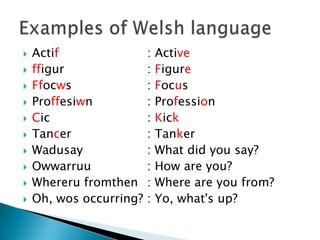
   Actif                :   Active
   ffigur               :   Figure
   Ffocws               :   Focus
   Proffesiwn           :   Profession
   Cic                  :   Kick
   Tancer               :   Tanker
   Wadusay              :   What did you say?
   Owwarruu             :   How are you?
   Whereru fromthen     :   Where are you from?
   Oh, wos occurring?   :   Yo, what's up?
Scottish is spoken by people who live in the
northern part of the island of Britain, more-
or-less defined as north of Hadrian’s Wall.
This dialect can be either very heavy or very
delicate.
The Scots use all the standard tricks described on
the dialect page, with just a few changes in
vocabulary:
 Scots tend to say "nae" for "not." So, instead of
  the word "cannot," the Scots would say "cannae."
  Similarly, "do not" becomes "dinnae," and so
  forth.
 Instead of the word "understand" Scots use the
  word "ken." This word is also occasionally used to
  substitute for "know," as in "I dinnae ken where
  the fellow be."
 Where an Englishman might say "lad" or "lass," a
  Scot will use the diminutive "laddie" or "lassie." A
  Scot might use these terms for adults, as well.
 Scots will also use "ye" instead of "you."
 Scots will use the word "wee" for "little" or
  "small."
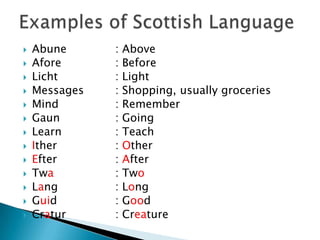
   Abune      :   Above
   Afore      :   Before
   Licht      :   Light
   Messages   :   Shopping, usually groceries
   Mind       :   Remember
   Gaun       :   Going
   Learn      :   Teach
   Ither      :   Other
   Efter      :   After
   Twa        :   Two
   Lang       :   Long
   Guid       :   Good
   Cratur     :   Creature
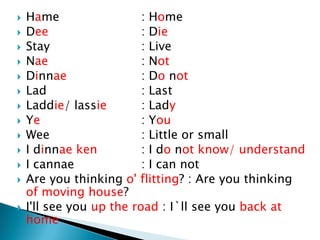
   Hame                  : Home
   Dee                   : Die
   Stay                  : Live
   Nae                   : Not
   Dinnae                : Do not
   Lad                   : Last
   Laddie/ lassie        : Lady
   Ye                    : You
   Wee                   : Little or small
   I dinnae ken          : I do not know/ understand
   I cannae              : I can not
   Are you thinking o' flitting? : Are you thinking
    of moving house?
   I'll see you up the road : I`ll see you back at
    home
Irish is a Celtic language spoken in mainly
Ireland (Éire). The Irish language, along with
Welsh and Breton, is one of the oldest
languages in Europe, dating back in writing to
the time when Latin was primarily written and
spoken. The progression of the Irish language
through history began in Central Europe in
the 5th century B.C. when a tribe called the
Celts came into Europe.
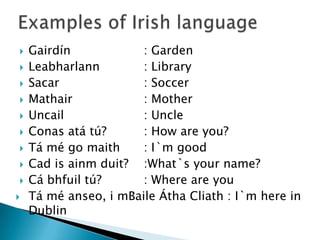
   Gairdín            : Garden
   Leabharlann        : Library
   Sacar              : Soccer
   Mathair            : Mother
   Uncail             : Uncle
   Conas atá tú?      : How are you?
   Tá mé go maith     : I`m good
   Cad is ainm duit? :What`s your name?
   Cá bhfuil tú?      : Where are you
   Tá mé anseo, i mBaile Átha Cliath : I`m here in
    Dublin
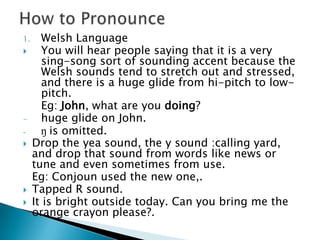
1.     Welsh Language
      You will hear people saying that it is a very
       sing-song sort of sounding accent because the
       Welsh sounds tend to stretch out and stressed,
       and there is a huge glide from hi-pitch to low-
       pitch.
       Eg: John, what are you doing?
-      huge glide on John.
-      ŋ is omitted.
    Drop the yea sound, the y sound :calling yard,
     and drop that sound from words like news or
     tune and even sometimes from use.
     Eg: Conjoun used the new one,.
    Tapped R sound.
    It is bright outside today. Can you bring me the
     orange crayon please?.
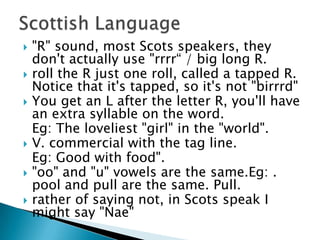
   "R" sound, most Scots speakers, they
    don't actually use "rrrr“ / big long R.
   roll the R just one roll, called a tapped R.
    Notice that it's tapped, so it's not "birrrd"
   You get an L after the letter R, you'll have
    an extra syllable on the word.
    Eg: The loveliest "girl" in the "world".
   V. commercial with the tag line.
    Eg: Good with food".
   "oo" and "u" vowels are the same.Eg: .
    pool and pull are the same. Pull.
   rather of saying not, in Scots speak I
    might say "Nae"
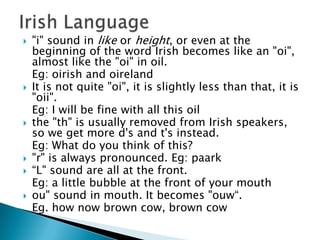
   "i" sound in like or height, or even at the
    beginning of the word Irish becomes like an "oi",
    almost like the "oi" in oil.
    Eg: oirish and oireland
   It is not quite "oi", it is slightly less than that, it is
    "oii".
    Eg: I will be fine with all this oil
   the "th" is usually removed from Irish speakers,
    so we get more d's and t's instead.
    Eg: What do you think of this?
   "r" is always pronounced. Eg: paark
   “L" sound are all at the front.
    Eg: a little bubble at the front of your mouth
   ou" sound in mouth. It becomes "ouw“.
    Eg. how now brown cow, brown cow

Its existence

  • 1.
    1. Nur MafissamawatiS. (201010100311307) 2. Niken Andrea S. (201010100311310) 3. Rizka Nur Rahmawati (201010100311313) 4. Lailatul Maghfiroh (201010100311314) 5. Kunthi Octavia (201010100311321)
  • 2.
    Language variation isan important part of sociolinguistics. Language variation is formed not only caused by the users who are not homogeneous, but also caused by various social interaction activities that people do.
  • 3.
    Phonetic  Phonological  Morphological  Syntactic  Semantic (Vocabulary Choice)
  • 4.
    Interference  Integration  Mixed Code or Code
  • 5.
    1. Welsh Language Welsh is spoken by more than 50% of the population in North-West, Central and South-West Wales. Fewer than 20% speak Welsh in the North-East and South-East, though the numbers speaking Welsh are highest here, because these areas have by far the largest population.
  • 6.
    Actif : Active  ffigur : Figure  Ffocws : Focus  Proffesiwn : Profession  Cic : Kick  Tancer : Tanker  Wadusay : What did you say?  Owwarruu : How are you?  Whereru fromthen : Where are you from?  Oh, wos occurring? : Yo, what's up?
  • 7.
    Scottish is spokenby people who live in the northern part of the island of Britain, more- or-less defined as north of Hadrian’s Wall. This dialect can be either very heavy or very delicate.
  • 8.
    The Scots useall the standard tricks described on the dialect page, with just a few changes in vocabulary:  Scots tend to say "nae" for "not." So, instead of the word "cannot," the Scots would say "cannae." Similarly, "do not" becomes "dinnae," and so forth.  Instead of the word "understand" Scots use the word "ken." This word is also occasionally used to substitute for "know," as in "I dinnae ken where the fellow be."  Where an Englishman might say "lad" or "lass," a Scot will use the diminutive "laddie" or "lassie." A Scot might use these terms for adults, as well.  Scots will also use "ye" instead of "you."  Scots will use the word "wee" for "little" or "small."
  • 9.
    Abune : Above  Afore : Before  Licht : Light  Messages : Shopping, usually groceries  Mind : Remember  Gaun : Going  Learn : Teach  Ither : Other  Efter : After  Twa : Two  Lang : Long  Guid : Good  Cratur : Creature
  • 10.
    Hame : Home  Dee : Die  Stay : Live  Nae : Not  Dinnae : Do not  Lad : Last  Laddie/ lassie : Lady  Ye : You  Wee : Little or small  I dinnae ken : I do not know/ understand  I cannae : I can not  Are you thinking o' flitting? : Are you thinking of moving house?  I'll see you up the road : I`ll see you back at home
  • 11.
    Irish is aCeltic language spoken in mainly Ireland (Éire). The Irish language, along with Welsh and Breton, is one of the oldest languages in Europe, dating back in writing to the time when Latin was primarily written and spoken. The progression of the Irish language through history began in Central Europe in the 5th century B.C. when a tribe called the Celts came into Europe.
  • 12.
    Gairdín : Garden  Leabharlann : Library  Sacar : Soccer  Mathair : Mother  Uncail : Uncle  Conas atá tú? : How are you?  Tá mé go maith : I`m good  Cad is ainm duit? :What`s your name?  Cá bhfuil tú? : Where are you  Tá mé anseo, i mBaile Átha Cliath : I`m here in Dublin
  • 13.
    1. Welsh Language  You will hear people saying that it is a very sing-song sort of sounding accent because the Welsh sounds tend to stretch out and stressed, and there is a huge glide from hi-pitch to low- pitch. Eg: John, what are you doing? - huge glide on John. - ŋ is omitted.  Drop the yea sound, the y sound :calling yard, and drop that sound from words like news or tune and even sometimes from use. Eg: Conjoun used the new one,.  Tapped R sound.  It is bright outside today. Can you bring me the orange crayon please?.
  • 14.
    "R" sound, most Scots speakers, they don't actually use "rrrr“ / big long R.  roll the R just one roll, called a tapped R. Notice that it's tapped, so it's not "birrrd"  You get an L after the letter R, you'll have an extra syllable on the word. Eg: The loveliest "girl" in the "world".  V. commercial with the tag line. Eg: Good with food".  "oo" and "u" vowels are the same.Eg: . pool and pull are the same. Pull.  rather of saying not, in Scots speak I might say "Nae"
  • 15.
    "i" sound in like or height, or even at the beginning of the word Irish becomes like an "oi", almost like the "oi" in oil. Eg: oirish and oireland  It is not quite "oi", it is slightly less than that, it is "oii". Eg: I will be fine with all this oil  the "th" is usually removed from Irish speakers, so we get more d's and t's instead. Eg: What do you think of this?  "r" is always pronounced. Eg: paark  “L" sound are all at the front. Eg: a little bubble at the front of your mouth  ou" sound in mouth. It becomes "ouw“. Eg. how now brown cow, brown cow