Hiberno-English
 
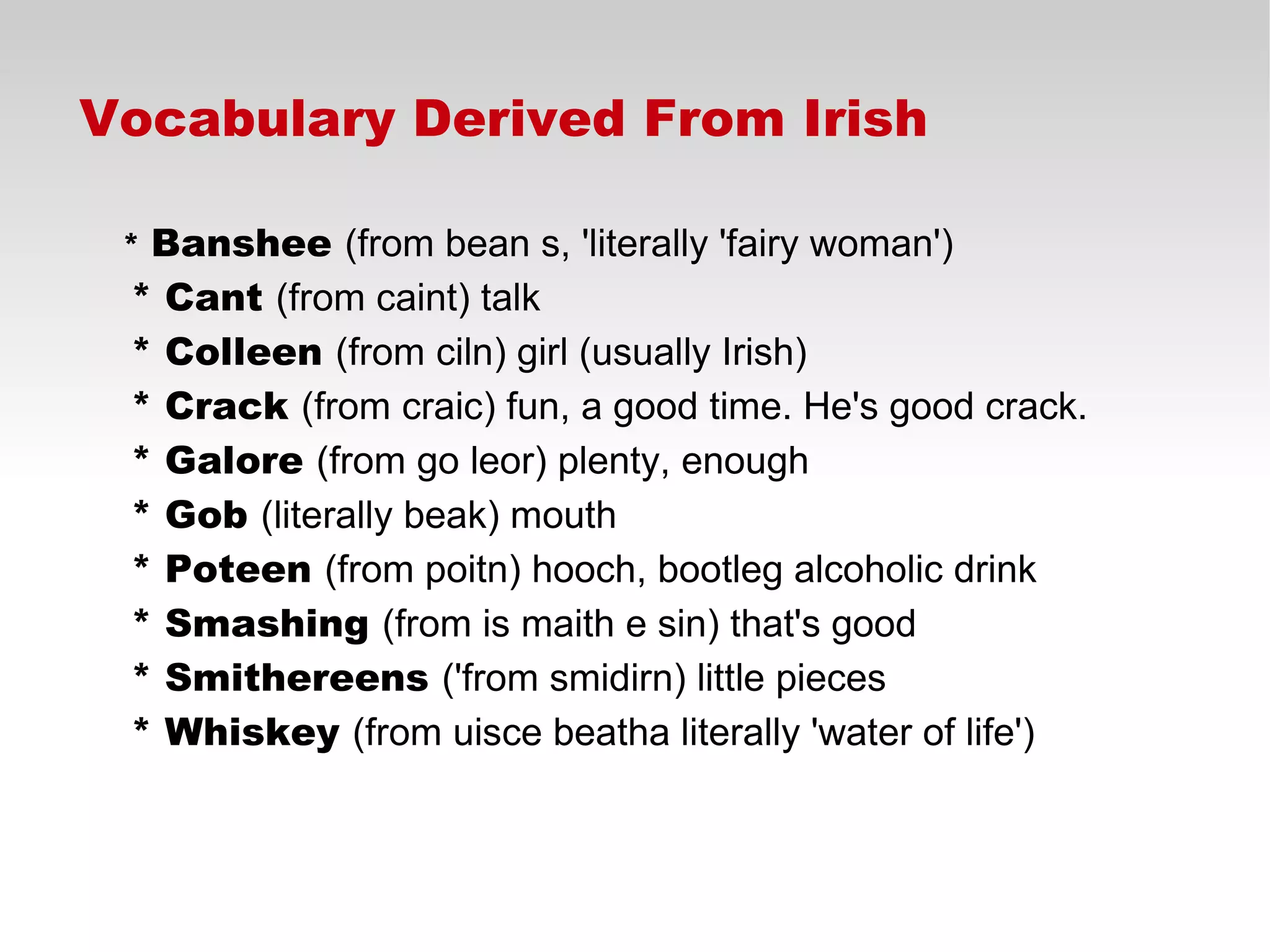
Vocabulary Derived From Irish *  Banshee  (from bean s, 'literally 'fairy woman') * Cant  (from caint) talk * Colleen  (from ciln) girl (usually Irish) * Crack  (from craic) fun, a good time. He's good crack. * Galore  (from go leor) plenty, enough * Gob  (literally beak) mouth * Poteen  (from poitn) hooch, bootleg alcoholic drink * Smashing  (from is maith e sin) that's good * Smithereens  ('from smidirn) little pieces * Whiskey  (from uisce beatha literally 'water of life')
Phonology Most Hiberno-English dialects are rhotic. /t/ is not plosive where it does not occur word-initially; instead, it is often pronounced as a slit fricative [θ̠] The distinction between w /w/ and wh /hw/, as in wine vs. whine, is preserved. The distinction between /ɒː/ and /oː/ in horse and hoarse is preserved, though not usually in Dublin or Belfast. A distinction between [ɛɹ]-[ɪɹ]-[ʌɹ] in herd-bird-curd may be found. The vowels in words such as boat and cane are usually monophthongs outside of Dublin: [boːt], and [keːn].
The /aɪ/ in "night" may be pronounced in a wide variety of ways, e.g. [əɪ], [ɔɪ], [ʌɪ] and [ɑɪ], the latter two being the most common in middle class speech, the former two, in popular speech. The /ɔɪ/ in "boy" may be pronounced [ɑːɪ]. /eɪ/ often becomes /ɛ/ in words such as gave and came (becoming "gev" and "kem"). /dj/ becomes /dʒ/, e.g. dew/due, duke and duty sound like "jew", "jook" and "jooty". /tj/ becomes /tʃ/, e.g. tube is "choob", tune is "choon".
Grammar Derived From Irish Like other Celtic languages, Irish has no words for "yes" and "no", instead the verb in a question is repeated in an answer. People in Ireland have a tendency to use this pattern of avoiding "yes" or "no" when speaking English: "Are you finished debugging that software?" "I am." "Is your mobile charged?" "It is." Irish speakers of English use a "does be/do be" (or "bes", although less frequently) construction to indicate this latter continuous present: "He does be coding every day." "They do be talking on their mobiles a lot." "They bes doing a lot of work at school."
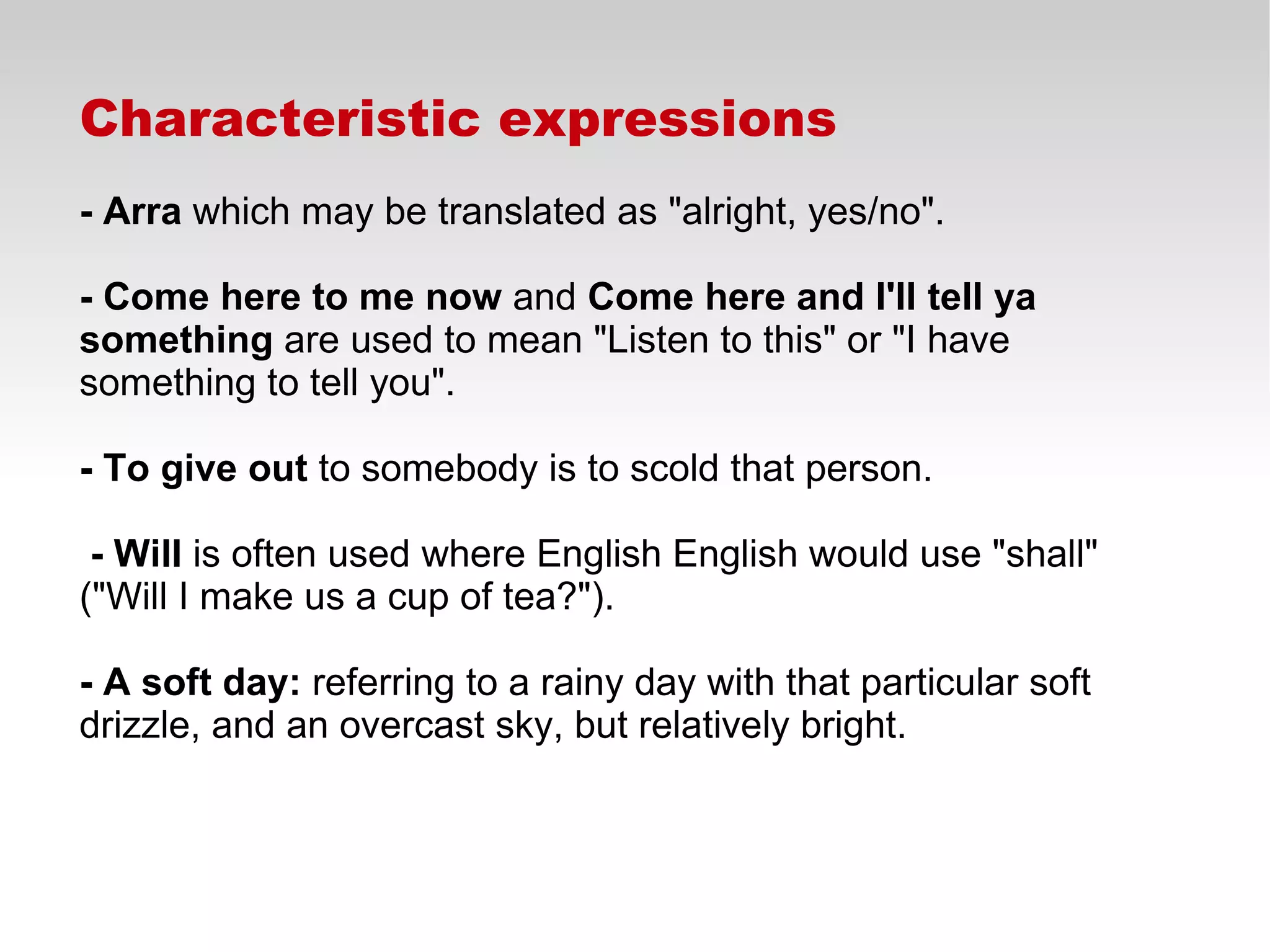
Characteristic expressions - Arra  which may be translated as "alright, yes/no". - Come here to me now  and  Come here and I'll tell ya something  are used to mean "Listen to this" or "I have something to tell you". - To give out  to somebody is to scold that person. - Will  is often used where English English would use "shall" ("Will I make us a cup of tea?"). - A soft day:  referring to a rainy day with that particular soft drizzle, and an overcast sky, but relatively bright.
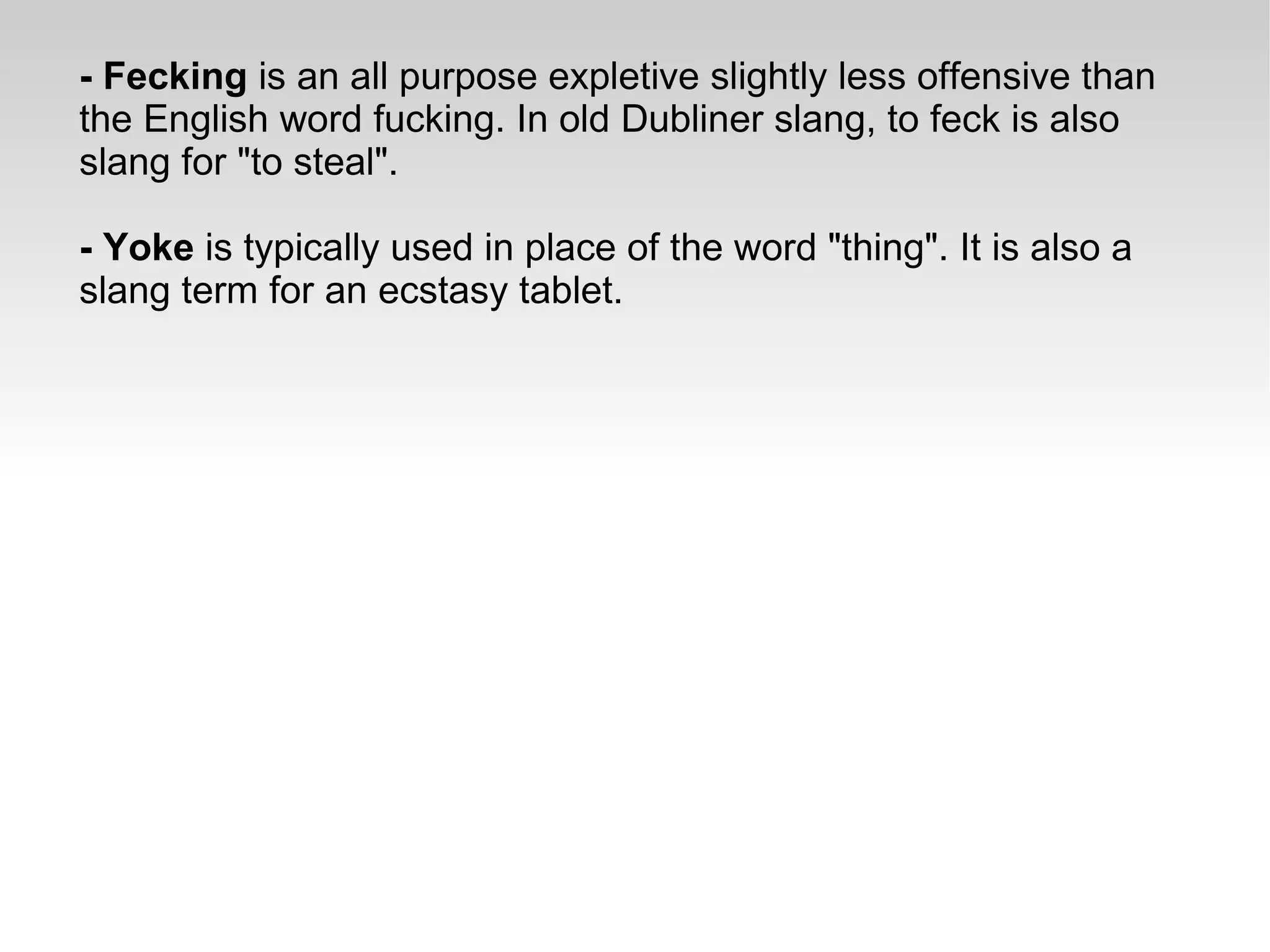
- Fecking  is an all purpose expletive slightly less offensive than the English word fucking. In old Dubliner slang, to feck is also slang for "to steal". - Yoke  is typically used in place of the word "thing". It is also a slang term for an ecstasy tablet.

Hiberno english

  • 1.
  • 2.
  • 3.
    Vocabulary Derived FromIrish * Banshee (from bean s, 'literally 'fairy woman') * Cant (from caint) talk * Colleen (from ciln) girl (usually Irish) * Crack (from craic) fun, a good time. He's good crack. * Galore (from go leor) plenty, enough * Gob (literally beak) mouth * Poteen (from poitn) hooch, bootleg alcoholic drink * Smashing (from is maith e sin) that's good * Smithereens ('from smidirn) little pieces * Whiskey (from uisce beatha literally 'water of life')
  • 4.
    Phonology Most Hiberno-Englishdialects are rhotic. /t/ is not plosive where it does not occur word-initially; instead, it is often pronounced as a slit fricative [θ̠] The distinction between w /w/ and wh /hw/, as in wine vs. whine, is preserved. The distinction between /ɒː/ and /oː/ in horse and hoarse is preserved, though not usually in Dublin or Belfast. A distinction between [ɛɹ]-[ɪɹ]-[ʌɹ] in herd-bird-curd may be found. The vowels in words such as boat and cane are usually monophthongs outside of Dublin: [boːt], and [keːn].
  • 5.
    The /aɪ/ in"night" may be pronounced in a wide variety of ways, e.g. [əɪ], [ɔɪ], [ʌɪ] and [ɑɪ], the latter two being the most common in middle class speech, the former two, in popular speech. The /ɔɪ/ in "boy" may be pronounced [ɑːɪ]. /eɪ/ often becomes /ɛ/ in words such as gave and came (becoming "gev" and "kem"). /dj/ becomes /dʒ/, e.g. dew/due, duke and duty sound like "jew", "jook" and "jooty". /tj/ becomes /tʃ/, e.g. tube is "choob", tune is "choon".
  • 6.
    Grammar Derived FromIrish Like other Celtic languages, Irish has no words for "yes" and "no", instead the verb in a question is repeated in an answer. People in Ireland have a tendency to use this pattern of avoiding "yes" or "no" when speaking English: "Are you finished debugging that software?" "I am." "Is your mobile charged?" "It is." Irish speakers of English use a "does be/do be" (or "bes", although less frequently) construction to indicate this latter continuous present: "He does be coding every day." "They do be talking on their mobiles a lot." "They bes doing a lot of work at school."
  • 7.
    Characteristic expressions -Arra which may be translated as "alright, yes/no". - Come here to me now and Come here and I'll tell ya something are used to mean "Listen to this" or "I have something to tell you". - To give out to somebody is to scold that person. - Will is often used where English English would use "shall" ("Will I make us a cup of tea?"). - A soft day: referring to a rainy day with that particular soft drizzle, and an overcast sky, but relatively bright.
  • 8.
    - Fecking is an all purpose expletive slightly less offensive than the English word fucking. In old Dubliner slang, to feck is also slang for "to steal". - Yoke is typically used in place of the word "thing". It is also a slang term for an ecstasy tablet.