Investigating Thinking Strategies
2013-2014
Introductions
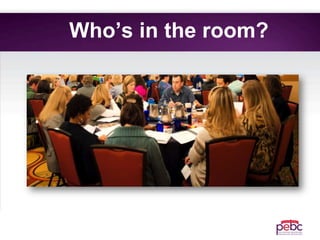
Who’s in the room?
The Public Education &
Business Coalition (PEBC)
is dedicated to developing
the intellectual and
scholarly practices of
educators across the
continuum of their
professional lives so our
schools are worthy of our
students.
We Started With Research
P. David Pearson, Roehler,
Dole, and Duffy, 1992.
“Developing Expertise in
Reading Comprehension.”
What Research Has To Say
About Reading Instruction.
IRA
Duke, N.K., & P.D. Pearson.
2002. Effective Practices for
Developing Reading
Comprehension.
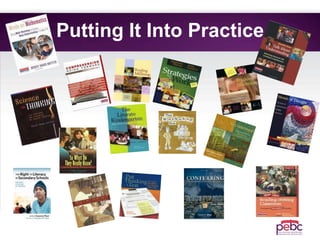
Putting It Into Practice
Essential Question
How do we grow thinkers?
“Mix and Mingle”
1.Grab a quote, read it over, and mull it over.
2.Find a partner and share your quote and
thinking.
3.Trade quotes and find a new partner &
repeat.
How do we grow thinkers?
Create a working
explanation… use
words, icons, metaphors, e
tc.
Agenda Overview
Through Comprehension Strategies
we:
• Become more reflective readers & thinkers
• Develop a common language of thinking
• Teach deep level comprehension explicitly
• Raise expectations & support for all kids
• Emphasize reading with depth & focus
• Teach the “reader” not just the text
• Build a bank of content area knowledge
From: Comprehension Going Forward, “Comprehension Instruction Grows Up,”
Keene, 2011
Institute Outcomes . . .
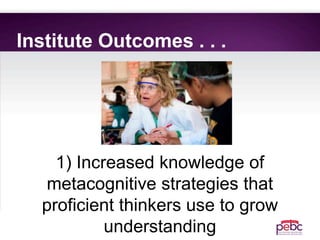
1) Increased knowledge of
metacognitive strategies that
proficient thinkers use to grow
understanding
Institute Outcomes . . .
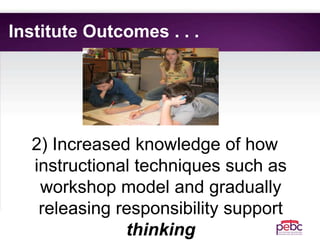
2) Increased knowledge of how
instructional techniques such as
workshop model and gradually
releasing responsibility support
thinking
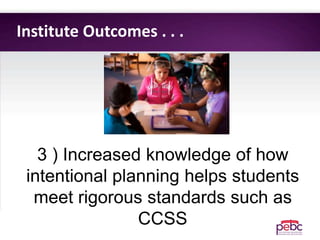
3 ) Increased knowledge of how
intentional planning helps students
meet rigorous standards such as
CCSS
Institute Outcomes . . .
• TRANSITION QUOTE
Self Assessment
• Self assess thinking strategies & workshop
model
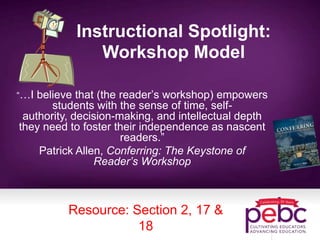
Instructional Spotlight:
Workshop Model
“…I believe that (the reader’s workshop) empowers
students with the sense of time, self-
authority, decision-making, and intellectual depth
they need to foster their independence as nascent
readers.”
Patrick Allen, Conferring: The Keystone of
Reader’s Workshop
Resource: Section 2, 17 &
18
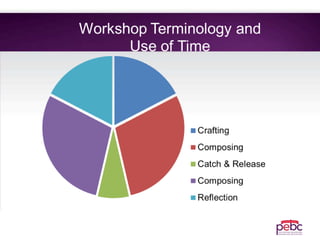
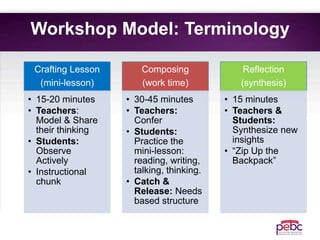
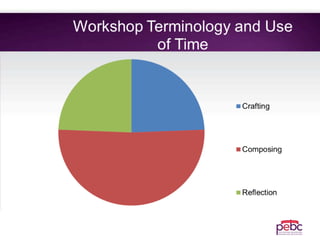
Workshop Model: Terminology
Crafting Lesson
(mini-lesson)
• 15-20 minutes
• Teachers:
Model & Share
their thinking
• Students:
Observe
Actively
• Instructional
chunk
Composing
(work time)
• 30-45 minutes
• Teachers:
Confer
• Students:
Practice the
mini-lesson:
reading, writing,
talking, thinking.
• Catch &
Release: Needs
based structure
Reflection
(synthesis)
• 15 minutes
• Teachers &
Students:
Synthesize new
insights
• “Zip Up the
Backpack”
Crafting
Composing: Work Time
Read and annotate your text
with your thinking… What are
you doing as a reader?
“Leave Tracks in the Snow”
Conferring
• Our goal is to understand you as readers and
thinkers
• Our task is to confer with you as you read
Catch & Release
Find a Partner & Share Annotations
What did you notice about yourself
as a reader of this type of text?
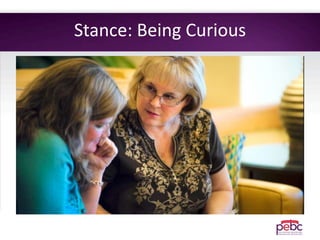
Stance: Being Curious
Reflection
Understanding the “reader” not the “reading”
Reflection
Cheryl’s
Classroom:
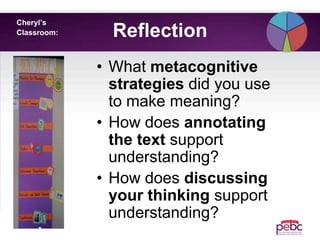
• What metacognitive
strategies did you use
to make meaning?
• How does annotating
the text support
understanding?
• How does discussing
your thinking support
understanding?
Return by
“Meaning making is not a
spectator sport.”
-Art Costa
What is it that
proficient thinkers do?
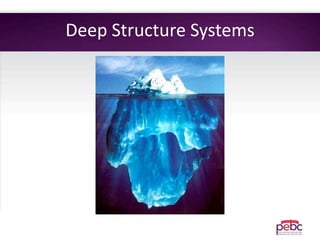
Deep Structure Systems
Cognitive Thinking Strategies
1.Activate, revise and apply schema
(background knowledge)
2.Draw inferences
3.Ask questions
4.Determine importance
5.Synthesize
6.Evoke sensory images
7.Monitor for meaning and employ fix up
strategies when meaning breaks down
Language Matters
Yes, vocabulary needs to be
taught…
Strategic Thinkers
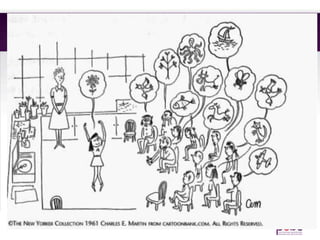
Proficient thinkers draw on schema
or background knowledge.
We use our own
background
knowledge to
understand the
text as we read
Pearson, et al 1992., Gordon and
Pearson, 1983; Hansen, 1981.
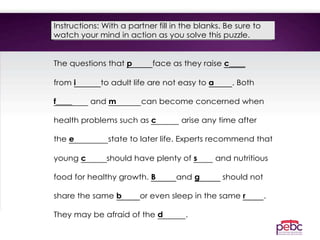
Instructions: With a partner fill in the blanks. Be sure to
watch your mind in action as you solve this puzzle.
The questions that p face as they raise c____
from i to adult life are not easy to a . Both
f____ and m can become concerned when
health problems such as c arise any time after
the e state to later life. Experts recommend that
young c should have plenty of s and nutritious
food for healthy growth. B and g should not
share the same b or even sleep in the same r .
They may be afraid of the d .
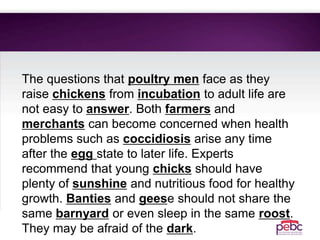
The questions that poultry men face as they
raise chickens from incubation to adult life are
not easy to answer. Both farmers and
merchants can become concerned when health
problems such as coccidiosis arise any time
after the egg state to later life. Experts
recommend that young chicks should have
plenty of sunshine and nutritious food for healthy
growth. Banties and geese should not share the
same barnyard or even sleep in the same roost.
They may be afraid of the dark.
Activating Schema Looks and
Sounds Like:
• This reminds me of…
• How is this like…?
• How can I connect this to
concepts I already know?
Proficient thinkers draw inferences
We infer when we use
schema and textual
information to draw
conclusions and form unique
interpretations and when we
make predictions, confirm
them, and test them as we
read. Anderson and Pearson, 1984
Aha!!!
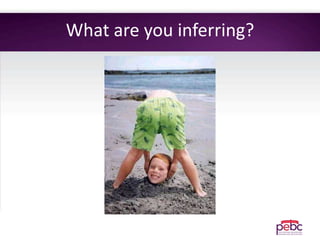
What are you inferring?
Investigating Inferences
In Triads
• Visit 3 posters and write a caption for
each picture
Investigating Inferences
Reflect
• What did you do to infer?
• How did thinking with others enhance your
understanding?
• How did the thinking of others enhance your
understanding
Drawing Inferences Looks and
Sounds Like:
• I bet…
• Can I draw a conclusion?
• My hunch is…
• I’m thinking that…
• The text doesn’t say this
but I think/ it seems like…
• I’m inferring…because…
Proficient thinkers ask questions.
We generate questions
BEFORE, DURING, and
AFTER reading which
helps us focus our
attention on important
components of the text.
Andre and Anderson, 1979; Brown and Palincsar, 1985
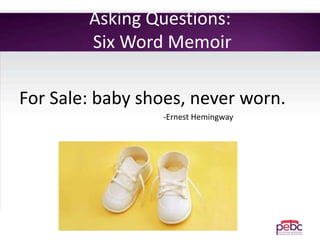
Asking Questions:
Six Word Memoir
For Sale: baby shoes, never worn.
-Ernest Hemingway
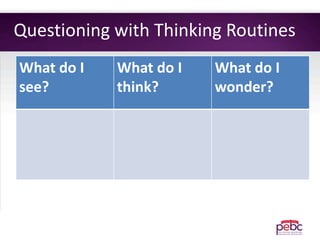
Questioning with Thinking Routines
What do I
see?
What do I
think?
What do I
wonder?
Asking Questions Looks and
Sounds Like:
• I am wondering…
• Why did that happen?
• What is important?
• How will my questions
help me understand?
Proficient thinkers determine
importance in text
We identify key ideas or
themes as we read,
distinguish important from
unimportant information,
and support our ideas with
evidence from the text.
Afflerbach and Johnston, 1984; Baumann, 1986;
Tierney and Cunningham, 1984; Winograd and Bridge, 1986
I
found
it!
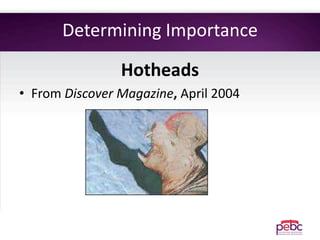
Determining Importance
Hotheads
• From Discover Magazine, April 2004
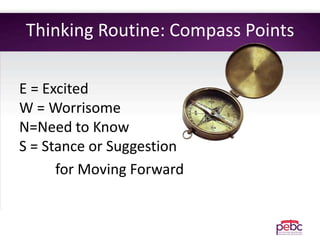
Thinking Routine: Compass Points
E = Excited
W = Worrisome
N=Need to Know
S = Stance or Suggestion
for Moving Forward
Determining Importance Looks and
Sounds Like:
• What is essential?
• I’ll remember…
• The big ideas are…
Proficient thinkers synthesize
information
As we read, we
monitor the overall
meaning, important
concepts and themes.
We are aware of how
these elements fit
together to create
overarching ideas.
Brown and Day, 1983
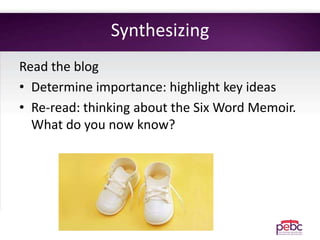
Synthesizing
Read the blog
• Determine importance: highlight key ideas
• Re-read: thinking about the Six Word Memoir.
What do you now know?
Thinking Routine: Headlines
If you were to write a headline for this topic or
issue right now that captured the most
important aspect that should be remembered,
what would that headline be?
Synthesizing Looks and Sounds
Like:
• First I thought, but now I
am thinking….
• Now I understand…
• Like putting a puzzle
together, the pieces
are…
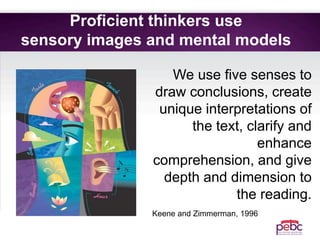
Proficient thinkers use
sensory images and mental models
We use five senses to
draw conclusions, create
unique interpretations of
the text, clarify and
enhance
comprehension, and give
depth and dimension to
the reading.
Keene and Zimmerman, 1996
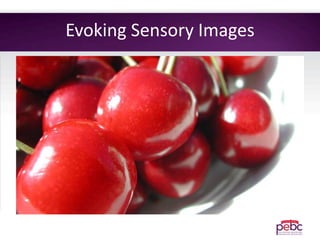
Evoking Sensory Images
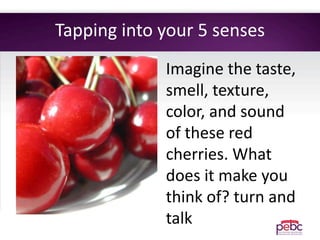
Tapping into your 5 senses
Imagine the taste,
smell, texture,
color, and sound
of these red
cherries. What
does it make you
think of? turn and
talk
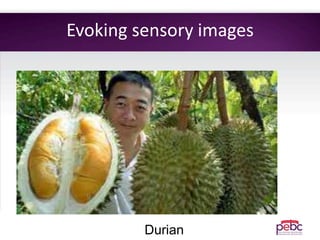
Evoking sensory images
Durian
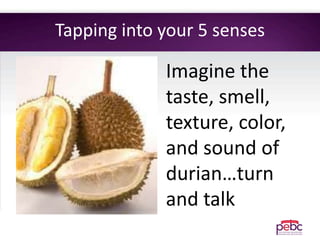
Tapping into your 5 senses
Imagine the
taste, smell,
texture, color,
and sound of
durian…turn
and talk
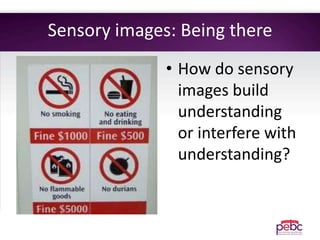
Sensory images: Being there
• How do sensory
images build
understanding
or interfere with
understanding?
Creating Sensory Images Looks and
Sounds Like:
• In my mind, I can
see/hear/smell/feel/taste…
• The movie in my head…
• I am experiencing…
Proficient thinkers monitor their
comprehension
We know when the text
makes sense, when it
does not, and what to
do when meaning
breaks down. We have
effective and flexible
strategies to repair
confusions and revise
interpretations.
Duffy et al, 1987; Paris, Cross, and
Lipson, 1984; Garner, 1987
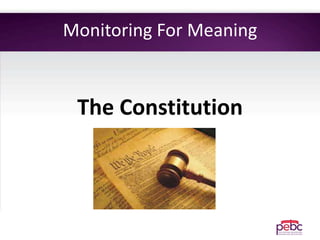
Monitoring For Meaning
The Constitution
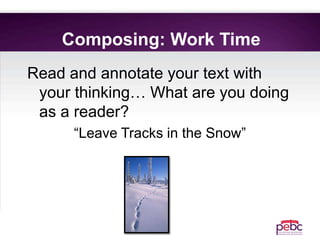
Composing: Work Time
Read and annotate your text with
your thinking… What are you doing
as a reader?
“Leave Tracks in the Snow”
How did we monitor for meaning?
Find a Partner & Share Annotations
What did you do to monitor your
understanding?
Monitoring for Understanding Looks
and Sounds Like:
• I am confused…
• I understand…
• I don’t get it…
• This makes sense…
Guiding Question
How do we grow
thinkers?
How Do We Grow Thinkers?
Write a six word memoir
Tomorrow…
• Bring some text that use for planning
• Preview Day 2
Day 2
• Look at standards… + dig into your own text
• (strikes and wonders protocol)

Its day 1

  • 1.
  • 2.
  • 3.
  • 4.
    The Public Education& Business Coalition (PEBC) is dedicated to developing the intellectual and scholarly practices of educators across the continuum of their professional lives so our schools are worthy of our students.
  • 5.
    We Started WithResearch P. David Pearson, Roehler, Dole, and Duffy, 1992. “Developing Expertise in Reading Comprehension.” What Research Has To Say About Reading Instruction. IRA Duke, N.K., & P.D. Pearson. 2002. Effective Practices for Developing Reading Comprehension.
  • 6.
  • 7.
    Essential Question How dowe grow thinkers?
  • 8.
    “Mix and Mingle” 1.Graba quote, read it over, and mull it over. 2.Find a partner and share your quote and thinking. 3.Trade quotes and find a new partner & repeat.
  • 9.
    How do wegrow thinkers? Create a working explanation… use words, icons, metaphors, e tc.
  • 11.
  • 12.
    Through Comprehension Strategies we: •Become more reflective readers & thinkers • Develop a common language of thinking • Teach deep level comprehension explicitly • Raise expectations & support for all kids • Emphasize reading with depth & focus • Teach the “reader” not just the text • Build a bank of content area knowledge From: Comprehension Going Forward, “Comprehension Instruction Grows Up,” Keene, 2011
  • 13.
    Institute Outcomes .. . 1) Increased knowledge of metacognitive strategies that proficient thinkers use to grow understanding
  • 14.
    Institute Outcomes .. . 2) Increased knowledge of how instructional techniques such as workshop model and gradually releasing responsibility support thinking
  • 15.
    3 ) Increasedknowledge of how intentional planning helps students meet rigorous standards such as CCSS Institute Outcomes . . .
  • 16.
  • 17.
    Self Assessment • Selfassess thinking strategies & workshop model
  • 18.
    Instructional Spotlight: Workshop Model “…Ibelieve that (the reader’s workshop) empowers students with the sense of time, self- authority, decision-making, and intellectual depth they need to foster their independence as nascent readers.” Patrick Allen, Conferring: The Keystone of Reader’s Workshop Resource: Section 2, 17 & 18
  • 20.
    Workshop Model: Terminology CraftingLesson (mini-lesson) • 15-20 minutes • Teachers: Model & Share their thinking • Students: Observe Actively • Instructional chunk Composing (work time) • 30-45 minutes • Teachers: Confer • Students: Practice the mini-lesson: reading, writing, talking, thinking. • Catch & Release: Needs based structure Reflection (synthesis) • 15 minutes • Teachers & Students: Synthesize new insights • “Zip Up the Backpack”
  • 22.
  • 23.
    Composing: Work Time Readand annotate your text with your thinking… What are you doing as a reader? “Leave Tracks in the Snow”
  • 24.
    Conferring • Our goalis to understand you as readers and thinkers • Our task is to confer with you as you read
  • 25.
    Catch & Release Finda Partner & Share Annotations What did you notice about yourself as a reader of this type of text?
  • 26.
  • 27.
  • 28.
    Reflection Cheryl’s Classroom: • What metacognitive strategiesdid you use to make meaning? • How does annotating the text support understanding? • How does discussing your thinking support understanding?
  • 29.
  • 30.
    “Meaning making isnot a spectator sport.” -Art Costa
  • 31.
    What is itthat proficient thinkers do?
  • 32.
  • 33.
    Cognitive Thinking Strategies 1.Activate,revise and apply schema (background knowledge) 2.Draw inferences 3.Ask questions 4.Determine importance 5.Synthesize 6.Evoke sensory images 7.Monitor for meaning and employ fix up strategies when meaning breaks down
  • 34.
    Language Matters Yes, vocabularyneeds to be taught…
  • 35.
  • 36.
    Proficient thinkers drawon schema or background knowledge. We use our own background knowledge to understand the text as we read Pearson, et al 1992., Gordon and Pearson, 1983; Hansen, 1981.
  • 37.
    Instructions: With apartner fill in the blanks. Be sure to watch your mind in action as you solve this puzzle. The questions that p face as they raise c____ from i to adult life are not easy to a . Both f____ and m can become concerned when health problems such as c arise any time after the e state to later life. Experts recommend that young c should have plenty of s and nutritious food for healthy growth. B and g should not share the same b or even sleep in the same r . They may be afraid of the d .
  • 38.
    The questions thatpoultry men face as they raise chickens from incubation to adult life are not easy to answer. Both farmers and merchants can become concerned when health problems such as coccidiosis arise any time after the egg state to later life. Experts recommend that young chicks should have plenty of sunshine and nutritious food for healthy growth. Banties and geese should not share the same barnyard or even sleep in the same roost. They may be afraid of the dark.
  • 40.
    Activating Schema Looksand Sounds Like: • This reminds me of… • How is this like…? • How can I connect this to concepts I already know?
  • 41.
    Proficient thinkers drawinferences We infer when we use schema and textual information to draw conclusions and form unique interpretations and when we make predictions, confirm them, and test them as we read. Anderson and Pearson, 1984 Aha!!!
  • 42.
    What are youinferring?
  • 43.
    Investigating Inferences In Triads •Visit 3 posters and write a caption for each picture
  • 44.
    Investigating Inferences Reflect • Whatdid you do to infer? • How did thinking with others enhance your understanding? • How did the thinking of others enhance your understanding
  • 45.
    Drawing Inferences Looksand Sounds Like: • I bet… • Can I draw a conclusion? • My hunch is… • I’m thinking that… • The text doesn’t say this but I think/ it seems like… • I’m inferring…because…
  • 46.
    Proficient thinkers askquestions. We generate questions BEFORE, DURING, and AFTER reading which helps us focus our attention on important components of the text. Andre and Anderson, 1979; Brown and Palincsar, 1985
  • 47.
    Asking Questions: Six WordMemoir For Sale: baby shoes, never worn. -Ernest Hemingway
  • 48.
    Questioning with ThinkingRoutines What do I see? What do I think? What do I wonder?
  • 49.
    Asking Questions Looksand Sounds Like: • I am wondering… • Why did that happen? • What is important? • How will my questions help me understand?
  • 50.
    Proficient thinkers determine importancein text We identify key ideas or themes as we read, distinguish important from unimportant information, and support our ideas with evidence from the text. Afflerbach and Johnston, 1984; Baumann, 1986; Tierney and Cunningham, 1984; Winograd and Bridge, 1986 I found it!
  • 51.
    Determining Importance Hotheads • FromDiscover Magazine, April 2004
  • 52.
    Thinking Routine: CompassPoints E = Excited W = Worrisome N=Need to Know S = Stance or Suggestion for Moving Forward
  • 53.
    Determining Importance Looksand Sounds Like: • What is essential? • I’ll remember… • The big ideas are…
  • 54.
    Proficient thinkers synthesize information Aswe read, we monitor the overall meaning, important concepts and themes. We are aware of how these elements fit together to create overarching ideas. Brown and Day, 1983
  • 55.
    Synthesizing Read the blog •Determine importance: highlight key ideas • Re-read: thinking about the Six Word Memoir. What do you now know?
  • 56.
    Thinking Routine: Headlines Ifyou were to write a headline for this topic or issue right now that captured the most important aspect that should be remembered, what would that headline be?
  • 57.
    Synthesizing Looks andSounds Like: • First I thought, but now I am thinking…. • Now I understand… • Like putting a puzzle together, the pieces are…
  • 58.
    Proficient thinkers use sensoryimages and mental models We use five senses to draw conclusions, create unique interpretations of the text, clarify and enhance comprehension, and give depth and dimension to the reading. Keene and Zimmerman, 1996
  • 59.
  • 60.
    Tapping into your5 senses Imagine the taste, smell, texture, color, and sound of these red cherries. What does it make you think of? turn and talk
  • 61.
  • 62.
    Tapping into your5 senses Imagine the taste, smell, texture, color, and sound of durian…turn and talk
  • 63.
    Sensory images: Beingthere • How do sensory images build understanding or interfere with understanding?
  • 64.
    Creating Sensory ImagesLooks and Sounds Like: • In my mind, I can see/hear/smell/feel/taste… • The movie in my head… • I am experiencing…
  • 65.
    Proficient thinkers monitortheir comprehension We know when the text makes sense, when it does not, and what to do when meaning breaks down. We have effective and flexible strategies to repair confusions and revise interpretations. Duffy et al, 1987; Paris, Cross, and Lipson, 1984; Garner, 1987
  • 66.
  • 67.
    Composing: Work Time Readand annotate your text with your thinking… What are you doing as a reader? “Leave Tracks in the Snow”
  • 68.
    How did wemonitor for meaning? Find a Partner & Share Annotations What did you do to monitor your understanding?
  • 69.
    Monitoring for UnderstandingLooks and Sounds Like: • I am confused… • I understand… • I don’t get it… • This makes sense…
  • 70.
    Guiding Question How dowe grow thinkers?
  • 71.
    How Do WeGrow Thinkers? Write a six word memoir
  • 72.
    Tomorrow… • Bring sometext that use for planning • Preview Day 2
  • 73.
    Day 2 • Lookat standards… + dig into your own text • (strikes and wonders protocol)

Editor's Notes

  • #8 apOur purpose: to ______ what it means to understand, how to surface instructional practices that support understanding, access strategies that support understanding , how to assess understanding
  • #10 Use slide if time…must break by 10:00!!!
  • #12 Intentional design for cognitive and physical ENERGY
  • #15 ap
  • #20 Be very explicit here! Ask participants to grab their workshop handout for extended learning. Emphasize how the workshop model allows teachers to interact with students and for students to interact with peers.
  • #22 Be very explicit here! Ask participants to grab their workshop handout for extended learning. Emphasize how the workshop model allows teachers to interact with students and for students to interact with peers.
  • #27 Model: share annotations and posing questions about thinking
  • #29 Build chart whole group
  • #31 Handout: strategy 1 pager
  • #35 Share vocabulary resources
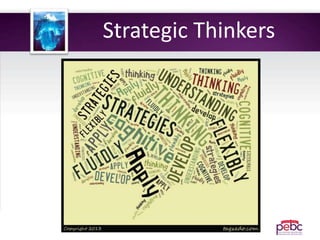
  • #36 What thinkers know and are able to do when using deep structure systems+Apply cognitive thinking strategies fluidly and flexibly to develop understanding
  • #43 Practice writing a caption using inferences: what would you say for the caption?Whole group…
  • #44 Trigger participants to engage in inferential thinking using visual literacyParticipants write a caption on sticky notes
  • #53 Handout Hot Heads reading and read the first paragraph to try out the “E” together
  • #57 HEADLINES ROUTINE A routine for capturing essence This routine draws on the idea of newspaper-type headlines as a vehicle for summing up and capturing the essence of an event, idea, concept, topic, etc. The routine asks a core question:
  • #63 DurianRegarded by many people in Southeast Asia as the "king of fruits", the durian is distinctive for its large size, strong odour, and formidable thorn-covered husk. The fruit can grow as large as 30 centimetres (12 in) long and 15 centimetres (6 in) in diameter, and it typically weighs one to three kilograms (2 to 7 lb). Its shape ranges from oblong to round, the colour of its husk green to brown, and its flesh pale yellow to red, depending on the species.The edible flesh emits a distinctive odour that is strong and penetrating even when the husk is intact. Some people regard the durian as pleasantly fragrant; others find the aroma overpowering and revolting. The smell evokes reactions from deep appreciation to intense disgust, and has been described variously as almonds, rotten onions, turpentine, raw sewage.
  • #71 Reflecting back on our essential question: write a six word memoir about this question